The Scriptures Abundantly Affirm the Divine Anomaly—He Created Universes of Worlds Before Dying on Calvary—His Eternal Sacrifice in Giving Himself to the Human Race
By the Late H. F. PHELPS
WHEN the historian tells us of the deeds of any of the mighty men of earth, without telling us of their birth and boyhood days, no one ever stops to question the previous existence of these men. That they had lived for years, and had been trained in the school of experience, is a foregone conclusion. This is not a parallel, but it is a feeble illustration of our theme.
It seems not a little strange that any person at all conversant with the teachings of the Bible should claim that our blessed Lord and Saviour, who is the Creator of all things, Creator of universes of worlds, of angels and men, never had an existence before He was born of the virgin Mary. Because they can not understand the mystery of the transformation that took place in the conception and birth of Christ, they would have us believe that the existence of Him upon whom our hopes depend for salvation is many years subsequent to the existence of sin.
EXPLAIN, IF WE CAN, THE MYSTERIES OF NATURE
But before we stumble over the "mystery of godliness," we had better explain the mystery of nature, as to the how and the wherefore of the growth of hair on the horse, and wool on the sheep, and feathers on the back of the goose, when all these creatures eat the same food. The first mystery is no greater than the last. And both are brought about by the infinite creative power of God.
CHRIST CREATED ALL THINGS
That Christ is the Creator of all things is evident from the testimony of the Holy Spirit. See John 1:3, 10:
"All things were made by Him; and without Him was not anything made that was made. . . . He was in the world, and the world was made by Him."
"For by Him were all things created, that are in heaven, and that are in earth, visible and invisible, . . . all things were created by Him, and for Him." Col. 1:16. Read Eph. 3:9 and Heb. 1:2.
It is therefore true that Christ, who created all things, had an existence before the existence of anything that was created. To the truth of this proposition the Holy Spirit also bears testimony as follows:
"Who is the image of the invisible God, the first-born of every creature. . . . And He is before all things, and by Him all things consist." Col. 1:15, 17.
BEFORE ABRAHAM, I AM
When Christ was here among men, He bore witness on this very question. And His testimony is just as applicable now as it was when He addressed the unbelieving Pharisees, who also questioned His divinity.
"Jesus said unto them, Verily, verily, I say unto you, Before Abraham was, I am." John 8:58.
This statement identifies Christ as the "I Am" of the Old Testament. Hence He was in existence as the leader of His people during the centuries before His birth as a babe. The Holy Spirit has also given us another testimony upon this point. In Proverbs 8 Christ is represented by wisdom—which is quite appropriate, for we read that He has been made wisdom to us.
"The Lord possessed Me in the beginning of His way, before His works of old. I was set up from everlasting, from the beginning, or ever the earth was. . . . I was by Him, as one brought up with Him." Prov. 8:22, 23, 30.
The American Revised Version gives the following as the rendering of verse 30: "Then I was by Him, as a master workman." And thus it becomes evident that this testimony refers not to wisdom in the abstract, but to Christ, who is the very personification of wisdom, and was the Master Workman by whom all things were created.
THE SIGN OF HIS POWER
And so, in the eternity of the past, when by the "breath of His mouth" the universes of worlds were brought into existence, He did nothing out of harmony with the establishment of a sign of His creative power in every world that He beautified for the abode of the "sons of God." And the establishment, in Eden, of the Sabbath, which is that sign, was also in perfect accord with the act of the creation of all the worlds. In this case, as the Master Workman, He established the annual revolution, the yearly cycle, of all the worlds at one and the same moment.
Reasoning from analogy, we may conclude that every world has a Sabbath of its own. And this Sabbath depends, in each world, upon the revolution of each particular world. And when the Lord of the Sabbath of one and all the worlds, beautified each world in six days, resting on the seventh, He established the weekly cycle. And when the weekly cycle was established, the Sabbath day itself was established, and that to all eternity; for as long as the cycle of weeks shall roll, so long the Sabbath will come and go to the inhabitants of any and every world.
"For as the new heavens and the new earth, which I will make, shall remain before Me, saith Jehovah, so shall your seed and your name remain. And it shall come to pass, that from one new moon to another, and from one Sabbath to another, shall all flesh come to worship before Me, saith Jehovah." Isa. 66:22, 23.
PERSONIFIED THE FATHER, YET AN UNRESERVED GIFT TO MAN
The testimony of the Holy Spirit, as recorded in Phil. 2:5-11 and Heb. 1:3, upon a careful analysis will be found most convincing. In brief, Christ was the very personification of the Father, in person and in glory. He did not esteem this a thing to be accounted22so precious as to be grasped when a world could be saved by its sacrifice. And so He emptied Himself of that which He was, made a most complete sacrifice of all that He was, and took the form of sinful man, sinful flesh, the form of a servant. So complete was this change, that He never will be again what He was with the Father before He became flesh. What wonderful condescension! Wonderful change! Wonderful love!
OUR CHOICE AND THE MIND OF SACRIFICE
And so the admonition, "Have this mind in you, which was also in Christ Jesus"—the mind of sacrifice, the mind of self-abnegation, the mind to become servant of all, in order to cooperate with Christ in the salvation of the lost. And this change should be so inwrought in the sinner, so full and complete, that he never again can be what he was before. It must be the total annihilation of the old man of sin. This change is dependent upon our choice in the matter, as it was with Christ. And when we make the choice, the same infinite, creative power of God that produced the change in Christ, will make the change in and for us. May the Lord give us the power and the willingness to make the choice, and submission to the process.
The Supernatural Gifts
By William P. Pearce
Do the Gifts of the Spirit Still Belong in the Church?—Is It Proper for Us to Covet Them?—Not Giftless if Born of the Spirit
By WILLIAM P. PEARCE
EVERY child of God has a gift. There are giftless children born into the world. Unfortunates we call them. But there are no giftless children born of the Holy Spirit. Each has a spiritual gift. There is a big difference between native gifts and Spirit gifts. Native gifts are infused by a divine dynamic when consecrated to God. But there are special Spirit gifts with whose production nature has nothing to do. They belong to the Spirit realm, and must be classed with the supernatural.
VARIOUS GIFTS OF THE HOLY SPIRIT
In exploring the Spirit realm, it would be well to note the various gifts of the Holy Spirit. Paul enumerates nine in 1 Cor. 12: 8-10,—the word of wisdom, the word of knowledge, faith, gifts of healing, the working of miracles, prophecy, discerning of spirits, divers kinds of tongues, and the interpretation of tongues.
Have these been discontinued, or have they lost their efficiency, or have the people of God lost their faith in them?
The apostle takes a big stride forward, and advocates a lawful covetousness for one or more of these gifts: "Covet earnestly the best gifts" (verse 31), or as the Revised Version has it, "Desire earnestly the greater gifts"—not the native ones of eloquence, or art, or leadership, but the greater, the supernatural gifts of the Holy Spirit.
THE BASIS OF THIS LAWFUL COVETOUSNESS
For some time the writer has been greatly impressed to pray for "the gifts of healing." 1 Cor. 12: 9. For years he has made a study of prayer therapeutics. He is convinced that "the gifts of healing" have not been withdrawn from the church. If they have, then have the others.
But why pray for this special gift or another? For fame?—No. For financial consideration?—No. But as Paul said, "Forasmuch as ye are zealous of spiritual gifts, seek that ye may excel to the edifying of the church." 1 Cor. 14: 12.
Paul wants us on the high level plane in Christian activity. We excel in letters and art and commercial enterprises. Why not in endeavors to the benefit of the saints? Do they not need us? Are there not those to whom every one receiving one or more of the Spirit gifts would be a benediction? O, the ignorant that need the gifted of knowledge and wisdom! The many who need the one strong in faith! The multitudes of shut-ins who need the one with the gifts of healing! The scores who need startling by the one gifted with prophecy! The followers of cults and so-called religions in which evil spirits work, that need to be aroused by the discerner of spirits! The conglomeration of the masses in our cosmopolitan cities as well as abroad who need the workers with "many tongues" and interpreters of tongues!
Dare criticism in taking the word of God literally. One of the great wrongs done the Word nowadays is the spiritualizing of things which God meant to be literalized. If the Word can not stand the literal test as it did in its early days, then much of its reliability has gone. If the "gifts" are withdrawn, then Christianity does not measure up to its infancy. The church is impotent in a large degree, because the saints have feared to reenforce their faith by the supernatural, which the Holy Spirit divides "to every man severally as He will." 1 Cor. 12: 11.
EXERCISE THIS GIFT
There are those who have a special gift or gifts, but they have permitted these gifts to remain dormant. Paul exhorted Timothy not to neglect the gift that was in him, which was bestowed at his ordination. 1 Tim. 4: 14. He urged him to stir it up. 2 Tim. 1: 6. What he did, needs to be done now.
Many have wonderful Spirit gifts, which would be mightily effective if used. And some of us need to pray for gifts, that we might be transformed from ciphers to figures of a larger denomination for the perfecting of the saints. We have a right to desire them, and to pray for them, and to claim them. "Delight thyself also in the Lord," said David, "and He shall give thee the desires of thine heart." Ps. 37: 4. In the name of Jesus Christ, Amen.
Offerings of the Sanctuary—Their Meaning
By Clarence Santee
"How Can We Know the Way?"
THIS question was asked of the Saviour by Thomas. Jesus answered, "I am the way: . . . no man cometh unto the Father, but by Me." John 14:6.
The steps that lead into the way and along the way are made known by various lessons.
There was a time when men could not see the life of Christ as we now see it. To them it was represented by something tangible from the flock or the herd. His death was not seen as we now see it; but by looking upon the death of the innocent victim, they could dimly picture the reality of an unoffending one taken by sinful hands, confessed over, killed, and the blood, which represented the life (Lev. 17:11), taken to atone for the sins of the transgressor.
They were represented as living in the "shadow," in the moonlight, as compared with the glorious sunlight of day. Heb. 8:5; Rev. 12:1.
THE SHADOWS VANISHED
When Christ came, and lived, died, and ascended to heaven, the shadows vanished. The life to which all the offerings pointed, and from which they obtained their luster, was written down by credible witnesses, filled with the Spirit that could make no mistakes.
It is our purpose to write out some of the beautiful lessons through which those in the shadow obtained that faith for which God has admonished us we should "earnestly contend." Jude 3.
As the godly priests taught conversion and acceptance with God, they pointed to the "Seed" (Gal. 3:16) who should come.
While the offerings were being made, each act was explained to the congregation present, and earnest calls were made for any whom God had touched to respond.
The first step taken by the sinner in throwing off the yoke of bondage, was to bring his sin-offering. Lev. 5:8; 4:32-34.
Friend, you may say that the record of these offerings is meaningless to you, but I hope that as you go with me through some of them they will shine out so brightly that in the future this portion of God's word will be of real interest.
CONSECRATION AND ACCEPTANCE ILLUSTRATED
Every phase of the experience from a state of sin to entire consecration and acceptance in Christ is wonderfully illustrated.
After one confessed his sins, placing them, in type, upon the head of the lamb, the burnt offering should immediately follow.
That we may more clearly see the need of this, I will anticipate, and state the close connection between the two.
The confession of sin must be the first step after conviction, in coming to the Lord. "If I regard iniquity in my heart, the Lord will not hear me." Ps. 66:18. The next step after a confession of sin, must be a surrender of all the powers of our being to God. This was embodied in the burnt offering. Of this offering I read:
"If his offering be a burnt sacrifice of the herd, let him offer a male without blemish: he shall offer it of his own voluntary will at the door of the tabernacle of the congregation before the Lord." Lev. 1:3.
There is no compulsion in the service of God. Man-made edicts can never change the heart. "He shall offer it of his own voluntary will."
"And he shall put his hand upon the head of the burnt offering; and it shall be accepted for him to make atonement for him. And he shall kill the bullock before the Lord: and the priests, Aaron's sons, shall bring the blood, and sprinkle the blood round about upon the altar that is by the door of the tabernacle of the congregation. And he shall flay the burnt offering, and cut it into his pieces. . . . And the priests, Aaron's sons, shall lay the parts, the head, and the fat, in order upon the wood that is on the fire which is upon the altar: but his inwards and his legs shall he wash in water: and the priest shall burn all on the altar, to be a burnt sacrifice, an offering made by fire, of a sweet savor unto the Lord." Verses 4-6, 8, 9.
Verses 10-13 repeat the same of the sheep or the goats.
A CONFESSION OF GUILT
The offerer placed his hand on the head of the innocent victim, signifying the placing of his sins upon it in figure, and by faith, upon the sinless Victim, Christ. With his own hand he then took its life. Here Christ and the sinner become one. The lamb represents the sinner. It takes his place with his sins. It also represents Christ, who takes his sins. Slaying the offering with his own hand was a confession that his own sins caused the death of the Lamb of God.
The skin was given to the priest. Lev. 7:8. It was that part which had been seen before, and it would represent the past life, that had been seen, of the individual before his turning to God. No man can do more with the past than to place it in the hands of our Priest. It has gone from us. He becomes responsible for its failures.
In reading of the burnt offering, you will notice that its flesh was cut in pieces, and each piece was placed in the hands of the priest, by the man who made the offering, to be placed, by the priest, upon the altar. A lesson is here taught that we seldom learn without many failures. It is that no man can lay his own weaknesses of the flesh upon the altar. Every effort is a failure and a source of discouragement. But we can place them in the hands of Christ, our High Priest, and He can lay them upon the altar. The head, the inwards, and the legs were also to be laid with the "pieces," by the priest, upon the altar.
THE COMPLETE SURRENDER TO GOD
The head represented the thoughts, or the mind; the "inwards," the heart. "I will put My law in their inward parts." Jer. 31:33; Heb. 10:16. The legs of the sacrifice correspond to the hands and feet of the one who would have his all laid upon the altar. The hands and the feet are mentioned in the surrender of the person to the Lord. "Cleanse your hands, ye sinners." James 4:8. "Their feet run to evil, and make haste to shed blood." Prov. 1:16. They must be washed before they can be acceptable to the Lord's service. When they have been washed, it can be said, "How beautiful upon the mountains are the feet of him that bringeth good tidings!" Isa. 52:7. Thus after confession of sin, the next step is the placing of all — desires of the flesh, the mind, the heart, hands and feet — in the hands of Christ, to be laid upon the altar.
One important part in the sacrifice of the burnt offering was the taking of the blood by the priest (Lev. 1:11) and sprinkling it where he willed upon the altar. "The blood is the life." Deut. 12:23. This typifies the surrender of the life to the Lord, to use wherever He may choose to use it in all the world, which is so well represented by the altar of burnt offering, where the sacrifices were consumed.
Before it is a perfect offering, there is one more requirement. It is found in Lev. 1:14-17. A bird is offered. "And he shall pluck away his crop with his feathers, and cast it beside the altar on the east part, by the place of the ashes: and he shall cleave it with the wings thereof."
The crop and feathers of the bird, that were to be taken and cast to the east of the altar, represented the food and clothing of the one who offered it, as made secondary, or cast behind his back, as he gave himself to the Lord. Our Saviour instructed His disciples, "Take no thought, saying, What shall we eat? or, What shall we drink? or, Wherewithal shall we be clothed?" Matt. 6:31. Making the kingdom first, all these things shall be assured. Verse 33.
WHERE MANY STUMBLE
Many halt in the service of God, never to advance, because they can not see every want supplied before it exists. Our Saviour taught, in the offerings of the house of the Lord, that until these things could be cast behind the back, and implicit faith in the providence of the Lord accepted, the offering could not be complete, and the Lord could accept of no other kind. The priest could not lay it upon the altar.
The wings were also cleaved. Lev. 1:17. The bird could follow no more in the way of its companions. A bird with the wing cord severed, can look upon its companions, they can come to it, but it can no more share with them the devious flights as in the past. So the sinner, coming to the feet of Jesus, leaves forever the associations of the paths of sin. He gives willing service, putting the past life in the hands of Christ, placing also in His hands the desires of the flesh, the thoughts, the heart, the hands, and the feet, considering not the food or the raiment, willingly and forever severing the ties that bound to a life of sinful pleasures, and placing the redeemed life at the disposal of Christ, to be used by Him in the place of His choice, anywhere, far or near, in the broad harvest-field.
Truly the burnt offering taught a gospel lesson of consecration complete and full. Dear reader, with all your greater gospel light and privileges, have you filled the measure called for in the burnt offering? If not, are you willing to do so to-day? Is it not a beautiful outline of a Christian character?
A Call to Holy Living
“As He which hath called you is holy, so be ye holy in all manner of conversation.”
HAVE WE HAD A CREATION OR AN EVOLUTION?
The Evolutionary Theory as Stated by Its Disciples—Its Failure to Account for Creation—Power Inseparably Connected with Intelligent Cause
EVOLUTION is a man-made substitute for a literal creation according to the God-given record in the first chapter of Genesis.
"The theory of evolution teaches that the creation of this earth was not accomplished in six days of twenty-four hours; that the divine method occupied ages and ages of immense duration; that nothing, of all the treasures of the globe as they now stand, was created at first in its present perfectness; that everything has grown, through the lapse of ages, into its present condition; that the whole earth, with the development in it, was, as it were, an egg, a germ, a seed; that the forests, the fields, the shrubs, the vineyards, all grasses and flowers, all insects, fishes, and birds, all mammals of every gradation, have had a long history, and that they have come to the position in which they now stand through ages and ages of gradual change and unfolding; also that the earth itself went through a period of long preparation, passing from ether by condensation to a visible cloud form with increasing solidity, to such a condition as now prevails in the sun; that it condensed and became solid; that cold congealed its vapor; that by chemical action and by chemical grinding of its surface by ice, a soil was prepared fit for vegetation, long before it was fit for animal life; that plants simple and coarse came first, and developed through all stages of complexity to the present conditions of the vegetable kingdom; that aquatic, invertebrate animals were the earliest of animals, according to the testimony of fossils in the earth. Fishes came next in order, then amphibians, then reptiles. 'All these tribes were represented by species before the earliest of the mammals appeared. The existence of birds before the first mammal is not proved, though believed by some paleontologists, upon probable evidence. The early mammals were marsupial, like the opossum and the kangaroo, and lived in the same era called by Agassiz the reptilian period. True mammals came into geologic history in the tertiary era. Very long after the appearance of the first bird, came man, the last and grandest of the series, it is doubtful whether in the tertiary period or immediately sequent. It is not established whether his bones or relics occur as far back as the tertiary era.'"
"This is a very brief statement, not my own, but that of Professor Dana, of renown. No man is more trusted, more careful, more cautious, than he, and this brief history of the unfolding series I have taken bodily from his writings."—"Evolution and Religion," by Henry Ward Beecher, pages 49, 50.
Mr. Beecher adds:
"As thus set forth, it may be said that evolution is accepted as the method of creation, by the whole scientific world, and that the period of controversy is passed and closed. . . . The theory of evolution is the working theory of every department of physical science all over the world. Withdraw this theory, and every department of physical research would fall back into heaps of hopelessly dislocated facts. . . . This science of evolution is taught in all advanced academies, in all colleges and universities, in all medical and surgical schools, and our children are receiving it as they are the elements of astronomy or botany or chemistry. . . . Evolution is held by men of profound Christian faith. . . . Evolution is certain to oblige theology to reconstruct its system."—Ibid., pages 50-52.
The foregoing is a fair statement of the evolutionary theory. It is the evolutionary record of creation without a Creator. It presupposes the origin of the material universe without an Originator. It undertakes to account for the stupendous miracle of creation without miracle.
SHOULD PRESENT SUBSTANTIAL FACTS
It must be admitted that when science breaks from the Bible account of creation, and introduces a theory that is to be accepted not only by the scientific world, but by eminent Christian men, and taught the students in all leading academies, colleges, and universities, necessitating the reconstruction of Christian theology, it should present as substantial a demonstration of facts in support of its claims for the origin of life and the elements of the material universe, as for the rotundity of the earth and the laws of gravity.
To say that all life sprang from a "seed" or "germ" does not answer the question of the origin of life. It merely removes the question to the origin of the germ. How did the first germ originate? Mr. Darwin's "Origin of Species" does not pretend to account for the origin of life. He contents himself with assuming origin, rather than proving it. Huxley began life history with protoplasm. But protoplasm is life in an ameboid or germ form. This does not account for the origin of protoplasm.
ADMITTEDLY IT DOES NOT SOLVE
Tyndall, one of the greatest of evolutionists, admits that evolution—
"does not solve—it does not attempt to solve—the ultimate mystery of the universe. It leaves, in fact, that mystery untouched. For granting the nebula and its potential life, the question whence they came would still remain to baffle and bewilder us. At bottom, the hypothesis does nothing more than transport the conception of life's origin to an indefinitely distant past."—"Fragments of Science," page 133.
AVOIDS THE MIRACLE
Thus according to the statements of its greatest leaders, evolution avoids the miracle of creation by admitting that science does not know how to account for the origin of life or of the material universe. It is therefore not a science that justly claims to be a rival of the God of creation. God explains the origin of both matter and life. Evolution relegates that question to the distant past and leaves it unexplained.
When evolution has accounted for the origin of its first elementary life germs without a Life-giver, the world will be confronted with the greatest miracle in its history. This is a counterfeit science, and like all other counterfeits, it does not bear the test. Genuine science is founded on fact. Evolution is founded on assumption. To reason that because things now exist they always have existed, is as unscientific as to reason that because a modern cannon found on a deserted battle-field is capable of lasting a thousand years, it must therefore have been manufactured a thousand years ago.
CREATION ONLY BY A CREATOR
Did the world create itself, or did it have a Creator? Either God created the heavens and the earth, or the Bible is absolutely unreliable in its first statement.
It was at one time announced by some astronomers that they had found clouds, or nebulae, or gas uncompounded with anything else, many millions of miles away in the heavens. They were so far away that it was supposed no one would be able to secure specimens for analysis. The astronomers therefore felt quite confident that their theory, that they had found in the nebulae the elementary "homogeneous gas" from which a world is made by first forming itself and then forming a world, without a Creator, would stand.
The invention of the spectroscope changed the supposed elemental gas to fire. But fire is the result of combustion, and the elementary nebular hypothesis was spoiled. The theory of elementary matter being self-existing from eternity was therefore left unsupported9by demonstrable facts, and this false science had failed to dethrone the Creator.
EVOLUTION COLLIDING WITH RECOGNIZED LAW
The first law of mechanics is that "to every action there is an equal and opposite reaction." Machinery can never, therefore, create power. For this reason, all human attempts at perpetual motion are a failure; but in the operation of the machinery of the material universe there is an illustration of perpetual motion. This demonstrates that a power outside of itself is balancing, guiding, and moving every part of the machinery of the universe on its onward course continually. No machine can create itself nor lift itself. Such a work can only be done by the application of some power from without. This proposition is so simple that one can easily test it by an attempt to lift himself by his boot straps. That common illustration is a refutation of all attempts to produce a universe and swing it in space without a Creator.
One might test the principle by attempting to run a locomotive without applied steam or electricity. Since matter can not originate itself now, and machinery can not run without applied power, what logic can show that such a thing ever happened? How remarkable it is that evolutionists who dare not assert that matter as it now exists can reproduce itself or generate its own power for poise, should assert such power for a single atom of matter! What philosophy has revealed a substance that was less powerful than the atoms composing it?
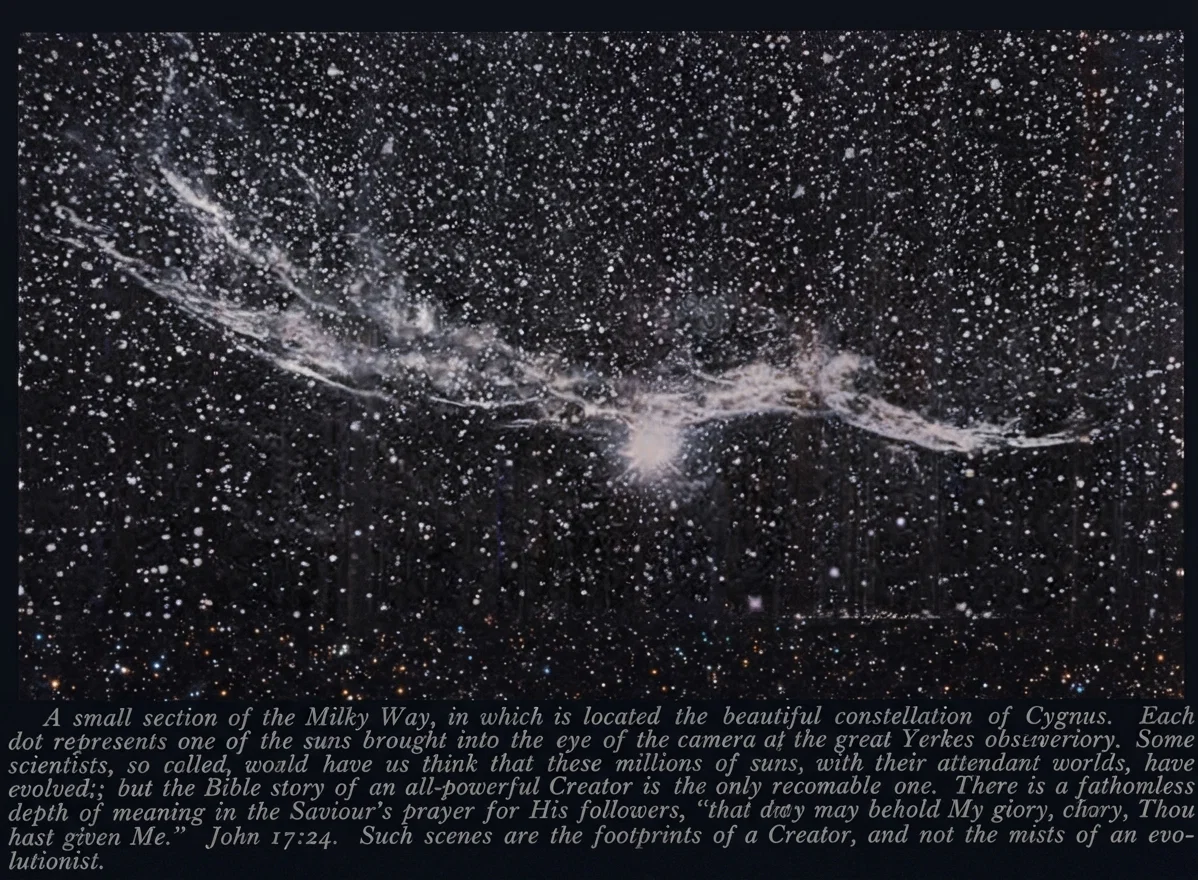
ONE OF THE MILKY WAY'S BEAUTY SPOTS
A small section of the Milky Way, in which is located the beautiful constellation of Cygnus. Each dot represents one of the suns brought into the eye of the camera at the great Yerkes observatory. Some scientists, so called, would have us think that these millions of suns, with their attendant worlds, have evolved; but the Bible story of an all-powerful Creator is the only reasonable one. There is a fathomless depth of meaning in the Saviour's prayer for His followers, "that they may behold My glory, which Thou hast given Me." John 17:24. Such scenes are the footprints of a Creator, and not the mists of an evolutionist.
Such reasoning is an effort to remove the basis of reasoning to such an infinitely small atom that what is assumed will be taken for granted, whereas regarding a larger form, reason would revolt at such an assumption, and demand proof.
Sir Henry Howorth is authority for the following truthful statement:
"It is a singular and notable fact that, while most other branches of science have emancipated themselves from the trammels of metaphysical reasoning, the science of geology still remains imprisoned in a priori theories."—"The Glacial Nightmare and the Flood," preface, 7.
LIFE ONLY FROM LIFE
Huxley asserts that "skepticism is the highest of duties, blind faith the one unpardonable sin." Yet according to his own statement, he believed in "the evolution of living protoplasm, from not living matter," without the slightest evidence. ("Methods and Results," pages 40, 41.)
Why has he given no proof? The reason is obvious. Science knows of no instance where life has been produced except from previously existing life. The evolutionist having failed to explain, in his theory of origin by "fire-mist," how the fire started without an ignitor of the fire, asserts that at one time the universe was in a state of solution in the form of primeval oceans; that these formed mud deposits, which hardened into salts, rocks, and earth; these formed the world, and without a seed, produced trees, grass, and vegetable life. One is asked to believe that the ocean formed itself, that from self-formed sea-mud the life germ developed itself contrary to all laws of natural history, and from that original germ, by "spontaneous generation," all other life has been produced.
And all this, evolution asks one to accept on "blind faith," without the slightest proof. Yet "blind faith" is the one "unpardonable sin" of this science.
Does the theory of "spontaneous generation" hold good when tested by natural history? No atom of the inorganic, or mineral world has ever been known to develop into life by "spontaneous generation." Science has produced no such demonstration.
"No biological generalization rests on a wider series of observations, or has been subjected to a more critical scrutiny, than that every living organism has come into existence from a living portion or portions of a preexisting organism."—P. C. Mitchell, in the "Encyclopædia Britannica," volume 3, page 952, Cambridge University edition.
For science to assume the origin of life without an Originator, and give no proof, is to admit defeat at the outset. Life from life is the universal law of natural history.
"SPONTANEOUS GENERATION"
To attribute "spontaneous generation" as a result of natural law is pure assumption. Natural law reveals no such process. Dana says:
"Thus the brute races of the middle quaternary on all the continents exceeded the moderns greatly in magnitude. Why, no one has explained."—"Geological Story Briefly Told," page 229.
Sir William Dawson says:
"Nothing is more evident in the history of fossil animals and plants of past geological ages than that persistence or degeneracy is the rule rather than the exception. . . . We may almost say that all things left to themselves tend to degenerate, and only a new breathing of the almighty Spirit can start them again on the path of advancement."—"Modern Ideas of Evolution," appendix.
Degeneration therefore is admitted by the most authoritative writers to be the tendency in the natural world. Where, then, is the evidence of "spontaneous generation"? A striking characteristic of the science of evolution is that whenever it reaches the point where evidence should be supplied to demonstrate its hypotheses, such is wanting. There are no scientific facts to support its claims.
"TRANSMUTATION OF SPECIES"
In the same category with all other evolutionary theories may be listed that of the "transmutation of species." That such a claim should be published under the name of science, in the absence of any facts in its support, is one of the most astounding surprises that confronts a real scientist. Every species of bird, beast, insect, and plant is a living protest against the theory. There are gradations of animal and vegetable life, but these do not come as the result of "transmutation of species."
EXPANDING MERE INFERENCES
Agassiz, well known as one of the greatest of scientists, is reported in the Presbyterian of December 7, 1872, as thus expressing his contempt for the unscientific theories of evolution, in a paper read before the Academy of Science:
"As I grow older in the ranks of science, I feel more and more the danger of stretching inferences from a few observations to a wide field. I see that the younger generation among naturalists are at this moment falling into the mistake of making assertions and presenting views as scientific principles which are not even based upon real observation. I think it is time that some positive remonstrance be made against that tendency. The manner in which the evolution theory in zoology is treated would lead those who are not special zoologists to suppose that observations have been made by which it can be inferred that there is in nature such a thing as change among organized beings actually taking place. There is no such thing on record. It is shifting the ground from one field of observation to another to make this statement, and when the assertions go so far as to exclude from the domain of science those who will not be dragged into this mire of mere assertion, then it is time to protest.
"He thought it was intolerant to say he was not on scientific grounds"
A WORD TO OUR READERS
By Editor
We send no papers from this office to individuals without pay in advance. When persons receive copies without ordering them, they are sent by other parties, and we can give no information in regard to them. Persons thus receiving copies of the SIGNS are not indebted to the office, and will not be called upon to pay for them. Please read the papers you may receive, and hand them to your friends to read.
DATE OF EXPIRATION
The SIGNS wrapper bears date of last issue due on your subscription. Unless renewed in advance, paper stops with expiration date.
If herewith is an order-blank, you will know you have overlooked sending renewal. You will not wish to miss a single issue. Back numbers often can not be furnished.
SCRIPTURE QUOTATIONS
Our authority for the doctrines we teach is the Bible. Quotations are usually from the King James Version or the American Standard Revised.