MANY women, otherwise scrupulously neat and cleanly, will come in from a long, hot, dusty trip, remove a warm, perspiration-soaked dress or coat, and hang it at once in a close, dark closet; or they will take off a skirt that has been gathering the filthy sweepings of the streets, street-car, and store floors, and hang it in the crowded wardrobe. Then they wonder that the closet or wardrobe gives out such a disagreeable smell when the door is opened. If, instead, the garment was hung in a current of air, when first taken from the body, this would not be so apt to happen. Dress-shields, the linings of dress collars, and the bindings of skirts should be often changed. Skirts, even though not allowed to sweep the pavements, can not fail to gather more or less of the dust mixed with disease-causing germs, and this is true of buttons, folds, and gathers, where dust can settle—not alone on women’s clothing, but on men’s as well. The garments should be well and often brushed, in every fold and wrinkle, around every button, buckle, or place where lint can gather, and the brushing should be done as we do our carpets—out of the house, the farther out, the better. There are many such habits indulged in by persons who would be greatly offended should you intimate that they were not neat.—Selected.
The Swedish Meeting
By Guy Dail
GUY DAIL
NINETEEN of the thirty-two churches were represented by seventy-five delegates at the twenty-seventh annual session of the Swedish Conference, which was held in Orebro, June 23-28. The conference was held in the workingmen's hall, and lectures for the public were also carried on in the tent not far distant. As many as two hundred fifty outsiders were at the lectures. About that many of our own people were also present, including the brethren who came from Norway and Denmark and Finland to attend the union conference, which was conducted at the same time.
A VIEW OF STOCKHOLM
Important actions were taken concerning the attention to be paid to the conversion of the children and youth, and their training in the Sabbath-school, and in active missionary work for the Master. One of the leading questions discussed was the education of church elders. In a field where there are 4,750,000 people, and so few laborers, it is imperative that the churches do not depend on the minister for their support; but that they be cared for by intelligent elders, who are really capable of leading the flock. It was decided that the conference committee should see that special attention be given to this important work the coming year. The circulation of the Swedish Tidens Tecken was also considered in detail, and, best of all, about one thousand more papers were ordered at the meeting. The vital importance of faithfulness in tithes and offerings was impressed upon the delegates, and it was voted that no one be elected to any church office who does not pay his tithe.
There was no disunion in the business of the meeting. Elder S. F. Svensson was again unanimously chosen president of the conference. He is assisted by four ministers, one licentiate, and three Bible workers. This field, also, as well as the other conferences in Scandinavia, needs an influx of young men to be developed into the ministry. No conference can afford to come to a standstill in this matter; for if it neglects the training of younger workers, it will begin to go backward. Of the students who attended the school at Nyhyttan the past winter, the larger majority are in the work in some capacity.
As our two missionaries who are preparing to enter Abyssinia, and located at Asmara, Eritrea, are from Sweden, it is but natural that the brethren of this conference should feel great interest in the work there. Indeed, this was shown by the fact that three hundred fifty-eight kroner were given toward missions as the first-day offering.
In Sweden, too, our people have been granted remarkable favors, so far as the military service is concerned. Although the higher authorities in one instance were inclined to be somewhat severe, yet the lower officer in the army arranged it nicely for our brother, as he permitted him to come into the office on Sabbath, bring his Bible, and study the whole time he was “on duty.” This officer said he did not believe in a soldier's being deprived of his right to worship God according to the dictates of his own conscience.
It may be interesting to remember that it was in Sweden where little children were called out by God to proclaim the first angel's message, when older persons were forbidden to preach it. Indeed, right here in Orebro we pass by the castle in which defenders of the faith have been imprisoned during the advent movement of 1840-44.
Financially, Sweden is picking up, so far as offerings are concerned; for, in 1906 the offerings were $885, while for 1907 they were $1,068. On the other hand, as there was quite a little extra tithe in 1906, we find that the tithe for 1907 is not quite so high; in 1906 it was $5,253, while last year it was $4,988. The book sales, too, for last year were only $19,382, against $20,370 for 1906. Some of the best canvassers were at the school last year, and then the “bad times” have had their effect.
There was a small increase in Sweden's membership during 1907. At the beginning of the year it was eight hundred forty-five; after forty-five had been baptized, and twenty-seven received by vote for the twelve months ending Dec. 31, 1907, the membership was eight hundred fifty-eight.
Elder Svensson and his fellow laborers are of good cheer. The refreshing on Sabbath forenoon, when there was a general move among all the people to seek God, indicated that the Spirit of the Lord was present. A number were baptized at the meeting. God grant still richer blessings to his people in this promising field.
Orebro, Sweden.
The School Around a Rice Sieve
By HUNG HEI YING
HUNG HEI YING
THE training of workers for the cause of God begins first and in a very important sense, in the family circle and in childhood. We have examples of this in the early years of Christ. Timothy is a good example of a child trained to the service of God in the home circle. Nowadays so many people are looking to teachers for the training and education of their children, but they themselves should not neglect to take a proper share of this responsibility. No one is too poor to do his full duty in this respect, and no one can estimate the influence in the family and on the community of such a home as that in which the foundation of Timothy’s training was laid.
Sometime ago while visiting among the country villages back in the interior from my home, I was surprised to find in one village the children intelligent in Bible knowledge. They seemed to know about the Bible characters, and could answer readily a great many questions. This was very strange, indeed, for the women and even a great many of the men did not know how to read. Where, then, had these children learned?
I asked if they had a school in their village. No, there was no school there. A chapel then?—No, there was no chapel in that part. Where, then, have13you learned these things? One boy answered that a certain man in the village taught the boys a little every evening.
I made it my way to search this man out, and this is what I saw. He was a farmer, and lived in a little mud-brick house with a straw roof and no floor. He was a poor man, too, for he must pay a high rent to the landlord on the fields he tilled. But every day after the evening meal was finished, he gathered into his little home his own children, and as many others as were willing and free to come. The big rice sieve was turned over on the bottom of a grain basket, and the children clustered around it for their lesson. This was their table, and the plain farmer was their teacher. The school went on merrily for an hour or more, the teacher naming the characters and the children, all together, repeating them after him. Afterward each child took a turn in reading by himself, after which their teacher spent a few minutes explaining the meaning of what had been studied.
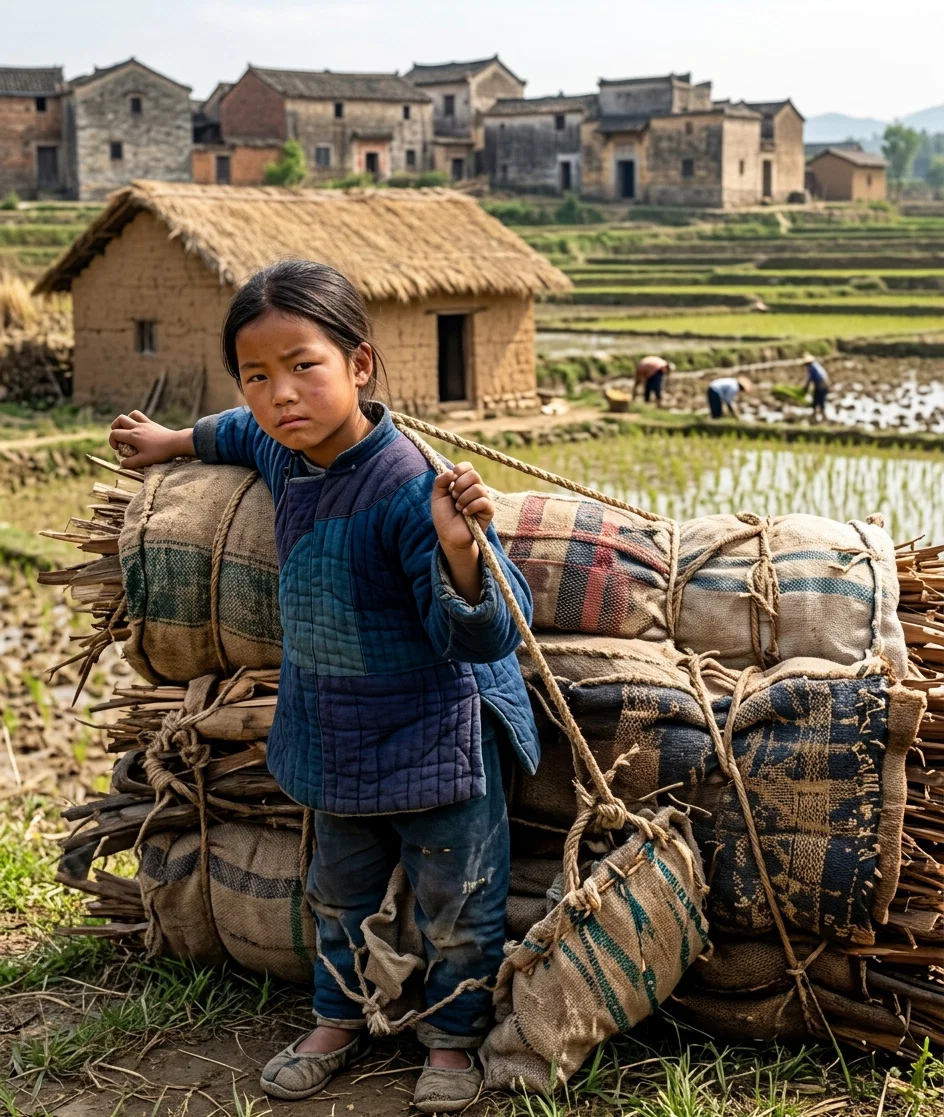
A LITTLE CHINESE BURDEN-BEARER
The table was then inverted, and became a rice sieve again, and the teacher was transformed into the farmer. “Come, children, we must work the harder now to make up for the time spent in reading. All hands move fast.”
The children flew to their work with the same willing spirit they had shown in their study.
These people were too poor to spare the children from work during the daytime, too poor to help support a school, or even to afford a table upon which to lay their books; but earnestness and zeal made up for the lack of these things, and eternity alone will reveal the influence of that faithful farmer and his school around the rice sieve.
A Visit to the East Indies
By J. M. JOHANSON
J. M. JOHANSON
Just recently I have returned from a visit to the East Indies. This trip was planned for rather suddenly, and upset my arrangements for my summer's work. But it seemed necessary that some one should go there without delay; and, although I felt sorry to miss the visit to West Australia, yet on the whole I believe it has been for the best that I spent the time I did in Singapore.
Through Java I journeyed by rail from Sourabaya to Batavia; this gave me a good opportunity for viewing the country and for getting some idea of the place, especially as the trains do not travel any too fast, and never after sundown. The Dutch believe in comfort, and they reason that the night is made for sleep and rest, not for travel. So long-distance trains start about six o'clock in the morning, and run till the same hour at night; then the traveler must get out, and find a hotel for the night.
In past years I have traveled considerably in many parts of the world, but I have never seen anything so beautiful as the scenery in Java. In every part of the country one sees intense cultivation—rice-fields and cane-fields on every hand, bordered by a luxurious growth of trees and shrubs. Here and there one gets glimpses of large cities and towns, partly hidden in the luxuriant foliage.
ON THE QUAY, SOURABAYA
The low-lying part of the country is very unhealthful. Sourabaya especially is a most unhealthful spot; in fact, it seemed to me about the most undesirable place to reside in that it has ever been my lot to visit. But when one gets a little way up into the hills, the climate is all that could be desired. We have now erected a rest-house about forty miles from Sourabaya, the place being connected with that city by a tram-line. And as it is well up in the hills, among the summer residences of many of the Dutch merchants, it should offer a healthful change for our workers, and be as well the means of giving them an opportunity to work during the summer months among the Dutch residents of that place. Our sisters who have been working in Sourabaya for some time have become quite proficient in the Malay. Sister Tunheim speaks Dutch quite fluently, and Sister Nordstrom is also acquiring the Dutch language, so that they will be prepared to make a special effort to reach the European families.
At Singapore I stayed at our school at Mount Pleasant, about three miles out of town. I spent a month at that place, and feel very thankful for the opportunity I have had of becoming personally acquainted with the progress of our work, past and present, as well as with the wonderful possibilities for aggressive work with our literature which that field presents. I fully believe that if we can succeed in getting the right man to take charge of the general work in that field, there should be no difficulty in making our publishing work self-supporting, and the manufacturing part of it a means of supplying the needed industry in connection with our school work, to enable us to conduct it on a self-supporting basis also.
The first effort will be to build up the work in the field, and develop agents, so that as soon as we get the native literature prepared, we shall have men who can speak the native languages to take the books right to the people. We have already demonstrated that we can sell books as readily to the Asiatics in the East Indies as we can to the Europeans in Australia. The greatest difficulty will be to find the right class of men who can take up the work. The East Indies, while they present many opportunities and advantages, are of necessity a difficult field. The climate is trying, and it takes men with good constitutions to go there,—men who will use good sense, and take care of themselves, in order to continue steadily at work. Still, I fully believe that the man who will study the situation, and use intelligence in planning his work, may enjoy as good health there as elsewhere.
Warburton, Victoria, Australia.
Visiting Our Companies in Korea
By MIMI SCHARFFENBERG
MIMI SCHARFFENBERG
Last winter I bought a compound with two very good houses. One of these was used for the girls' home. The other, quite large, I had planned to fix up for myself; but finances were low after arranging the one for the girls to live in. But at the end of this month I expect to have my house ready. I can then be a better help to my girls. The house is in a fairly good location, and I think it will be no danger to health to move into it. Also I have started in to do quite a little canning, so that we shall have fruit enough when Miss Scott comes.
The first of June I left Soonan for Chinnampo. There we had a four-days' study with the sisters, holding three meetings a day. Many had become discouraged; but we felt that during our studies we received special blessings. Those who attended the meetings said they would not give up now.14
From Chinnampo, Kin Yu Tock and I went to Sondol. We found a good interest. There being such a mixed multitude, we held from four to six meetings each day, studying with those who know nothing of the Bible, and holding different classes for those who had been Christians for some time. Kim Yu Tock and Si Song Il both worked well with the people, and helped them. In Sondol, also, we spent but four days. This is a busy time in the year, and it is difficult for the women to get any spare time, but they attended well as long as we stayed.
Leaving Sondol, the above-mentioned native workers accompanied me to Nongdong. The company at that place, although very small, seems to be united. There are only five or six families. The women tell me that they could not read when they became Christians, but their husbands taught them, and every woman in the church can now read. I think this in very interesting. The men generally seem very unwilling to let their wives learn. I feel more and more that if our sisters here do not learn to read, it will be hard for them ever to become established in the truth.
Si Song Il returned home from Nongdong, and Kim Yu Tock and I went on to Yopo, where there was a good interest among a good class of people. We also became acquainted with a few young women who told us they were coming to school this winter.
Next we visited Pamaiki. I was taken sick there, and thought best to return home as quickly as possible, so stayed only one day. We stopped, however, at Cangdaimuro, to cancel our appointment for study there. At these two places we changed our appointment for six weeks later. Kim Yu Tock went to Chinnampo, and I came home. I had malaria, but am well again. But I shall rest a few more weeks, before going out again. The other time I was out three weeks. Two weeks will be as long at a time as I shall try to stay after this.
The people all knew when we were coming, so had a special cleaning up, and nice places fixed for us to stay, so we had as pleasant a time as we could wish. I can not thank our Heavenly Father enough for the blessings received while on this trip.
Soonan.
Alabama
By C. C. WEBSTER
BIRMINGHAM.—One year ago last November, supported by the Ohio Conference, I came with my family, to this place, and found a little church of ten or twelve members. We have held five series of tent-meetings besides our regular pastoral work. The Lord has been our daily support in the many difficulties and discouragements we have had to encounter, and by his help we have been enabled to increase our membership to something over forty. These have paid into our church treasury, from June 1, 1907, to May 31, 1908, $1,225.
Assisted by Brother E. L. Iles and his wife we are now holding our sixth series of tent-meetings. The tent is well-filled every night when it does not rain; and a good number are present at every meeting, rain or shine.
Truly this is a needy field, and those of our brethren who can do so would do well to move here and live the truth. Our address is 1125 North Seventeenth St., Birmingham, Ala.
C. C. WEBSTER.
North Carolina
By J. O. Johnston
EUFOLA.—For a few years past the writer has been laboring at this place, building up an educational interest and laboring as the way opened among the neighbors and friends in the surrounding country. After fifteen years' experience in tent work in the Southern field, I became fully convinced that in many instances our ministers could accomplish far more if they would seek to build up a more solid and permanent work. Effort after effort has been put forth in tent labor, and very little has been accomplished, because the work did not abide after the tent was taken down, and the ministers left the place.
A few years ago these words came to the writer from one who speaks with authority: “If one hundred laborers would step out of the ‘regular lines,’ and take up self-sacrificing work, such as Brother — has done, souls would be won to the Lord. And the workers would understand by experience what it means to be laborers together with God.”
Shortly after receiving the above instruction, I came to Eufola, erected a school building, and began to work among the people. A few accepted the truth, and others moved in to get the benefit of the school, until a church of some twenty-five members developed. This year we felt that the time had come to make a strong public effort for our neighbors; so we asked the conference to furnish us with a large tent. This they did, and we began meetings on June twenty-six. Dr. Albert Carey was present during part of each week, and his help was greatly appreciated. Elder D. T. Shireman was also present a few days. All were glad to hear this aged servant of God, who has ability to speak words which sin-sick souls love to hear.
August 2 the meetings closed, as the tent had to be taken down and sent to Lexington, where it is to be pitched for the coming camp-meeting. The interest, which was not very good at first, began to increase, and continued to increase until its close. Never has the writer seen a more solid, wide-spreading interest than has developed at this place. While only twelve or fifteen can be definitely counted upon as ready for baptism, yet many more are deeply stirred, and the Spirit has spread conviction beyond our own borders into other neighborhoods. The daily paper of Statesville has published stirring articles with reference to the meetings, giving some of the arguments presented in favor of the truth; and by this means the hearts of at least some have been turned to inquire for the message.
The interest now will be carried on by visiting and holding meetings in the academy building. We ask for earnest prayer in our behalf, that this work, which is but begun, may be fully developed.
We can not find words to express our joy at seeing so many of our neighbors uniting with us to keep all the commandments of God. We are seeing of the travail of our souls, and it is a satisfying portion; but all the glory is the Lord's, who has made us partakers with him of his joy.
J. O. JOHNSTON.
Virginia
By Mrs. Geo. A. Stevens
MONTROSS AND CHILTONS.—Knowing the desire of our people to learn the progress of the message in the field, we send a short report. My husband, assisted by Brother C. Hennage, began on June 7 a tent effort at Montross, the county-seat of Westmoreland County, the county in which George Washington was born.
Several difficulties confronted us at Montross, which would be of interest, but suffice it to say that God's blessing was upon the effort. The attendance the first night was about one hundred. The following Sunday night, there was an overflow, people sitting around the platform, and many standing outside; in all, about two hundred fifty were present. The meetings during the week were usually well attended.
We closed this effort in about a month, a man and his wife having taken their stand for God's truth. I said “we closed,” but might better have said we continued these meetings at Chiltons, about three and one-half miles distant, as there was an urgent call to come to this place, and it was near enough for the interested ones at Montross to follow.
We boarded at Montross, and our endeavor to live the truth was so respected by the lady of the house that she had our food prepared on Friday for the Sabbath, and also gave us a good vegetarian diet.
At Chiltons we could find no boarding place, so we pitched a family tent. The people show a kindly feeling, and keep us supplied with fruits and vegetables. The effort at Chiltons has been even better attended than at Montross. The15tent has often been nearly filled on week nights, and on Sundays usually more than filled.
The Baptists have a church in the same grove that we are in; and on the day of their picnic, they invited us to the dinner, and then had my husband speak for them in their church in the afternoon. Many of them remained over, and came to our night service at the tent. They show a friendly spirit.
We enjoyed a week's visit from Elder H. W. Herrell, who left here last Thursday. Sunday, August 2, we had a morning and an afternoon service, the people bringing their lunches, and remaining over. There was a large attendance, and God's presence was felt. The testing messages were given, and will be continued several nights this week.
At Chiltons eight persons have already taken their stand for God's Sabbath, making ten in all. Several more manifest deep interest. We are expecting great things from God. Pray with us to this end.
MRS. GEO. A. STEVENS.
A School for Buddhist Children
A BROTHER in Meiktila, Burma, who accepted the truth last February, has been showing the earnestness of his first love for the spread of this message. He not only gives to the Lord the tenth that is his, but pays a further second tithe. He believes that the Lord would have his children taught something of the truth, so has taken them from the outside schools, and hired a private teacher to instruct them,—a teacher who has recently accepted the truth, and whose heart is warm with love for it. Further than that, he has gathered a school of forty high-class Buddhist children, and is now calling for a teacher for them.
Bolivia
By E. W. THOMANN
COCHABAMBA.—Since writing to you last, I have been to Chile, to Argentina, and to Uruguay, attending the conferences in these three countries. During my absence, as there was no other worker here, the work stood still in Bolivia, except what the Señales may have done among the subscribers.
Returning to Cochabamba, we found that the few who showed an interest before, still retained it. We began meetings, and they are gathering again.
At the union conference I succeeded in obtaining another worker to help in Bolivia. I did not expect to get one, after hearing the strong and urgent pleas from the superintendents of other fields; but the Lord let me have the promise of one, in the person of my brother Walter. He wrote me a few weeks ago that he expected to attend the workers' course in the Pua (Chile) School this year, from June to September, but that after that he will be ready to come. I would like to see more done for Bolivia. But when I read about the many other fields, I hardly dare to ask for anything, for I know the Mission Board has more on hand than it is able to provide for.
Yesterday the lawyer from Quilocollo, who is a believer, came to visit us. He was very glad to know that another worker would come to help to spread the truth in Bolivia. This morning my wife told me that Friday she had a conversation with a native woman, who, when she knew that our baby, more than a year old, was not baptized, asked if we were “heretics.” She very likely did not know any other word for non-Catholics, because she was friendly, and did not mean to insult. My wife explained to her that Jesus was baptized when he was grown up, and that the Scriptures did not teach the baptism of children, or even of adults, before they believed. The woman said that was “admirable.”
A seminarist who is studying for the priesthood, who last year took a subscription to the Señales, met me the other day on the street. I loaned him a copy of “Steps to Christ” in Spanish. Last night I met him again, and he said he had read it nearly through. He asked the price of the book, and said he would buy it. Loaning this book to our neighbors will help to give them an elevated idea of Christ and the truth.
We had the week of prayer a month later than our other brethren in South America—from May 16 to 23. The offering in cash and promises reached the amount of seventeen dollars gold. One person sold a violin, and gave the product for the mission collection. If our brethren everywhere would sell what they do not absolutely need, and give the product to the Lord's treasury, the Mission Board would have more means to send missionaries to all lands and support them. E. W. THOMANN.
South Carolina Camp-Meeting
By W. A. WESTWORTH
THE first annual camp-meeting and conference of the South Carolina field was held according to appointment at Greenville, S. C., July 24 to August 3, on the city park about a half-mile from the center of the city. The attendance was fair considering the size of the conference, and the interest and missionary spirit manifested were very good.
Besides the regular conference workers there were present Brethren R. T. Dowsett, W. R. Hanson, V. O. Cole, and the writer. The work of the session passed off harmoniously, and we believe that with the zeal manifested the future of the conference is a bright one.
Several new churches, with a total membership of fifty-seven, were admitted to the conference, showing that the Lord had gone before the workers and had helped them.
Elder R. T. Nash was re-elected as president for the ensuing year, and Brother E. W. Carey was ordained to the sacred work of the gospel ministry.
The various lines of our work all received attention, and steps were taken in advance lines all around.
At the same time the camp was held, a tent-meeting for the colored people was being conducted in another part of the town by Elder Sidney Scott, with a large attendance (numbering from three hundred to five hundred nightly) and a good interest. The omens for a bountiful harvest from this effort are very hopeful. The work in South Carolina is onward. W. A. WESTWORTH.
Jamaica
By U. Bender
KINGSTON.—I believe that all our people will be glad to hear how matters are going with the work of erecting the church building at this place. One year ago the twenty-fourth of last May, the corner-stone was laid, and the framework was begun soon afterward. At one time it was reported in the REVIEW that it was planned to dedicate the building Jan. 14, 1908, the anniversary of the earthquake. This item was taken from a private letter, and proved to be misleading; for at the time of the Jamaica conference meeting, January 10-20, the building was not entirely enclosed. At that time it was found upon close investigation that the building was unsafe. There were several causes, the principal one being that the timbers selected for the rafters and plates were too small to sustain the weight of the roof. The gables were not sufficiently braced to withstand the pressure of the heavy breezes that we often have. Another16difficulty was that most of the lumber shipped here after the earthquake was southern pine, and not well seasoned. As soon as put into a frame, it twisted and warped very badly, unless secured at once and protected from the weather. As a result of having to use this unseasoned lumber, the siding shrank, leaving large cracks in the walls.
At the time of the conference a committee was appointed to lay plans as to the best means of strengthening the building, but we were unable to reach a decision at that time. About the middle of February it was decided to practically rebuild from the foundation; also change the tower and entrances. This would tend to greatly strengthen the building and would be less expensive than finishing as at first planned, and would improve the appearance of the building from an architectural standpoint.
Just at this time Elder D. E. Wellman and wife from the South Caribbean Conference stopped in Jamaica on their way to the States, where a furlough had been granted them by the General Conference. Brother Wellman's coming to Jamaica at this time was felt to be opportune, as he has had a large experience in erecting church buildings. But we felt a hesitancy in asking him to remain here and take charge of reconstructing the building, as they have already spent ten years in the tropics, and are greatly in need of the furlough granted them. However his interest in the cause constrained him to cheerfully consent to remain and take up this work.
The work of reconstruction has been pushed vigorously, and by the time this reaches the readers of the REVIEW, the building will be practically finished. The cost of the building and the added burden of reconstruction is far in excess of the ability of our brethren in Jamaica to bear, and it becomes necessary for us again to appeal to the liberality of our brethren in other places. The General Conference Committee has approved of our making an appeal through the columns of the REVIEW for six hundred dollars to assist us in lifting this burden.
We greatly appreciate the liberal manner in which our brethren have responded to our appeals in the past. Though we have failed to accomplish as much as we should with what has already been sent, yet we are confident that our friends will still be favorable toward us and help in this time of need.
U. BENDER.
California
By H. Shultz
LODI.—Four years ago we organized in this place a church of about twelve members, which has since increased to more than one hundred. During the last four months about forty have been added to the church,—thirty-six by baptism, the others by letter. On a recent Sabbath I buried three dear souls with their Lord in baptism. Thus the good work continues.
The young people of the church have decided to raise one hundred fifty dollars as a scholarship to be used in helping some student at the Washington Foreign Mission Seminary. A good portion of this fund has already been secured.
We also have a small German church here, which is growing. The present membership is about twenty. Two were recently added by baptism. We expect six others will join.soon. Onward is our watch-word here. The Lord is on the giving hand. H. SHULTZ.
_Wisconsin_
By C. McREYNOLDS
WE are encouraged by the reports gleaned from the record of work done, in our conference during the quarter from April 1 to June 30. Those who have accepted the truth number seventy-one. Of these sixty were baptized, and added to the churches. No camp-meetings have been held during this time. During this quarter, three churches were organized, four new Sabbath-schools were started, and three church-schools begun in new places. Calls have recently come for teachers to locate in two other new places.
More books were sold by the canvassers in June than have been sold in this conference in any other one month in ten years. Success is attending our tent-meetings; and in some an unusual interest is manifested. Our tent company sent out to Georgia is having good success in Atlanta.
We are thankful to God, and render to him all the praise.
C. McREYNOLDS, President.
Mississippi
By P. SHEPARD; N. B. KING
CANTON.—With joy we chronicle the passing of another Sabbath of the Lord to be especially remembered because of the blessing of God. On this day two dear souls (school-teachers) decided to keep the Sabbath. A number of children have voluntarily become members of our Sabbath-school, and their interest in our meetings exceeds anything we have hitherto experienced. On this day the law of God was recited and studied, and texts of scripture explaining each precept was read; love was shown to be the fulfilling of the law. The profound and impressive yet simple lessons of Matthew 7 and Luke 6 sent the truth home to the hearts of the children. All were benefited. The next day one girl with tears in her eyes told her mother she was converted, and was going to keep the Sabbath. Others are putting away swine’s flesh, and telling their parents which is the true day to keep holy, and that they want to keep it. We rejoice in the Lord and the power of his Word.