Your ShelfYour Projects

Signs of the Times, Vol. 36, No. 10.

The Glory of the Serving

Signs of the Times

Mar 10, 1909

Pacific Press Publishing Association · Mountain View, California · Mar 10, 1909

The Glory of the Serving

By LLEWELLYN A. MORRISON
The spirit of the towel and the basin, And the cool, refreshing water, pure and sweet, Manifested by the minist’ring oblation Of the Master in the washing of the feet; Or by Mary, in the box of ointment, broken For the love of Him for whom the love was pour’d, Is the test of every action, trust and token Of our sonship in the kingdom of the Lord.
We forget the limitations on our serving When we fee another hand to bear our balms; For the Holy One who marketh all deserving Credits but the self-bestowment in our alms; Thus we miss the gracious Spirit’s inspiration, And we lose the subtle growth it doth afford,— So we never know the blessed exaltation Of our service in the kingdom of the Lord.
O, Beloved of Jehovah, bow before Him! Seek the open heart that comprehends the truth! All who learn this pregnant lesson and adore Him Find the secret of divine, immortal youth; For the glory of the deed is in the doing, And the witness of the will, within the word; And the life of life hath infinite renewing In the comfort of the kingdom of the Lord.
New York City.

Question Corner

[All proper questions on Bible and history will be answered on this page as soon as possible after receiving them. This will sometimes mean a month or more. We can not promise to reply to the same question often. Let those who ask read other answers; they may find reply to their own. Always enclose stamp if answer is required. Those outside our Bible Band, please enclose ten cents. This does not begin to meet expenses oftentimes. “Foolish . . . questions avoid.”]

2761.—Outward Man and Inward Man.

Please explain what is meant by the outward man and the inward man spoken of in 2 Cor. 4:16, and also the things not seen, in verses 17 and 18. J. H. W.
The outward man is the mere physical or earthly man. Our outward man perishes, falls, grows old, dies; the inward man would refer, of course, to the new heart, the new hopes, the new aspirations, the spiritual nature fed from the life of God. The things which are seen are the things which our physical eyes look upon; upon which the ambitions of the natural man are centered. The things not seen are the things which we grasp by faith; all the gracious promises of God with the inheritance which lies on before.

2762.—A Ransom for All.

In 1 Tim. 2:5, 6 we read, “For there is one God, and one Mediator between God and men, the Man Christ Jesus; who gave Himself a ransom for all, to be testified [to all] in due time.” Since death, destruction, was brought upon the whole human race through the disobedience of one man, does not the death of Jesus Christ provide for a resurrection from the dead for all, and does it not guarantee that a full, fair, and impartial opportunity shall be given to every member of Adam’s race for life everlasting? H. E. H.
The text does not read “to be testified [to all] in due time,” nor is there anything that will admit of this interpolation. The Revised Version reads “The testimony to be borne in its own times.” Rotherham’s translation from the Westcott and Hort text: “Who gave Himself a ransom in behalf of all, a testimony in its own fit times;” by which the apostle seems to mean simply this, that God’s promises were all fulfilled and the testimony of those promises demonstrated when Christ came and died. This does not imply that the world was in utter darkness or that there was not light enough to save the soul who really desired salvation. John bears witness of Christ: “That was the true light which lighteth every man that cometh into the world.” John 1:9. One ray of light from God’s throne is sufficient to save a soul, if he with all his heart lets that light in. It matters not how it may come; it may come from the heavens, the contemplation of the stars: “For the heavens declare the glory of God, and the firmament showeth His handiwork.” Paul quotes this very Psalm in Romans 10 as a proof that the very heathen have themselves heard. It may come, as it did to one infidel in the little flower, the Texas star, which he found worth while to contemplate for a few minutes till he saw God in its very arrangement. This, of course, is not the fulness of light which the Lord wishes to give to the world and which man, because he loves darkness rather than light, has shut away from him, but this is true, and it has been demonstrated again and again in the history of mission work and among the darkest tribes, that there were persons whose hearts cried out for God, and God heard and gave them light. Romans 1 teaches the same thing. The very goodness of God is manifested in His works of power and the soul that will yield to that light will always find enough to save him. God does save men from the Adamic death. There shall be a resurrection both of the just and of the unjust. “As in Adam all die, even so in Christ shall all be made alive.” Men are not responsible for Adam’s death. From all that for which they were not responsible, Christ saves them. They are responsible, however, for the use of their time and opportunity which God gives to every soul who has time given him at all upon the earth. They are responsible for the pleadings of the universal Spirit, and if they fail here, they themselves are alone responsible. It is not for men to measure out nor determine the amount of light which God gives to every soul. The one simple fact that not an intelligent soul upon this earth but what condemns himself when he does wrong, is evidence that he has light which he does not follow. And this is emphasized by the fact that he condemns his neighbor, when that neighbor transgresses his own standard of right. God does not condemn us without pointing out the way by which we may be saved from the condemnation. Poor, puny, mortal, self-complaining, self-justifying man would say, whatever God might do for the race, that some had better opportunities than others.

2763.—Secret Fraternal Organizations.

What is your stand regarding secret fraternal organizations? Please give reasons both from a spiritual and worldly standpoint. C. R.
From a worldly view-point wholly there may be benefit in some of the secret organizations, but from the true Christian standpoint there can be none; for the reason that in the church of the Lord Jesus Christ, according to 1 Corinthians 12, are found all the gifts and blessings that are necessary for His children. As expressed in the last verses of Ephesians 1, that church is “the fulness of Him that filleth all in all.” Why should Christians turn from God’s great reservoir which He has placed in this earth, and which is connected with the great Living Fountain, to the broken cisterns of this world?
Secondly, Jesus said: “I spake openly to the world; . . . and in secret have I said nothing.” John 18:20. He had no blessing, no truth, no secrets, but what He was willing that the whole world should share and receive benefit of them. They were not held for money or emoluments of any kind. The mysteries of the Gospel of the Lord Jesus Christ were always to them who would submit themselves to Him. Not so with the fraternal organizations; they endeavor to hold the very best things which they may possess, many of which are utterly worthless even to the members alone.
Thirdly, the admonition to the church of Christ is: “As we have opportunity, let us work that which is good toward all men, and especially toward them that are of the household of faith.” Gal. 6:10. Fraternal organizations carry out that in part; they have regard for their own household, but wherever tests come, all those without must suffer. Then, too, there are the oaths; the extrajudicial oaths and vows that men are called to take upon themselves regarding that of which they know nothing, but which is in many cases to be afterward revealed. This is utterly out of harmony with the Gospel. From a worldly standpoint, it is questionable indeed, honeycombed as society now is with fraternal organizations, whether there is as much benefit in a fraternal organization as there is in money which is carefully saved and properly invested.

2764.—What About These?

I believe in the universal Fatherhood of God; in the spiritual authority and leadership of His Son, Jesus Christ; in the trustworthiness of the Bible as containing a revelation from God; in the certainty of just retribution for sin; in the final harmony of all souls with God. . . . R.
We have not space in this column to answer all the questionable theology which may arise in the minds of individuals. In the first place, as a Bible statement of creed, it is altogether incomplete. Like every human creed it is the expression, the mere opinion, of man instead of the word of God. The true Christian, the enlightened Bible Christian, has for his creed the word of God—the Bible. He finds that all-sufficient. That indicates that while in the sense of creation God is the Father of the race, yet in the sense of character He is the Father of all those who are in harmony with His will; and Jesus Christ is more than mere spiritual authority or leader. Through His redemption only are souls saved, and belief in Him is necessary for more than leadership, but for the salvation from sin. There will be just retribution for sin, but the Bible tells us that that retribution is death; and if the soul wishes to choose death or extinction of life, that is the privilege of that soul. God will not compel it to live; it therefore teaches no final harmony of all souls with God.

2765.—“Him That Is Weak.” Rom. 14:2.

Will you kindly explain the meaning of Rom. 14:2? Are we to understand thereby that vegetarians are weak, shallow, silly, puerile; and meat-eaters are strong, intelligent, resourceful, manly, etc., in contradistinction? J. W. C.
We are not to understand anything about either class in this chapter; if you will notice, the whole chapter revolves around one thing, and that is, judge not. It is not our business to sit in judgment upon the eaters of anything. Of course, the apostle is talking to Christians; their duty is expressed in the last verse of the preceding chapter: “Put ye on the Lord Jesus Christ, and make not provision for the flesh, to fulfil the lusts thereof. But him that is weak in faith receive ye, yet not for decision of scruples.” The one thinks he can eat all things; another who has very weak faith, confines himself to a much more strict diet. It is not a matter of weakness of body or weakness of mind, but weakness of faith. Some have scruples that the others do not have. The thought of the apostle is that we should not judge one another. As to the relative strength and health of vegetarians as compared with flesh-eaters, this is practically demonstrated in the lives of thousands. One finds just as strong, just as intelligent, and generally more spiritual people among the vegetarians than he does among flesh-eaters. You will find, however, that many vegetarians are weak, not because of the vegetarian diet, but they have utterly ruined themselves on a mixed diet before they adopted vegetarianism. Almost invariably these will be found to be on the up-grade, with no desire to go back to a mixed diet.

2766.—The Name of “Christ.”—T. L. P.—

The mere word “Christ” amounts to nothing. The mere name “Church of Christ” amounts to nothing. We may call ourselves by the name; we may repeat it in our prayers; neither of these will save us. Saved by His name is saved by His character, and the church who is under His name is the church who has been baptized into His character. Let no one deceive you by empty words. It is character which God is after. There will be thousands upon thousands saved in the kingdom of God who know nothing of the word “Christ,” as we know it; but they have known this, that it means the absolute emptying of self, and that simple faith in God so that God could fill them with His own presence; and that is salvation through His name.

2767.—Genealogy of Christ. Matthew 1 and Luke 3.

In Matt. 1:1-16 the writer says that from David the line of Christ’s genealogy was through Solomon; and in Luke 3:23-38 the writer says that from David the line of Christ’s genealogy was through Nathan, a brother of Solomon. C. E. P.
The one gives the genealogy of Joseph, and the other of Mary; the one the kingly genealogy, or the royal line through Joseph because the line came through the males; the other the literal blood line through Mary. Joseph is mentioned instead of Mary because it was the custom to name the males instead of the females in the genealogical line, inasmuch as the inheritance came in that way.

2768.—The Time of the Crucifixion.—F. D.

See the article on Passover and Pentecost in last issue. It may help you. If not, write us again.

Be Not Anxious

By Mrs. E. G. White
“In the Dewy Freshness of the Morning.” E. Lansyer
He who has given you life, knows your need of food to sustain it. He who created the body, is not unmindful of your need of raiment. Will not He who has bestowed the greater gift, bestow also what is needed to make it complete?
Jesus pointed His hearers to the birds as they warbled their carols of praise, unencumbered with thoughts of care, for “they sow not, neither do they reap;” yet the great Father provides for their needs. And He asks, “Are ye not of much more value than they?”
The hillsides and the fields were bright with flowers, and, pointing to them in the dewy freshness of the morning, Jesus said, “Consider the lilies of the field, how they grow.” The graceful forms and delicate hues of the plants and flowers may be copied by human skill, but what touch can impart life to even one flower or blade of grass? Every wayside blossom owes its being to the same power that set the starry worlds on high. Through all created things thrills one pulse of life from the great heart of God.
The flowers of the field are clothed by His hand in richer robes than have ever graced the forms of earthly kings. And “if God so clothe the grass of the field, which to-day is, and to-morrow is cast into the oven, shall He not much more clothe you, O ye of little faith?”
It is He who made the flowers, and who gave to the sparrow its song, who says, “Consider the lilies,” “behold the birds.” In the loveliness of the things of nature you may learn more of the wisdom of God than the schoolmen know. On the lily’s petals God has written a message for you—written in language that your heart can read only as it unlearns the lessons of distrust and selfishness and corroding care. Why has He given you the singing birds and the gentle blossoms, but from the overflowing love of a Father’s heart, that would brighten and gladden your path of life? All that was needed for existence would have been yours without the birds and the flowers, but God was not content to provide what would suffice for mere existence. He has filled earth and air and sky with glimpses of beauty to tell you of His loving thought for you. The beauty of all created things is but a gleam from the shining of His glory. If He has lavished such infinite skill upon the things of nature, for your happiness and joy, can you doubt that He will give you every other needed blessing?
“Consider the lilies.” Every flower that opens its petals to the sunshine obeys the same great laws that guide the stars, and how simple and beautiful and sweet its life! Through the flowers God would call our attention to the loveliness of Christlike character. He who has given such beauty to the blossoms desires far more that the soul should be clothed with the beauty of the character of Christ.
Consider, says Jesus, how the lilies grow; how, springing from the cold, dark earth, or from the mud of the river bed, the plants unfold in loveliness and fragrance. Who would dream of the possibilities of beauty in the rough, brown bulb of the lily? But when the life of God, hidden therein, unfolds at His call in the rain and the sunshine, men marvel at the vision of grace and loveliness. Even so will the life of God unfold in every human soul that will yield itself to the ministry of His grace, which, free as the sunshine and the rain, comes with its benediction to all. It is the word of God that creates the flowers, and the same word will produce in you the graces of His Spirit.
God’s law is the law of love. He has surrounded you with beauty to teach you that you are not placed on the earth merely to delve for self, to dig and build, to toil and spin, but to make life bright and joyous and beautiful with the love of Christ,—like the flowers to gladden other lives with the ministry of love.
Fathers and mothers, let your children learn from the flowers. Take them with you into the garden and field and under the leafy trees, and teach them to read in nature the message of God’s love. Let the thought of Him be linked with bird and flower and tree. Lead the children to see in every pleasant and beautiful thing an expression of God’s love for them. Recommend your religion to them by its pleasantness. Let the law of kindness be in your lips.
Teach the children that because of God’s great love their natures may be changed and brought into harmony with His. Teach them that He would have their lives beautiful with the graces of the flowers. Teach them, as they gather the sweet-blossoms, that He who made the flowers is more beautiful than they. Thus the tendrils of their hearts will be entwined about Him. He who is “the Chiefest among ten thousand!” and the One “altogether lovely” will become to them as a daily companion and familiar friend, and their lives will be transformed into the image of His purity.
“God would not flood me with blessings, meaning me only to pine Amid all the bounties and beauties He pours upon me and mine. Therefore will I be grateful, and therefore will I rejoice! My heart is singing within me! Sing on, O heart and voice!”

The Great Threefold Message

By Roderick S. Owen

II. The World Needs a Message from God.

The great Threefold Message of Rev. 14:6-12, which as we see by verse 14 is to go to the world just before Jesus comes, is one of the most solemn and startling given in the word of God. Surely no one who reads it and believes the Bible can do so without being inspired with a desire to understand it, and surely a just God would never give such a solemn warning to be followed by such terrible results if not heeded, without giving it so that it may be understood. And of this we are assured, for in the first three verses of this book God calls it a revelation, and pronounces a blessing upon those who read, hear, and keep the things written therein. And near the close of the book, Rev. 22:10, He says: “Seal not the sayings of the prophecy of this book.” These messages are some of the sayings of this book and hence are not sealed. Upon this assurance we may proceed with confidence in the study of this scripture.
This great message in its three phases must be given unitedly to the world because there exists between them an intimate relation. The second states a fallen condition. The first sets forth what would have been a preventive, and, if accepted, would now be a cure; to wit, Fear God, worship, and give glory to Him.
The third forbids the worship of the beast or his image and the reception of his mark, and tells the terrible results to follow upon those who do not obey the first message.

What Is Babylon?

“Babylon is fallen, is fallen.” What does this mean?—Babylon means confusion. Bab-il or Babel originally meant “Gate of God,” or “Gate to God,” because the people in the plains of Shinar began to build a tower to reach into heaven, to discover the secrets of the Almighty, and thus secure themselves against any future destruction. But that which was designed to be the way to God, or the way to salvation, peace, and safety, turned out to be confusion.
Spiritually, the church was designed to be the gate to God; was designed to present before man the way of escape from destruction to the place of peace and safety. But how has it resulted? As we look about us in the world to-day, we find several hundred sects, each claiming to present before men the way to God, and in the religious world we hear a Babel of confusion, a jargon of sounds which bewilder the one who attempts to follow the instruction. Did God design that this should be so?
Jesus prayed that His children might all be one, even as He and the Father are one. John 17:21, 22. Paul by the Spirit of God says that we should all be of one mind, and all speak the same thing. 1 Cor. 1:10. Of the believers in Jesus when they were all one we read: “And they, continuing daily with one accord in the temple, and breaking bread from house to house, did eat their meat with gladness and singleness of heart, praising God; and having favor with all the people. And the Lord added to the church daily such as should be saved.” But because of confusion now, the church is bereft of her power to save men. And because the statements of the professed followers of God are so contradictory that it is impossible to believe them, all the masses of mankind are fast coming to set aside the word of God and accepting only that which can be grasped by sight or hearing. Because God is not the Author of confusion but peace, and because His Spirit can not dwell where there is strife and discord, it is rapidly being withdrawn from the professed people of God, and must leave them to perish in Babylon.
That which was designed to be as a city set upon a hill, whose light can not be hid, is so enshrouded in mysticism and the clouds of disbelief that it emits but a faint glimmer of light. But thanks to Him who died for us, God will not permit the Gospel to thus close, but the earth will once more be lighted, in the loud cry of this message; for we read in Rev. 18:1: “After these things I saw another mighty angel come down from heaven, having great power; and the earth was lightened with His glory. And he cried mightily with a strong voice, saying, Babylon the great is fallen, is fallen.” This condition of confusion, darkness, and sin, which is to precede the last lighting up of earth, is referred to in the following scriptures:

Last-Day Conditions.

“Because iniquity shall abound, the love of many shall wax cold. But he that shall endure to the end, the same shall be saved.” Matt. 24:12, 13.
“This know also, that in the last days perilous times will come. For men shall be lovers of their own selves, covetous, boasters, proud, blasphemers, disobedient to parents, unthankful, unholy, without natural affection, truce-breakers, false accusers, incontinent, fierce, despisers of those that are good, traitors, heady, highminded, lovers of pleasures more than lovers of God; having a form of godliness, but denying the power thereof. From such turn away.” 2 Tim. 3:1-5.
Here is a list of eighteen sins, every one of which is prevalent to-day, and the sad part of it all, as here indicated, is that they are found among the professors of the religion of Jesus. Because men are lovers of themselves, the world is filled with a covetous, grasping, greedy spirit. Because there is a lack of natural affection, children are disobedient to parents, unthankful, and unholy. Because men are proud, they are boastful, blasphemous, heady, high-minded. Because they are covetous, they are truce-breakers, false accusers, incontinent, and traitors.
A century back a man could hand his neighbor a loan of money and scarcely require a note to secure payment. To-day most men must be tied up in every conceivable way to force them to meet their obligations. And so many have assumed the name of Jesus as a cloak for their sins, that to profess Christianity is no guarantee of honesty. Enrolled on the church-books of to-day are thousands who are there simply for policy. The banner of Prince Immanuel is being trailed in the dust, and the professed people of God have no power.

What of the Revivals?

But some will say, Are we not having in many churches most wonderful revivals? Are there not evangelists who are going from place to place, and are not people thus moved to join the churches by the hundreds?—Yes, there are indeed some wonderful religious movements sweeping over the land, but the writer has carefully watched many of these, and has observed some strange facts relative to them. Let us note a few. Many of these latter-day evangelists conduct their meetings in such a way as to produce great levity, and this feature is used to attract the crowds. The discourses are often filled with talk. O, what a contrast to the solemn heart-stirring discourses of our Master! How out of harmony with the admonitions of the Spirit through the apostle Paul, who said: Let “neither filthiness, nor foolish talking, nor jesting,” “be once named among you, as becometh saints.” Eph. 5:3, 4.
In connection with these jests there will be interspersed the most solemn and sacred things, and as stated by the prophet there is no difference made between the holy and profane, between the clean and the unclean. Eze. 22:26.
Then it is a sad fact that the results of these great revivals are not lasting. Out of the hundreds who are awakened, very few indeed are faithful more than a short time. The great mass of them are soon going with the world. To be sure, their names still remain on the church-book, but this fact only renders the situation worse, for it still further breaks down the distinction between the church and the world, and assists in forming a closer alliance between them. The world is the Delilah of the church, and through this alliance of the world, which has been strengthened year by year, we see the church to-day, like Samson of old, blinded and shorn of her strength, grinding away at the mill of sin, while her enemies look on in scorn and derision.

Federation.

But some will say, Is there not an effort to federate on the part of nearly all the churches to-day, and will not this bring about the desired unity? This effort at federation is an acknowledgment of the need of unity, but will not bring it about. This union is being effected only on points of common agreement. Each church still adheres to its peculiar points of faith. Hence this is only a surface union. Down in the heart and core exist the same differences as before. In order to bring about a real unity, something must be received which will lead all to a common faith, even the faith once delivered to the saints. God has a message, which, if accepted, would do this and heal Babylon, but since she will not be healed, this message will call out a people who will be one in Christ. This message is found in Rev. 14:6-12 and 18:1-7. Study it well.

The Great Day of the Lord

By Marvin Herrick Brown

III. The Millennium.

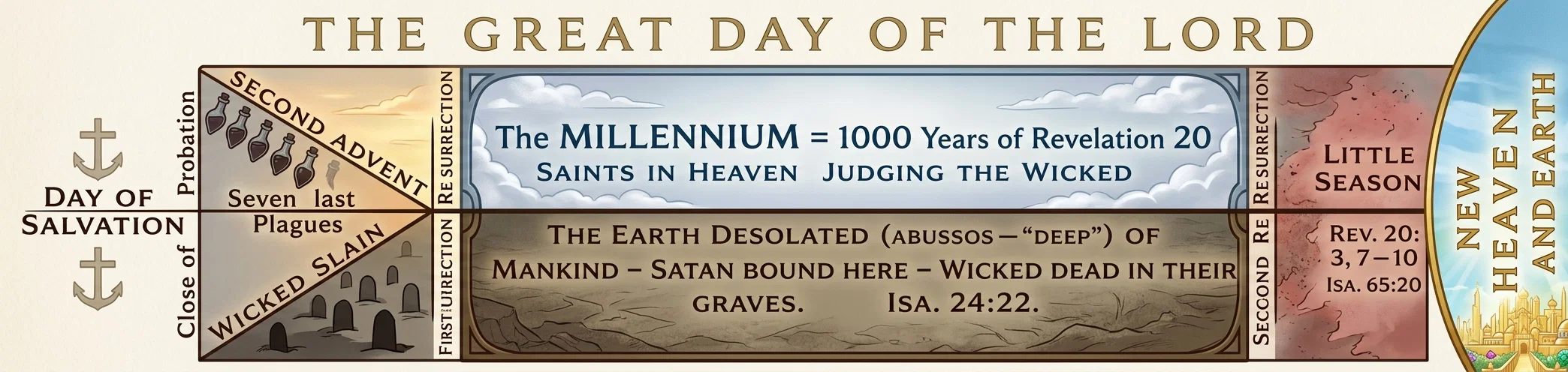
Millennium means a thousand years. While the term is not in the Bible, its equivalent, “a thousand years,” is used six times in Revelation 20, in six consecutive verses; namely, 2–7, inclusive.
The millennium is marked at its beginning by the first resurrection, and it closes with the second resurrection. Verses 4 and 5. The last sentence of each verse refers to the resurrection of the just. “Blessed and holy is he that hath part in the first resurrection.” Verse 6. The first part of verse 5 is evidently parenthetical; the connection shows this clearly. After speaking of the righteous in verse 4, the last clause says: “They lived [that is, they were raised from the dead] and reigned with Christ a thousand years.” The question would then naturally arise in the mind of the reader, what about the rest of the dead? Hence the parenthetical statement concerning them in verse 5, before declaring in the last clause, “This is the first resurrection,” referring to the righteous dead mentioned in verse 4, who “lived” again and reigned with Christ a thousand years.
The Saviour speaks of a “resurrection of the just” (Luke 14:14), and also of a “resurrection unto life,” and a “resurrection unto damnation.” John 5:29. Paul also taught two resurrections, one of the “just” and one of the “unjust.” Acts 24:15.

The Time of the Resurrection.

While the Saviour and Paul both teach two resurrections, they do not, in these scriptures, indicate how far apart they are. But in the Revelation it is plainly taught that the resurrection of the just is at the beginning of the millennium, and the resurrection of the unjust at the close of the millennium. The following scriptures show conclusively that the first resurrection takes place when Christ comes the second time: Matt. 24:30, 31; 1 Cor. 15:22; 23:51–54; 1 Thess. 4:16, 17. At that time the living wicked are slain by the glory and brightness attending the Saviour’s coming. 2 Thess. 1:7, 8; 2:8; Matt. 16:27; 24:30; Luke 9:26. The brightness of one angel caused the Roman soldiers at the sepulcher of Christ to fall as dead men. Matt. 28:2–4. The wicked are unable to endure the great glory manifested when Christ comes again. They are consumed.

Peace and Safety.

When the day of the Lord is near, and God’s wrath is to be poured out in the seven last plagues, and the coming of the Lord is nigh, the cry of peace and safety is raised that the people may rest in a false hope, and be unprepared for the impending destruction. The peace and safety cry is heard in the declaration by “many people” that the world is growing better, and will be won to Christ; that swords shall be beaten into plowshares, and spears into pruning-hooks, that nation shall not lift up sword against nation, neither shall they learn war any more. Isa. 2:2–4; Micah 4:1–3. “Many people” say these things in “the last days.” See Isa. 2:2, 3, and Micah 4:1.
The people also declare that “the mouth of the Lord hath spoken it.” Verses 4, 5. Yet in “that day” God “will arise to shake terribly the earth,” and His judgments will be visited upon the ungodly. See Isa. 2:10–21.
Paul also testifies that just before the second advent and the day of the Lord, there will be a cry of “peace and safety” from those upon whom His coming is as a thief in the night, and sudden destruction will come upon them, and they shall not escape. 1 Thess. 4:16–18; 5:1–3. He also declares that perilous, not glorious, times shall come in the last days (2 Tim. 3:1), and that “evil men and seducers will wax worse and worse, deceiving, and being deceived.” Verse 13.
God’s word says that men will prophesy peace in the last days; that men will say that the nations will learn war no more. In marked contrast with this, God says the nations will be stirred up to war, the heathen will be awakened, plowshares will be beaten into swords and pruning-hooks into spears. Joel 3:9–13.
Shall we believe man’s word or God’s word? God says, “Cease ye from man, whose breath is in his nostrils: for wherein is he to be accounted of?” Isa. 2:22. He will soon cast his idols of silver and gold to the moles and bats, and seek refuge in the rocks and mountains, that he may be hid from the face of the coming King, and from the wrath of the Lamb, when He comes in flaming fire, with power and great glory. Verses 19–21; Rev. 6:14–17.

The Earth Desolate.

We have found that the day of the Lord begins with the pouring out of the seven last plagues. These are described in Revelation 16. They continue one year, as we learn from Rev. 18:8, where one day, prophetic time, is applied to them. In prophecy a day stands for a year of literal time. See Num. 14:34 and Eze. 4:4–6. The plagues destroy vast numbers of the wicked, no doubt. The remnant are slain by the consuming glory of the second advent of Christ (Rev. 19:11–21), and the righteous are taken to heaven. 1 Thess. 4:16, 17; John 14:1–3; Rev. 19:1. Thus the earth is emptied of its inhabitants and left desolate. Isa. 24:1–3; Jer. 4:19–27.
Here in the desolate earth, Satan is bound during the thousand years. Rev. 20:1–3. By the circumstances under which he is placed, with man entirely beyond his reach, the wicked being all dead and the righteous in heaven, Satan is as effectually bound as tho he were actually bound with a literal chain and cast into a cell, six by eight. A prisoner is confined that others may be safe from harm. So Satan is confined to the earth where he can do no harm during the thousand years. The term “bottomless pit” is from the Greek word abussos, which in the Septuagint is the word for “deep” in Gen. 1:2. The earth was then empty, without form and void, and this will be its condition during the millennium. Satan will be shut up in this prison-house, unable to visit other worlds, and not only under circumstances which limit his operations, but they absolutely take away all his opportunities to deceive and destroy souls.

Deal Gently with the Erring.

In my long experience in the ministry, I have many times had people come to me and say, “I wish you would give Brother A. a good, plain talking to, for he is certainly going to the bad; he has not attended church for months.” In talking with such a discouraged one I have often thought that under like conditions those who were so ready to accuse him might not have done any better than the one so rashly condemned. In dealing with the erring, we should as far as possible place ourselves in like circumstances.
We should consider what their past life has been, in what ways they are tempted, especially ways in which our feet have not been led. A consideration of these things will help us to have more charity for the erring.
Christ is our example in all things, and it is said He was “in all points tempted like as we are, yet without sin.” Heb. 4:15.The only difference then between Christ and us in our fallen condition is that He never yielded to temptation. He “did no sin, neither was guile found in His mouth.” When Christ was here in human flesh, see how gently He dealt with the erring! Opportunity was not wanting of being harsh and denunciatory in public discourse as well as in private life. But His object was to win. See how kindly He dealt with the woman of Samaria, whom He knew had an unsavory record. She was won with His teaching and was convinced that He was Christ. At once she began to bring others to the Saviour.
Truly Jesus “spake as never man spake.” He was gentle in all His dealing with fallen humanity. How often in our zeal we forget that if any man have not the Spirit of Christ, he is none of His!
One of the most impressive lessons of the tender love of Christ for fallen humanity is recorded in the eighth chapter of John. When the Pharisees brought the woman who was a sinner, with not a doubt of her guilt, He might have held her up as a terrible example of sin. This would have pleased her accusers. But after quietly showing that He knew their past lives, their secret sins, they left Him. Finding Himself alone with the woman, He asked her, “Woman, where are those thine accusers? hath no man condemned thee? She said, No man, Lord. And Jesus said unto her, Neither do I condemn thee, Go, and sin no more.” Christ did not come to condemn, but to save the erring and lead them to live a better life. This was the beginning of a new life to this tempted, fallen soul, a life of purity and peace, devoted to the service of God. In raising this woman to a life of virtue, Jesus performed a greater act than of healing the most grievous bodily malady; He cured the sickness of the soul which is unto death everlasting. This penitent woman became one of the firmest friends of Jesus. We may well believe that she repaid His forgiveness and compassion with a self-sacrificing love and worship.
In His act of pardoning and encouraging this fallen woman to live a better life, the character of Jesus shines forth in the beauty of a perfect righteousness. Knowing not the taint of sin Himself, He pities the weakness of the erring one and reaches to her a helping hand.
It is not the true follower of Christ who turns from the erring with cold, averted eyes, leaving them unrestrained to pursue their downward course. Christian love is slow to censure, quick to discern penitence, ready to forgive, to encourage, to set the wanderer in the path of holiness, and stay his feet therein.
These are thoughts we do well to consider, and in so doing there will be less censuring and more of the old-fashioned Gospel of our divine Lord.
GEO. O. STATES.
Cedaredge, Colo.
Continue reading: The Jewels of Christ