Your ShelfYour Projects

Signs of the Times, Vol. 28, No. 36.

THE CITY OF THE SUN

Signs of the Times

Sep 3, 1902

Pacific Press Publishing Company · Oakland, California · Sep 3, 1902

“THE CITY OF THE SUN.”
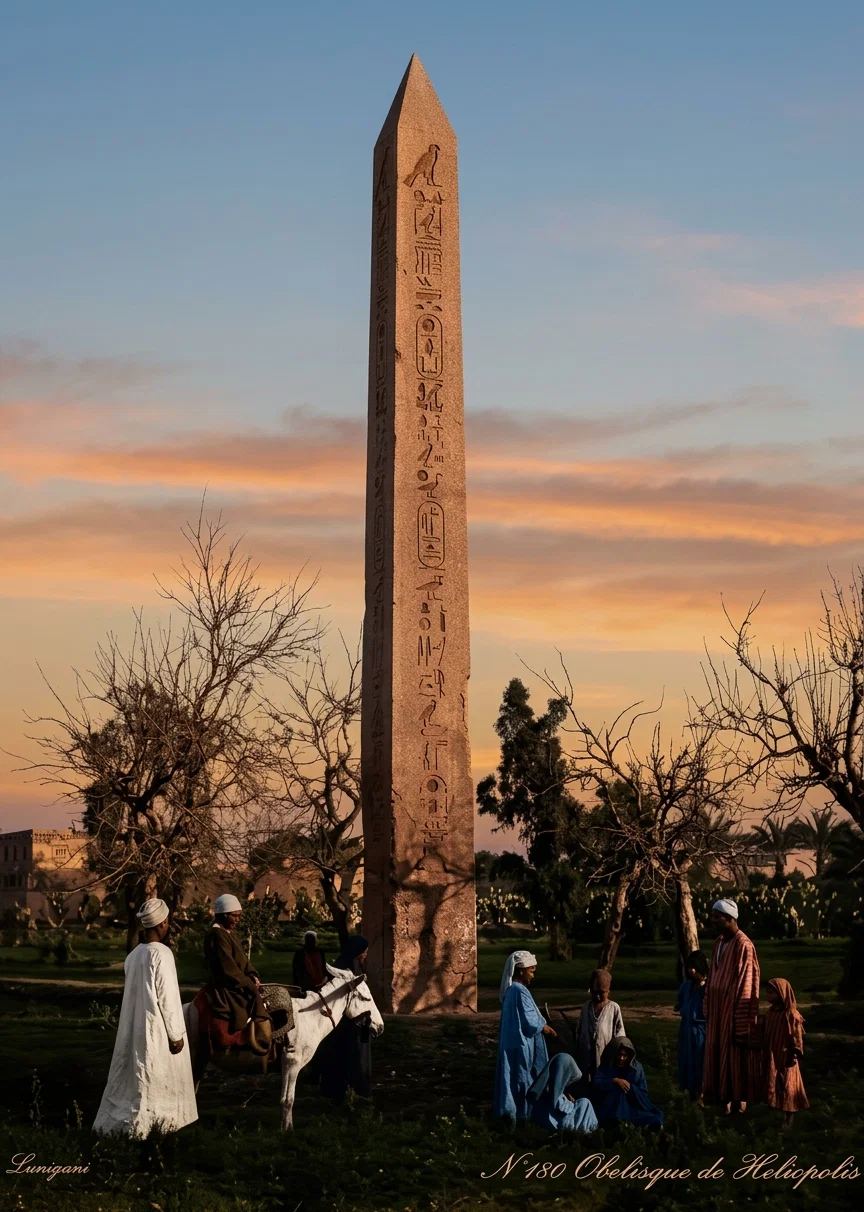
ONE of the oldest and most famous of the cities of Egypt was situated in lower Egypt, just at the beginning of the great Nile delta. Its civil name was An; its sacred name was Pe-Ra, the “house of the sun.” It is called in Gen. 41:45, 50; 46:20, by the name of On, and in Jer. 43:13, Beth-shemesh, the Hebrew for “the house of the sun.” The Greeks called it Heliopolis, “the city of the sun.”
Obelisk of the Temple of the Sun, in Ancient On, Egypt.
THE city was noted for three things: (1) It was the great famous center of sun-worship devoted to the sun-god Ra. (2) Here was the “University of Egypt,” including a school for priests devoted to sun-worship, and a noted medical school, also connected with the sun temple. (3) Its many obelisks, the peculiar symbols of the sun-god. Most of the obelisks (often erroneously called Cleopatra’s needles, with which she had naught to do) taken to Europe have been taken from On. To these schools came the Greek Plato and other philosophers; and the magnificent sun-temple is the only Egyptian temple of which a Greek writer has given us a description. Here dwelt “Potipherah, priest of On,” the father-in-law of Joseph. Gen. 41:45.
THIS old idolatrous worship was founded on the perversion of the true. “God is light; and in Him is no darkness at all.” The sun is but one of God’s mediums in giving light to the world. Men, refusing to know God as the Giver of light and life, solely because of His inherent righteousness, shut from their hearts the knowledge of the Creator by the worship of the creature. The carnal heart did not love the righteousness of God. It preferred the lusts of the flesh to the love of righteousness. It deified the sun as the father of all, as the minister of the procreative powers of nature used not to glorify God, but to satiate lust. Hence sprang the basest and most licentious of all, nature-worship, condemned everywhere in the Word of God, and always as among the worst. (See Ezekiel 8.) No other worship so took hold upon the perverted sexual elements of humanity; and this baseness was consecrated and glorified as acceptable religion. “When they knew God, they glorified Him not as God.” Rom. 1:20–25.
THE education of Egypt was founded upon what was once a true basis. Surely who should seek to be illuminated more than the priest, the minister to the souls of men, the representative of God. Many of them may have seen beyond the creature to the Creator.
Doubtless some of them did look beyond the soulless forms to Him who dwelleth in the light; but they grew fewer with the years, till Egypt became a symbol and synonym of spiritual darkness. There is healing in the light, healing in the sunlight; and where better could be located a medical school? But this branch of science was in the same gross bondage, and the light became darkness, the healing became disease, till nothing in physical ills could be worse than the diseases of Egypt. (See Ex. 15:26; Deut. 7:15; 28:60.) In the first of these scriptures the deplorable result in physical ills from Egypt’s transgression is set in contrast to the healing of Jehovah upon those obedient to His laws of righteousness, His statutes of life.
THE obelisks of Egypt are symbols of the grossest phases of sun-worship; and they are also evidences of the sacrifices which men will make, of the time and money they will expend to gratify carnal lust. These obelisks were red or pink granite monoliths, or single stones. They ranged in height from seventy feet to one hundred and eight feet, and from twenty-five feet in circumference to thirty feet and over. The largest at Karnak weighs two hundred and sixty-seven tons. All of them were taken from the quarry, brought down the Nile in great barges, lifted from the barges to wagons, and in some casestransported a hundred miles overland. They were then placed upon foundation mounds and pedestals, raising them from one hundred and twenty-five to one hundred and fifty feet high. The one in our illustration is all that is left in On. It was one of two, Rawlinson tells us, that stood before the entrance of the temple of the sun, at the inner end of an avenue of sphinxes. Its apex was once covered with a casing of gilt bronze.
BUT On, or Beth-shemesh (“the house of the sun”), is now in ruins, and the one obelisk, or pillar, stands alone of all its magnificent monuments, covered with idolatrous inscriptions, emphasizing the utter ruin and destruction of every system of worship which puts the creature, however bright and shining it may be, in the place of the Creator. The prophecy of Jeremiah (43:12, 13) has received fuller fulfilment than predicted of Nebuchadnezzar: “He shall break the pillars [margin, “obelisks”] of Beth-shemesh, that is in the land of Egypt; and the houses of the gods of Egypt, shall He burn with fire.” When these mighty monuments were erected, Egypt was one of the greatest of earth’s empires; now we see fulfilled in her the prophecy of Ezekiel (29:15): “It shall be the basest of the kingdoms; neither shall it any more lift itself up among the nations; and I will diminish them, that they shall no more rule over the nations.” Thus will it be with every nation, every soul, which perverts the truth of God into a lie.
“GOD is light.” The sun is but a symbol of His glorious presence; a manifestation of His mighty power. It should lead man to worship, not the shining orb, but the Creator who made and appointed it. “God is light,” and He would illumine the souls of all His children. He wishes to be honored here, not by dead stones, howsoever magnificent they may be in their cold grandeur, but in living temples of light; in living witnesses to His power; in souls recreated from the darkness of nature to the light of God; in light-bearers that more than shine and coruscate in borrowed splendor, but that give warmth and hope and cheer to those in the great cold world. Such souls will honor God. One such is worth infinitely more to point the way heavenward and uplift the world than all the obelisks which in Egypt pointed skyward. Men wander far to see a few of the latter; God abides with the former.

HAVING VISIONS AND BEING VISIONARY.

THERE is a great difference between seeing visions as a young man and being visionary,—as much difference as there is between being child-like and being childish. Being visionary is being filled with baseless fancies, led or misled by mere imaginings that have no sound reasons beneath them, and that can never be realized. Having visions is seeing with the mind’s eye, with the eye of expectation, or of hope, or of faith, beyond one’s present horizon or zenith, seeing that which may be as real as anything which is already within the sweep of unaided sight, having a reasonable basis, even though no superstructure is yet upreared upon it. Being visionary is likely to interfere with practical efficiency in one’s line of business, be he subordinate or principal. Seeing visions may be a help, an incitement, and an inspiration, in one’s practical duties, whatever is his business sphere. A young man who is visionary is not likely to succeed. A young man who is efficient now, and who is likely to rise above his present station, is well-nigh sure to have visions,—and he ought to have them.—Sunday School Times.

"LET THIS MIND BE IN YOU."

BY MRS. E. G. WHITE.
The ethics inculcated by the Gospel acknowledge no standard but the perfection of God's mind, God's will. God requires from His creatures conformity to His will. Imperfection of character is sin, and sin is the transgression of the law. All righteous attributes of character dwell in God as a perfect, harmonious whole. Every one who receives Christ as his personal Saviour is privileged to possess these attributes. This is the science of holiness.
How glorious are the possibilities set before the fallen race! Through His Son, God has revealed the excellency to which man is capable of attaining. Through the merits of Christ, man is lifted from his depraved state, purified, and made more precious than the golden wedge of Ophir. It is possible for him to become a companion of the angels in glory, and to reflect the image of Jesus Christ, shining even in the bright splendor of the eternal throne. It is his privilege to have faith that through the power of Christ he shall be made immortal. Yet how seldom he realizes to what heights he could attain if he would allow God to direct his every step!
God permits every human being to exercise his individuality. He desires no one to submerge his mind in the mind of a fellow mortal. Those who desire to be transformed in mind and character are not to look to men, but to the divine Example. God gives the invitation, “Let this mind be in you, which was also in Christ Jesus.” By conversion and transformation, men are to receive the mind of Christ. Every one is to stand before God with an individual faith, an individual experience, knowing for himself that Christ is formed within, the hope of glory. For us to imitate the example of any man,—even one whom we might regard as nearly perfect in character,—would be to put our trust in a defective human being, one who is unable to impart a jot or tittle of perfection.
As our Example we have One who is all and in all, the chiefest among ten thousand, One whose excellency is beyond comparison. He graciously adapted His life for universal imitation. United in Christ were wealth and poverty; majesty and abasement; unlimited power, and meekness and lowliness which in every soul who receives Him will be reflected. In Him, through the qualities and powers of the human mind, the wisdom of the greatest Teacher the world has ever known was revealed.
Before the world, God is developing us as living witnesses to what men and women may become through the grace of Christ. We are enjoined to strive for perfection of character. The divine Teacher says, “Be ye therefore perfect, even as your Father which is in heaven is perfect.” Would Christ tantalize us by requiring of us an impossibility?—Never, never! What an honor He confers upon us in urging us to be holy in our sphere, as the Father is holy in His sphere! He can enable us to do this, for He declares, “All power is given unto Me in heaven and in earth.” This unlimited power it is our privilege to claim.
The glory of God is His character. While Moses was in the mount, earnestly interceding with God, He prayed, “I beseech Thee, show me Thy glory.” In answer God declared, “I will make all My goodness pass before thee, and I will proclaim the name of the Lord before thee; and will be gracious to whom I will be gracious, and will show mercy on whom I will show mercy.”
The glory of God—His character—was then revealed: “The Lord passed by before him, and proclaimed, The Lord, The Lord God, merciful and gracious, longsuffering, and abundant in goodness and truth, keeping mercy for thousands, forgiving iniquity and transgression and sin, and that will by no means clear the guilty.”
This character was revealed in the life of Christ. That He might by His own example condemn sin in the flesh, He took upon Himself the likeness of sinful flesh. Constantly He beheld the character of God; constantly He revealed this character to the world.
Christ desires His followers to reveal in their lives this same character. In His intercessory prayer for His disciples He declared: “The glory [character] which Thou gavest Me I have given them; that they may be one, even as We are one; I in them, and Thou in Me, that they may be made perfect in one; and that the world may know that Thou hast sent Me, and hast loved them, as Thou hast loved Me.”
To-day it is still His purpose to sanctify and cleanse His church “with the washing of water by the Word, that He might present it to Himself a glorious church, not having spot, or wrinkle, or any such thing; but that it should be holy and without blemish.” No greater gift than the character that He revealed, can Christ ask His Father to bestow upon those who believe on Him. What language there is in His request! What fulness of grace every follower of Christ has the privilege of receiving!
God works with those who properly represent His character. Through them His will is done on earth as it is done in heaven. Holiness leads its possessor to be fruitful, abounding in every good work. He who has the mind that was in Christ never becomes weary in well-doing. Instead of expecting promotion in this life, he looks forward to the time when the Majesty of heaven shall exalt the sanctified ones to His throne, saying unto them “Come, ye blessed of My Father, inherit the kingdom prepared for you from the foundation of the world.”
O that we might more fully appreciate the honor Christ confers upon us! By wearing His yoke and learning of Him, we become like Him in aspiration, in meekness and lowliness,in fragrance of character, and unite with Him in ascribing praise and honor and glory to God as supreme. Those who live up to their high privileges in this life will receive an eternal reward in the life to come. If faithful, we shall join the heavenly musicians in singing with sweet accord songs of praise to God and to the Lamb.
It is our life-work to be reaching forward to the perfection of Christian character, striving constantly for conformity to God's will. Day by day we are to press upward, ever upward, until of us it can be said, “Ye are complete in Him.”

GOD IS LOVE.

E’en the sparrows seem to say That God is love; All things teach from day to day That God is love.
O may we strive His love to show Along our pathway as we go, And help our needy friends to know That God is love.
May we teach some weary one That God is love; May we bring some lost one home, Where God is love.
O, scatter smiles along your way, And fervent to the Saviour pray To bring a wanderer each day Where God is love.
May our hearts be gay and light, For God is love. May our lamps be burning bright, For God is love. Let us follow every day In the straight and narrow way, For ’tis well that we can say God is love.
Cheney, Kansas. Mrs. J. E. GILCHRIST.

The Coming of the Lord

BY L. A. PHIPPENY

The Third Advent.

In popular parlance, heaven is the reward of the righteous,—the dwelling-place of happy souls after death. These few words constitute about the sum of ordinary preaching and conception of the future for man, so far as reference is made to the Bible. While heaven as a place is to be the home of the redeemed, it will be temporary only, it will be their home for only one thousand years. With eternity of existence as the future of the saved, a thousand years is only a beginning!
At the end of the thousand years—the millennium—the final events in the history of the conflict of righteousness and sin will be enacted, and upon the earth. We must again bring prominently to the front the fact that God did not create the earth in vain. He made it to be inhabited,—not for six thousand years only, but for eternity. He designed it to be the everlasting home of man, and the design will be carried out. Heaven—the planet we may call heaven—is a glorious place, beyond question the brightest, most beautiful spot at the present time in all the universe, and it will be a delight beyond comprehension to spend a thousand years there. But the earth, after all, is the final thought of those who were created from it, who have lived upon it, and have been brought forth again from its dust to immortality. “Behold, the righteous shall be recompensed in the earth,” are the words of Inspiration concerning man’s future estate.
This article is entitled the “Third Advent,” and the words may sound strange to many at first hearing. But they indicate accurately what will occur at the close of the long judgment work by the saints, with Christ and the Father. The earth is Christ’s. He has purchased it, conquered the enemy who usurped Adam’s dominion, and will come at that time to enter into everlasting personal possession with the great family of the redeemed of the human race. He is the second Adam.
It will be remembered that at the time of the second advent, Christ does not descend upon the earth, but remains in the air above the earth. But the third and final advent is for the purpose of taking possession. In the prophecy of Zechariah are words descriptive of that time, and we learn that “his feet shall stand in that day upon the mount of Olives, which is before Jerusalem on the east, and the mount of Olives shall cleave in the midst thereof toward the east and toward the west, and there shall be a very great valley; and half of the mountain shall remove toward the north, and half of it toward the south.” Zech. 14:4–10. Afterwards this valley, or plain, shall be “lifted up,” elevated as a vast tableland, and upon this prepared, cleansed portion of the earth will descend the New Jerusalem from heaven, the capital city of the earth in its renewed condition. A vast plain this will be for the city which lies foursquare, and measures three hundred and seventy-five miles on each side. See Revelation 21.

The Second Resurrection.

As Christ and the host of the redeemed descend to the earth, the wicked dead are called forth from their graves. “The rest of the dead lived not again till the thousand years were finished,” are the words of Revelation. This is the time; and all the world shall at that time behold the glory and majesty of the Son of Man, as He comes from the land that is far away, with His righteous followers. The resurrection of the wicked dead looses Satan from his long idleness, his bound condition, his prison, and he and his angels go forth to deceive again the nations brought forth from death.
For “a little season,” the Word tells us, the bold deceiver is to be loosed. Rev. 20:3. As one contemplates the scene, the mind is staggered at the thought of the motley throng that comes forth to life for a brief existence at this time. There are all the inhabitants of earth from the first unsaved individual in the world’s history to the millions destroyed a thousand years before by the brightness of Christ’s second advent. There are world rulers, captains, generals, mighty men of every age, bondmen, slaves, false teachers, professed Christians, revilers, the abominable, and millions upon millions innumerable of every age, nation, tongue, and clime, who have disregarded the little or great light given them. And they come forth, unchanged in motive. They come forth for final rewards soon to be given them.
At this time the deception of Satan is that his power has raised the multitudes to life, and that the beautiful city is properly his and theirs. This is evident from the words of Scripture, that the multitudes are marshalled into armies, and gather from all parts of the earth into besieging positions about the New Jerusalem. Once again the ancient falsehood will be uttered to the people by Satan that after all they shall not surely die, and the fact that all are now alive will be urged as final demonstrations of the truth of the statement. He will inspire them with the hope that they are able, with his inventions, and assisted by the generals and commanders among them, to capture the bright stronghold before them, and live and reign forever upon the earth.
Some time must elapse between the resurrection of the wicked dead and the time for an attack to be made on the Capital City. The record is brief, but does not prevent the filling in of necessary details. Councils must be held; plans will be carefully laid; engines of destruction devised and constructed; and, most important of all, the nations must be kept alive, and perhaps live in some kind of dwellings in the meantime. It must not be forgotten that the leader in this movement is an angelic being, with angelic assistants, possessed of powers far beyond our present knowledge. We now know him to be possessed of remarkable power to work miracles and signs, and he will use these powers at that time in strengthening the feeble, and in various ways designed to maintain his supremacy.
We can not assert that there will or will not be food. Nevertheless, it would appear from a number of Scriptures (Isaiah 13 and 34; Jeremiah 50, etc.) that include the final overthrow of all nations in their application, that not all the beasts and birds are destroyed at the second coming of Christ, but live on as at present, propagating their kind amid the ruins of earth. During the thousand years that intervene between the second coming of Christ andthe resurrection of the wicked, the numbers of these denizens of the wilderness would be increased enormously. One could perhaps conceive of no more fitting diet than these creatures for a world that even now includes in its bill of fare a large portion of the animal kingdom. But we know in any event, that there will be provision of some kind for the sustenance of the hosts called forth at that day.
The words of Rev. 20:9, with other scriptures, indicate that the space cleansed at the descent of Christ reaches beyond the city’s walls, and includes more or less adjacent territory. Here the saints, or many of them, are encamped without the walls, until the approach of the vast host that finally is brought against the city. Here Satan gathers “them together to battle; the number of whom is as the sand of the sea. And they went up on the breadth of the earth, and compassed the camp of the saints about, and the beloved city.” Rev. 20:8, 9.

The End of the Wicked.

The old doctrine of eternal torment for the wicked is repulsive, and dishonoring to God, and entirely antagonistic to the positive teaching of the Bible. Let us follow the study with the positive teaching before us. Afterward brief reference may be made to the doctrine referred to.
Imagination must waver before the sublime and awful spectacle presented, when the city of God, with the redeemed within the walls, shall be surrounded by the hosts marshalled under Satan’s banner. When all is ready for the final attack, the advance of the wicked is suddenly arrested. Before them is the beautiful city—“Thy city Jerusalem, Thy holy mountain.” The prophet John says: “And I saw a great white throne, and Him that sat on it. . . . And I saw the dead, small and great, stand before God; and the books were opened [these are the books of death]; and another book was opened, which is the book of life; and the dead were judged out of those things which were written in the books, according to their works.” John speaks of them as the dead, for in vision he saw them raised from the land and sea.
The work of deciding the degrees of punishment takes place in heaven during the thousand years. But now the assembled ones of all ages are confronted by the records of their deeds. This is the culmination of the events in particular mentioned by Matthew: “And before Him shall be gathered all nations; and He shall separate them one from another, as a shepherd divideth his sheep from the goats; and He shall set the sheep on His right hand, but the goats on the left. Then shall the King say unto them on His right hand, Come, ye blessed of my Father, inherit the kingdom prepared for you from the foundation of the world.” “Then shall He say, also unto them on the left hand, Depart from me, ye cursed, into everlasting fire, prepared for the devil and his angels.” Matt. 25:32–34, 41. The wicked will see the results of their wrong choice, acknowledge that God is just, and their sentence just. They will experience terrible remorse as they realize what they have lost, but will have no true repentance. Nowhere in the Scriptures is there a hint of a second probation for sinners. This life is the time for developing and testing character. Were the wicked permitted another lifetime, their course would result ultimately as at present.
Then it is that fire is rained upon the wicked “from God out of heaven,” and John says that this fire “devoured them.” Rev. 20:9. “And death and hell [the grave] were cast into the lake of fire. This is the second death. And whosoever was not found written in the book of life was cast into the lake of fire.” “And the devil that deceived them was cast into the lake of fire and brimstone.” Note the expressions, “devoured,” and “second death.” This is the positive teaching. Through the prophet Malachi the end of the wicked is thus graphically described: “For, behold, the day cometh, that shall burn as an oven; and all the proud, yea, and all that do wickedly, shall be stubble; and the day that cometh shall burn them up, saith the Lord of hosts, that it shall leave them neither root nor branch. . . . And ye shall tread down the wicked; for they shall be ashes under the soles of your feet in the day that I shall do this, saith the Lord of hosts.” Another testimony is: “The heavens and the earth, which are now, . . . are . . . reserved unto fire against the day of judgment and perdition of ungodly men. . . . And the elements shall melt with fervent heat, the earth also and the works that are therein shall be burned up.” 2 Peter 3:7–10. Again: “The wicked shall perish, and the enemies of the Lord shall be as the fat of lambs; they shall consume; into smoke shall they consume away.” Ps. 37:20.
Satan, his angels, and the wicked of earth, and all that has been defiled by the curse of sin, will be utterly destroyed. Satan is the “root,” his followers the “branches,” of sin. But does not the Word speak of his being tormented “forever and ever?” It does; but this expression, in view of the positive teaching here adduced must be understood as are other usages of the Word “forever” in a number of instances, signifying until the death of an individual, or the end of a nation as such. See Deut. 15:17; Josh. 4:7, etc. There will be no endless torment. While there will be physical suffering because of a wicked course in the present life, yet the mental suffering occasioned by a knowledge of what has been lost will transcend all other pain. When the wicked have also been recompensed in the earth (Prov. 11:31), there will be an end forever for sin. There will never be a resurrection again for sinners. Death and the grave and him who had the power of death—the devil—will be exterminated.
Not only will Satan suffer for his own evil course, but the confessed sins of the redeemed will be placed upon him, and he will suffer for the sins he has caused the righteous to commit. This is the teaching of the ceremony of placing upon the scapegoat the sins of the people at the door of the sanctuary. These sins are placed upon Satan, the antitypical scapegoat, when Christ leaves the sanctuary above, at the beginning of the thousand years. As senior partner in the firm of wickedness he shares the liabilities; when one breaks partnership with him, he, as remaining member of the firm, must assume responsibility for all. In the “lake of fire”—the burning earth—sin passes away forever. This is the end of the wicked. “Nevertheless we, according to His promise, look for a new heaven and a new earth, wherein dwelleth righteousness.”
Next week we must take a brief glance at that new condition.
[The next and concluding article in the series is “The Dominion Restored.”]

ONE GOOD PROOF.

A SUGGESTIVE answer was recently given to the question, “What one conclusive proof have you that Christ did not change the Sabbath from the seventh to the first day of the week?”
The simple fact that the inspired writings nowhere record the Saviour as mentioning the first day of the week, was the answer.
But what is there so significant about this silence, returned the first party?
Let me explain, replied the second. Christ could not have changed the Sabbath to the first day of the week, without making mention of the day to which it was changed. Notice the divine way of making a Sabbath, and see how specific the record is of the particular day involved:—
“Thus the heavens and the earth were finished, and all the host of them. And on the seventh day God ended His work which He had made; and He rested on the seventh day from all His work which He had made. And God blessed the seventh day, and sanctified it; because that in it He had rested from all His work which God created and made.” Gen. 2: 1-3.
Five expressions of the day of the Sabbath in this one brief record. Again in the wording of the commandment which enjoins its observance:—
“Remember the Sabbath day, to keep it holy. Six days shalt thou labor, and do all thy work; but the seventh day is the Sabbath of the Lord thy God; in it thou shalt not do any work, thou, nor thy son, nor thy daughter, thy manservant, nor thy maidservant, nor thy cattle, nor thy stranger that is within thy gates; for in six days the Lord made heaven and earth, the sea, and all that in them is, and rested the seventh day; wherefore the Lord blessed the Sabbath day, and hallowed it. Ex. 20: 8-11.
Thus the Lord sets forth the divine institution. Would it be like God to change this to another day of the week and in the change make no mention of the other day?
In Isa. 28:10 the Lord declares His manner of teaching truth to a world-blinded people. “For precept must be upon precept, precept upon precept; line upon line, line upon line; here a little, and there a little.” This being the divine order, it appears quite evident that another party has been at work on the change. When God makes an institution, He speaks in no uncertain terms. Might it not fitly be said of this assumed change of day, as in the parable of another questionable appearance, “An enemy hath done this”?
E. E. GARDNER.
Cresco, Ia.

Get Ahead by Forgiveness

HE who desires to “get even” with his enemy is almost a fool. He acknowledges that his enemy is degraded and base, yet he desires to “get even,” or in other words, to come down to his enemy’s level by making two fools where one was one too many. Better not get even with your enemy by revenge, but get ahead of him by forgiveness.—Thos. H. Nelson.

The Divine Purpose in Affliction

THE MISSION OF PAIN AND THE LANGUAGE OF DISEASE. NO. 6.

The Divine Purpose in Affliction.

“I will go and return to my place, till they acknowledge their offense, and seek My face; in their affliction they will seek me early.” Hosea 5:15.
THERE is a wise and loving purpose in all the plans of God and the permissions of divine providence. In general, the purpose of affliction is to produce repentance. We are often called upon to endure affliction under such conditions as make it very difficult to find the cause of transgression which produced it, or to ascertain the divine purpose in permitting it to continue so long. “For He doth not afflict willingly [margin, “from His heart”], nor grieve the children of men.” Lam. 3:33. Affliction is not a part of God’s chosen plan for His creatures, and so He does not afflict willingly—from His heart. He does not desire to bring suffering and sickness upon us; but His desire to save us and lead us to repentance compels Him to do so when He has exhausted every other means to turn us from the way that leads to destruction. When God has spoken once, twice, or even three times, to His erring children, exhorting them, “Turn ye, turn ye, from your evil ways; for why will ye die?” and yet they continue in transgression, then it is that God permits the just harvest—the natural consequence of our sins—to fall upon us; hoping that pain and affliction may lead us to see the error of our way, and the folly of further resisting the love of God and the light of heaven.
As it were, God holds back for a time the just penalty of our transgression, thus giving the sinner an opportunity to repent before the full harvest of his wrong-doing breaks upon him. But when patient forbearance fails to lead to repentance, there is but one thing more that God can do, and that is to permit the sinner to reap what he has sown. And this reaping has been carefully arranged by God to constitute the last corrective effort that shall be made to turn the transgressor from his sin.
Let us further examine the words of the prophet: “Wherefore doth a living man complain, a man for the punishment of his sins? Let us search and try our ways, and turn again unto the Lord. Let us lift up our heart with our hands unto God in the heavens. We have transgressed and have rebelled.” Lam. 3:39–42. Rather than complain of our affliction, let us search and try our ways and turn again to the Lord. The penalty of our transgression condemns us, in that it clearly shows that we have departed from truth and righteousness. Then let us not criticize God, and complain of the penalty which reminds us that we are wrong-doers; but rather let us search out the cause of our troubles; “cease to do evil; learn to do well.” Let us lift up our heart with our hands unto the God of heaven, and say, “We have transgressed and rebelled.”
So, then, we see that the divine purpose of affliction is, first, correction and cure; and after that, if the penalty of sin fails to correct the disposition to sin, the harvest of wrong-doing will ultimately destroy the sinner. So when the causes of transgression, either physical or spiritual, have been removed, then the correcting penalty ordinarily disappears, the disposition to transgress having been corrected.
We may be forgiven for the cause of our affliction, but forgiveness of the cause is not always attended by the immediate removal of all the effects. To illustrate: You may plant thorns and thistles in your front yard. You may afterward see the folly of your doings and heartily repent; and the moment you repent,God forgives you for the planting of the thorns and thistles. You are forgiven for the cause of your trouble; but the effects—the piercing thorns and the prickly thistles—remain. Forgiveness of the cause of affliction may be had upon repentance. Freedom from all the effects of transgression may not come instantly. These matters are in the hands of the One whose judgments are just and altogether righteous.
“Cursed is the ground for thy sake.” Gen. 3:17. The curse was not pronounced upon the earth because of God’s wrath or anger, but because of His love. It was given for our sakes. It was better, under conditions of sin, that man should be obliged to labor hard and continuously to secure a livelihood, that he might have less disposition, time, and energy, to devote to evil thoughts and works. The curse was the best way God could bless man under sinful conditions. And so all afflictions, whether mental, moral, or physical, are for our sakes. When the divine purpose of love and mercy has been accomplished, and to just the extent and just as fast as it is accomplished, our afflictions of soul or body will disappear, either instantly or gradually, as a wise Father may deem best for His erring children.
W. S. SADLER.

The Modesty of Greatness

Who is not pleased with a great, humble man whose unostentation makes him apparently unconscious of his greatness? Who does not enjoy worth when its modesty makes it appear mean and it acts humbly displeased with itself.—Pentecost Herald.
Continue reading: DO WE WANT HEALING FROM SATAN’S AGENCIES?