ON a recent Sunday, Rev. D. S. Phelan, LL.D., the editor of the "Western Watchman," the leading Catholic paper of the Middle West, gave a discourse on the subject, "Is the World Getting Better?" At the outset of his talk he said:
"People claim that the world to-day is not as good as it was; that men are getting worse and worse all the time. Well, I don't think we are getting any worse, but certainly we are not getting better very fast. What is the reason? This is the question of questions: What is the reason that men do not become better, when all men approve the best?"
Mr. Phelan begins his answer to these queries by saying:
"Well, we are dealing with two beings when we treat with man. Man is part god, and he is part brute. And when you link them together, when you put them under the same yoke, it is idle to ask why the divine in man does not go ahead; rather should we ask why the brute in him holds back. He can not go ahead unless both yoke-fellows go together. That is the secret. Man does approve what is right; man does love the truth; but he has a yoke-fellow, a brute, that does not love what is good, and actually hates what is true. And he can not go ahead unless he can drag this brute companion of his along with him. But he can drag that brute. He is the master. True, he has two natures: but one is higher than the other; and man can command the brute; man can chastize the brute; he can spur the brute on; he can compel the brute. And when you would answer the question, why men are not more religious, you have simply to inquire why they do not bring that brute to do their bidding."
It is a very easy matter from the foregoing paragraph to get an idea that is wholly out of harmony with Scripture. To say that "man is part god," and spell god with a small "g" as Mr. Phelan does, is quite indefinite. But in his next sentence he speaks of "the divine in man," which would indicate that he thinks that man in his natural state is part God. Such utterances are quite out of harmony with these words of the apostle Paul:
"For I know that in me, that is, in my flesh, dwelleth no good thing: for to will is present with me, but to do that which is good is not." Rom. 7:18.
Is Man Divine?
Mankind, apart from the real conversion that comes thru Christ, has ever been prone to believe that he had some good thing in him, no matter how depraved he might be. But the foregoing text plainly says that in mankind "dwelleth no good thing." That is God's presentation of the matter, and God is always right.
The impulses that sinful man has to do right; the voice within him that always approves of things that are excellent; his "lofty ambitions" and things of a like nature, are not evidences that man is part "god" (or that he is part God, either), or that there is something divine in his sinful being; all these inner promptings to goodness are the evidences that God Himself is at work by His Spirit on each heart, striving to get man to surrender the wrong, sinful self, and turn to the Lord for the power of cleansing from all this evil, and also for the divine power to do the right.
The man who will yield to this voice from the Lord will find that it is not necessary for him to continually trail the "brute" nature after him all thru his life. The "brute" may be completely destroyed thru the almighty power of the Christ of God. It is not necessary to continually torture one's self and to inflict ceaseless rounds of penances in order to "chastize," harass, subject, and weary the "brute." The thing to be done is to surrender unconditionally to Christ, and in the mighty power of His righteousness the "brute" is put to death; and by the exercise of faith and prayer and a constant study of the divine word of God the "brute" may be ever held in the chains of death, so that the Christian may constantly enjoy the strong and pure life of right-doing. But all this glorious work is accomplished by the power of God, and not by man exercising what he mistakes for a divine principle within himself.
Love for the Fighter.
In another part of his discourse Mr. Phelan said:
"Now I love a fighter. I love war. I believe in war, because I believe in manhood. And as long as men will believe that there is for them something more precious than life, so long will there be war in this world. You ask how long war will continue? I answer, as long as there will be true men in the world; men who regard truth as more precious than property; who will regard purity as more precious than gold; who will regard honor as more precious than life. And as long as you have men in this world who will respect truth and honor and purity more than life, so long will you have war."
From the standpoint of a man of this world who looks to this world as the great center of his ambitions, the foregoing quotation is sound. But where does the teaching or practice of Christ authorize any such utterances in His name? Certainly the foregoing utterance from the doctor is not in harmony with the text which says:
"Then they came and laid hands on Jesus, and took Him. And behold, one of them that were with Jesus stretched out his hand, and drew his sword, and smote the servant of the high priest, and struck off his ear. Then saith Jesus unto him, Put up again thy sword into its place: for all they that take the sword shall perish with the sword." Matt. 26: 50-52.
Or how can his utterances concerning war be made to harmonize with the following statements of the Master in His great inaugural address, His sermon on the mount?
"Ye have heard that it was said, An eye for an eye, and a tooth for a tooth: but I say unto you, Resist not him that is evil: but whosoever smiteth thee on thy right cheek, turn to him the other also. And if any man would go to law with thee, and take away thy coat, let him have thy cloak also. And whosoever shall compel thee to go one mile, go with him two. Give to him that asketh thee, and from him that would borrow of thee turn not thou away."
"Ye have heard that it was said, Thou shalt love thy neighbor, and hate thine enemy: but I say unto you, Love your enemies, and pray for them that persecute you; that ye may be sons of your Father who is in heaven: for He maketh His sun to rise on the evil and the good, and sendeth rain on the just and the unjust. For if ye love them that love you, what reward have ye? do not even the publicans the same? And if ye salute your brethren only, what do ye more than others? do not even the Gentiles the same?" Matt. 5:38-47.
There is higher ground for the Christian to stand upon than the ground of the soldier whose sole object is to kill and to destroy. There are more powerful weapons than the sword and spear of the arm of flesh. The Christian soldier is ever and always to say:
"For tho we walk in the flesh, we do not war according to the flesh (for the weapons of our warfare are not of the flesh, but mighty before God to the casting down of strongholds); casting down imaginations, and every high thing that is exalted against the knowledge of God, and bringing every thought into captivity to the obedience of Christ; and being in readiness to avenge all disobedience, when your obedience shall be made full." 2 Cor. 10:3-6.
Fighting for Moral Victories.
These Bible statements all show that the work of the Christian is to get moral victories; his work is to develop character that is in harmony with the life and example of the Lord Jesus. The life of the Christian is to be built upon the solid foundation of righteousness, and not carved out with the sword. "The weapons of our warfare are not of the flesh," but they are nevertheless "mighty before God to the casting down of strongholds." The weapons of the Christian's warfare do not carry him onto the bloody field of carnage, but they draw him instead into that place where mind and heart are yielded to the power of God, and to the peaceful, the mighty, influences of His Spirit.
Is Universal Peace Possible?
Many people have been teaching in these times that we are coming to a time in this world when men will no longer go to war to kill each other with the rifle and the sword. But with the teaching of strong men in the Catholic Church to the contrary, the work of securing such a peace in this world is not very promising. The whole history of the Catholic Church is closely linked with the intrigues and maneuvers of politicians. She has always worked to get hold of the civil power to subordinate it to the uses of her church. Her strongest men are, and ever have been, most masterful politicians. She is, and ever has been, on the alert to use every bit of her influence to help her to dominate in the politics of the nations of earth. And since this is her history and character it is perfectly natural that she should pay her tributes of homage to the forces of war.
We say these things in the terms of highest respect to the individuals who compose the Catholic body. The most of the members of that church were born and reared under the influences of her teachings. But it is due to even the Catholics themselves that they should closely compare the teachings of the men in her church with the teachings of Jesus Christ. For it is by the words of the Bible that men will be judged, and not by what any church teaches. T.
Union of Churches
Union of Churches.—The Evening Bulletin of Philadelphia, date of February 11, reports Archbishop Ryan (Roman Catholic) as saying that there may be a corporate union of the Anglicans and the Episcopalians with the Catholic Church in the near future. The present agitation, he declared, is "a continuation of a movement that has been going on for some time in England, aiming at a reunion with Rome." He says again, "I think a great many Episcopalians will come into the Catholic Church individually, and there may be a corporate union." Of the Episcopal clergy he says, "They are not priests. They would have to be ordained. The clergy of the Greek Church are priests, and when a number of them came into the Catholic Church their orders were recognized as valid. They came on the ground that concessions would be made to them in certain matters which were not essentials, but matters of discipline, such as receiving the holy communion under the forms, the marrying of clergy before ordination, etc. Then there are the Syrians, Ruthenians, etc., which are permitted to have their own peculiar rites. But all these peoples are one in articles of faith and in essential discipline, and all united in the Catholic Church under the pope, the successor of St. Peter." One of the schools of thought in the Episcopal Church led by Father Paul is doing its best to induce its fellow Anglicans to acknowledge the primacy of the See of Rome. If this point is gained, they will come into the Catholic Church in a body. Referring to a book written by Father Paul, Archbishop Ryan says, "It is a defense of the primacy of St. Peter and would be regarded as thoroly orthodox by any Catholic." The same paper in a despatch from New York, February 11, declares that the High Episcopalians are organized for the purpose of bringing their church back to the Catholic fold, with Father Paul as its head. Three special movements are referred to, one for the union of Episcopalians and other Protestants, one for a union between the Episcopalians or Anglicans and the eastern "Orthodox" churches, and the last a union of the Anglican or High Church Episcopalians with the Catholic Church. Sometime it will mean a confederation of all, for so the sure word of prophecy declares.
The milk question is becoming one of national importance in England and Germany, and ought to be in this country. A large percentage of cows are said to be afflicted with tuberculosis, and the handling of milk in many places is filthy.
Sunday Laws Infringe on Personal Liberties.
By L. H. Logan
WHEN we begin to legislate in religious matters or in things that pertain exclusively to the individual conscience, we are going to infringe on some one's rights and liberties. It is inevitable. As a matter of fact, in the realm of conscience there is no other right than the right of individual conscience. There is no such thing as a collective, corporate, or sectarian conscience. Conscience pertains solely to the individual. It is the individual's own view of his personal relation of faith and obedience to God, neither is there such a thing as "civic righteousness." There is only one kind of righteousness, and that is the righteousness of God. It is imputed to us as individuals and not as a corporate body.
Religion is calculated to make men righteous. Then, since religion pertains solely to the conscience, to our duty to our Maker, and no one can deal with our conscience righteously but our Maker, it necessarily follows that all religious legislation is unrighteous legislation.
Sunday legislation is religious legislation, it matters not by what name it may be called, or under what garb it may be carried on. We will state two undeniable facts in evidence of it: First, Sunday is a religious institution; it originated as such, it is observed as such. Second, leaders in this Sunday-law movement are religious.
From the first Sunday law that was enacted by Constantine in the fourth century to the last Sunday law that has been enacted in the world in the twentieth century, it has had for its object, directly or indirectly, to make people more religious. We repeat that we can not make people more religious by legislation. It only makes hypocrites of those who submit to it, and if allowed to go on to its ultimate end it will result in religious persecution.
The pages of history are written with the blood of innocent victims for over 1,000 years as a result of the first Sunday law enacted by Emperor Constantine in A.D. 321. And since human nature is the same the world over and in all ages, and since like causes produce like effects, it follows that the same kind of legislation now would produce the same results.
So, with malice toward none and good-will toward all, we must register our objection against religious legislation in all its forms.—L. H. Logan.
Pure Milk in San Francisco.—With the endeavor to clean up the city, on the part of the united forces of federal, state, and municipal governments, there are also organizations which are fighting for pure food. Milk conditions have been shown to be deplorable. Stringent laws have been enacted against these unhygienic, unsanitary milk supplies. The law has been upheld by the courts, and if properly carried out, San Francisco will be given better milk in the future. The same warfare is extended to the butcher shops, and thousands of pounds of meat have been condemned. Let the good work go on. Sometime perhaps men will learn that there is a better food than meat, one that will sustain life and energy equally as well or better, and that food is an endless variety of fruits, grains, and vegetables.
In connection with the discussion of drunkenness at Stanford, it is stated by those who seem to know that Stanford is not an exception in the matter of drunkenness, but that in other great universities in the land it is just as common. This certainly is a sad condition of things. If the great centers of education are weakly yielding to the destructive appetites and desires of human nature, what can we expect of the product they will turn out? True education ought to build up a whole man, mentally, physically, spiritually, well-balanced and strong to meet the perplexing trials and conflicts of life. That education is defective which develops such a class of students as is in evidence in some of the great institutions of learning, or which condones their weakness and vices.
San Francisco is opening a free market in which producer and consumer can be brought together. One of these is to be located on West Mission Street, between Herman Street and Deboece Avenue; and one is planned on the water-front at the gore formed by East, Pacific, and Dunn Streets. Mr. John H. Behan, clerk of the Board of Supervisors, 70 Eddy Street, solicits correspondence with producers and growers. This is a splendid step if carried out justly, as we are assured it will be. It will prevent tons of produce from being dumped into the bay if the trust can not get its price. People in San Francisco ought to hurrah for a free market.
Jews and Sunday Laws.—The Pueblo Star-Journal, of February 9, published a long paper from Rabbi Montague N. A. Cohen, of the Jewish synagog in that city. While he inveighs against the blue laws of New England, at the same time he urges a civil rest day. This is nothing strange. Rabbi Cohen does not know the first principles of true Sabbath-keeping: if he did he never would seek to obtain a civil Sabbath law. No Jew who believes the Bible would hold with Rabbi Cohen in his position.
Fire Losses in San Francisco.—The Scientific American tells us that the actual fire losses in San Francisco at the time of the earthquake were $600,000,000, only $200,000,000 of which was covered by insurance, leaving a net loss of $400,000,000.
The “European Concert.”
MUCH has been said during recent decades concerning the “concert among the powers of Europe to keep the peace.” When any of the weaker nations are in danger of being dismembered or broken up, some one or more of the “great world powers” steps in and prevents it. This has been done so often that there has come to be a general belief that the powers are bound together to keep the peace and that big wars will be therefore averted. The plan has been carried out largely thru the jealous fear among the nations as a whole, lest any one nation should become strong enough to act as a dictator to the rest.
Trade and the conquest of territory are usually at the bottom of all the difficulties between nations. And one of the principal bones of contention between the powers of Europe has been the Turk and his territory. They have had a determination among themselves that no one of the so-called Christian powers should be allowed to get possession of Constantinople with all its great advantages in a military and naval way.
Recently, however, Emperor William has become very friendly to the Turk, and it is thought that he has come to consider that his navy is sufficiently strong to vie with that of England (the British navy has heretofore been acknowledged protector of the Turk), and that he may now break away from the concert of powers and reap some benefits of his own from Turkey. Nothing special may come of this, but it is interesting to note from day to day the materials for war that may be seen among the nations. We are rapidly coming to the time when the war of the great day of God will break forth, and he is blind who can not see that the materials are gathering in every quarter of the globe, preparatory to the awful strife of that near-by time.
Trade was never sought for more eagerly nor with more covetous determination than at the present time. Greed for gain is one of the most marked conditions and evils of this age. This being true, the subject-matter for wars will be ever abundant, and while good men and women should always be doing all they can to promote peace, yet all who are studying the prophecies know full well that there will be no peace on this earth till the coming of Him who is the Prince of Peace, the Son of the living God. Between now and the time when Christ shall actually appear in the clouds of heaven, there will be more and more war talk and greater and greater war preparations, until finally the great war of the great day of God, as foretold by the prophets, will break out, and shortly following that the end will come.
T.
Progress of the Work in Fiji.
By C. H. Parker
THE great Gospel commission embraces every people, nation, kindred, tongue, and it has made each who has heard the joyful news a debtor to every one who has not heard it. What a responsibility it places upon us who know the truth for this generation! No other people has been called upon to take the Gospel to the whole world in a single generation. May the Lord help us to face the situation and apply ourselves to work with an earnestness that will bear all things, hope all things, and endure all things.
The work in the Fijian mission field is onward, and gathers more strength from week to week. A few years back we could count our membership on two hands, but now the numbers have reached up into the hundreds. The past year has been quite an epoch in the work here. We see the stately steppings of our God in our midst, and see Him leading on before. We can not prepare workers fast enough to fill anywhere near the calls for help. We are encouraging a more mature class of men to enter our school so that they can prepare quickly for the field.
Thru the generosity of our Australian brethren we have been able to purchase nearly three hundred acres of very good land for our leading school for this mission. It cost us $1,250. If we were to purchase the same piece now, a much larger figure would be required. At our last council in June our native converts passed a resolution that in every town where there should be any of our people that they should give a piece of land for a church-building, and another piece for the teacher's house, besides farming land.
These people are very poor. A penny to them is like pounds to us. If it were not for their lack they would give liberally to the support of the work here. Yet they give liberally in their poverty. At our last week of prayer the offering was a little over one hundred dollars. While other denominations find it difficult to get them to give, and have to resort to devious ways and means to gain this object, we find no trouble by following the Bible way. As we stick to the Bible plan of giving, the natives are led to have confidence in us; for they can see that we are not trying to make merchandise of them. How much we ought to thank God for the tithing system!
Some of our Australian and American brethren have thought it a privilege to support some of the workers here. This has been a great help and blessing, besides, we know that it reacts in a greater measure upon these dear, self-sacrificing brethren.
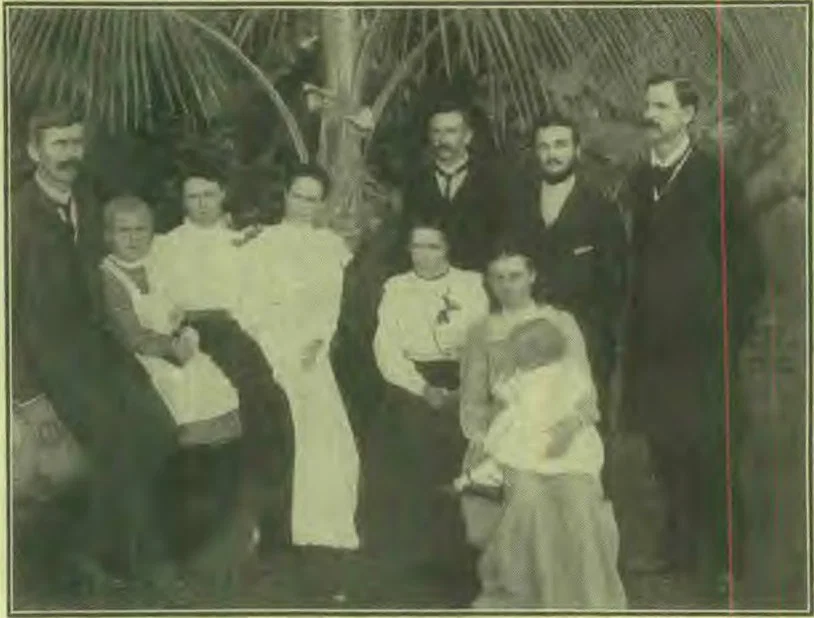
The superintendent of our school work in Fiji has lately been appointed to New Guinea. With this appointment we are enabled to send out our first Fijian missionary to a field beyond. It is a cause of great rejoicing to us to see this advance step. It will not be long before numbers of our young men here will be telling the message in the now unentered groups.
Our Fiji Workers.
Another fact that is appealing to us in this field is that there are about thirty thousand Indians from India that must have the message given to them. In fact they are calling for it of themselves. Then we have several thousand Europeans. The field is indeed white for the harvest. What is one European laborer for such a field? O, for more to labor in gathering in the harvest. "Pray ye therefore the Lord of the harvest, that He will send forth laborers into His harvest."
C. H. PARKER.
Our Work and Workers.
EIGHT persons were baptized at Santa Barbara, Cal., January 12.
BRETHREN V. W. ROBB and W. A. Easley report two families won for the truth at North Cedar, Kansas.
TENT-MEETINGS at Northcote, Melbourne, Australia, held late in the year 1907, resulted in the conversion of sixteen, with continued interest.
"FIVE were added to the Kansas City church last Sabbath (February 1). Two of these were the result of Bible work being done there."—Kansas Worker.
BOLIVIA is receiving the light of the truth thru Brother E. W. Thomann, who is conducting studies at Cochabamba. The meetings are attended by students, all Catholic.
MADAGASCAR has no living preacher of present truth, but the brethren in Australia are sending the printed page there, and several are learning to love the truth as a result.
"BROTHER Huntington writes from Utah that five more converts are reported by Brother Charles Nelson, one of their Scandinavian workers, from Logan for January."—Pacific Union Recorder.
BROTHER A. G. HOUGHEY reports 272 baptisms in the West Michigan Conference last year. Four new churches were organized. Donations to foreign missions amounted to $21,208.40, an increase over the previous year of over one thousand dollars.
"My delivery was extra good," "twenty-two orders in three hours," "in all, I sold books to the amount of about twelve hundred dollars," are expressions from the report of Brother Thomas H. Davis who has been canvassing in Ecuador for Patriarchs and Prophets.
THE largest Seventh-day Adventist Union Conference is the Russian Union, which was organized by a small body of delegates from all parts of Russia, October 26-29. Perfect freedom is allowed our workers in that hitherto closed land, and the work is onward. The Russian membership is 2,553.
THE Central Union Conference held its regular annual meeting at Boulder, Colo., January 23 to February 2. The officers elected were: E. T. Russell, president; A. T. Robinson, vice-president; B. E. Huffman, educational secretary; Meade MacGuire, young people's secretary; Union College, treasurer.
FOLLOWING are the officers elected for the North Pacific Union Conference, at a meeting held at College Place, Wash., January 31 to February 9: President, W. B. White; vice-president, G. E. Langdon; secretary, A. G. Adams; treasurer, C. H. Castle; educational secretary, M. E. Cady; religious liberty secretary, A. J. Breed; general field missionary, C. E. Weaks.
SOUTHEASTERN UNION CONFERENCE is the name of a recently organized union conference composed of North Carolina, South Carolina, Georgia, and Florida, and the eastern halves of Kentucky and Tennessee. Of this conference K. C. Russell, of Washington, D. C., was chosen president. G. A. Irwin, also of Washington, was chosen as president of the Southern Union Conference.
'Tis but a Step.
By G. Milner
SAY not that we from heaven are far,
When holy thoughts thereto may run,
And every breath of faithful prayer
Brings answer ere our words are done.
Say not that life is dark or lone,
That here unseen, unheard, we lie,
When stooping from His glorious throne,
The Eternal hears our meanest cry.
Say rather, God and heaven are near,
And we, by golden links of prayer,
Are bound with every human fear
To Him, the highest, holiest there.
—G. Milner.
Wanted for Missionary Work.
ENGLISH or German papers and tracts; Mrs. G. F. Fraser, Homewood, Ill.
SIGNS, Life Boat, Watchman, and tracts. Address, I. T. Reynolds, Pineville, La.
PAPERS and tracts for ship missionary work; Alfred Dyberg, 220 Main St., Vallejo, Cal.
CLEAN copies of SIGNS and other denominational literature; D. P. Rans, 26 Madison Ave., Hamilton, Ont.
SIGNS, Little Friend, Watchman, and any foreign tracts and papers; address, Florence E. Howard, 155 Orange Ave., Irvington, N. J.
ANY denominational papers, books, and tracts, for distribution among Indians; address, Sumner B. Taft, Kiowa Agency, Anadarko, Okla.
CLEAN copies of our papers and tracts for use in supplying a reading rack in the railroad depot. Address J. W. Johns, Box 365, Guymon, Okla.
Literary Notices.
“English Synonyms, Antonyms, and Prepositions.” By James C. Fernald. 564 pages, cloth. Price $1.50 net. Funk & Wagnalls Company, New York and London.
It is not pleasant to read a composition or hear an address in which over and over, and frequently, the same word is used to express a thought when the language furnishes from two to a dozen synonymous terms; for the English language is peculiarly rich in synonyms. The reason is that it has appropriated from every great language of the world. Yet these synonyms often differ, sometimes radically, in meaning. To avoid both extremes—either barrenness in expression, or the careless and incorrect use of words—a study of synonymous words is necessary. In such a study the student can find no better help than the work named above. More than 7,500 synonyms are classified and discriminated. The prepositions to be used with many of these words are indicated by illustrative examples. Another great help to the student is the list of antonyms, or words of opposite meaning. Questions and examples are given in Part II to encourage the study and facilitate the acquirement of the right use of the various words treated. Both author and publishers are entitled to our thanks.
“American Communities and Cooperative Colonies.” By William Alfred Hinds, Ph.D. Second revision, 608 pages. Charles H. Kerr & Company, Chicago.
Mr. Hinds has given us a valuable contribution in bringing together in one volume the various communistic settlements and cults from the Ephrata Community in Pennsylvania, 176 years old, to Fellowship Farm Association, Westwood, Mass., the latest of colony experiments. The rise or attempted rise of a hundred or more communities is given, and also the failure of most of them. Still the author believes in ultimate communism because of the man’s longing for it. It will never be reached in this world. Man’s longing will be met only in Jesus Christ and His coming sinless kingdom of regenerate souls.
“Liberty, Union, and Democracy. The National Ideals of America.” By Barret Wendell. Price $1.25 net. Charles Scribner’s Sons, New York.
This book contains four lectures delivered before the Lowell Institute, in Boston, 1905, as follows: “The National Character of America,” “Liberty,” “Union,” and “Democracy;” and these were the outgrowth of lectures delivered in France. Mr. Wendell holds, and rightly, we believe, that the true American character is not composite, but peculiarly, distinctly American, indigenous to the soil, born of revolution and desire for liberty. His lecture on liberty is a discussion to quite an extent of the national and states’ rights ideas, the unit of government, and the rights of the individual, but, strange to say, he does not even touch on the principles of religious liberty, which played such a part in American independence. Like others, the author seems to misinterpret the phrase, “All men are created equal,” in the Declaration of Independence to mean equality in point of mentality, power, etc., when, as we conceive it, the fathers meant equal in point of privilege, in the enjoyment of “life, liberty, and the pursuit of happiness,” to which the ignorant dolt is as clearly entitled as the chief magistrate. Mr. Wendell has given some readable essays, but we wish he had developed some of his principles further.
“A Desk-Book of Errors in English, Including Notes on Colloquialisms and Slang to Be Avoided in Conversation.” 232 pages. By Frank H. Vizetelly, F.S.A., associate editor of the Standard Dictionary. Funk & Wagnalls Company, New York and London.
This handy little volume bound in red cloth is one of the Standard Desk-Book Series. It stands for correct English. The preface declares: “The purpose of these pages is not to dictate a precise course to be followed, nor to lay down rules that will prevent any speaker or writer from exercising his privilege as an individual of speaking or writing freely and independently the thoughts that are uppermost in his mind. It is, rather, to point out common errors which he may unconsciously commit, and to help him to avoid them and the vulgarisms of the street which have crept into the language, as well as those absurd blunders that have been recorded as the unconscious acts of persons qualified in other respects to rank as masters of English.” The author has given us a helpful little manual. May it prosper on its way.
“The Union Prayer Meeting Helper, 1908.” Notes by the Rev. W. C. Stiles, Brooklyn, N. Y., and Prof. Robert Scott, Montclair, N. J. Topics prepared by the Rev. Claude R. Shever, St. Louis, Mo. Price 25 cents. Funk & Wagnalls Company, New York and London.
This handy little book contains a calendar of 1908, fifty-two excellent topics for prayer-meeting for the year, notes generally good, and many excellent hints on the conducting of prayer-meetings. Sometimes the notes are most excellent, as in topic 6, sometimes they flatly contradict the Scripture, as in topic 30. But the little book is worth its price and more in its suggestions and arrangement.
“The True Method of Healing.” By George Mitter, Pastor Third German M. E. Church, 603 Livernois Ave., Detroit, Mich. English, 50 cents; German, 80 cents. Address the author.
Mr. Mitter first considers the true method of healing the human soul, by leading the soul to Christ by the word and Spirit. In the healing of the body the author holds that “the vital force of the sick body” is the only power that can heal. To assist this vital force the body must be cleansed externally and internally. He also admits the influence of the mind over the body, and endeavors to prove his basic proposition by appeal to magnetism, hypnotism, etc. But he makes a sorry argument when he endeavors to prove that the cases which Jesus healed were by the same method; namely, inducing the vital energies of the sick body to effect the healing. It is so much easier to believe that Jesus healed by the power of His life, infused into the sick or dead.
“The Secret of a Good Memory: A Practical Treatise on Memory and Its Cultivation.” By J. Mortimer Granville, M.D. Eagle Printing and Binding Company, Pittsfield, Mass.
In this volume the author presents the principles developed and originated by Mr. J. W. Clarke, of London, England. The contention of the author is that every person has some one sense more acute than others, some best way of taking in notions or ideas, some by the eye, for instance, others by the ear. This sense or method should be more strongly cultivated and made to subordinate others to its purpose of building up a good memory. The secret of good memory is therefore in ascertaining the way by which our thought makes its most permanent records, to learn the faculty most serviceable, and cultivate it to its highest degree of usefulness.
“China and Methodism.” By Bishop James W. Bashford, 118 pages, 35 cents, net; Published by Jennings and Graham, Cincinnati, Ohio.
This little volume gives an interesting account of the land and the people of China; it tells of their religions, and also describes the progress of Christianity in the empire. In a chapter on “Possibilities” in China the opportunities for Christian work are set forth in a convincing manner. The volume came from the press in 1906 and was designed as an appeal especially to the Methodists of the United States to stir them up to suitably participate in the centennial celebration of the founding of missions in China, which celebration was held in Shanghai the last of April and the first of May, 1907. And while the book was prepared for that special purpose, yet it is full of valuable and interesting facts.
“Practical Christian Sociology.” By Rev. Wilbur F. Crafts, Ph.D. Revised, fourth edition. Funk & Wagnalls Company, New York and London.
This book is a collection of lectures by the author on Moral Reforms and Social Problems. Mr. Crafts is a prodigious worker, a user of apt similes and trite metaphors; but he is poisoned with the virus of the National Reformers, and therefore believes and works for impossible things thru a union of church and state. He believes in not only rendering to Cæsar the things that are Cæsar’s, but in Cæsar’s compelling men to render to God the things which the National Reform Bureau, of which Mr. Crafts is the head, decides to be God’s. Some of his reforms are truly to be commended, but when he enters the religious field, he is a forerunner of the recrudescence of the Dark Ages. The book is valuable for its facts and figures; it is venomous in its politico-religious teaching.
“The Apostles’ Creed: Its Origin, Its Purpose, and Its Historical Interpretation.” A lecture with critical notes by Arthur Cushman McGiffert, Washburn professor of church history in the Union Theological Seminary, New York. 1,206 pages. Charles Scribner’s Sons, New York.
The contention of Dr. McGiffert is that the Apostles’ Creed is a growth founded on what is called the old Roman Symbol, a much abbreviated form; that the latter arose in the second century, in Rome, as a baptismal formula, a protest against certain errors which had then begun to come into the church. From the lecture and the learned notes one can easily see that the creed has no other authority than tradition. The book will be chiefly of interest to those who wish to know the traditional beginnings of extra Biblical customs.
“Of Such Is the Kingdom, and Other Stories from Life.” By Richard L. Metcalf, associate editor of The Commoner. The Woodruff-Collins Press, Lincoln, Neb.
This little book is a home brightener in its sweet stories of children, and brave souls. We may not always agree with its death-bed theology, but we feel constantly that we are in sympathy with the writer, whose touches of nature make all his readers kin.
Our Candle Is Burning Out.
A LITTLE girl was asked one evening why she kept so steadily at her work; whereupon she promptly said: "My candle is almost gone, and I have no other."
Her answer was suggestive. Life is the candle; and it, too, is partly gone—it may be almost gone—and we have no other.
Because her candle would soon go out, the little girl felt impelled to make the most of it while it should last.
What lesson comes from this to your heart, my brother, as you pause at the15threshold of a new year to think of the years gone by, of the work to be done, and of the time before you in which to do it?
One thing is sure; some of your candle is gone. It may be the greater part of it is burned out now. Quite an appreciable portion of it has gone since 1907 began, and here it is burning rapidly into 1908. Have you any special work that should be done before your candle goes out? All that is gone has gone forever. You can never again have the opportunities that have been neglected. Whatever we do must now be done in the little time that is left us. If we are dissatisfied with the little we have done, there is only one remedy—fill full all the time we have left. The candle is rapidly burning out and we have no other.
—Sabbath Recorder.