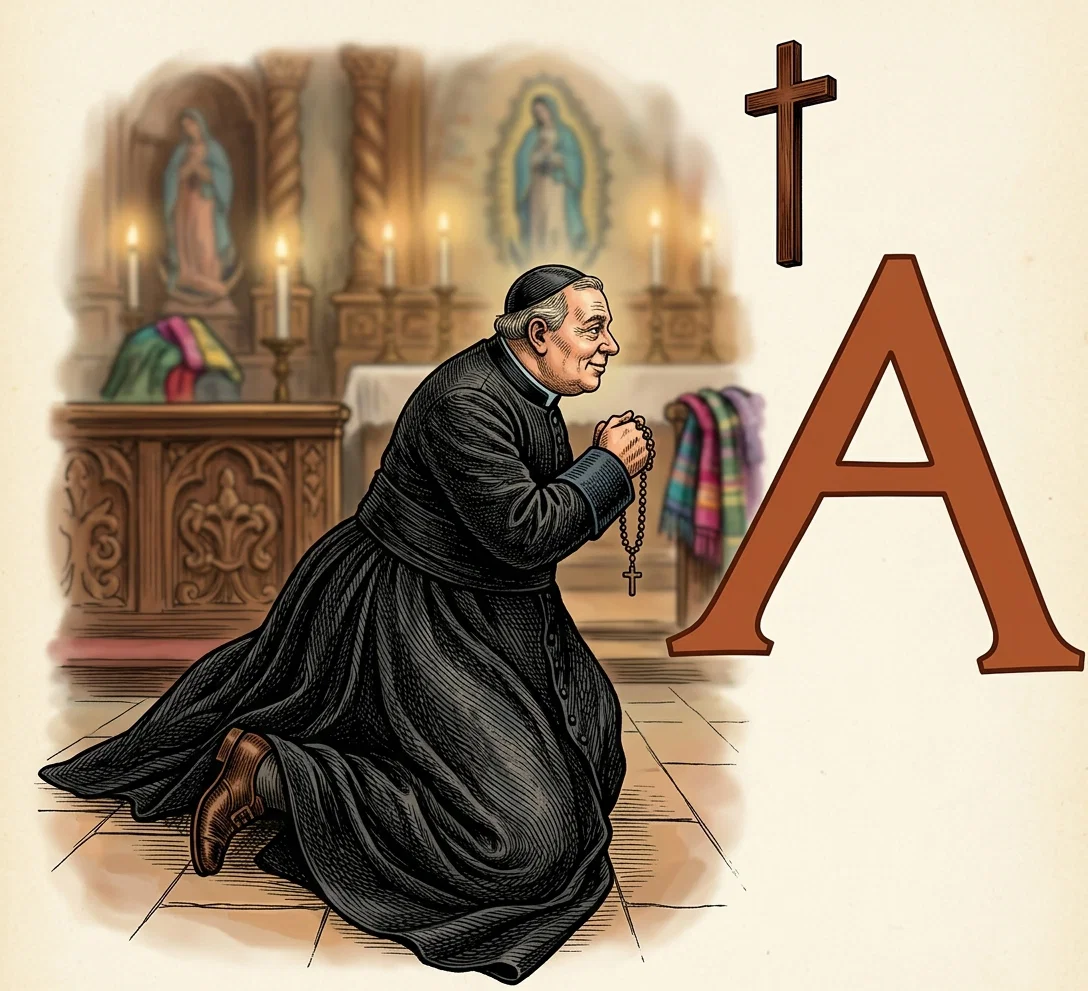
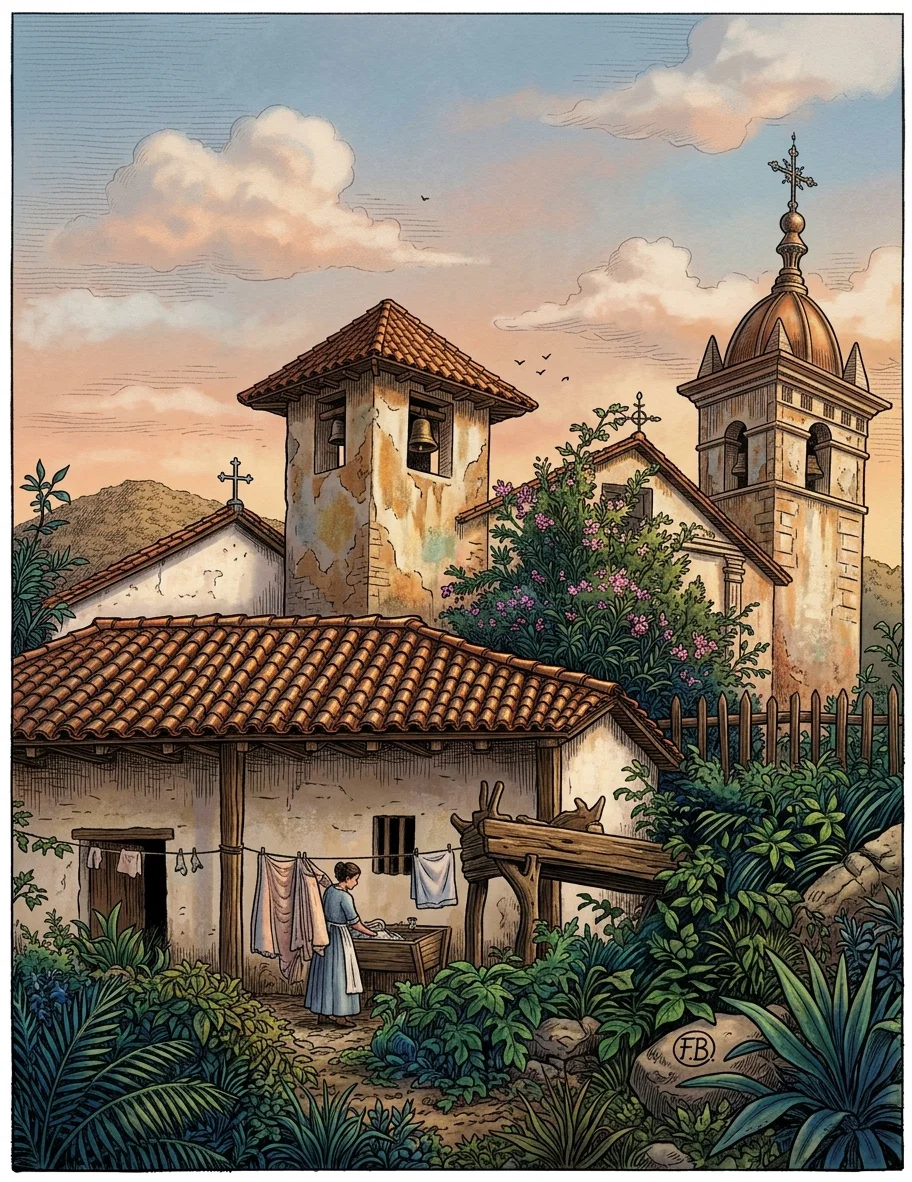
VERY religious people are our neighbors of Honduras. The fat old priest does not forget his devotions, and the little child learns early to repeat his prayer to the Virgin Mary.
When the boy climbs the belfry tower at vespers, the women and children gather in the large living-room for prayers; and before children can talk, they often ask for a blessing by patting their little heads, and mumbling a formula taught them. When you meet a man upon the road, he greets you, Adios!—to God,—which means, translated freely, “I would to God a safe journey for you.” The most ungodly man will tell you that he will do this or that “Dios primero,” an equivalent for our phrase, “Providence permitting.” Profanity, as we hear it on the streets in the United States, is almost unknown here, for there remains among this people a strong feeling of respect for the forms of their religion.
They know that Jesus came to the earth and died, but it has been so long since their religious teachers have studied their Bibles that they think Mary, the mother of Jesus, will answer their prayers more quickly than Jesus himself. They have forgotten why Jesus was resurrected and went unto his Father. They know nothing of the work of our Saviour in the heavenly sanctuary. They say they believe in the second personal advent of Christ to the earth, but that coming means nothing to them. They would be more greatly stirred if assured that Mary would come again in person.
The religious service here is a misuse of the kindergarten idea. In the church they have pictures and images of saints to hold their attention while they repeat their prayers. Each worshiper carries a string of beads, arranged on the decimal system, around her neck.
Here is the evening prayer: “Holy Mary, mother of God, pray, Lady, for us sinners now and in the hour of our death. Amen, Jesus,” alternating in responses of the following: “God save thee, Maria, full of grace; the Lord is with thee. Blessed art thou among women, and blessed is the fruit of thy womb, Jesus.”
After the repetition of the first formula by the leader, who is usually the mother or grandmother, the family join in the second part, and one bead is slipped on the rosary. When this has been done ten times, a large bead is the next in the string, and this is slipped with these words: “Our Father who art in heaven, hallowed be thy name. Forgive us our debts as we forgive our debtors. Amen, Jesus.”
Then the first two verses are repeated ten times in reverse order,—“God save thee, Maria,” being said by the leader, the family repeating Holy Mary, etc. This order is followed until the beads are all slipped, when worship is over, and cigarettes are lighted.
Families usually retire early. Among the poor and those of moderate means the house is one large room, the kitchen being built apart. Around the four walls of the big room the cedar bedsteads, covered with cowhide, are ranged. A dim light of pitch-pine serves for retiring; and when all is quiet, one can locate the older members of the family by their cigarettes.
OUR NEIGHBORS IN SANTA LUCIA
Before daylight the daughters are up. One takes hulled corn from a huge wooden dish under her bed, and begins milling tortillas in the kitchen. Two of the younger ones find their yoguals (cloths used in forming a circular cushion under the water-pot when placed on the head), and are off to the river for water.
The young men are up next. Passing around in front of each bed that has an occupant, they make a polite bow, and say, Bueno dies (good morning). The old people and visitors are the last to arise, but it is barely daylight. The air is fresh and cool outside, where preparations are being made for milking. The calves of a few of the best cows have been kept up overnight, and are now tied to the forelegs of the cows that are considered extra good milkers if they give three or four quarts at a milking.
The horses about the place seem to have scant tails, and we understand why when two of the boys bring out a curious spinning-wheel and a lot of long horse-hair, and begin to spin twine for ropes and halters. These are not the only kind of ropes made, but they are prized because mules will not chew a hair halter.
These rancheros are a kind-hearted people. Last week a friend of mine was thrown from a vicious mule in a lonely spot far from home. A stranger came along, lifted him onto his mule, and walked beside him until a house was reached, where he was cared for tenderly, his bruises bathed and bound in hot leaves greased with tallow. Tea was made from fever grass; and when the long night was passed, the old ranchman brought out a gentle mule, put the injured man on it, and brought him home, refusing pay for any service except a very small allowance for the mule. Thus these Spanish-Indian inhabitants of Honduras are our neighbors.
This article is now so long that I will not tell you much about our personal work. Underneath us are the everlasting arms. Over and over again are we proving the precious promises of God, and they never fail. This country is behind the other Catholic countries of America in that it has not been worked by any Bible Society. Our daily prayer has been that we might work among these people so wisely that they would not be frightened. Distributing or selling our papers and books containing references and allusions to various parts of a Book that the people do not possess,13seemed to me like selling keys to maps without the maps.
At last, Bibles are being sold in Honduras, and a shipment from San Salvador has reached Tegucigalpa for us. We are able constantly to preach the truth to these people in such a way that they say, “What do these things mean?” We have some of the best families in Juticalpa reading, and the poor are asking questions. My soul goes out in gratitude to God that I am permitted to labor in his vineyard, even in this out-of-the-way corner.
Juticalpa, Honduras, C. A.
The General European Conference
By Guy Dail
GUY DAIL
(Concluded)
A PORTION of the last day of the conference was devoted to the consideration of the publishing work. Brother Sisley led out in this, giving a brief account of the way in which the work in Great Britain had grown the last two years. Last year the circulation of Present Truth averaged 18,476 copies a week, while the English Good Health had a monthly issue of 46,083. There were 100,097 tracts published, or three times as many as the previous year. The retail value of last year's sales was $84,718. Each of two men, not of our truth, paid for the publication and circulation of fifty thousand small tracts on the Sabbath question. The London house has also done some publishing in the Zulu language, and has been selling to our mission fields at as low a figure as possible. There is no longer a loss on the Good Health, and there has been but a small loss on Present Truth.
Elder Wilkinson stated that the publishing work in the Latin Union is but a mere child, one year old. The book stock that was formerly in Basel was divided between the depositories in Geneva and Paris. In 1903 there were one hundred and twenty-five thousand copies of our periodicals printed, and we published Secret of Health and “Glorious Appearing” in Italian, and “We Would See Jesus” and Signs of the Times, in Spanish. Our sales for the year amounted to about six thousand dollars.
In Finland, Brother A. Boettcher has charge of the publishing house. He stated that we print in Finnish, and must also get out our own literature in the Swedish, as it is impossible to introduce books in that language from Sweden. The last two years they have printed 11,500 copies of “Christ Our Saviour,” 5,000 of these being delivered to our house in Sweden; of “Steps to Christ,” 13,000 in Finnish, and 8,000 in Swedish; 335,000 pages of tracts in both languages have been printed; the circulation of our Finnish paper has increased from 600 a month in 1901 to 5,000 now; the sales for the field amounted to $10,000 during the two years. It would be very much to the advantage of our Finnish work if our brethren in the States, wherever there are Finns, would take an interest in them, and seek to increase the circulation of our Finnish literature among them.
In connection with the publishing work in Helsingfors, this recommendation, with its preamble, was passed:—
“Whereas, The Book Mission in Finland is not registered, and, consequently, has no legal rights; therefore,—
“We recommend, This Book Mission to organize itself into a stock company with ten thousand Finnish marks, in harmony with the existing laws, and that the shares be held by the International Tract Society in Hamburg and in London, or by the General European Conference, in the event of its legal organization, and that Brethren A. Boettcher, K. Sandelin, and W. Vasenius be appointed as a committee to effect such an organization.”
It may seem a little strange, perhaps, that we recommend the organization of a stock company; but when our brethren learn that this is the only sort of legal organization that the laws of Finland allow, they will see the reasonableness of our action.
Brother D. Ostlund, who is located in Reykjavik, Iceland, stated that the past two years his paper in the Icelandic has so increased its list that he now gets out a semimonthly edition, of two thousand five hundred, and he hopes that the coming year there will be a gain, instead of a loss, as heretofore. There is also in readiness for immediate publication the manuscript for the book “Prophecies of Revelation,” translated from the Danish by Brother Matteson.
During the two years ending July 1, 1902, the Hamburg house had printed 34,401,280 pages in the German, and 1,788,890 pages in the Holland, Lettish, Hungarian, Rumanian, and Bulgarian, or a total of 36,190,170 pages; the next two years, 54,692,400 pages were printed in the German, and 4,219,440 pages in the languages just mentioned, and, in addition to those languages, the Polish, the Russian, the Portuguese, and the Servian should be included. This makes, for the past two years, a total of 58,911,500 pages, showing an increase of 22,721,670 pages. The first two years we printed 1,254,900 papers; the next two years we issued 1,659,500 copies, showing a fair gain. The retail value of the sales for the first two years amounted to $100,180, and for the second two years to $139,322. We are now publishing in thirteen different languages, and hope soon to begin in the Suaheli and Wapare tongues, of German East Africa.
On the publishing work, these resolutions were passed:—
“Resolved, That we express our sincere gratitude to God for his abundant blessing that has attended our publishing work throughout our entire field, and that we consider this a reiteration of the statement that, if there is one work more important than another, it is that of getting our publications before the people; and, further,—
“Resolved, That we express our appreciation of the faithful service of our self-sacrificing agents, who, by the blessing of God, have carried the message through the printed page, into both the old and new and difficult fields, thus opening the way for the living preacher; also,—
“Resolved, That, as this is one of the most important means among us of extending the third angel's message, and is a financial strength, and proves an excellent training-school for workers, we encourage, to the best of our ability, the agents already in the field, and make earnest efforts to secure new workers.
“Whereas, The Lord has blessed the work of getting out our publications in various languages; therefore,—
“Resolved, That we urge our publishing houses not only to increase their literature in these tongues, but also to secure translations into yet other languages.
“Whereas, The International Publishing Association, of College View, Neb., U. S. A., has been organized for the purpose of increasing the circulation of our literature among the foreign-speaking people of the United States; therefore,—
“Resolved, That we express our interest in this move, and our desire to co-operate in every possible way in the general interest of our international publishing work.”
The last resolution is not to be interpreted to mean that we would be able to take editions or parts of editions of books printed in America, but it expresses our desire to see the interest of our people quickened in the circulation of our foreign literature.
The cause in the Latin Union received a great deal of thought and attention. Here we have to deal with the establishment of a school and sanitarium, and to secure more help, if possible. It was felt that we should do all within our power to save the capital we now have for the purpose of erecting the necessary institutions in this field. These resolutions will therefore be easily understood:—
“Whereas, The realizable capital remaining with the Basel property is only twenty-five thousand dollars; and,—
“Whereas, There is a pressing necessity to provide the Latin field with a permanent school and sanitarium; and,—
“Whereas, There is now a favorable opening to transfer this property for a more suitable place on Lake Geneva; therefore,—
“Resolved, That we ask the Mission Board to again kindly provide this field with the necessary appropriations from Jan. 1, 1905, instead of further consuming the capital already mentioned.
“Resolved, That we indorse the invitation extended by the Latin Union, which requests the General Conference Committee of America to secure for Spain a worker who could help in developing Spanish literature for our work.
“Resolved, That we indorse the invitation extended by the Latin Union to Brother S. Jespersson, of Beirut, to14come to their field and engage in labor under their direction.”
The change suggested for Brother Jespersson is made necessary by the precarious condition of his health, as well as by the needs of the work in the Latin Union. Since his removal from Jerusalem to Beirut, Brother Jespersson's health has not improved as we had hoped it might; for he is still much afflicted with the fever.
There were other recommendations for additional laborers to go to the Latin field, but these will be made known after we have heard from the individuals in question.
A few more rather general resolutions follow. One gives expression to the feelings of the delegates at the necessity of losing the labors of Brother C. H. Castle, whose broken health makes it imperative for him to seek another field:—
“Whereas, Brother C. H. Castle, of the North England Conference, has been medically advised to at once seek a change of climate by going to Colorado or some equally favorable region; therefore,—
“Resolved, That we express our sympathy for Brother and Sister Castle, and, while regretting to lose them as fellow laborers in Europe, we recommend action on the medical advice given that they return to America.”
It was also thought best to take this action with reference to Elder John Hoffman, who has been laboring in Finland for the last few years:—
“We recommend, That the Scandinavian Union Conference accept Elder John Hoffman's proposal that he be allowed to change his field of labor from Finland to the northern part of Sweden.”
As to who should be included in the list of delegates for the General Conference to be held in Washington, D. C., next year, this action was taken:—
“Resolved, That the president of the General European Conference, and the presidents of the Union Conferences, and the superintendents of the union mission fields, be recommended as delegates to the next session of the General Conference, and that the appointment of further delegates be left for future arrangement.”
The delegates from abroad had shared the hospitality of the German brethren, and they passed this resolution just before closing the last meeting:—
“Resolved, That we express our hearty appreciation to the German Union Conference for their provision for the entertainment of the delegates from abroad, and to the managers and helpers at the sanitarium for their kind attention and hospitality.”
The committee on credentials and licenses recommended that ministerial credentials be given to L. R. Conradi, W. H. Wakeham, Z. G. Baharian, Awada Ebd-El-shaheed; ministerial licenses to J. K. Ouzounian, S. Jespersson, E. Zarub, G. Dail; missionary credentials to Drs. A. W. George and J. M. Keichline.
As a result of the nominating committee's report, which was adopted, the following were asked to serve the next two years: President, L. R. Conradi; Vice-President, O. A. Olsen; Secretary, Guy Dail; Treasurer, W. C. Sisley; Auditor, S. S. Barnard; Executive Committee, L. R. Conradi, O. A. Olsen, P. A. Hansen, B. G. Wilkinson, W. H. Wakeham, H. F. Schuberth, J. Erzenberger, J. T. Boettcher, D. P. Gaede, W. C. Sisley, H. R. Salisbury, E. E. Andross, O. A. Johnson, Dr. J. C. Ottosen, L. P. Tieche.
The departmental committees appointed are: Educational: H. R. Salisbury (chairman), B. G. Wilkinson, O. Luepke, O. A. Johnson, W. H. Wakeham. Publishing: L. R. Conradi (chairman), W. C. Sisley, Dr. A. B. Olsen, J. Roberts, A. Boettcher. Finance: W. C. Sisley (chairman), L. R. Conradi, O. A. Olsen, P. A. Hansen, H. F. Schuberth. Medical: Dr. J. C. Ottosen (chairman), Dr. A. J. Hoenes, L. R. Conradi, Dr. P. A. De Forest, W. C. Sisley.
These are the chief things that would be of general interest to our readers. We might state in closing that the Sabbath was a most blessed day. God's Spirit visited his people. Nearly twenty different nationalities were represented in the large tent, and it was a precious sight to see how God's truth for this time has made it possible for so many naturally discordant and inharmonious elements to meet together under a single roof, singing praise to him, and re-dedicating themselves anew to the work of carrying the gospel to their respective peoples, all working zealously and devotedly for the accomplishment of the one great purpose of warning the nations of the Lord's soon coming.
It is the universal testimony of our brethren here that God has again met with his people, and all will go forth to their fields with renewed courage and strength, because of the benediction of the Prince of Peace, who has been with us.
Friedensau.
Mission Notes
THE Scriptures issued by the British and Foreign Bible Society last year numbered 5,697,361 copies. The total for the previous year was 5,943,775 copies. These are by far the two highest annual totals ever attained by the society.
SOME remains of the Mohawk Indians still exist in Canada, and they have asked the British Foreign Bible Society to issue a new edition of the old Mohawk translation of the Scriptures, since, to many of them, the Bible is a closed book in any other tongue.
A MISSIONARY, moved by the spectacle of Russian wounded cared for by Japanese trained nurses who wear the red cross, and do all that they can for their stricken enemies, writes: “The war has been a marvelous revelation of Japan’s capacities and character. The nation loves high ideals, and keeps its gaze steadily upon them.” There is surely to be an opportunity for preaching Christ in Japan before long, the like of which has not been seen in any other non-Christian land.
A MAN in Tsin-uin, Che-kiang, China, recently reached his fiftieth birthday. The occasion calls for idolatrous festivities. But the man was a Christian, and after some study of his duty in the emergency, he contributed to church building the money which the pagan festivity would have cost. That man’s conversion has reached every fiber of his being.
NATIVE Christians of the Cannibal Islands—for the Solomon Islands in Melanesia surely deserve that name—are active in foreign mission work. Fourteen men from Florida Island are missionaries in Guadalcanar, Mala, and Raga. The people of Savo Island have now asked for teachers, and four more volunteers from Florida are to go to that field.
HERE is a hint of the influence of the mission leper asylums in India. The Bible woman at the Nasik (Bombay) Asylum was taken sick, and could not conduct evening prayers. The Hindu women in the asylum, though not professing to be Christians, conducted the services themselves,—singing the hymns, repeating the Scripture texts one after another, then the ten commandments, and finally the apostles’ creed, after which the leprous Hindu women called on a Christian girl to offer prayer. The girl prayed for help, gave thanks for help given, and thus the strange service ended. So out of the mouths of these babes in knowledge does God ordain praise!
THE following table showing the number of widows in Bengal from one year old and upward, was recently published in the Prabsi of Allahabad:—
AGE
No. of Widows
0—1
433
1—2
576
2—3
651
3—4
1,756
4—5
3,681
5—10
34,705
10—15
75,900
15—20
142,871
The fact that babies in their first year are already widows implies that a far larger number of marriages at that age have taken place, and it might be possible to estimate the number of wives under one, two, three, four years and upward by multiplying the number of widows by thirty or forty. This applies only to Bengal, and would need to be further multiplied, according to local conditions, to find the total, for all India, of child-widows and child-wives, any of whom may become lifelong widows long before they know what marriage means.—Selected.
Scotland
By W. A. Westworth
The second annual meeting of the Scottish Mission was held in Edinburgh, August 9-14, and was a season of blessing to all.
Reports from various parts of the field showed reason for great gratitude to our Heavenly Father for his leading, and for the prosperity that has attended the work during the past conference year.
Resolutions were passed expressing thankfulness to God for his many blessings, advocating the more earnest study of the Testimonies, regarding the faithful payment of the Lord's tithe, recognizing the value of the Review and our local papers, and urging a wide circulation for these means of grace, raising our part of the fund for the London School library, and regarding the circulation of Present Truth and Good Health.
At the request of the British Union and North England Conferences, Sister Edie was transferred to the North England Conference as a Bible worker. Elder Knight and his wife were received from the South England Conference as help that was greatly needed, and we assure them of a hearty welcome to the field.
Ministerial credentials were granted to W. A. Westworth and W. Knight; ministerial license to W. B. Scott; and missionary licenses to D. P. Miller, A. Monteith, E. Aplin, J. Nethery, Miss F. B. Cude, and Mrs. Knight.
The nominating committee presented the following report which was unanimously accepted: For Superintendent, W. A. Westworth; Secretary and Treasurer, F. B. Cude; Advisory Committee, W. A. Westworth, W. B. Scott, E. S. Taylor, E. Aplin, C. Gunn; Canvassing Agent, W. B. Scott.
During the session we were favored with the presence of Elders O. A. Olsen, W. A. Spicer, and E. E. Andross, besides the workers in the field.
There was a good attendance, and although at the last general meeting there was but one place represented, at this meeting we were glad to see faces from at least ten different towns and cities. So we thank the Master, and go forward into the new year with renewed zeal and determination to press forward in his might, knowing that, however hard may be the struggle, victory awaits us.
All went from the meeting with a deeper sense of the need of entire consecration, and a willingness to follow where the Captain of our salvation may lead.
W. A. WESTWORTH.
West Africa
By J. M. HYATT
ACCRA, GOLD COAST.—This leaves us in fair health. We are here for a little change. School is out now. I have been to Aburi, the much-talked-of place. It is more than twenty-five miles from here. A good road extends far beyond the place. I saw the chief personally, and had a long talk with him. I saw my breath in the morning while there, the first time since coming to Africa. Aburi is not the only desirable place, as there are a number of villages in this mountain range.
I made the trip on my bicycle, hence went to many of the villages in the mountains. The Basel Mission is very strongly established in this part. They have the largest store in Accra, and have schools in every village of any size for miles around Aburi. Many nice churches are to be seen in these villages. The chief offered us a place in Aburi for a house. He also spoke of his own land, about twenty miles from Aburi, on another road from Accra. There are many schools in different parts of this section, and more are being established by the Basel and Wesleyan Missions.
There are many things that make farm-work self-supporting here, such as raising cotton, palm-oil, rubber, besides food stuff. If we were to take up this work, we would receive much assistance from the government in trying to raise cotton, especially as a strong effort is being made to get cotton-growing started on the West Coast.
The Basel Mission has many German missionaries scattered all through this section. There are only a few at Aburi. From my talk with the chief, I think that we can get a farm for little or nothing. If I have time, I intend to see his land before I go back to Cape Coast. I find the people here in Accra very intelligent. I was out with some tracts, and in a few hours sold more than four dollars' worth. I also have one yearly subscription for our paper, and the promise of several more to be paid this week. Some have met me since reading the tracts, and say that they see plainly that the seventh day is the Sabbath. I believe that a strong effort here by a good force of workers would bring good results.
We are well received wherever we go. Here we were met at the landing by one of the leading native merchants. His friend, a lawyer of Cape Coast, had telegraphed him that we were coming. This man likes our papers. He gave me his son's address in London, that I might see that he received some good reading-matter.
This seems to be quite a healthy place. There is a good sea breeze blowing most of the time. The governor and other officers live here. There is not much bush, but mostly grassy plains. It seems good to get a little change. At the same time we are putting out the silent messengers. J. M. HYATT.
H. ARMSTRONG
By H. ARMSTRONG
Ceylon
COLOMBO.—I am sending you a few more lines, that you may know how the Lord is opening up avenues for the advancement of his work here in Ceylon. When we first arrived, we found considerable prejudice against Adventism, owing to the fact that a few years ago a small company of people calling themselves Adventists began a work here in Colombo, and made a miserable failure of it. The leader, I understand, also professed to keep “Saturday for Sunday,” and, therefore, was a Seventh-day Adventist. In the conduct of their work they became involved financially, and16were unable to meet their liabilities; consequently, they had to give up their meeting-house, and their goods were seized to pay the rent.
You can understand, then, that when we came into the island, and the people learned that we were Seventh-day Adventists, they treated us not only with indifference, but began to warn people that against us and our work. However, we sought the Lord to break down all barriers, and make known to the people that we were his servants, having no connection whatever with those who had previously caused reproach to fall upon the work of God. This he has done in a marked degree, and now we are finding avenues opening up before us, and hearts are inquiring into the truth with an interest that is very encouraging.
The brother who has recently taken his stand for the Sabbath of the Lord is continuing firm, and is growing into the truth day by day. Previously he was a co-worker with others, who, like himself, had grown weary of dead formalisms. But when the truth was presented, he was ready to walk in the light as it came to him. His co-workers, however, were unwilling that the truth should be preached to them, and refused to invite me into their assembly. We continued in prayer before God that he would grant us an entrance into that company of men who were seeking for the very truth of God had so graciously given to us. At last the answer has come. One of the members said he had received a message from God to invite me down. I received the invitation, and went, and God did manifest himself to us all, and allowed the gentle influences of his glorious truth to enter their hearts.
About a week later, several attended our little meeting, and at its close they asked me if I would come to their meeting. I did so. When we were all seated, the leader said, “Brother Armstrong, we desire that you should open the Scriptures to us which will give us light on the Sabbath question.” We all sought God in prayer, and continued in study far into the night. We are going to continue this meeting again in a few days, and O, I pray that God will give them grace to accept his saving truth!
When we look around upon the need, our hearts are made sad; for the laborers are so few, and the means so limited. What can we do to meet this? We know the treasury can send means only according to the willingness of our people to give. The time has come, fully come, when all our dear people in the home lands should sense the need of these destitute fields in the East. The offering may be small. But if every one would make an investment, not of what he can spare, but of what he can share, God would honor it, and there would be an abundant supply. Our hands are tied because of the lack of means and men. We pray that God may open the hearts of our people to our need here. We can not do more than present the situation, but we believe God will cause a response to be given.
I think of many things that would be a blessing to our work. O, if we had a tent! We could secure ground easily, and conduct meetings nearly all the year round. Who is there among the people of God who would not like to help to lift up the banner in this place?
H. ARMSTRONG
Bermuda
By James A. Morrow
HAMILTON.—Last week my wife and I visited a family in Bailey Bay. The man has been reading our books and papers for some time. He seems deeply interested. He thought we could rent a small hall in his neighborhood, in which to hold meetings, and promised to ask for it, and to write to me. If he obtains this hall, we shall open meetings there immediately.
We have used the stereopticon two Sunday evenings, and without making any effort, our little room was full. We had the offer of a larger hall here in Hamilton for two nights each week, at $9.60 a month. I feel sure that we would have no trouble in meeting the expense by the collections. I feel favorable to renting this hall if the way does not open to hold meetings in either Somerset or Bailey Bay. I have thought it would be best to hold meetings now in these out places, and leave Hamilton until the winter. Our earnest prayer is that we may know and follow the mind of God. JAMES A. MORROW.
British West Indies
By W. G. Kneeland
St. George, Grenada.—I returned yesterday from our conference at Barbados. On the whole, the conference was a success, and it was much help to the work locally. We were able to get the best hall in Bridgetown, usually rented for religious services for ten dollars, for four dollars a night and expenses, about two dollars more. One of the merchants paid for fourteen nights in advance for us to get this rate. Over ninety dollars was raised by collections, with prospects of private subscriptions amounting to one hundred dollars, so we expect to be able to pay all bills. We were favored with good weather and a large attendance. The hall seats about eight hundred. Some nights scores of people were unable to find even standing room.
Conference business passed off as usual. Several changes were made that will involve some additional expense, but will, I believe, help to advance the general work. I will mention the opening of the work in Venezuela and Dominica, the securing of additional type so we can start some one on Watchman typesetting, the issuing of leaflets in the “talky-talky” dialect of Dutch Guiana. The removal of the book depository and conference office to Barbados will, I think, help in securing quicker business facilities, and give Barbados some of the help needed. Barbados is the largest English field in the West Indies, except Jamaica.
We expect to begin another series of meetings here in St. George in a hall next month. We are all well, and of good courage. The field is a hard one, but we must do our part, and leave results with God.