Your ShelfYour Projects

Signs of the Times, Vol. 40, No. 5.

The Invitation of Our Lord

Signs of the Times

Feb 4, 1913

Pacific Press Publishing Association · Mountain View, California · Feb 4, 1913

The Invitation of Our Lord

Isaiah 1:16-20 (Lowth's Translation)
Wash ye, make ye clean; remove ye far away
The evil of your doings from before Mine eyes:
Cease to do evil; learn to do well;
Seek judgment; amend that which is corrupted;
Do justice to the fatherless; defend the cause of the widow.
Come on now, and let us plead together, saith Jehovah:
Tho your sins be as scarlet, they shall be as white as snow;
Tho they be red as crimson, they shall be like wool.
If ye shall be willing and obedient,
Ye shall feed on the good of the land;
But if ye refuse, and be rebellious,
Ye shall be food for the sword of the enemy:
For the mouth of Jehovah hath pronounced it.

Our Bible Band

Schedule for the Week Ending February 8, 1913

Day Month Date Reading Chapters
Sunday February 2 Exodus 5, 6
Monday " 3 " 7, 8
Tuesday " 4 " 9, 10
Wednesday " 5 " 11, 12
Thursday " 6 " 13, 14
Friday " 7 " 15
Sabbath " 8 Psalms 13, 14, 15
Our lessons in Exodus cover the experience of Moses in the delivery of the children of Israel. It carries us from the time that Moses first demanded that the children of Israel might go to worship God in the wilderness, to the time when they sang the song of triumph on the other side of the Red Sea. Reading the lesson with the whole subject in mind, we can see how considerate and kind God was to Pharaoh. Had Pharaoh yielded to the first request that God's people might go and hold a feast to Him in the wilderness, that would have been the opening of his own heart to receive other truth which might have followed. Step after step God dealt with him, in kindness at first, afterward showing by the mighty miracles which were wrought that the gods of Egypt were all nothing before Him; and yet Pharaoh hardens his heart against all things, until the Spirit of God leaves him, and his host is devoted to destruction.
Psalms 13, 14, and 15 present excellent thoughts for our Sabbath reading, more especially Psalm 15, with its picture of the character that God regards, characters that shall dwell in His holy hill.

“IF YE WILL INQUIRE, INQUIRE YE.”

This Inquirer's Department is conducted for the purpose of helping those who are studying the Bible. The answers are oftentimes only suggestive. They are never to be considered infallible, only as they agree with the infallible Word. The writer who may answer them does not consider that his opinion is infallible. He will simply give the best that he has, and plead with the inquirer to search the Word. Such questions only will be answered as, to the editors, seem to minister to the good of the readers and to the mission of the paper. We can not answer repeatedly in the same volume questions upon the same scripture. The name and address must accompany question, not for publication, but as an evidence of good faith, and that answer may be made by letter if deemed advisable. No letters are answered which do not contain the name of the writer. It is well always to enclose stamp for reply.

3979 — Paul and the Lord's Coming

Will you kindly explain 1 Thess. 4:15-17? Some persons hold that Paul expected the Lord to come in, or during, his lifetime. They appear to come to that conclusion from the fact that he uses the pronoun “we.” N.
The passage reads as follows: “For this we say unto you by the word of the Lord, that we that are alive, that are left unto the coming of the Lord, shall in no wise precede them that are fallen asleep. For the Lord Himself shall descend from heaven, with a shout, with the voice of the Archangel, and with the trump of God: and the dead in Christ shall rise first; then we that are alive, that are left, shall together with them be caught up in the clouds, to meet the Lord in the air: and so shall we ever be with the Lord.” A.R.V.
First, let us say that the Word of God is written for all time; all time is present with the great God of heaven. Therefore the apostle counts himself as among God's children of all ages. He makes himself one of the “we,” one of the flock. Some would be alive, some would die; but those of us who are left unto the coming of the Lord shall not precede those that are fallen asleep, for before the living are taken to heaven the dead in Christ shall rise. “Then we that are alive, that are left [that is those of us, whoever they may be], shall together with them be caught up in the clouds, to meet the Lord in the air: and so shall we ever be with the Lord.” The same thought is expressed in 1 Cor. 15:51,—“We all shall not sleep, but we shall all be changed.” He counts himself among the “all.” But that Paul did not believe that the Lord was coming in his day, is clearly evident from what he says in his second epistle. Some of the Thessalonian brethren seemed to get the idea from his first epistle that the Lord was very soon coming. This he corrects in his second letter. “Now we beseech you, brethren, touching the coming of our Lord Jesus Christ, and our gathering together unto Him; to the end that ye be not quickly shaken from your mind, nor yet be troubled, either by spirit, or by word, or by epistle as from us, as that the day of the Lord is just at hand; let no man beguile you in any wise: for it will not be, except the falling away come first, and the man of sin be revealed, the son of perdition,” etc. Paul knew that the prophecies given in Daniel must be fulfilled before Christ should come. Therefore his use of the “we,” or his classing himself among those that should live when Christ comes, is no evidence that he expected to do this. He is simply making himself one of God's children of all ages.

3980 — A Prophecy of the Messiah

I have occasionally noticed that Gen. 49:10 is referred to as a prophecy that the Messiah should come through the tribe of Judah. I am anxious to know why it is so regarded, as I see only an apportionment to Judah of strength and relationship. H. E. S.
The oldest son usually was the heir of the estate in Israel, unless some arbitrary change was made. This among Jacob's sons naturally belonged to Reuben; but Reuben was a weak character, “unstable as water,” the prophecy said; he should “not excel.” The Lord therefore divided the birthright among three of the sons; to Joseph went the double portion; his two sons came in as regular tribes. To Levi came the priesthood, to Judah the rulership. This was not simply given to Judah personally, but to Judah and his posterity. The text reads: “The scepter shall not depart from Judah, nor a lawgiver from between his feet, till Shiloh come; and unto Him shall the gathering of the people be.” Shiloh is generally considered to be Christ, and unto Him—Shiloh—should the gathering of the people be—not unto Judah, but unto Shiloh of the tribe of Judah. It is a remarkable fact that while the other tribes were scattered, and their genealogies lost, the genealogies of two were preserved, that of Levi, the priesthood, and that of Judah, the ruler; so that the lineage of Jesus could be traced through not only His mother's side but His father's side, as well. See Matthew 1 and Luke 3. The tribe of Judah was held together until Jesus came, and from that time forth He became the center of the gathering of God's people. And therefore He Himself tells us, in John 4:22, that “salvation is of the Jews.” The fact that Christ came through the tribe of Judah is also stated in Heb. 7:14. The Syriac and two other authorities are noted by the “Companion Bible” as giving Gen. 49:10 as follows: “The scepter shall not depart from Judah, nor a lawgiver from his seed, till He, Shiloh, come, and to Him the obedience of the peoples.”

3981 — What to Eat

Please explain Luke 10:8. By this verse it seems proper to eat anything that it is customary to eat. C. A. M. C.
The scripture reads: “And into whatsoever city ye enter, and they receive you, eat such things as are set before you.” First of all, it is well to remember that the Lord sent these seventy out into Israel. They were sent to the lost sheep of the house of Israel. They would not meet with the Gentile diet in their journeyings. It was not until after Pentecost that the disciples were especially instructed to go to the Gentiles. Consequently, they would find nothing set before them but that which was in accordance with the law of Moses. But to carry the thing further, our correspondent wishes to know what we would do in eating at our friends' houses, and where they were almost sure to have things in which unwholesome shortening was used, such as lard, etc. In such a case as this, it seems that the instruction of the apostle would be in place: “Eat what is set before you, asking no questions,” for “food will not commend us to God: neither, if we eat not, are we the worse; nor, if we eat, are we the better.” The apostle says this in view of the fact that some foods were offered to idols before they were sold in the shambles, or markets. So far as we are concerned, we could eat that food just as well as we could eat any other, because the idol to us would be nothing. But if we knew that that was unwholesome food, the only wise way would be not to partake of it; and if some one was likely to stumble over any action that we might take, it would be better for us not to put the stumbling-block in his way. The apostle declares, “If meat causeth my brother to stumble, I will eat no flesh forevermore, that I cause not my brother to stumble.” 1 Cor. 8:13. But if we did not know, if we had reason to suppose that everything was proper and right, eat without asking. Do not offend souls who may not understand all that you understand, by seeming to criticize the food which they have prepared. But eat temperately and wisely, always keeping in mind the great rule that the apostle has given,—“Whether therefore ye eat, or drink, or whatsoever ye do, do all to the glory of God.” That is the one rule which ought to guide Christians in all that they do. On the other hand, if we knew that food was cooked with lard, or other unwholesome ingredients, we should not eat it, unless it was a necessity, and Christian tact and courtesy and kindness ought to be able to bridge over difficulties with reasonable persons.

3982 — In the Far Future

I wish you would harmonize Isa. 66:22, 23 and Isa. 30:26, with Job 26:10. R. T. L.
The scriptures read as follows:
“For as the new heavens and the new earth, which I will make, shall remain before Me, saith the Lord, so shall your seed and your name remain. And it shall come to pass, that from one new moon to another, and from one Sabbath to another, shall all flesh come to worship before Me, saith the Lord.” Isa. 66:22, 23.
“Moreover the light of the moon shall be as the light of the sun, and the light of the sun shall be sevenfold, as the light of seven days, in the day that the Lord bindeth up the breach of His people, and healeth the stroke of their wound.” Isa. 30:26.
“He hath compassed the waters with bounds, until the day and night come to an end.” Job 26:10. Taking the last scripture first, the Revised Version reads: “He hath described a boundary upon the face of the waters, unto the confines of light and darkness.” That is, where to the eye the light begins and where to the eye the darkness ends. The “Companion Bible” gives a beautiful metrical translation: “The round horizon bounds the waters' face, and there the fading light with darkness blends.” It does not mean where day and night shall forever cease, but where to the appearance of the eye the light seems to fade away, and the darkness seems to come, or vice versa as to whether it is night or morning. Isa. 30:26 is a description of what will be in the new earth, when the veil of sin is forever removed,—and the light of the moon shall be as now the light of the sun, and the light of the sun shall be sevenfold what it is now; and yet God's glory is so bright that it eclipses the sun, in the capital of that new earth, the glorious city, we learn from Revelation 22. Isa. 66:22, 23 is simply a prophecy of God's children in the new earth,—it shall remain forever and so shall His people. The Sabbath will be there, the weeks will be counted as here. The new moon simply indicates the months, and is so rendered by some, so that from one month to another, and from one Sabbath to another, all shall come to Jerusalem. Comparing this with Rev. 22:2, where the Tree of Life is said to yield its fruit every month, we can see how that from month to month God's children will meet at Jerusalem, and there pluck the various fruits of the Tree of Life which each month brings. There they will honor God from week to week, in the observance of the Sabbath.

3983 — Proclamation of Peace by Caesar Augustus

At what date did Augustus Caesar give peace to the Roman world? Was not Jesus born on that day? C. E. B.
We do not have the day when peace was proclaimed, or the temple of Janus was closed. It was in the year B.C. 5 that Little's “Dictionary of Dates” gives the fifth closing of the temple of Janus in Roman history, because of universal peace; but the same cyclopaedia gives B.C. 4 as the birth of Jesus Christ. When the angels proclaimed peace, it was not the peace of Rome, or any worldly peace whatsoever; but it was the peace which God only could give through the righteousness of Christ. And so Jesus said, “Peace I leave with you, My peace I give unto you; not as the world giveth, give I unto you.”

The Love of Christ

By Mrs. E. G. White
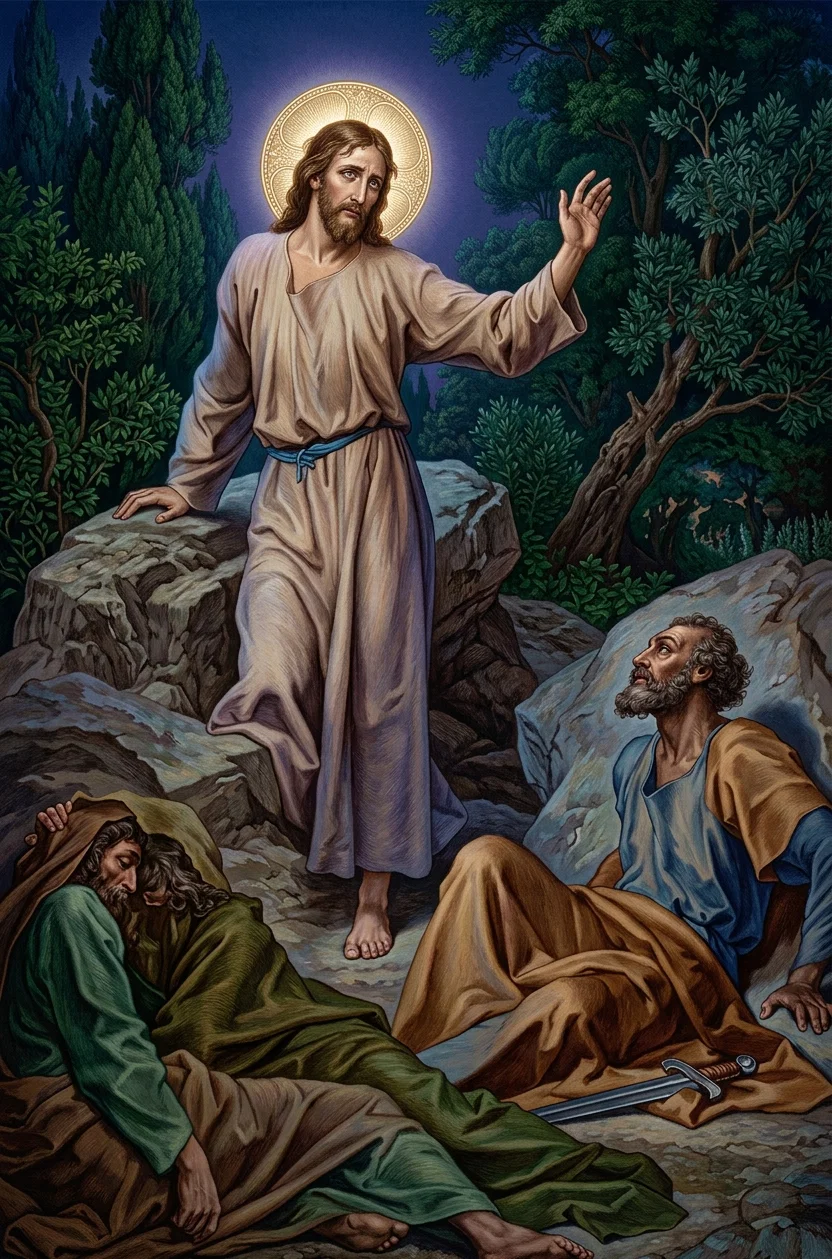
JESUS IN GETHSEMANE, PASSING THROUGH THE AGONY OF A DYING WORLD
O was there ever suffering and sorrow like that endured by the dying Saviour! It was the sense of His Father's displeasure which made His cup so bitter. It was not bodily suffering which so quickly ended the life of Christ upon the cross. It was the crushing weight of the sins of the world, and a sense of His Father's wrath that broke His heart. The Father's glory and sustaining presence had left Him, and despair pressed its crushing weight of darkness upon Him, and forced from His pale and quivering lips the anguished cry, “My God, My God, why hast Thou forsaken Me?”
Jesus had united with the Father in making the world. Amid the agonizing sufferings of the Son of God, blind and deluded men alone remain unfeeling. The chief priests and elders revile God's dear Son while in His expiring agonies. Yet inanimate nature groans in sympathy with her bleeding, dying Author. The earth trembles. The sun refuses to behold the scene. The heavens gather blackness. Angels have witnessed the scene of suffering until they can look on no longer, and hide their faces from the horrid sight. Christ is in despair! He is dying! His Father's approving smile is removed, and angels are not permitted to lighten the gloom of the terrible hour. They could only behold in amazement their loved Commander suffering the penalty of man's transgression of the Father's law.
Even doubts assailed the dying Son of God. He could not see through the portals of the tomb. Bright hope did not present to Him His coming forth from the tomb a conqueror, and His Father's acceptance of His sacrifice. The sin of the world with all its terribleness was felt to the utmost by the Son of God. The displeasure of the Father for sin, and its penalty, which was death, were all that He could realize through this amazing darkness. He was tempted to fear that sin was so offensive in the sight of His Father that He could not be reconciled to His Son. The fierce temptation that His own Father had forever left Him, caused that piercing cry from the cross, “My God, My God, why hast Thou forsaken Me?”
Christ felt much as sinners will feel when the vials of God's wrath shall be poured out upon them. Black despair, like the pall of death, will gather about their guilty souls, and then they will realize to the fullest extent the sinfulness of sin. Salvation has been purchased for them by the suffering and death of the Son of God. It might be theirs if they would accept of it willingly, gladly; but none are compelled to yield obedience to the law of God. If they refuse the heavenly benefit, if they choose the pleasures and deceitfulness of sin, they can have their choice, and at the end receive their wages, which is the wrath of God and eternal death. They will be forever separated from the presence of Jesus, whose sacrifice they had despised. They will have lost a life of happiness, and sacrificed eternal glory for the pleasures of sin for a season.

Reliance in a Crisis

Faith and hope trembled in the expiring agonies of Christ, because God had removed the assurance He had heretofore given His beloved Son of His approbation and acceptance. The Redeemer of the world then relied upon the evidences which had hitherto strengthened Him, that His Father accepted His labors and was pleased with His work. In His dying agony, as He yields up His precious life, He has by faith alone totrust in Him whom it has ever been His joy to obey. He is not cheered with clear, bright rays of hope on the right hand nor on the left. All is enshrouded in oppressive gloom. Amid the awful darkness which is felt even by sympathizing nature, the Redeemer drains the mysterious cup even to its dregs. Denied even bright hope and confidence in the triumph which will be His in the near future, He cries with a loud voice, “Father, into Thy hands I commend My spirit.” He is acquainted with the character of His Father, His justice, His mercy and great love. In submission He drops into the hands of His Father. Amid the convulsions of nature are heard by the amazed spectators the dying words of the Man of Calvary, “It is finished.”
Nature sympathized with the sufferings of its Author. The heaving earth, the rent rocks, and the terrific darkness, proclaimed that it was the Son of God that died. There was a mighty earthquake. The veil of the temple was rent in twain. Terror seized the executioners and spectators as they beheld the sun veiled in darkness, and felt the earth shake beneath them, and saw and heard the rending of the rocks. The mocking and jeering of the chief priests and elders was hushed as Christ commended His spirit into the hands of His Father. The astonished throng began to withdraw, and grope their way in the darkness to the city. They smote upon their breasts as they went, and in terror, speaking scarcely above a whisper, said among themselves: “It is an innocent person that has been murdered. What if, indeed, He is, as He asserted, the Son of God?”

It Is Finished

Jesus did not yield up His life till He had accomplished the work which He came to do, and exclaimed with His departing breath, “It is finished!” Satan was then defeated. He knew that his kingdom was lost. Angels rejoiced as the words were uttered, “It is finished.” The great plan of redemption, which was dependent on the death of Christ, had been thus far carried out. And there was joy in heaven that the sons of Adam could, through a life of obedience, be finally exalted to the throne of God. O, what love! what amazing love! that brought the Son of God to earth to be made sin for us, that we might be reconciled to God, and elevated to a life with Him in His mansions in glory. And O, what is man that such a price should be paid for his redemption!
When men and women can more fully comprehend the magnitude of the great sacrifice which was made by the Majesty of Heaven in dying in man's stead, then will the plan of salvation be magnified, and reflections of Calvary will awaken sacred and living emotions in the Christian's heart. Praises to God and the Lamb will be in their hearts and upon their lips. Pride and self-worship can not flourish in the hearts that keep fresh in memory the scenes of Calvary. This world will appear of but little value to those who appreciate the great price of man's redemption.
All the riches of the world are not of sufficient value to redeem one perishing soul. Who can measure the love Christ felt for a lost world, as He hung upon the cross, suffering for the sins of guilty men? This love was immeasurable, infinite.
Christ has shown that His love was stronger than death. Even when suffering the most fearful conflicts with the powers of darkness, His love for perishing sinners increased. He endured the hidings of His Father's countenance, until He was led to exclaim in the bitterness of His soul, “My God, My God, why hast Thou forsaken Me?” His arm brought salvation. The price was paid to purchase the redemption of man, when, in the last soul struggle, the blessed words were uttered, which seemed to resound through creation, “It is finished.”
(Concluded next week)

The Hope of the Ages

By A. O. Tait
Before the days of the Flood, even in that remote time, do we find men hoping in and teaching the second coming of Christ; for we read, “Enoch also, the seventh from Adam, prophesied of these, saying, Behold, the Lord cometh with ten thousands of His saints.” Jude 14.
Thus were the antediluvians directed to the second coming of Christ by the prophesying of Enoch. The great event of the Lord’s appearing was the hope, in that remote period, of the man Enoch, of whom it is said in another scripture: “By faith Enoch was translated that he should not see death; and was not found, because God had translated him; for before his translation he had this testimony, that he pleased God.” Heb. 11:5. This great character of Bible history walked so closely with God that he was finally translated. This close contact with his God elevated Enoch to the place where visions of the future were opened before him; and in those visions he saw clear on to the second coming of Christ. It was one of the pillars of his hope, and he taught it to the antediluvian world.
Following the days of the Flood, Job expressed his hope in seeing Christ, in these words:
“O that my words were now written! O that they were printed in a book! That they were graven with an iron pen and lead in the rock forever! For I know that my Redeemer liveth, and that He shall stand at the latter day upon the earth: and tho after my skin worms destroy this body, yet in My flesh shall I see God: whom I shall see for myself, and mine eyes shall behold, and not another; tho my reins be consumed within me.” Job 19:23-27.
Job’s faith, then, grasped the time when his Redeemer would stand in person on the earth. And even tho the worms had destroyed his body, as it crumbled back to the dust, yet he would see his God for himself with his own eyes. This shows that he not only looked forward to the second coming of Christ, but he also believed in the resurrection.
In the beauties and graphic force of Hebrew poetry, the psalmist gave utterance in words that were to be intensified by music, as he set before the people of his time—and of all future ages—his visions of the coming of the Lord. His words are (Ps. 98:4-9):
“Make a joyful noise unto Jehovah, all the earth: Break forth and sing for joy, yea, sing praises. Sing praises unto Jehovah with the harp; With the harp and the voice of melody. With trumpets and sound of cornet Make a joyful noise before the King, Jehovah. Let the sea roar, and the fulness thereof; The world, and they that dwell therein; Let the floods clap their hands; Let the hills sing for joy together Before Jehovah; for He cometh to judge the earth: He will judge the world with righteousness, And the peoples with equity.”
How sublime are the foregoing poetic as well as prophetic utterances! How intense and how lofty are the measured sentences that would set all creation a flutter with acclamations of joy at the thought of the Lord’s coming to earth!
Isaiah, the “gospel prophet” of ancient Israel, expressed some of his visions of the coming of the Lord in these words:
“It shall be said in that day, Lo, this is our God; we have waited for Him, and He will save us: this is Jehovah; we have waited for Him, we will be glad and rejoice in His salvation.” Isa. 25:9.
In the preceding passage Isaiah raises the mind to the towering heights of prophetic vision, and bids us look forward to that day when a people will be shouting with notes of triumph, “Lo, this is our God; we have waited for Him, and He will save us;” and “we will be glad and rejoice in His salvation.”
When the Master was here in person, He continued the work of the prophets that He had inspired all through the ages. For we find Him comforting His followers with these words:
“Let not your heart be troubled: believe in God, believe also in Me. In My Father’s house are many mansions; if it were not so, I would have told you; for I go to prepare a place for you. And if I go and prepare a place for you, I come again, and will receive you unto Myself; that where I am, there ye may be also. And whither I go, ye know the way.”
There is no mistaking the purport of such a promise. It is too plain to be misunderstood. The Lord would have us look forward to and hope in His second coming.
One of the first recorded promises that were given us, after the Lord closed His ministry at His first advent and returned to His Father’s throne, was another reminder of the hope of His second coming. It was given to the disciples by the tongue of an angel, while their gaze was fixed upon the cloud that received the Master, at His ascension, to bear Him away to His Father. That angel said: “Ye men of Galilee, why stand ye looking into heaven? this Jesus, who was received up from you into heaven, shall so come in like manner as ye beheld Him going into heaven.” Acts 1:11. “This Jesus,” who was here in person once, is to come in person again. This is the clear promise; and we are invited to look forward with joy to the great event.
The last book of the Bible is a book of prophecy. One of its opening utterances is, “Behold, He cometh with the clouds; and every eye shall see Him, and they that pierced Him; and all the tribes of the earth shall mourn over Him.” Rev. 1:7.
Some of the closing utterances of this same book read: “Behold, I come quickly; and My reward is with Me, to render to each man according as his work is.” “He who testifieth these things saith, Yea; I come quickly. Amen: come, Lord Jesus.” Rev. 22:12, 20.
Thus may we see that the scriptures in the foregoing paragraphs unite in teaching that the second coming of Christ has been the hope held before the church of God in all the ages,—from the days before the Flood, even down to the very last utterances of the writers of the inspired Book. And space has been taken for only a part of the many promises that relate to this interesting and consoling subject.
Line after line of prophecy unites to show that the event so long promised is very near. Have you studied the subject? Are you ready for the great day?

The Law of God

By H. W. Cottrell

The Law and the Gospel

THE gospel of Jesus Christ was given to substantiate the perfect character, immutability, and eternity of the law of God; and to redeem sinful man from its transgression. Could the character of the perfect law have been changed, and the immutability of the law made void, then the eternity of the law of the Eternal might have been limited to time, and the Son of God would not need have given His life for the redemption of a sinful race, for there would have been no sin.
God can not deny Himself; He can not therefore alter perfection, for to do so would be to deny His character. He could not destroy or deface His law, which is perfect, and which does perfect work in pointing out the imperfections—sin—in character.
Because our Father could not deny Himself by changing or abolishing heaven’s constitution after it had been violated, He verified to the universe the eternity of the law by the gift of His own life, in the person of His beloved Son, to free penitent sinners from its transgression; that the character of the law, and the justice and mercy of God, might be demonstrated even to sinful man. For “God commendeth His love toward us, in that, while we were yet sinners, Christ died for us.” Rom. 5: 8. “For God so loved the world, that He gave His only-begotten Son, that whosoever believeth in Him should not perish, but have everlasting life.” John 3: 16.

“God Is Love”

Love is composed of two attributes: justice and mercy. God has extended mercy to man, withholding justice, ever since His law was first violated—sin entered our world. Had God meted out justice to sinners, instead of mercy, death would have been the portion of all men; “for all have sinned”—transgressed His law.
The law and the gospel are inseparably woven together in the work of the redemption of sinners, “that sin by the commandment might become exceeding sinful.” “For we know that the law is spiritual.” Rom. 7: 13, 14. But that which the law could not effect through sin-weakened flesh, “God sending His own Son in the likeness of sinful flesh, and for sin, condemned sin in the flesh; that the righteousness of the law might be fulfilled in us, who walk not after the flesh, but after the Spirit.” Rom. 8: 3, 4.

The Gospel

“For I am not ashamed of the gospel of Christ: for it is the power of God unto salvation to every one that believeth.” Rom. 1: 16. The law calls its transgressor a sinner; the gospel calls the sinner to repentance. The law points out the sin, and the gospel points the sinner to Christ—the fountain for cleansing. “In that day there shall be a fountain opened . . . for sin and for uncleanness.” Zech. 13: 1. We further read of Christ, “Neither is there salvation in any other: for there is none other name under heaven given among men, whereby we must be saved.” Acts 4: 12. As a mirror points out the smirch on the face, but is powerless to remove it, and the water cleanses it away; so the law points out sin from the least to the greatest, and the gospel points the sinner to Christ, who cleanses it away. “And the blood of Jesus Christ His Son cleanseth us from all sin.” 1 John 1: 7.
The apostle Paul was aware in his day of the long reign of sin, and knew of its growing popularity. He foresaw that some men would even dare to declare null and void the divine instrument that points out sin; so for our benefit he queried, “Do we then make void the law through faith?” and answered, “God forbid: yea, we establish the law.” Rom. 3: 31. Paul gives assurance that true Christians will stand in defense of the law of God, and that their faith in the gospel tends only to establish it—the law. The law and the gospel are coöperative agencies in the plan of our Lord for the guidance and redemption of sinful humanity. The law points out sin in men, and Jesus and the gospel condemn it in the flesh. “God sending His own Son . . . condemned sin in the flesh.” Rom. 8: 3.
Men are granted no sinful indulgences either by the law, the gospel, or the Christ.

The Attribute of Justice

From the view of the righteous character of our Father, He will never cease waging His warfare against sin, until it is erased from His fair universe; so those who will not accept His long-proffered mercy—release from cherished sins—must meet God face to face as He sits on His throne in justice. “So speak ye, and so do, as they that shall be judged by the law of liberty.” James 2: 12. “And I will make justice the line, and righteousness the plummet; . . . and the waters shall overflow the hiding-place.” Isa. 28: 17, A.R.V.
The law is eternal. Its transgression introduced sin. The gospel was ordained, through which to erase sin. Sin still exists in the world, hence the gospel and law continue to exist. Were there no law to-day, there would be no sin to-day, and no need of the gospel. The law, transgressed, brings condemnation. The gospel, received, is justification. The law and the gospel in Christ, obeyed by the justified one, is sanctification. “Sanctify them through Thy truth: Thy word is truth.” John 17: 17. “Thy law is the truth.” Ps. 119: 142. “Jesus saith unto him, I am the way, the truth, and the life.” John 14: 6.

Our Surety

HEAR what Paul says: “If Christ be not raised, . . . ye are yet in your sins;” but now he means to say, ye are no longer in your sins. “How! does Paul mean to say, no more under the curse and wrath?” No! he means also, no longer in your sins. O, mystery of godliness! The risen One are we. “Who? We?” Yes, yes, we poor sinners! Not a ray of light that is seen in Him, not a virtue which shines around Him, that is not ours.
Behold, how He stands there; a youthful champion upon His open tomb—such we stand before God. Not such we shall stand; but such we stand. He has suffered—we also! He was taken away from judgment—we with Him! Nothing damnable rests longer upon Him—nothing damnable upon us also. Here is a picture of purity and beauty—we no less! He is clothed with nothing but obedience and light; the same light, the same obedience, adorns us, also. He dares venture, clothed in pure linen, into the light of the Eternal fire-eyes, without any fear lest the least grain of dust should be found upon Him—we venture, too! He is the righteousness of God Himself; we are, also, for His righteousness is given to us.
“But our old Adam! What of him?” He lies before God in the grave of an everlasting oblivion. O, ecstasy of joy! We are not merely pardoned delinquents; we are beloved and honored saints of God; and as from the cross we should cry, “Who is he that condemneth?” so from the theater of our Redeemer’s triumph we cry, “Which of you convinceth me of sin?”
And what we cry to-day, the same will we cry to-morrow, and the day after, and on to the end. Everything possible supposed—stumbling and defects, falling away and straying, new sins, and new shame—yet, out of every fall, out of every overthrow, we will venture to cry, “Who is he that condemneth?” Our Surety is not gone far over land; we see Him, either as King upon the throne, or near the throne, as Advocate and Intercessor; and joyfully shout: “Christ is here, who not only died and rose again, but who sitteth at the right hand of God, and maketh intercession for us.”—F. W. Krummacher.

The Father's Chisel

“THE present circumstance, which presses so hard against you, if surrendered to Christ, is the best shaped tool in the Father's hand to chisel you for eternity. Trust Him then. Do not push away the instrument, lest you lose also its work.”

The Light and Bread of Life

“DARKNESS and death are abroad, and we have the Light of Life; a world of famine, and we have the Bread of Life. God is calling. O, for a church that dares to do great things for God!”
Continue reading: Babylon---World Civilization