Pilgrim Fathers, Church Monopoly, and True Patriotism Number
Page 2
Review and Herald
Apr 16, 1914
Review and Herald Publishing Association · Takoma Park Station, Washington, D. C. · Apr 16, 1914
Pilgrim Fathers, Church Monopoly, and True Patriotism Number
By Editor
Read James Madison, Daniel Webster, and Other Patriots on Religious Liberty, Government Chaplains, etc. See Also Church and State Cartoons
The fight for our Constitutional rights of free speech, free press, and free assembly is not won! Witness, for example, the canceling of two hall contracts recently in Columbus, Ohio, through pressure on the part of Roman Catholics, when our editor, Prof. Chas. S. Longacre, had been advertised to lecture upon the subject "Shall America Adopt a National Religion?" in the Chamber of Commerce and the A. I. U. halls, respectively. HELP TO EDUCATE THE PUBLIC BY CIRCULATING THIS MAGAZINE!
Send $1.00 for 20 or $2.00 for 50 copies
NOTE THESE OTHER FEATURES
Important Judicial Decisions — Daniel Webster's Oration on Religious Liberty — James Madison on Government Chaplains — Religion in the Public Schools — Church and Politics — Limits of Rightful Authority — Governor Patterson on "Why I Changed Front on the Liquor Question" — America Traveling in the Wrong Direction — Are Sunday Laws Constitutional? — Conservation of Natural Rights, etc.
35 CENTS A YEAR — 10 CENTS A COPY
10 yearly subscriptions, for yourself and nine friends, only $2.00 — regular price, $3.50.
Post-office Stamp Books Accepted.
LIBERTY MAGAZINE :: Washington, D. C.
The Swindler and the Swindled
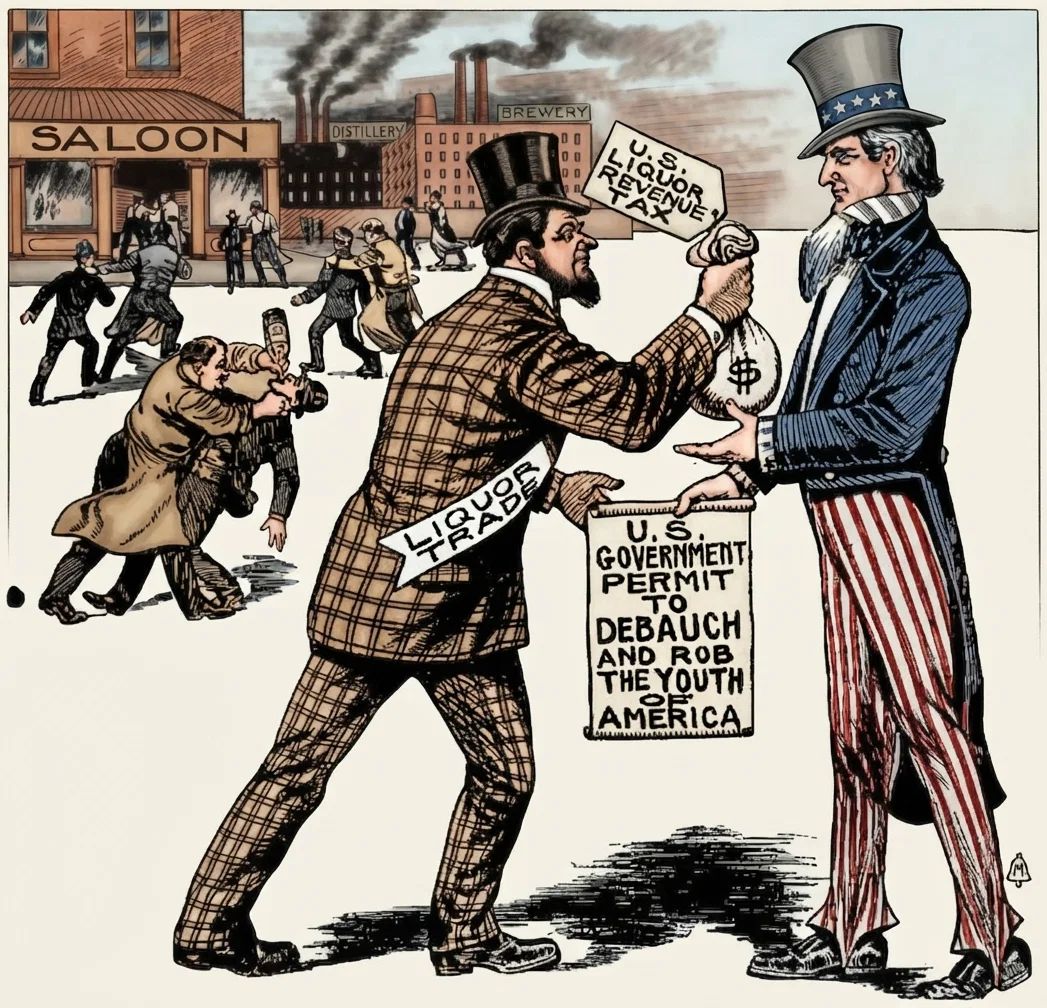
Liquor Traffic and Uncle Sam
In a recent year the liquor traffic paid our government $335,000,000 for taxes and license to conduct its destructive work; but its operation that year cost the nation $5,000,000,000, besides taking the lives in that year of 109,500 of the nation's best subjects, wrecking thousands of homes, and leaving sorrow and misery in its wake.
Uncle Sam needs to be educated — taught how to deal with the liquor traffic. The instruction needed is in —
THE INSTRUCTOR TEMPERANCE ANNUAL
Place it in Uncle Sam's homes, and the liquor traffic will go out.
At Dansville
By Ellen G. White
Early Counsels on Medical Work — No. 3
At Dansville
MRS. E. G. WHITE
The first five weeks of our affliction we spent at our own home. For wise purposes our Heavenly Father did not see fit to raise my husband to immediate health in answer to our earnest prayers, although he seemed preciously near to comfort and sustain us by his Holy Spirit.
We had confidence in the use of water as one of God's appointed remedies, but no confidence in drugs. But my own vital energies were too much exhausted for me to attempt to use hydropathic remedies in my husband's case. His wearing labors had long been bringing about the breakdown, and could we expect God to work a miracle to heal him without our using the means or agencies he had provided? As there was no one in Battle Creek who dared take the responsibility of administering water in my husband's case, we felt that it might be duty to take him to Dansville, N. Y., where he could rest, and where we could have the care of those well skilled as hydropathic physicians. We dared not follow our own judgment, but asked counsel of God, and after prayerful consideration of the matter, decided to go. My husband endured the journey well, much better than we had feared.
We remained in Dansville about three months. We obtained a room a short distance from the institution. Our accommodations were by no means pleasant; our room was small, and the sun visited it but a few minutes in the morning. Yet we did not feel this as we should had we been confined to our room. We were both able to walk out and be in the open air much of the time. Every day, except Sabbath and First day, we took treatment, and this did not leave much time for us to be in our room.
Some may have thought that when we went to Dansville and placed ourselves under the care of physicians, we had given up our faith that God would raise my husband to health in answer to prayer. But not so. While we did not feel like despising the means that God had placed in our reach for the recovery of health, we felt that God was above all, and that he who had provided water as his agent, would have us use it to assist abused nature to recover her exhausted energies. We believed that God would bless the efforts we were making in the direction of health. We did not doubt that God could work a miracle, and in a moment restore to health and vigor. But should he do this, would we not be in danger of again transgressing,—abusing our strength by prolonged, intemperate labor,—and thus bring upon ourselves even a worse condition of things?
If we violate the laws of our being, we must pay the penalty. Suffering, more or less severe, will follow every violation of nature's laws. But when we repent of our transgressions, and earnestly begin the work of reform; when we do all that we can to redeem our errors, by placing ourselves in the best possible condition to regain the strength we have lost, then we are in a position where we can exercise faith in God, and ask him to do for us that which we cannot do for ourselves. Thus we may rely upon God's promises, believing that his power will repair even nature's broken-down machinery, and will place us where we can labor in the cause of God more understandingly, wisely preserving the strength given us, instead of crippling it by excessive labor.
We went to Dansville for rest of body and mind. And although we expected to hear and see that which we could not receive and unite in, yet these things, notwithstanding our efforts to the contrary, excited our minds more or less; and during the long, wakeful nights we compared the life of Christ, and his teachings in regard to what constitutes a Christian, with the teachings on this point set forth at the Dansville institution; and we could not harmonize them. . . .
When we left Battle Creek for Dansville, we did not feel that in order to regain health we must leave our religion behind. We felt that if ever we needed the consolation of faith and hope, it was in our time of severe affliction. Three times a day we had special seasons of prayer for the Lord to restore my husband to health, and for his special grace to sustain us in our affliction. These seasons of prayer were very precious to us. Our hearts were often filled with unspeakable gratitude that it was our privilege to call God our Father; that in our affliction we had a Heavenly Father in whom we could trust without fear,—One who was acquainted with all our distresses, and who had invited us in our helplessness and affliction to lean upon his strong arm for strength and support.
My husband could obtain little rest or sleep at night. He suffered from extreme nervousness. . . . He required almost constant care, and the Lord gave me strength according to my need. I was wonderfully sustained. Many a night when my husband was suffering with pain, unable to rest or sleep, I left my bed at midnight, and bowing before God, earnestly entreated him to grant us this token of his love and care—that my husband might realize the soothing influence of his Holy Spirit, and find rest in sleep. For ten nights in succession, when it was otherwise impossible for him to rest or sleep, we were granted evidence that God heard us pray, and my husband would drop into a quiet sleep.4
We frequently felt a refreshing from the presence of God, and our Saviour seemed so precious that we praised God aloud without fear or restraint. And as we awoke refreshed in the morning, our first moments of wakefulness were generally spent in praise to God for the blessing of rest and sleep.
My husband was of good courage nearly all the time he was at Dansville, although he was a great sufferer. During the last few weeks that we were there, we had better rooms, in a much more pleasant home, than we had previously occupied. Our rooms were now on the first floor, which made quite a difference in my labor, as heretofore I had been obliged to ascend a flight of stairs. . . .
November 26, at our season of prayer in the morning, we were led out to pray fervently that God would especially bless my husband, and give him a large measure of his Holy Spirit. The Spirit of God rested upon us; we were especially revived and strengthened in the Lord, and we united our voices in praise to God. . . . The twenty-sixth of November was a cheerful, happy day for me. I felt the peace of God abiding upon me, and that night spent much of the time in prayer to God for my husband.
November 27, Elder Loughborough came into our room, and united with us in family prayer. We all had an unusual spirit of supplication. Heaven seemed very near. We felt the sanctifying influence of the Spirit of God; not a cloud intervened between us and our Saviour. Unspeakable gratitude filled our hearts, and we could not hold our peace. We shouted the high praise of God for his rich blessing, which we prized more highly than any earthly treasure. How rich, how exceedingly precious, seemed the promises of God! We could thank him for affliction. For more than an hour we could only rejoice and triumph in God. Especially did my afflicted husband share largely in this shower of grace. His countenance, though emaciated by disease, was radiant with a holy light as he praised God with a loud voice. Angels of God seemed to be all around us. I thought that the time had come when my husband, in the strength of God, would rise above disease and triumph in his saving power. The influence of this heavenly refreshing seemed to abide with us many days. But we had to learn that the time for our deliverance had not yet come; that this great blessing was to prepare us for still greater trials.
Plead Thou My Cause
By Worthie Harris Holden
WORTHIE HARRIS HOLDEN
Plead thou my cause, O God of might,
For foes oppress, to left, to right,
Without, within, and all day long,
And I am frail, and they are strong.
Plead thou for me, thou canst not fail;
Thy wrestling Angel must prevail;
The life of ages flees from me
Unless I conquer mightily.
Plead, thou who suffered, bled, and died,
That I might claim the Crucified;
So shall my soul exultant be
To laud thy grace eternally.
Portland, Oregon.
Chaplains in the Government Service
By Editor
Protestants and Roman Catholics on Common Ground
Congress is now being urged to provide more chaplains for the navy. Protestants and Roman Catholics have united in pressing this demand. We believe that this movement calls for some serious consideration of the principles involved in it.
In the first place, a strict interpretation and application of the Christian and American principle of the separation of church and state would forbid the appointment of chaplains to be paid out of the public treasury. This is not a new view, and we can quote good authority for it. In a letter to Edward Livingstone, written July 10, 1822, James Madison, that earnest and consistent advocate of religious liberty, thus expressed himself upon this subject:—
“I observe with particular pleasure the view you have taken of the immunity of religion from civil jurisdiction, in every case where it does not trespass on private rights or the public peace. This has always been a favorite principle with me; and it was not with my approbation that the deviation from it took place in Congress, when they appointed chaplains, to be paid from the national treasury. It would have been a much better proof to their constituents of their pious feelings if the members had contributed for the purpose a pittance from their own pockets.”—“Writings of James Madison,” Vol. III, page 273 et seq.
Better even than the plan suggested by Mr. Madison was the proposition submitted to the Thirty-fourth Congress of the United States by some of the clergymen of Washington. We quote the latter part of their communication:—
“We beg leave to state to you our conviction that the established election of a chaplain from abroad by your honorable bodies had its origin in a necessity now no longer existing; that the plan adopted by many of our State legislatures, of inviting neighboring pastors to act as their chaplains, thus removing all objection to associating religious devotion with their deliberations, would reflect more credit on Christian ministers, would conduce more to their individual acceptableness and general usefulness among members of Congress and their families, and would in every way promote the end had in view in the election of chaplains.
“We therefore respectfully tender our services, offering to alternate in the weekly service of opening the two houses with morning prayer, and in conducting divine service on Sabbath morning, with the distinct understanding that we decline receiving any remuneration for these services.
“George W. Samson, Pastor of E Street Baptist Church,
“Byron Sunderland, Pastor of First Presbyterian Church,
“Jas. R. Eckard, Pastor of Second Presbyterian Church,
“T. A. Haskell, Pastor of Western Presbyterian Church,
“P. D. Gurley, Pastor of F Street Presbyterian Church,
“Geo. Hildt, Pastor of McKendree Chapel, M. E. Church,
“Geo. D. Cummins, Rector of Trinity Church,
“J. George Butler, St. Paul Lutheran Church.
—“Christian Life and Character of the Civil Institutions of the United States,” B. F. Morris, Philadelphia, George W. Childs, 1864, page 328.
Waiving the main question for the present, however, without conceding the principle of having paid chaplains, we wish in this article to direct attention to the official report of a hearing before the House Committee on Naval Affairs held January 20, at which an increase in the number of chaplains was the subject under consideration. We first quote from the remarks of Dr. Charles S. Macfarland, secretary of the Federal Council of the Churches of Christ in America, the first speaker to address the committee:—
“I think I should remind you that the Federal Council now unites thirty of the so-called Protestant denominations, and includes 150,000 churches and ministers and possibly something like 16,000,000 of the people so far as the actual church membership is concerned. . . . I will say that it [the Federal Council] has never taken any action that we know of that did not express what would be practically the unanimous consensus of the churches. . . . It is to be remembered that we are here today distinctly representing the churches. The Federal Council of the Churches distinctively represents the churches. . . . The Federal Council, therefore, is concerned with the appointment of those men who are qualified to represent the churches in the army and navy, and their action has, therefore, been with relation to the appointment of chaplains. The chaplains only can represent the churches.”
We would like to know just what Dr. Macfarland meant by that expression, “the so-called Protestant denominations.” It does not sound well. It appears as if he himself rejected the word Protestant, and apologetically adopted a word used by others. Is this to be the policy of the Federal Council of the Churches as the result of striking out the word Protestant from the report of its executive committee at its meeting in Chicago in December, 1912? We prefer the attitude of Dr. Wallace Radcliffe, chairman of the great Protestant mass meeting in the New National Theater in this city Dec. 14, 1913, when he said, “One of the best words in the English language is Protestant.” We like the estimate placed upon this word in an editorial in the St. Louis Post-Dispatch, April 27, 1913: “Protestant is a word that typifies the highest ideals of human progress, and one not lightly to be abandoned.” Let us hear no more of “the so-called Protestant denominations.”
But our chief objection to Dr. Macfarland's position in this matter is that he claimed to be there “distinctly representing the churches,” emphasizing this claim repeatedly, and evidently expecting that it would have great weight with the committee. Dr. Macfarland or any other man has a perfect right to appear as a citizen, or as a representative of citizens, before any committee of Congress which will give him a hearing, and to urge arguments for or against any proposed measure; but when the churches as such are brought into Congress demanding5legislation in their interest, there is a violation of one of the fundamental principles of this government—the separation of church and state. We are just as strongly opposed to any attempt on the part of the Protestant churches, as churches, to control legislation as to the same attempt on the part of the Roman Catholic Church. On what consistent ground can we protest against the activities of the Roman Catholic Church in politics and its efforts to secure legislation favorable to its interests, if we consent to the idea that the united Protestant churches may enter the political field and may use their great membership as a strong argument in favor of what they ask for?
And it should be remembered in this connection that it was just this church influence in political affairs in the fourth century which corrupted both the state and the church, and which finally led up to the complete union of church and state and the papal domination over the nations of western Europe.
We are sure that there are hundreds of thousands of church members among the "16,000,000 of the people" mentioned by Dr. Macfarland who are absolutely opposed to this tendency of the Federal Council to exert a controlling influence in political matters, and that the Federal Council will hear from them. This was one of the reasons why the Southern Presbyterian Church came so near withdrawing from the Federal Council; and one Presbyterian paper (the Christian Observer, January 21) objected to the appointment of an official representative of the Federal Council to be located at Washington, and declared that "an earnest protest now may prevent the Federal Council from committing a blunder in the matter of the relation of church and state." This desire to save the Protestant churches from departing from one of the fundamental principles both of Protestantism and of Americanism—the separation of church and state—is most praiseworthy. It ought to succeed.
Pertinent in this connection, as we believe, are some statements made in an editorial in the New York Evening Post of February 18. After discussing the alleged influence of the Roman Catholic Church at the White House the Post goes on to say:—
“Having thus given our opinion of the latest Catholic 'plot,' we are bound to add a word about the great mischief which is done whenever the Catholic Church, or anybody professing to speak for it, does try to exert the influence of Catholics as a unit in any election having to do with general political questions and results. We do not say this because we dislike the Catholic Church in politics more than any other church. If it were a question of the Baptists voting one ticket solidly, we should feel precisely the same about it.”
This statement is applicable to any case where any one church or any combination of churches seeks to exert a controlling influence in legislative affairs by appealing to a large and united membership as a reason for granting the demand made.
Another speaker at this same hearing was Rev. Lewis J. O'Hern, C. S. P., of Washington, D. C., who introduced himself to the committee by saying:—
“I assure you that it is a great pleasure to appear before this Committee on Naval Affairs in such distinguished company as the official representative of the Catholic bishops and archbishops of the United States.”
The whole Roman hierarchy of this country was thus present in its ecclesiastical capacity, officially represented by this priest, who wished it to be distinctly understood that he was not speaking as an individual citizen, but as the mouthpiece of the Roman Catholic Church. In doing this he was simply following the bad example set by Dr. Macfarland. The first argument introduced by this priest was a letter from "J. Cardinal Gibbons, Archbishop of Baltimore," in which it was stated that "the proposed scheme of substituting 'welfare secretaries' for chaplains [suggested by Secretary Daniels] does not meet with the approval of the American Catholic archbishop." It seemed to be taken for granted that if "the American Catholic archbishop" was not pleased with any proposal, that was a sufficient reason for rejecting it. But what has "the American Catholic archbishop" as an ecclesiastic to do with civil affairs?
The priest also spoke of the work of a chaplain at an instruction camp who "furnished moving picture and theatrical entertainments, so that every night the men were kept in camp, happy, and away from dangerous environment." He also argued for chaplains instead of welfare secretaries on the ground that the chaplain "dispenses the sacraments, something which no layman is authorized to do." In answer to the question whether every chaplain would conduct practically the same service on board ship, the priest replied: “Well, no, sir; not entirely. At the morning service a Catholic priest would celebrate mass.” Here is one of the anomalies of this chaplain question: A Protestant nation pays from the public treasury for a chaplain to conduct what thousands of taxpayers believe to be an idolatrous service.
But perhaps the most significant statement made by this priest was one relating to the apportionment of the chaplains among the different religious bodies. Note it carefully:—
“According to the figures quoted above [giving the membership of the several churches], the Catholic Church is entitled to a little more than forty-one per cent of the religious leaders, and in a representative government such as ours she should have something to say about the kind of religious leaders to be appointed. Therefore I ask you to give kindly consideration to the words of His Eminence Cardinal Gibbons, that welfare secretaries cannot be considered as substitutes for regularly ordained ministers of the gospel.”
The full meaning of this paragraph should not escape the attention of our readers. The claim that "the Catholic Church is entitled to a little more than forty-one per cent of the religious leaders" is based, not upon the number of Catholics in the navy, but upon the number of Catholics in the United States compared with the number of Protestant church members, and then it is declared that "in a representative government such as ours" that church "should have something to say about the kind of religious leaders to be appointed." This view of the matter is based upon the un-American principle that the representative idea in this government extends to the churches, and that the churches should have a voice in the government in proportion to their numbers. This may be the Roman Catholic interpretation of a representative government, but it is absolutely foreign to the genius of the American system of republican government. And what is the inevitable logic of this claim?—It is that as the Roman Catholic Church increases in numbers in this country she will be entitled to have more and more to say about the way the government should be run, until she dominates the whole situation. We absolutely repudiate any such interpretation of the representative principle in America. It is the Roman Catholic doctrine of the union of church and state. We wonder if the Protestant clergymen present at this hearing realized, after this priest had finished his remarks, that they had united with Roman Catholics on Roman Catholic ground, and that the Roman Catholics would be the ones who in the end would reap the full benefit of their efforts. We hope they will learn the lesson taught by this experience.
We must make one more extract from the official report of this hearing before we drop this subject. In a conversation between one of the members of the committee and Bishop Lawrence, of the Episcopal Church, the following questions and answers are found:—
“Bishop Lawrence: On the question of the inquiry, I have never heard of an immoral navy being a good fighting force, and therefore I should say the first essential in the navy was to create a high standard of character and intelligence, thereby making them a good fighting force. That is what we are after.
“Mr. Gray: Do you regard a Christian as a better fighter than a man who is uncivilized or unchristianized?
“Bishop Lawrence: That would take more of a generalization than I should be able to work out this morning. I can say that in the long run the Christian nations have beaten out the savages. I do not know anything about individual Christians.
“Mr. Gray: Do you think that a man can shoot another man better if he is a Christian than if he is a barbarian?
“Bishop Lawrence: I would rather have the committee discuss that question.”
This is a good illustration of the confusion of principles which results when church6and state get mixed up. A navy is a fighting force, drilled in the most effective methods of warfare, instructed in the use of the most modern inventions for destroying an enemy; and a minister of the gospel of peace, the gospel which teaches us to love our enemies, advocates more chaplains in the navy in order to make it a better fighting force, but when his own logic is pressed upon him, he dare not stand for it, but refers the question to the committee. This little dialogue ought to have made a deep impression both upon the clergymen present and upon the committee.
An interesting side light is thrown upon this whole question by a statement made in "Recommendations of Chaplain J. F. Fleming, United States Navy," printed as a government document:—
“The government recognizes an obligation to the religious interests of the country, and tries to fulfill it by supporting twenty-four clergymen in the navy, whose return for their support is indifferent.”
The reason here given for the appointment of chaplains in the navy is not that they may be of some benefit to the men on the ships, but as a recognition of "an obligation to the religious interests of the country," and then it is declared that the return which these chaplains make "for their support is indifferent." And the man who made this contribution to the discussion of the question was himself a chaplain! We refrain from any further comment.
What a splendid opportunity there is for doing real missionary work in the army and the navy! Why should not the churches supply men for this work, just as they support Christian workers in other fields? To our minds this is the solution of this problem of chaplains, rather than for the churches to insist that the government shall appoint their representatives and pay them from the public treasury. Keep the church and the state separate.—The Protestant Magazine, May, 1914.
"Some Shall Depart From the Faith"
By C. H. Bliss
C. H. BLISS
It is a very easy matter for one whom God has blessed and prospered to any great extent to forget the rock whence he is hewn, and the "hole of the pit" whence he is digged. Sometimes the soul is lifted up unto vanity, and one imagines himself to be something when he is nothing. Then the mind is led off into vain speculations, and the Spirit of God is supplanted by the spirit of the evil one. So subtle is the working of the enemy, who transforms himself into "an angel of light," that darkness is changed into light, and the deceived one really believes that he has new light.
It is then that such souls often "kindle a fire," and walk in the light of their fire and in the sparks they have kindled. See Isa. 50:11. When such a one awakes and sees his real condition before God, he may truly say, "I sink in deep mire, where there is no standing." Ps. 69:2.
But to him who realizes that he is sinking, a kind, loving Saviour holds out a helping hand, as he did to Peter, and bids him look up. If he accepts the proffered help, with the psalmist he may say, "He brought me up also out of an horrible pit, out of the miry clay, and set my feet upon a rock, and established my goings." Ps. 40:2. Truly he made us, and not we ourselves, and "those that walk in pride he is able to abase." Even Job after his trying experience could say, "Behold I am vile; what shall I answer thee?" "I abhor myself and repent in dust and ashes."
Revivals and Their Results
By E. K. Slade
E. K. SLADE
THE account of Christ's ministry furnishes a most profitable study for those who would be successful soul winners. To a large extent, he engaged in personal efforts or revealed vital saving truths to groups that gathered around him. His public efforts consisted largely of assemblies where he taught the people the great vital truths upon which their salvation depended. His ministry was effective. His methods and manner of labor are clearly revealed in the Scriptures. In so far as revival work is right and required in the ministry, it was employed by him; yet we see but little in his labors like the modern revivals, which have become so common and so much relied upon in evangelistic effort.
Unless our eyes are fixed much of the time upon our Leader and upon his teachings, our tendency will be to gravitate toward the modern, popular ways in public efforts. There has been a decided tendency on the part of some ministers to do this. Many young ministers have been made to feel that they are practically a failure in the work if they cannot conduct one of the efforts where the emotions are stirred to flow freely, resulting perhaps in a well-nigh universal move forward. Not only has such an effort been looked upon as about the only proper thing, but many at our large meetings have figuratively folded their arms, neglecting a work that they might accomplish, while trusting too much in the revival and the revivalist. There has also been some inclination to postpone and concentrate the great and vital soul-saving and reviving work of a meeting largely to one time and one man, when the burden should be borne by all during all the time.
Repeated warnings and counsel have been given relative to the manner of conducting revival services. The following paragraph from "Gospel Workers," page 275, is to the point:—
"There are in the ministry, men who gain apparent success by swaying minds through human influence. They play upon the feelings at will, making their hearers weep, and in a few minutes laugh. Under this kind of labor, many are moved by impulse to a profession of Christ, and there is thought to be a wonderful revival. But when the test comes, it is seen that the work is not enduring. When the feelings were stirred, many were borne along by the tide that seemed to be setting heavenward. But in the strong current of temptation they quickly float back as driftwood. The laborer is self-deceived, and thus he misleads his hearers."
While we have spoken unfavorably of such revivals as those mentioned in this quotation, and of our danger of drifting in that direction, it remains true that there is much good accomplished by properly conducted revival efforts. There is converting, reviving, and saving power in the word. The Spirit of God attends the ministry of the word. We should realize more fully and recognize more constantly that there is power in the presentation of those truths that relate to our time, and that reveal the love, the plan, the purpose, and the power of God. There is great need of more teaching that we may attain unto that wisdom that is unto salvation. We have seen most effective revival efforts, resulting from deep conviction through a clear setting forth of the truth without appealing to the emotions. One who leaves a meeting where he has listened to a clear-cut, convicting message is really benefited more than one who has been moved by the tide of influence, though he may go forward and be prayed for. The less spectacular and the less emotional revivals wrought by the mighty, moving power of the Spirit of God accompanying the preaching of the Word, will produce more lasting results and truer conversions.
Lights Out
By M. G. NUNES
M. G. NUNES
During the latter part of 1908, I was on my way to Colon from Trinidad, West Indies. Off the coast of Cartagena, Colombia, our steamer passed a wrecked vessel. I inquired of one of the officers as to the cause of the wreckage, and was told that the near-by lighthouse failed to give its light the night the vessel was steaming down, and it ran on a reef and was lost.
With the thought of this occurrence we can appreciate more fully the Master's statement in Matt. 5 : 14: 'Ye are the light of the world.' As the light of that lighthouse would have kept the boat from being stranded on the reef, in like manner our lights will help many as they go through life, which may be compared to the sea of time. There are many human vessels sailing down this sea of time. Are we as bright, shining lighthouses, showing them how to avoid the reefs of sin and shame? or are our lights out?
We are called of God to be lights in this dark world. With Christ, light is life. 'Ye are the light' really means ye are the life of the world. Lights out means wreckage and disaster. If we fail to shine, this neglect of duty will stand against us in the judgment. Let us be God's lighthouses stationed everywhere to show forth dangers by the way.
Editorial
By Frederick M. Wilcox
Everyday Religion; Some Personal Questions
DEAR reader, are you a Christian? I do not ask if you have been baptized and joined the church. You may have done this, and still not be a true follower of the Lord Jesus Christ. You may be an officer in the church; you may stand every Sabbath before a class of boys and girls, seeking to instruct them in the ways of righteousness; you may be a Bible worker, going from door to door and instructing the people in this precious truth; you may be a distributor of gospel-filled literature; you may be even a minister of the gospel; but though you are any one or all of these, this of itself does not constitute you a Christian.
The vital question is, Does your daily life measure up to the standard of Christ's character? Are you working with an eye single to the glory of God? Does your love for God and your love for souls prompt your service? What kind of life do you live in your home? Do you growl because your meals are late? because the baby keeps you awake nights? Do you answer the fretfulness of your children with impatient words? Do you gossip about your neighbors? Do you find fault with God and with his people? Do you fail to keep your promises, neglect your debts, and prevaricate and falsify in your efforts to avoid censure? If you habitually do these things, you do not know the power of a truly consecrated life.
Your profession may be as high as heaven. You may occupy some official position and receive honor of the world or of your brethren, and still be nothing in God's sight. All this does not make up for the lack of that practical Christian experience which really constitutes the foundation of all that you may hope to achieve for God and for your fellows. The Jews of old trusted to outward form for salvation. They felt that in observing with scrupulous regard the Sabbath of the Lord, in the payment of tithe to the smallest minutia of their income, they constituted themselves the true children of Abraham. But our Saviour did not so view their experience. He charged them with omitting the weightier matters of the law, and these he declared to be the exercise of "judgment, mercy, and faith." "These," he says, "ought ye to have done, and not to leave the other undone."
Will it be that we shall find at last that our religion after all has consisted of a form, a pretense, an outward cloak? that while we have been careful to observe outward forms, while in our zeal for God, like the Jews of old, we compass sea and land to bring men to the gospel of Christ, we are neglecting in our living, practical experience the cultivation of those qualities of heart and mind which above everything else constitute us Christlike? These come first. These are vital, and with the doing of them the outward forms will not be neglected. The man who in his own consciousness comes to know God, who exemplifies before his own family and his own neighborhood the principles of the government of heaven, O, that man's influence will be carried by the angels of God to earth's remotest bounds! It will find its expression in Christian service, in gifts to the treasury of God, and in the performance of every good work.
Of all kinds of deception self-deception is the most terrible. May God forbid that we shall be self-deceived; that we shall go on trusting we are right, and hoping we are right, when in the consciousness of our own hearts, if we but stop to think, we know that we are far from God. Let us be true to God, true to the interests of our own souls, and true to our fellow men.
F. M. W.