Your ShelfYour Projects

Signs of the Times, Vol. 26, No. 41.

THE SNARE OF THE NATIONS

Signs of the Times

Oct 10, 1900

Pacific Press Publishing Company · Oakland, California · Oct 10, 1900

THE SNARE OF THE NATIONS.
ONE inexorable law runs through the history of nations. Luxury follows conquest; indolence comes with luxury; and disaster follows both. The world is a crowded cemetery, crowded with the faded glories of nations that have conquered other nations and reveled in their wealth.
The hosts of luxurious Babylon melted away before the onslaughts of the frugal Medes and Persians. They conquered Babylon, but they could not conquer a foe which their conquest let loose upon themselves. The vice of luxurious living came with the captured spoils of the fallen nation, and a weaker generation met the indomitable Alexander, and fled before him. And Alexander, with a conquered world at his feet, succumbed to its luxury, and paved the way for the division of his kingdom and its ultimate conquest by the iron-handed Romans. But this uncrowned conqueror of the nations was victor even over the iron kingdom. They dragged proud kings at their chariot wheels, and made slaves of their peoples to prove their power over the world. But with conquest accomplished, there came luxury, lust, and decay; and Rome went the way of all the world before her,—her legions scattered, her sovereignty broken, and her dominion shattered into fragments. The national intoxication that comes with conquests upon foreign shores is similar to the intoxication that overcomes the individual who tarries over the flowing bowl. Wrecks of intoxicated men and nations strew the earth. Of some the tombstones are standing yet; of others even the memory has faded like the spent cloud in the summer air.
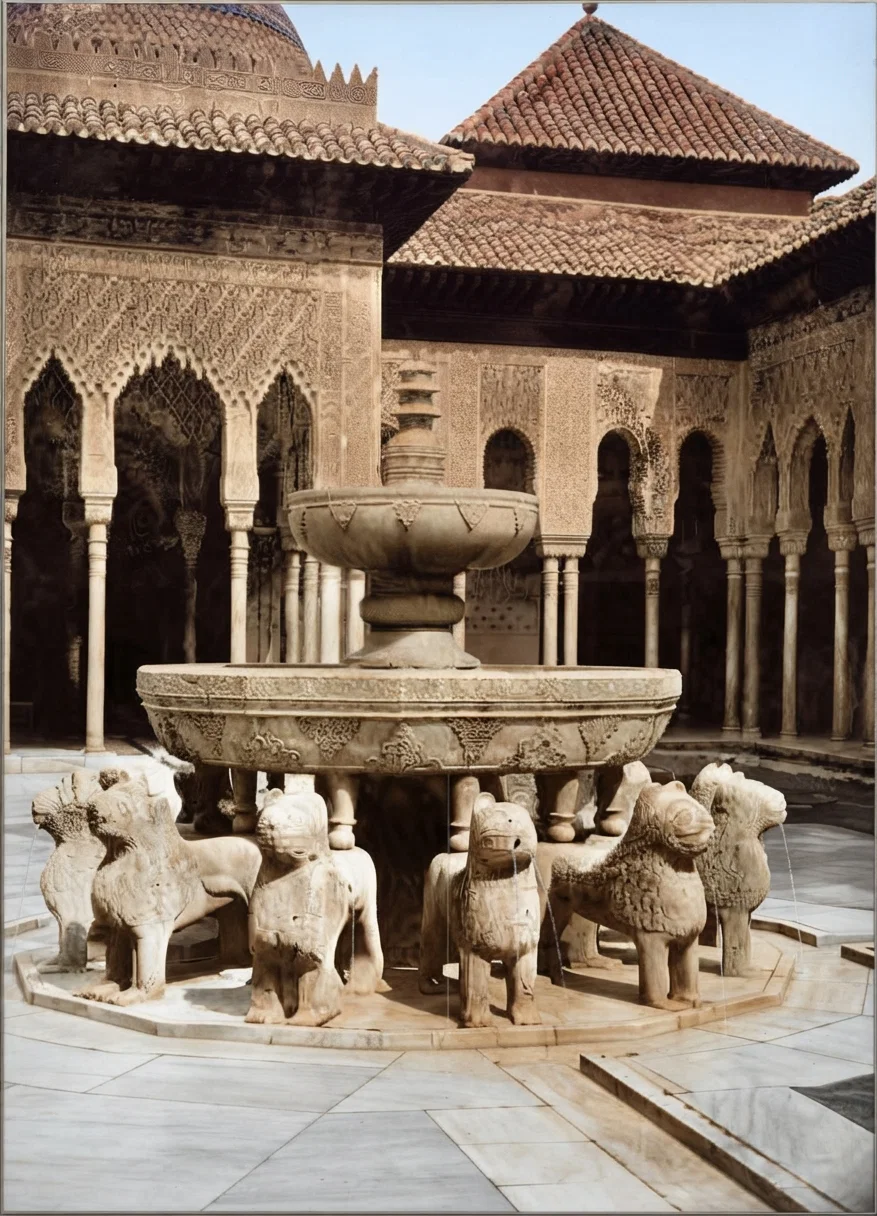
The Court of Lions, one of the many beautiful sections of the Alhambra. This building, situated in Granada, Spain, is a crumbling monument of the lost dominion of the Moors.
On the tomb of Babylon stands the crumbling, wind-harried heap of Birs-Nimrud, whose shifting dust was once raised high toward heaven in the sun-baked bricks of Babel. The memories of Egypt's ancient dynasties cluster round her naked pyramids. The glories of ancient Greece are memoried in her crumbling handiwork; and the written history of the rise and fall of Rome is her mausoleum of faded glories.
The lesson is one of experience, and no nation seems content to learn it from the experience of another. No nation that subjects another to itself can survive the results of its own victories. Napoleon was invincible while redressing the wrongs of Poland; but when he would make Europe his dominion, he met his Waterloo. America is a united nation to-day; but had she taken Mexico when it was at her mercy, she would have been cut in twain by the War of the Rebellion. And still she has not learned the lesson.
One of the greatest object lessons in the fate of the conqueror is seen in the rise and fall of the Moorish dominion in Spain. In 710 the leader of the Moors, the Saracens of the West, received permission from the Successor of Mohammed to carry "the faith" into Andalusia (Spain). Mohammed had died in 632, but the Khalifa (Successor) hoped to see this Mohammedan invasion of Spain sweep over the Pyrenees, and establish "the faith" with fire and sword from Gibraltar round to the Golden Horn.
On one side were the zeal and vigor of the new faith; on the other, “the decaying remains of a Latin empire.”
The original inhabitants of Spain (Basques) had been driven by the Kelt-Iberians over the Pyrenees. The latter were subdued by the Romans, and adopted their language and customs. Spain was next overrun by the Vandals; and then followed a struggle between the Suevi and Visigoth (Western Goth), ending in 621 in the complete conquest of Spain by Swintila the Goth. The new conquerors gradually succumbed to the seductive influences of the Latin culture. The luxury of Rome ate like a canker into the vigor of the Goth; and when idleness and vice had ripened Gothic Spain for its overthrow, Tharyk, with his terrible host of Mohammedan Moors, landed at Gibraltar, defeated Roderick the Goth, and began (711 A.D.) the conquest of Spain. After a six years’ struggle, the conquest was complete, and Mohammedanism—Ishmael’s version of Judaism—was triumphant in the Iberian peninsula.
Beyond the Pyrenees they could not go; for the wave after wave of conquered peoples that had been swept up into these hills formed a barrier the Moor could never shatter. But Spain was his, and he seated himself before the luscious fruits of his victory. It was to him terrestrial paradise, and he lived accordingly. He cultivated art and philosophy, drew up astronomical tables, experimented with the polarity of the magnet, made curious clocks, and established the use of the mariner’s compass. He reared beautiful palaces, and embellished them with gilded stucco-work that has not tarnished with time. Probably no more beautiful wreck of former glory exists to-day than is seen in the delicate architecture of the Alhambra of Granada, slowly but surely sinking in decay. Its beautiful sculpturings in marble and alabaster are a cause of wonder to the tourists of every country. The Court of Lions shows little of the ravages of time. In its center stands a great fountain of alabaster, supported by twelve lions. The court is laid out in flower gardens, surrounded by light Arabian arcades of open filigree work, supported by slender pillars of white marble—all indicating a delicate, graceful taste, “a disposition to indolent enjoyment.”
Near the Court of Lions is the beautiful Hall of Abencerrages; named after the band of cavaliers treacherously slain by the father of Boabdil. Looking down into the Court of Lions is the grated gallery where Boabdil (Abou Abdallah), the last of the Moors, was imprisoned with his mother, by order of the king, his father. All around are towers and turrets, halls, palaces, aqueducts, fountains, and dungeons, some crumbling into ruin, and others courageously defying the slowly-conquering elements.
For eight hundred years the Moors held Spain, and looked upon its dominion as theirs forever; but luxury and idleness were a mightier foe than the “terrible horsemen of the desert” had ever met, and it beat them down from generation to generation, until Ferdinand and Isabella were able to scatter their armies and drive them back to the land whence their fathers had come eight hundred years before. Boabdil, the last of the Moors, in his flight looked back upon the Alhambra he could not defend, and wept over the dominion that had passed away. The Tharyk of conquest had given place to the Boabdil of luxury; and the lesson was repeated that one nation can not rob another nation and profit by the theft.
But the vices of that luxury which conquered Belshazzar, Darius, Alexander, Cleopatra, Cæsar, and Abou Abdallah, are found to-day in every nation under heaven. They are ripening for an overthrow, not at the hands of other nations, but at the hands of the Lord of hosts Himself. “And in the days of these kings [the kings or the kingdoms that are in existence to-day] shall the God of heaven set up a kingdom; which shall never be destroyed; and the kingdom shall not be left to other people, but it shall break in pieces and consume all these kingdoms, and it shall stand forever.” Dan. 2:44. And this last universal kingdom “shall be given to the people of the saints of the Most High, whose kingdom is an everlasting kingdom; and all dominions shall serve and obey Him.” Dan. 7:27.
This last great overthrow is near at hand, and the privilege of being an inhabitant of God’s great, universal kingdom of righteousness is still held out to every inhabitant of the earth. Let us as individuals be diligent, watchful, earnest, that we may not be taken in the snare of the nations and be overwhelmed in their destruction. C. M. SNOW.

HIS WONDERFUL LOVE.

GOD created Adam and Eve, and placed them in charge of the Garden of Eden, where everything was beautiful to look upon, and the fruit pleasant to the taste. He said to them, "Of every tree of the garden thou mayest freely eat; but of the tree of the knowledge of good and evil, thou shalt not eat of it; for in the day that thou eatest thereof thou shalt surely die." They were forbidden to eat the fruit of this tree. This seems a small thing, but it was a test of their obedience and of their trust and confidence in God. God told them that if they disobeyed, death would be the result. Their happiness depended on obedience.
By obedience Adam would have lost nothing which it was for his good to retain. But, notwithstanding this, he disobeyed. The temptation to transgress was presented by Eve, who, having herself eaten of the forbidden fruit and realized no immediate harm, offered some of it to Adam, telling him of the great advantages of which they were deprived by not being allowed to eat of it.
Thus sin was brought into the world. God closed against the disobedient pair the gates of Paradise, placing an angel with a flaming sword to guard the way to the tree of life. Man must not now eat of the fruit of the life-giving tree; for sin must not be immortalized. One star of hope illumined the dark and dismal future. God said to the serpent, "I will put enmity between thee and the woman, and between thy seed and her seed; it shall bruise thy head; and thou shalt bruise his heel." Thus was given the promise of the Redeemer.
God pitied the fallen race. He "so loved the world, that He gave His only-begotten Son, that whosoever believeth in Him should not perish, but have everlasting life." Christ came to bring life and immortality to those dead in trespasses and sins. Who is he that carries such a weight of responsibility?—"There shall come forth a rod out of the stem of Jesse, and a Branch shall grow out of his roots; and the Spirit of the Lord shall rest upon Him, the spirit of wisdom and understanding, the spirit of counsel and might, the spirit of knowledge and of the fear of the Lord." "Unto us a Child is born, unto us a Son is given; and the government shall be upon His shoulder; and His name shall be called Wonderful, Counselor, The mighty God, The everlasting Father, The Prince of Peace."
Christ declared, "Before Abraham was, I am." By this declaration He laid open the resources of His infinite nature, imparting in His words assurance of peace and pardon for the guilty race. He spoke with the assurance that He was able to take up and lay down His life as He chose, to secure the salvation of those who have fallen into Satan's snare.
Christ spoke with the authority of greatness, as with a clear, distinct voice He said: "I am the light of the world." "I am the bread of life." "I am the Way, the Truth, and the Life." "I am the Good Shepherd. . . . My sheep hear My voice, and I know them, and they follow Me; and I give unto them eternal life; and they shall never perish, neither shall any man pluck them out of My hand." "Come unto Me, all ye that labor and are heavy laden, and I will give you rest. Take My yoke upon you, and learn of Me; for I am meek and lowly in heart; and ye shall find rest unto your souls. For My yoke is easy, and My burden is light."
John calls our attention to the love that God has bestowed on us. "Behold, what manner of love the Father hath bestowed upon us, that we should be called the sons of God." Altho for ages sin has been accumulating, altho through falsehood and artifice Satan has cast the black shadow of his interpretation upon the Word of God, yet the Father's mercy and love have not ceased to flow earthward in rich currents. If human beings would open the windows of the soul heavenward, in appreciation of the divine gifts, a flood of healing virtue would pour in, leading men to exclaim, "Herein is love, not that we loved God, but that He loved us, and sent His Son to be the propitiation for our sins."
To enlarge our views of God's goodness, Christ calls upon us to behold the works of His hands. "Behold the fowls of the air," He says; "they sow not, neither do they reap, nor gather into barns; yet your heavenly Father feedeth them. Are ye not much better than they? Which of you by taking thought can add one cubit unto his stature? And why take ye thought for raiment? Consider the lilies of the field, how they grow; they toil not, neither do they spin; and yet I say unto you, That even Solomon in all his glory was not arrayed like one of these. Wherefore, if God so clothe the grass of the field, which to-day is, and to-morrow is cast into the oven, shall He not much more clothe you, O ye of little faith? Therefore take no thought, saying, What shall we eat? or, What shall we drink? or, Wherewithal shall we be clothed? . . . For your heavenly Father knoweth that ye have need of all these things. But seek ye first the kingdom of God, and His righteousness; and all these things shall be added unto you."
Tho men have sinned grievously, they are not forsaken. The Hand that upholds the world, upholds and strengthens the weakest and most sinful human being. The great Master Artist, whose skill is infinitely beyond the skill of any human being, who gives to the lily of the field its delicate and beautiful tints, and who cares for the little sparrow, cares also for His children.
The care bestowed by Heaven on any given object is proportionate to the place occupied by this object in the scale of creation. If the flower is given a beauty that outvies the glory of Solomon, what can be the estimate that Godplaces on His purchased heritage? Christ points us to the care bestowed on the things that wither in a day, to show us how much love God must have for the beings created in His own image. He desires every mind to grasp this precious truth. He opens before us the volume of providence, and bids us behold the names written therein. In this volume every human being has a page, on which are written the events of his life. And from the mind of God these names are never absent for a moment. Wonderful indeed are God's love and care for the beings He has created.
In behalf of man God has poured out the whole treasury of heaven, and in return He claims and expects our entire affections. For us He gave up His only-begotten Son to a life of rejection, abuse, insult, and mockery.
All this God did that man might become filled with the divine love and benevolence. Thus He would assure sinners that sins of the greatest magnitude can be forgiven if the transgressor seeks for pardon, surrendering himself, body, soul, and spirit, to be transformed by the grace of God, and changed into His likeness.
Christ imparted His divine benediction, with a copiousness which showed that all power in heaven and earth have been given to Him with which to bless and strengthen humanity. All the treasures of eternity are at His command. There is no restriction of His beneficence. To all, high and low, rich and poor, who receive Him by faith as the Son of God, He is a very present help. He thought it not robbery to be equal with God, that in word and deed He might reveal God.
Having brought into the world the great treasures of heaven, owned and created by the eternal God, Christ can give to all eternal life. With His humanity He touches humanity, and with His divinity He firmly grasps divinity. Into man, prostrated, diseased, enfeebled, He can breathe the breath of life, making him a partaker of the divine nature.
MRS. E. G. WHITE.

The Stamp of Truth

No NEED has he of honor's printed scroll Who wears the stamp of truth within his soul; No need has he of ruling wealth or power Who blesses life and crowns it, hour by hour; No need has he of coronet or seal Whose "coat of arms" is manhood's kingly zeal; No need has he of jeweled pomp or place Who wears God's living sunshine in his face. —Selected.

SOWING FOR MIRACLES.

THOU hast given a banner to them that fear Thee, that it may be displayed because of the truth." Ps. 60:4. It is an easy matter to inscribe something on a banner, and then wave it to the breeze; and this is the method that worldly organizations have adopted to display their sentiments. The human plan is to have some outward demonstration. God's plan is to have an inward demonstration of His power upon the life and character of the individual. The first-named banner can be made and displayed in an hour; the second requires a lifetime for its completion. It is displayed as it is in process of making, and always "because of the truth," and not to attract attention to the human agent who carries it; for "the kingdom of God cometh not with outward show," because "the kingdom of God is within you." Luke 17:20, 21, margin.

Spurious Manifestations.

In spite of these plain Scripture declarations there are professed Christians who are so determined to have some outward demonstration as a proof of their Christianity, that they will actually manufacture it themselves, when they find that they can not persuade God to furnish them such an outward display as would be pleasing to their carnal hearts. Therefore they will finally be among the class who will claim to have "cast out devils" and "done many wonderful works." Matt. 7:22. But Christ will say of them, "I never approved of you." Verse 23, Rotherham's translation.
Many are looking forward to some indefinite time in the future when they hope to have the baptism of the Holy Spirit, and experience some remarkable external demonstration; but after David had received the gift of the Holy Spirit, his experience was one that few would naturally choose. He was anointed king, and "the Spirit of the Lord came upon David from that day forward." 1 Sam. 16:13. About three years later we find him still deprived of his just rights, hiding in a dark cave in the wilderness; and the character of his associates is told in the words, "And every one that was in distress, and every one that was in debt, and every one that was discontented, gathered themselves unto him; and he became a captain over them." 1 Sam. 22:2.
Imagine the daily trial and tribulation David must have experienced in maintaining peace and harmony among this motley crowd. If we somehow imagine that the gift of the Holy Spirit will exempt from temptation, then let us bear in mind that Christ's fiercest temptations came immediately after He had been anointed by the Spirit of God.
When we are faithfully sowing for spiritual and physical health, then if, from a human standpoint, "the vision . . . tarry, wait for it; because it will surely come. . . . The just shall live by faith." Hab. 2:3, 4. But there are many who become impatient in waiting. It seems to them that their harvest is delayed, while the wicked about them appear to be flourishing and receiving a bountiful harvest, for which they have not even sowed. This was such a source of perplexity to the psalmist that his "steps had well-nigh slipped." Ps. 73:2. He came near backsliding as he saw how little outward result came from his earnest endeavor, and then recognized that the wicked "are not in trouble," "neither are they plagued;" "their eyes stand out with fatness;" in other words, they appear healthy, and they "increase in riches." Ps. 73:2-12. And the psalmist came to the short-sighted conclusion that he had cleansed his heart in vain, for he was plagued every day, and chastened every morning. Verses 13, 14. But when he went into the sanctuary, there his eyes were anointed, and he saw that he had simply been harboring a delusion.
The famous Indian jugglers have the power of hypnotizing the eyesight to such an extent that they can make serpents suddenly appear to be crawling up a rope which they hold in their hands; but an enterprising American traveler took a photograph of this performance, and the picture revealed nothing but the rope, altho his eyes saw a serpent and the rope. God managed the chemicals in the camera, and they told the truth. Satan hypnotized the human eye, and it conveyed to the brain a falsehood.

The Harvest Determined by the Sowing.

Are we so rooted and grounded in reference to God's law of sowing and reaping that when we see a person who has apparently been instantly restored to either spiritual or physical health without any sowing or intention to do so, and who, furthermore, insists that he is relieved from any future responsibility in maintaining right conditions, we shall not be fascinated and led astray by these representations? There are abroad in the earth pretentious movements that do not emphasize the principle, "Go, and sin no more" (John 8:11), and thousands are led into them for no other reason than that wonderful works seem to accompany them; but God's people are not to follow outward demonstrations, but to live by principle.
When an individual has truly repented of his wrong sowing, and has fully determined in his heart to sow for health, which includes the utilization of all suitable God-given remedies which the circumstances afford, then the way is clear for God to restore him; and whether that process is to be long or short can safely be left in the hands of the great Healer. Even if such a person is instantly restored to health, it does not relieve him from the responsibility of continually cultivating health, any more than a person that is instantly converted is relieved of the responsibility of cultivating his spiritual health. We expect, yes, insist, that the latter shall utilize all the means of grace in his power, that he may "grow thereby;" and no one supposes for a moment that this is a denial of faith. Likewise, as long as we are upon this earth, there are still higher attainments for us to reach physically, and we should thankfully, cheerfully, and even enthusiastically appropriate every known means normally to strengthen and build up our physical health; and in so doing, instead of working against God, we are directly co-operating with Him. DAVID PAULSON, M.D.

LEONARD FELL'S COURAGE.

LEONARD FELL, son of Margaret Fell (who afterwards became the wife of George Fox), returning from meeting one Sunday evening, and passing along a solitary road, was suddenly attacked by a highwayman, who, seizing the bridle rein, demanded, "Your money or your life!" The young Friend immediately took out his purse and handed it to him. As he did so, the robber, seeing seals and watch and chain, became bolder, and presenting his pistol again, demanded, "Your watch or your life!" The watch was given him, and, emboldened still more by this, and thinking he had only a coward to deal with, he presented his pistol again, saying, "Your horse or your life!" The young man dismounted, and the robber mounted the horse, and would have ridden off; but Leonard Fell took hold of the bridle rein, and began to expostulate with him on his sinful course, preaching to him of "righteousness, and temperance, and judgment to come."
Again the pistol was presented, with the threat, "If you do not stop, you are a dead man."
But without paying any regard to this threat, our young Friend continued his earnest words of rebuke and exhortation, to the great amazement of the robber, who exclaimed:—
"I thought you were a coward; you gave me your watch and your horse to save your life, and now you have nothing more to lose, you risk it standing there preaching to me."
Leonard Fell's reply is worthy of being written in letters of gold:—
"Tho I would not risk my life to save my money, my watch, or my horse, yet I will risk it to save thy soul."
The man dropped his pistol, listened to the words of the young preacher, dismounted, confessed his sin, gave a sad detail of his past life and the circumstances that had led him to such a course, how he had taken to drinking, lost his work and his character, and, when going down hill, found every one ready to give him a kick, and so he had gone from bad to worse; until, with a sickly wife and starving children, he had been driven to his present life.
Leonard Fell gave him his address, and promised to provide him with work if he would forsake his evil ways and abstain from liquor. He did so, and became a changed character, and henceforth lived industriously and honestly.—Life and Letters of Elizabeth L. Comstock.

LESSONS FROM MATTHEW 24

"LET NO MAN DECEIVE YOU."

AND Jesus went out, and departed from the temple; and His disciples came to Him for to show Him the buildings of the temple. And Jesus said unto them, See ye not all these things? verily I say unto you, There shall not be left here one stone upon another, that shall not be thrown down.
"And as He sat upon the Mount of Olives, the disciples came unto Him privately, saying, Tell us, when shall these things be? and what shall be the sign of Thy coming, and of the end of the world?"
"And Jesus answered." He answered fully. His answer covers all the time from that time until His coming and the end of the world.
A number of important matters are touched, and others are quite fully considered. But the first of all things said in the Lord's answer to the question of His disciples, is, "Take heed that no man deceive you." This, then, is the most important of all considerations in connection with the coming of the Lord and the end of the world.
This thought is repeated and emphasized by Paul, when he writes of the same subject: "Now we beseech you, brethren, by the coming of the Lord and by our gathering together unto Him, that ye be not soon shaken in mind, nor be troubled, neither by spirit, nor by word, nor by letter as from us, that the day of Christ is at hand. Let no man deceive you by any means." 2 Thess. 2:1-3.
To be deceived with respect to the coming of the Lord and the end of the world is the worst possible deception; for to be so deceived is to be unprepared for that wonderful and all-decisive event, and so is to be taken unawares, and to be destroyed. For "the day of the Lord so cometh as a thief in the night." And "when they shall say, Peace and safety, then sudden destruction cometh upon them; and they shall not escape" (1 Thess. 5:3); "for as a snare shall it come on all them that dwell on the face of the whole earth" (Luke 21:35).
To be deceived into thinking that the Lord is not coming when He is coming, is to be unprepared, and so taken unawares and destroyed. To be deceived into thinking that He is coming when He is not coming, is only to be disappointed, and so by the deception and disappointment to be caused not to believe in His coming when He is really coming, and thus, also, to be not ready, and therefore to be taken unawares, and, as a consequence, destroyed. And just because to be thus deceived involves the most fatal of all consequences, Jesus begins His instruction on this all-important question with that which is the most important of all considerations, "Take heed that no man deceive you."
Further, this is the most important of all instruction in connection with the subject, because in this very matter more effort is made to deceive than in any other. Jesus Himself says that "many shall come in My name, saying, I am Christ; and shall deceive many." Matt. 24:5.
And again, "Many false prophets shall arise, and shall deceive many." Verse 11.
And yet again, "There shall arise false christs and false prophets, and shall show great signs and wonders; insomuch that, if it were possible, they shall deceive the very elect. Behold, I have told you before." Verses 24, 25.
Having taken such precaution as this, and having shown such care to guard all against being deceived, it must needs be that He would make the whole matter so plain that all may escape deception. This, indeed, He has done. He has done it so thoroughly that any one who will believe His Word, can entirely escape all deception as to His coming, whether as to the personality, the time, or the manner of His coming.
First, as to the personality and manner of His coming. Note again His word in verse 5: "Many shall come in My name, saying, I am Christ; and shall deceive many." It is therefore perfectly plain that any one who comes anywhere, at any time, or in any manner, saying, "I am Christ," is a deceiver; and no one is ever to believe any such representation.
Again He says, "If any man shall say unto you, Lo, here is Christ, or there; believe it not." Verse 23. From this it is perfectly plain that whenever or wherever one person shall say to another, "Christ is come here, or He has come there, come and see Him," that person is a deceiver, and, if he believes it himself, is himself deceived. And no person in the world is ever to believe that any such thing as that is the coming of the Lord. Jesus further emphasizes this: "Wherefore if they shall say unto you, Behold, He is in the desert; go not forth; behold, He is in the secret chambers, believe it not." Verse 26.
Surely, then, no one need ever be deceived in any of these ways as to the coming of the Lord; it is exceedingly easy to escape all deception in any of these ways. The way is made perfectly plain; the tests are all simple, and easily applied; and the word concerning them is brief and easily remembered. All that any one needs to do is simply to believe this simple word of Jesus.
Yet He does not stop even here. He goes on and states the case so clearly as absolutely to preclude any possibility of deception as to His coming, on the part of anybody who will pay any attention whatever to His word. He not only tells, as in the words already quoted, that any person coming and saying, "I am Christ," or saying, "Lo, He is here, in the secret chamber," or, "Lo, He is there, in the desert," is a deceiver, but He tells why all such ideas are deception.
And here is the reason: "For as the lightning cometh out of the east, and shineth even unto the west; so shall also the coming of the Son of man be." Verse 27. As stated in another place, "For as the lightning, that lighteneth out of the one part under heaven, shineth unto the other part under heaven; so shall also the Son of man be in His day." Luke 17:24.
That is a reason so simple, so easily remembered, and yet so conclusive, it annihilates every possibility of deception as to His coming on the part of anybody who has any disposition whatever to believe the Word of Jesus as to His own coming again to the world. There is no possibility of any one counterfeiting His coming, and when that coming is in its brightness as the lightning that brilliantly lightens up the whole heavens and earth, there is neither chance nor need for one person to say to others, "Lo, here He is, or there." Is it not even written, "Behold, He cometh with clouds; and every eye shall see Him." Rev. 1:7. How, then, could it be possible to counterfeit it? and how can anybody be deceived with regard to it, who will but believe the Word?
A word farther as to the heaven-filling brightness in which the Lord's coming is displayed: the cause of this is not in some particular display that is made to grace the occasion; it is simply the nature of His coming itself. For He Himself comes in His own proper glory; He comes also in the glory of the Father, and with the holy angels.
Now of Jesus Himself in His glory it is written, "His head and His hairs were white like wool, as white as snow; and His eyes were as a flame of fire; and His feet like unto fine brass, as if they burned in a furnace; . . . and His countenance was as the sun shineth in his strength." Rev. 1:14-16.
Of the Father it is written that He dwells in "the light which no man can approach unto"—a light so far above the brightness of the sun that in that day the sun shall be ashamed (Isa. 24:23), and the city of God has no need of the sun to shine in it, for the glory of God lightens it, and the Lamb is the light thereof.
This is the glory of the Father and of Christ, in which Jesus appears at His second coming.
Yet even this is not all; the holy angels come with Him. And of but one of these it is written that "His countenance was like lightning, and His raiment was white as snow." Matt. 28:3. This of only one; and yet when Jesus comes there come with Him of these "ten thousand times ten thousand and thousands of thousands," "an innumerable company"—such a mighty host that the heavens are so filled with them and their glory that the whole seems like vast billows of clouds. The whole heavens are perfectly "wrapped in a blaze of boundless glory."
And such as this is the coming of the Lord. This, and this only, is the manner of His coming.
Yet more: the accompaniments of that coming:—
First, the tearing asunder of the heavens with a great noise, when the heaven departs as a scroll when it is rolled together. 2 Peter 3:10; Rev. 6:14.
Secondly, uttered from the temple of heaven, from the throne, that voice that shakes both earth and heaven, so that they are completely broken up and removed. Heb. 12:26; Rev. 16:17-20.
Thirdly, the resurrection of the dead and the translation of the righteous living; "for the Lord Himself shall descend from heaven with a shout, with the voice of the Archangel, and with the trump of God; and the dead in Christ shall rise first; then we which are alive and remain shall be caught up together with them in the clouds, to meet the Lord in the air; and so shall we ever be with the Lord." 1 Thess. 4:16, 17.
The coming of the Lord is all this, and not an iota less; yea, it is even much more. And in view of it all, or in view of only so much of it as we have been able here to set down, how is it possible for anybody to be deceived as to His coming?—it is not possible, except as people refuse to believe His Word.
"Take heed that no man deceive you." "Let no man deceive you by any means." And that is only to say in other words, Believe the Word, receive the Word, hold fast to the Word, as it is spoken by Jesus, and as it is in Jesus. So shall you be safe from all deception, and so shall you be saved.
ALONZO T. JONES.

TRUE CHRISTIANITY.

A GLORIOUS mission it is, for those who love the light, to teach by word of mouth or by pen the true unfoldment of the soul within; but far greater and more beautiful is the life of him who, by example and precept, leads his fellow-man in life's pathway, so shaded by the trees of love divine that the blasting breath of the storms of selfishness shall sweep above their heads, while peace and rest attend their works below.
The true church of God is within each heart, and no man who has not cast out the idols of the flesh, can expect our Father to enter in and share with earthly vanity and pride the obedience and love His due.
If those who are undertaking the task of uplifting the moral standard of man have aught in their lives that can be condemned by the unchristian, how much more is it to be condemned by the pure and perfect Christ, who trod the same pathway over which they stumble!
"No chain is stronger than its weakest link;" and no church within whose fold lies the spirit of discontent and inharmony, can expect, by the standard they thus hold aloft, to entice within their walls those who walk upon the outside, leaving a life to them seemingly good enough, to labor in a strange vineyard, whose fruits seem tainted with the blights of strife and wrangling. All who labor in the fields of sin will receive the help of the Holy Spirit in proportion to their earnestness of purpose and purity of life. But no man or sect not living in obedience to God's divine laws will have their efforts crowned with true success; for God will not stretch forth His arm to the aid of those who will not hear His voice, to walk therein.
It is well to say, "Sinner, repent," but how much better the cry of, "Christian, awake;" for the day of our Lord is at hand; the Bridegroom cometh, and your lamps have burned low. Yea, the harvest is ripe, but your sickle is dull and rusty. How can you work with tools like that?
Will not the stacks be broken and left to rot on the fields, instead of being gathered into the barns? Will not the church whose life will not stand the light of truth so embitter those it seeks to save that they will hold up the soiled garments of its members to their shame, and choose the life of revelry without, to one of strife within? Can any man teach that which he does not know? And lives there a Christian being who knows the true path and wilfully shuns it? "Even from the days of your fathers ye are gone away from Mine ordinances, and have not kept them. Return unto Me, and I will return unto you, saith the Lord of hosts. But ye said, Wherein shall we return?" Can you go to the man whose troubled soul has caused the clouds to appear over your church and have him admit that he is wrong, and still continue in his ways?
Unless the Spirit of the living God has entered into your soul, ye know not the light and the way, but if it has, His voice will ever guide you to the truth; for "He will lead the blind in a way that they know not."
Let us again take up the war cry, "Awake, O Christian!" that the world may see the fruits of your lives and taste thereof, and know that they are good. Keep thy heart attuned to deeds of charity (brotherly love), and God, who readeth thee from within, will reward thee accordingly; but do thy acts of mercy in secret, lest pride cause thee to do them for the reward of the praise of men; for "tho I bestow all my goods to feed the poor, and have not charity, it profiteth me nothing." Then will the sinner, seeing the goodness and purity of your heart, enter in and dwell with you as brother with brother, and you shall sit down to meat together, and Christ will gird Himself and serve you.
FRED F. FRENCH. Skagway, Alaska.
Continue reading: GOD'S SIGN OF POWER