Your ShelfYour Projects

Review and Herald, Vol. 84, No. 30.

Love Divine
Earlier text: Atlantic Union Conference

Our Most Important Work as Parents

PARENTS, for Christ’s sake do not blunder in your most important work, that of molding the characters of your children for time and for eternity. . . . You determine for them what they will be, and what they will do for Christ, for men, and for their own souls.—“Testimonies for the Church,” No. 31, pages 35, 36.
Light has been shining from the Word of God and the Testimonies of his Spirit, so that none need err in regard to their duty. God requires parents to bring up their children to know him and to respect his claims. . . . By neglecting their duty, and indulging their children in wrong, parents close to them the gates of heaven.—Id., No. 32, pages 81, 82.
Many are going directly contrary to the light which God has given to his people because they do not read the books which contain the light and knowledge, in cautions, reproofs, and warnings. . . . The volumes of “Spirit of Prophecy,” and also the Testimonies, should be introduced into every Sabbath-keeping family, and the brethren should know their value, and be urged to read them.—Id., Vol. 35, page 209.
Many parents do not themselves seek instruction from the Testimonies, and of course they can not impart it to their children.—Id., No. 31, page 57.
The Bible gives explicit directions concerning the important work of educating children. “Hear, O Israel: The Lord our God is one Lord: and thou shalt love the Lord thy God with all thine heart, with all thy soul, and with all thy might.” The parents themselves are to be connected with God; they are to have his fear before them, and to have a knowledge of his will. Then comes their work: “And thou shalt teach them diligently unto thy children, and shalt talk of them when thou sittest in thine house, and when thou walkest by the way, and when thou liest down, and when thou risest up.” . . . Here the duties of parents are clearly set forth. The Word of God is to be their daily monitor. It gives such instruction that parents need not err in regard to the education of their children, but it admits of no indifference or negligence. The law of God is to be kept before the minds of the children as the great moral standard. . . . and its principles are to be interwoven with all their experience.—Id., No. 32, pages 84-86.
The directions that Moses gave concerning the passover feast are full of significance, and have an application to parents and children in this age of the world. “Moses called for all the elders of Israel, and said unto them, Draw out and take you a lamb according to your families, and kill the passover. And ye shall take a bunch of hyssop, and dip in the blood that is in the basin, and strike the lintel and the two side posts with the blood that is in the basin; and none of you shall go out at the door of his house until the morning. For the Lord will pass through to smite the Egyptians; and when he seeth the blood upon the lintel, and on the two side posts, the Lord will pass over the door, and will not suffer the destroyer to come in unto your houses to smite you.” The father was to act as the priest of the household, and if the father was dead, the eldest son living was to perform this solemn act of sprinkling the door-posts with blood. This is a symbol of the work to be done in every family. Parents are to gather their children into the home, and to present Christ before them as their passover. The father is to dedicate every inmate of his home to God, and to do a work that is represented by the feast of the passover. It is perilous to leave this solemn duty in the hands of others. This peril is well illustrated by an incident that is related concerning a Hebrew family on the night of the passover. The legend goes that the eldest daughter was sick; but that she was acquainted with the fact that a lamb was to be chosen for every family, and that its blood was to be sprinkled upon the lintel and side posts of the door, so that the Lord might behold the mark of the blood, and not suffer the destroyer to enter in to smite the first-born. With what anxiety she saw the evening approach when the destroying angel was to pass by. She became very restless. She called her father to her side and asked, “Have you marked the door-posts with blood?” He answered, “Yes, I have given directions in regard to the matter. Do not be troubled; for the destroying angel will not enter here.” The night came on, and again and again the child called her father, still asking, “Are you sure that the door-post is marked with blood?” Again and again the father assured her that she need have no fear; that a command which involved such consequences would not be neglected by his trustworthy servants. As midnight approached, her pleading voice was heard saying, “Father, I am not sure. Take me in your arms, and let me see the mark for myself, so that I can rest.” The father conceded to the wishes of his child: he took her in his arms, and carried her to the door; but there was no blood mark upon the lintel or the posts. He trembled with horror as he realized that his home might have become a house of mourning. With his own hands he seized the hyssop bough and sprinkled the door-posts with blood. He then showed the sick child that the mark was there. Are parents placing the mark of God upon their households, in this their day of probation and privilege? Are not many fathers and mothers placing their responsibilities into others’ hands? Do not many of them think that the minister should take the burden, and see to it that their children are converted, and that the seal of God is placed upon them?
. . . Fathers and mothers place their responsibility in the hands of others, and thus perilously neglect their own households.—Review and Herald, Vol. 72, No. 21.
“Parents, for Christ’s sake do not blunder in your most important work.”

A Dangerous Practise

ONE of the most dangerous exercises for children is jumping the rope. It is very frequently carried to such excess as to cause serious injury to the child, if not sudden death. Recently a girl of thirteen, living at Cleveland, Ohio, came to her death as a direct result of jumping the rope. The jar of the constant jumping had set up a disease of the bones which physicians were powerless to overcome. At the funeral the father of the little girl made an earnest appeal to her schoolmates to cease the dangerous practise, and many of them gave their pledge so to do.

The India Mountain Mission Home

G. B. THOMPSON
MANY are deeply interested in the mission home for our workers in India, and have contributed toward the purchase of this home. All will rejoice to know that a beautiful place has been purchased at Mussoorie, one of the leading hill stations in the Himalaya Mountains.
OUR NEW MOUNTAIN MISSION HOME AT MUSSOORIE, INDIA
In company with Elders Shaw and Miller, and Brother and Sister Burgess, I visited Mussoorie among other places while in India, to assist in locating this mountain Home. After carefully looking over various hill stations and different properties, a place known as “Annfield House,” in Mussoorie, has finally been decided upon. This is a beautiful place, situated in the cool, bracing climate of the Himalaya Mountains, at an elevation of about seven thousand feet, and only fourteen miles from the railway terminus at Dehra Dun. At first, the owner of the property asked thirty thousand rupees, or nearly ten thousand dollars. But later he reduced the price to twenty-four thousand rupees, or a little less than eight thousand dollars.
After the sale was consummated, he wrote as follows: “It is a wrench to us to part with this property. I am inclined to your belief that some other than human agency is at work for us to part with our ‘home,’ for the purpose of your mission, as we are not aware of any definite reasons why we should sell the property, since we have refused other applications for its purchase.” Much earnest prayer was offered concerning this matter; we feel sure the Lord has directed in the securing of this beautiful property. The house, including bath-rooms, contains nineteen rooms, and is fully furnished with about a thousand dollars’ worth of furniture. Only those who have visited this place can fully appreciate what it means to build and furnish a home in these hills, where all the material has to be carried up the mountainside either by man or on the backs of mules. The estate comprises twenty-three acres, and is centrally located, so that it will be a credit to our work, and increase in value from year to year. It is in every way a most desirable place. Brother Shaw writes:— “Mussoorie, the hill station, in which the ‘Annfield estate’ is located, has a population of between twenty and thirty thousand, and, I am told, made up mostly of Europeans and Indians, with their servants, who flee from the plains in the hot season to escape the awful heat. The climate is cool and pleasant, and never gets uncomfortably hot. We believe Annfield, located as it is with the beauty that surrounds it, will bring new life to our worn and exhausted workers whose strength gives way in the hot, low, malarial plains below.”
The securing of this Home not only affords us a place to which our faithful workers in India can go from the burning heat and trying climate of the plains, but it opens our work in a definite way among the millions of Northern India, among whom we have previously not made a beginning.
Mussoorie has been selected by other denominations for a similar purpose. Besides this summer population, about twelve or fourteen miles below lie the plains, which are swarming with human beings without God or hope in the world. Dehra Dun, the terminus of the railroad, is only fourteen miles distant, and has a population of over twenty thousand. This is a healthful place, with three thousand feet elevation, and an excellent field for mission work. Rajpur, seven miles distant, has a population of over five thousand. Brother and Sister Burgess have opened work in Dehra Dun. Dr. Lucinda Marsh, Sister Kuntz, and others are with them, studying the language. They are making rapid progress, and are preparing for work among the Indian people in their own tongue.
Good results are already being seen. A native Presbyterian minister has embraced the truth, resigned his mission work with his denomination, and is now studying the message, preparatory to entering the field as a worker. Literature has been sent to some interested natives at Agra, a few hundred miles to the south, and a company are keeping the Sabbath there.
The climate at the Mountain Home benefits the workers healthwise. In a letter from Elder Shaw, he says he has not felt so well in four years as since being at this Mountain Home. We thank the Lord for this. Other workers have visited the Home, and have received great benefit also.
We feel sure the securing of this Home near the region of the eternal snow of the Himalayas, is an advance step in our mission work. It will provide the way by which workers can remain more permanently in the field.
In order to purchase their “Home,” it was necessary to incur a debt of about one thousand dollars. They are planning to dedicate it in October, and hope to be able to do so without any debt. Let all pray that this Mountain Mission Home for India may be all that the Lord intends it should be in advancing the message.

G. A. IRWIN

From Port Said to Naples, Italy

G. A. IRWIN

In addition to the tonnage and passenger dues, each vessel passing through the canal at night must pay the charges of an electric search-light, supplied by the canal company, of sufficient power to light the channel for 4,100 feet ahead and a circular area around the ship of 683 feet. The regulations of the company are printed in both French and English, and cover every little detail andpossible contingency that might arise during the transit of a vessel through the canal, all of which are arbitrary and must be complied with. As expensive as the passage is, it is much cheaper for vessels going from Great Britain and other European countries to Australia, India, China, and the East Indies than to sail around the continent of Africa. The traffic through the canal has become so great that there is strong talk of constructing another to run parallel with the present one.
The country traversed by the Suez Canal is barren and desolate in the extreme. But this section about the Red Sea is of great interest to students of the Bible, for it was here that the Israelites crossed through the deep, with mighty walls of water on either side, on foot from Egypt to Arabia, on their way to the promised land. And across these same waters in the future will pass ships to form that mighty horde to participate in the last great battle of this earth's history, which will be fought in the same country toward which the Israelites journeyed centuries before. Also this country which has and will witness these scenes, will be within the radius of the New Jerusalem when it rests upon the earth.
Tuesday morning, April 23, we reached Port Said, which is located on the Egyptian side at the Mediterranean entrance to the Suez Canal. Port Said is a part of the Ottoman empire's possessions in Egypt. Its native population consists of Turks, Arabians, Greeks, Armenians, Egyptians, and Persians. The place has grown rapidly in the last few years, and is now one of the principal seaports of the Mediterranean. The harbor is constantly being enlarged, and better accommodations provided for vessels. Quite a large number of Europeans are engaged in business in the town. As yet we have no workers in the place, nor is there a Sabbath-keeper to my knowledge. There is a company of believers in Alexandria, one hundred and sixty miles to the west, and a few in Cairo, one hundred miles south, and it is to be hoped that in the near future a worker can be located in this important seaport.
We left Port Said at 2:30 P. M. the same day, and steamed out into the Mediterranean in the face of a strong and cold north wind. This sudden change from tropical heat to frost-laden air was accounted for the second morning following, when we came in sight of the island of Crete, and saw the tops of the mountains covered with snow. Crete is an island in the eastern part of the Mediterranean Sea, five hundred miles northwest of Port Said and one hundred and fifty miles southeast of Greece. The island is one hundred and fifty miles long by an average width of twenty-five miles. It is under the government of Turkey in Europe. The truth in the days of the apostles had many adherents on the island.
While passing through the Red Sea, and in sight of the places in the Mediterranean mentioned there, I read and reread the fourteenth chapter of Exodus and the twenty-seventh and twenty-eighth chapters of the book of Acts; but after all it was difficult to make myself believe that I was really passing over the same waters, and seeing with my own eyes the countries and towns mentioned in this narrative. My only object in writing as much as I have about these places is that some who read may get a burden to go and take to these people the third angel's message, which is the completion of God's eternal purpose and plan, of which the former-mentioned events were a part.
I can not pass by the island of Sicily without mentioning the strange sight of an active fiery mountain, or volcano, covered with snow. Mt. Etna, one of the world's most noted volcanoes, is on the island of Sicily in plain sight from the decks of vessels passing through the Messina Strait. When we passed by, April 26, it was covered with snow up to the crater, from which was issuing volumes of white smoke or steam. Stromboli, a high, cone-shaped island located a few miles north of Sicily, is another active and noted volcano of this region.
On Sabbath morning, April 27, at four o'clock, we reached Naples in fairly good condition, after a voyage through tropical heat of twenty-five days. Having planned to leave the vessel here and go overland through Italy to Gland, I had written Brother Everson to meet me in Naples, to act as an interpreter and guide while visiting Pompeii and Vesuvius. My surprise can be better imagined than described in words when, just as the bell rang for breakfast, I heard some one call my name, and looking over the side of the vessel, I saw Brother Everson and my wife in a small boat below. Without waiting for breakfast, or even to say good-by to the acquaintances I had made on the boat, I hastened below to greet them, and learn how my wife came to be there. I soon learned that Sister Prescott and son and Sister Weller were in the city, and had come on the same boat, my wife coming as a companion for Sister Weller. Mrs. Prescott had come to join her husband, who had arrived from China two weeks before. After reaching our stopping-place in the city, which was on a street fronting on the Bay of Naples, we spent the Sabbath quietly in our rooms, thanking our Heavenly Father that he had spared all our lives and brought us together again. While waiting for Brother Thompson, who was expected to arrive from Egypt on Monday morning, we spent the time in writing and in visiting the museum and other places of interest in the city. Brother Thompson arrived as expected, early on Monday morning, April 29, and after disposing of his luggage, he and Brother Everson joined the other members of our party at the ruins of Pompeii.
We spent the entire day looking over that portion of this fateful city that has been exhumed, going through the principal public buildings and most noted private dwellings in an effort to learn all we could of the habits and customs of the people of that wicked metropolis. The city was located near the base of Mount Vesuvius. In the year A. D. 63, a severe earthquake destroyed a portion of the city. Sixteen years later—A. D. 79—the first recorded outbreak of Vesuvius took place, from which Pompeii was buried under twenty feet of ashes, and Herculaneum under a torrent of mud from eighty to one hundred feet deep. Previous to that year, Mount Vesuvius was not thought to be a volcano. But since then it has broken forth with violence sixty times, and many more times with less destructiveness. In 472 its ashes fell as far away as Constantinople. In 1538 Mount Nuova was lifted in two days to the height of four hundred and thirteen feet, with a girth of eight thousand. Ninety-three years later, lava and boiling water flooded the villages at its foot, and destroyed eighteen thousand lives. In 1779, just seventeen hundred years after the first eruption, Mount Vesuvius, roaring like a giant fiend, belched forth fire and smoke, lava, red-hot stones and ashes, with occasional tongues of flame leaping upward for hundreds of feet. Fifteen years later there was a violent eruption; again in 1822, and in 1855. In 1865 began a series of convulsions, of which the one in 1906 was the latest.

The Birth of the Black Republic

W. JAY TANNER
The origin of the Haytien republic should be interesting to Adventists, from the fact that its birth was one of the results of the French Revolution, which was itself a fulfilment of the prophecies of Dan. 11:36-40 and Rev. 11:7-13. Of that time, the historian says: “From 1788 Saint Domingue (Hayti) was as much prepared for a revolution as France herself. In the colony, as in the metropolis, all minds aspired to a new order of things.”
The population of the colony was then made up of two principal classes,—the colonists, or French, comprising the official class and army, the planters, the merchants, etc.; and the slaves. The latter, as might be supposed, far outnumbered all other classes. Their lot was an unusually hard one; and as is generally the case under such circumstances, they were kept in abject ignorance of the “evangile” or any learning that would lead up to it. Besides these, there was also a small class of hommes de couleur, as the free-born sons of the colonists by their female slaves were called. These mulattoes were not restricted in the matter of acquiring an education, and in many cases were sent by their fathers to Europe for this purpose. But no matter how enlightened they might be, or how great or varied their talents, they were allowed none of the usual privileges of citizenship. This naturally engendered bitterness on the part of the free colored people toward their white fathers; and here is, in reality, the beginning of France’s colonial troubles, which finally led to the Haytien republic. Although the white population at thattime was not nearly so great as that of African descent, yet the fact that the former controlled the army, the wealth, and all the natural advantages, made them the most powerful, as long as they remained united among themselves. But unity and harmony had for some time been banished from St. Domingue. Factions, revolts, and anarchy had taken their place, and the colonists found themselves divided into hostile camps, that exhausted their strength in a senseless warfare upon one another.
In May, 1791, the French Assembly passed a decree permitting all free-born colored people the rights of citizenship that they had been demanding for some time. This decree the officials of the colonial government refused to have anything to do with, and the home government was either unable or too fickle to force it into operation. This led to organization, on the part of the mulattoes to obtain their rights. They first addressed a very temperate, but firm letter to the governor, asking that they be granted the privileges accorded them by the home government. The governor refused their request, and ordered them to discontinue their conference that was then in session at Mirebalais. This they did, but only to take up arms against the colonial government. In this latter step they were more successful; for the next year the mulattoes not only voted, but held as many seats in the Colonial Assembly as were occupied by the French themselves.
This victory naturally led to much bitterness. But still it was not a sufficient cause to bring the two principal factions of colonists together for the purpose of opposing the growing power of the free colored people. Indeed, the rioting and discord continued until the governor, finding that his party was losing power, called in the aid of the slaves to help him crush his opponents. The government party thereby gained the day, but at the same time the way was paved for the slave uprisings which soon followed, and which brought a veritable “reign of terror” into the colony, that the emancipation act two years later (1793) far from terminated.
But another result that grew out of this use of the slaves for political and military purposes, and which was far more disastrous to French sovereignty in St. Domingue, was the fact that it called forth Toussaint Breda, better known as Toussaint Louverture. This man, who was destined to become one of the greatest of his race, had up to this time faithfully served his French master as a coachman on a property near Cape Haytien. By some means he had acquired a fair education; and, being a leader among the slaves, the government saw fit to use him as an intermediary in its dealings with them. The result of this is well known. Toussaint proved himself a more able man in politics and in generalship than any of the French in the island in those days. It would be impossible in these articles to go into the details of this remarkable African’s rise and power. But it will be sufficient to say that in less than nine years he rose from the state of a slave to that of governor-general of the entire island. Nor does he seem to have been unworthy of this eminence; for under his régime the colony enjoyed a greater degree of peace and prosperity than for years, his administration of justice and of finances being much better than that of his predecessors.
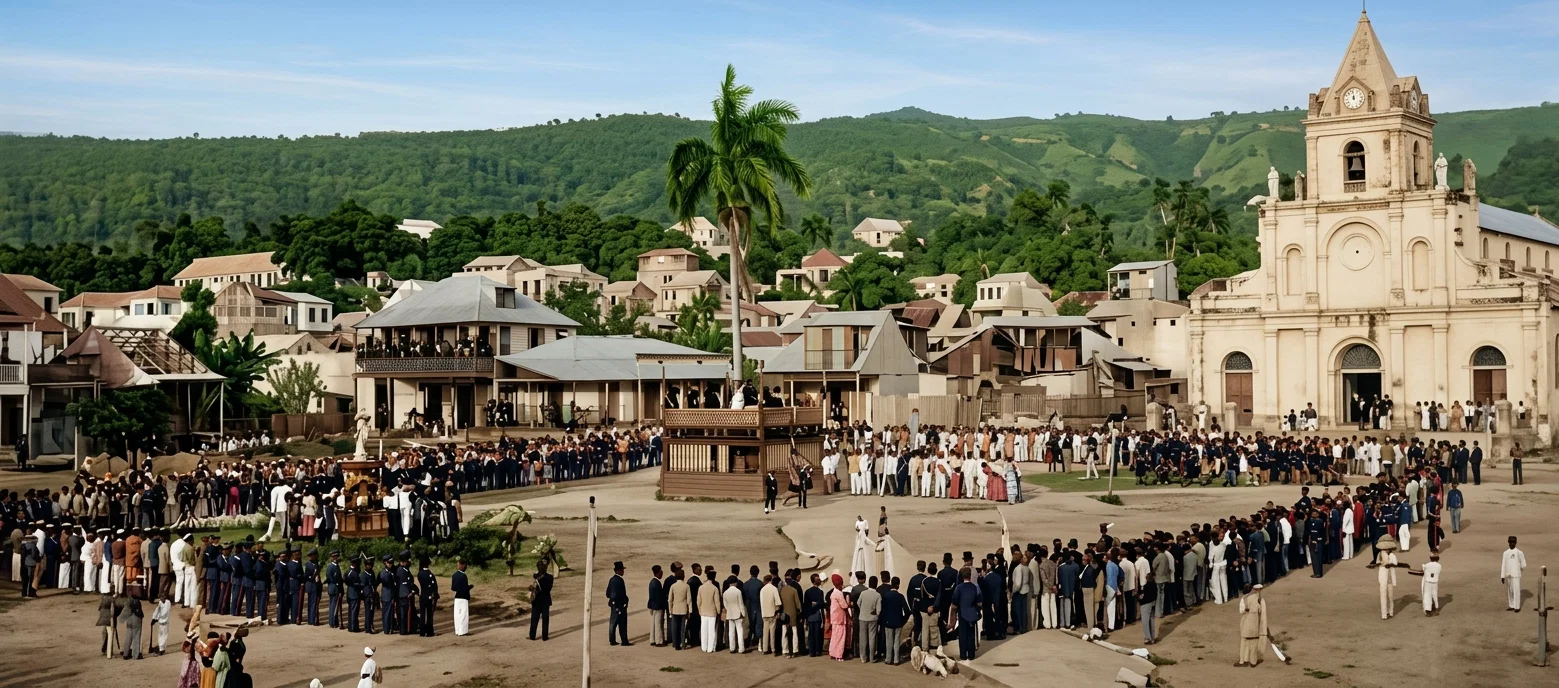
A FESTIVAL DAY. PORT AU PRINCE, HAYTI
Nor was Toussaint’s popularity confined to the humble homes of the recently liberated black people. The white colonists, high and low, seem to have manifested a respect and a confidence toward the ex-slave that is truly remarkable, when one considers their antipathy of a few years before. This conversion of feeling was, however, because it was plainly manifest to all that Toussaint was the only man among them with sufficient genius to weld together the discordant factions in the colony, and to bring a return of that prosperity that had made St. Domingue famous in the early part of the century.
But this happy state of affairs was not permitted to last long. Napoleon, fearing the power and popularity of Toussaint, determined upon his fall. Finding a suitable pretext, the “First Consul” sent a large military expedition out to St. Domingue, for the double purpose of unseating the governor-general, and to re-enslave the negroes. Toussaint offered resistance, but was finally overcome by superior numbers, taken prisoner, and sent to France, where he died the following year (1803), as the result of the inhuman privations to which he was subjected in prison in the Château-de-Joux.
Only thus far did the plans of Napoleon succeed. It was not in God’s purpose that any backward step should be taken toward reshackling the souls and bodies of the African people. God’s final message must be proclaimed to this down-trodden race, and the emancipation which began in Hayti must continue until the black man should be as free to accept it as his white brother. About the time of the deportation of Toussaint, yellow fever broke out among the French soldiers, slaying thousands in a day. The ex-slaves, realizing now that French success would mean a return to their former chains, arose and fought with that desperation which is prompted by the prospect of the loss of liberty.
The war was sanguinary and barbarous, but the extermination of the white colonists, which took place at this time, was suggested to the ex-slaves by acts of equal cruelty on the part of General Rochambeau, the French commander. The war, as is well known, resulted disastrously to the French, and they were compelled to leave the colony the latter part of 1803. The first day of the following year, Gen. J. J. Dessalines proclaimed the independence of the French part of the island, an independence which these people have been able to preserve, with certain variations, for more than a century.
Cape Haytien.

The New England Camp-Meeting

So far as our own people were concerned, the location of the camp for the New England meeting was everything that could be desired. It was in a cleared spot, with a heavy sod, on nice level ground, only a little way from a beautiful lake which is used as a resort for the people in the vicinity. It was just off the trolley line which connects Fitchburg, a city of about twenty thousand people, with Leominster, Worcester, South Lancaster, and Boston. The weather throughout the meeting was most favorable. It would be difficult to think of more favorable conditions for a good meeting than we enjoyed at this place.
The attendance was not large, but ran from three hundred and fifty to five hundred, including a nice class of young people, who took a deep interest in the meetings. Elder E. W. Farnsworth and wife, Elder S. N. Haskell and wife, Profs. B. G. Wilkinson and B. F. Machlan, and the writer were the visiting brethren present during all or a part of the meeting. Most of the conference laborers were also present, and rendered most efficient help. No session of the conference was held in connection with the camp-meeting, but will be held sometime in the autumn of the present year.
Sabbath, June 29, was a good day for the camp. It was understood that no donation would be taken up for missions, as the General Conference had consented that the New England Conference should make their offering for the Melrose Sanitarium, instead of for the $150,000 fund, inasmuch as this conference had already paid its full quota of the fund. So it had been arranged that the donation for the midsummer offering should be taken up on Sunday, when it was earnestly desired that a good donation be given to help equip the Melrose Sanitarium. However, before the discourse was concluded Sabbath morning, a brother arose in the congregation, and said that he would like to have fifty men line up with him and lay a five-dollar bill on the desk for foreign missions. More than fifty people were on their feet in a short time, and were anxious to contribute to the support of foreign missions. The president of the conference thought it was wise to allow the people to give, inasmuch as they demanded the opportunity, and in a short time a donation was taken in cash and pledges for the foreign work, amounting to more than twenty-five hundred dollars.
After this, nearly the whole congregation, dedicated themselves to the service of God, pledging to lay their lives, their property, their children, and every earthly consideration upon the altar, and give themselves to God’s work for its completion. It was indeed a most remarkable meeting, the like of which I hope to see often repeated in days to come.
In the afternoon a call was made for young people who would dedicate their lives to the work of God in giving this truth to the world. It was made very specific that those who answered to this call should lay all their future upon the altar, placing themselves in the hands of God for him to use them in any part of the wide world, wherever they could be of the most service. In answer to this call, seventy young people consecrated their lives to the cause of God. It was a most solemn meeting, and the Spirit of God was present in a marked manner.
On Sunday more than fifteen hundred dollars was pledged and raised in cash to be devoted to equipping the Melrose Sanitarium. The Sabbath-school offerings for the two Sabbaths during the meeting exceeded one hundred dollars, all of which was donated to the foreign mission work.
We rejoice with New England that she has already turned in her quota on the $150,000 fund, the same being $2,623.61. The New England Conference has turned into the General Conference treasury during the last seven months, an amount exceeding six thousand dollars for the general work.
We rejoice in the liberality of the New England people. They remind us of the experience of which Paul wrote concerning the Macedonians, that they were liberal beyond their means; but God loves a cheerful giver, and we believe that the New England Conference will prosper as long as it continues in its liberal attitude toward the cause of God.
We have seldom enjoyed a meeting more than we enjoyed the one at Fitchburg. The Christian love and unity that prevailed in the meeting made it a delight to be present. We wish the conference a large measure of success in the great closing work in which we are all engaged. I. H. EVANS.

Japan

KOBE.—We have liked this place very much from the beginning. Of course the enemy works as hard as at home, or even harder; for he sees that the heathen are to be taken out of his hands, and in many ways he is trying to discourage the work. I am so thankful that we have a Captain who has never lost a battle, and that we can put our whole trust in him.
Japan has had quite a religious awakening in the last few months. During the first week in April, the world's convention of the Student Volunteer Movement was held in Tokyo. From all reports, it was a good meeting, and in the eyes of all, it was a great success. There were present one hundred and sixty delegates from abroad, who represented twenty-five nations of different races and colors, from all quarters of the habitable globe.
The motto of the conference was “One in Christ.” Messages were received from King Haakon, President Roosevelt, King Edward, and many other persons in high places, wishing the conference success. The conference received much encouragement from the Japanese government. Marquis Ito, himself a heathen, subscribed five thousand dollars toward its expense. The men upon whose shoulders this government rests realize that there must be a reform in the social and commercial life of this nation; and although not willing to accept Christianity themselves, they seem to be willing to support any effort which is made to exalt high ideals and a Christian character. They realize that Christianity is doing something for these people which Buddhism, Confucianism, and Shintoism combined have failed to do, and that is, to make known the value of an ideal. May God help these people in their efforts, and help us to take hold of the opportunity which lies at our feet, and proclaim this message with such force, and in such a spirit of meekness, as will turn these people from utter darkness to his marvelous light.
At present General Booth is touring Japan, and will be in Kobe to-morrow afternoon, May 10.
We enjoyed the visit of Elder Prescott very much. We had a good meeting, and the Spirit of God was present at all our services. We were only sorry that he could not stay with us longer.
The sanitarium has been full most of the winter and spring. Even after Dr. Lockwood left, we had patients enough to pay the running expenses. Our being without a doctor for two months is a setback to us. But we hope soon to make up for lost time, and are anxiously waiting for Dr. Dunscombe, who, I hope, is on the way now. We were glad to get a letter from Dr. Myrtle Lockwood, stating that she was much better.
Brother Field has been here about three weeks. He is now visiting churches with Brother Okohira, north of Tokyo.
Mrs. Herboltzheimer and I are keeping house here all alone. Miss Harriman is in Kyoto, nursing, and Miss Young is taking a vacation.
The Japanese sanitarium is doing well, and the workers there are all of good courage. I never saw a better class of laborers. All seem to take an interest in what they do; and they are doing a great deal to spread the message.
Recently a man who was on the police force was converted, and began to keep the Sabbath. He was compelled to give up his position. Some of our Japanese brethren have advanced him money to purchase a supply of Bibles and tracts, and he goes out canvassing for these. He seems very earnest. His wife is said to have expressed her willingness to starve to death rather than give up the Sabbath. We are helping them along the best we can, and we feel sure that God will hear our prayer in this brother's behalf, and furnish him with a means of support.
A young sister who has recently accepted the truth has had some interesting experiences with the Catholic priests. She is very well educated, and speaks English, French, and Japanese fluently. When she accepted the truth, she had to leave home, and work for herself. She is teaching, and God is blessing her. Recently the Catholic bishop came down from Tokyo, and sent word that he desired to see her. She went, and he pleaded, with tears in his eyes, that she should consider the course she had taken. He is like a father to her, having known her from childhood. He said that when he first heard of the step she had taken, he could not believe it, and that he askedthat she be let alone, hoping she would finally see her mistake and return. She had quite a long talk with him, in which he never asked her to return, but inquired as to what it was she had found which had made her change her mind. She told him, and asked him if the Catholic Church changed the law. He admitted that it had. She gave him “Thoughts on Daniel,” and requested him to read it, and mark any passage in it which was not true. With tears in his eyes, he promised to do so. She is now anxiously awaiting an answer from him.
JOHN N. HERBOLTZHEIMER.
Continue reading: The Kingston Church Building