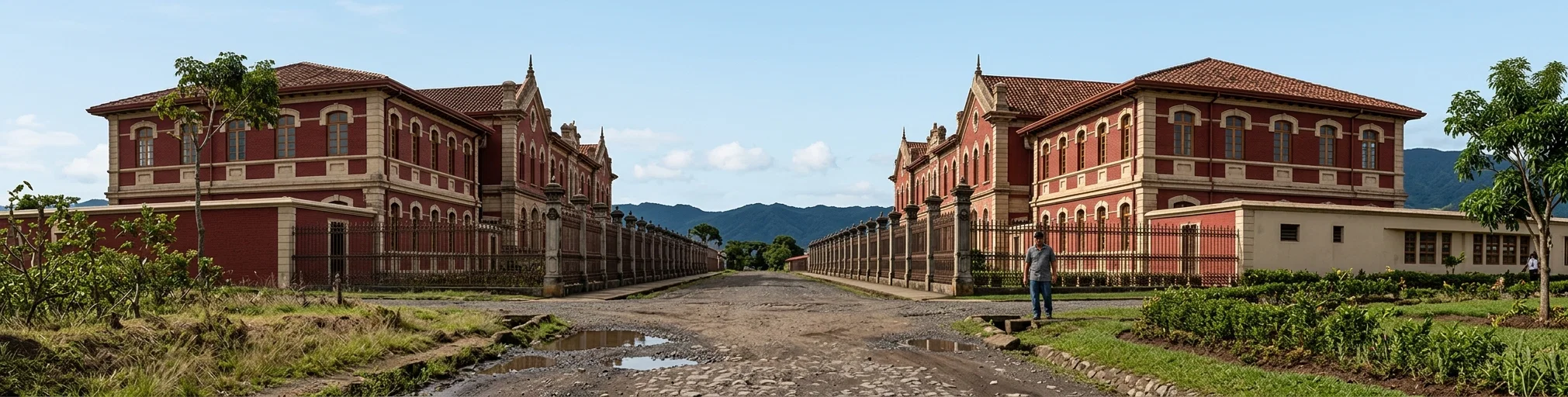
The Kingston earthquake, which occurred last January, tore the ends of our two-story church building away from the sides, leaving the building in a wrecked condition, and unsafe for occupancy.
The building was a story and a half in height, the chapel being over a basement, which was principally above ground. The chapel being rendered entirely useless by the earthquake, the basement was fitted up with seats, and the Kingston brethren have used it for meetings since the tent was taken down.
The building was so racked that it was impossible for it to be repaired except by rebuilding from the foundation. Besides, the location of the old building was most undesirable from every standpoint. It was completely isolated from the better class of citizens. About it on every side were cheap, low buildings of an inferior quality. In front of it ran a low stagnant stream, which must be crossed in order to reach the church. In the wet season this stream would often become a dashing torrent.
The church has done wisely to locate its new building on a beautiful large corner lot, on one of the best streets in the city. This lot fronts on what might properly be termed the Boulevard, or driving road of the city, and is one of the most attractive streets for a church building site that could be reasonably obtained. The location is just out of the noise and bustle of the commercial life of the city, and yet so close to the heart of the city as to be easy of access from all parts. The elevation of the present site is excellent, and the location all that could be asked.
More than four hundred persons residing in Kingston are now keeping the Sabbath. There has been a bountiful ingathering of souls the last year, especially since the earthquake. It is impossible for the present membership to find accommodations in their present quarters. A letter just received from the president of the conference says: “At the present time about half of the congregation have to stand outside during services on Sabbath and Sunday nights.”
Again he asks a question. “Yet what is to be done with four hundred members of the Kingston church, with one hundred and fifty children in the day-school, with no proper building in which they can gather and worship, to say nothing of the one hundred to two hundred interested persons who usually attend our services in spite of the lack of accommodations?”
It must not be forgotten that these people are very poor. Most of them are renters and live by daily toil. Wages are low. Often a man works all day in the field for from twelve to twenty-four cents. This means absolute poverty; often hunger and want. Such people can do something, but they are powerless to supply all the means necessary to the task of the erection of a suitable church building in the city of Kingston.
Last spring Elder Strickland called for help on this church building, and there has been received up to date, $348.60. This is not a very large sum for our people in the United States to contribute toward the erection of a much-needed church building. We must not forget that most of these people had the houses in which they were living ruined by the earthquake, and even if they did not own their homes, it brought to them great distress and perplexity.
The brethren have asked that two thousand dollars be contributed by our people toward the erection of this church building. From another letter, under date of July 4, from Elder Kneeland, president of the conference, I quote as follows:—
“The brethren in Kingston are doing well in raising money, considering their circumstances. The country people have suffered severely from the long drought, and will not be able to help much until next year’s crop. I am sure it will take no long argument to convince you that we alone can not raise the required amount for a long time. In the meantime, must the building stand as it is for six months or more until we can put on a roof? That alone will cost five hundred dollars, and our people can not raise this before Jan. 1, 1908. If the two thousand dollars could come in soon, we could get on far enough to shelter the people from sun and rain this year. Otherwise I have no idea how this can be done.”
We trust that there are many of our people scattered throughout the field who will be glad to send in from five to ten dollars to help on this fund. We believe that our people will esteem it a great privilege to assist our Jamaica brethren who lost their church building, and many of them had their homes completely destroyed by the disastrous earthquake. Send all donations to I. H. Evans, Treasurer, Takoma Park, Washington, D. C.
I. H. EVANS.
W. H. SMITH
By W. H. Smith
Pennsylvania
SCRANTON.—We are now nearly settled in our new home in Scranton, and are much encouraged over the prospects of our new field of labor. We regretted much to leave Williamsport, for there the Lord gave us many warm hearts and precious souls for our hire. Although only a small part of the three years that we were connected with that field was spent in Williamsport, yet we feel to praise the Lord for the way he blessed our labors in that place. If I remember correctly, there were forty-nine buried with their Lord in baptism, ten of whom were baptized just before we left the field. Of the forty-nine, five or six were rebaptisms.
During this time there were several added to the Cherry Flats and Roaring Branch churches, besides, a new company of about twenty members was raised up and thoroughly organized at Lorenton; for which we feel to give the Lord all the glory, for it is "not by might, nor by power, but by my Spirit, saith the Lord of hosts."
Now that we are located in Scranton, and intend soon to pitch our tent, we earnestly ask all our people to remember us daily in their prayers, that the Lord will add many precious souls to the Scranton church ere the summer's work shall come to its end.
W. H. SMITH
Western Oregon
By K. C. Russell
THE annual meeting of the Western Oregon Conference was held in Portland, Ore., May 23 to June 2. The camp was nicely located in the eastern part of the city, and was accessible from all parts of the city. Being so centrally located, we had a large attendance every evening. There were over one thousand of our people at the meeting. Besides the regular employees of the conference there were in attendance, Elders A. J. Breed, H. W. Decker, John Isaac, and George F. Enoch, Prof. M. E. Cady, Miss Katherine Hale, Carl E. Weaks, and the writer.
Special attention was given to the work of reaching those who have never given their hearts to the Lord, and to reclaiming those who were backslidden. Many responded to the different calls that were made from time to time, by repentance and humble confession of sins. We shall hope and pray that the work that was begun at this meeting will prove to be a thorough and permanent one.
Those in charge of the meeting so planned their work that the various phases of it were given careful consideration. The educational work in this conference presents a very encouraging outlook. They now have three industrial schools; namely, Laurelwood, Cottage Grove, and Gravel Ford. The church-school work was also very thoroughly considered, and especially the question of the support of church-school teachers. The following recommendations were unanimously adopted:—
“Resolved, That a rate of tuition be fixed according to the grades, at not less than one dollar, nor more than two dollars, a month for each pupil.”
“Resolved, That each member of the conference in addition to the tithe, be recommended to pay a sum equal to ten per cent of the same to be set apart as a deficit fund to make up the amount still due the teacher on salary over and above what the tuition amounts to in each church; and further, that such tithe of the tithe be forwarded to the treasurer of the conference with the regular tithe, and that the responsibility of collecting and distributing the tuition be laid upon the church-school board, and that no demands be made upon the deficit fund until the rate of tuition has been fully met, and applied on the teacher’s salary.”
I trust that our conferences will consider this proposed plan as they study the question of financing their church-schools.
The early morning meetings were largely devoted to a careful study of the spirit of prophecy and church organization. As the principles on these questions were presented, those who had been somewhat in sympathy with the present apostasy from the message, saw the evil of their course, and took a firm stand on the side of organization and the spirit of prophecy.
The tithe of the conference for the past year was upward of $21,000, with a18surplus of $5,000. They donated to the General Conference for foreign mission work $1,000. It was also voted to pay their proportion toward a 20,000 edition of the Christian Endeavor number of Liberty, which is to be used at the International Christian Endeavor Convention to be held at Seattle, Wash., July 10-15. A liberal donation was also made toward the transportation and expenses of the six volunteer missionaries for India, to which reference is made in my report of the Western Washington meeting.
Elder F. S. Bunch was again unanimously elected president of the conference. Elder W. L. Black was elected vice-president. Miss Edith Starbuck was also again elected to the position of secretary and treasurer of the conference. W. C. Raley was chosen as tract society secretary. Brethren C. L. Butterfield and R. W. Airey were ordained to the gospel ministry. The ordination prayer was offered by Daniel Nettleton, and the charge was given by the writer.
We were pleased to meet at this meeting Dr. J. E. Froom and family and Dr. W. B. Holden. Mrs. May Taylor Quantock, who was returning to India, where she has previously labored as a missionary, was present at the meeting. She has regained her health, and expressed herself as of good courage as she returns to take up her work in this needy and important field.
K. C. RUSSELL.
NORMAL SCHOOLS, SAN JOSÉ, COSTA RICA, CENTRAL AMERICA
Central America
By Hubert Fletcher
ALTHOUGH our plans for our union conference in Kingston, Jamaica, were thwarted by the disaster that befell that city January 14, yet I am sure none of our visiting brethren have regretted their experience. We have seen, through it all, the love and care God has for his people, and have learned to trust him more. In fact, these disasters are among God's means of furthering the message, and of shortening the work in righteousness.
Under more favorable circumstances, it would doubtless have taken years to have brought in touch with our work those who have come in touch with it in one month. Immediately after the earthquake, the news went far and wide, by land and by sea, that the Seventh-day Adventists were the only people who had their building left standing. The earthquake has been a help to our people in Jamaica in their work, instead of a ruin. God's people can “look up,” and lift up their heads, for their redemption draweth nigh; while with bowed heads the people of the world are filled with fear and trembling. The earth, and heavens also, will very soon be shaken; the islands will disappear, and the cities of the nations be thrown down; but God's people, like Peter on Galilee, will stand on the word, which can not be moved.
On my return from the conference, I was able to meet with the Colon church. I found all of good courage. After a spirited meeting six persons applied for baptism. From there I took steamer for Limon, Costa Rica. I spent nineteen pleasant and very profitable days strengthening the churches, and planning with the workers for the work in that part of the field. My time was divided among the following places: Limon, Pacuarito, Guacimo, Jimenez, and San José. As I surveyed the vast field with the hundreds of thousands of inhabitants without a knowledge of the message, and only one minister, I had to ask, What is he among so many?
It is from among the thousands of West Indians that we have our present membership in that country. The natives sadly need our help. If we had an experienced Spanish worker to take hold of the work, and locate in San José, one who could fluently and correctly speak the language, more could be done than is being done for the Spaniards or natives. There are many large and important cities surrounding the capital. San José is the most modern of the Central American capitals. It is about one hundred and six miles west of Port Limon, and about midway between the two oceans. It is located in a healthful and picturesque valley. The temperature, especially in Cartago, is almost freezing in the winter. Any one coming from the north can enjoy good health.
At Pacuarito I found the church growing in numbers, and all of good courage. Many impressive services were held. Plans are being laid for the erection of a suitable church building. Elder Mignott has procured a house at Guacimo for a series of meetings. He reports a good interest. The work in Costa Rica needs re-enforcement. It is a difficult field in which to labor. The only means of getting from place to place is by train. There are several branches of the railroad, along which the people settle transiently. But in spite of the difficulties, all must hear the message, and the honest be gathered out. The workers are of good courage, but we need help. In Bocas the work is still progressing in spite of hindrances. We have had to enlarge our lecture room. The day-school is growing, and is creating quite an interest among those not of our faith. But the Roman Catholics and the government are using all their influence to close all the Protestant schools, and have only one Spanish school, to be principaled by the priest. Of course, that is only a stratagem to have all the children taught the Catholic religion. We are, nevertheless, working and praying that the Lord may overrule, so our school may continue.
We are making an effort to circulate our Spanish paper, the El Sentinel. One of our brethren has done a good work with it, placing it in the hands of the governor and his subordinates. They all like the paper. The governor says it is the best paper they have ever had, and his wife enjoys reading it. Now is the time for us to work in these fields. The Lord is opening up the way, and preparing the hearts of the people for the reception of the truth. We have many difficulties to encounter, but by the grace of God we are all of good courage, and determined to be wholly consecrated to the Lord, and press the battle even to the gates of the enemy. The outlook is very encouraging.
I go now to Colon again, to look after the land for our church building there. Pray for us. HUBERT FLETCHER.
E. H. GATES
By E. H. Gates
China
AFTER the Shanghai council I spent a few days at Hongkong, and at Canton and its vicinity. In the latter place I learned more fully about the Hakkas, a people living inland from Canton about one hundred and fifty miles.
They number about ten million, and as a rule are quiet, and seem susceptible to the influence of the truth. They first learned the truth in this way: One of their young men was attending school in Singapore, and in some way came into contact with Brother Timothy. Learning from him the Sabbath truth, this young man went to his people and told them what he had learned. Sometime during the past year, several young men from this tribe came to Canton to be taught the truth more fully. The result was that five of them received baptism, and united with the Canton church. I met one of these, who is living with Dr. Law Keem, at Fat Shan, ten miles from Canton.
It is now expected that a mission will be opened soon among these Hakkas. Brother J. P. Anderson, a young man who lately arrived in China from America, has been chosen to open this new field.
I spent two days at Fat Shan, which is a moderate-sized village of five hundred thousand people. What would our American people think of calling that place a village? Forty or fifty miles from Canton is another village of one million inhabitants. At Fat Shan, Dr. Law Keem, our Chinese brother, has lately opened a medical mission. He is19located in a central part of the town, and has pleasant and well-fitted-up treatment rooms and a chapel. Though the mission was opened but a few weeks before my visit, there are evidences of good already seen.
One intelligent heathen family is already interested. A young man of this family has volunteered his services in Dr. Law Keem's family, and seems a faithful, devoted servant. The mother and daughter often come and offer their services to the doctor's wife, and are interested in Christian truths.
A young Hakka minister called upon me. He believes in the Sabbath, and is studying the different points of present truth. So the message goes forward to the different nations.
E. H. GATES
Porto Rico
By Mrs. J. C. Brower
MAYAGUEZ.— If it is true in some fields that the people are standing with outstretched hands and anxious faces, pleading for some one to teach them the gospel, such is not the case here. While there are many of the “common people” who show some desire to become “Protestants,” yet it is not because of a desire to renounce their sins, and to experience a change in heart and life. It is rather for purposes of gain to themselves in the quantity of loaves and fishes they may receive.
The first of March, Brother C. N. Moulton went to the republic of Santo Domingo, to work in the interests of our Spanish literature. He has, thus far, met with marked success, using about a thousand copies of El Centinela de la Verdad each month. Not much Protestant missionary work is being done there as yet. It seems a good opportunity for the third angel’s message, if some one could remain to follow it up.
Mr. Brower is making a tour of the south side of this island, on horseback. His health, his language work, and his courage all seem to be excellent. Brother and Sister Connerly expect soon to start on a trip around the north side. The paper is growing in favor, and the list of subscribers is steadily augmenting.
While there is a standstill in some phases of our work, which we can not understand, yet we are not in the least disheartened, and are determined to press forward as never before.
MRS. J. C. BROWER.
The Printed Page in China
By J. N. Anderson
It can scarcely be overstating the facts to say that China has more books and a greater respect for letters and literature than any other nation in the world. This is a very significant fact, and one that must carry weight in solving the missionary problems in such a field as China. Printing is said to have originated with this people, and the art of expressing ideas by means of written symbols dates from ancient times. When the nations of the West were barbarous and without letters, the Chinese were a literary and highly cultured race. They have continued to be such to the present time, and the situation becomes all the more interesting and important in view of the present educational ferment which is working among all classes. It is indeed the intellectual renaissance of the whole race, and the leaven that is working is the modern, Western ideas that today dominate Europe and America.
In view of all this, what is our duty as children of the light? The printing invention is doubtless one of God's special agencies designed to serve his purpose in carrying the final message of salvation to the ends of the earth.
If possible, the printed page has a larger field of usefulness in China than in any other country to which the message is being carried. We are more and more impressed with the necessity of having large, well-laid plans looking to this phase of our work. It is doubtless the most economical means of preaching the truth, and with the least effort it can become the most pervasive. By this means all our workers, and even our lay members can be fully enlisted, and so a perpetual campaign can be carried on.
By means of the printing-press other missionary societies have done a great and very far-reaching work in China. This is especially true of the three Bible Societies operating in this field. By these millions of copies of the Scriptures, as well as other Christian literature, have been scattered in all parts of this empire. It is impossible to estimate the magnitude and the influence of the work already done in this way. If we are wise, we shall not fail seriously to lay hold of this most important line of work. A good beginning has been made in creating a literature on the message for the Chinese people. It is indeed a mere beginning, but we are now in a position to push forward this work provided we are given financial support. Publishing and distributing literature in China when it has to do with Christian subjects, can be successfully carried on only so far as there are funds, since it is invariably the case that such work is done at a monetary loss. Generally speaking, all such literature is sold at a price that falls considerably below the actual cost of publishing, and then there is, of course, beyond that the expense of distributing the literature. Our aim is to sell all our publications at such a figure as to cover the cost of printing, but beyond that our literature is almost sure to be a mission expense. A good, liberal endowment for this purpose is needed, and we confidently look to our faithful people in the home land to raise us a fund for this purpose. This is one of our first needs, and all contributions to this work will be thankfully received.
A small printing plant is being equipped at Sin-yang Cheo, Honan, but this is to serve only temporarily until we can carry into effect our plans which look toward a central publishing house to be located at Shanghai in connection with our general headquarters. It is agreed that one well-equipped printing plant can serve this entire field, and to do so it must be located centrally. And there can be no doubt but that Shanghai is in every particular the most favorable place for such an interest. Already there are large publishing interests centered in Shanghai, and the demand for books and all kinds of literature is so great that these presses are driven to their full capacity.
Dr. H. W. Miller, who is to return to the States this summer in the interest of the publishing work in China, has undertaken to lead out in building up our printing work. We bespeak for him a hearty response as he seeks to further the interests of this branch of the work. This is a work to which we are all committed, and we in China feel free, and even glad, to lay our needs before you.
J. N. ANDERSON.
Unworked Territory in South Carolina
By C. F. Dart
MANY have written to me, asking if there is any territory in the State that has not been canvassed. I will say, Yes; there are forty-one large counties in South Carolina, and below is a list of the unworked territory for the following-named books:— “Great Controversy,” 41 counties; “Patriarchs and Prophets,” 41 counties; “Desire of Ages,” 41 counties; “Story of Daniel,” 41 counties; “Story of Seer of Patmos,” 41 counties; “Daniel and the Revelation,” 41 counties; “Coming King,” 37 counties; all health books, 41 counties, and there are practically forty-one counties for all other books.
About half these counties will require two persons each a year to canvass them thoroughly. To any one desiring to come here, I can give any county in the State for almost any book desired. Who will come and help us in this needy field? There is plenty of room for all kinds of work except office work.
We have nothing in the medical line in the entire State. The only doctor in my home town, Campobello, just died. He had a large practise. Possibly this may be a good opening for one of our doctors who wishes a location to build up a practise. The writer's address is Chester, S. C. C. F. DART.
British Guiana
By O. E. Davis
GEORGETOWN.—Since our last report there have been some encouraging developments in this place. Several weeks ago a young East Indian, who is employed in the government telegraph service, came to me inquiring about the truth. For about three years he has been reading the Caribbean Watchman and other publications; and being convinced on some points by reading, he desired to meet a living teacher, and at last found my address and came to my home. He desired to become fully acquainted with all points of the message. Believing the Lord will soon come, he is very anxious to fit himself for active labor in the interest of his people, who compose more than one half of the population of this colony. Having decided to keep the Sabbath, he sent in a letter fully explaining his position, and asking to be excused from duty on Saturday, that he might keep the day according to his convictions; and to my surprise, his request was granted, and he still holds his position. How long this blessing may continue we do not know. However, he expects to give it up entirely as soon as he can arrange to take up some branch of the work. Thus we see God is raising up workers for this people of their own tongue.
March 24 I buried eleven souls in baptism. Nine new converts, and two who were already members desiring rebaptism. The attendance at the services is steady, and the interest firm, and there are good prospects that others will accept the message soon.
O. E. DAVIS.
Tried and Convicted on Sunday, on the Public Highway, for Violating a Sunday Law
By Cyrus Simmons
ABOUT twelve miles from Knoxville, Tenn., on Copper Ridge, stands a Seventh-day Adventist church that has recently been constructed. Twenty-five or more new Sabbath-keepers attend this church. Threats have been made that any who worked on Sunday would immediately be arrested.
Near the county line dividing Knox County from Anderson County lives Brother John E. Grubbs. On Sunday, March 3, Brother Grubbs was cutting some wood for the church, which is not very far from his home. He also spent some time grubbing on his farm at a place sufficiently removed so as not to be a disturbance to any one. We are informed that an officer lurked near by for the purpose of getting a case against Brother Grubbs. When the afternoon service of the church was dismissed, and Brother Grubbs was leaving, the officer, in company with the magistrate, arrested him, and took him a few feet from the building, where they tried and convicted him in the public highway, and sentenced him to jail for non-payment of fine. The nearest jail was at Clinton, nine miles distant. They immediately started with their victim to that place.
Brother Grubbs at first refused to pay the fine, and went with them, intending to remain in jail. After he had gone some miles, however, he remembered that his mother, who is very old, was in delicate health, and the news of his incarceration might hasten her death. He thereupon resolved to return home and pay the fine. There was considerable sympathy manifested in the neighborhood in favor of Brother Grubbs by those who are not Seventh-day Adventists. Many expressed themselves freely, saying that Brother Grubbs has been an exemplary citizen and a good neighbor, and that his arrest and summary trial and conviction was the result of the bad feeling against him on account of his religion.
When the magistrate and officers were later informed that their trial and conviction on Sunday was a violation of the very law they sought to enforce, and the conviction and the imposition of a fine on Sunday was absolutely void in law, and that Brother Grubbs, if he had the same spirit that they manifested, could proceed against them for false imprisonment, and against their bond for collecting an illegal fine, they were disposed to be more lenient and civil.
When the State becomes the arbiter of one's conscience, persecution is inevitable. The neighborhood in which Brother Grubbs lives is mountainous and thinly settled, and the work he did could disturb no one. In the same place neighbors who do not keep the Sabbath haul wood, and attend to business generally on Sunday without the least molestation. The one who prosecuted Brother Grubbs has recently transacted business with him on Sunday, and one who encouraged this prosecution, we are informed, has frequently brought plows to Brother Grubbs on Sunday to be sharpened.
CYRUS SIMMONS.
Knoxville, Tenn.,
To Help the Pastor Out
By Editor
If Sunday laws are simply “civil” affairs, and have nothing to do with religion or with the matter of church attendance, it is difficult to understand such items, clipped from recent newspapers, as the following:—
Half-Lid in Milwaukee—Saloons Closed until Noon Sunday
“It is expected that all the churches in Milwaukee will have large congregations to-day and each Sunday hereafter. It had come to the notice of the mayor and council that attendance at the morning services had fallen off considerably, hence it was decided to help the pastors out. At the regular meeting of the council last Tuesday night it was unanimously voted that all saloons be kept closed Sundays until twelve o’clock, and this new order goes into effect to-day.”—Portland Oregonian, June 16, 1907.
Revive Old Blue-Law in Pennsylvania Town
“CORRY, PA., July 15.—The blue-law of 1794 was enforced in this city, for21the first time, yesterday. All cigar and confectionery stores remained closed until after church yesterday morning, the ministers granting them the right to open in the afternoon. Milkmen may deliver only before 9 A. M. and after 5 P. M.”—Washington Times, July 15, 1907.
A Great Nation
By W. A. C.
SPEAKING of “Our Independence Day,” the Washington Times of July 4, says: “On this day, one hundred and thirty-one years ago, the Continental Congress declared a group of separate States independent of their mother country. The delegates to that congress did not themselves appreciate the potential fruits of their courage. Many, if not most, of them confidently expected ultimate reunion with the greater nation across the water, but out of their declaration has come the greatest power for general education, individual self-reliance, God-fearing personal character, helpful co-operation for the benefit of good government and influence for the peace and prosperity of the world which is known to history.” W. A. C.
A Report from Canada
By Mrs. Luella B. Priddy
“SABBATH observance” and “church union” is the key-note of the churches in Canada now. In some of the conferences they have passed resolutions asking or “demanding” that various measures be adopted by the government. The churches have assumed an air of authority. The government having yielded the one important point in passing the Sunday law, the churches now expect their power to be recognized. And we may well ask, Where will it all end?
The Lord's Day Alliance officials have been interviewing the Ontario government, and have obtained their consent to prosecute in certain cases. Humanly speaking, the liberties of the Lord's people seem to hang upon a slender thread; but in reality the child of God is free, even when behind prison bars. The Lord can use this means to give the truth publicity, that souls may be saved. We are of good courage.
MRS. LUELLA B. PRIDDY.
Current Mention
— An unsuccessful attempt was made to assassinate President Fallières of France July 14.
— July 17 a cloudburst in West Virginia destroyed property amounting to hundreds of thousands of dollars, and caused the death of three persons.
— Nine persons known to be dead, two missing, and five badly injured is the list of casualties from a building collapse in London, Ontario, July 16.
— Two thousand dock laborers of Duluth and Two Harbors, Minn., and Superior, Wis., are out on a strike, and thousands of others are forced into idleness.
— An excursion train bearing about 800 passengers was wrecked July 20 near Salem, Mich. At last reports thirty-one were dead and seventy-five badly injured.
— Six persons met instant death, and twenty were injured, when a fast train on the Southern Railway collided with a switch engine near Johnson City, Tenn., July 14.
— During target practise, July 15, a sack of powder exploded aboard the battle-ship “Georgia.” Eight men were killed, and thirteen seriously injured, of whom two have since died.
— Excessive rains throughout much of Germany have caused the overflow of streams, and much country and some cities are inundated. Fifty lives have been lost, and much damage to crops is reported.
— A train on the Canada Northern Railway, near Kashabowie, ran into a cloud of moths, July 13, obscuring the view, and covering the tracks so deeply that the train was stalled. It took the train crew about two hours to clear the tracks so that the train could proceed.
— Unprecedented prostrations from heat occurred in Philadelphia, Pa., July 19. During the parade of the Elks, thousands of persons on the grand stands and streets were overcome. No less than 4,380 cases were counted, besides thousands more that were hurried to their homes. All sorts of vehicles were pressed into service to assist the patrols and ambulances. The mortality rate, however, was small. Adulterated lemonade, which was freely sold, is thought to be responsible for many of the prostrations. On the same day there were fifty prostrations and seven deaths in New York City.
— The emperor of Korea abdicated the throne July 18 in favor of the Crown Prince. In his address he states as his reason for so doing the fact that national calamities have followed so rapidly during the forty-four years of his rule that he thinks the time has come for him to follow the usual Korean custom. But it is quite generally thought that Japan has secretly forced this situation. The day following his abdication an uprising in Seoul was started by the mutiny of a company of Korean soldiers. They were joined by citizens, using stones and clubs against the Japanese, who lost in killed and wounded about twenty-five persons. It is not known how many Koreans suffered.
Christian Liberty
Reports, Notes, and Comments Pertainingto the Current History of theRights of Conscience
Conducted by the Religious Liberty Bureau
K. C. RUSSELL, — — — — — Chairman
W. A. COLLORD, — — — — — Secretary