Your ShelfYour Projects

Signs of the Times, Vol. 39, No. 24.

An Utterance of 1776

Signs of the Times

Jun 18, 1912

Pacific Press Publishing Association · Mountain View, California · Jun 18, 1912

An Utterance of 1776
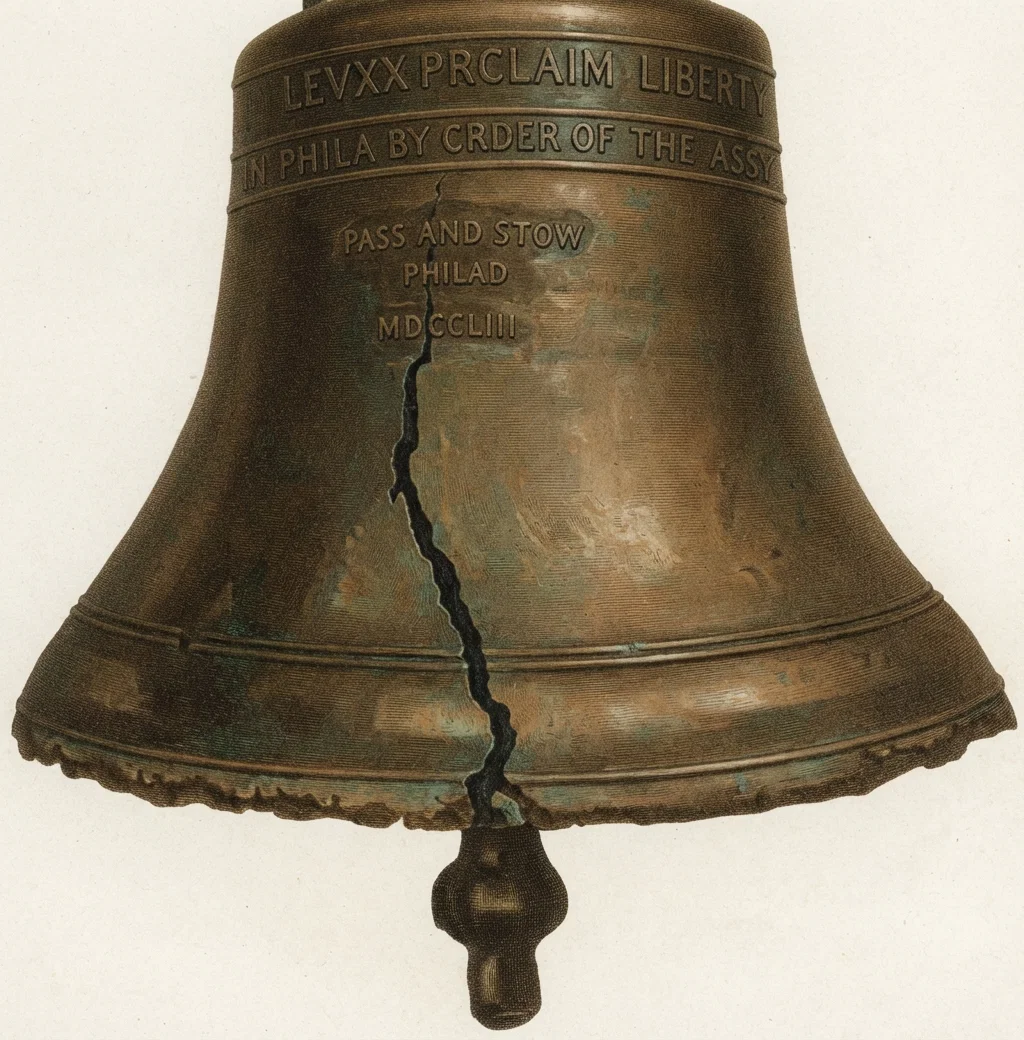
In Civil Things "Render to Cæsar the things that are Cæsar's." —Jesus to the Pharisees.
In Religious Things "We ought to obey God rather than men." —Peter to the Sanhedrin.

An Utterance of 1776

(From the address of the Presbytery of Hanover, Virginia, and the Baptists and Quakers, to the General Assembly of Virginia, 1776)
In this enlightened age, and in a land where all of every denomination are united in the most strenuous efforts to be free, we hope and expect that our representatives will cheerfully concur in removing every species of religious as well as civil bondage. Certain it is that every argument for civil liberty gains additional strength when applied to liberty in the concerns of religion; and there is no argument in favor of establishing the Christian religion but may be pleaded with equal propriety for establishing the tenets of Mohammed by those who believe the Alcoran; or, if this be not true, it is at least impossible for the magistrate to adjudge the right of preference among the various sects that profess the Christian faith without erecting a claim to infallibility which would lead us back to the Church of Rome. Religious Liberty Series, No. 5

"IF YE WILL INQUIRE, INQUIRE YE."

This Inquirers' Department is conducted for the purpose of helping those who are studying the Bible. The answers are oftentimes only suggestive. They are never to be considered infallible, only as they agree with the infallible Word. The writer who may answer them does not consider that his opinion is infallible. He will simply give the best that he has, and plead with the inquirer to search the Word. Such questions only will be answered as, to the editors, seem to minister to the good of the readers and to the mission of the paper. We can not answer repeatedly in the same volume questions upon the same scripture. The name and address must accompany question, not for publication, but as an evidence of good faith, and that answer may be made by letter if deemed advisable. No letters are answered which do not contain the name of the writer. It is well always to enclose stamp for reply.

3780 — Staying with the Church

If one's name has been on the church book, and he sees things so wrong in the church that he withdraws from it and leaves the church, and still lives his conviction, will such a one be lost?
Not necessarily. And still there is great danger. There never will be a time in the history of poor, mortal man when everything will be just right within the church of God. The Lord does not receive people who are just right. The just right ones are ready for translation. He accepts people as children — little children — those who first yield to Him. So He calls them. They are not able at first to bear strong meat; they are fed on milk. They are not able to bear strong temptations. He deals with them gently, as a shepherd deals with the lambs. We do not expect that a child at first will walk as does a man. We are not surprised at all if he stumbles. Likewise God's children may stumble, and still be His children. Sometimes they may make decided failures, as have some of God's estimable and eminent servants in the past. The real question is, Is the church holding to right principles? Is she holding to principles which will correct her mistakes and her blunders and her sins? If she is, stay by the church. Not until the church turns from the Word of God and rejects it, ought we to leave the church.
When the church sets up her own standard instead of God's standard, and we can not help her to see the right standard and the mistake she is making, then it may be time for us to separate and walk alone with God. But we ought to know that that time is reached before we separate. God has associated His children in church relationship because His children need it. The man who seeks to go alone to the kingdom of God, develops idiosyncrasies of character, develops a one-sided character, develops an uncharitable character, as a general thing. We need human associations to break off our sharp corners, to help us to be more charitable and more generous and more helpful. That is the reason that God has made us social creatures. This is manifest in the home where there are simply the husband and the wife, with no children. Such persons often become selfish. With no one dependent upon them, there is nothing to draw out their love and affection and tenderness and helpfulness. They do not reach the highest elements in character just as long as they live for themselves, and do not learn the lessons of tenderness and consideration that come to every father and mother. And it is the same with those who stand outside of church relationship. They are prone to set themselves up for a standard, and criticize those who do not reach the standard, instead of lending helpful, earnest hands to those who are stumbling and weak. There is great danger in departing from the Lord's flock.

3783 — War in Heaven, Rev. 12:7-9

Can Rev. 12:7-9 be applied to Satan's first fall?
C.
We think not. The first fall is set before us in verses 3 and 4. When Satan fell, our Lord Himself stepped down from His high estate of reigning with the Father, and took upon Himself the form of a creature, in order to save, and the first step in that downward career of sacrifice was to become an angel — Michael the Archangel. There began the spiritual warfare between our Lord as angel, and Satan, and which continued until the time that Christ took the second step downward and died upon the cross, a man. This is perfectly harmonious with all that is taught elsewhere.

3779—Impossible to Repent

Would you please harmonize Heb. 6:4-6 and Jer. 3:12-14, giving a full explanation of the former text?
Jer. 3:12-14 is just simply one of God's many calls to the backslider to return. "Return, thou backsliding Israel," "only acknowledge thine iniquity, that thou hast transgressed against the Lord thy God," etc. It is God's everlasting, earnest plea to those who are in sin. This is God's side of the question. Heb. 6:4-6 presents the human side. It warns us that one may go so far that no power whatsoever can reach him. "It is impossible for those who were once enlightened, and have tasted of the heavenly gift, and were made partakers of the Holy Ghost, and have tasted the good Word of God, and the powers of the world to come, if they shall fall away, to renew them again unto repentance." Read the American Revised Version, which makes it clearer—those once enlightened, who have tasted of the good Word of God, and the powers of the world to come, and then fall away, it is impossible to renew again to repentance. The text reveals those who had had a very high and clear experience, those who had known the power of God to save, the mercy of God to forgive, the wisdom of God to guide. If from all this wonderful knowledge they fall away, turn away, choose of themselves to go, it is impossible to bring them back to repentance, and we are told why,—"seeing they crucify to themselves the Son of God afresh, and put Him to an open shame." In Heb. 10:29 the thought is expressed, they tread underfoot the Son of God, and count the blood of the covenant wherewith they were sanctified an unholy thing, and do despite to the Spirit of grace. That is to say, they so turn away from the agencies that God has for saving men, that He has no others left. They so turn from all His wonderful manifestations of love and goodness, their minds become so perverted, that they can not tell when good comes. They have made the sacred thing common, consequently can not discern between the sacred and the profane. This the writer of Hebrews proceeds to illustrate: "The earth which drinketh in the rain that cometh oft upon it, and bringeth forth herbs meet for them by whom it is dressed, receiveth blessing from God." That is the fruitful garden that grows continually, and supplies the need of its owner. But here is another piece of land, that instead of bearing that which is good, bears thorns and briers, and continues to bear thorns and briers, notwithstanding all the rain that falls upon it and the cultivation that is given it. We know what we would do with such a piece of land as that; we would reject it. The only thing that God can do with such a soul as that is to leave him to himself. The heart reaches that condition where there is no repentance or sorrow for sin felt, and it is unforgivable only because it is unrepentable. There is no end to God's mercy—"His mercy endureth forever." The danger does not lie there; it lies in the fact that the human conscience can become so hardened that God can not touch it by any means which He can bring to bear upon the soul.

3781 — A Disreputable Class

Have you any light on Isa. 66:17, or any extracts that will make it clearer?
The prophet is simply revealing to us a class of apostates of the last days manifest to a greater or less extent in all the great crises of human history. The class is made up of those who turn from the salvation, the only salvation which God can give, and that sanctify themselves, and purify themselves. Their thought is not upon God, but upon their own selfish devices. The one tree evidently has reference to an idolatrous emblem, or symbol, and "asherah" a symbol of nature-worship. Evidently in this worship they hold high revels, eating swine's flesh and the abomination and the mouse — characteristic of their worship. All of these things were forbidden in the menu which God gave to Israel. They are evidently used here to show that the class mentioned have no regard for God or for the instructions which He has given.

3782 — The Carcass and the Eagles

Please explain Matt. 24:28. Can this be taken together with Rev. 19:17, 18?
To answer the last question first, we would say, Hardly; and yet perhaps in part. We understand that what is suggested in Matt. 24:28 is the plagues,—"Wheresoever the carcass is, there will the eagles [or vultures] be gathered together." This comes in direct connection with the coming of Christ,—"As the lightning cometh out of the east, and shineth even unto the west; so shall also the coming of the Son of Man be." When probation closes, the plagues will fall. They will fall upon those who have rejected Christ, those who are condemned to death. The wicked are therefore likened to dead bodies, or carcasses, and the plagues to vultures that prey upon them. See Luke 17: 34-37. The thought in Revelation 19, we gather, is a literal occurrence. It is, so to speak, a call to all the birds of prey to come and feast upon the carcasses of the armies of those who are slain in the great battle of Armageddon, when the slain of the Lord, according to Jer. 25:33, shall be from one end of the earth to the other.

If

3784—"IF"

If the Israelites had kept pace with the prophecies which God gave them, and had known how the Lord was to come, and if they had received Him, do you think He would have come to save the whole world just the same?
Surely He would; anything that the Israelites might do, or that we might do, or that all the inhabitants of the universe might do, would not change God's nature. He loves the world and loves sinners, so much so that He gave His only-begotten Son to die; and while man's acceptance or rejection might have changed God's ways of operating for a little while here in this world, it would not have changed His purpose nor its results. He would have used the Jews then as His messengers, just the same as He wants to use every soul who accepts Christ; so that if the Jews had accepted Jesus when He came, He would have laid down His life the same, and they would have been His heralds to the world of the great love of God.

3785 — The Day of Atonement

I am told that the Day of Atonement fell on the last day of the year. If that is so, how is it the tenth day of the seventh month? Lev. 23:27.
There were two years which the Jews held: the one the civil year, beginning with the month Abib, as stated in Exodus 12. The other year was the sacred year, what might be called the year of the sanctuary. The atonement came on the tenth day of the seventh month of the civil year, but it came on the last day of the sacred year, the last day of the offerings, the summing up in the sanctuary of the work that had been done there.

3786 — Cain's Wife, Gen. 4: 16, 17

Where did Cain get his wife, since we do not read of Cain being married before?
Cain married his sister, one of Adam's daughters. The record is not in consecutive order. There may have been many years from the time that Cain was sent out into the land of wandering to the time that he took his wife, and during these years there were other daughters born to Adam, of whom Cain evidently took one for a wife. This seems to be a reasonable supposition.

3787 — The Papacy and Jerusalem

According to Micah 4:2, 3, will the Papacy be established in Jerusalem in the last days? If not, who is to be in Jerusalem that will give law and rebuke nations?
It seems clear to us that that is the case. See the articles on Daniel in our last three issues in April, in which this thing is discussed quite fully. There is a wealth of prophetic utterances in God's Word which points to that very thing.

Readings from Isaiah and the Psalms

Our readings this week conclude the first part of Isaiah. These chapters are full of practical instruction, warnings against uniting with the world, however strong the world may be, prophecies of the reign of our Lord Jesus Christ, judgments upon the world for its wickedness, an interesting and encouraging and warning lesson taken from events in Hezekiah's reign, recording with faithfulness the great, good king's mistake. The week's readings close with Psalms 57, 60, 61, and 62. The 58th can be read with profit, if we will but remember that the psalmist is not praying through any personal feelings which he may have against the wicked. They are the prophetic words of God as to what shall come upon those who have merited such punishment.

Weekly Bible Reading Schedule

Sunday | June 23 | Isaiah 29 Monday | " 24 | " 30 Tuesday | " 25 | " 31, 32 Wednesday | " 26 | " 33 Thursday | " 27 | " 34, 35 Friday | " 28 | " 38, 39 Sabbath | " 29 | Psalms 57, 60, 61, 62

Christ's Kingdom Not of This World

Jesus and Intolerance
WHEN Jesus Christ gave Himself up to the mob in the Garden of Gethsemane, He was taken before the priests, from whom He had a right to expect just and merciful treatment. The office and profession of the priest not only required him to be just, but also to "have compassion on the ignorant, and on them that are out of the way." Heb. 5:2. But Christ had spoken against their traditions which had among the people made void the Word of God. He had denounced hypocrisy and sin of which they were guilty. They had endeavored, and failed, to answer Him; and instead of accepting the truths which He taught, and bringing their lives into harmony with them, they turned in bitter hatred toward Him who had spoken in love. They determined to destroy Him who had come to save them.
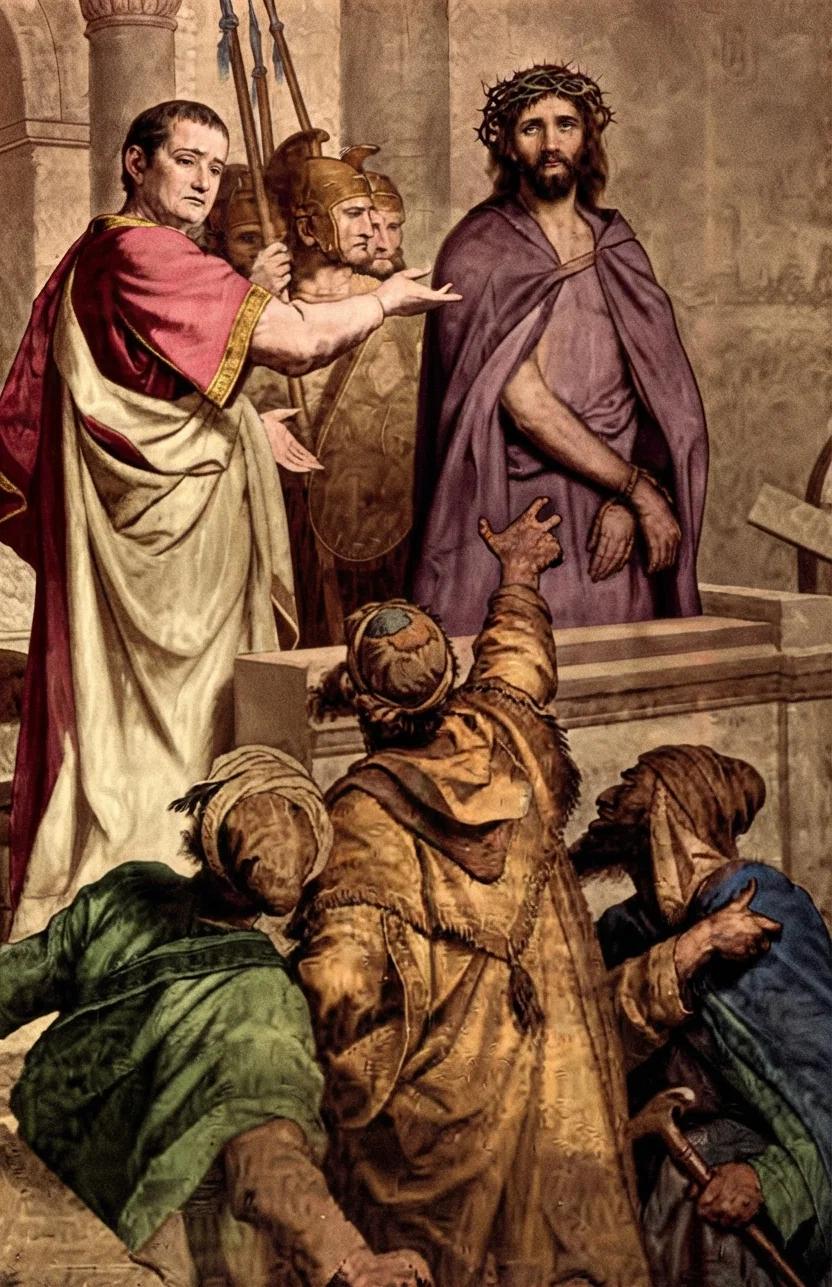
Hofmann Christ and Pilate. "Behold the Man," says Pilate; and in Him behold every other persecuted man for whom that Man stood. Might then seemed triumphant, and priests and Pilate in power; but the Man knew then, as His followers now may know, that in Right is Might eternal.
The blind prejudice of these priests had driven from their hearts all sense of justice and mercy. "And the men that held Jesus mocked Him, and smote Him. And when they had blindfolded Him, they struck Him on the face, and asked Him, saying, Prophecy, who is it that smote Thee? And many other things blasphemously spake they against Him." Luke 22:63-65. The servants were allowed to strike Him with their hands, and spit upon Him. Mark 14:65. This treatment continued through the night. "And as soon as it was day, the elders of the people and the chief priests and the scribes came together, and led Him into their council. . . . Then said they all, Art Thou then the Son of God? And He said unto them, Ye say that I am." Luke 22:66, 70. With this they said, "He is guilty of death." Matt. 26:66.
Such blind bigotry and injustice, which seem almost inconceivable, had come to those men because they had refused to accept the truth which had been taught them by Jesus Christ, altho He taught them from the writings of Moses, in which they professed to believe.

Like Causes, Like Effects

The same causes will produce the same effects, in any age, among any people. In 2 Thess. 2:10-12 it is predicted that just before our Lord comes the second time, there will come upon a class a "strong delusion, that they should believe a lie," because they would believe "not the truth," because they would not receive "the love of the truth." Evidently some message of truth will be given to the world at that time, and to reject it is to go into darkness, believe a lie, and be lost. Let each one ask, "Lord, is it I?"
The priests and elders of the people, together with the council, had fully determined to have Christ put to death. But they had no power to take life. The civil government of Rome had reserved this authority to itself. It was therefore necessary, in order to carry out their purpose, that they get Pilate, the Roman governor, to sentence and execute Christ. "And the whole multitude of them arose, and led Him unto Pilate." Luke 23:1. They then "accused Him of many things." Mark 15:3, 4. To these charges Pilate seems to have given no special attention, except to the one that pertained to the kingdom. The accusers said, "We found this Fellow perverting the nation, and forbidding to give tribute to Caesar, saying that He Himself is Christ a King." Luke 23:2. Pilate, learning that Jesus was a Galilean, and being willing to rid himself of the responsibility of deciding His case, sent Him to Herod of Galilee. Herod, when he had asked Him some questions, and received no reply, mocked and scourged Him, and sent Him back to Pilate. When Pilate saw that he must hear the case, he was disposed to give Jesus a fair trial, and therefore he asked Him, "Art Thou the King of the Jews?" Jesus asked him if he asked this question for his own information, or because of what others had said. Pilate answered, "Am I a Jew?" By these words he meant to disclaim all personal interest in the matter of who was "King of the Jews," as he was not one of that nation. Then he told Jesus that His own nation had delivered Him, and made the charge against Him. In our Lord's answer, while admitting His future kingdom, He said, "My kingdom is not of this world: if My kingdom were of this world, then would My servants fight, that I should not be delivered to the Jews." Jesus declared that He had come into the world to "bear witness unto the truth," and "that every one that is of the truth heareth My voice." Pilate acquitted Christ of every charge that was made against Him, and said, "I find in Him no fault." John 18:33-38.

The Two Kingdoms

While Christ admitted His future kingdom, He defined the character of His kingdom clearly; and Pilate saw that it was entirely distinct and separate from that of Caesar. Christ's kingdom was not of this world. Caesar's was worldly in every detail and particular.
Christ's kingdom stood a witness for truth, Caesar's was to carry out his own will, right or wrong.
Christ's kingdom was ruled by love — no fighting, no contention, no strife either in it or for it. Caesar's was built up and maintained by oppression, strife, and the sword.
Pilate could see that Christ was not seeking to obtain the throne of Caesar; He did not want that kind of kingdom.
It was plain that the subjects of Christ's kingdom could dwell in the kingdom of Caesar, and be a blessing to it, tho it was oppressive to them.
The nature of Christ's kingdom was manifested before Pilate in the conduct of its King. In His trial He made no defense. No witnesses were called to testify in regard to His teaching or work. No lawyers were engaged to break down the testimony of the false witnesses who witnessed against Him. No pleadings were offered in His behalf. The accusers were allowed to bring any charge, and any kind of evidence, unquestioned. "He was oppressed, and He was afflicted, yet He opened not His mouth: He is brought as a lamb to the slaughter, and as a sheep before her shearers is dumb, so He openeth not His mouth." Isa. 53:7.
In the ministry of Christ during the years that were past, He had carefully guarded His work, and sought for the most favorable opportunities to teach the people. He invited all to follow Him, but never forced any to do so.
Christ and His kingdom are the same to-day as when He was on trial before Pilate — the kingdom of love.
Caesar's kingdom, civil government, is maintained by force and the power of the sword to-day, the same as in the days of Herod and Pilate.

Spiritual Fornication

For the church to unite with earthly governments is to forsake Christ. It is spiritual fornication to be "unequally yoked" with an unbelieving power.
The Holy Spirit is promised to give force and power to the teaching and work of the church. To use the power of civil authority for that purpose, is to reject the work of the Holy Ghost. To call upon civil government to enforce a sabbath, or any other purely religious institution or precept, is to put that government in the place of God to the church. The church has not been authorized to force, drive, or compel men, but "knowing . . . the terror of the Lord, we persuade men." 2 Cor. 5:11. To do otherwise is to deny them their God-given liberty and freedom of conscience.
Jesus taught us to say to our Father, "Thine is the kingdom, and the power." To call upon the kingdoms of men for power to sustain the church and enforce its teaching, is to turn from and deny the kingdom and power of God. Not far hence, all the kingdoms of this world will be destroyed. They will be "broken to pieces together," and removed "like the chaff of the summer threshing-floors." Dan. 2:35.
When they that use the sword are destroyed, the power of the sword will perish. Jesus said to Peter, "Put up again thy sword into his place: for all they that take the sword shall perish with the sword." Matt. 26:52. Peter was using the sword in defense of his Lord when Christ said that all such should perish with the sword. They may not all be killed by the sword; but when Christ shall set up His kingdom, the sword will be forever destroyed. It will perish with earthly powers that trusted in it; and all, in the church or out, who have trusted in the sword, will then perish with it; while those who have trusted in God's truth and love, and the power of His Holy Spirit, will hear the glad words, "Come, ye blessed of My Father, inherit the kingdom prepared for you from the foundation of the world."
W. M. HEALEY.

Christianity a Life

We commend the following from the great historian of the Reformation, D'Aubigné (book 14):
"The Reformation was accomplished in the name of a spiritual principle. It had proclaimed for its teacher the Word of God; for salvation, faith; for king, Jesus Christ; for arms, the Holy Ghost; and had by these very means rejected all worldly elements. Rome had been established by THE LAW OF A CARNAL COMMANDMENT; the Reformation, by THE POWER OF AN ENDLESS LIFE.
"If there is any doctrine that distinguishes Christianity from every other religion, it is its spirituality. A heavenly life brought down to man — such is its work; thus the opposition of the spirit of the Gospel to the spirit of the world was the great fact which signalized the entrance of Christianity among the nations. But what its Founder had separated had soon come together again; the church had fallen into the arms of the world; and this criminal union had reduced it to the deplorable condition in which it was found at the era of the Reformation.
"Thus one of the greatest tasks of the sixteenth century was to restore the spiritual element to its rights. THE GOSPEL OF THE REFORMERS HAD NOTHING TO DO WITH THE WORLD AND WITH POLITICS. While the Roman hierarchy had become a matter of diplomacy and a court intrigue, the Reformation was destined to exercise NO OTHER INFLUENCE OVER PRINCES AND PEOPLE THAN THAT WHICH PROCEEDS FROM THE GOSPEL OF PEACE.
"If the Reformation, having attained a certain point, BECAME UNTRUE TO ITS NATURE, began to parley and temporize with the world, and ceased thus to follow up the spiritual principle that it had so loudly proclaimed, it was faithless to God and to itself. Henceforward its decline was at hand. It is impossible for a society to prosper if it be unfaithful to the principles it lays down. Having abandoned what constituted its life, it can find naught but death.
"It was God's will that . . . a striking contrast was to make this truth stand gloriously forth. One portion of the reform was to seek the alliance of the world, and in this alliance find a destruction full of desolation. Another portion, looking up to God, was haughtily to reject the arm of flesh, and by this very act of faith secure a noble victory.
"If three centuries have gone astray, it is because they were unable to comprehend so holy and solemn a lesson."

True to God and Man

We owe allegiance to the State; but deeper, truer, more, To the sympathies that God hath set within our spirit's core; Our country claims our fealty; we grant it so, but then, Before man made us citizens, great Nature made us men.
He's true to God who's true to man; wherever wrong is done, To the humblest and the weakest, 'neath the all-beholding sun, That wrong is also done to us; and they are slaves most base, Whose love of right is for themselves, and not for all their race.
God works for all. Ye can not hem the hope of being free With parallels of latitude, with mountain range or sea. Put golden padlocks on Truth's lips, be callous as ye will, From soul to soul, o'er all the world, leaps one electric thrill.
'Tis ours to save our brethren, with peace and love to win Their darkened hearts from error, ere they harden it to sin; But if before his duty man with listless spirit stands, Erelong the Great Avenger takes the work from out his hands. — James Russell Lowell.

TOLERATION VERSUS LIBERTY

Toleration is an important step from State-churchism to free-churchism. But it is only a step. There is a very great difference between toleration and liberty. Toleration is a concession which may be withdrawn; it implies a preference for the ruling form of faith and worship, and a practical disapproval of all other forms. . . . In our country we ask no toleration for religion and its free exercise, but we claim it as an inalienable right.—Dr. Philip Schaff, in Church and State in the United States.

Only Proper Objects of Civil Government

“We would also humbly represent that the ONLY PROPER OBJECTS OF CIVIL GOVERNMENT are the HAPPINESS and PROTECTION of men in the present state of existence, the SECURITY OF THE LIFE, LIBERTY, AND PROPERTY of the citizens, and to restrain the vicious and encourage the virtuous by wholesome laws, EQUALLY EXTENDING TO EVERY INDIVIDUAL; but that the DUTY WHICH WE OWE TO OUR CREATOR AND THE MANNER OF DISCHARGING IT, CAN ONLY BE DIRECTED BY REASON AND CONVICTION AND IS NOWHERE COGNIZABLE BUT AT THE TRIBUNAL OF THE UNIVERSAL JUDGE.”

The Gospel Needs No Civil Aid

"NEITHER CAN IT BE MADE TO APPEAR THAT THE GOSPEL NEEDS ANY SUCH CIVIL AID. We rather conceive that when our blessed Saviour declares His kingdom is not of this world, HE RENOUNCES ALL DEPENDENCE UPON STATE POWER; AND AS HIS WEAPONS ARE SPIRITUAL, AND WERE ONLY designed to have influence ON THE JUDGMENT AND HEART OF MAN, we are persuaded that if mankind were left in quiet possession of their inalienable religious privileges, Christianity, as in the days of the apostles, would continue to prevail and flourish in the greatest purity by its own native excellence, and under the all-disposing providence of God."—Presbyterians, Baptists, Quakers, to the General Assembly of Virginia, 1776.
Continue reading: Limitations of Civil Authority