Pacific Press Publishing Association · Mountain View, California · Aug 15, 1911
"IF YE WILL INQUIRE, INQUIRE YE."
By Editor
This Inquirers' Department is conducted for the purpose of helping those who are studying the Bible. The answers are oftentimes only suggestive. They are never to be considered infallible, only as they agree with the infallible Word. The writer who may answer them does not consider that his opinion is infallible. He will simply give the best that he has, and plead with the inquirer to search the Word. Such questions only will be answered as, to the editors, seem to minister to the good of the readers and to the mission of the paper. We can not answer repeatedly in the same volume questions upon the same scripture. The name and address must accompany question, not for publication, but as an evidence of good faith, and that answer may be made by letter if deemed advisable. No letters are answered which do not contain the name of the writer. It is well always to enclose stamp for reply.
3532 — The Word of Faith
Please help me to understand what "the word of faith" means. Ever since I was a little boy that word has puzzled me.
W. R.
The expression occurs in Rom. 10:8: "But what saith it? The word is nigh thee, even in thy mouth, and in thy heart: that is, the word of faith, which we preach." The expression also occurs in the plural in 1 Tim. 4:6: "Nourished up in the words of faith and of good doctrine." "The word of faith" means, first of all, that on which faith can be based; it is God's Word. So it is on God's part. All God's words are words of faith; that is, they are words upon which we can base faith and rest. On our part, it is God's Word received by faith; and received by faith it becomes nigh us, even in our mouth and in our heart. That is the Word which Paul says he preached. That is to say, he did not preach a mere ethical religion, he did not give them a mere code of precepts, he did not tell them the cold duty which they were to do. What he did do was to present before them the Word which faith could appropriate, which faith could receive, and which would become in them power and life. So the Thessalonians received it, and therefore Paul said to them, "For this cause also thank we God without ceasing, because, when ye received the Word of God which ye heard of us, ye received it not as the word of men, but as it is in truth, the Word of God, which effectually worketh also in you that believe." Therefore "the word of faith" is that upon which we can base our faith and not be disappointed, and which received in our heart will work out for us all that the Word demands.
God's commandments received in that way become enabling acts, furnishing us the very power to do them through Christ. We read of the word of promise, Rom. 9:9 — that is, it is a word which contains God's promise, and a word which received makes God's promise effectual in the soul which receives it.
Our inquirer asks also, "Is there a difference between faith and belief?" There is. "Belief" is used sometimes in the strong sense of faith, but "faith" means more than mere belief. For instance, there is one God, and there are thousands that believe that; the devils believe it, and tremble at the thought of it, but they do not have faith in Him. They have not had that experience with Him that will lead them to leave all to Him and take all from Him that He has to give. That is what faith does. Faith yields all to God, and faith accepts God's Word for all that it is to us, all that God desires that it shall be to us. For instance, that Word tells each man that he is a sinner; and the soul that receives it by faith says, "Amen; so it is, Lord; I am a sinner." The Word says, "Thou art worthy of death." The soul says, "Even so; I am worthy to die, and there is no hope for me in myself." But the same Word that condemns the sinner, and declares that he is worthy to die, says also that there is hope in Jesus Christ; there is in Him forgiveness of the sin; and there is in Him life to redeem from death; there is in Him righteousness for the sin, life for the death. And the same faith says, "Even so, Lord; I accept it," and faith makes it real. Faith grasps it as a fact. There may be feeling, or no feeling; that has nothing to do with it. Feeling will come, however, when the soul yields to God, as the fruit of faith. But faith may be exercised when there is no feeling at all; and that, above all other times, is the time to exercise faith.
Faith, too, is based not on our conception of God, but on God's Word. It is not based on what we think God's Word is; it is not based on what men think God's Word is; but it is based on the Word of God itself. And when faith is, and when faith grasps that Word, when we ask and do according to God's will, we have all the will of God in that word of faith to do all that He asks; and if that will says, "Remove the mountain," it will remove the mountain; and if the will says, "Open the Red Sea," it will open the Red Sea. But we can not trade on that word of faith; we can not say, "I will do that so that people will see what I can do." That is another thing. We have heard of the old lady who had a hill that annoyed her near her house, and she prayed and prayed that the Lord would remove that hill. But in the morning the hill was there, and she remarked that it was just as she expected. In the first place, it was not the Lord's will to remove that hill, and she had no word regarding it. In the second place, she did not really expect what she was praying for, after all. Now there are things just as great as the removal of a hill or a mountain, things that are even more impossible to us than the removal of a mountain; for a man in a lifetime, and sometimes in a good deal less than a lifetime, might remove a mountain by the physical help of others, and by the various means which men have nowadays in the way of explosives, steam machinery, and electricity. But there is one thing that men never can remove, and that is sin. Man can not cleanse his own heart; he can not make pure the tremendous, great fountain of sin, can not remove the traces of original sin that are in him. But the Lord Jesus Christ can do all this, and will do it by the reception of His Word, which becomes to us a word of faith.
3534 — Apostles
By L. V. G.
Why do not Seventh-day Adventists have the twelve apostles, as Jesus had?
In the first place, the Lord has never said that there should be just twelve apostles, and no more. He chose Him first twelve, because there were twelve tribes of Israel,—one to each tribe; but the twelve apostles were not all that there were. One of the twelve failed, and still the eleven are called the twelve. Another one was chosen to take his place. In a very short time one of those apostles, James, was killed, and in a little while from that time others suffered martyrdom, until within a comparatively short time after our Lord's death there were few of the original twelve remaining. Then other apostles were ordained. Paul was an apostle to the Gentiles, Barnabas was an apostle, Epaphroditus was an apostle, and is so called in the Scriptures, "An apostle" simply means "one sent." That implies that he has a mission and a message; and God has had such ones through all the Christian dispensation. They may not have been chosen as the twelve were. Barnabas was not chosen as was Paul. We have no account as to how Epaphroditus was chosen. To our mind William Carey was an apostle to India, Ziegenbalg was another, Judson was an apostle to Burma; and every true man who goes in the spirit of the Master out to foreign fields, bearing God's saving Gospel message to those fields, is an apostle of God. Of course there may be many others sent who do not bear the seal and strength of apostleship; but God has His apostles now just as truly as He ever had. The idea of choosing just simply twelve, is endeavoring to carry out a dead form in which there is no life or power. There is no scripture to demand just twelve apostles. There were at least seventeen or eighteen in the early days of the church.
3533 — What Book Is Referred to?
By Editor
Please explain Isa. 29:11. What book is there mentioned? L. V. G.
There is no particular book mentioned. You have not read the prophecy carefully. It reads: "And the vision of all is become unto you as the words of a book that is sealed, which men deliver to one that is learned, saying, Read this, I pray thee: and he saith, I can not; for it is sealed: and the book is delivered to him that is not learned, saying, Read this, I pray thee: and he saith, I am not learned." The prophecy is one against the Jews. God had given them line upon line, precept upon precept, vision upon vision by His prophets; and all those visions declaring to them their duty were to them just like a sealed book. Their learned men said, "It is sealed up, and we could not understand it;" and their ignorant men depended upon the learned men. Consequently the nation went on in their utter blindness to destruction. So it was when Jesus came; and so we learn in Matt. 15:8, 9 as compared with Isa. 29:13 that it applied to them in our Lord's day. It is equally applicable down here in our own day. God has given prophecy upon prophecy concerning His second coming, even as He did of His first. He has given two books in His Word which are almost exclusively composed of prophecies concerning His second coming,—Daniel and the Revelation,—one book to be sealed until the time of the end, so that it could not be comprehended in its fullness,—that of Daniel; and the other book an open revelation, and so called. And yet now, as in the Jewish days, if learned men are asked to explain it, they tell us it is sealed and can not be understood; and if the ignorant are asked concerning it, they will say that "I am not learned, and I can not understand it." And yet God has made it an open book to all His children.
The prophecy in Isa. 29:11, 12 has no more reference to Mormonism or to the later Mormon revelations than it has to Mohammedanism, or the dreams of esoteric Buddhism.
3535 — A Sect
Can it be truthfully said of those who keep God's commandments that they are a sect?
J. R.
The word "sect" as used in the Scripture comes from the Greek term "hairesis," the Greek form of our word "heresy." Its root meaning is to choose, a choice or option. That is, instead of following God's way, heretics choose their own way, and by choosing their own way separate themselves from Him. God's church, on the other hand, is made up of those who are called out. The word from which "church" comes is "ekklesia," and literally means, "the called out ones." They are those who follow God's call; and those who strictly follow the Lord's way and the Lord's Word can not be called rightfully "a sect," however small they may be, while those who follow their own way instead of God's plan can not, certainly, be spoken of as a church. They are truly a sect.
Five books come within our reading of this week—the closing chapters of Daniel, covering in another form the same four great empires of the world; the book of Ezra, of Esther, of Haggai, and of Zechariah—all of them books of the captivity. Ezra was written by the priest whose name it bears, and who went up from Babylon with the children of the captivity. It was probably written about the year 456. The book of Esther is based on some wonderfully interesting incidents which had a great bearing on the people of God, occurring at the court of Xerxes, the Ahasuerus of the book. It is a marvelously told story, and invariably holds the interest of the reader from the beginning to the close. The name of God, or anything which refers to it, is not mentioned in the entire book, doubtless because of the position of the Jews, and so as not to offend the Persians. It was probably written by Mordecai. One who is familiar with the Bible will constantly recall what God said concerning the Amalekites, first in Exodus 17, in which it is intimated that Amalek would be against the throne of God forever; again in the 15th chapter of 1 Samuel, where Saul was instructed to destroy a power that was wicked and only wicked, but failed to do it, and now we have them cropping up again, with the descendant of the very King Agag himself—Haman—plotting against God's people. And yet we see God's wonderful providence in overruling all of Haman's plotting to the salvation of the Jews.
The children of Israel went up to Jerusalem under the decree of Cyrus in 536. They started building with a great deal of courage and vigor; but they were comparatively few in number, and their enemies on every hand, especially the Samaritans, did all in their power to thwart the work and discourage Israel. In addition to that they sent word to the Persian king, who at that time happened to be the false Smerdis, and who gave a decree that the work be stopped. The children of Israel turned from the work of God, in their discouragement, and sought their own interests. Then came the prophecies of Haggai and Zechariah. God stirred them up to point out to the children of Israel their lethargy and sin in turning from God's work to their own, and how God's blessing had been turned from them because of that. This led them to return to the Lord's work, and brought God's blessing. In consequence of this the enemies still complained. Inquiry was made by officers of the new king. These officers were told that a decree had already been given for them to do the very work which Israel was then doing. Search was made in the government records, and it was found as Israel had said, and the decree was renewed by the king.
SIGNS OF THE TIMES
"Even as we have been approved of God to be entrusted with the Gospel, so we speak; not as pleasing men, but God, who proveth our hearts."
"Alway"
By Clara Edna Rosencrans
By Clara Edna Rosencrans
SOMETIMES, in the weariness of partial invalidism, one is led to question many things. Why, for instance, are so many strong and capable workers, fitted by nature and attainment for the highest places in the Master's service, allowed to fall at their posts of duty, while those who can do so little to benefit humanity—who must be as it were cumberers of the ground, taking the time of those so needed for other activities, in constant wearing service for them—stay suffering on year after year? Why does the Master call our loved ones, who were so faithful, so loyal and true, and leave us almost alone? Why have others more than heart could wish, and we are so poor, and well-nigh helpless?
As often as these questions recur to the writer, she lifts her eyes to a little motto which hangs over her writing-table.
It is a dainty thing, a mass of blue forget-me-nots, and lily-bells; but it is not its delicate coloring, nor the silver letters which compose the motto, that appeals to her. The words are simple; they could hardly be more so. And yet their depth of meaning thrills my heart. "I am with you alway." Ah, the beauty and depth of meaning in the time-worn words!
The value of a promise depends on the one who makes it. If some worthless person, with neither the inclination nor power to keep his promise, had spoken these words, they would not be worth—in common parlance—"the paper on which they are written."
But—the King of the universe has said it. The Good Shepherd has said it. Our Elder Brother has said it.
Nearer and more near presses the thought, as I look at that little motto, till I am almost overwhelmed at its wonderful significance.
First, a King. What mighty power is His! All the power that lies behind the throne, the wondrous resources of a hundred worlds, with their armies of sinless beings, untouched by the weakness and infirmity of our own fallen sphere; all the wealth that lies hidden away from human eyes, besides the countless numbers of heavenly beings, who at a moment's notice stand ready to answer His call!
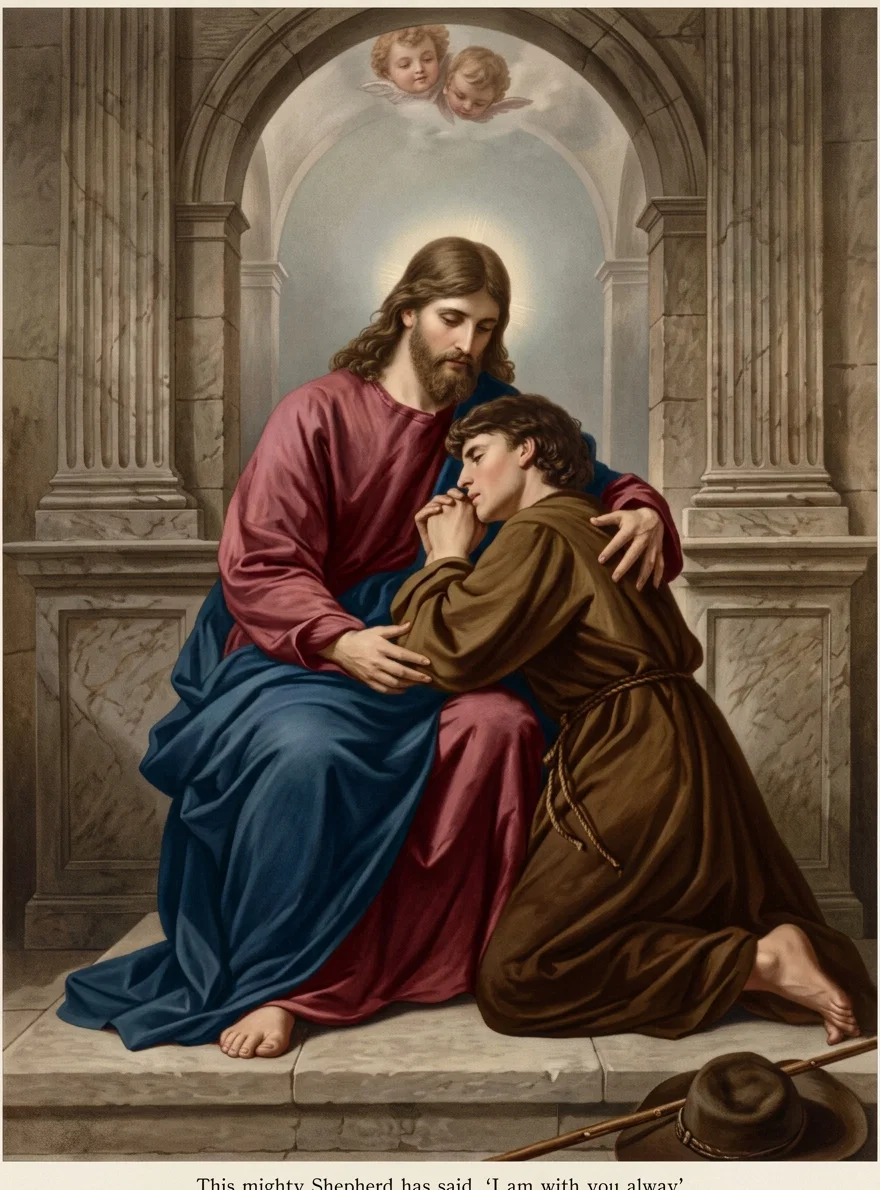
"This mighty Shepherd has said, 'I am with you alway'"
All these are waiting our need; and how can we feel desolate or alone, how can we feel poor, when this mighty Being says, "I am with you alway!"
Second, the Good Shepherd. Reader, did you ever see a flock of uncared-for sheep? Dirty their fleeces, torn with briers, roaming about on some rocky hillside trying to gain from the scanty herbage enough to sustain life. There is no water, for the brooks are dry in their stony beds, and the sheep have to walk weary miles in order to quench their thirst.
Now let me draw another picture.
It is that of a wide, sunny pasture-land. Clumps of trees here and there dot its broad expanse, forming cool, shadowy retreats beneath their ample branches. A broad, shallow brook flows quietly between green banks, where, after feeding on the sweet, cool grasses, the sheep may drink their fill, and lie down to rest.
As nightfall draws on, the shepherd comes and calls his sheep.
They lift their heads, and follow, while he leads them by a safe path. Into the quiet fold, with protecting walls, and feeling of perfect peace and security, the innocent, confiding animals are led, and lie down to a night of undisturbed and refreshing rest.
And this is the relationship that our Good Shepherd sustains to all who are His. "By Me," He says, "if any man enter in, he shall be saved, and shall go in and out, and find pasture."
The poor sheep in my first picture have no shepherd. They are left to take care of themselves. The prey of disease and hunger, in constant danger from prowling dogs, who devour the timid, helpless creatures, their condition is pitiable.4With those who belong to the fold of the Good Shepherd, all is different; for He loves them no matter how far they stray away from Him; and would give His precious life for either or any of them.
How can we feel uncared for when this mighty Shepherd has said, 'I am with you alway'?
Third, our Elder Brother. The sheep in our illustration are helpless, dependent creatures, not only unable to care for themselves, but quite incapable of reciprocating the loving interest that the good shepherd takes in them.
In the case of the elder and younger brother, it is very different. Here each receives as much as he gives. There are no barriers cast up by the difference in state, no limitations to that perfect understanding and tenderness which the relation implies.
We stand upon a perfect equality, united by the ties of blood.
To know how beautiful this relationship may be, it is only necessary to visit in a family where the big boy takes almost the place of the father to the younger brothers and sisters.
Notice how tenderly he rocks the baby, while the mother prepares supper; how the tiny golden-haired girlie of three summers comes with her tale of a hurt finger, and how the little boys crowd around him for the evening game. Then when slumber has come to the younger ones, watch him draw his chair to the light and patiently help the elders on with their lessons. When sickness comes, he is the tenderest of nurses, watching with sleepless eye until the danger is past; bearing the little convalescent in strong, gentle arms that never tire of their loving task.
Into his attentive ear are poured all the confidences that mother is too tired to hear, or father too much engrossed in business to attend to.
The faithful instructor of his brothers, the watchful guardian of his sisters! Is it any wonder that Jesus has chosen this simile to convey to our minds a small part of the many-sided relationship which He bears to His own? The fatherhood of God is not more wonderful than the brotherhood of Jesus; and it is only in Him that we meet, in all its perfection, one of the tenderest and most enduring of earthly ties.
Ennobled, purified, and uplifted by His having taken upon Him its cares, burdens, and responsibilities, brotherhood will always seem more to us from His having shared it with us.
And He has said—ah, how the words should thrill our hearts!—'I am with you alway.' 'Blessed be God for His unspeakable gift.'
Bearing Fruit for God
By Ellen G. White
By Mrs. E. G. White
THROUGH vital connection with Christ, the mysteries of the kingdom of heaven will be unfolded, and according to your capacity to receive, the Lord will bless you, if you are willing and obedient. But the young Christian may often be brought into strait places, and into trying circumstances, as were the children of Israel. Of old the Lord brought His people into these trying places that He might finally bring them blessing. He says: “And thou shalt remember all the way which the Lord thy God led thee these forty years in the wilderness, to humble thee, and to prove thee, to know what was in thine heart, whether thou wouldest keep His commandments, or no.” God knew what was in the hearts of His people before He brought trial upon them; but they were ignorant of the condition of their own hearts. Under trial and test their deficiencies were made manifest, and they felt indeed that they had not understood themselves. But the fierce flames of trial and temptation did not consume them, but rather worked for their purification and refinement, and aided them in the development of Christlike character.
Not to Shun Responsibilities
Let the young Christian seek to fulfil all the responsibilities that devolve upon him, and meet obstacles and difficulties with courage, keeping an eye single to the glory of God, that his profiting may appear to all. In whatever circumstances you may be placed, the Lord designs that you shall find His grace sufficient, that your love may abound more and more, that you may approve things that are excellent, and be filled with the fruits of righteousness which are by Christ Jesus, to the glory and praise of God. But unless the Christian continues to grow, he will retrograde, and his experience will become sickly and be fruitless of good. Jesus says, “Herein is My Father glorified, that ye bear much fruit.”
In order to bear much fruit, we must make the most of our privileges and opportunities, becoming more and more spiritually minded. We must put away all commonness, all pride, all worldliness, and daily receive divine aid. If you grow spiritually, you must employ all the means which the Gospel provides, and be prepared to gain in piety by the influence of the Holy Spirit; for the seed is developed from blade to full corn by unseen and supernatural agencies. The promise with which Jesus consoled His disciples just before His betrayal and crucifixion was that of the Holy Spirit; and in the doctrine of divine influence and agency, what riches were revealed to them! for this blessing would bring in its train all other blessings. The Holy Spirit breathes upon the soul who humbly rests on Christ as the author and finisher of his faith; and from such a believer fruit will come forth to life eternal. His influence will be fragrant, and the name of Jesus will be music in his ears, and melody in his heart.
How the Darkness Rolled Away
The Christian will be a savor of life unto life to others, altho he may not be able to explain the mysteries of his experience. He will know that when clouds and darkness compassed him about, and he cried to the Lord, the darkness was dispersed, and peace and joy were in the temple of the soul. He will know what it is to have the pardoning love of God revealed to the heart, to experience the peace that passes all understanding, to have praise and thanksgiving and adoration welling up in the soul to Him who has loved us, and washed us from our sins in His own blood. He has peace through Jesus Christ, and joy in the Holy Ghost. One with Christ, his soul is filled with submission to His will, and heaven is enshrined in his heart while he is enfolded in the bosom of infinite love. Christians of this order will bear much fruit to the glory of God. They will rightly interpret the character of God, and manifest His attributes to the world.
Jesus illustrated the compassionate mercy and tender love of God in many of the parables that He uttered; and in His own life and character He gave us an exhibition of infinite love. He represents Himself as the life of the world. He says, “Verily, verily, I say unto you, He that believeth on Me hath everlasting life.” “I am the living bread which came down from heaven; if any man eat of this bread, he shall live forever: and the bread that I will give is My flesh, which I will give for the life of the world.” “Verily, verily, I say unto you, Except ye eat the flesh of the Son of Man, and drink His blood, ye have no life in you.” There is no growth where there is no life. Where there is no life, there is no fruit.
How Shall We Know the Christ Life?
But how shall we know that we are in Christ?—We may know it by the character of our fruit. The fruit borne on the Christian tree is holiness of heart,—wholeness to Christ. God will be in the thoughts of the Christian, and he will love those for whom Christ died. He will follow in the path of self-denial, and his life will be fragrant with the love of Jesus. He will delight more in contemplation of the love of God than in anything earth can offer. He will prefer his plain, homely duties rather than romantic novelties, and will be satisfied with the place God has appointed him. When the heart is renewed by the Spirit of God, when consecration to God is maintained, there can be only love and thankfulness and praise in the heart, because Jesus is within, the hope of glory, and they live as seeing Him who is invisible. Christ is in him a well of water springing up unto everlasting life; and the true follower of Christ strengthens the good purposes of every one with whom he comes in contact. Such believers are living, growing Christians. They carry with them the fragrance of holiness, and are reaching on to the measure of the stature of men and women in Christ Jesus.
Decorative Divider
——**——
Christ’s Work in the Believer
“Christ proposeth to fill the hearts of His children, and teach them step by step what He can do, and how to produce His image and life in them until they are solid in the truth. He designs to bring them where they can rejoice evermore, and pray without ceasing, and in everything give thanks. This is not the work of a moment. As the soul goes down, truly Christ can lift it up.”
God Will Find Thee Work
By Robert Browning
GET thy tools ready; God will find thee work.—Browning.
Restoration of the Sabbath
By Roderick S. Owen
Bind up the testimony, seal the law among My disciples. Isa. 8:16.
THIS text not only teaches that God's law, like every other, has a seal, but that it has been robbed of it among His disciples. As we have found, the seal of the living God is the Sabbath, the sign of creative power, the memorial of the Creator's name.
Turning to the twentieth chapter of Exodus, and reading the law as spoken by Jehovah, we find, in all translations, that the seventh day is still set forth as the Sabbath of the Lord. Hence the law has not been really robbed of its seal.
But the great mass of His disciples, or followers, are keeping another day, the first day of the week, instead of the seventh; and the apostate power foretold in Dan. 7:25, in the falling away, has fulfilled that prophecy, which states that he would think to change the times and laws.
This he has done by teaching men to disregard the true Sabbath, and observe his substitute. But God has not allowed presumptuous hands to be laid upon His law to alter it; and having preserved it for us in its purity, He calls upon us to seal His law among His disciples by restoring in our practise the Sabbath of the Lord, and discarding the sign and substitute of the apostate power.
This makes the proclamation of the seventh-day Sabbath present truth, and its observance a test of our loyalty to God. Hence the remnant of God's people in the close of time are described as keeping the commandments of God. See Rev. 12:17 and Rev. 14:12.
In Isaiah 11 the work of Christ as the branch out of the roots of David is described. In speaking of Him as being lifted up for an ensign for both Jews and Gentiles, even for all nations, the thought is expressed that God's people will be so united that all envy shall depart, and they shall not vex one another, but shall stand united to oppose their enemies.
But in connection with this, God will set His hand a second time to recover the remnant of His people from Assyria, and from Egypt, and from Pathros, and from Cush, and from Elam, and from Shinar, and from Hamath, and from the islands of the sea. The remnant here referred to is shown to be composed of both Jews and Gentiles, even of all who will recognize Christ as God's ensign; for this ensign is to be set up for the nations, and to it are the Gentiles to seek, as well as the dispersed of Judah and the outcasts of Israel. In this the prophet foretold the gathering of the last of God's people from all over the then known world, even including the islands of the sea. Verse 15 shows that the deliverance will be as marvelous as was that of the children of Israel from Egypt. Since this is to take place all over the earth, the destruction of a tongue of the Egyptian sea, and the smiting of the river of Egypt, would, but little affect this deliverance; hence, we conclude that these are used in a figurative sense. Egypt stands for darkness and atheism.
Thus in the deliverance of the last of His people, God will flood the earth with His glory, and smiting all the streams of darkness, will open up a pathway of light before the remnant, and they shall pass through the floods of error dry-shod; and God will give such manifestation of His power that atheism will stop her mouth, and not one soul in all this world will question His existence. In verse 16 He tells us that there shall be a highway there, as it was to Israel when he came up out of the land of Egypt.
In Isa. 35:8 we are told that in the final deliverance, the highway will be the way of holiness, and the unclean shall not walk therein. But the text says there shall also be a way, and a highway. Christ is the way; and no man can walk in the highway of holiness except he walk in Christ; and this means to walk in the way in which He walked, for "he that saith he abideth in Him ought himself also so to walk, even as He walked," and that was in the way of His Father's commandments.
But this way is to be like the way He required Israel to walk in the day He brought them up out of the land of Egypt. In Ex. 16:4 we read, "Then said the Lord unto Moses, Behold, I will rain bread from heaven for you; and the people shall go out and gather a certain rate every day, that I may prove them, whether they will walk in My law, or no."
Thus we see that the way He required them to walk in was His law; and that there might be no mistaking it, He spoke it to them in thunder tones from the top of Mount Sinai, and wrote it for them upon two tables of stone. We also find that the especial point of test at that time was the Sabbath; and so it will be at the last. To this end the Sabbath question is fast crowded upon the attention of all people; and in a short time all earthly powers will combine on the one side to enforce Sunday observance, while on the other side will be the plain Word of God enjoining the seventh day, or Sabbath of Jehovah.
The question fraught with eternal destinies will then be forced upon each man, and he will be compelled to choose whom he will serve and recognize, the Creator or the creature; whether he will walk in God's way of holiness, or in the path dictated by man.
In Eze. 13:1-9 we find that certain teachers or prophets of Israel will be declaring certain things as coming from the Lord, when the Lord has not spoken, and by their fox-like cunning they will lead others to hope that they will confirm the word. This class God says shall not be found in the writing of the house of Israel—the Lamb's Book of Life—nor have part in the inheritance.
He states that there is a breach in the defense, so that the people can not stand in the battle of the day of the Lord; and these false teachers will not properly close the gap, or breach. In Rev. 12:17 and 14:12, the remnant of God's people, who are to stand in the final conflict, are brought to view, and that which enables them to stand is the commandments of God and the faith of Jesus. When we compare the law of God with the teachings of many of the leaders of Christendom, we find that they have made a breach in the law by taking out the seventh-day Sabbath and trying to make a substitute stand in its stead. At the same time, they are representing that when all will receive this law as changed by them, and make it the supreme law of all lands, the millennium will burst upon us with all its peace and glory.
In harmony with this, the tenth verse and onward tells us that these false teachers have seduced God's people, "saying, Peace; and there was no peace; and one built up a wall, and, lo, others daubed it with untempered mortar." The Catholic Church claims the right to change the law of God, and boldly asserts that they have done so by substituting Sunday, the first day of the week, for Saturday, the seventh day.
Dan. 7:25 states that a power would think to change times and laws. The Papacy has thought to do this by teaching contrary to it, and many Protestants are thinking to make it stand by daubing it with untempered mortar, which is arguments founded upon the word of man instead of God's Word. But the Scripture says, "Say unto them which daub it with untempered mortar, that it shall fall: . . . and ye shall be consumed in the midst thereof." Thus the fact is clearly stated that in the battle of the day of the Lord, the false wall, the ones who built it, and those who have daubed it, will all fall together.6
Restoration of the Sabbath
(Continued from page 5)
That the Sabbath is at least one of the breaches in this wall of defense, is clearly shown by Eze. 22:25-31, where the same subject is again dealt with; and in verse 26 we find these words: "Her priests have violated My law, and have profaned Mine holy things: they have put no difference between the holy and profane, neither have they showed difference between the unclean and the clean, and have hid their eyes from My Sabbaths, and I am profaned among them."
But the Scriptures clearly teach that God will find some who will repair the breach, who will restore the seal to the law, and who will stand in the battle of the day of the Lord; for we read in Isa. 58:10-14 as follows: "And if thou draw out thy soul to the hungry, and satisfy the afflicted soul; then shall thy light rise in obscurity, and thy darkness be as the noonday: and the Lord shall guide thee continually, and satisfy thy soul in drought, and make fat thy bones: and thou shalt be like a watered garden, and like a spring of water, whose waters fail not. And they that shall be of thee shall build the old waste places: thou shalt raise up the foundations of many generations; and thou shalt be called, The repairer of the breach, The restorer of paths to dwell in. If thou turn away thy foot from the Sabbath, from doing thy pleasure on My holy day; and call the Sabbath a delight, the holy of the Lord, honorable; and shalt honor Him, not doing thine own ways, nor finding thine own pleasure, nor speaking thine own words: then shalt thou delight thyself in the Lord; and I will cause thee to ride upon the high places of the earth, and feed thee with the heritage of Jacob thy father: for the mouth of the Lord hath spoken it."
Also through the prophet Jeremiah God admonishes us, saying: "Stand ye in the ways, and see, and ask for the old paths, where is the good way, and walk therein, and ye shall find rest for your souls. But they say, We will not walk therein." Jer. 6:16.
When God shall have found the last one who will repair the breach, who will turn away his foot from trampling upon the Sabbath, who will walk in the good old way, the path marked by the feet of prophets and apostles, even the way of His commandments, in which the Saviour trod; when the remnant shall be made up who keep the commandments of God and the faith of Jesus,—then Christ will come. Then the saints will be gathered from all nations, and caught up in the clouds to meet the Lord in the air. O, wondrous deliverance!
For them the desert shall blossom like the rose, and be glad; and a highway shall be there, the way of holiness; and they shall walk therein. For "from one new moon to another, and from one Sabbath to another, shall all flesh come to worship before Me, saith the Lord."