Your ShelfYour Projects

Review and Herald, Vol. 88, No. 35.

Not as I Will

Review and Herald

Aug 31, 1911

Review and Herald Publishing Association · Takoma Park Station, Washington, D. C. · Aug 31, 1911

Not as I Will

Blindfolded and alone I stand With unknown thresholds on each hand; The darkness deepens as I grope, Afraid to fear, afraid to hope; Yet this one thing I learn to know Each day more surely as I go, That doors are opened, ways are made, Burdens are lifted or are laid, By some great law unseen and still, Unfathomed purpose to fulfil, “Not as I will.”
Blindfolded and alone I wait; Loss seems too bitter, gain too late; Too heavy burdens in the load, And too few helpers on the road; And joy is weak, and grief is strong, And years and days so long, so long! Yet this one thing I learn to know Each day more surely as I go, That I am glad the good and ill By changeless law are ordered still, “Not as I will.”
“Not as I will,” the sound grows sweet Each time my lips the words repeat; “Not as I will!” the darkness feels More safe than light when this thought steals Like whispered voice to calm and bless All unrest and all loneliness. “Not as I will!” because the One Who loved us first and best has gone Before us on the road, and still For us must all his love fulfil— “Not as we will.”
—Helen Hunt Jackson.

What They Say of the “Protestant Magazine” for the Third Quarter, 1911
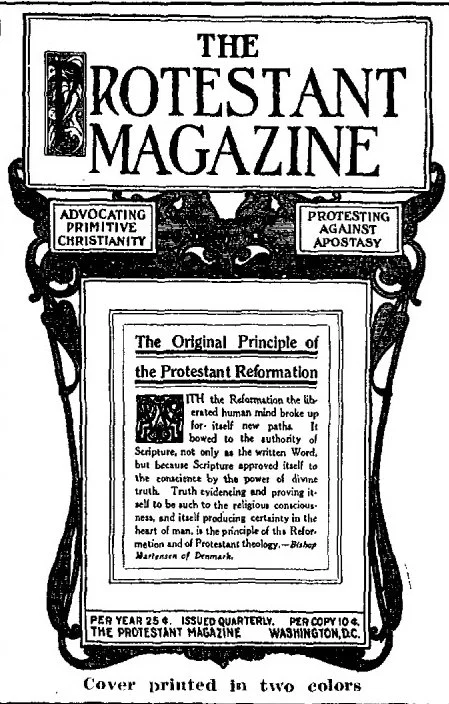
ATLANTIC UNION CONFERENCE: It seems to me that the “Protestant Magazine” becomes richer and better with every issue. As we near the great crisis, no doubt this will be more apparent. No. 3 is a splendid number; and if it could be placed in the hands of Protestants everywhere, it would certainly open their eyes to the danger that is threatening our nation. We shall do what we can to give it a wide circulation in this field. W. B. WHITE, President.
WESTERN CANADIAN UNION CONFERENCE: The “Protestant Magazine,” No. 3, is filled with important matter that ought to be read by every Protestant in the world, and especially in North America. This magazine can be used in any country with good effect. Its circulation means more in the near future than many realize. H. S. SHAW, President.
SOUTHERN UNION CONFERENCE: No. 3 of the “Protestant Magazine” is an excellent number. It should not only be read, but studied by every minister. I keep every number for reference. This is a good number to circulate among reading people. C. F. McVAGH, President.
Cover printed in two colors
CANADIAN UNION CONFERENCE: A very excellent number. Thousands of people should read the article “Making America Catholic,” also “The Double Doctrine of the Church of Rome.” I shall do all I can for the circulation of this excellent number. WM. GUTHRIE, President.
NORTHERN UNION CONFERENCE: There are a number of splendid articles in this number, which will be much appreciated when read. The “Protestant Magazine” has become a sentinel upon the battlements, giving warning of the approach of danger, and many outside our own church have recognized it as such. Will do what I may be able to increase its circulation. T. D. GIBSON, Secretary.
LOUISIANA CONFERENCE: There is no better champion of the cause of true Protestantism than this truth-filled magazine. It is a veritable beacon-light of freedom, exposing the designs of popery in sapping the foundations of our republic. Truly the “Protestant Magazine” is needed to stem the tide Romeward that is carrying away its thousands today. E. L. MAXWELL, President.
WISCONSIN CONFERENCE: I think No. 3 is the best number you issued. The “Protestant Magazine” is good all the time, from cover to cover. The articles are clear, forceful, and convincing, and the magazine should be placed in every home in the land. W. H. THURSTON, President.
IOWA CONFERENCE: Have made a careful examination of the third quarter issue of the “Protestant Magazine” for 1911, and am more than pleased with it. This magazine is faithfully performing its appointed work as a watchman, and is giving the trumpet no uncertain sound. M. N. CAMPBELL, President.
ARIZONA CONFERENCE: The “Protestant Magazine” has its mission. The rapid decay of professed Protestantism, and the sudden, bold attitude of the Papacy in the United States, make the duty plain for some one to “cry aloud” and tell men everywhere the true meaning of these eventful months, and also that there is more to follow. H. G. THURSTON, President.
NORTHERN NEW ENGLAND CONFERENCE: The editor has evidently taken special pains with No. 3 of the “Protestant Magazine.” I consider this magazine one of our best publications. W. H. HOLDEN, President.
EAST PENNSYLVANIA CONFERENCE: I find the last issue of the “Protestant Magazine” to be especially good. I consider this magazine one of the very best papers we publish. It is to the point, and timely. It is a journal especially designed to educate, and enable one to know why. W. H. HECKMAN, President.
EAST MICHIGAN CONFERENCE: I am delighted with the contents of the “Protestant Magazine,” No. 3. Certainly no mistake was made in launching this new magazine. I feel that it is filling a most important place in our work, and that it should be read and used very largely by our people. E. K. SLADE, President.
DISTRICT OF COLUMBIA CONFERENCE: Have carefully examined the “Protestant Magazine” for the current quarter. In my opinion it is the best number ever issued. I sincerely hope that the vital issues set forth in this number can be brought to the attention of every lover of religious and civil liberty. J. L. McELHANY, President.
WYOMING CONFERENCE: I am decidedly of the opinion that the issue for the third quarter is a valuable and important number, worthy of having a wide circulation. I regard the “Protestant Magazine” very highly. E. A. CURTIS, President.
ARKANSAS CONFERENCE: No. 3 will do a good work. The “Protestant Magazine” is better every time it comes out. Will do all I can for it. J. W. NORWOOD, President.
KENTUCKY CONFERENCE: I believe this issue is the best out, and wish it could be placed in every home in the land. Every Seventh-day Adventist ought to read this number, and endeavor to place it in the hands of his neighbors. B. W. BROWN, President.
WESTERN NEW YORK CONFERENCE: The “Protestant Magazine” has its specific work. It can enter a field that none of our other publications are exactly fitted for. I feel a growing interest in its circulation. H. W. CARR, President.
BRITISH COLUMBIA CONFERENCE: This number of the “Protestant Magazine” appeals to me so forcibly that I have decided to send for 100 copies for my own personal use. I will sell them after office hours. I will do all I can to interest our people in giving this number an extra wide circulation. ANDREW RAEDEL, Secretary.
OHIO CONFERENCE: Have carefully scanned the pages of the “Protestant Magazine” for the current quarter, and find it brimful of important matter. Any one who may be in doubt as to the tendency of professed Protestantism toward Roman Catholicism, should read this issue. Do not see how any one can be up-to-date without reading the “Protestant.” J. I. CASSELL, Secretary.
GREATER NEW YORK CONFERENCE: The subject-matter is of great importance to Protestants, also a shining light to Catholics. Like John the Baptist, it is a voice upholding the principles of Jesus. F. M. DANA, Secretary.
VIRGINIA CONFERENCE: After a careful perusal I must say I consider the “Protestant Magazine,” No. 3, worthy of a wide circulation. It has a field distinctly its own. A. M. NEFF, Secretary.
SOUTH DAKOTA CONFERENCE: A number of exceptional value. We are anxious to have it placed in the hands of all the clergy of South Dakota, as well as other leaders among the people. NELLIE B. UNDERWOOD, Miss. Sec.
TENNESSEE RIVER CONFERENCE: I consider this the best number that has been issued. T. E. PAVEY, Secretary.
NORTH MICHIGAN CONFERENCE: The last number of the “Protestant Magazine” stands true to its calling. It merits the hearty support of all true Protestants. J. H. NIEHAUS, Missionary Secretary.
If you have not seen the last number of this quarterly magazine, send 10 cents for the same to your conference tract society. Or, better still, send $2 for 50 copies to distribute among your neighbors and friends.
The Aug. 18, 1911, issue of the “Catholic Columbian,” of Columbus, Ohio, contains an editorial one foot long devoted to an attack upon the “Protestant Magazine” and two other Protestant publications. This fearless quarterly is making thousands of friends, however, among all thinking Protestants. Lists of from 100 to 600 yearly subscriptions are being received from individuals and Protestant societies in various parts of the country. Remember that for introductory purposes, we send the magazine for one year to ten different names and addresses for only $1.50.
Address all orders to your conference tract society. If you do not know the address of the tract society, write to the publishers of this paper.

THE WORK AND THE WORKERS

A recent Saturday's mail, opened the next morning, contained orders for 6,911 copies of "Life and Health," "Liberty," and the "Protestant Magazine."
Rush telegraphic orders for one thousand or more copies of our magazines are frequently received at our office, several of them being occasionally received in one day.
We recently received two courteous notes from the White House Office, acknowledging, with thanks, the receipt of a bound volume and current numbers of the "Protestant Magazine."
One of the latest recruits to our large army of "Life and Health" agents is a well-known attorney and counselor-at-law, residing in Evansville, Ind. This gentleman recently sent us several yearly subscriptions.
A very interesting two-page letter was recently received by the manager of our magazine department, from Lyman Abbott, editor in chief of the "Outlook," with reference to the "Protestant Magazine" and the principles of Protestantism.
Referring to an order for 350 copies of "Life and Health" sent in by a young girl, the secretary of the New Jersey Tract Society says: "This agent is a girl about fourteen or fifteen years of age. She sold 50 copies in two hours on Saturday night."
"Liberty" is now being mailed regularly to all the legislators, governors, and leading public officials of 23 States. We trust that in the near future the senators and representatives of all the States will have the privilege of reading this valuable magazine.
A few days ago we sent 10 copies of "Life and Health" "on suspicion," to one of our sisters whom we believed would make a good worker. The following interesting letter has just been received from this new worker: "I received the 10 copies 'on suspicion,' as you wrote me, and this morning, with the help of the Lord, sold them all; also took one yearly subscription. Find enclosed money-order to pay for the same. Please send 20 copies each month until further notice is given." We are sure there are thousands of other good Seventh-day Adventist sisters who could do as well as this one if they would only try.
According to recent reports of periodical sales received from our workers in China, our American magazine agents in this land of plenty will do well if they keep up with the beginners in that far-off, difficult field. In a recent letter from Dr. A. C. Nelson, assistant superintendent of the China Union Mission, he says: "One of the Hankow men sold 600 papers in three days. On his best day he sold 225 copies. He has had no special training. You remember the Korean,—the one with the cropped hair, and hat and clothing of his own manufacture. We set him at work selling our paper here in Shanghai. In the past all our Chinese brethren who have tried it have made signal failures, but this man has been selling for three days. He sells the papers for two cents each, both the Mandarin and Wenli editions. The first day he sold 27, the next day 63, the next 23. He gets along with the police and every one generally."
In a letter just received by the manager of our magazine department, from Brother B. A. Roberts, of the Seventh-day Adventist Mission Press, Shanghai, China, he says:—"I just heard the other day that there was an earthquake in the southern part of China, and that one of our canvassers took advantage of it, and sold over 700 copies of our paper in one hour. The reason he did not sell more was because he ran out of papers. We printed 13,000 copies of our April Chinese 'Signs of the Times,' 12,000 of the May number, 20,000 of the June, 25,000 of the July, and 32,000 of the August. You see we shall soon be up to some of our home papers in the United States. You may ask what it is that causes this increase. Well, it is just this: We are turning out the truth, and there are some people here in China who want it. I would not be surprised if our editions ran up to the 50,000 mark before the end of the year. What we need here in China is a good man to train our workers to sell the literature."
May these encouraging reports from our little handful of laborers in China stir our home magazine agents to greater zeal, activity, and success in this more favored field.

The Blessed Years of Heaven

L. D. SANTEE
I AM growing older, older, As the years are passing by, But my hopes have ne'er grown colder, Of a home in yonder sky; Even now that hope is dearer Than the joys that earth has given, And I feel each day I'm nearer To the blessed years of heaven.
Beautiful in all their glory Are the mansions I shall see; Wondrous is the thrilling story That the Lord has died for me. All the prophecies are clearer That the sacred Word has given; I am only so much nearer To the blessed years of heaven.
Let young manhood's season leave me, And old age steal on apace, All these changes can not grieve me, Or their shadows cloud my face; For the blessed hope supernal To my waiting heart is given,— I shall share the joys eternal, In the blessed years of heaven.
O, the blessed years of heaven, Where no life shall e'er grow old, Where the gleaming walls are jasper, And the streets are paved with gold! We shall meet the loved and loving, Where no ties will e'er be riven, There shall gladness reign eternal In the blessed years of heaven.
Moline, Ill.

Paul at Ephesus

MRS. E. G. WHITE
While Apollos was preaching at Corinth, Paul fulfilled his promise to return to Ephesus. He had made a brief visit to Jerusalem, and had spent some time at Antioch, the scene of his early labors. Thence he had traveled through Asia Minor, “over all the country of Galatia and Phrygia,” visiting the churches which he himself had established, and strengthening the faith of the believers.
In the time of the apostles, the western portion of Asia Minor was known as the Roman Province of Asia. Ephesus, the capital, was the great commercial center of the West. Its harbor was crowded with shipping, and its streets were thronged with people from every country. Like Corinth, it presented a promising field for missionary effort.
The Jews, now widely dispersed in all civilized lands, were generally expecting the advent of the Messiah. When John the Baptist was preaching, many, in their visits to Jerusalem at the annual feasts, had gone out to the banks of the Jordan to listen to him. There they had heard Jesus proclaimed the Promised One, and they had carried the tidings to all parts of the world. Thus had Providence prepared the way for the labors of the apostles.
On his arrival at Ephesus, Paul found twelve brethren, who, like Apollos, had been disciples of John the Baptist, and, like him, had gained some knowledge of the mission of Christ. They had not the ability of Apollos, but with the same sincerity and faith, they were seeking to spread abroad the knowledge they had received.
These brethren knew nothing of the mission of the Holy Spirit. When asked by Paul if they had received the Holy Ghost, they answered, “We have not so much as heard whether there be any Holy Ghost.” “Unto what then were ye baptized?” Paul inquired; and they said, “Unto John’s baptism.”
Then the apostles set before them the great truths that are the foundation of the Christian’s hope. He told them of Christ’s life on this earth, and of his cruel death of shame. He told them how the Lord of life had broken the barriers of the tomb, and risen triumphant over death. He repeated the Saviour’s commission to his disciples: “All power is given unto me in heaven and in earth. Go ye therefore, and teach all nations, baptizing them in the name of the Father, and of the Son, and of the Holy Ghost.” He told them also of Christ’s promise to send the Comforter, through whose power mighty signs and wonders would be wrought, and he described how gloriously this promise had been fulfilled on the day of Pentecost.
With deep interest and grateful, wondering joy, the brethren listened to Paul’s words. By faith they grasped the wonderful truth of Christ’s atoning sacrifice, and received him as their Redeemer. They were then baptized in the name of Jesus; and as Paul “laid his hands upon them,” they received also the baptism of the Holy Spirit, by which they were enabled to speak the languages of other nations, and to prophesy. Thus they were qualified to labor as missionaries in Ephesus and its vicinity, and also to go forth to proclaim the gospel in Asia Minor.
It was by cherishing a humble, teachable spirit that these men gained the experience that enabled them to go out as workers into the harvest-field. Their example presents to Christians a lesson of great value. There are many who make but little progress in the divine life, because they are too self-sufficient to occupy the position of learners. They are content with a superficial knowledge of God’s Word. They do not wish to change their faith or practise, and hence make no effort to obtain greater light.
If the followers of Christ were but earnest seekers after wisdom, they would be led into rich fields of truth, as yet wholly unknown to them. He who will give himself to God as fully as did Moses, will be guided by the divine hand as verily as was the great leader of Israel. He may be lowly and apparently ungifted; yet if with a loving, trusting heart he obeys every intimation of God’s will, his powers will be purified, ennobled, energized, and his capabilities will be increased. As he treasures the lessons of divine wisdom, a sacred commission will be entrusted to him; he will be enabled to make his life an honor to God and a blessing to the world. “The entrance of thy words giveth light; it giveth understanding unto the simple.”
To-day many are as ignorant of the Holy Spirit’s work upon the heart as were those believers in Ephesus; yet no truth is more clearly taught in the Word of God. Prophets and apostles have dwelt upon this theme. Christ himself calls our attention to the growth of the vegetable world as an illustration of the agency of his Spirit in sustaining spiritual life. The sap of the vine, ascending from the root, is diffused to the branches, sustaining growth and producing blossomsand fruit. So the life-giving power of the Holy Spirit, proceeding from the Saviour, pervades the soul, renews the motives and affections, and brings even the thoughts into obedience to the will of God, enabling the receiver to bear the precious fruit of holy deeds.
The Author of this spiritual life is unseen, and the exact method by which that life is imparted and sustained, is beyond the power of human philosophy to explain. Yet the operations of the Spirit are always in harmony with the written Word. As in the natural, so in the spiritual world. The natural life is preserved moment by moment by divine power; yet it is not sustained by a direct miracle, but through the use of blessings placed within our reach. So the spiritual life is sustained by the use of those means that Providence has supplied. If the follower of Christ would grow up “unto a perfect man, unto the measure of the stature of the fulness of Christ,” he must eat of the bread of life, and drink of the water of salvation. He must watch and pray and work, in all things giving heed to the instruction of God in his Word.
There is still another lesson for us in the experience of those Jewish converts. When they received baptism at the hand of John, they did not fully comprehend the mission of Jesus as the sin-bearer. They were holding serious errors; but with clearer light, they gladly accepted Christ as their Redeemer, and with this step of advance came a change in their obligations. As they received a purer faith, there was a corresponding change in their life. In token of this change, and as an acknowledgment of their faith in Christ, they were rebaptized in the name of Jesus.
(Concluded next week)

The Sanctuary Service

Many Voices—No. 3

The Sanctuary Service

GEO. I. BUTLER
BEFORE considering the work and position of Christ in the heavenly sanctuary, it may be proper to notice some facts in Bible history bearing upon the subject of the Old Testament system of priesthood service, the sanctuary, etc.
From the fall of man till the erection of the sanctuary by Moses, B. C. 1491, according to Bible chronology,—that is, some twenty-five hundred years,—there was no temple building on earth, no sanctuary of worship on earth, and no order of priesthood among men but the patriarchal. That is to say, The head of each family, or possibly the head of each tribe in some cases, officiated in the simple act of offering sacrifices, and presided in religious rites and ceremonies and in the worship of God. Noah did this as they came out of the ark; Abraham and Jacob also made such offerings. Evidently this was the constant and continual custom of all who feared God during this long period of twenty-five hundred years. Gen. 8:20; 15:9-12; 22:1-13; 35:1-7.
The first instance mentioned of offering sacrifices to God was in the case of Abel. “And at the end of days it came to pass, that Cain brought of the fruit of the ground an offering unto the Lord. And Abel, he also brought of the firstlings of his flock and of the fat thereof. And the Lord had respect unto Abel and to his offering: but unto Cain and to his offering he had not respect. And Cain was very wroth, and his countenance fell. And the Lord said unto Cain, Why art thou wroth? and why is thy countenance fallen? If thou doest well, shalt thou not be accepted? and if thou doest not well, sin lieth at the door.” Gen. 4:3.
The result was that proud Cain slew his brother. The offering by Cain of the fruits of the field was simply an expression of gratitude for the blessing of life. But the offering of a lamb by Abel and the shedding of its blood was a recognition of the fact that he was a sinner, lost and undone, without a substitute. His life was forfeited because of sin. An innocent lamb was presented by the penitent sinner, thus showing his faith in the Lamb of God, “which taketh away the sin of the world,” and by that act recognizing the fact that he could not save himself by his own righteousness. Cain made no such confession of sin, and felt no need of a Saviour; hence sin lay unforgiven at his door. There have been many Cains in the past, and there are many in the present, who feel not the need of a Saviour. In this first recorded sacrifice the great facts of the gospel of Christ are shadowed forth. True repentance and faith in Christ, as manifested in obedience to God, are now, and have ever been since the fall of man, the fundamental truths of the Christian religion.
Here is the remedial system, recognized by faith in the remotest ages. For twenty-five centuries these great facts were being constantly acknowledged by all true worshipers of God. Then came additional light to the people of God—the chosen people—in the sanctuary and its services. All the truths of the past were still held by them and constantly practised. But in the sanctuary services additional light was given. What was this light?—A knowledge of God's plan for the final disposition of sin in all his universe. He gave this light in an object-lesson, a yearly round of services which was a miniature type, or representation, of heavenly things. The type was a round of services each year constantly repeated. The sanctuary commanded by God to be made (Exodus 24) was composed of two apartments, the holy place and the most holy place, or as it was sometimes called, the holy of holies. In the first apartment the regular services were carried on every day in the year save one, repentant sinners bringing their victims to the door of the tabernacle. The sinner laid his hand on the victim’s head, confessing his sins over him, thereby conveying in figure his sins to the victim, which was then slain, and its blood was sprinkled in the sanctuary, conveying those sins to the sanctuary itself, there to remain till the last day of the year, the tenth day of the seventh month, the great day of atonement. This was the only day of the year when the collected sins brought in by figure could be disposed of. This, in brief, was done by the high priest entering into the most holy place (after making offerings for himself and family) and offering what was called the Lord’s goat, confessing the sins of the people, and sprinkling its blood in the sanctuary and on the mercy-seat, thus cleansing the sanctuary and removing the sins conveyed there in figure to the other goat chosen, called the scapegoat, confessing over it the sins of the people. This goat was led away by the hand of a fit man into the wilderness, and there let go. Thus very briefly we have tried to describe the main features of the yearly round of services in the earthly sanctuary. Every intelligent Jew will tell us that this great day of atonement was to that people “the day of judgment.”
This yearly round of services in the earthly sanctuary, we are informed by the Scriptures, represents the services carried on in the heavenly temple above. It was a feeble type of the greatest things occurring in the great scheme of redemption. During all the years of human history a record has been kept and preserved in the heavenly archives. Every one of those sins must be atoned for; every person has an account to settle with God. In the very last days of time the judgment will sit, and the books will be opened. The cleansing of the heavenly sanctuary will take place. All those books will be examined, and a decision will be made, eternal in its consequences. Sin will be forever removed from the heavenly sanctuary, and the responsibility of sin will be placed where it really belongs, on the head of the anti-typical scapegoat, which is no other than Satan himself.
The saints of God, those who have truly repented of their sins and have been true to him, will have their sins blotted out, and will be saved to all eternity, while unrepentant sinners will suffer for their own sins. Christ is the true Substitute shadowed forth by every sacrificial offering during all the ages of the past. Only the righteous choose to take Jesus as their Substitute. While all have the same privilege, only a small portion really make the choice, and the larger portion die in their sins, with no Saviour; and must suffer eternal death—the true penalty for their sins. The righteous are forgiven because they accept Christ as their Saviour after truly repenting of their sins; so it is but just that Satan shall become the scapegoat, upon whom these sins are placed in their final disposition. Thus the records of the sins of the whole world are examined, passed upon, and finally settled to all eternity. For this reason the sanctuary services under the Aaronic priesthood became a wonderful object-lesson to the children of men.
Bowling Green, Fla.

Its Necessary Adjunct

Tracings of the Prophetic Gift—No. 17

Its Necessary Adjunct

J. O. CORLISS
FROM what has thus far been said, it will hardly be necessary to state that true prophetic instruction is by no means of an independent order. God being over and above all things in mortals, his prophets must ever speak and teach in accordance with his will. To do otherwise would be to reveal one's disloyalty to Jehovah, and place him in the ranks of heaven's pronounced enemies. The Logos, or Word, being that from which creation sprang (Ps. 33:6), and that by which all things are upheld (Heb. 1:3), it must hold first place in the guidance of minds in the path of its operations.
Again, Christ having come to earth as that creative and sustaining Word, sent by, and with the authority of, High Heaven, he must be acknowledged as the principal actor in the race for life. The true prophet's words must therefore be the “testimony of Jesus Christ,” the eternal Word. So to pay heed to the utterances of a loyal prophet, is not to worship the prophet, nor to pay undue respect to him, but to reverence the word of the Lord in his tongue, which the Holy Spirit causes him to speak. 2 Sam. 23:2.
The prophet's work, therefore, must not only find its limit within the bounds of the original Word, but it must look to the same end as that Word. To do this, the prophet is bound to be controlled by the same Spirit which underlies and animates that Word. This clothes the prophet with the same power of mind penetration that the Word contains. How great this power is may be learned from the following acknowledged authority: “The word of God is quick [living], and powerful [energetic], and sharper than any two-edged sword, piercing even to the dividing asunder of soul and spirit, and of the joints and marrow, and is a discerner of the thoughts and intents of the heart.” Heb. 4:12.
To gather the force of this text, one should consider the illustrative picture it contains. It is said that the ancient Hebrew custom was to have all flesh meats officially pronounced free from disease before the flesh was eaten. This was the task of the priest. His examination was to cover more than a cursory observation of the beast's heart, liver, and other viscera; he was to sever the leg joints, for the examination of the lubricating substance, and even to penetrate to the very marrow, in search of physical contamination.
The text uses this figure to convey the searching power of the Word, showing that it penetrates to the innermost depths of soul and spirit to search for sin's corruption. It thus becomes a discerner—that is, a discriminating and thorough judge—of one's thoughts, and also of his secret intentions. This being a preeminent quality of the Word itself, in order for the prophet to penetrate beyond the surface of that Word, and so be able to teach its subtle significance to the obtuse human heart, he must be endowed with a special dispensation for that purpose. The same illuminating vision will also grant a spiritual discernment of erring minds to whom the prophet may be divinely sent, because this is the power of the Word which the prophet is sent to unfold.
This may seem an overdrawn picture; but judged by historical statements in Holy Writ, it appears a sane and safe conclusion. One reference will suffice on this point. At a time when the king of Syria went to war with Israel and secretly laid careful plans to overthrow that people, he found that all his schemes were fully anticipated and provided against by the king of Israel. Being greatly troubled about the matter, an investigation was made which revealed that the prophet Elisha had kept his people warned of every design upon them. The conclusion was therefore drawn—and rightly, too,—that the prophet was a able to tell the king of Israel the very words his enemy spoke in his own bed-chamber. 2 Kings. 6:8-12.
This was further made clear when, with his attendant, the prophet went forth to the limit of the city, where they saw the Syrian host spread abroad before them. The young man was greatly alarmed at the sight, and cried: “Alas, my master! how shall we do?” In calmness the prophet replied: “Fear not: for they that be with us are more than they that be with them.” The prophet was able to answer thus because his inner vision viewed a sight which was till then hidden from the young man. To give his attendant confidence, the prophet asked the Lord to open his companion's eyes to see the true situation. Then the young man saw the mountains round about lined with chariots of war in heavenly array.
In the same way God opens blind eyes to behold wondrous things out of his law. Ps. 119:18. The fact that men in sin are in darkness, and need the help of God's Spirit to give them understanding, is proof that he provides the remedy needed. It is not designed to ignore in these studies the gift of a personal Holy Spirit for every one. It is well known that his work is to convince of sin, and of righteousness, and of judgment. John 16:8. All will readily grant that the Spirit does his office work in darkened minds, calling them to repentance. But he points all these to the Word for definite instruction in the way of reform.
The Word, then, is the foundation of righteousness. But even though the Spirit has said to the individual, “Repent,” God does not leave him to grope his way alone through the apparent difficulties of understanding the inner sense of the Word, especially the requirements of the fundamental rule of all righteousness. The Spirit of God was just as available to the Jews in their day as he is to the present generation. But after they rejected the voice of their prophets, they wandered in darkness farther and farther from God, because they could not of themselves, with all their zeal, see that the life of Christ was in the law, and that he was the real aim and purpose of its teaching. Rom. 10:1-4.
Prophets have not been in the habit of calling attention to themselves, but they have invariably pointed souls to God and to the principles of his government. Their work has been the same as that assigned to Christ, to “magnify the law and make it honorable.” Isa. 42:21. They could not help doing this, since they are commissioned to bear the “testimony of Jesus” to the world. The law and the prophets being inseparable in purpose, it follows that when the law shall have been dishonored by persistently substituting a man-prescribed duty in the place of a divinely and definitely marked service enjoined by the law, God himself is dishonored, and his prophetic entreaties to such a people cease.
Especially must this be the case with a people who openly boast of havingabolished a requirement which they say was instituted, and especially consecrated to God's honor, as was the Sabbath of the fourth commandment. But having gone so far in dishonoring Jehovah, the head of the papal church has assumed to speak in the place of God in the earth, as his divinely appointed prophet.
The Papacy, having departed from the principles of God's law, has shown that it, together with the whole system it represents, is under the censure of that Word to which true prophets ever direct the minds of men. God is, however, zealous to maintain his honor against all competitors, not from a selfish motive, but because when men lose sight of his power and authority, they place themselves beyond the pale of salvation. He therefore sends a special message to the last living generation, asking them, in view of the judgment they must soon meet, to “fear God, and give glory to him.” Rev. 14:6, 7.
The thought of the text is further extended by exhorting all to “worship him that made heaven and earth, the sea, and the fountains of waters.” This implies that the world has been worshiping one not entitled to the honor,—one who has in some way robbed the Creator of his own standing in men's minds. This calls for reform which will cause men to change masters. What will such a reform involve?—Much, indeed. But this phase must wait for another study.
Mountain View, Cal.

God's Love Story

EARLE ALBERT ROWELL
Probably all who read this have indulged in the pernicious habit of reading, at some time, the so-called love story, the silly and nauseous sentimentalism of Satan's manufacture and inspiration. Millions read this trash, and think it profitable.
Great genius has been lavished upon the love story, to captivate the world, to enrich the author and build up his fame. My young friend, does your heart yearn for reading that has pure love in it, that feeds the longings of the heart?
There is only one love story in the world that is of supreme value. This one is worth all the others put together, because it is the love story of God, inspired by God. What can so thrill the imagination as the thought of God loving? When we read of some noble sacrifice made by the hero of some story, how it thrills our soul! But in the love story of God we read of a Sacrifice so much greater than any recorded in the highest flights of fancy, that it is like trying to outshine the midday sun with a match.
Would you read a love story in which there is a hero worthy of imitation? then read of the divine Hero who bravely suffered a most agonizing death for you and me. What hero is there to compare with God's Hero?
“God so loved the world.” Ah, do you want to read of love? Where is there love to compare with this? You will not want to hide this love story under the table when your mother enters the room unexpectedly.
Here is love unfathomable, infinite. Here is love that satisfies every longing of the heart. Do you hunger to read a love story? Then read God's love story; for “blessed is he that readeth.”
Portland, Ore.
Continue reading: Awake, Thou That Sleepest