I AM glad to tell you that we have reached the mission at Malamulo safely, and are gradually getting into mission life. We have now been here a fortnight, and are perfectly well in spite of our long trip in the heat.
Soon after leaving the boat we passed from Portuguese to British territory, and at Port Herald, when passing the customs, had to answer a good many questions. “Are you connected in any way with the leaders of the Nyasaland uprising?”—“No.” “Have you had any correspondence with them?”—“No.” Mr. Hurlow was very emphatic in these two answers. “Are you Seventh-day Adventists?”—“Yes.” “Are you British?”—“Yes.” We are allowed to pass, and we breathe a silent prayer of thankfulness, for we should not like to be sent back now that we are so near the end of our journey.
We find Malamulo Mission is a large station in a splendid position, with plenty of flowers, fruit, and vegetables, and best of all, a good work going on among the natives. The teachers’ training school, which has been in session the last two months, has closed today, September 28. The outschools had their long holiday, and all the teachers came to the mission to receive further instruction. Some brought their wives, so a meeting on Bible hygiene was held every morning for these women.
For the teachers themselves, each day was full of work. The bell rang at five-thirty each morning, and at six they met for morning worship in the schoolhouse (which is also the church). From that time till about 8:30 P. M. they were busy, studying to make themselves better teachers and better followers of Christ. There were about sixty teachers in the training school, and they seem very earnest young men. A number of them speak English a little, though they understand it better than they can speak it. Two or three head teachers who remain on the mission act as interpreters at meetings, etc., and they do it splendidly. They are good, faithful boys, and work well.
Last Sabbath we had a baptismal service, Brother Ellingworth officiating; twenty-eight were baptized. Some were students, and some were assistant teachers. They stood in a long row on the bank of the stream, first the women, then the married couples, then the men and boys. The wife of a native teacher, a good Christian woman, helped the women out of the water, and a native teacher helped the men; everything was done just as at a white people’s baptism. The singing and the praying were in the Man’ganja language, the people all joining in heartily.
On Sunday we celebrated the ordinances in the church. The new members were received, also Miss Fourie, Mr. Hurlow, and myself. It was good to join in the ordinances. The women all seemed to understand their meaning. Two native head teachers acted as deacons, and carried round the bread and wine. One could not find a quieter, more reverent and earnest congregation anywhere, and the church was full. Brethren Robinson and Ellingworth officiated.
Today, the last day of school, there was a wedding, when one of the teachers was married to one of the mission girls. Miss Edie and I were appointed to decorate the church, but when we arrived we found the bridegroom’s colleagues were already there, and, according to their ideas of decoration, were doing very well. You should have seen the result! With a little advice and assistance from Miss Edie and myself, order was brought out of confusion, and the room made to look very nice. After the wedding, food was served to all the teachers and their wives, also to the villagers and headmen who were present. These people seem to know when anything of interest is going to occur at the mission, and they are sure to be present in large numbers.
Tonight Brother Robinson is sending the teachers off to the schools in their respective villages. May the blessing of the Lord go with them, and help them to shine as lights in dark places till the day dawns.
An African Pioneer
By W. B. WHITE
W. B. WHITE
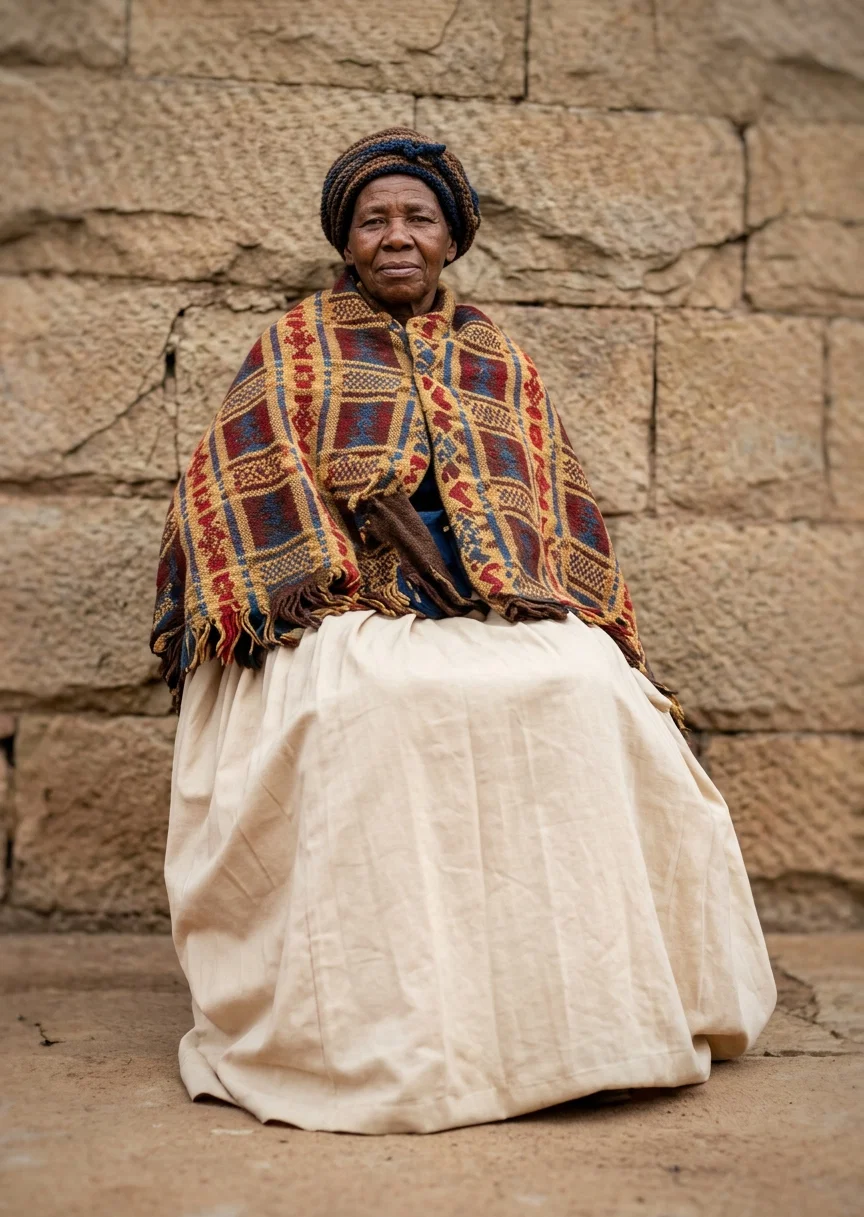
PERHAPS the readers of the REVIEW would be glad to see a picture of one of the first native women of Africa to receive the truth. Sister Adel Kalaka is the wife of Davil Kalaka, who embraced the truth in this field under the labors of Elder S. N. Haskell years ago. He was our first native evangelist in Africa, served the cause of truth faithfully for eight years, and died in the blessed hope in 1904.
Sister Kalaka did not yield herself to the truth when her husband did, but a few years later the light shone into her heart, and ever since she has faithfully served her Master. She is the mother of Brother Murray Kalaka, our Basuto teacher, preacher, and translator. Our native sister is now seventy years old, but is still strong and active. On the occasion of our recent Bible school in north Basutoland, Sister Kalaka rode one hundred miles in an oxcart to listen again to the presentation of the truths of the message. Surely the truth is reaching honest hearts in the Dark Continent, and transforming lives, and we praise God for his wonderful workings.
ADEL KALAKA
Mission Notes
THE Bible is appreciated out in the trenches where men are face to face with death. A wounded man from the Dardanelles tells how, at Gallipoli, a comrade “used to take out his Testament in the trenches and read it to us night and morning. He wouldn’t miss a day. All in that part of the trench where he was, often a dozen men, would go and listen.”
ROUGH men in the ranks, strangers to prayer, repeat fervently simple prayers taught them by mothers when children. One young man received at the front a letter from his wife, saying, “Be sure and say your prayers,” and from that time he prayed every night, “Now I lay me down to sleep,” etc. In the hospital he said, “My mother taught it me,” and in the trenches these words of his childish prayer came back to him, and through them his mind again turned to God.
STILL illustrating what a comfort the Bible is to soldiers, an experience at Flanders is related: “A corporal and a comrade fell wounded, remaining still under fire. The corporal applied his first-aid dressing both to his comrade and himself, and then took out his Testament and began to read. The two men lay side by side for hours, until a shell killed them both. They were found with the Testament still open between them.” Some one gave that the Testament might be given. Little does he know how much good was accomplished by his gift.
What the Home May Do to Save the Children and Youth
By L. A. Hoopes
L. A. HOOPES
CHILDREN! Home! Salvation! What words appeal to our hearts more than these? What would home be without children? And what happiness would there be to children with no prospects of a home? And what a blight there would be if salvation were not obtainable! God does not picture the eternal reward with homeless children, or with childless homes, for God’s plan of salvation is for both parents and children. The one is the complement of the other. Our heavenly Father’s ideal should be the watchword for all our actions.
Home! What an endearing word! How much it means! Home is the center of the family’s interest. It is where father and mother, brothers and sisters, are inseparably linked together by ties of love. Do you ask, What can the home do to save our children and youth? Rather, ask, What can it not do? Is there any factor that can be more potent than a Christian home? Every phase of its organization constitutes the home a life-saving station.
Home is more than a tent, a cottage, or a mansion—more than a mere building in which one resides. Home is the place where father’s and mother’s presence has been revered because of so many hallowed recollections. Every nook and corner is “sacred to the memory of the ones who love God, and to whom the law of God is a sacred legacy.” Whether we are at play, work, or prayer, every room seems to have written on its doorposts “the commandments of God.”
“Father the high priest of the family, and mother the home missionary!” Father’s word is alpha and omega to the young, trusting heart of his child. His word is consolation in the hour of grief and trouble. Father knows how to comfort and console. Every true father’s heart sees the trouble long before it reaches his child. His petitions reach the throne of grace, anticipating every real need of his child. An unseen tie links the hearts of both. And mother’s place! What child has not felt the tender caresses, the unnumbered loving touches, of mother’s hands? No mortal can take her place. Neither time nor space will permit a recital of all that mother is to the home. No language has a vocabulary large enough to record the story.
Do you ask what fathers and mothers can do for the salvation of the boys and girls?—All that anybody can do. The destiny of our children is in our hands. If we know how to win for ourselves, in the conflict with sin, then we know how to win in behalf of our children. “Like parent, like child,” is true to life. With this truism, God lays upon parents a responsibility which cannot be placed upon another. Parents must face the situation exactly as it is. The judgment alone will determine how we have performed our part. Other responsibilities may sometimes be shifted to another; this one, never. Job recognized this when he said, “It may be that my sons have sinned, and cursed God in their hearts.” He “offered burnt offerings according to the number of them all. . . . Thus did Job continually.” Job did not, could not, feel that his responsibility ended when his sons came to possess homes of their own. Nor can we.
Every means of grace must be put into operation to save our children, and keep them saved. This is the time. It cannot be put off to a more convenient time. What can we do? We can pray. We must pray. We must pray for ourselves. We must pray for our children. We must pray for the children whose parents do not pray. We must know the power of prevailing prayer.
Our children must know that this is the most serious business of our lives, and that they can never get away from father’s and mother’s prayers.
We must teach our children to pray. Prayer is the great check book on the bank of heavenly blessings. Temporal food is essential, but there is something more essential. Prayer is the great battering-ram by which we demolish all the battlements of the enemy. Prayer is the electric spark that sets in motion the great dynamo of the universe, the Spirit of God. Prayer is the heart’s wooing, longing for a better life.
We must come close to our children. Be a child with them. Enter into their joys and sorrows. Anticipate their needs and direct their young, energetic, plastic minds. Look upon every God-intrusted gift of your child as a sacred legacy, a talent upon which both parent and child must trade. See that each talent brings definite returns. By and by God’s cause will have a wide-open door for your child. Its demands are for boys and girls who have made a success.
Far more attention must be given this question at all our meetings than has been given it heretofore. Is it not time that special parents’ meetings should be held, where the salvation of our homes is the theme?
Why not make this the time when the Elijah message will be proclaimed in very deed and truth? We cannot complete this message in this generation without our children. God needs them, and we should not rest satisfied until we see every one saved who will be saved.
The Fable of the Three Elms.
By Margaret E. Sangster, Jr.
The North Wind spoke to three sturdy elms,
And, “Now you are dead,” said he;
“I have blown a blast till the snow whirled past,
And withered your leaves, and see,
You are brown and old and your boughs are cold;”
And he sneered at the elm trees three.
The first elm spoke in a hollow tone
(For the snow lay deep and white);
“You think we are dead, North Wind?” he said,
“Why, we sleep—as you sleep at night.
Beneath the snow lie my sturdy roots,
They grip on the friendly earth,
And I rest—till another year!” said he,
And he shook with a noisy mirth.
The second elm laughed a hearty laugh,
And, “North Wind,” he cried in glee,
“Beneath my bark glows a living spark,
The sap of a healthy tree.
My boughs are bare and my leaves are gone,
But—what have I got to fear?
For the wintertime is my time of rest,
And I sleep till another year.”
The third elm spoke, and his voice was sweet,
And kind as the summer sea;
“O Wind,” he said, “we are far from dead,—
The God in whose hand we be
Looks down, with love, from the winter sky,
And sends us his sun to cheer;
If we had no snow, there would be no spring,—
We rest till another year.”
The three elms rocked in the stinging blast,
And under the heavy snow
Their roots were warm from the raging storm,
And safe from the winds that blow.
They smiled in their hearts, and their leafless boughs
Spread over the frosty way;
For they knew that the God of forest trees
Would watch through each winter day.
The North Wind uttered a frosty sigh
As the snow blew far and free;
And his weary eyes sought the winter skies,
And, “Mighty is God!” said he.
“To die or live are his gifts to give;”
And he smiled at the elm trees three.
—Margaret E. Sangster, Jr., in the Christian Herald.
Conducted by Mrs. I. H. Evans, Takoma Park, Washington D. C
By Mrs. I. H. Evans; Miss Lora E. Clement
Assisted by Miss Lora E. Clement
Through the columns of this department, hints will be given on all matters pertaining to the home life. Short articles and letters are solicited from home makers, telling of their everyday experiences,—their joys and sorrows, their failures and successes.
The Christian Activities of One Busy Mother
By Agnes Lewis Caviness
AGNES LEWIS CAVINESS
ONE of the students of the mothers' normal department in the Fireside Correspondence School had not reported for a number of months, and we had begun to wonder why she did not seem to be keeping up her work. But we have recently received another lesson from her, accompanied by an explanation of the delay, which shows in such a striking way what an influence for good a Christian mother may have upon her community, that we present portions of her letter for the encouragement of other mothers:—
“DEAR INSTRUCTOR: It has been a long time since I have sent in a lesson, but I have not been idle in the meantime. All winter I have been holding Bible studies with my neighbors; and, finding that there was much interest, we engaged the aid of a minister. As a result a company of Sabbath keepers has been raised up in our neighborhood. On both sides of us are new believers. There is a Sabbath school of about thirty-five members. The meetings are held in our home.
“My little boy has been studying some all the time. He is halfway through his ‘Little Folks’ Bible Nature,’ and to page 112 in his reader. We have added three to our home school, so we now have four, and expect another will enter soon. My little girl, not quite three years of age, has her tiny desk, too, and comes to class. She cannot talk plainly, but in her baby language says the first two verses of Psalm 23. The children are learning this psalm in school, and she has learned some from hearing them recite. She knows many of the colors, and does fairly well at card sewing. The other children range from five to seven years of age. We have school from ten in the morning to three in the afternoon. I have the children help me with my work. This we call the domestic science class. They wipe dishes, help clean cupboards, sweep, etc. The parents who send their children are delighted with what is being done for them. The people are poor, so we make no charges; but I feel well paid when I see the good that is being done. There are older children in our Sabbath school, who go to the public school, but next fall we hope to be able to have a regular church school and hire a teacher.
“Besides our home school, I have six pupils taking lessons on the organ. This class consists of older girls in our Sabbath school, ranging from ten to twenty-two years of age. I also conduct a singing class every Saturday night, in which both old and young take part. On Sunday afternoon I have a class in Old Testament history for the young people.
“I do feel encouraged with my work. Of course I could do better if I had better facilities, but the people are so poor, and we are as poor as the rest, so we can't afford to buy many supplies. We have a good slate blackboard, tables, and seats. We also have a designing board on which the children make designs with bright-colored marbles. We use this in number work. Corn-flake boxes are utilized for sewing cards, etc. The Lord is certainly blessing our efforts, and I am thankful that I can work in this humble way for my Master. Pray for us.”
To this mother I would say: Surely the Lord is using you and your family to help your neighbors. I can well believe you are busy; but I know your happiness must be great at being able to help so many around you. Do not grieve over being slow at sending your lessons. Just continue your good work, and send the lessons as fast as you can.
Pneumonia
TEN per cent of the deaths in the United States result from pneumonia. It is estimated that during the past thirty days this rate has been doubled in some sections. Tuberculosis and heart disease, each causing one ninth of all fatalities, are the only diseases which outrank pneumonia, and in certain cities pneumonia has even surpassed the mortality from tuberculosis. Seventy per cent of all cases occur between December and May. It is distinctly a cold-weather infection, seemingly brought by wintry blasts, but especially prevalent during the winter season only because its victims are rendered more susceptible at that time by exposure, debilitating influences, and the presence of predisposing infections.
Pneumonia principally affects those at the extremes of life, but no age is exempt. It is invariably a germ disease. The predisposing and exciting organisms are so numerous that it would be futile to attempt their enumeration. Many of them are constantly present in the mouths and throats of healthy persons, and it is only through the aid which we unwittingly extend to them that they are transformed from harmless organisms to one of man’s most powerful enemies.
The presence of other diseases is the great predisposing cause of pneumonia. They prepare the soil for invasion. Holding first rank in this category is influenza, the increased incidence of pneumonia at this time being largely due to the present epidemic of la grippe. Individuals suffering from this infection are peculiarly susceptible to respiratory complications, and should properly observe every hygienic rule. Inflammation of with the upper air passages, pharyngitis, bronchitis, and tonsillitis, often predispose to the development of the disease, particularly among the aged and infirm. The acute contagious diseases of childhood, more especially measles and whooping cough, frequently prepare the way for pneumonia. Any one who through neglect or carelessness permits the spread of these infections is therefore open to the severest condemnation. Exhausting disease, of whatever nature, is often sufficient so to reduce our resistance that we are unable to cope with organisms which should be easily overcome, and hence predisposes to the infection.
Debility, either temporary or chronic, developing from any cause, increases susceptibility. Because of this the disease most often attacks those at the extremes of life. Among debilitating influences must be mentioned cold, exposure to penetrating winds, and the chilling of body surfaces as a result of exposure to wet. The combination of lack of food and fatigue proves particularly disastrous during the winter season, and is a condition to be avoided whenever possible. Bad housing, mental or physical harassment, and overwork are alike the advance agents of the infection. Overcrowding, in street cars, halls, and other public places, is unquestionably in part responsible for the spread of pneumonia in cities, as far greater opportunity is thus offered for the dissemination of the predisposing diseases through indiscriminate coughing, etc., as well as the directly injurious effects which inevitably result from exposure to such environment. The overheating of rooms is also seemingly harmful. Promiscuous expectoration may be, and probably is, a factor in infection, and consequently should be avoided by every citizen. A remaining most important agent should be mentioned—alcohol. It is in truth the handmaiden of pneumonia, and there is none more certain or more sure of success, especially if liberally and continuously used.
While the foregoing facts constitute in part our knowledge of the reasons for the widespread dissemination of an infection which carries with it a mortality of from ten to thirty per cent, it should be remembered that our scientific data are not yet complete. There are problems connected with immunity, predisposition, and the occurrence of epidemics which are yet to be solved. It is known that pneumonia sometimes attacks those who are perfectly well, and who apparently have observed every hygienic rule. Whether this is due to the increased virulence of the organism or to other causes is unexplained. It is, however, recognized that avoidance of the factors so briefly enumerated will in large part diminish individual susceptibility and therefore the incidence of the disease.—United States Public Health Service, Jan. 24, 1916.
A Mother’s Good-By
By John R. Clements
A WAVE of the hand from the cottage door
As her boy turned the roadway’s bend;
A wave of the hand as in days of yore—
A wave of the hand, but ’twas vastly more!
A mother’s heart and a mother’s prayer
That will follow his footsteps everywhere
Is the token her boy will read for aye
In the wave of the hand she gave today
From the old hillside cottage door.
—John R. Clements.
Patience, Poise, and Prayer
PATIENCE, poise, and prayer never fail to bring peace and power into the home.
A Worker's Prayer
By Richard Hook, Sr.
RICHARD HOOK, SR.
LORD, grant us grace while here below,
To read and love thy Word;
That we may dwell with thee, and know
Where thy sweet words are heard.
Thy word is life and liberty,
And truth and righteousness;
It standeth through eternity
To lead, instruct, and bless.
Lord, help us to believe, obey;
For those alone are blest
Who do thy will, and only they
Can enter into rest.
Lord, give us wisdom now to choose
The straight and narrow way,
That we our path may never lose,
But gain eternal day.
Takoma Park, D. C.
The Work in Maine
By H. W. CARR.
Owing to the prejudice which existed in the East in the early days of the message, Sister White gave instruction that much more could be accomplished in the West at that time, but that after the work should be established in the West, the message would return to the East with power. Those who are familiar with the experience of moving the denominational headquarters from Battle Creek, Mich., to Washington, D. C., in 1903, saw the beginning of this prediction.
Many times during Sister White’s last days she mentioned Portland, Maine, as a special city to be visited by the returning light of truth. Readers of the REVIEW will recall the appeals made for means to help in building a memorial church in Portland. This effort seems now to have been a preparation for the return of the work to the East with power. The local brethren broke ground for the new church building, which was soon erected; but the funds were not sufficient to cover the cost, and there remained an $8,000 debt, with its constantly accruing interest.
About three years ago Elder S. N. Haskell and his wife undertook the task of liquidating this debt. It was a hard fight. Elder A. E. Sanderson was called from Boston to assist them, and later the writer was called from western New York. Blow after blow was dealt to the enemy, until Jan. 1, 1915, the last mortgage was burned in the presence of a rejoicing congregation.
New Inspiration
Courage came into the hearts of the people. An annex was built, and the church was equipped with a beautiful baptistery, and accommodations were provided for classrooms and conference headquarters. This was all paid for. The church membership was doubled; gifts to missions increased to fifty cents a member per week; nearly $1,100 was raised in the Harvest Ingathering effort; and, best of all, a bond of unity, fellowship, love, and confidence took the place of dissension. These favorable conditions made it possible for still greater accomplishments.
City Effort
There is a manifest desire on the part of the people of the city to hear the truths of God’s message for today. Recently the city hall, the largest auditorium in Portland, was secured for January 23, 26, and 30, and three evening lectures by Elder A. G. Daniells were thoroughly advertised. The first evening, a congregation of 1,800 persons listened with intense interest as he explained with vigor how the present world crisis is a fulfilment of Bible prophecy.
The following evening Elder Daniells was invited to speak at the Business Men’s Club. They had heard of the impressive talk of the evening before, on “The European War and Bible Prophecy,” and requested that it be repeated to them. About two hundred and fifty of the leading men of the city listened with deep interest as he explained that the present scramble for Turkish territory must result in the removal of the Turkish capital to Jerusalem, and that the deliverance of God’s people will soon follow.
On Wednesday evening, January 26, a congregation of nearly one thousand persons listened with much interest to Elder Daniells’s lecture on “Miracles of Modern Missions.”
“Armageddon” was the subject on the last evening. It was very manifest that the congregation of nearly two thousand felt a solemn conviction of truth and duty as the impressive assurance of the speedy approach of the “time of trouble such as never was,” came to them from the Word of God in a clear and earnest way. We thought of Sister White’s prediction that the message would return to the East with power, and we fervently thanked the Lord for what we witnessed.
The city papers gave good space for reports of the meetings, with many favorable comments on the points made by the speaker. The thorough advertising given the little book, “The World’s Crisis,” has resulted in many expressions of appreciation from the best citizens of Portland, and many orders for the book by mail, over the telephone, and by personal calls at the office.
The city hall was offered free of charge to Elder Sanderson to address the people Sunday evening, February 6, on the subject “The Kingdom of Peace, or the World to Come.” The city is awakened as never before. Arrangements are being made by the church to carry forward the good work already begun, and similar efforts will be made in Boston and other large cities.
H. W. CARR.
Arriving in Rio de Janeiro
By N. Z. Town.
AFTER a prosperous voyage of sixteen days from New York, our boat steamed into Rio harbor about ten o'clock the evening of December 27. Entering at night, we missed seeing some of the natural beauties of this fine harbor, but the display of electric lights in the city and along the avenues around the harbor made a very pretty sight.
Those who have had the experience of landing in a strange land, among a people of a strange tongue, will readily understand how our hearts were filled with joy when, as we came alongside the dock the next morning, we saw the familiar face of Elder F. W. Spies among the crowd. Brother Spies was accompanied by Brother F. R. Kuempel, the director of the Rio Espirito Santo Mission, and Brother E. C. Ehlers, who is engaged in evangelical work in the city of Rio.
After passing the customs, and getting a room at a hotel, we went to visit these workers in their homes. Brother and Sister Kuempel, with their two children, Elsie, now nine years old, and Seigfried, seven, came to Brazil from Germany four years ago. Brother and Sister Ehlers were sent to Brazil by the Mission Board in 1908. They have two children, Herta, aged six, and Elsie, two and a half.
Here we also met Sister Sarah A. Kinner, who is engaged in Bible work in Rio, and Brother and Sister Specht and little Victoria from Minas Garaes. These workers came from the States after the General Conference in 1913. All these laborers are enjoying good health and are happy in the work.
We enjoyed very much seeing the beautiful city of Rio, but the sight that did us the most good was the company of believers who gathered in the little chapel for an evening service while we were there. When Mrs. Town and I stopped off at Rio in 1896 on our way to Argentina, Brother W. H. Thurston, who then had charge of the Brazil Mission, and his family were the only Sabbath keepers in Rio; but at present there is a church of seventy-one members. The Lord greatly blessed Brother E. C. Ehlers and his coworkers in the tent effort which they had in the city last year. As a result of this effort twenty-six were baptized and taken into the church. Over sixty believers gathered at the evening service which we held with them. As they opened the meeting with the old hymn “Heaven at Last,” in the Portuguese tongue, it sounded just as good as in the homeland.
Sister Kinner told us an interesting story of how one native woman was captivated by the truth. This woman received an urgent invitation to attend a special evening service in her own church, as the bishop was to be there. She arrived at the church a little early, and found the door still locked. She said to herself, “What shall I do? I do not wish to wait here on the street with all the people passing. I think I will step into this tent, and at eight o'clock I will come out to the meeting in my church.” “But,” she said, “when eight o'clock came, I could not leave; I was captivated by what I was hearing.” She continued to attend the meetings, but always sat on the back seat and seemed to avoid any conversation with the workers. When they asked her where she lived, her only reply was, “In Piedades.” But as Piedades is a15large section of the city, it was impossible to locate her. But finally the truth got such a hold of her that she invited Sister Kinner to her home. At the time of our visit, Sister Kinner was holding Bible readings with her every week, and she was rejoicing in the truth as far as she had learned it. She had also interested several of her neighbors.
Such experiences as these are the oases in the lives of our workers in these dark Latin Catholic fields. The workers in Rio say that the people are just waiting for the truth, and that with little effort they are brought to accept it. The Rio Espirito Santo Mission now has a membership of three hundred and twenty-six, and the outlook for the future is very promising.
N. Z. Town.
Mississippi
By C. S. WIEST.
IN many respects the year 1915 was a very profitable and yet a very anxious year for Mississippi. More was undertaken by our believers than any previous year, and what has been accomplished is very encouraging.
During the summer three tent efforts were held, one for the white people, and two for the colored. These efforts, with the labor bestowed on the churches, have been the means of winning fifty believers to the third angel's message. In one of our tent meetings the brethren had an excellent interest, but just as they reached the height of their effort, the tent was burned down. We have not yet been able to raise sufficient money to replace this loss.
For several years it seemed imperative that the city of Jackson should have a church building for the white believers. Accordingly, at the conference of 1914 it was decided that immediate steps be taken for the erection of a church and school building combined. This required a financial obligation of $8,000. It was quite an undertaking for a small church, and the whole conference numbered only one hundred and sixty-one believers. The task was undertaken, and from the very beginning we had evidence that God approved our endeavor. Today a neat, comfortable church is bearing witness to the present truth to the people of Jackson, and is giving indeed prestige to our work throughout the State.
Because of the heavy responsibility caused by the erection of the Jackson church building, we hardly hoped that this conference could meet every call that came to it from the organized work, and are indeed glad that Mississippi has not fallen behind in responding to the call beyond her border. We were successful in raising more than our twenty cents a week per member, and have also received the distinction of being placed on the honor roll in the Harvest Ingathering goal. Our tithe during the year increased $512 over that of 1914.
The year just closed has been an abnormal one on account of the financial depression caused by the war. But the State is becoming adjusted to the present conditions, and we are looking for greater advancement in our denominational work during 1916.
We are sure that those who have contributed to the Jackson church building will be pleased to hear that the main auditorium is being filled at our Sunday night meetings. The interest is good and the indications are that a good-sized church will be raised up in Jackson. Men of prominence are attending these services, and we feel that a substantial work is being established.
We are also much encouraged at what has been done in the mission, which embraces the colored work. On the fund for missions we have raised almost ten cents a week per member, and we have reason to hope that the colored believers will raise their full quota of fifteen cents a week per member for missions during 1916.
We are making plans for a strong effort in every branch of the work during this present year. We need the prayers of all our people.
C. S. WIEST.
The Influence of the Press in Seattle, Wash.
By S. N. RITTENHOUSE
As already reported in the REVIEW AND HERALD, the efforts put forth in Seattle last summer were blessed in the winning of about fifty persons to God. One of the most effective agencies in securing audiences was the newspapers. We inserted advertisements of the meetings, and were given space for reports of the sermons, and we can truly say that the results were very gratifying.
There are two large dailies printed in Seattle. Both of these have been very liberal in allowing free space for our reports and announcements. The Post-Intelligencer, our morning paper, was especially liberal, and printed many of our reports in full, and extracts from them when space was limited.
About thirty-five sermons were reported during the series. These, of course, embraced nearly every phase of our message. Some of them stated very plainly and clearly the most pointed truths that we hold.
Some of the regular attendants spoke of preserving the reports for future reference and study. Others, some of whom were business men of wide reputation and influence, though not able to attend the services, told us that they had been following the trend of the meetings through the daily reports.
One evening a lady came to the front at the close of the service to receive the literature that was being given away. On conversing with her we found that she had come from Bellingham, a distance of about one hundred miles, to hear that very sermon. She had been reading the reports in the paper and watching the announcements, so when “The Change of the Sabbath” was announced, she decided to come to hear it. She seemed to feel well repaid for the effort.
Our experience here in Seattle has seemed to prove that if we do not secure space in the papers, the fault is with us for not reporting. As a rule, we are given as prominent a place as some of the most popular pastors of the city.
It seems too bad that we as ministers do not more often avail ourselves of this great opportunity of spreading the message. The only effort it seems to take is the placing of copy in the hands of the editors, then they publish it to their thousands of readers. Is not this one way that the truth is to be “scattered like the leaves of autumn”?
S. N. RITTENHOUSE.
A Mighty Helper
By Andrew Yost
ANDREW YOST
God and his law are my delight,
My glory and my song,
My sure support by day and night,
The pleasure of my tongue.
When darkness overspreads my mind,
His Word supports me still;
I'm then convinced that God is kind,
Though I no comfort feel.
Are my afflictions sharp and long?
Does pain extreme ensue?
God's Word I trust; his arm is strong,
His wisdom bears me through.
Glory to thee, thou God of love,
For favors so divine,
Which taught my heart to soar above,
And made these blessings mine.
Had not thy Word been my relief,
Had not thy truth sustained,
I should have perished in my grief;
No other help remained.