Your ShelfYour Projects

Review and Herald, Vol. 91, No. 20.

THE WORK AND THE WORKERS

Review and Herald

May 14, 1914

Review and Herald Publishing Association · Takoma Park Station, Washington, D. C. · May 14, 1914

THE WORK AND THE WORKERS
GET the June or "Antitobacco" and "Swat the Flies" number of Life and Health, just off the press.
BROTHER S. A. RUSKJER, missionary secretary of the Minnesota Conference, writes: "I am getting a good force of Minnesota workers for the magazines this season. Our aim: $8,000 worth of magazines sold in Minnesota during 1914."
TWELVE great tobacco-destroying articles in the June number of Life and Health. Facts, figures, pictures, poetry—every argument necessary to put King Tobacco out of business! Send $2.00 for 50 or $1.00 for 20 copies today. Will sell "like hot cakes."
REAR ADMIRAL GEORGE W. BAIRD, U. S. N., retired, believes in and circulates both Liberty and the Protestant. Commenting on the last-named magazine, he says: "The Protestant Magazine, the best Protestant paper ever printed!" Other prominent army and navy men are also friends and well-wishers to these magazines.
MR. J. W. WHITELEY, provincial organizer of the Grand Orange Lodge of British Columbia, writes: "I am a regular subscriber to the Protestant Magazine, and take pleasure in recommending a periodical that is run along the lines of a sane, sound, and clear-cut evangelical Protestantism. I have found the articles that it contains to be thoroughly reliable, and have been able to use many of them in connection with my work. A dollar invested in a year's subscription is money well spent."
REV. S. J. LEE, rector of St. James Protestant Episcopal Church, San Francisco, Cal., writes: "I have received a sample copy of the Protestant Magazine, February issue. Please find inclosed $1.00 for a year's subscription, beginning with the January issue. Probably more subscriptions will follow as the copies are submitted to some of my people. Yours faithfully." Every clergyman in America should receive the February number, containing Dr. McKim's great speech at the Protestant mass meeting in Washington, D. C.
THE three-color cover design of the June Life and Health shows a boating party in mountainous Bohemian Switzerland—a thing of beauty. Note these antitobacco articles: "Cigarettes a Cause of Crime;" "Burning Up the Bread;" "The Tobacco Habit" (symposium); "The Cigarette and Physical and Mental Decadence;" "Price of the Cigarette Habit;" "Alcohol and Tobacco" (by Luther Burbank); "The Boy and the Cigarette" (two-page poem, illustrated); "Chewing the Rag" (a real incident); "The Cost of Tobacco;" "Narcotics Versus Longevity;" "Mental Effect of Tobacco;" "Tobacco and the Blood Vessels." Other features: "Healthful Cookery," "The Plague of Flies," "Questions and Answers," etc. Send $2.00 for 50 or $1.00 for 20 copies today. Others order 1,000 copies at a time, why not YOU? Only $40.00, and sell for $100.00, profit on 1,000 being $60.00.
THE secretary of the Chicago Church Federation Council recently sent a post card to 650 Protestant clergymen of that city, on which was printed the following: "Write to Washington, D. C., for a copy of the February issue of the Protestant Magazine, containing an account of the Great Protest Meeting held there Dec. 14, 1913." What ought we to do with this magazine?
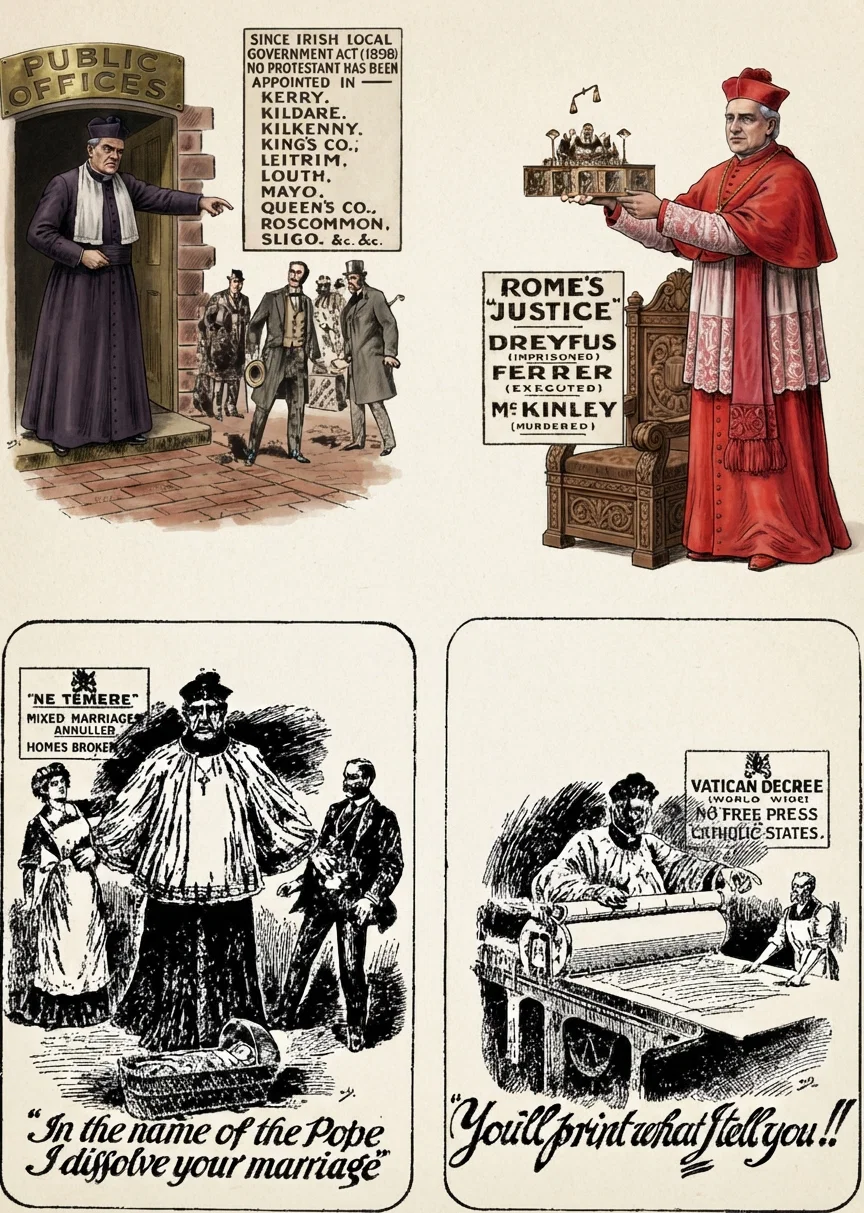
From the "Churchman's Magazine" (London), April, 1914

One of the Four Pages in the "Picture Section" of the May Number of the "Protestant Magazine"

Speaking of this great "Roman Mobs," "Bible Burning," "Home Rule," "Government Chaplains," and "Toleration in Maryland" number, Pastor G. W. Anglebarger, of Denver, Colo., writes: "We are very glad for the May number of the Protestant Magazine, containing the splendid account of the Spurgeon kidnapping. We are going to use a big lot of this number here in Denver. I heard Mr. Spurgeon lecture here, and I also visited him in St. Luke's Hospital after he had fallen into the hands of the mob, and I wish to say that he is a Christian gentleman. When lying upon his bed, after the cruel beating and treatment he had received, he said, when greeting me: 'This had to happen to open the eyes of the people.'"
FILL YOUR COMMUNITY WITH THIS "FREE SPEECH" NUMBER. BUY 50 for $2.00 or 20 for $1.00, AND SCATTER OR SELL THEM EVERYWHERE. ALSO SEND THIS MAGAZINE FOR SIX MONTHS TO TEN FRIENDS ($3.00) OR TO FIVE FRIENDS ($1.50) BEGINNING WITH THE FEBRUARY OR "GREAT PROTESTANT MASS MEETING" AND "ROMAN MASK PUT ON AGAIN" NUMBER. The March, April, and May numbers speak for themselves. The June number will tell HOW AND WHY MR. SULZER WAS DRIVEN FROM THE GOVERNOR'S CHAIR OF NEW YORK STATE BY THE ROMAN HIERARCHY. The July number will be equally interesting. CIRCULATE THESE SIX GREAT NUMBERS. Address your tract society, or the Protestant Magazine, Washington, D. C.

The Stroke of God

ARTHUR W. SPAULDING

"Son of man, behold, I take away from thee the desire of thine eyes with a stroke: yet neither shalt thou mourn nor weep, neither shall thy tears run down. . . . So I spake unto the people in the morning: and at even my wife died; and I did in the morning as I was commanded." Eze. 24: 16-18.
O SEER, that knew no passion but the holy joy Of serving Him, invisible, by thee beheld, What thoughts assailed thee on that day that didst destroy The dearest passion of the human heart unquelled?
The smiling palms of Aram's plains drooped low with grief, And Chebar's sluggish stream wept floods of sympathy; But tears and sighs were not for thee to bring relief: A woe too deep to utter moan was portioned thee.
Set for an omen of thy people's coming woe, Dry-eyed above the bier thou took'st the signal stroke. Spake in the morning what thy God didst bid thee show, Bowed at the eventide beneath the heavy yoke.
Thrice and again thy word had summer's fiery breath Borne, warning, to the rebels of thy stiff-necked race; Four winters had thy summons to impending death Brought no repentant turning to a pardoning grace.
Then, swift and sudden, on thy meek, victorious head Fell there the stroke of God, that they, the blind, might see. Stricken for them, thine eyes undimmed beheld thy dead, And they, thy people, saw their ominous doom in thee.
What, when thy hard commission first thine ears did hear,— As flint thy forehead and as iron thy brow,— What of the stone and steel did thy devotion fear Was pent for thine own heart within thine ardent vow?
Ah, not for thee to con and reckon were the stones; The hand that reached to lead thee could supply thy need! As in the valley of the dry and scattered bones, Thy cry, "Ah, Lord, thou knowest!" held thy simple creed.
And when the hour of anguish came no other knows Than he whose wedded flesh quivers beneath the blade, Came with the hour transcendent power of repose In him whose wisdom all the ordeal made.
O seer of God, across the dim and blackened page Where men have traced the record of their doubt-filled span, Bright shines the glory of thy faith from age to age, To fire the spirit of the fear-beleaguered man.
Wondering, I trace the splendors of thy visions rare, Wherein the glories of thy God thou didst behold; Yet with a deeper thrill I guide mine eye to where The pen of God thy humble sufferings doth unfold.
And in mine hour of anguish, when I would despair, May I remember, and in fellowship with thee, Before my God be able, answering to my prayer, To write the word, "I did as he commanded me."
Hendersonville, N. C.

Principles Underlying Sanitarium Work

Early Counsels on Medical Work—No. 7

Principles Underlying Sanitarium Work

MRS. E. G. WHITE
In former numbers of "Testimonies for the Church," I have spoken of the importance of Seventh-day Adventists establishing an institution for the benefit of the sick, especially for the suffering and sick among us. I have spoken of the ability of our people, in point of means, to do this; and have urged that, in view of the importance of this branch of the great work of preparation to meet the Lord with gladness of heart, our people should feel themselves called upon, according to their ability, to put a portion of their means into such an institution. . . .
I had taken great interest in the health reform, and had high hopes of the prosperity of the Health Institute. I felt, as no other one could feel, the responsibility of speaking to my brethren and sisters in the name of the Lord concerning this institution and their duty to furnish necessary means, and I watched the progress of the work with intense interest and anxiety. When I saw those who managed and directed, running into the dangers shown me, of which I had warned them in public, and also in private conversation and letters, a terrible burden came upon me. That which had been shown me as a place where the suffering sick among us could be helped, was one where sacrifice, hospitality, faith, and piety should be the ruling principles. But when unqualified calls were made for large sums of money, with the statement that stock taken would pay large per cent; when the brethren who occupied positions in the institution seemed more than willing to take larger wages than those were satisfied with who filled other and equally important stations in the great cause of truth and reform; when I learned, with pain, that, in order to make the institution popular with those not of our faith, and to secure their patronage, a spirit of compromise was rapidly gaining ground at the Institute, . . . when I saw these things, I said, This is not that which was shown me as an institution for the sick, which would share the signal blessing of God. This is another thing.
And yet calculations for more extensive buildings were made, and calls for large sums of money were urged. As it was then managed, I could not but regard the Institute, on the whole, as a curse. Although some were benefited health-wise, the influence on the church at Battle Creek and upon brethren and sisters who visited the Institute was so bad as to overbalance all the good that was done; and this influence was reaching churches in this and other States, and was terribly destructive to faith in God and in the present truth. Several who came to Battle Creek humble, devoted, confiding Christians, went away almost infidels. The general influence of these things was creating prejudice against the health reform in very many of the most humble, the most devoted, and the best of our brethren, and was destroying faith in my Testimonies and in the present truth. . . .
The brethren who have stood at the head of this work have appealed to our people for means, on the ground that the health reform is a part of the great work connected with the third angel's message. In this they have been right. It is a branch of the great, charitable, liberal, sacrificing, benevolent work of God. . . .
In what I have been shown and what I have said, I received no other idea, and designed to give no other, than that the raising of funds for this branch of the work was to be a matter of liberality, the same as for the support of other branches of the great work. . . .
The friends of humanity, of truth and holiness, should act in reference to the Institute on the plan of sacrifice and liberality. . . . Let the donations come in as needed; let the sums, small and large, come in. Let means be expended judiciously. Let charges for patients be as reasonable as possible. Let brethren donate to partly pay the expenses at the Institute of the suffering, worthy poor among them. Let the feeble ones be led out, as they can bear it, to cultivate the beautifully situated acres owned by the Institute. Let them not do this with the narrow idea of pay, but with the liberal idea that the expense of the purchase of them was a matter of benevolence for their good. Let their labor be a part of their prescription, as much as the taking of baths. Let benevolence, charity, humanity, sacrifice for others' good, be the ruling idea with physicians, managers, helpers, patients, and with all the friends of Jesus, far and near, instead of wages, good investment, a paying thing, stock that will pay. Let the love of Christ, love for souls, sympathy for suffering humanity, govern all we say and do relative to the Health Institute.
Why should the Christian physician, who is believing, expecting, looking, waiting, and longing for the coming and kingdom of Christ, when sickness and death will no longer have power over the saints, expect more pay for his services than the Christian editor or the Christian minister? He may say that his work is more wearing. That is yet to be proved. Let him work as he can endure it, and not violate the laws of life which he teaches to his patients. There are no good reasons why he should overwork and receive large pay for it, more than the minister or the editor. Let all who act a part in the Institute and receive pay for their services, act on the same liberal principle. No one should be suffered to remain as helper in the Institute who does it simply for pay. There are those of ability, who, for the love of Christ, his cause, and the suffering followers of their Master, will fill stations in that Institute faithfully and cheerfully, and with a spirit of sacrifice.

In Due Time

A. E. PLACE
"For when we were yet without strength, in due time Christ died for the ungodly." Rom. 5:6.
TRAINS are occasionally ahead of time, and often behind time; we can never be sure. But the gospel train never fails. Jesus Christ, the conductor on that train, has been on the road for six thousand years, and he is always on time, "the same yesterday, and today, and forever." He became the "Lamb of God" at the foundation of the world and "in due time." He was there in the garden of Eden ready to save the father and mother of our race; and when he had to send them out of the garden, he sent them out to walk in the shadow of his cross. He was born a child "when the fullness of time had come." He is always on time to help in sickness, in health, in sorrow, and in death. While some say, "My Lord delayeth his coming," he will be on time. We sometimes think he is "slack concerning his promises," but he knows just when the time is due. Blessed is that soul who knows this and rests his all upon it.
A man, while standing upon a wharf one day watching the departure of a ship, lost his balance and fell into the water. Not being able to swim, he sank. A noted swimmer saw the accident, and immediately threw off his coat and hat, pulled off his boots, then stood watching the man, who had come up and was floundering aimlessly and to no purpose. The man soon gave up the struggle and went down. Instantly the swimmer plunged in, and, as the drowning man came up again, caught him and easily brought him to the wharf, where he was taken out and restored.
When the excitement was over, a gentleman stepped up to the swimmer and asked, "Why did you wait till that man went down?" "Because," said the swimmer, "if I had gone before, he, being a strong man, might have drowned us both, but I knew that as soon as he got through trying to save himself, I could save him."
My brother, my sister, are we fruitlessly "beating the air" or the waters of life's sea? Jesus pities us. He is watching our struggles. He stands waiting for the due time to come in our experience. Shall we not, ought we not, to look up and see him, acknowledge that we are "without strength," give up the fruitless self-saving struggle, and let ourselves sink? If we do, we shall but find that we sink into the ocean of his love, and "in due time," while underneath are the everlasting arms.
"When through the deep waters I cause thee to go, The rivers of sorrow shall not overflow. "When through fiery trials thy pathway shall lie, My grace all-sufficient shall be thy supply; The flame shall not hurt thee; I only design Thy dross to consume and thy gold to refine."
Do you feel that you are "without strength"? Then know that Jesus died for you, that he might meet your need just now; and do not fear, yea, do not fail to thank him for present salvation.
San Jose, Cal.

A Strange but Glorious Triumph

T. M. FRENCH
DURING ancient Roman times, triumphs were awarded generals who had won distinction in campaigns against Rome's enemies. It was the ambition of every Roman general to be accorded one of these triumphs.
A triumph consisted of a triumphal entry into the city of Rome upon the return from a great victory. "The procession formed just outside the city walls, headed by the magistrates and senate, who were followed by trumpeters and then by the spoils. Next came the victims destined for sacrifice, especially white oxen with gilded horns. They were followed by the prisoners who had not been sold as slaves but kept to grace the triumph; they were put to death when the procession reached the Capitol. The chariot which carried the general (triumphator) was crowned with laurel and drawn by four horses. Last came the soldiers, shouting, 'Io triumphe!' and singing songs both of a laudatory and scurrilous kind. On reaching the temple of Jupiter on the Capitol, the general placed the laurel branch on the lap of the image of the god, and then offered the thank offerings. A feast of the magistrates and senate, and sometimes of the soldiers and people, concluded the ceremony."
King Jesus was accorded a triumph similar in some respects to the Roman triumph, but of far different character. He entered the dominion of Satan to win a perishing race and to regain a lost dominion; but not with the most favorable prospects of achieving his purpose: "for verily he took not on him the nature of angels; but he took on him the seed of Abraham." He took on him all the weakness of man in order to win man's victory. Not with the force of arms did our Saviour engage in the mightiest conflict of all ages, but by employing principles that are as lasting as eternity. "But unto the Son he saith, Thy throne, O God, is forever and ever:a scepter of righteousness is the scepter of thy kingdom."
Instead of a mission of destruction, our Saviour's was one of salvation. Wherever he went, he healed the sick, gave sight to the blind, cast out devils, constantly undoing the work of the enemy. It was this very work that was evidence of the victorious efforts of our Saviour. "But if I with the finger of God cast out devils, no doubt the kingdom of God is come upon you. When a strong man armed keepeth his palace, his goods are in peace: but when a stronger than he shall come upon him, and overcome him, he taketh from him all his armor wherein he trusted, and divideth his spoils."
"It is finished"—a strange cry of victory, to the human mind, as our Saviour hung on the cross and yielded up his life. To all human appearance his cause had failed. But that righteous life, rather than to destroy a rebellious race, our Saviour laid down as a substitute for man. That death meant man's victory; and as Christ had espoused man's cause, his cause as man's cause triumphed. Never was such nobility, such bravery, manifested in the life of an earthly general as to lay down his life for that of his enemies. A double victory,—the kingdom established, and the rebellious race saved with the lost dominion! No wonder the hero is accorded the greatest triumph ever given to any being!
"All heaven was waiting to welcome the Saviour to the celestial courts. As he ascended, he led the way, and the multitude of captives set free at his resurrection followed. The heavenly host, with shouts and acclamations of praise and celestial song, attended the joyous train.
"As they draw near to the city of God, the challenge is given by the escorting angels,—
" 'Lift up your heads, O ye gates; And be ye lift up, ye everlasting doors; And the King of glory shall come in.'
"Joyfully the waiting sentinels respond,—
" 'Who is this King of glory?'
"This they say, not because they know not who he is, but because they would hear the answer of exalted praise,—
" 'The Lord strong and mighty. The Lord mighty in battle. Lift up your heads, O ye gates: Even lift them up, ye everlasting doors; And the King of glory shall come in.'
"Again is heard the challenge, 'Who is this King of glory?' for the angels never weary of hearing his name exalted. The escorting angels make reply,—
" 'The Lord of hosts: He is the King of glory!'
"Then the portals of the city of God are opened wide, and the angelic throng sweep through the gates amid a burst of rapturous music.
"There is the throne, and around it the rainbow of promise. There are cherubim and seraphim. The commanders of the angel hosts, the sons of God, the representatives of the unfallen worlds, are assembled. . . . They are eager to celebrate his triumph and to glorify their King.
"But he waves them back. Not yet; he cannot now receive the coronet of glory, and the royal robe. He enters into the presence of his Father. He points to his wounded head, the pierced side, the marred feet; he lifts his hands, bearing the prints of nails. He points to the tokens of his triumph; he presents to God the wave sheaf, those raised with him as representatives of that great multitude who shall come forth from the grave at his second coming. . . . Now he declares, 'Father, it is finished. I have done thy will, O my God. I have completed the work of redemption. If thy justice is satisfied, \"I will that they also, whom thou hast given me, be with me where I am.\"'
"The voice of God is heard proclaiming that justice is satisfied. Satan is vanquished. Christ's toiling, struggling ones on earth are 'accepted in the Beloved.' Before the heavenly angels and the representatives of unfallen worlds, they are declared justified. . . . The Father's arms encircle his Son, and the word is given, 'Let all the angels of God worship him.'
"With joy unutterable, rulers and principalities and powers acknowledge the supremacy of the Prince of Life. The angel host prostrate themselves before him, while the glad shout fills all the courts of heaven, 'Worthy is the Lamb that was slain to receive power, and riches, and wisdom, and strength, and honor, and glory, and blessing.'"
Canary Islands.

The High Ideal

ALBERT WEEKS
THE Christian ideal cannot be placed too high. The Saviour says, "Be ye therefore perfect, even as your Father which is in heaven is perfect." Matt. 5:48. Why be perfect?—Because the perfect character is the only character that can associate with God. Of the city of God it is said, "There shall in no wise enter into it anything that defileth." Rev. 21:27.
To excuse oneself in sin is to separate from God. To lower the standard of righteousness is to form a character that will exclude us from the society of our Lord and from heaven. "Blessed are the pure in heart: for they shall see God." Matt. 5:8.
Paul realized something of the high calling of God when he said, "I press toward the mark for the prize of the high calling of God in Christ Jesus." Phil. 3:14. He had not attained to that exalted condition, but was earnestly working to that end. He says: "Not as though I had already attained, either were already perfect: but I follow after, if that I may apprehend that for which also I am apprehended of Christ Jesus. Brethren, I count not myself to have apprehended: but this one thing I do, forgetting those things which are behind, and reaching forth unto those which are before, I press toward the mark for the prize of the high calling of God in Christ Jesus."
Dismissing the discouragements of our past experience, let us set the mark of attainment high, and press the battle against the enemy. Our Saviour is abundantly able to give us success. He was tempted in all points as we are, yet without sin, and is thus able to help us overcome. It is only a question of submitting all to him in faith; then he will enable us to do the will of God in everything. Let us open the doors of our hearts and invite the blessed Saviour in.
Omer, Mich.

Let Us Get Ready

GRACE WHITE
WE as a people know that we are in the time of the end. We know that human history will soon close, probation will soon be over, and we must meet the results of life as individuals. Is it not, then, time to consider our cases as individuals?
Personally I am very thankful for the searching messages we received during the week of prayer, and I am praying that the searchlight of the Spirit may be turned on my heart and life and their true condition revealed. I want to be purified, even as He is pure, and thus cease to hinder his coming. Years ago it was written, "There are Enochs in the world today." Only tonight do I realize what that means. Is it not that they walk with God; that their cases have been examined, their names confessed in heaven, and they are ready for translation? It must be that there are many more Enochs now than when that was written, and that soon the testimony of Christ will be confirmed among us, and we "be perfectly joined together in the same mind and in the same judgment."
The day will soon come when our names will be called in judgment. What are we doing each day to make sure that our names will be found in the book of life? Why not this year each of us make it his business to get ready, working out his salvation with fear and trembling? and then each will be ready to help his neighbor, or, rather, will be helping his neighbor all the while.
The way to walk with God is to "keep his testimonies" and to "seek him with the whole heart." They who do thus "do no iniquity: they walk in his ways." Ps. 119:2, 3. Then let us take time to be holy, take time for urgent prayer to be filled with the Spirit, for we know that God says, "Not by might, nor by power, but by my Spirit." He also bids us: "Ask ye of the Lord rain in the time of the latter rain." "This promised blessing, claimed by faith, brings all other blessings in its train;" but "only to those who wait humbly on God, whowatch for his guidance and grace, is the Spirit given." Christ has promised, and it is for us to claim the promise. When we do this, fulfilling the conditions, we shall receive it and become channels through which God can work.
"There is no limit to the usefulness of the one who, putting self aside, makes room for the working of the Holy Spirit." He who has all power in heaven and earth will cut short the work in righteousness and come quickly. Let us say Amen by surrendering wholly and letting him work in us to will and to do of his good pleasure. The disciples "did not realize the necessity of watchfulness and earnest prayer in order to withstand temptation."
Guadalajara, Mexico.

Lessons From the Life of Daniel

THE prophecies of Daniel are, in many respects, the most remarkable in the Word of God. Each one foretold the history of this world from the day it was revealed to the end of time; and at the close of these most interesting revelations, Daniel was told to "shut up the words, and seal the book." The book was not always to be sealed, however; for at the time of the end the wonderful truths which it contained were to be unfolded.
John the revelator, as recorded in the tenth chapter of Revelation, was shown the time when this book was to be opened. With the opening of the book a message was to go to all the world, as is revealed by the angel with one foot on the land and the other on the sea, delivering a message from the book. His message was in connection with the first angel's message of Revelation 14. In fact, it was a part of it. This shows that the prophecies of Daniel were to play an important part in the giving of the threefold message to the people of this generation.
From what has already been said, we see that to Daniel of old, God gave the message which he expects this people to give to the world.
Let us take a little time to study the character of the man to whom God revealed this truth; for does not our Heavenly Father desire the people who handle this message to be in character the same as the man to whom he revealed it? We believe that he does. In studying these characteristics, let us compare his character and time with our time, and see the lessons we can draw from them.
In the first place, Daniel was not willing to defile himself with the customs of his day in the matter of diet. In the test which followed his declaration of these principles, he proved that his reform in the matter of diet was truly a reform conducive of health.
In the giving of our message God has given to this people a reform in the matter of diet, by which he wishes to show the people of our day a method of living that will make them the peer of the most healthy. Nebuchadnezzar called for Daniel to interpret his dream because he knew Daniel had the Spirit of God (Dan. 4:9), and on the night when God gave the warning to Belshazzar of the overthrow of his kingdom by the handwriting on the wall, Daniel was called to interpret it because the queen gave a similar testimony concerning him. Dan. 5:10, 11. Does not our Heavenly Father wish us to have that same reputation in the world and to receive like declarations from the men of our time?
Again, after the overthrow of Babylon, Daniel, because of his faithfulness as prime minister of the realm, was immediately elevated to the same office by the Medes who conquered Babylon. This is an honor such as no other man has ever received. The jealousy of the other officials was so aroused over the honor conferred on Daniel that they sought to find somewhat against him, but no fault could be found with him except concerning the law of his God. Then Daniel, rather than give up the custom of prayer which had made him the great man that he was, faced death among the lions in their den; but it was here that he felt the protection of the angels of heaven. It was when Daniel entered the den of lions that he realized the presence of angels. It was when the three Hebrew worthies entered the fiery furnace that they saw the Son of God in their midst. It was when Daniel continued in prayer that Gabriel touched him.
This people must face conditions and trials similar to those of Daniel's. The Lord desires to give to us his Spirit as he did to Daniel. We shall have to be what no other people have been, and do what no other people have done. The spirit of prophecy has told us that our faithfulness and fidelity to God and his commandments will yet bring upon us the persecution of the world; but when this comes, we shall feel the angels' touch and the presence of the Son of God.
The fact that Daniel had the Spirit of God was known from the days of Nebuchadnezzar to those of Belshazzar, and on to the days of Darius the Median; for when Darius commanded that Daniel be cast into the lions' den, he said, "Thy God whom thou servest continually, he will deliver thee." This same Darius had made Daniel head over the presidents and princes, "because an excellent spirit was in him." These leaders came from all over the then-known world. Esther 1:1. The character of the people who make the prophecies of this book known to the world must be like that of him to whom the prophecy was given.
There are many things in the prophecies of Daniel which find a very striking parallel in the advancement of our work under the advent movement. For instance, Nebuchadnezzar, like the people of our time, was compelled to turn from the learned of his day to a man of God for information revealing the events that were to take place in his kingdom and throughout the history of the world; and Daniel, like God's people of our own time, bore to the king the message of Christ's second advent and of the setting up of his kingdom.
In the night of revelry, when the king had called together a thousand of his lords, the Word says they drank wine from the vessels of God. These were the vessels that were set apart for the service of the Lord in his temple at Jerusalem, vessels that were sanctified by God. Babylon was now using them and drinking from them the wine of Babylon. The Babylon of modern times is taking the sacred things of God, his commandments, and dealing from them the wine of Babylon. Rev. 18:3. The Sunday institution is surely a modern Babylonian creation, and the fourth commandment is being given to fasten the institution upon the people.
While Babylon that night drank wine from these golden vessels, God sent a message, and it was written on the walls of the palace. He also sent a messenger to declare that message. The message was: "Mene; God hath numbered thy kingdom, and finished it. Tekel; Thou art weighed in the balances, and art found wanting. Peres; Thy kingdom is divided, and given to the Medes and Persians." Does not this picture the fall of Babylon? In our time, while the world is made to drink the wine of Babylon from the vessels of God, God has sent a message and a messenger. That message is, "Babylon is fallen, is fallen;" and that messenger, the advent people of today.
Daniel's greatest test came when he was called to pray to no other god than the king who represented the government of his time. By signing the decree which forbade any one to worship any god but himself, the king put himself in the place of God. This is what Rome has done in our day; and she will demand that every one worship only her. Our message today is the message of the third angel, which says, "If any man worship the beast and his image, and receive his mark in his forehead, or in his hand, the same shall drink of the wine of the wrath of God." Like Daniel, the people who refuse to worship at the dictation of the state are the people who will be saved by the mighty hand of God. By meeting the test, Daniel met the conditions of the third angel's message of Revelation 14.
To Daniel was given the vision of the 2300 days, and the cleansing of the sanctuary, or the judgment. He therefore received from God the time of the judgment, the first angel's message. He declared the overthrow, or fall, of Babylon, the principle of the second angel's message, and met the test in the third angel's message.
Daniel was always true to the trust placed upon him, and faithfully gave the messages God gave him to give; and now the Lord is seeking for Daniels to deliver those messages to the world.

Editorial

Sometime We Shall Understand

The Scriptures of Truth bring to view two mysteries,—first, the mystery of God as comprehended in the plan of salvation and the marvelous working of his mighty power; and second, the mystery of iniquity. These mysteries we shall never be able fully to comprehend, nor shall we be able to understand, at least in this life, many things in our own experience which are the outgrowth of, or associated with, these two great mysteries.
Some there are who reject the Scriptures of Truth because of the mysteries contained therein. As reasonably one could reject or discredit his own experience because of the mysteries associated with it; for life presents many phases which we cannot now comprehend. As we review the years that are past, we are led to marvel at some decisions we have made. We are daily confronted with circumstances that we cannot explain. Sickness, sorrow, death, and many phenomena which occur, hold in their grasp unsolvable questions, beyond our finite comprehension. We cannot tell why prosperity comes to one, and disaster to another; why under the same conditions one man grows strong and rugged, and another sickens and dies; why wealth and preferment are secured by one, and elude the eager grasp of others; why the noble and the true and the brave are permitted to fall a prey to death, and other lives far less helpful to the community and to the work of God are continued. These questions have ever been mysteries to finite understanding, and they will remain mysteries to the end of time. But the children of God have the definite assurance in his Word that "all things work together for good to them that love God."
How blessed is this assurance! Man cannot read the future, but God can. Heaven knows the outcome of every issue. The human mind naturally consults first of all temporal convenience, and would choose the best for the present at the sacrifice of eternal gain. Heaven, viewing the end from the beginning, and considering the results to be obtained of paramount importance, shapes life's experiences with a view to the eternal destiny. God "doth not afflict willingly nor grieve the children of men." He delights not in the suffering and sorrow and pain which are the lot of mankind, and yet in his infinite wisdom he permits these conditions. He permits them for some wise purpose, and to his trusting children he will work out every experience for good in the end.
The human heart, like Jacob, may cry out, "These things are against me," but as Jacob lived to see that those things which appeared so evil in his sight were permitted of God to work out the accomplishment of Heaven's purpose in his life, so we shall see sometime—if not now, then in the world to come—that God has tempered every wind that blows; that he has caused even the wrath of man to praise him; and that though he has brought his children through the furnace of affliction, it was that the dross might be purified from their characters, and they be fitted as living monuments to show forth his praise throughout eternity.
In view of these considerations, let us trust where we cannot see. We serve a God of infinite love and of infinite wisdom. He cannot be unkind; he cannot err. We may safely commit to him every one of life's issues. We may cast upon him every sorrow. He is the great burden bearer, a friend that sticketh closer than a brother. Sometime, if not now, we shall understand.
F. M. W.
Continue reading: Some Missionary Deliverances