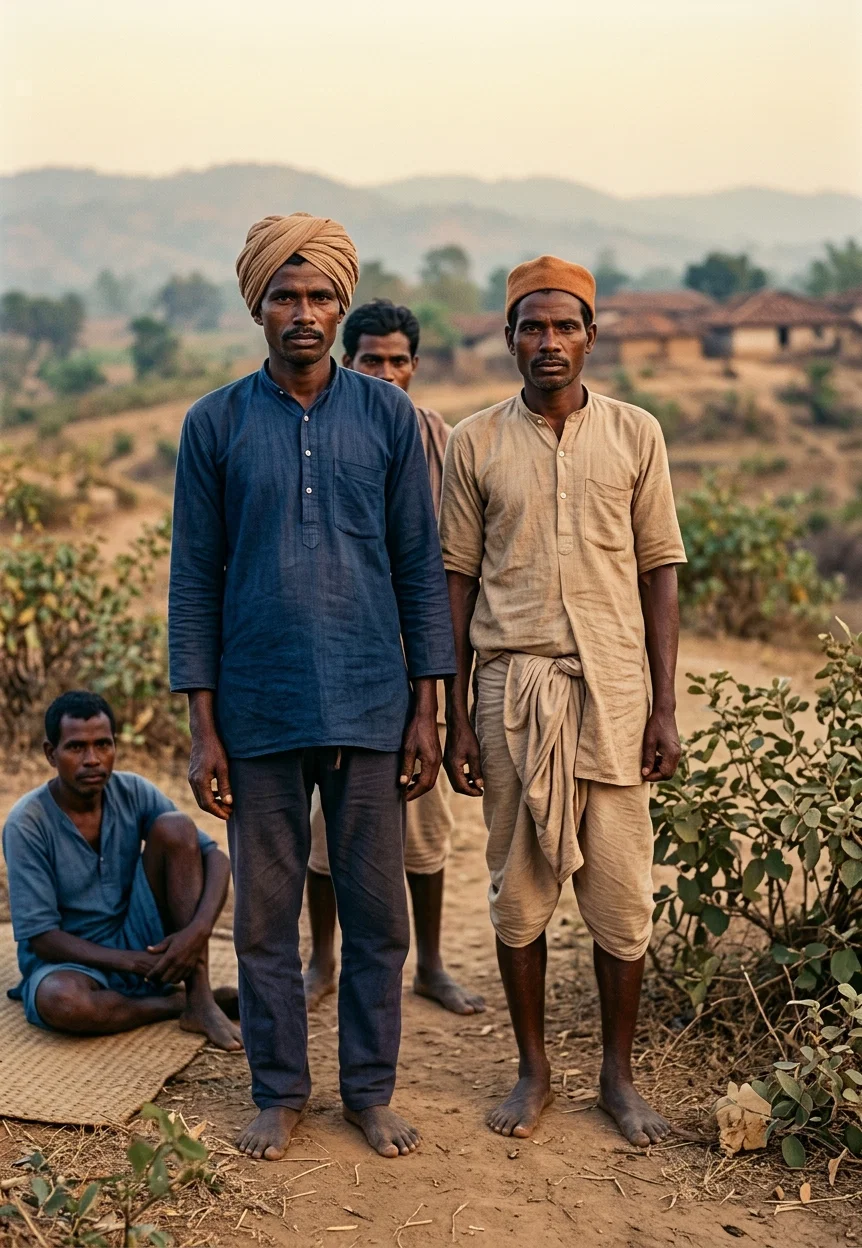
The Santals have their 'home among the hills which abut on the valley of the Ganges in lower Bengal. They dwell in villages of their own, apart from the people of the plains, and number about a million. Although still clinging to many customs of a 'hunting, forest tribe, they have learned to use the plow, and have settled down into skilful husbandmen.
Each hamlet is governed by its own headman, who is supposed to be a descendant of the original founder of the village, and who is assisted by a deputy headman and a watchman. The boys of the hamlet have their separate officers, and are strictly controlled by their own headman and a deputy, till they enter the married state at about sixteen to twenty years of age.
These people know not the cruel distinctions of Hindu caste, but trace their tribes, usually fixed at seven, to the seven sons of the first parents, Adam and Eve. Some give the number of his tribes as twelve. One tribe being lost, these are the names of those remaining: Hembrom, Kisku, Murmu, Hasda, Baske, Marndi, Besra, Soren, Bedya, Paoria, and Tudu. The whole village feasts, hunts, and worships together.
HOUSEHOLD SERVANTS. COOK AND SWEEPER
So strong is the bond of race, that expulsion from the tribe used to be the only Santal punishment. A heinous criminal was cut off from “fire and water” in the village, and sent forth alone into the jungle. Smaller offenses were forgiven upon a public reconciliation with the tribe, to effect which the guilty one had to provide a feast, with much rice-beer, for his clansmen.
Santal Ceremonies
The Santals do not allow child weddings. They marry at from fifteen to seventeen years of age, when the young people choose for themselves. At the end of the ceremony the girl's relatives pound burning charcoal with the household pestle, and extinguish it with water, in token of the breaking-up of her former family ties. The Santals respect their women, and do not take a second wife, except when the first remains childless. They solemnly burn their dead, and float three fragments of the skull down the Damodar River, the sacred stream of the race.
Their Religion
They have no knowledge of bright and friendly gods, such as the Vedic singers worshiped. Still less can they imagine one omnipotent and beneficent deity, who watches over mankind. Hunted and driven back before the Hindus and Mohammedans, the Santal does not understand how a being can be more powerful than himself, without wishing to harm him. “What,” said a Santal to an eloquent missionary who had been discoursing on the Christian's God, “what if that strong One should eat me?” They think that the earth swarms with demons, whose ill-will they try to avert by the sacrifice of goats, cocks, and chickens. There are the ghosts of their forefathers, river-spirits, forest-spirits, well-demons, mountain-demons, and a mighty host of unseen beings, whom they must keep in good humor. These dwell chiefly in the ancient sal-trees, which shade the village or are situated near it, and they are called the Jaher, or sacred grove. In some hamlets the people dance round every tree, so that they may not by evil chance miss the one in which the village-spirits happen to be dwelling.
History
Until near the end of the last century, the Santals lived by plundering the adjacent plains. But under British rule they settled down into peaceful cultivators. To prevent disputes between them and the villages of the lowlands, the officers set up in 1832 a boundary of stone pillars. But the money lender soon came among them, and the simple hillmen plunged into debt. Their strong love of kindred prevented them from running away, and they sank into serfs to the Hindu usurers. The poor Santal gave over his whole crop each year to the money lender, and was allowed just enough food to keep his family at work. When he died, the lifelong burden descended to his children; for the high sense of honor among them compels a son to take upon himself his father's debt.
In 1848 three entire villages threw up their clearing, and fled in despair to the jungles. In 1855 the Santals started in a body of thirty thousand men, with their bows and arrows, to walk to Calcutta, and lay their condition before the governor-general. At first they were orderly. But the way was long, and they had to live, and the hungry ones began to rob. Quarrels broke out between them and the police, and within a week they were in armed rebellion. The rising was put down, not without much bloodshed. Their complaints were carefully inquired into, and a very simple system of government, directly under the eye of a British officer, was granted to them. They are now a prosperous people. But their shyness and superstition make them dread any new thing. A few of them took up arms (bows and arrows) to resist the census of 1881.
Among these people the Seventh-day Adventist mission has been spreading the third angel's message during the past few years, and a training-school was started about two years ago. We will report this work later.
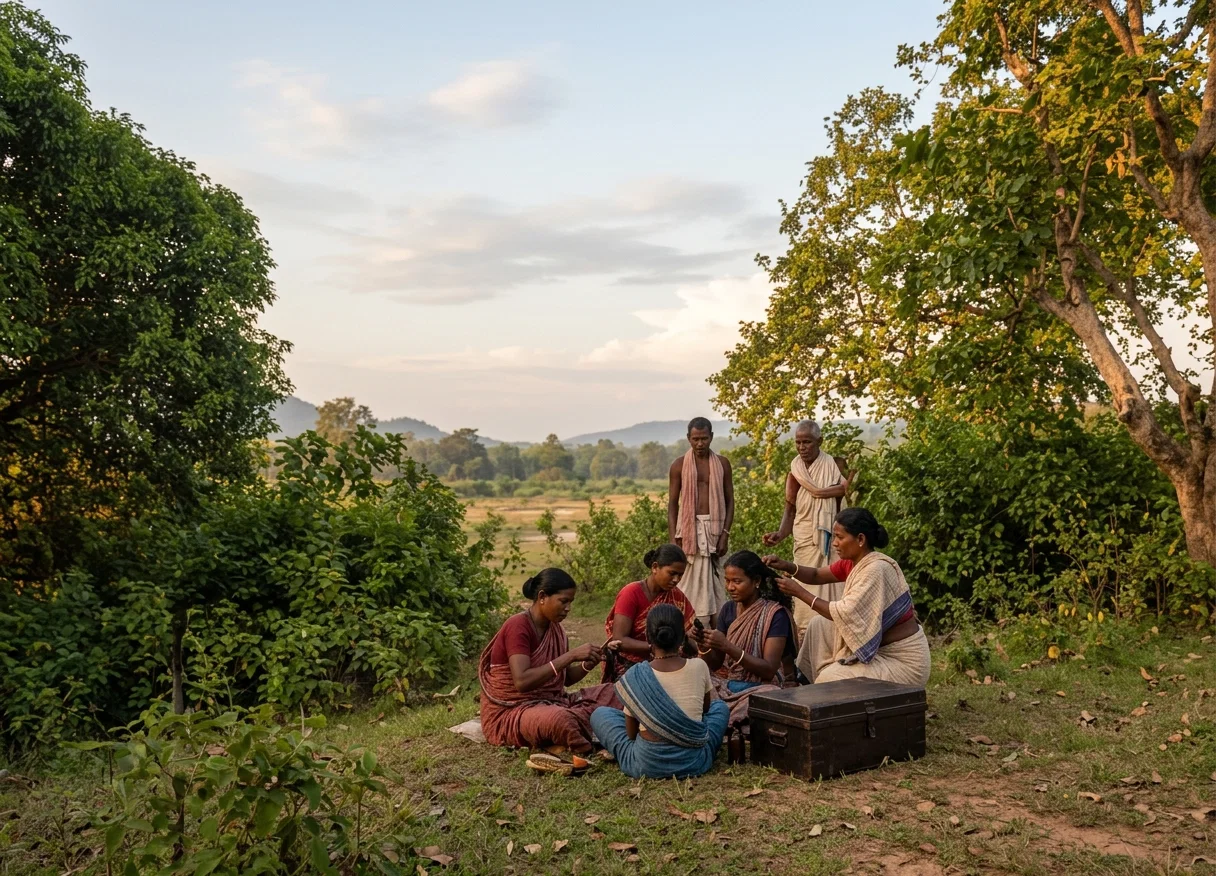
PILGRIMS HAVING HAIR DRESSED BEFORE PRESENT- ING THEMSELVES FOR WORSHIP AT THE TEMPLES AT DEOGHUR, BENGAL, INDIA
A Call From Ethiopia
By W. S. HYATT
W. S. HYATT
“ETHIOPIA shall soon stretch out her hands unto God.” Ps. 68:31. Long years ago the Lord saw the darkness of the African race, and he inspired his servant to prophesy of a time when this poor, despised people would reach out after the Lord. In the book “Education” the Lord sends us this message:13“Ethiopia is stretching out her hands unto God.” The time has come for God’s truth to go to a hungry people. With outstretched hands Ethiopia stands begging for the Bread of Life. Shall we give it? or shall we treat this appeal the same as many do the ordinary beggar when asking for bread?
Listen, brethren. Listen to the sound of the going in the tops of the mulberry trees. Nearly one hundred years ago the missionaries began work in this country. The native listened, heard, and received some of the things taught. For a long time he was contented, satisfied, with what he had. But after a time he began to read the Bible for himself. The Spirit began to enlighten the dark mind, and then he became dissatisfied. Independent churches were organized. The light shone clearer, and some saw the truth on baptism. More light from the open sanctuary revealed the truth of feet washing. A Zulu in Natal received a few Bible readings, and then started up the country through Zululand, returning by a different route. Everywhere he went, he preached the Sabbath truth. In Cape Colony our brethren found an old native who had kept the Sabbath for many years. He had learned of it from his Bible. The light of truth is shining, and this people whom we have passed by so long are beginning to feel its power, and to respond. Ethiopia is stretching out her hands unto God. Is it not time for us to bestir ourselves as never before? God is no respecter of persons. We all know the story of Philip, and his going down to preach the good tidings to the city of Samaria. Many heard and accepted the things he preached. Although hundreds of people continued to listen, the Lord knew of one hungry soul from Ethiopia, and Philip was called to go and meet him and preach unto him Jesus. I wonder if God is not calling many more the same as he did Philip, desiring to use them to do a similar work? Our experience the last few months shows to us clearly that the Lord can send his truth among the native tribes like the spread of wildfire. Who will consecrate his all to this grand cause, and join in the work of soul-saving?
The last generation is almost finished. Its work will close suddenly. The sealing work will soon be over. Brethren, is your work well done? Are you ready for these things to come? Ah, but there are many who are expecting to join the working band before that great day shall come. To-day they are just waiting—waiting for a more favorable time to invest in the salvation of souls.
The third angel’s message is onward, and nothing can stop it. Victoriously it is marching through the earth. Of every nation it will gather a few as trophies of His redeeming grace.
Cape Town, South Africa.
In Cannibal Land
The Mission World gives the following extract from a letter from Dr. J. G. Paton, of the New Hebrides, as to the present condition of affairs among these islands:—
“God has given us over sixteen thousand worshipers, and over three hundred and thirty of them are native teachers and evangelists, who are now helping us in the work of trying to bring the remaining population, from forty to sixty thousand cannibals, yet on the group, to fear and serve our dear Lord Jesus Christ.
“On Malekula and its surrounding islands the natives are almost entirely without clothing. They frequently strangle the very aged and those long sick, or bury them alive. When their female children come to be from six to twelve years of age, they knock out their two front teeth, and then sell them to the highest bidder, for from six to ten or twelve hogs for each. The purchaser may have three or more wives already; he may be young, but is generally old. The poor girl may weep, and plead not to be sold, but she has no choice in it. Her father disposes of her at will, and under a guard armed with loaded rifles, her purchaser takes her to his home. If she runs away, as is often the case, she is forced to return; if she runs away a second time, she is fetched back, and a row of three or more holes is burned in her breast or side by fiery sticks; if she runs away a third time, a hot stone is placed behind her knee, or knees, so burning her that she can not run away again. So some are lamed for life. The buyer can sell her again, or kill her at will, and none dare find fault. She is his own. He bought her, and can do with her as he pleases. So women are slaves, and used as beasts of burden to men.
“The teaching of our dear Lord Jesus is the only effectual cure for all these evils. At the three mission stations on the island of Malekula, occupied only a few years, there are: at Uripiv, fifty-four church-members and three hundred and nine attending the services; at Pangkumu, eighty-six church-members and four hundred and fifty attending the services; and at Aulua, one hundred church-members and five hundred attending the services. These are doing all they can to help the missionary in bringing others to worship and serve Jesus Christ.
“How it would have rejoiced our helpers in the home lands to have seen nearly three hundred assembled on a recent Sabbath, when I baptized eleven adults, and dispensed the Lord's supper to six whites and one hundred and fifty-three of our natives, sitting on the green grass, where only a few years ago I baptized the first six converts and celebrated the first communion! Our converts from Christian villages generally live near one another, and begin and close every day with praise and prayer. They try to work for Jesus in teaching and preaching the gospel to others. By grog, ammunition, and firearms given to the savages, chiefly by French and other traders, many have lately been ruined and killed, and great suffering has been caused.”
Tidal Wave in the Marshall Islands
ON June 30 a tidal wave swept the Marshall Islands of Micronesia, involving the loss of the lives of many natives.
Mission Notes
“THE door to the heart of the remote East is Japan, and to-day it is wide open to all that is best in the West.”
A MESSAGE to a church missionary society of London states that a man was crucified at Akpu, in Nigeria, by the king of Ugboko, as a sacrifice, at an annual festival. It is believed that human sacrifices are made frequently among these tribes, notwithstanding their proximity to a region governed by white people.
“Of late the roar of cannon in Manchuria has been heard in Peking, and slumbers ages old are disturbed. Japan has sounded the call for China’s rejuvenation, and China is listening. Witness her military and commercial activities, the new demand for education, and the calls from some thoughtful men for reform in worship and religion. A new China is knocking at the door of the American churches.”
It is not the missionary, but the Book given him to expound, which changes dissolute, brutal, and blood-thirsty savages into godly, peaceable, and useful citizens. Wild head-hunters and slave-raiders are changed into men by the power of the life and words of Jesus Christ. When we at home realize that the mission fields are full of illustrations of this power of the Bible, we shall go humbly to them for the wherewithal to silence doubters and build up the faith of our own people.
FROM Sumatra the Rhenish Missionary Society reports a year of harvest such as it has never before seen. The number of pagans baptized during the year was 4,712, besides 136 Mohammedans. The total of Christians is now 61,764. In 301 schools 14,519 boys and girls are under instruction. The Bataks, among whom the society has its field, are the same people who in 1834 killed the American missionaries Munson and Lyman. Now 412 of these Bataks are skilled Christian workers, twenty-seven of them being ordained clergymen.
THE government of Holland has laid before its parliament a report on the condition of the native races in Borneo, Sumatra, Nias, and other Malaysian islands. It declares that while the government has found itself powerless to extirpate various cruel or immoral customs of the savage tribes of these islands,—cannibalism, slavery, head-hunting, debauchery, etc.,—Christianity has abolished them over a wide territory, and that the tribes which have accepted Christianity are steadily improving in propriety of social habits, in character, and in material prosperity.
Fiji
By Mrs. C. H. Parker
LAU DISTRICT.—The work is making progress in the Lau District, the eastern section of this group. You will be glad to hear that we now have a memorial in Mualevu, the town near which we live. A neat little building, thirty by sixteen feet, has been erected, and enclosed by a fence. The roof is of corrugated iron, the walls are of reeds, and the floor is of boards. The cost was fifty-five pounds. The brethren have paid nearly thirteen pounds; the rest devolves upon us.
The occasion of entering the new church building was a glad one. We had a union quarterly meeting. On Sabbath morning after Sabbath-school, the whole company walked a mile to a quiet spot beside a little stream. Our songs of praise ascended to the Lord, and new love and courage were awakened in each heart as one more followed the Lord in baptism. All nature seemed rejoicing. A few of the townfolk were there.
The brethren at Cikobia, an island near by, have started their house of worship. It was decided to have it ready to dedicate by the next quarterly meeting. The truth is slowly but surely taking root. MRS. C. H. PARKER.
Porto Rico
By B. E. Connerly
Our work has been moving slowly, and there has really seemed little to report. As this vacillating people have been under the influence of Catholicism for centuries, the condition found here is indeed hard for us to master, and it is difficult to know when we have made real advancement for the gospel. Sometimes it is only by faith that we can press forward, with nothing in sight to encourage us; but we know Porto Rico must have the message, whether its inhabitants will hear, or whether they will forbear. God is pouring out his Spirit on all flesh, and Porto Rico must be included.
For several months we have been confining our efforts almost exclusively to Mayaguez. Mrs. Fischer has been nursing and holding Bible studies, and Mrs. Connerly and myself have worked in the office, and held meetings.
Our native boys began holding meetings in April, and they have improved beyond our expectations. Now they can preach the message in quite an acceptable manner. We have held meetings in eight different parts of the city, in all of which there has been considerable interest and a fair attendance.
For a month Mrs. Connerly has been ill, and unable to work, and we have now moved out into the country about fifteen miles from Mayaguez.
The boys are keeping up the interest as best they can, and I go to the city every week and stay over Sabbath with them, holding two or three meetings. While the work sometimes seems fruitless, our only wish or desire is that we may be wise in working, and be led of the Spirit; and we know that we share this desire in common with all our brethren. So let us labor on, praying for and strengthening one another, until this precious message has accomplished its work in the earth.
B. E. CONNERLY.
Portugal
By C. E. Rentfro
CARCAVELLOS.—July 23 I arrived home from a three-weeks' trip to Switzerland, where I attended our Latin Union camp-meeting. I crossed Spain and one corner of France. As I traveled, I thought of the Suevi, the Goths, and the other barbarian tribes that once inhabited these countries, of whom we still find traces. Also, the Pyrenees and the Alps reminded me of the Waldenses, who found that “the earth opened her mouth, and swallowed up the flood” of persecution. In Geneva I was told of a chapel where Calvin preached probably about thirty years. Our camp was located on the same property as our school, sanitarium, and health food factory. It is one of the most beautiful places on either side of Lake Geneva, comprising ninety acres, a great deal of which is covered with large white oaks, Eucalyptus trees, and pine trees. A large frontage on the lake gives plenty of space for bathing purposes. In the distance, Mt. Blanc, with its snow-capped summit, can be seen quite plainly, and is very pretty.
Our committee planned to help me by authorizing me to publish some special tracts in Portuguese, one entitled “The Secret of Health,” and the others on the second coming of Christ. On my return home I found a donation from a sister in California for this very purpose. We praise God for this, as well as for a club of twenty Signs, which is furnished us by two lovers of present truth. For these we have a number of regular and interested readers. We expect soon to learn of a brother and his wife opening up the work in Tangier, Morocco, north Africa. They were sent from our camp-meeting. I was glad to make their acquaintance, and to meet other workers.
While at Barcelona, Spain, I had the privilege of attending a Spanish Sabbath-school. One little girl repeated the books of the Bible without a mistake, and another the ten commandments. They were bright little girls, probably eight years of age. As I traveled through Spain, and saw the many villages, towns, and cities, with their hundreds and thousands of people, I thought, “How long before they can be warned?” Then, as I saw the beautiful fields of grapes and fruits of all kinds, where irrigation insures crops, I wondered, “Why can not some one come and buy a place, and live here, and teach the truth to this people?”
Truly, I thank God for the light of his Word. And how thankful I am to be here to help teach it to this people! I expect to put in another good month in language study; then I shall begin selling papers and distributing literature. Remember us still in your prayers. Soon the battle will be over, and we shall greet one another on the eternal shore.
C. E. RENTFRO.
Panama
By I. G. KNIGHT
BOCAS DEL TORO.—At the time of my last report in the REVIEW, we had not closed our tent-meetings in Port Limon. When we did so, there were twelve accessions to the faith. The need of a place of worship being felt, an effort was put forth to secure a church building. In this was plainly seen the hand of God; for in two weeks after taking down the tent, we had completed a neat little chapel, which we dedicated August 13, the interest manifested being extraordinary. There was not room enough to accommodate all who came, and many stood outside on the portico.
We returned to Bocas the next day, and the following day a quarantine was again on, so we have been unable to visit them since. There is an excellent interest in the different islands around Bocas, and some are taking their stand for the truth. We have been holding meetings at a place called Western River. The interest was awakened by one of our canvassers. This place is fifteen miles from Bocas, but we run down there easily in our launch. Eight have begun the observance of the Sabbath. I baptized five of these, and three at another place. The work moves on encouragingly.
I have been up and down with the tropical fever the last six weeks. At one time I passed through a very severe attack, having a hard struggle for life, but am better now.
We wrote you about our visit to Old Providence Island last June; after holding meetings for twenty-eight evenings, eight accepted the truth. I have just heard from them, and learn that they are passing through a severe test brought on15by the opposers of the truth there. I quote from a letter written by one of the brethren there:—
“We are truly witnessing the fulfilment of the Scriptures in this place. Yesterday I received a summons from the alcalde’s office to appear there at 9 A. M. I was there promptly at the time specified, and received notice from the alcalde prohibiting me from doing any manner of work on Sunday, saying it was the government’s rest day, and I as a citizen must obey the government. I replied that if he would show me from the Bible where God commanded his children to submit to governments in matters of conscience, then I would rest on Sunday, otherwise I could not. I can not compromise. He said, ‘You are disobeying the authority, and I shall have to execute orders.’”
This is the first experience of this kind in our field. It is in marked contrast to the attitude of the government toward other denominations. But we know that persecution will come sooner or later to all who are faithful. May the Lord help us each to stand firm, as this brother has. Remember us at the throne of grace.
I. G. KNIGHT.
Oklahoma
By G. F. Haffner
SHATTUCK.—The local camp-meeting at this place is now in the past, but the blessing received during that time is not all in the past. Some impressions were made which will never be forgotten. The last two days of the meeting, Sabbath and Sunday, were specially blessed by the presence of God. On Sabbath afternoon at the young people's meeting the Lord came in, and filled the tabernacle with his converting power. Sinners came forward and cried to God for forgiveness of sin. Others went out and invited those in who knew not God, and hard hearts melted under the influence of the Holy Spirit. About thirty gave themselves to the Lord. On Sunday forty were baptized. The good work was continued, and a few others have taken their stand on the Lord's side. Last Sabbath two were baptized, and five were added to the church.
I can truly say that this was the best camp-meeting I have attended this summer, and I know that all were blessed by the presence of God. May the Lord continue to add to the church daily such as shall be saved. My courage in the Lord is good. The truth shines brighter every day as we near the great day of the Lord. G. F. HAFFNER.
Africa
By M. C. Sturdevant
BULUWAYO, RHODESIA.—I have just been on the scaffolding, working on our new church; but the wind is so strong to-day that I had to come down. This is midwinter in Africa, and we have had some very cold winds this season, which have brought much influenza. We have suffered from it here at the mission, but, to the praise of God, all are around again now.
I will give you a program of our work this winter: Rising at 5:45, all go to work till seven o'clock, when we have prayer and breakfast. At eight the first school is taught by native teachers, primary division. The same hour I take some boys, and go to building or other work, Brother Tarr, if at home, taking boys to other work. If he is away, I look after all the work. At ten o'clock we come in from work, and enter school, studying till two o'clock. As this second school begins, the first school is dismissed, and goes to work until two. The dinner hour is from two to three. After that all work until six. At 6:45 the bell rings for worship, which is followed by night-school till 8:45. At nine o'clock lights are out, and we are ready for bed.
The intervening moments are spent in caring for the sick, and drawing teeth, the latter a daily work in the winter season, because of the cold winds which test every weak place in the body.
In spite of the dreadful drought of last year, the Lord blessed us above our fellows, and gave us quite a little. From our farm crop we obtained seven hundred bushels of corn, seventy-five bushels of Kaffir beans, thirty-five bushels of Nyanti Kaffir grain, one hundred and forty bags of peanuts, and a goodly store of pumpkins. We also have ten acres in sweet potatoes. To the praise of God, we can say that we have raised food enough for our family, and a little to spare. And while our store has brought in little this year, it will provide clothing for all, and wages for our native teachers, I think.
The spiritual condition of our mission is very encouraging to me. Our school hours are a spiritual feast to me, and I am sure I can say the same for the children. Many are truly putting on the image of the Holy One. The change can be seen in the life, and few, if any, manifest an indifferent spirit. After having a weekly study with a class of twelve for many months on the subject of baptism, they were baptized. Last Sabbath—August 5—we invited Brother C. R. Sparrow and his family from the Kupravula Mission to join us, and after Sabbath-school at the schoolhouse, we all went to the river, about two miles distant, to baptize these dear children. There were about two hundred natives present, to whom we delivered four short discourses. Brother Tarr showed from the Word why the missionary had come to their land. Our native boy, Jim, followed, speaking of God's great love for his people. Brother Sparrow then gave a talk, telling them that now is the accepted time. The writer then reminded all of the fact that about one year ago the same call was made. To the praise of God, twelve had responded. Yet his voice was pleading. Who would follow? The candidates were urged to faithfulness, and to accept the proffered gift of the Holy Ghost.
The candidates all gave testimony, telling their people why they had accepted Christ as their Saviour. The testimonies were rich, and full of feeling. All were then buried with their Lord in baptism. Many of the fathers and mothers were present, and we trust another favorable impression was made upon the people. Our courage is good, and we desire to be found in the harness. Pray for your fellow workers here.
M. C. STURDEVANT.
North Michigan Camp-Meeting
By S. E. Wight
This meeting was held at East Jordan, August 29 to September 10. It was not large, but it will long be remembered by all in attendance. The Spirit of the Lord was in the camp, and it was noticeable in the conduct of the brethren and sisters. Each one considered the welfare of others rather than his own. Nearly all came to this meeting with the desire of getting help, and from the very first, the impression seemed to be that we must press in while the door of mercy is open. Only three left the meeting unconverted. The last day of the meeting twenty-four were baptized.
The conference was held in connection with the camp-meeting, but it did not in any way lessen the interest. Situated near the schools of other conferences, we were not obliged, in the consideration of our educational work, to spend any time in raising money for institutions, but it was devoted entirely to interesting young people in attending school. As a result several have decided to enter some school this fall to fit themselves for work in the Master's vineyard.
The spirit of sacrifice came in, and the key which unlocks the door for the Holy Spirit to enter was applied, and those who have been long in the way and know what it is to live the Christian life drank anew of the Fountain of life. Certainly the Lord has visited this conference, and we have every reason to believe that the good work begun at this meeting will be continued.
The conference has reduced its apportionment of the General Conference debt about one half, and it was decided to spend most of our energies this year in raising means to purchase tents, which are much needed.
The following-named ministers were with us during a part of the meeting: Elders Allen Moon, K. C. Russell, F. C. Gilbert, W. D. Curtis, C. A. Hansen, and S. M. Butler, and Brother J. B. Blosser. The labors of these servants of God were greatly appreciated; and as they presented the needs of foreign fields, the needs of our conference appeared very small; and although we have seen, this past year, the hardest time for years, yet we responded to the call, and about one dollar for each person on the ground was donated to foreign mission work, and when Elder C. A. Hansen and his wife left our grounds, en route to India, they were given a hearty hand-shake and God-speed by all.
There was a good outside attendance, the largest ever enjoyed at any camp-meeting held in the North. At the last meeting the large tent was crowded, and many stood outside and listened to the words of Elder K. C. Russell on the subject of Religious Liberty.
S. E. WIGHT.
Home Improvement Courses
By M. E. KERN; B. E. HUFFMAN
UNDER this title the Central Union Conference last February offered two courses of home reading for young people. Of these the general culture course consisted of readings from the spirit of prophecy and missionary biography. The special training course (for teachers) included the reading of a book on teaching, together with the Testimonies on the same subjects as treated in the book. A large number of young people, not only in the Central Union Conference, but in many other conferences, took one or the other of these courses, and received great good from their study.
It has been decided to continue this work another year, beginning October 15, and continuing eight months. All who desire to do so are invited to enrol in one or the other of these courses.
Plans for the Work
The general culture course will consist of two parts; first, a course in Bible reading, Old Testament history, including references to the works of prophets, the captivity and return of the Jews, and the rebuilding of Jerusalem; second, missionary biography, “Life of John G. Paton,” a missionary in the New Hebrides. This is a most interesting story of missionary life. Both parts of this course will be carried on at the same time. The outline lessons and helps will be published in the Educational Messenger.
Special Training Course
The special training course for teachers or others interested in teaching, will also consist of two parts. Part 1, “The Place of the Bible in Education,” will require about eight or ten weeks’ work. Part 2. “Elementary Agriculture or School Gardening,” to continue throughout the school year, will consist of a series of lessons and experiments in the study of plant culture. The topical outline for review work in Part 1, and notes and suggestions on the lessons in Part162, will be published in the Educational Messenger.
Time to Begin
For either course, now is the time to make preparation. The first lessons appeared in the Educational Messenger of October 15. To enrol for the general culture course, write M. E. Kern, College View, Neb.; for the special training course, address B. E. Huffman, College View, Neb.
Records, Examinations, and Certificates
A careful record is kept of all who enrol in either of these courses, and examinations will be given at the close of each course. To those who finish the course satisfactorily, certificates will be given showing the work done.
Books, Helps, Etc.
General culture course: “Life of John G. Paton;” order of M. E. Kern, College View, Neb.; price, $1.50. The Educational Messenger, price 50 cents a year; order of the Union College Press, College View, Neb.
Special training course: “The Place of the Bible in Education;” price, 25 cents; order of your tract society or of the Pacific Press Publishing Co., 1109 E. Twelfth St., Kansas City, Mo. The Educational Messenger. A number of bulletins issued by the United States and State Departments of Agriculture, will be needed for the second part in this course. Bulletin numbers and addresses will be announced later.
M. E. KERN, Sec. Y. P. W., C. U. C.,
B. E. HUFFMAN, Ed. Sec., C. U. C.
Vermont's Aid to China
By F. M. DANA
At our last conference and camp-meeting our brethren thought it in their line of duty and in the plan of co-operation in the mission work under this message to all the world, to consider a proposition for supporting a worker in some mission field. Accordingly the following resolution was passed:—
“Whereas, A great blessing came to our people throughout the conference when we gave and supported a worker in Scotland; and,—
“Whereas, Our worker has returned to this country, and is located in another conference, therefore,—
“Resolved, That we pay into the mission treasury the sum of six hundred dollars, to be expended in China by the Mission Board, preferably for a new or added worker.”
A copy of this resolution was forwarded to the Mission Board with a request for the name of the worker to be reported to Vermont as soon as they decided upon the same. We received the following response:—
“I am in receipt of your kind letter, and wish to extend to your conference the gratitude and appreciation of the Mission Board for the generous support that your small conference has extended to the mission work. We thank you very much, more than tongue can tell, for this generosity.
“We will try to forward you the names of the workers in China. There are several who have been sent there, and I will lay the matter before the committee for advice, and either the secretary or myself will write you as soon as the matter is brought to a conclusion.
“With kind regards, and wishing you much of the blessing of the Lord, I remain, Sincerely your brother,
“I. H. EVANS.”
Later we received the following letter, which we are sure will be of interest:—
“At a recent meeting of the General Conference Committee the following action was taken:—
“Resolved, That we gratefully accept the offer of Vermont to pay the salary of a worker in China, and suggest to them that they take Dr. Law Keem as their representative in the land of Sinim.”
This action of the General Conference Committee has been accepted by the Vermont Conference Committee, and now our interest will naturally turn to the reports from this field. Thinking further quotations relative to Dr. Keem may be of help, we quote:—
“Dr. Keem is a native Chinese, and will be able at once to work in the language of China without years of delay in learning the language. Thus Vermont will be busily engaged from the start. Dr. Keem has been in this country nearly twenty years, and so is thoroughly conversant with the truth and with American ways. In fact, he is so much of an American that he has married a nurse in California, and they are both now in China. Special help was provided to land them in China, and our Board felt that the situation was such that they ought to push in without delay, and yet, really, they went last spring as almost a matter of faith on the part of our Board as to their support.
“We are assured that he and his wife will be able and efficient laborers in both medical and evangelistic lines. May the Lord make this splendid gift a blessing to Vermont as well as to China. The Lord's providence is going before us in China, and the time has come when at least a few workers should be placing the leaven of truth in this populous land, the most populous of the countries of the earth, and the last to be entered by the message.
“I can assure you that in the situation in which the Mission Board finds itself, this help proposed from Vermont comes most timely indeed. With kind regards,
“Truly your brother,
“W. A. SPICER.”
May the prayers of God's people now ascend as we unite, with heart and hand, in the work of proclaiming the gospel in this dark land, till Jesus shall come again.