“Train up a child in the way he should go: and when he is old, he will not depart from it.” Prov. 22:6. To train up a child in the way he should go, can mean nothing less than to keep him in the way all the time until he reaches manhood. Thus early impressions become fixed as habits, a part of the very life.
The training of a vine illustrates this truth. The gardener does not simply consider the present needs of the plant, but he has in his mind a picture of what he expects the vine to be when it reaches maturity. He arranges his frames and trellises with that end in view.
As he watches the growth of the vine, he will notice branches and tendrils reaching out here and there, frequently in directions that are contrary to his plan. He gently bends the supple twigs in the direction he would have them grow, knowing that harsh handling will mar the beauty and usefulness of the plant.
Should he carelessly neglect the vine for a time, he would find some of the branches tangled and twisted and doubled back upon themselves, in a way quite contrary to his wishes. Efforts to improve it now will be attended by some risk. Some branches can not be straightened without breaking them off. The vine, though much improved by future watchfulness, can never be what it might have been, had it never been neglected.
Thus it is with a little child. If he is kept in the way, not being allowed to develop evil traits of character, it will mean a useful life all the way along. He will escape many struggles and difficulties.
To train up a child for the service of God on earth, and for the future immortal life, is the work of years. The burden can not be safely laid down until the child has not only been converted, but until a habit of right-doing has been so firmly established that he will not be easily lead into evil. Here is where many fail. They imagine that their children are old enough to look after themselves, and they allow them to choose their own associates and surroundings, when as yet their judgment is immature, and the knowledge of the results of their conduct is very limited. They thus become the sport of circumstances. “Evil communications corrupt good manners.” 1 Cor. 15:33.
We may learn a lesson on this point from the life of Moses. He was born under peculiarly trying circumstances, and his mother had the privilege of caring for him only about twelve years. But she had taught him so faithfully during those early years, that he never lost his love for God and truth, even though surrounded by all the splendors of an Egyptian court; and the prospects of a throne could not turn him from his loyalty to the despised people of God.
But there is a dark chapter in the life of Moses. He was taken from his pious surroundings at a tender age, and his education was not finished. He was placed in the worldly schools of Egypt, where he learned the art of war. He knew he was the chosen leader of Israel, but he had imbibed the erroneous idea that he was to deliver them by the power of the sword. Hence he slew the Egyptian. He was obliged to flee for his life, and spend forty long years in the humble occupation of a shepherd, unlearning the lessons of his youth.
There have been children who have gone out of pious homes into a wicked world, and have drifted away from the teachings of their childhood, and, in later years, have returned to the God of their fathers. But many under such circumstances never return.
In this day when time is so short, we can not afford to let our children be taught in worldly schools, there imbibing wrong views of life which will take long years of repentance to overcome. The end will come and they will not be ready. They should be kept “in the way.”
Markham, Ontario.
What a Letter Did
A WOMAN who had known wealth and gentle surroundings suffered reverses and found herself among rough people in the logging districts in the northwest. If poverty had been her only misfortune it would not have been so bad; but with the loss of means and the subsequent privations, had come also a neglect of the moral and spiritual side of life, a decadence of her better self, which made her a person of small account, even among her rough neighbors.
A Christian worker in that region, seeking to obtain good reading-matter for the people in his district, wrote and obtained the names of thirty families in one well-known city church, each family agreeing to send to a designated family in the woods its second-hand reading-matter. This was so different from the usual sending out of barrels of cast-off clothing that some of the donors entered into correspondence with those to whom their periodicals were mailed.
So it came about that a refined woman in the distant city, following her magazines with a letter, was surprised to receive a reply as well written as her own letter had been, and showing evidence of no little culture.
To the woman in the logging-camp the letter of the city woman was a new contact with the life that she had thought forever lost to her, and it quickened her pulse a little to be writing again to a gentlewoman.
The correspondence went on for some time, with profit on both sides. The city friend — for such she had come to be — improved the opportunity to plead with the woman in the woods to turn again to those better things in life which she had so long neglected, and to trust God for help. A penitent but earnest resolution, with a prayer and a promise, found expression in the next letter — a promise that she would make the effort, would try to lift herself to a higher plane.13
She did try, and she succeeded. She is honored now for the good work she is doing for her neighbors; and the neighbors have not ceased to marvel at the change. But she herself knows that its beginning was in the Christian love and fellowship that came to her from far away.
“Why must you polish that lens with the palm of your hand?” asked a man in a telescope factory.
“There comes a time in the making of a fine lens,” the workman replied, “when nothing can be substituted for the human touch.”
It is so with our efforts to help men and women to lead a better life. The reading-matter, of itself, might have done good, but how blessed was the letter that brought with it the sense of companionship and sympathy! — Youth’s Companion.
Be Tender to Those Who Are Old
LET us ever be tender to those who are past
The glory and joy of their prime;
Whose strength and whose vision are weakening fast
’Neath the shadowing touches of time.
Let us ever be tender to those who are old,
For once they were happy and young;
And when the bright future before them unrolled,
They merrily frolicked and sung.
With strength and with hopefulness life was enjoyed,
And gaily they went on their ways,
Undreaming of hopes to be baffled—destroyed;
Undreaming of sorrowful days.
The years are fast speeding; they soon will be gone
The aged ones with us to-day;
Their feet are approaching eternity’s dawn,
Make haste to be kind while we may!
—Selected.
Learn to Be Methodical
EVERY man and woman who has amounted to much has been distinguished early by a power to work hard. Genius alternates periods of frantic application with spells of idleness in which spent forces recover tone; but talent proceeds more steadily and smoothly. Its rests are regular and its work more methodical. Without method it is lost, and I believe there is no more certain sign of superior ability in a child than an innate tendency to methodize his labors and the disposal of his time. In order to bring to fruition any germ of this healthy and beautiful faculty, teach the little one from his earliest years to be regular in all his habits; not merely to have a place for his belongings, but a special hour for special duties. Encourage him to regulate his life in accordance with rules which he himself has chosen. Let him experiment and find out the defects of his system, that he may reform it continually, until he has arranged one that can stand.—Christian Uplook.
How Animals Doctor Themselves
MANY animals doctor themselves, and among our domestic animals the dog and cat probably claim first place. Both at times eat medicine plants as emetics, the dog selecting spear grass and the cat showing a preference for valerian and cat mint. They vary their treatment with an occasional dose of ashes and cinders, just as the crocodile, lizard, and some birds swallow gravel and stones to counteract a fit of indigestion. Both practise personal cleanliness as a preventive, and their unfailing habit of licking bruises, cuts, and wounds to keep them in the condition most favorable to healing is a familiar characteristic. The elephant uses his trunk cleverly in dressing wounds and by this means applies water, mud, or dust to the injury.—Selected.
Homes in the Country
By J. W. Watt
J. W. WATT
“It was not God's purpose that people should be crowded into cities, huddled together in terraces and tenements. In the beginning he placed our first parents amid the beautiful sights and sounds he desires us to rejoice in to-day. The more nearly we come into harmony with God's original plan, the more favorable will be our position to secure health of body, and mind, and soul.”—“Ministry of Healing,” page 365.
Those who are preparing to meet the soon-coming Saviour certainly desire to be in harmony with the mind of God in all things. From the above statement from the servant of God, and in view of the fact that serious troubles will soon be seen in the large cities from various causes, is it not time that we as a people should begin to plan and work to the end that many of our people who are not actually needed in the cities as workers may find homes in the country.
Already some of the large cities have been destroyed by earthquakes. Trouble between labor and capital is liable at any time to cause a very undesirable experience. During these or any other of the unpleasant experiences that will come to so many before the Lord comes, the quiet country home will be far preferable to the home in the city.
“Within the vast boundaries of nature there is still room for the suffering and needy to find a home. Within her bosom there are resources sufficient to provide them with food. The tilling of the soil, the employment God appointed to man in Eden, opens a field in which there is opportunity for multitudes to gain a subsistence. . . . Thousands and tens of thousands might be working upon the soil who are crowded into the cities, watching for a chance to earn a trifle.”—Id., pages 188, 189.
I suppose the above is intended as much for the Seventh-day Adventist people of the cities as for others. Why is our attention called to this matter by the spirit of prophecy if there is not something to be done by us as a people? “Christian farmers can do real missionary work in helping the poor to find homes on the land, and in teaching them how to till the soil and make it productive. Teach them how to use the implements of agriculture, how to cultivate various crops, how to plant and care for orchards.”—Id., pages 192, 193.
“Let farmers, financiers, builders, and those who are skilled in various arts and crafts go to neglected fields, to improve the land, to establish industries, to prepare humble homes for themselves, and to help their neighbors. “The rough places of nature, the wild places, God has made attractive by placing beautiful things among the unsightly. This is the work we are called to do.”—Id., page 194.
This being the work we are to do it is certainly time that we were giving heed to what the Lord has said upon this point. To some it will seem like an utter impossibility to carry out this instruction; but it has been the experience of this people from the rise of the message that it is always best to step out by faith and do what God says should be done, not by a rash or fanatical movement, but by quietly and firmly walking in the light given.
In the little pamphlet entitled “Christian Schools,” pages 77, 78, we read:—
“Serious times are before us, and there is great need for the families to get out of the cities into the country.” “Fathers and mothers who possess a piece of land and a comfortable home are kings and queens.”
Place alongside this instruction, to get out of the cities into the country, the instruction given to establish schools in rural districts, and we have a work of importance before us.
The writer's view of the matter is this: that the time has come when a few families of our people might consistently locate near together in the country and establish a school, thus meeting the mind of God in getting away from the evil influences of the cities, and at the same time taking our children from the public schools and educating them for God and his cause, but where a movement of this kind is made, we should locate, if possible, where the truth is unknown, and thus the light may be carried to many who at present are in darkness.
Note carefully some of the statements in the Testimonies quoted, above: “There is great need for the families to get out of the cities.” When the Lord says there is great need for us to do a certain thing, shall we go on from year to year without making an effort to do that thing? There is danger that we may not feel the importance of this as we should, and that many will remain in the cities until they are overtaken by the serious disasters that are to fall upon them.
Note another statement. After speaking of the duty of Christian farmers to assist others in getting homes in the country, and gaining a living there, these words are spoken: “This is the work we are called to do.” If this is the work we are called to do at this time, as servants of the Lord, let us take hold and do it.
When a Testimony comes, it always proves to be a sad mistake not to heed the light given.
If any who read this article have not read the book “Ministry of Healing,” they should obtain the book and study it very carefully, not only upon this point of leaving the cities, but upon many other points of interest to us as a people.
Indiana, Pa.
God's Thought for Us
By Anon.
EVERY beautiful flower, feathery fern, graceful palm, or singing bird tells us of God's love for us. The spirit of prophecy assures us that beautiful things were placed in the earth by our Father with the express purpose of affirming his love to us. Then so long as the spotless water-lily with its delicate fragrance can be found, or the rose with its fascinating beauty, we have no reason to doubt God's love, or his willingness to establish upon us his own beauty. The consciousness of this fact brings him very near to us.
A little fellow without father or mother was being taken by a stranger to a strange home. As they rode along, the boy often put his hand into his blouse as if to make sure of some treasure. The curiosity of his companion was aroused sufficiently to lead him to ask the little fellow if he had something he prized especially. The boy rather hesitatingly revealed his secret. “It’s just a piece of mother’s dress. When I get kind—kind o’ lonesome—I like to feel it. Most seems as if she—wasn’t so far off.” It should be thus with the things of nature all about us. Our Father meant that they should make him seem very near to us, that they should often remind us of his love, and of the beauty of the One altogether lovely, and by their grace and beauty remind us of the Christian graces we should be daily cultivating.—Anon.
J. T. BOETTCHER
By J. T. BOETTCHER
Munich-Bavaria
J. T. BOETTCHER
Munich, the capital of the kingdom of Bavaria, is the third largest city in the German empire, having a population of five hundred and thirty-eight thousand. The kingdom has been ruled for many years by a brother of the king, as Prince Regent. The people, however, elect representatives, who are the law-making body. As the majority of the inhabitants are Catholics, two thirds of the House of Representatives are of this faith, as are also the Prime Minister and all the secretaries.
It will be of interest to learn what religious liberty means in this country. No religion is tolerated except the state religion. We as a denomination are not permitted to hold religious meetings of any kind. In Nurnberg, where we have a church of fifty-five members, they have been fined as high as $12.50 each for attending meeting. Yet our people come together every Sabbath—not in the same place each time, but in different places, sometimes even in the woods.
The last Sunday in November I was called to Nurnberg to preach the funeral sermon of one of our sisters. It had been announced that she was a Seventh-day Adventist, and when we arrived at the churchyard, about five hundred people had gathered to hear. I stood on a big pile of sand, above the people, and preached the truth of God. We sang “Asleep in Jesus,” and prayed with as much freedom as though we were in America. This sister preached the truth, even though dead. The same evening I held a meeting in an upper chamber, and the next morning a lady came to be baptized, thus filling up the gap which had been made by our deceased sister.
I am now conducting a course of lectures in Munich. When I was questioned as to what kind of lectures I intended giving, I answered that they would be historical and religious. The permission was granted without any trouble. Of course I am not allowed to pray, or to say “Amen” at the close.
The first meeting presented a sight wonderful to behold. The people sat in their chairs, with their big beer mugs in their hands, and smoked like steam engines. I did not know what to do, but could only pray that I might find words to help these poor people—and God did bless the spoken word. At present no one comes to smoke, nor does any one drink.
In all Germany there is not another city where one drinks so much beer as here. In the country itself, three billion marks are spent each year for alcoholic drinks, or just as much as the national debt amounts to. The little children get beer in the nursing-bottles, just as others elsewhere get their milk. Most of the priests are stockholders in the breweries, and they themselves drink more than any of the others. For this reason many people have lost faith in any religion. Others still cling to their church because it is all they know, and they have nothing better. We tell them that the Bible says so and so; but the poor people have never seen a Bible, so we sell Bibles to them.
A VIEW IN MUNICH, BAVARIA
It does one good to see how these dear people listen to the simple story of the cross. One lady told me to-day of how she had put peas in her shoes, and then walked a long distance, that her sins might be forgiven, but never could feel that they were. But now she is happy, and reads her Bible day and night. She can hardly wait until she can be baptized. The greater part of our congregation are Catholics. The Lord is good in blessing the world with such a truth that can penetrate even the most beclouded minds. Of late we have been baptizing many Catholics in southern Germany.
We have found a new way by which we may hold meetings in Bavaria. The law permits societies of all kinds to be organized, and meetings to be held by the same. So we have organized ourselves into a society of Seventh-day Adventists, coming together for the purpose of reading the Bible, two members of said society explaining what has been read. We can not pray nor sing.
Last Sabbath, after we had opened the Sabbath-school, a detective walked in, and sat down to listen to what was said. When such men are in sight, we do not offer public prayer. One brother stands at the door, to watch, and when he gives a sign to the speaker, all understand, so that the program is changed in a moment. Last Sabbath we also celebrated the Lord’s Supper, and organized a church of eighteen members. Before many weeks are passed, with the Lord’s blessing we shall have a fine church here. We find many people who are willing to come out from Rome and follow Jesus to the kingdom. It is a precious thing to work for the lost and dying, even amid danger. Our God will give us the victory.
A number of times we have tried to get a petition to the Prince Regent, asking for freedom to hold meetings, but so far we have not been helped. I told one of the government officials that we should come to Munich, with or without permission. Now we are here, and with the Lord’s help we have come to stay. In the places where the darkness is the greatest, God’s truth will but shine the brighter. Our courage is good, for we shall soon all be home.
Notes from India
By G. B. Thompson
G. B. THOMPSON
In company with Elder J. L. Shaw, I left Calcutta for Karmatar, January 18. Elder W. W. Miller came up later, and five members of the advisory board being present, some important matters were considered. Definite arrangements were made for opening the work in the native village of Kora, four miles from Karmatar, which contains several thousand Bengali-speaking people. It will be necessary to erect a small building for the workers to live in. A portion of the funds needed for this has already been raised. Brother A. G. Watson and wife and Sister Della Burroway will devote their whole time to acquiring the language and opening the work. It was arranged that other laborers can connect with these workers and also have opportunity to perfect themselves in the Bengali. All at Karmatar have some knowledge of this language, and can begin operations at once.
The Lord is blessing in every step that is being taken to open work in the vernaculars. If nothing happens, we shall soon have five or six Europeans among the Bengali people, speaking the last message to them in their own tongue. Once we have sturdy pioneers15among the various tribes, speaking the language of the people, we shall be able to do a quick work in this land.
The way has been opened in the village of Karon, by the faithful efforts of Sister Whiteis as a medical missionary. There is no place, it seems to me, where a consecrated medical missionary can find a greater field of usefulness than in India. This line can be made the most effectual of any in reaching the people—not by establishing institutions, but by going into the villages, to minister to the hundreds and thousands who are suffering with all manner of disease. Here is a limitless territory for our medical workers. Doctors and nurses can go thus among the people, and without any great outlay of capital in erecting institutions, but with only a small dispensary and outfit for giving simple treatments, will soon secure the good will of the natives. Even advertising will be unnecessary.
This is real missionary work. We shall need to undergo many hardships, and suffer many inconveniences among the heathen, and under a tropical sun. It is of but little use to undergo these privations simply to bring physical blessings to them. Our primary object is to bring the third angel's message to souls; and only those should come to India to take up this work who love this message more than life, and who come to stay. To labor effectually, we shall need to learn the language—and this means spending our lives in the country.
While at Karmatar a church of twelve members was organized. Brother J. C. Little was chosen elder, and A. G. Watson deacon. The ordinances were also celebrated. The work has been carried forward here for several years by means of the orphanage, and great good has been accomplished. Some of the orphans have grown up, and are filling positions in the printing-office, and in other departments of the work. Here two faithful pioneers in this country—Brethren D. A. Robinson and F. W. Brown—lie buried side by side, awaiting the resurrection. The Lord witnessed to the organization of the church at this place, and all felt glad that the time had come when this step could be taken.
From Karmatar we went to Simultala, where we have a mission among the Santals. Brother Barlow and wife have rendered faithful and effective service here for several years. They have mastered the language, and literature has been translated. Brother and Sister Cook, from the Boulder Sanitarium, have joined them, and will begin at once a study of the language, preparatory to doing aggressive work among this people. The Santals are said to make the most substantial Christians of any of the Indian people. A few have already accepted the message. Caste does not prevail among them, and work for them is much easier than for those of other tongues.
How great are the needs of these poor heathen souls! They are in the bondage of sin, and desire help. They paint characters over the doors of their crude homes, and stretch chains across the door, to keep out the devil. How much they need the blessed light of God's Word! Shall we delay longer in giving them the light, which alone can deliver them from Satan's power? They are earnest in their devotions, though worshiping they “know not what.” I have seen a long train of freight-cars, filled with these poor souls, going to some distant place on a pilgrimage to take part in some festival. Each car was as full as it could be of people sitting on the floor. They did not complain, and seemed willing to spend their last pice to get to their destination. As I saw this, I wondered if we would be willing to go to camp-meeting in as rude a conveyance as this, to worship the true God, and hear the closing message of salvation. A consecration proportionate to the greatness of the message we carry will soon warn the world, and bring the end.
The South African Conference
By George A. Irwin
G. A. IRWIN
At six o’clock on the morning of Jan. 1, 1907, we cast anchor in Table Bay, thus bringing to an end a sea voyage of 13,256 miles—the distance from San Francisco to Cape Town. Brother Fortner met me at the dock, and took me direct to Claremont, a suburb of the city, and the place that had been chosen to hold the coming conferences and camp-meeting. On the way to Claremont I was informed that Brother and Sister Rogers, who were under appointment to Africa, and who had left the States about a month later than I, going by the way of England and the west coast of Africa, had arrived just thirty minutes ahead of me.
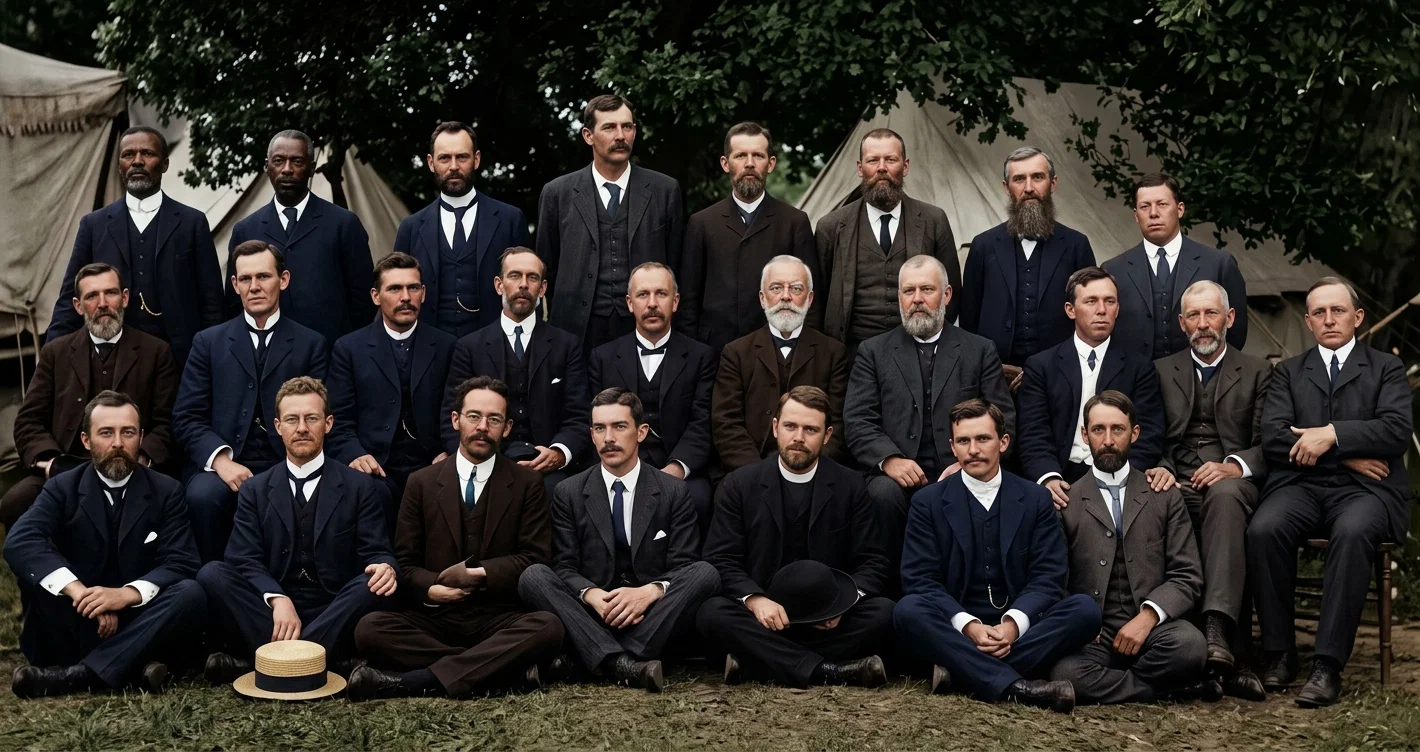
It had been arranged to hold the Cape Conference and the South African Union Conference in connection with the annual camp-meeting of the Cape Conference, and in order to have sufficient time, the meeting was to run from January 4-20, being in session over three Sabbaths. The first week was devoted entirely to business, with the exception of the hour from six to seven in the morning, which was used for Bible study and social meeting. The evening hour was devoted to a preaching service for the benefit of the campers, and any who might attend from the outside. While the attendance of our own people was not large, yet it was said to be the most representative gathering that they have ever yet held in this field, delegates being present from Rhodesia, Natal, Nyasaland, Basutoland, Barotseland, Transvaal, Orange River Colony, and all parts of Cape Colony. Each of the seven missions carried on among the natives was represented by the one standing at the head, and in four instances the wife accompanied her husband. In addition to the white delegates, there were two native laborers—Brother Moko, a Kafir preacher who had been connected with Brother Shone in the Kafir Mission, and Brother Kalaka, who has been acting as interpreter for Brother Chaney in the Basutoland Mission.
Believing that it would be of interest to the readers of the REVIEW to know how the work started in this field, I will at this point quote a few paragraphs from the report of the president of the Cape Colony Conference, as rendered during the session:
'In a most marvelous way the Lord started the message in this country, and no one can doubt but that the Holy Spirit was the teacher sent of God at that time. In the year 1885, or twenty-one years ago, the Lord led Brother Peter Wessels to accept the Sabbath. The Spirit opened his mind, and sent him to the Bible for truth, and point after point was revealed to him, baptism, and then the Sabbath truth. Not long afterward Brother Wessels met Brother William Hunt, who was then living in Kimberley. Up to that time Brother Wessels thought that he was the only Christian Sabbath-keeper in the world, and he was very glad to meet another person holding the same faith.
'Through Brother Hunt, Brother Wessels learned about the brethren in America, and he at once opened correspondence with them. Appeals were made for a minister to be sent out, and these appeals were emphasized by sending £50 to pay the passage. These appeals stirred the hearts of our brethren, and at the same time the Lord, through the spirit of prophecy, said that help should be sent, for the work would be prosperous from the start. Elders Boyd and Robinson reached Africa in 1887, and it was not long after that that the diamond mine was found on the Wessels’ farm. This was sold, and thousands of pounds found their way into the tithe fund, and other thousands were invested in other branches of the Lord’s work.
'In the beginning the power and blessing of the Lord attended the work. Love and unity bound the hearts of the believers together. The healing power of the Lord was among them, and the sick were healed. The message spread rapidly. Our books had a wonderful sale, and the hearts of the people were stirred as the message spread among them. The South African Conference was organized in the year 1892. From this point I will pass over the next few years with but one remark—Satan was angry with the woman (the church), and made war upon her, succeeding in crushing the confidence and love that existed, bringing weakness into our ranks.'
Without entering into details, I will supplement this bit of history by saying that the lack of love and confidence that brought the weakness referred to, cost them the loss of their large and well-equipped sanitarium, and the loss of students in their school, and came near depriving them of their orphanage property, to say nothing of the scores of bright young people, who became discouraged, and are lost to the cause in a time like this, when workers are so greatly needed. The Boer War, also, which began about this time, and continued16nearly three years, proved a serious set-back to the work. Martial law was proclaimed, and rigidly enforced throughout the whole field. It was with the greatest difficulty that persons could obtain permission to go outside their own town or district. Papers were seized and burned, and every precaution was taken to keep men and women from giving aid and comfort to the enemy. Under the most favorable conditions, Africa has proved to be the most difficult field in all the world in which to get a hearing among the people, but when suspicion, distrust, and lack of confidence in the loyalty of her people to the government reached the point where it was deemed expedient to proclaim and maintain martial law, aggressive work was brought to a standstill.
This brief explanation will, in a measure, help the reader to understand why so little real progress has been made in this field in the twenty years that the work has been going on, and will account for the small membership (717) and the great dearth of experienced workers. Deplorable as are some of the past experiences, it is very gratifying to be able to report that although times are very dull, the clouds that have been hovering over our work are lifting, and it is taking on new life. Hope and courage are taking the place of discouragement, and there is a manifest desire to press the battle to the gates.
In the biennial period just closed, there has been a gain in the entire field of six churches and 110 Sabbath-keepers, making a total, at the present time, of twenty churches, and 717 Sabbath-keepers. The total tithe for the same period was £5,569 1s 8d, and the offerings for missions was £930 19s 5d. The South African Union Conference is composed of two organized conferences—the Cape and Natal-Transvaal—and seven missions and stations, as follows: Nyassaland, in charge of Brother Branch; Barotseland, in charge of Brother Anderson; and Basutoland, in charge of Brother Chaney; Solusi, Matabeleland, in charge of Brother Sturdevant; Somabula, Matabeleland, in charge of Brother Armitage; and Mkupavula, Matabeleland, in charge of Brother Sparrow. The seventh, and last established, is located in Cape Colony, among the Kafirs, and is in charge of Brother Shone.
The original territory of the South African Union Conference, embraced all the States bordering on and adjacent to the Indian Ocean from Cape Colony on the south to the Zambezi on the north, but by request of the General Conference they have taken charge of the Barotseland and Nyassaland Missions, which practically adds Rhodesia and British Central Africa to its territory. This makes a field nearly two thousand miles in length, with an average width of over five hundred miles. The Cape-Cairo railway runs directly through this territory north and south, and is finished within three hundred miles of its northern boundary. This territory contains a population of 7,739,513—6,604,153, or over six-sevenths of whom are natives. Of the 717 members composing the union conference, only 128 are natives. These figures show that greater proportionate effort must be put forward in the future to reach the natives with the message. Of all the reports presented during the conference none elicited such interest and attention as those from the persons laboring among the native peoples. Most of the missions now in operation, and where the largest part of the reported membership is located, are hundreds of miles away from Cape Town—the headquarters of the conference, and in some instances among people utterly heathen, while within a few hundred miles of the same city, there are millions who are partially civilized, for whom practically nothing has yet been done.
The time has passed in these older States and Colonies for obtaining large grants of land from either the government or indunas for mission purposes, but these people must have the message carried to them just the same. The zeal and courage of the few persons already engaged in this mission work is something wonderful. Each and every one stands ready, and some are even anxious, to push on and enter new territory, and will do so when some one is found to take the work already established.
The great need in this branch of the work in the South African Union Conference is a score or more of consecrated young persons who have a love for these ignorant people, and are prepared to teach them to become Christians, cure their simple diseases, construct dwellings, understand and exemplify agriculture—in fact, turn their hand to anything that is essential to the evangelization and elevation of this people. It may be said that this will take means as well as men. True; but we will never get the means until we make the forward move. It was when the priests’ feet touched the water, that the Lord parted the Jordan, and not when they stood afar off, magnifying the difficulties, and saying, ‘It can’t be done.’ When our people see something doing, and are made acquainted with the need, they will respond to the call for means. Our offerings and appropriation for Africa should be trebled the coming year. We owe it to the field; we owe it to the faithful men and women who are struggling on, in a fainting condition, physically; and we owe it to the memory of those who have laid down their lives to start this work.
A GROUP OF OUR WORKERS IN ATTENDANCE AT THE SOUTH AFRICAN UNION CONFERENCE