Before the National Association for the Study and Prevention of Tuberculosis, Dr. S. A. Knopf recently read a paper, which the Medical Record has since published, on various devices for enabling consumptives to sleep in the open air without inconvenient exposure. Quoting Dr. Trudeau, of the Saranac Sanitarium:—
“Ideal sleeping-out places of this kind are built out from a second-story room, and on them the comparatively well patient can sleep at night, or the bedridden invalid may spend the entire time out of doors and in close proximity to family and friends. The bed can be moved out at will on this little structure, and the patient can step at once into a room heated when necessary, to bathe or dress at any time, or to get warm if chilled.
“These second-story sleeping-out verandas can be built at comparatively small cost, and attached to almost any country house, and the consumptive who for any reason can not leave home can do much to arrest and cure the disease by equipping his house with such an out-of-door sleeping place, which will enable him to live at rest out of doors the year around; for in winter one step will take him into a warm room, where he can bathe and dress in comfort.
“The window of an ordinary second-story room is cut down to the floor, and replaced by a door; the floor of the little sleeping-out porch is supported by wooden brackets attached to the sides of the house; the two ends are boarded up with thin boards, with or without glass casings, supplied with dark shades; an overhanging shingle roof completes the structure, and by its overhang prevents the rain from beating in directly on the patient. An awning is a great additional comfort against sun and rain.
“When the invalid has selected an ordinary veranda for a sleeping-out place, his bed should be placed in a corner, so that he is sheltered from the wind on two sides, at least, and far enough back to prevent the rain from beating on the bed. One end of the veranda can thus, with a bed, a rug, a table, and a chair, be turned into a sort of open-air room, where the patient can spend not only the nights, but most of the days, as well. A slender-bowed switch will do to attach the often indispensable mosquito-net, or the entire end of the veranda can be screened off for this purpose.”
An ingenious device for enabling a patient to sleep in the open air in winter without leaving his room, and without annoying other persons by opening windows, has been invented by Dr. Knopf, who calls it a “window-tent.” He says:—
“This window-tent is an awning which, instead of being placed outside of the window, is attached to the inside of the room. It is so constructed that air from the room can not enter nor mix with the air in the tent. The patient lying on the bed, which is placed parallel12with the window, has his head and shoulders resting in the tent. . . . The ventilation is as nearly perfect as can be produced with so cheap a device. . . .
“The frame of the tent does not quite fill the lower half of the window; a space of about three inches is left for the escape of the warm air in the room. By lowering the window, this space can be reduced to one inch or less, according to need. On extremely cold and windy nights there need not be left any open space at all above the window-frame. The patient’s breath will rise to the top of the tent, and the form of the tent aids in the ventilation. The awning is made of stout duck and is water-proof.
“The patient enters the tent through a flap which can be made either on the right or on the left side of the tent. The lower edges of the canvas that come at the head and side of the bed are long enough to be tucked well under the mattress to exclude the air from the room and protect the patient from draft. The flap is so constructed as to admit of easy access by the patient. . . .
“A piece of transparent celluloid is placed in the middle portion of the tent to serve as an observation window for the nurse or members of the family to watch the patient if this is necessary. It also serves to make the patient feel less outdoors and more in contact with his family. He can, if he desires, see what is going on in the room.”—N. Y. Christian Advocate.
More Blessed to Give
“It is more blessed to give than to receive.” Acts 20:35.
The · Tragedy of Carelessness
WHO could ever estimate the lives lost, the vast number of human beings injured, and the tremendous loss of property caused every year by carelessness? Just a little indifference or carelessness, just a few little bubbles in a casting, and the whole building is wrecked, or a bridge goes down into the river, carrying its train of precious human freight.
Just a little flaw in a rail, or in a wheel, or in a bit of machinery, just a little carelessness, and scores of people may lose their lives. We are always on the lookout for big things; but it is the little things that escape detection that cause the great mischief.
O, the tragedy of carelessness, enacted every day in our country by employees, which comes from indifference, from lack of interest, from not thinking, from a wandering mind! How many customers and how much money are lost by business houses every year from careless letters, careless packing, and careless addressing — useless blunders. How many lives are lost from the carelessness of railway employees, of switchmen, and of motor-men!
It is a most unfortunate thing for a large establishment to be honeycombed by carelessness of its employees. Boys break things, ruin goods, furniture, china, glassware, works of art—all sorts of things—by sheer carelessness.
In our homes everywhere we see evidences of carelessness and indifference. Our furniture is always falling to pieces; because not properly glued or properly doweled, and our beds breaking down, casters coming out, and chairs coming to pieces.
The little mistakes of the employees in John Wanamaker’s establishment cost the firm more than twenty-five thousand dollars a year. The manager in a large Chicago house says that he has to station pickets here and there all through the establishment in order to neutralize the evils of inaccuracy. One business man states that inaccuracy costs the city of Chicago one million dollars a day, and, when we remember that somebody is blundering somewhere every minute of the day, this does not seem strange. Yet the most of those who make mistakes would say that they are little things to make such a fuss about; in the aggregate, however, they amount to a small fortune. These careless clerks doubtless wonder why they are not promoted, and would be greatly surprised if told that these trifling errors are the cause of their slow advancement.
Some minds seem to be almost incapable of accurate action. There is loose-jointedness about their very mental make-up. If we analyze these people, we find that they do not observe definitely or think sharply. They lack mental method and system. Slipshod thinkers are loose-jointed doers.
“O, that is good enough! Do not spend so much time on that thing. We can not afford it, Charlie. We do not get pay for it.” This was the exclamation of the proprietor of an upholstery shop to a new boy who was employed to run errands and to get and deliver goods in a push-cart. When the boy had a few minutes, he borrowed tools and repaired furniture. He soon became so skilled that the proprietor set him to work at upholstering furniture. The only fault he had to find was that he was too particular, and he would say, “Do not use two nails where one will do. Do not spend two hours on a job when one will do. We do not get pay for that sort of nicety.” But the boy was not satisfied with “good enough,” or “pretty fair.” He always insisted upon everything being done to a finish, and would never let a job go out of his hands, if he could help it, until it was done just as well as he could do it. This was his trade-mark.
The determination of this young man to do everything to a finish has carried him to a high and very responsible position within a very few years, and, now he has hundreds of men under his authority.
The reputation of being absolutely accurate and painstaking is equal to a large amount of capital to a young man going into business for himself. Banks are more likely to give him credit, and jobbing houses will trust him, when they would not place confidence in a slipshod man of equal ability.
Thoroughness is the twin brother of honesty. When an employee gets the reputation of doing a thing not pretty nearly, but exactly right, it has more influence with his employer than talent. For example, a young stenographer who is accurate in taking notes, who spells correctly, punctuates properly, and whose judgment and common sense enable him to correct involved sentences, or matter that has been hastily dictated without reference to grammatical construction, will never be out of a place.
There is never a day in a business office when accurate understanding and clear-headedness are not at a premium.—Success.
The Joyous Day
By Harriet Prescott Spofford
WHEN we pray, Thy will be done,
Every day beneath the sun,
As it is in heaven, do we
Think how vast the change must be,
What surcease of strife and stress,
What the peace and perfectness?
As it is in heaven. Then must
All our being breathe but trust,
In the life of that new earth
No rebellious thought have birth;
In that radiant atmosphere
Mighty love must cast out fear.
As it is in heaven. Then
Love for God and love for men
Every heart would overflow,
Self would be forgotten so—
All our joy and all our dream
But beneficence supreme.
Speeding here, and speeding there,
Just God's work our only care,
Just God's will the only one;
When that will on earth is done
As it is in heaven, we
Must ourselves God's angels be!
—Harriet Prescott Spofford.
Foreign Missions
“THE American Board of Commissioners for foreign missions—the parent missionary society of the United States—had issued a report which gives interesting statistics concerning the work of Protestant foreign missions. The societies of the United States and Great Britain combined show a total number of missionaries of 16,618; native workers, 75,281; communicants in churches, 1,397,042; pupils under instruction, 1,127,853; total native constituency, 3,613,391.
“They also have 5,741 stations and 22,364 out-stations. In this work the United States is represented by 6,991 stations and out-stations; 1,617 men, 2,638 women, 20,901 native laborers, 506,606 communicants, added last year 43,723, and 259,537 under instructors. The income of the societies reported is $7,176,845.
“The total amount received from the beginning in 1810 until now (Jan. 21, 1904) is $34,431,255.”
The preceding, from World’s Events, and showing progress in mission work in ninety-four years, is not what it ought and might have been; yet it should encourage every worker; for who can not but see that this is preparing the way for the great and final message which is now going through the world, and which will be completed in this generation?
Lift Up Your Eyes
By Rev. R. Ernest Little
“Lift up your eyes,” the Saviour says;
“Behold the whitened fields;
The patient sowing of the Word
A waving harvest yields.”
“Lift up your eyes,” the Saviour says;
“Behold the golden grain
Is ripened by my bitter tears,
My passion, and my pain.”
“Lift up your eyes,” the Saviour says;
“Seed that ye have not sown
Bends ready for the harvester
In distant lands unknown.”
Lift up your eyes, despondent one,
Nor let your spirits droop;
God’s husbandmen on many a field
O’er glorious harvests stoop.
Go forth, then, happy reaper band,
Look unto Christ for strength;
With many sheaves, from many climes,
Ye shall return at length.
— Rev. R. Ernest Little.
The Work in the German Empire
By L. R. Conradi
—No. 2
L. R. CONRADI
OUR fourth midwinter conference in the German empire was held in the extreme eastern part of the country, at Koenigsberg, a city containing about one hundred and ninety-seven thousand inhabitants, January 14-17. It is now two years since the two eastern provinces of Prussia, known as East Prussia and West Prussia, were separated from the East German Conference, and organized into the Prussian Conference, with Brother J. G. Oblander as president. There are about three and one-half millions of people in this field, and it has a membership of six hundred and nine. Although only nine workers were engaged here last year, yet no less than one hundred and fifty-seven additions were reported.
In Koenigsberg, which is the leading city in the conference, we were able to secure a fine hall belonging to the Free Church, for our services; in the gallery was a nice pipe-organ; and the evening lectures were so largely attended that the hall, which holds about four hundred persons, was crowded. About two hundred of our brethren and sisters were in attendance, representing all the different churches and companies throughout this field.
Brother Erzberger, Dr. Hoenes, and Brother Gaede, of the North Russian Mission, with the writer, were able to assist in presenting the message for this time. The trouble in Riga had reached such an acute stage that Brother Gaede had thought it best to bring his family to Koenigsberg, where they are to remain, while he returns to his field. The Prussian Conference was a season of refreshing to all present, and we were very highly pleased to see how God had blessed us during the year 1905, especially in the growth of the finances in this field. The tithe was nearly four thousand four hundred dollars, and even after paying two tithes to the union conference, and raising the wages of their workers, they were able to settle all their bills, and still have a small surplus in the treasury. The brethren contributed liberally to the First-day and Sabbath offerings, and raised over one hundred dollars on the material fund for the “Ministry of Healing.”
The Sabbath was a most precious day, especially in the afternoon, when Brother H. Fenner was set apart to the gospel ministry; by prayer and laying on of hands, and two brethren were ordained as local church elders. All present at this conference session went to their homes with a new determination to push forward in the good work. Elder Oblander was again unanimously elected president of the Prussian Conference for the coming year.
It happened that the subjects announced for Saturday night and Sunday night were, “The Solution of the Labor Question,” and “Missionary Experiences in Russia.” As the Socialists were expecting to make great demonstrations about this time, we found the police not only armed with revolvers for the first time, but were also a little surprised to see two of them in the hall to protect us. After observing the orderly behavior of the audience, and listening for a while to the discourse, they left us. Our church in Koenigsberg has now nearly one hundred members, and is the largest church we have in the Prussian field.
The next day after the close of this meeting, I went to Danzig, the capital and chief city of West Prussia. It was our privilege here to baptize one willing brother in the Baltic Sea, although we had to perform the service in very stormy weather, when the waves were rolling high. In the evening we spoke to quite a large company here. One of the great questions we have to deal with in all these large cities is, Where can we find suitable quarters for our meetings, without incurring too great expense?
The following evening I was in Stettin, the capital of Pomerania, where we have quite a large church, and our meeting hall was filled to overflowing. Wednesday night I spoke in our chapel in Berlin, and Thursday morning I had an audience such as it was never my privilege to have before. Some time ago a number of our books were forbidden to the canvassers in various parts of Germany, especially in Catholic sections. It is not only necessary to have government permission to canvass in this field, which must be annually paid for, but each book and paper must be allowed to the canvasser by a specially appointed committee in each district of the country. Now, the law states that if any book or any paper should prove offensive to anybody, either religiously or morally, this committee in the district is empowered to forbid the circulation of such publication through the colporteur. Thus, in Rhenish Prussia, a Catholic committee struck out quite a number of our books and publications, which were considered hostile to the Catholic Church. As we protested, the number of these forbidden books was reduced from twelve to six, and even from six to two, the only books remaining in the list as forbidden being14“Great Controversy” and the German “Revelation.”
About twenty passages were marked as objectionable in these two books, as they showed up the papacy in the light of prophecy. These two books were finally referred to the highest administrative court in Germany; and although they had already written us that they would uphold the lower committee in its decision, yet they granted us a hearing. Seven of the leading judges in Germany, with their secretaries, were present, and before this committee I was permitted to review our position, occupying over an hour, and taking up the rejected passages one by one. The greatest interest was shown in what was said, and after we had finished presenting our case, they retired to consider anew their decision. They remained away until they had themselves carefully reviewed the case, and then came back and stated that, according to the plain letter of the law, no publication offensive to any party in the state could be circulated by the canvassers. But this would not exclude the sale of the literature through the book-shops, and any local committee in any district could allow the circulation of these books if they so desired. But we to-day do know that if any of these local committees desire to forbid these two books in their district, they have a perfect right to do so, and have the decision of the highest administrative court in the empire behind them. This is certainly a warning to our people, showing that they should circulate the truth as fast as possible, while they are permitted to do so.
From Berlin we went straight to Breslau, and when we arrived here in the evening, we found Elder Erzberger speaking to a large congregation in the Palace Hotel Hall. In order to hold our evening meetings here, we had to secure three different halls, although we made arrangements for these three months ago. This was necessary because the celebration of the emperor’s birthday took place the twenty-seventh, and the halls were engaged so far ahead on that account. About two hundred and fifty of our people were present, and during the evening lectures as many as five hundred and fifty, and among the strangers were some of the leading people of the city, even pastors being in the congregation. The city of Breslau contains four hundred and fifty-nine thousand people, and it is the leading place in the province of Silesia.
The East German Conference, with about twenty-five workers had no less than two hundred and forty-three additions last year. Elder Schilling is now following up the interest in Breslau, so that the conference, with this new addition to its working force, sends five ordained ministers into the field. Their present membership in eastern Germany is one thousand one hundred and nineteen, and their tithe was nearly twelve thousand dollars for 1905. This conference, also, was able to pay two tithes to the German Union, settle with all its workers, and still have a small surplus in the treasury to begin the new year. If the work continues to grow this year, there will be another conference formed with the beginning of 1907, cutting off two of the provinces now in the East German field. At present the East German Conference contains the four Prussian provinces of Pomerani, Brandenberg, Posen, and Silesia, together with the kingdom of Saxony; population, nearly eighteen million. Four were baptized at this meeting.
Of the five meetings held in Germany this winter, it can truly be said that in attendance and interest each meeting surpassed the preceding one, and the last was the largest of all. The presidents of the various local conferences are now en route to Hamburg, where we have our union committee meeting, January 29 to February 3. We are thankful to God that to-day there are in Germany proper four thousand and sixty members, and that last year eight hundred and fifty-three were added to our ranks in this empire. The tithe was forty-two thousand seven hundred and sixty-five dollars, an average of over ten dollars a member. We surely have every reason to be encouraged that God has so greatly blessed us, in spite of many difficulties.
Breslau.
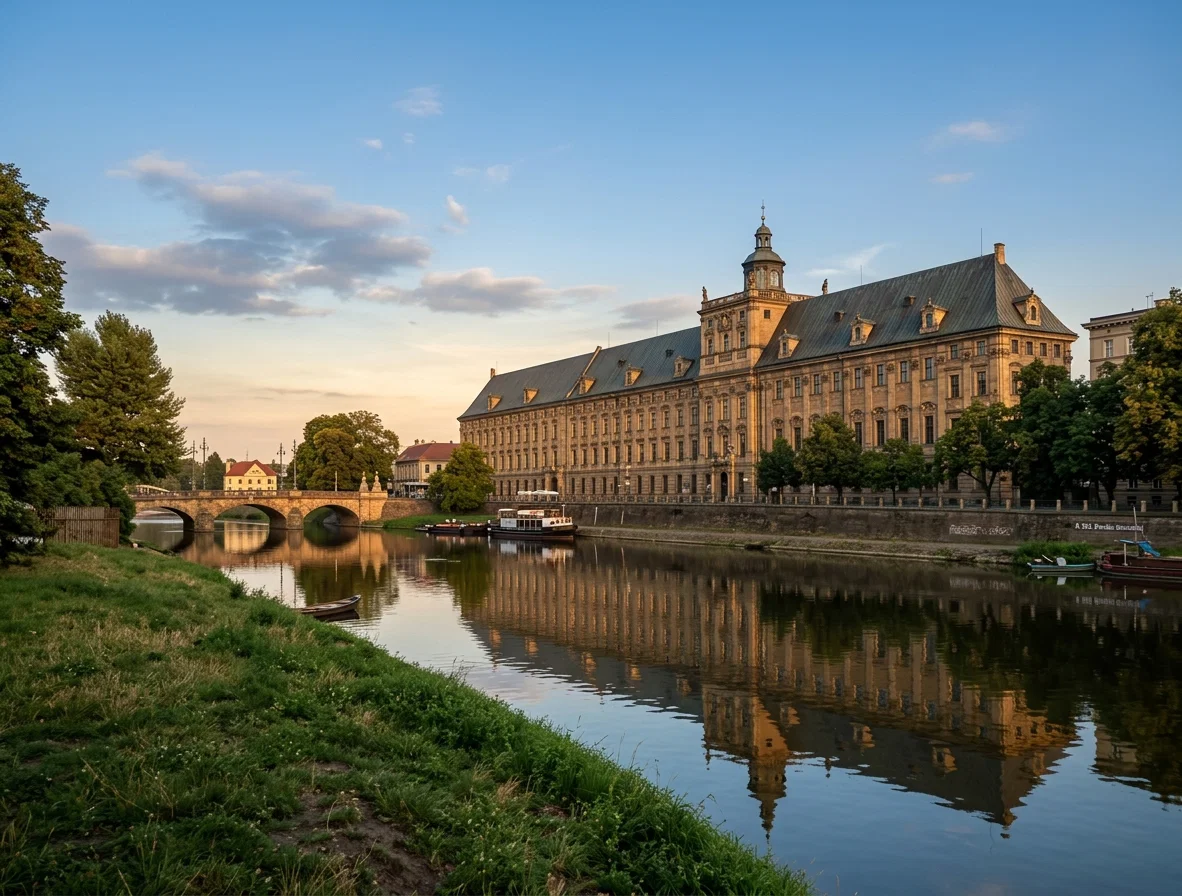
THE UNIVERSITY AT BRESLAU
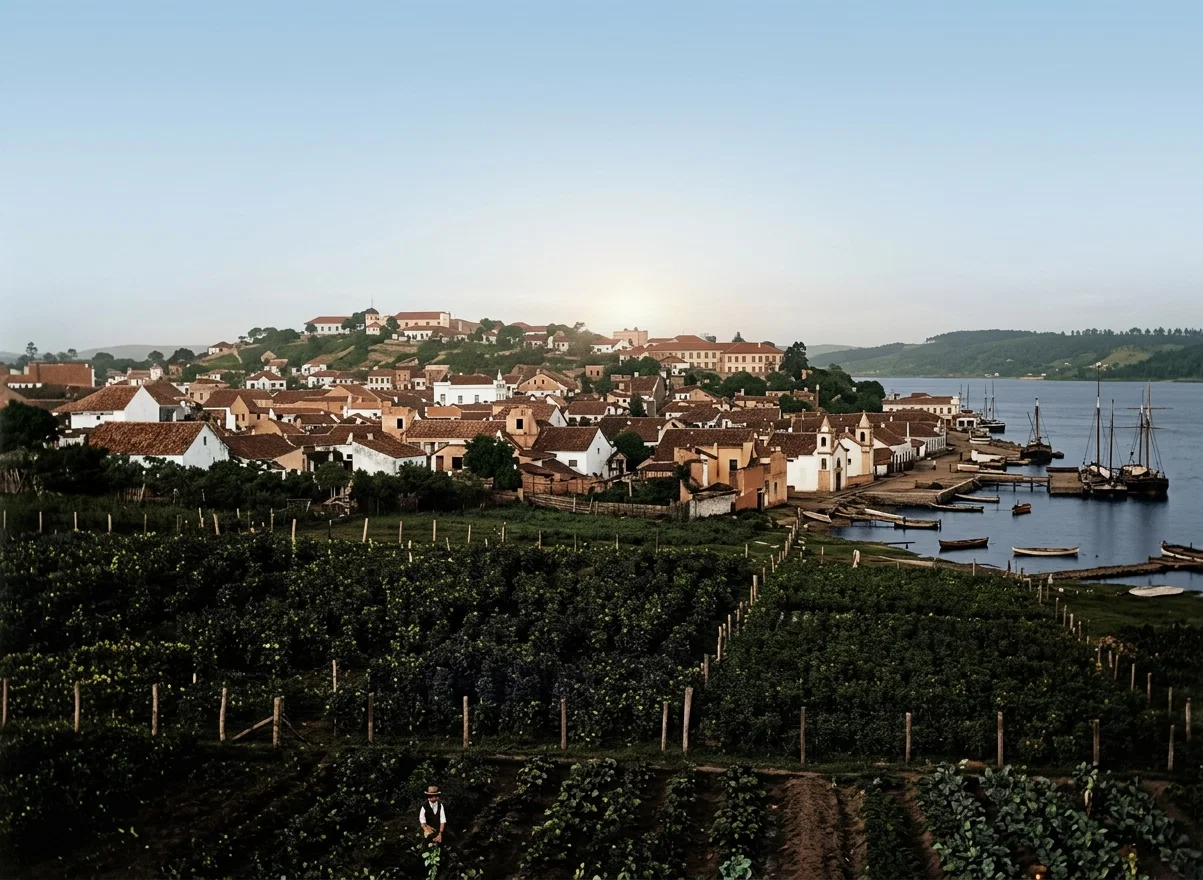
PORT ALEGRE, CAPITAL OF RIO GRANDE DO SUL
Rio de Janeiro, Brazil
By F. W. Spies
F. W. SPIES
It is some time since my last report, and it has been a very busy time to us. Last June I moved my family from the Province of Parana, where I had been temporarily located, to Rio de Janeiro, Brazil’s capital. Owing to improvements which the government is making here, and which include, among other things, several wide avenues that are being cut through the heart of the city, thousands of dwellings have been torn down, resulting in a great scarcity of houses and high rents.
This, of course, made it somewhat difficult to find a home. But the Lord, who always provides for his people, led us to a house, which, though by no means modern in its equipments, could be made to serve our needs quite well.
It may be remembered that in a former report I mentioned the locating of our printing plant. It was finally decided to establish our printing-office at Taquary, Province of Rio Grande do Sul, as it was thought that this would be the most economical place for the time being. But having decided to locate the printing enterprise at Taquary, it appeared desirable , and even necessary, that our book depository and general business management should, for economy’s sake, be united with the printing-office, and hence, also, go to Taquary.
The preparations for the removal of our depository and business office, in view of their being turned over to the management of another person, made considerable work, a part of which fell to my lot, and this, with a large amount of correspondence, consumed much of my time, so that I could not give as much time to general missionary work as I desired to do. Then, too, as the Rio church had been without an elder for almost two years , the church itself needed considerable attention. My first burden, therefore, was to get things righted up in the church.
To accomplish this, I began by causing to be elected by the church a committee composed of three persons of known experience in and fidelity to the truth, who, with the writer, should share in the responsibilities and counsels of the church work. Toward the close of November we announced that those who desired baptism might make known their request to any member of the committee. Four requested baptism, but one of them soon withdrew his request.
The candidates were then invited to appear before the church committee in four different meetings, and were examined as to their knowledge of and standing in the truth. Special pains was taken to inquire into their personal Christian experience, and to make plain practical Christian duties. Inquiries were also made as to their understanding of the different points of the truth, and to see if they were in harmony with them. Such Christian duties as giving to the Lord his own in tithes and offerings, obedience to the light on healthful living, instruction as to the sin of vanity in dress, wearing of gold, were placed before them, and when they were clear in these things, and the importance and significance of baptism had been placed before them, the ordinance followed.
I believe that if we always took more pains to carefully and thoroughly instruct15candidates for baptism, and to see that they were in harmony with the whole truth, we should have a holier church, with less trouble, and fewer members who refuse to walk in the Lord’s counsels.
On December 14 we had the privilege of burying these three souls with their Lord in baptism, and on Sabbath, December 16, we had the Lord’s supper, for the first time in the Rio church for about two and one-half years. It was a season of much blessing. At this writing, December 25, there are about fifteen who are keeping the Sabbath, but have not yet been baptized, while as many others are deeply interested in the truth as far as they understand it; some of these are promising people, and may the Lord help them to take their stand for the Sabbath and all other truths, and may he give us wisdom to faithfully instruct them to this end.
The day following the ordinances we had a business meeting, at which, after duly laying before the church the requisite qualities of elder and deacon and their duties and responsibilities, a brother was elected according to the word, to be “proved,” for each of these offices, and later on ordained if found called of the Lord to this responsibility. Tithes and offerings were, on this occasion, also brought into the Lord’s treasury, and ten dollars United States gold was pledged, and partly paid, toward the purchase of a small foot-power printing-press, which is greatly needed by our new printing enterprise.
As duty now calls me, after having had the privilege of being at home for about six months (the longest time I was at home at any one time during my nine years’ work in Brazil), to leave my loved ones and go forth to help other needy souls, I feel grateful for the good prospect of the work here in Rio, and, most of all, grateful that the church as a whole is wide-awake and active in the work of saving souls, and that the Lord has given us here three capable and earnest brethren, to whom, during my absence, I can entrust the work, and who I hope will, because of the responsibility thus placed upon them, become still more useful and efficient in the service of the Lord.
Rio de Janeiro.
Maine
By J. B. Goodrich
SKOWHEGAN.— We are still presenting the straight truth for this time in Skowhegan. Sunday evening we had a larger audience than ever before. In the afternoon, Brother Osborne spoke to attentive listeners. Brother Hersum spent February 10 and 11 with the mission, and presented the message with clearness. We have several preaching services each week, and have very spiritual social meetings, and devote our leisure to calling from house to house and holding Bible readings.
Last month I was enabled to preach thirteen sermons, give eight Bible studies, hold twelve prayer-meetings, and make forty-eight family visits. I also distributed eight hundred and seventy-eight pages of tracts and forty-five periodicals, sold two Bibles, and obtained one subscription for the Watchman.
Many calls come to us from different places, but we feel that it will be well to stay here a little longer. Praise the Lord for the strength he gives me. Praise his holy name! Pray for the work here. J. B. GOODRICH.
Delaware
By O. O. Farnsworth
WILMINGTON.—The Lord has greatly blessed in the work here in behalf of the church. First of all, the church has received a spiritual reviving. Some who had become almost discouraged have taken hold anew.
Soon after coming here five united with the church. Others then began to take their stand for the truth, until twenty-three have thus given themselves to the Lord. Of these, eighteen have united with the church, and one will unite with the Philadelphia church. We trust there will be others ready for baptism soon. There are others who are deeply moved by the truth of God for whom we have strong hopes.
Some of the people of this city begin to see clearer than ever the coming conflict between truth and error. On last Sunday Dr. Wilbur F. Crafts delivered a sermon here in the Central Presbyterian church on the “Imperiled Sabbath” (meaning Sunday). His text was Rev. 1:10. He said this was the first time Sunday was mentioned in the Bible as the Lord’s day, but that it had been doubtless called that since the resurrection of Christ, and had come down to us from John in one unbroken chain. John was commanded to write on that day to the churches, and he wanted his hearers to translate the messages to the seven churches into English by sitting down that day and writing to the members of Congress in favor of the bill now before Congress in behalf of Sunday.
He said the Sabbath was made in Eden for all men, not the Jew alone. Christ kept the Sabbath and taught its observance till his crucifixion. The Sabbath was always a movable feast, and Christ slipped it over onto the first day of the week, which doubtless was the creation Sabbath, and by a legislative act he made the first day of the week the Sabbath. His last reason given for keeping the day was because it was a law of the state.
He said the Seventh-day Adventists would be the most bitter opposers of the bill. There was danger in it for them. They were circulating millions of pages of literature while we were scattering thousands.
I advertised in the papers that I would review him on Tuesday night, speaking on Religious Liberty. It being a very stormy night, not many came out. But the Lord is working for us here, and seventeen have begun to keep the Sabbath.
O. O. FARNSWORTH.
Our Work in Asia Minor
By Z. G. Baharian
God gave us an opportunity to hold a Bible school for our workers in Asia Minor. Brethren Elexan Buzugherian and Enoch Ayvazian, my prison mates, attended the school, also Brother H. Touzjian, of Marash, and Brother Garabed Simionyan, of Aksaray, Iconium. These were our workers. Besides, a brother from Marash took part in the lessons. The school was under the leadership of Brother Wakeham, and continued a month, from Oct. 20 to Nov. 20, 1905. It was a success. God's protecting hand was upon us.
After the school, the workers went to their fields. Brethren Buzugherian and Simionyan went to Adana, and from there Brother Simionyan intended to go to Iconium. As they had no passports for the interior, both were arrested when their journey was half finished, and were kept in Osmaniyeh about ten days, until notices were received about them. Then they were sent to Adana under soldiers' care. I quote from Brother Buzugherian's letter of December 12, written from Adana:—
“From Osmaniyeh we were sent to Adana, and presented directly to Vali, the governor. He asked where we had come from. I told briefly how I was imprisoned in Ourfa and acquitted, and was now going home. Then Brother Simionyan said that he had gone to Aintab to be baptized. The governor was very angry, and cursed, and commanded that we be exiled. Our papers were written, and we were told to be ready to go. My father gave a petition and tried for my deliverance, but in vain. At last I told him that it was impossible, and that he should go after Loutfi effendi, through whose guarantee I might go to Hadjin without soldiers. Loutfi effendi called on Vali, and presented my proposition. Vali called my father and asked him about me. As my father was unable to relate the circumstances of our acquittal in Ourfa, Vali sent for me. I was not aware of what had taken place. The guardians told me that probably Vali would beat me. While I was going, I prayed for strength to bear the beating. I went before Vali, and saw that there was a council, including16the Armenian bishop and my father. Vali asked me, ‘Who is this man?’ I answered that he was my father. ‘Honor your father,’ said Vali; ‘Loutfi effendi will be a guarantee for you, and I shall leave you, but you must promise these three things: You must shave your beard, you must quit the Sabbath, and you must not preach to anybody.’ After praying in my heart, I said, ‘Sir, I obey my father, and I would obey you also, but with humble spirit I say that I can not promise these things, as they are against my conscience. If you should beat me now, and send me down, I should preach the truth to the prisoners.’ Vali said, ‘This religion has been prohibited; you must not call gatherings.’ I answered: ‘Sir, we have no church building here; but if I should promise you not to preach, it would be against my conscience, also a lie; for wherever I go, I preach the truth.’ Vali said, ‘I shall cause you to drive out of this country if you will not quit the Sabbath and the preaching.’ I said, ‘Sir, there are about three hundred Sabbath-keepers; I also would go with them wherever you sent them.’ My father said, ‘Sir, threatenings avail nothing; if you should bring a knife and threaten to cut his throat, it would be in vain; he will not quit his religion.’ The Armenian bishop was always accusing me, but Loutfi effendi was opposing him. At last Vali let me go free. Now I am free, thank the Lord.’”
So in a marvelous way God has saved him. As for Brother Simionyan, I will quote from his letter of January 8, from Nevshehr, Iconium:—
“After waiting two days in prison at Adana, I was started in company with a guardian soldier, my hands being tied with iron bands. I was obliged to give half a dollar to the soldier to untie my hands, because I could not mount the horse. He untied my hands, and they were not tied any more until I arrived here, but in one place the officers tied me by the throat with an iron chain, and once also a soldier in Negdeh beat me. They stole my blanket. In Bor I was put in a dark place, with no light and no heat. The snow drifts were very severe, and one might die readily; nevertheless, passing through these dangers, I arrived at Aksaray. The ruler did not let me go free; four or five days I remained in prison, and then was sent to Nevshehr. Yesterday I was made free through a bail-bond. I thank God that I passed through these experiences. I thank him for the lessons he taught me through difficulties. Now I shall pass the winter here. Pray for me.”
Our Brother Enoch Ayvazian also went to Alexandretta, near Antioch. New citizen papers were being given in this land. Brother Ayvazian is having much difficulty in getting his. I quote from his letter of December 17:—
“I went to Belan to get my paper; there also I could not get it. The Protestant sect is telling the government that I am not a member of this sect; likewise the other sects. I called on one member of the Protestant national council, who dealt with me very hard. He said that they would not acknowledge us. I told him, ‘You are taking into your body many liars, murderers, and fornicators, and calling them Protestant; but as soon as one obeys God and keeps his Sabbath, you are denying him.’ He said, ‘They are far better than you.’ This man proposed to give me my citizen paper on condition that I give them twenty-five dollars in advance. This was an unjust proposition.’”
Unless he takes his citizen paper, he can not travel or enjoy his civil rights. This they know.
This is our present situation. Difficulties lie on every hand, but the message is going. At present three souls obey in Aintab. Brother Buzugherian reports from Adana that our church there has been revived since his arrival. He has visited Tarsus also, where we have now three believers. A sister has been added. Remember this field in your prayers.
Z. G. BAHARIAN.
The Cost of Bengali Bibles
CAREY’S first Bengali Bible cost twenty dollars; a Bengali Bible can now be purchased for a few cents.
Missionary Progress in New Guinea
THE Anglican Mission in New Guinea has made remarkable progress during the last five years. It has now 53 workers, 12 mission stations, 40 preaching places, 300 baptized natives, 100 communicants, and more than 1,000 pupils in its schools. As to the results, listen to the governor of New Guinea: “A man must go with a gun in those parts of the islands where there are no missions. An umbrella suffices in the districts under missionary influence.” — Missionary Review of the World.