The centuries of the past have witnessed many eras of national and international prosperity and progress, but it has been reserved for the last hundred years to witness the greatest progress in scientific research, the greatest achievement in invention and constructive ability, and the greatest advancement in general education which history records. The increase in the wealth of the world has likewise been phenomenal. Indeed, this increase in material prosperity has opened the way for much of the progress witnessed in all lines of human endeavor.
No less an authority than Sir George Paish, editor of the London Statist, declares that “at no time in history has the economic condition of the world improved as rapidly, or as much, as in the past hundred years.” While all countries have not advanced equally, this writer declares that the progress made is nothing short of marvelous. He gives, according to the Literary Digest of June 27, 1914, some interesting statistics relative to the increase of wealth in four of the leading nations of the world: namely, Great Britain, France, Germany, and the United States of America.
The United Kingdom possessed in 1814 a total wealth of about £2,500,000,000. A conservative estimate now makes the wealth of that country £17,000,000,000, an increase of sixfold. In France during the last hundred years there has been a fivefold expansion of national wealth, an increase from £2,000,000,000 to nearly £10,000,000,000.
Equal progress has been shown by the German Empire. Of course, one hundred years ago there was no great federation of German states. They existed largely as separate kingdoms. Sir George estimates the combined wealth of these states one hundred years ago as “probably less than France’s,” but at the present time the wealth of the united German Empire has reached £16,000,000,000, or £6,000,000,000 more than the wealth of France, and within £1,000,000,000 of the wealth of Great Britain.
During this one-hundred-year period the population of Great Britain increased less than two and one-half fold; the population of France, one third, or thirty-three and one third per cent; while in Germany the population has grown from 24,000,000 to 67,000,000, more than 180 per cent.
But these figures, although they are stupendous in their character and almost beyond our comprehension, are eclipsed by those representing the wealth of the United States, which has behind it a history of a little more than one hundred years. This country, standing as the Benjamin among the nations, has received, as did Benjamin, a fivefold portion in the unlimited resources it contains and in the material wealth possessed by its people. Sir George gives for the United States a total wealth in 1814 of about £350,000,000 and a total wealth now of £30,000,000,000, an increase of nearly ninetyfold. The total income of this country has arisen from less than £100,000,000 to about £7,000,000,000, or to more than the combined incomes of Great Britain, France, and Germany. A twelvefold expansion has marked the growth in population.
A recent number of the New York Press speaks of the wonderful advantages enjoyed by the wage earners of the United States. Of the amount of their deposits in the savings banks of the country the Press says:—
Upward of $5,000,000,000 held in the savings banks by the wage earners of this country—and it is the wage earners who make the savings bank deposits—tells no story of poverty up to last year for the great mass of the American people. It tells a story which only a generation ago as a prophecy would have looked like the wildest dream that ever came out of the imagination of man.
In 1890 the savings bank deposits in the United States were $1,524,844,506. Since that time the savings of the American people as represented in their savings bank deposits alone—irrespective of their other investments in homes built and bought, in bonds and stocks taken in small amounts—have increased by $3,000,000,000, with more than another $200,000,000 on top of that.
But in this country, as in the countries of the Old World, a growing inequality of wealth distribution is seriously apparent. A list of the big fortunes left by wealthy men who have died since Jan. 1, 1913, is given in a recent number of the Washington Post, as follows:—
John Jacob Astor .......................... $87,218,791
Anthony N. Brady ........................ 75,000,000
J. Pierpont Morgan (exclusive of art works) ........ 65,000,000
George W. Vanderbilt .................... 50,000,000
D. O. Mills .............................. 37,000,000
Chas. E. Appleby ........................ 50,000,000
George Westinghouse ..................... 35,000,000
Benjamin Altman ........................ 30,000,000
L. H. Severance .......................... 15,000,000
James R. Keene .......................... 15,000,000
George A. Hearn ........................ 10,000,000
Edwin Hawley ............................. 9,720,000
Henry M. Flagler ........................ 6,000,000
Isaac V. Brokaw .......................... 5,000,000
This great increase of the world’s wealth, together with the products of man’s inventive genius, has entirely changed the atmosphere in which men live. Speaking of this, the editor of the Statist bears the following testimony:—
It is difficult to grasp the fact that only a century ago none but the very wealthy could afford to travel, that nearly all were chained to the localities in which they were born, that even in London there were no omnibuses, that all but the very rich were compelled to live in the immediate vicinity of their workshops or businesses, and that now it is possible for most persons to travel not merely by motor bus, tramcar, railway, motor car, or bicycle, from their homes to their occupations, but to journey many thousands of miles at small cost to obtain employment, either temporary or permanent. Moreover, when one stops to think that in those days newspapers, magazines, books, or engravings were very great luxuries, to be indulged in by the few, and that it was exceptional for people to know anything of affairs outside their own village or town, whereas now nearly all are rich enough to purchase newspapers or magazines containing information about everything under the sun, to possess prints of the greatest pictures in the world, and are able to keep in touch with social, scientific, political, and religious thought not only in their own locality and State, but in every country, one is compelled to acknowledge, however averse one is to doing so, that the advance in the mental condition of the world in consequence of the growth of wealth and of income has been extraordinary.
In completing his review of the present financial situation, Sir George declares:—
Thus a very cursory review of conditions today and a century ago reveals the wonderful change on every side of life, in this and in other countries, and the great forward movement of the nations both in mental and in economic well-being.
It was to this progressive and enlightened age in the world’s history that the prophet of the Lord looked forward years ago. He declared that in the last days “many shall run to and fro, and knowledge shall be increased.” Whether we apply this running “to and fro” to the searching of the Scriptures of Truth or to the extensive travel by railroad and steamship as seen in the world today, the prophecy is equally meeting its fulfillment. It is the day of the Lord’s preparation8and in the giving of the gospel message to the world the agencies of promotion and transmission have been prepared for a speedy work.
The great aggregation of wealth was foretold by the apostle James. James 5:1-8. But the increase of wealth and the determination to control the world’s supply and demand, the apostle indicates would be attended by serious strife between the warring factions of society. We see that also being fulfilled today, and in still more striking measure will future days reveal the intensity of the controversy.
May God grant that our eyes shall be anointed to see, our hearts opened to understand, and our hands and feet made willing agencies to co-operate with the Lord in the giving of the gospel of the kingdom in this day of his great preparation. F. M. W.
Daniells Begins His Mission Journey
By A. G. Daniells
From Elder A. G. Daniells
[June 3, Elder A. G. Daniells, president of the General Conference, accompanied by Mrs. Daniells, his niece Miss Hare, and Miss Florence Shull, a mission worker en route for China, sailed from San Francisco to visit some of the great outlying mission fields. The following interesting details of the beginning of his long journey are taken from a personal letter to the editor. Our readers will enjoy the personal details of the narrative.—ED.]
My journey thus far from Washington has been a very agreeable one in every respect. On the way to San Francisco, Mrs. Daniells and I were able to visit, without any extra cost, quite a number of our relatives.
We spent our first Sabbath after leaving Washington in Dallas, Tex., the town in which we landed thirty-six years ago when we left Iowa to take up the work of the ministry. At that time we went there to act as tent master and cook for Elder Kilgore’s party. Our main effort with the tent during the summer was at Plano, about twenty miles north of Dallas. There we raised up a large church. The Huguley family, in all its branches, came into the truth at that place. At Dallas I found Brother Job Huguley, son of old Father Huguley, still rejoicing in the message. He is elder of the Dallas church. He and his wife and his grown-up children are all earnest workers in the church. I also found Brother Will Huguley, a nephew of Job, who, with his family, is faithful in the Lord’s cause. Will is a brother to J. B. Huguley, who was once at the Boulder Sanitarium. I cannot tell you what a pleasure it was to come back to this town where we left the train to take up our work, and to find persons who embraced the truth in our first efforts still faithful and rejoicing in the message, after a separation of thirty-six years. As our train neared the city of Dallas early Sabbath morning, I had an hour or two of serious but sweet reflection while reviewing God’s mercies and care and help during these years. I started when very young and inexperienced and full of trepidation. How little I knew of the future, and how strangely and wonderfully the Lord has led since those days of beginning and fear and trembling!
Leaving Dallas, Mrs. Daniells and I visited one of her nephews, about our own age, with whom we were brought up in childhood. We had not seen him for forty years. We found him gray, and surrounded by a large family of sons and daughters. They met us at the railway station with three automobiles, and still left a small houseful of grandchildren to welcome us on our arrival at their home. We could stay with them only two days, but we enjoyed the visit very much. We went to the homes of five of his married sons and five of the married daughters. I spoke one evening in the town in which they live.
In California we visited my people at Fresno, and many dear friends in Loma Linda, Los Angeles, Oakland, and St. Helena. We spent only one night in Los Angeles, and one night each in St. Helena, Oakland, and Mountain View.
Our visit in the northern part of the State around the bay was most pleasant, and we would have greatly enjoyed a full week there. Sister White sent an invitation while we were at Loma Linda for us to visit her and to make our home with her while in St. Helena. We found her feeble, but her mind was quite clear, and we had a very pleasant visit. We talked over old times, and she expressed herself as very happy in the Lord and rejoicing over the progress of the work.
As Sister Shull, who has done stenographic work in the Pacific Press office for years, was to sail with us on her way to China, quite a delegation of brethren and sisters came up from Mountain View to see us off. This made our departure a happy one.
Our voyage from San Francisco was one of the most pleasant I have made during all my travels. The first day out was a little rough, but after that the sea was like a mill pond. The service on the boat was good, and the company of my wife, my niece, and Sister Shull made the journey unusually pleasant to me.
On our arrival at this place [Honolulu] we were met by Brother and Sister Conway, Brother and Sister McKeague, and Sister Robinson, our missionary workers, and also by some of the church members. They gave us a royal welcome, I can assure you, and we are having a delightful time in this beautiful place.
Each night we gather in our church for service. The brethren and sisters have wanted meetings, and they have needed help. So I have felt that I must have a meeting every night. On Sabbath they wanted me to give the Sabbath school a talk. I also spoke at the regular hour in the forenoon. As they were having an interesting time in the federal prison, they were anxious for me to meet the officials and the two hundred prisoners, and had arranged for me to address them, which I did at three o’clock. Then they asked me to speak to the young people at four thirty, and as this would be my only chance, I felt that I ought to do so. This made four addresses during the day, but really, I did not see how I could do anything less. Had I been remaining several weeks, I could have avoided it. I hope I shall not have to repeat this program; and yet you can imagine how it will be all the way along. Well, I am out to do the best I can, and shall go, I suppose, to about the limit of endurance.
Today is a national holiday in honor of Hawaii’s first great king, Kamehameha I. Leading natives have come from the different islands for a great pageant. We shall see them in their native costumes of nearly a century ago.
In a little less than a week we are to leave on the steamship “Marama” for Fiji and New Zealand. We can spend only one day, the twenty-sixth, at Fiji, and are due at Auckland, New Zealand, the last day of this month. It will be twenty-eight years since I landed in that city, a total stranger to everybody, to proclaim our message there. I need not tell you that I am looking forward to my visit there with great interest.
A. G. DANIELLS.
They Want to Get Back
By W. A. S.
WITH hundreds of workers spread through the tropical regions of the earth, it is inevitable that now and then a worker will break in health and be compelled under medical advice to return to more northern climes to recuperate. A hundred years of missions has taught the missionary societies that these changes to prevent complete disablement are decided economies in missionary administration.
One thing the Mission Board notices, however, and that is, invariably the workers are most earnestly anxious to get back to the fields as soon as the furlough time is over. Anxious letters are written, and interviews had with medical authorities to make sure that the word to return comes as soon as the health is satisfactorily restored. The interests9of the great mission fields in darkness root themselves into the hearts of the workers until life itself is wrapped up in laboring for souls in the needy regions beyond.
A friend wrote us some time ago, reporting satisfactory progress being made by one of our missionaries on sick leave from the Orient, who was obliged to pass through a serious operation in one of our sanitariums. The first query of the worker on coming out of the operation was, “Will I be able to go back to ——?” This is the burden carried upon the heart of the worker held in the homeland to fight the battle for renewed health.
W. A. S.
Cebu, Philippine Islands
By R. E. STEWART
R. E. STEWART
It has been seven months since we turned our faces toward the Philippine Islands to begin our foreign missionary life in response to the call of the last General Conference, and we thought that a short account of ourselves and our work might be appreciated.
THE CLASS OF SIX CEBU BOYS, OF PHILIPPINE ISLANDS
Five weeks of the seven months were spent in making the long journey from Iowa to Manila, a journey which will long be remembered by us. We were very glad to reach the end, and as the steamer entered Manila Bay early in the morning, we were on deck with our hearts full of curiosity and expectation, and a desire to be at work in our new field.
We spent nearly three months in the city of Manila, becoming acquainted with the people, surroundings, and climate, studying the language, and helping with the printing work; and these were indeed pleasant days. As soon as advisable, Elder Finster assigned the new workers to their fields of labor. Accordingly we bade farewell to our friends in Manila, and sailed to the island of Cebu, which is between Manila and the equator. We arrived safely in the city of Cebu, the third largest city on the islands, two days later. Our first evening here will never be forgotten.
As we sat on the deck of the steamer, looking over the city’s low buildings with a beautiful background of high mountains, and as we watched the busy people on the street and docks, we felt as never before our dependence upon God. We were alone in a strange land, and among strange people. The next day we found a suitable house, and in a few days were settled, and very grateful for divine guidance and protection.
After two weeks of study, I began canvassing, and from that day the Lord has blessed us abundantly, and we have become self-supporting. The canvassing work here is very interesting and profitable. I have been working mornings only, studying the language in the afternoons, and giving Bible readings in the evenings, and in eight weeks my orders amounted to 530 pesos.
I have nearly finished my first delivery of “Home and Health,” and have lost only two orders. I thank the Lord for this, as the islands are passing through a time of political unrest, and money is quite scarce.
We soon came in contact with some intelligent young men and women, and they became our friends. We have had a class of six boys, and also a class of girls, studying the Bible with us since we came here. Two have already decided to obey the truths for this time, and several others are progressing well in the way of everlasting life. Truly the harvest is ripe in the Philippines. Young people are breaking away from the Catholic Church, and we must reach them soon with this message or the results will be very sad. We believe that the young people will have an important part in the finishing of this work.
Sumatra
By B. JUDGE
B. JUDGE
HERE in Sumatra we have a school for teaching the Chinese and the Malays. The object is to teach Christianity. School work seems to be the only way of helping these children to learn of the God of love. As it is, they know absolutely nothing of him or of a risen Saviour.
Many times parents have come to us and asked us to take their children into our homes, offering payment. In some instances we were sorry that we could not do this, as it would take the children away from the influences surrounding them in their homes. At the time of entering our day school, it is quite natural for these children to deceive, tell lies,10smoke cigarettes, and use bad language. But after a great deal of patient teaching, we have found sometimes that they are impressible, and will confess when they have done wrong.
Our hearts are filled with pity for these heathen little ones who have no one to teach them in their homes. Day by day at the school they learn what is right and good, but upon returning home for the rest of the day they see their parents' heathen ways, and live in surroundings which do not help them to carry out the instruction given in the school. It is from their parents that they learn to deceive and speak wickedly. Though the teaching of these little ones is no light task, still if we finally see at least a few of them enter the kingdom of God, the sacrifice will not have been too great on our part. We believe the work of teaching the children will finally bring its reward.
The older people are very unimpressible. They are so bound to their old ways and customs that it seems almost impossible for them to give them up. Their customs seem to be part and parcel of themselves. But a few do get the victory. We turn to the young with hope that the influence exerted on them will surely bear fruit when they come to years of greater accountability.
When upon earth, our Saviour blessed the children and tenderly bade them come to him; and it will be a cause of great rejoicing to us if we finally see these little ones safe within the great Shepherd's fold.
Will you not pray for the heathen children? Will you not pray for their parents? Sumatra cries aloud for divine help. Pray that God will send his Spirit to convict them of sin, and then lead them to search for the true and living God.
Death Rate for 1913
WE copy from a recent number of the Lutheran the following figures relating to the death rate of the various American cities for the last year:—
According to a bulletin of the Bureau of the Census, the death rate of the registration area of the United States for 1913 was 14.1 per thousand estimated population. In 1912 it was 13.9; in 1911, 14.2. For the years from 1901 to 1905 the average was 16.2; from 1906 to 1910 it was 15.1. We are therefore continuing an improvement, the average for 1911, 1912, and 1913 being 14.06. These are the exact figures as stated in the report of the Census Bureau. What they mean in actual lives is not indicated except by closer analysis. The decrease from 16.2, the average from 1901 to 1905, to 14.1, the average for 1913, amounts to 13 per cent, or a reduction of one death in every eight. If the same rate had prevailed in 1913 as in the period from 1901 to 1905, there would have been 1,025,446 deaths recorded instead of 890,823, an excess of 134,623. The largest percentage of decrease was shown for Rhode Island (15.7), followed by New York (12.3), New Jersey (11.2), and Massachusetts (9.6).
Among the cities of over 100,000 population, Seattle and Spokane lead by far with death rates of only 8.4 and 8.9, respectively. Portland, Oregon, follows, with a rate of 9.5, so that this particular corner of the United States by comparison would seem to be more than holding its own. It seems almost obvious that location, climate, and character of population are responsible for this low rate. Minneapolis and St. Paul, as usual, contest for next place with 11.6 and 11, Oakland and Milwaukee following with 12.5 and 12.7. The highest rates occur in Memphis, Tenn., 20.8; Richmond, Va., 20.4; New Orleans, 19.9; Albany, N. Y., 19.8; Baltimore, 18.5; Nashville, Tenn., 17.8; Birmingham, Ala., 17.4; Atlanta, Ga., 17.4, and Washington, D. C., 17.3.
Alcohol and Insanity
ONLY fifteen Kansas men and women went insane last year because of the habitual use of alcoholic liquors, and only six others gave alcohol as a contributing cause of the breaking down of the mind. Kansas is dry. In a New York hospital 31.4 per cent of the insane patients were sent to asylums as the result of the habitual use of liquor.
The Garhwal School, North India
By Charles C. Belgrave
CHARLES C. BELGRAVE
AMONG the foothills of the grand Himalayas, is situated our Garhwal School. This is the only school we have in the Garhwal district with its many villages scattered far and near. To this school come many of the boys of these hills, some from forty miles away. The boys are instructed in Bible knowledge as well as in things secular. Great interest is manifested in the study of the Word of God, and from outward manifestations we are convinced that the good seed is finding its way into good soil.
During one of our meetings held on the last Sabbath of the school year, Dec. 13, 1913, an opportunity was given to the students to express themselves in regard to the benefits they had derived during the past year. The boys were quick in responding; many an encouraging word was heard, and the last student added: “And another thing, we are steadily learning the way to God.” We are confident that by the grace of God we shall be enabled to bring some of these Hindu boys to the cross of Christ.
The dissemination of the third angel’s message throughout this great hilly district must inevitably, to a great degree, devolve upon the boys who attend our school. Therefore we are endeavoring to give them the best possible training,11so that when any of them take their stand for the truth, they will be able to give it to their own people.
North Basutoland
By W. B. WHYTE
W. B. WHYTE
THURSDAY evening, March 19, the writer, in company with Elder O. K. Butler, reached Generaals Nek, on our way for a few days' visit at Emmanuel Mission, in north Basutoland. Our train did not arrive till long after dark, and as the siding was twelve miles from the mission, we were a little anxious as to whether we should find a conveyance waiting to carry us to the mission. On alighting from the train, we were very glad indeed to meet the superintendent, Brother H. C. Olmstead, and were also glad to greet Brother and Sister R. P. Robinson, who had arrived a few hours before from Cape Town. We were all soon in the large lumber wagon with our baggage, pulled by three yoke of oxen. Thus we began our journey of twelve miles to Emmanuel Mission. Our pace was not swift, but it was quite sure, and shortly before midnight we reached the mission.
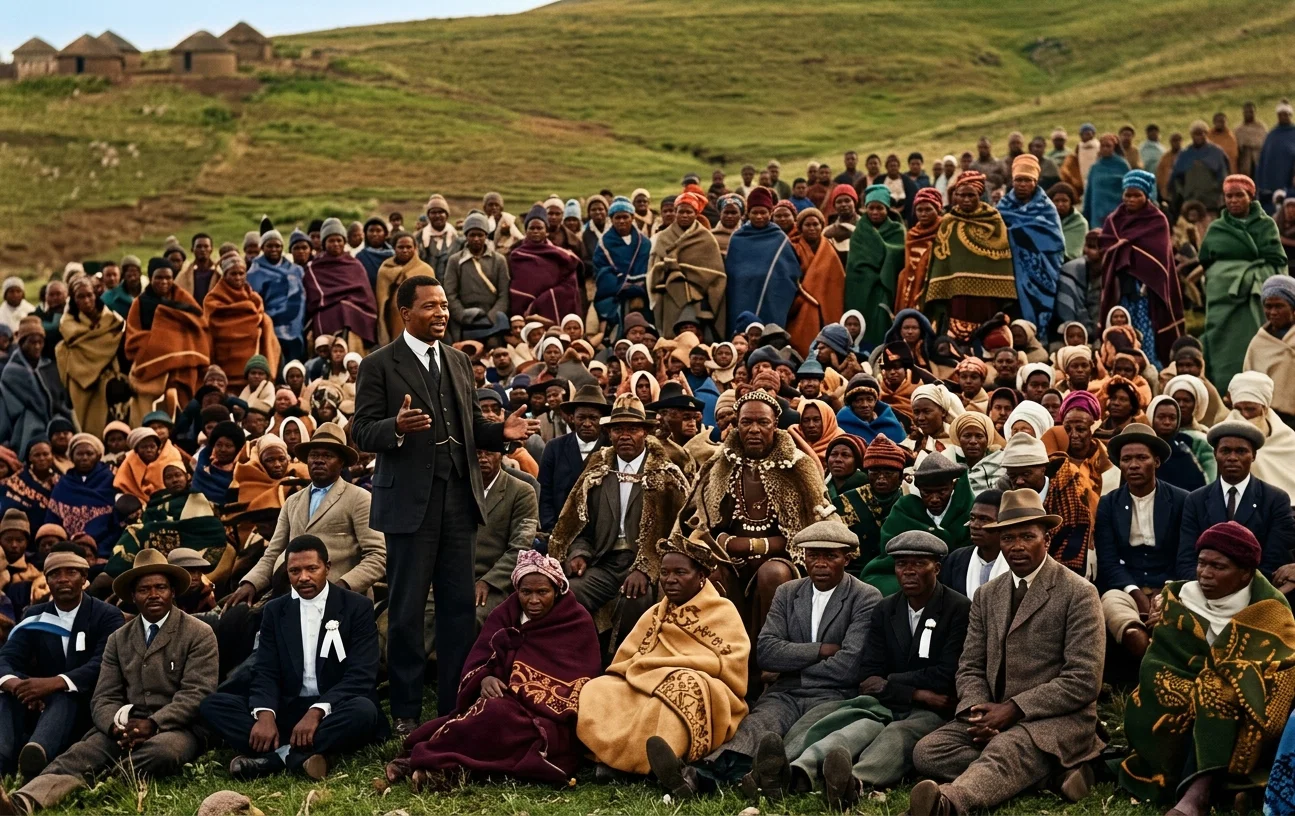
The next day, Friday, we spent in counsel over many things pertaining to the work. On the Sabbath we held a meeting at eleven o'clock. Word had gone out throughout the native kraals that we were to be there, and at the time appointed the Basutos, a large number of them in their best dress and bright-colored blankets, began to assemble in the schoolhouse for divine service. The writer was glad for another opportunity of speaking to this people. The room was crowded. They filled the seats and covered the floor, and gave splendid attention to the words spoken. On Sunday, a still larger crowd was present. Pastor Butler addressed the people on the plan of redemption. About three hundred were present at this service, including a number of prominent Basuto chiefs who appeared interested.
A BASUTOLAND (AFRICA) CONGREGATION LISTENING TO THE MESSAGE. THE MEN SEATED NEAR THE FRONT ARE CHIEFS. THOSE BAPTIZED ARE SITTING AT THE LEFT OF PASTOR O. K. BUTLER
After this service five were baptized. This was the first time baptism by immersion had ever been seen in Basutoland, and the people were very curious to see the rite performed. The accompanying picture shows the large crowd that gathered to listen to the preaching of God's word. The men seated in chairs are all chiefs. The five seated on the ground in front were baptized. The day of baptism was a good day for Emmanuel Mission. It was thoroughly enjoyed by all. The baptismal service was performed in one of the large springs on the mission farm.
There are some promising students in the school. We are glad to report that the work at this station is going forward under the blessing of God. When I reached the mission on this visit, Brother Olmstead handed me the first apple taken from the orchard. It is certainly a beautiful specimen of fruit, and is an earnest of what will come later when the orchard gets a little older. It is now producing some very good fruit. [One other, a third of the tree's yield, was sent to the Mission Board by Sister Hyatt on her returning to the States, and was divided at a meeting—a fine specimen of fruit surely, both in appearance and flavor.] While we were here, Brother J. R. Campbell came from the Tsungwesi Mission, Southern Rhodesia. An attack of the fever made it necessary for him to leave. We are sorry to say that even since returning to north Basutoland, which is a very healthful climate, he has still had the fever quite badly. He is now some better, and we hope he may soon be able to take up work again.
We also improved the opportunity on this occasion to have a mission council. Elder W. S. Hyatt came over from Natal and met with us, and we considered various matters pertaining to our mission stations. We are glad to see the work progressing in north Basutoland, and are also glad to find our workers at this station full of courage and good cheer.
Encourage the Youth to Have a Purpose
PARENTS can do much to tide their sons and daughters over the irresponsible period of the “teens” by helping them to early choose a calling, that is, conditionally. Of course no one can tell just what profession he may follow, but it will do no harm, and may do much good, to talk over different callings, and help the young mind to come to a temporary choice.
It is worth everything to have a purpose. The way to have a successful future is to have a successful present. Doing well the work of today is a long step toward doing well the duties of later life. Encourage your child to be brave and true as a boy, and he will be more likely to have higher aims as a man. If you want your daughter to be a successful woman, help her to do well the duties that come to her now. Some one has said, “The whole world is now living the verb ‘to do;’ it is not enough simply ‘to be.’”
“There is more virtue in perspiration than inspiration,” says J. C. Van Dyke. Let there be assigned tasks and definite obligations. Do not be afraid to give a little wholesome praise. “Self-distrust is the cause of half our failures.” “Blessed be drudgery.” It is good for us to be obliged to perform certain duties on schedule time, whether we feel like doing it or not. Kingsley says, “Thank God every morning when you get up that you have something to do that day which must be done whether you like it or not.”
“Thousands of offenses designated by the law as misdemeanors or crimes are committed during the long vacation each year because an army of boys is turned loose on the community with nothing to do. Their time is not motived,” says a writer on boy life. It is every parent’s duty to keep constantly before the mind of his child an aim, a purpose. Raising a garden, earning money for missions, completing certain studies within a given time, making a garment, anything that is worthy,—it is not so much matter what the thing is, it is the determination and purpose to accomplish something that counts.
It is truly pitiful to see a large number of young people growing up aimlessly—mere driftwood on the sea of life. “Hitch your wagon to a star,” is an inspiring call to every boy and girl to make the most of life. The world is calling for men and women of worth. The cause of God needs leaders “who can neither be bought nor sold, who are as true to duty as the needle to the pole.” Why should parents not hold up these high and holy ambitions before their growing sons and daughters?
“Live for something, have a purpose,
And that purpose keep in view;
Drifting like a helpless vessel;
Thou canst ne’er to life be true.
Half the wrecks that strew life’s ocean,
If some star had been their guide,
Might have long been riding safely;
But they drifted with the tide.”