Your ShelfYour Projects

Signs of the Times, Vol. 32, No. 12.

FUNDAMENTAL PRINCIPLES. No. 6.

Signs of the Times

Mar 21, 1906

Pacific Press Publishing Company · Mountain View, California · Mar 21, 1906

FUNDAMENTAL PRINCIPLES. No. 6.

From "AN ACT for Establishing Religious Freedom."
Adopted by Virginia, Dec. 26, 1785
Almighty God hath created the mind free.
All attempts to influence it by temporal punishments or burdens, or by civil incapacitations, tend only to beget habits of hypocrisy and meanness, and are a departure from the plan of the holy Author of our religion, who being Lord both of body and mind, yet chose not to propagate it by coercions on either, as was in His almighty power to do.
The impious presumption of legislators and rulers, civil as well as ecclesiastical, who being themselves but fallible and uninspired men, have assumed dominion over the faith of others, setting up their opinions and modes of thinking as the only true and infallible, and as such endeavoring to impose them on others, hath established and maintained false religions over the greatest part of the world, and through all time.
To compel a man to furnish contributions of money for the propagations of opinions which he disbelieves, is sinful and tyrannical.

OUR PUBLICATIONS

In this space we are giving, each week, a review of some of our publications. We feel sure that you will be well repaid by watching this page carefully.

MY GARDEN NEIGHBORS

By L. A. Reed. A new nature-study book just fresh from the press. All will be interested in the true story of the sparrows who learned to imitate the bluebirds, of the cat that went wild, of the cowbird that imposed on a sparrow, and all the others in this instructive and entertaining book. It contains 256 pages with over fifty illustrations, several of them colored. Bound in cloth - - - $1 00

THE GOSPEL IN CREATION

By E. J. Waggoner. An illustrated work setting forth clearly and simply the relation between God's work in creation and redemption. The confirmation of the truths of the Gospel drawn from the study of the Creation makes this book a valuable one to all who are watching with interest the attacks that are now made on the authority of the Bible. Board covers - - - - - - $0 25 Cloth - - - - - - - 40

THE GOSPEL PRIMER

Revised edition. The object of this little book is to teach reading, and at the same time combine lessons that will instil into the mind of the learner the truths of the Gospel. The first pages are devoted to the alphabet, each letter of which combines some Bible scene. The remaining part of the book is given to Bible stories, made so simple that, any child can understand them. Each story is illustrated with a full-page engraving. 128 pages, board covers, cloth back, cover design in gilt and colors - - - $0 25 Fine English cloth, embossed cover, lemon edges - - - - - 50 Published in German, Swedish, Danish, and Spanish languages at same prices.

GOSPEL WORKERS

By Mrs. E. G. White. A compilation of carefully-selected extracts from the "Testimonies for the Church," and other writings of the author. Designed to give instruction to ministers and missionary workers. 12mo. cloth, silver side stamp, 480 pages. - - - - - - - - - - - $1 00

THE GREAT CONTROVERSY

By Mrs. E. G. White. This volume presents the most wonderful and intensely-interesting history that has ever been written of the great conflict between Christianity and the powers of darkness, as illustrated in the lives of Christian martyrs and reformers on the one hand, and wicked men and persecuting powers on the other. Beginning with our Lord's great prophecy, given while viewing Jerusalem from the Mount of Olives, this book outlines the history of the whole dispensation down to the time when "sin and sinners are no more, God's entire universe is clean, and the great controversy is forever ended." It contains 39 full-page illustrations, nearly all of them new and specially engraved. It is printed on fine tinted paper, beautifully and substantially bound, and contains 700 octavo pages. Over 100,000 copies already sold. English cloth, embossed in jet and gold - - - - - - $2 50 English cloth, embossed in jet and gold, gold edges - - - - 2 75 Library style, full sheep, marbled edges - - - - - - 3 00 Half morocco, gold edges - - - - - - - - - 3 50 Full turkey morocco, gold edges - - - - - - - - 4 50

A Reader’s Appreciation of the Signs

The Home of the "Signs of the Times." PUBLISHED WEEKLY
"I would rather go without other things than without the dear SIGNS. I very much appreciate your kindness in sending me the two last papers, as my time had overrun. It was through the SIGNS I was led to accept the blessed truth two years ago. The artist who furnished the cartoon for the cover page of the paper bearing date of December 31 is a brother Bible student with me in Sabbath-school, and was also baptized with me. Wishing you every success, I remain, "Yours in the Master's service, "Mrs. H. DeWitt."

SIGNS OF THE TIMES LEAF-LET SERIES

The Leaflets contain two pages each, and the titles are as follows:
  1. The Sure Word of Prophecy
  2. Prophetic History of the World
  3. Second Coming of Christ
  4. Signs of Our Times
  5. The Sanctuary
  6. The 2,300 Days
  7. The Law of God
  8. The Sabbath of the Bible
  9. The First Day in the Bible
  10. Who Changed the Sabbath?
  11. The Great Threefold Message
  12. The Seal of God and the Mark of the Beast
  13. Church and State
  14. Life and Immortality
  15. The Great Judgment Day
  16. The Home of the Saved
The prices are so low that no one can excuse himself from using them liberally. More than 2,000,000 copies already sold.
PRICES
Not Post-paid. Post-paid.
100 (all one kind) . . . $0.15 $0.15
1000 (100 each of ten kinds) . . . 1.00 1.30
1600(100 each of 16 kinds) . . . 1.50 1.95
1 lb. (about 18 of each) . . . .42 .50
No orders filled for broken packages, except in pound lots as above.
They may be ordered of any Tract Society or Publishing House, or of

PACIFIC PRESS PUBLISHING CO.

MOUNTAIN VIEW, CALIFORNIA 1109 East Twelfth St., Kansas City, Mo. 285 Salmon Street, Portland, Ore.

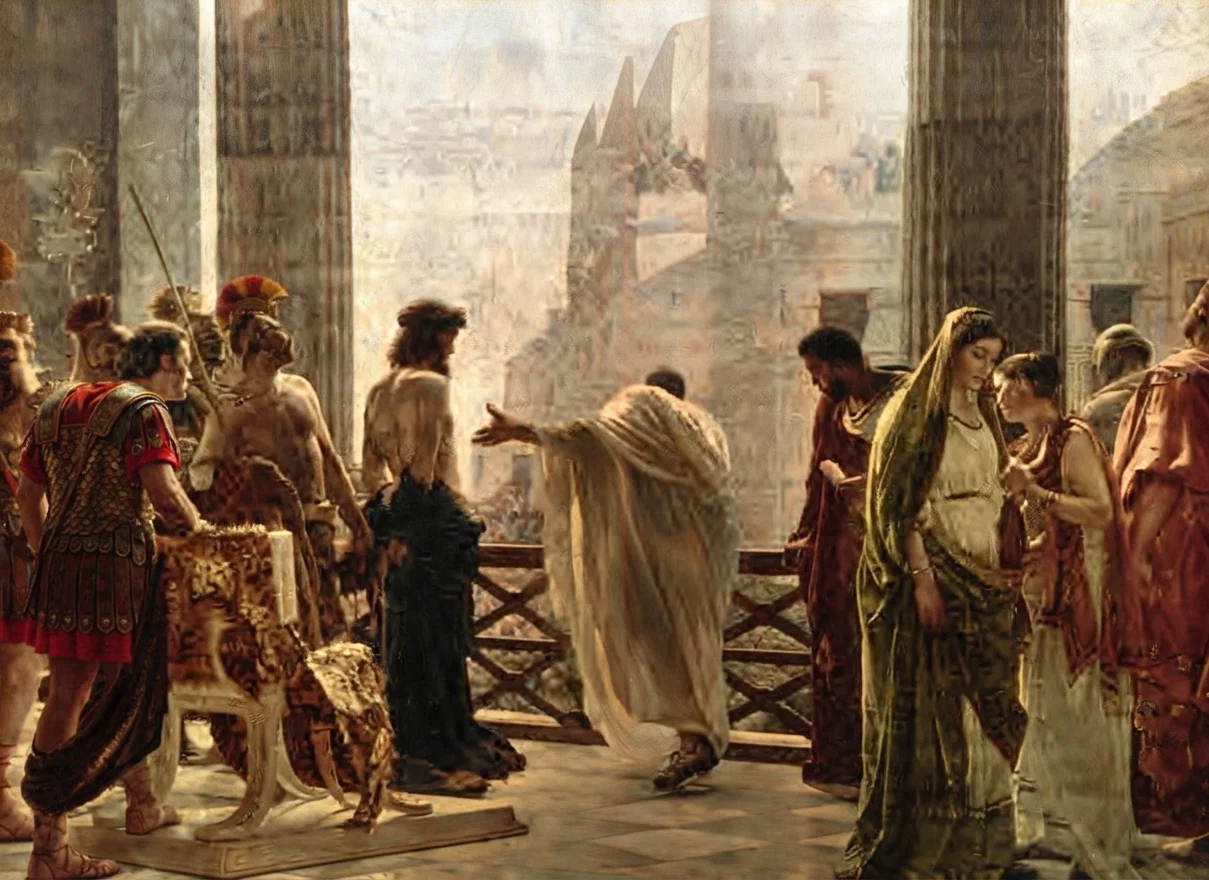
"BEHOLD, THE MAN!"

IT is said that nearly every artist who has sought to depict the Christ, pictures Him as a man of his own nationality, an ideal man of the artist, but one whose individual characteristics stamped the portrait as of One of the same nation as the artist. Consequently we have pictures of our Lord in Italian, Spanish, German, French, Russian, Dutch, etc.
ART may criticize, but heart will not. He was the one Man of the nations, embracing in His plan of salvation, His purpose, His sympathy and love, His power to save, the whole race of mankind. He was, on His human side, brother to them all. And so the apostle does not say that Jesus was born of an Egyptian woman, or a Syrian woman, or a Jewess. No; not so do we read. "He was born of woman, born under the law" (Gal. 4:4), the very place occupied by all men.
"WHEREFORE when He cometh into the world, He saith, Sacrifice and offering Thou wouldst not, but a body Thou didst prepare for Me." No blood of bulls or goats could take away sin; they could only faintly typify the perfect offering to be made. But when the Offering of God came, He took the body divinely prepared, which included in itself all the weaknesses and tendencies and proclivities and needs of humanity.
“BEHOLD, THE MAN!”
“BEHOLD, THE MAN!”
THAT body came through one of the wickedest lines of ancestry. Jesus was "made of the seed of David according to the flesh." Rom. 1:4. Trace through the unholy ancestry, going back even to the licentiousness of Judah; through the Canaanite harlot Rahab, the Moabitess Ruth, the licentious Solomon, and all the idolatrous kings which followed in the Judean line. Think of the wickedness of an Ahaz and a Manasseh; the weakness of a Jehoiakim or a Zedekiah. Who could have recorded a worse ancestry? Truly in a double sense He bore our grief and carried our sorrows, and the Lord hath made "to light [to meet, to focus] on Him the iniquity of us all."
THEREFORE, while He was the divine Son of God, He was also "the Son of Man," "the Man Christ Jesus." As He was the Son of God in the truest, fullest sense, so when He became the Son of Man, He also became man in the truest, fullest sense. Neither did He become man as was Adam before the fall, but man as pertaining to the flesh, as man was when Christ came into this world, "born of the seed of David according to the flesh;" "born of a woman," as were all other men; "born under the law," condemned by it, because He had taken man's place and identified Himself with the whole human family. "Since then the children are sharers in flesh and blood, He also Himself, in like manner partook of the same." The flesh and blood He possessed was like the flesh and blood of all God's children, and He partook of it in the same manner that they did—by birth. Nay, more, "it behooved Him [it was duty, necessary, essential] in all things to be made like unto His brethren, that He might become a merciful and faithful high priest."
THIS Man suffered in the flesh. "Himself took our infirmities, and bore our diseases." Matt. 8:17. "Surely He hath borne our sicknesses." Isa. 53:4, marginal Hebrew. "He was . . . a Man of sorrows, and acquainted with sickness." Verse 3, marginal Hebrew. He suffered from the mighty temptations which sweep over humanity; "for in that He hath suffered being tempted, He is able to succor them that are tempted." Butwhen thus tempted, He did not yield, He did not sin. "Who in the days of His flesh, having offered up prayers and supplications with strong crying and tears unto Him that was able to save Him from death, and having been heard for His godly fear, tho He was a Son, yet learned obedience by the things which He suffered."
BUT this Man "did no sin." He was in the flesh, but He was not dominated by the flesh. The flesh might clamor for the mastery, He yielded not. The Spirit controlled the flesh. The Spirit put to death the deeds of the body. The Spirit wrought in the flesh the righteousness of God and demonstrated the power of God through faith to be sufficient to overcome sin where sin had become intrenched, incarnated. The Incarnate Word overcame the incarnate sin.
IN this is man's hope. God gives not the regenerate sinner a different flesh; but he puts into the flesh a different spirit, a different life, a different power. Convicted by the law of God through His Spirit, the sinner longs to do right, tries to do right, and fails. But let him yield all to Christ Jesus, and receive Christ's presence, power, Spirit, and law, and a new life takes possession of him. Before this, the flesh ruled. His mind was the fleshly or carnal mind; after that the Spirit rules the flesh, the Christ rules in the flesh.
THE how of all this, the modus operandi of Jesus, in His own life and experience, or in ours, we will not speculate upon. When we can tell how two exactly similar seeds, so far as we can see, can extract in their growing from the same soil and sunshine entirely different colors and shades, then we may attempt to analyze the mystery of godliness in Jesus of Nazareth, or through Him in the hearts of poor humanity. We take the revealed facts of the Word as they are, gloriously demonstrated through varied and regenerate souls through all the ages.
JUST how Jesus was divine without using His divine power save through faith, we do not know, but He was the Son of God; He did become flesh; He did completely, gloriously, conquer sin in sinful flesh in our behalf. He is the God-man, the Man Christ Jesus, our Brother, Redeemer, Saviour, Friend, King. "Behold the Man!" He embraces within His flesh, with its tendencies, every class and grade of men. He overcame for all. Little did Pilate know the depth of truth he uttered when, to appease the mad mob by appealing to their sympathy, he pointed to the Suffering One, and cried, "Behold, the Man!" The full-orbed Man in all His trials and temptations, in all His sympathies, in all His excellences of character. The full-orbed man in all strength and victory and helpfulness and leadership! The same always, whether thorn-crowned in Pilate's judgment hall, or triumph-crowned in the courts of God. The same whether rebuking the lust of the flesh in Peter, or comforting the mourning, or bestowing His Spirit upon His appointed ones, or coming in glory to receive them all.
BEHOLD, the Man! Crowned with thorns in this world; He is coming again in glory.
"There is a King of glory, Ere long on earth to rise. Sung in prophetic story, Descending from the skies; The Babe of Bethlehem, 'tis He; It is the Man of Calvary,— Not crowned with thorns and gory, But crowned with glory now! Not crowned with thorns to-day, Not mocked and led away, But crowned with everlasting glory now."

GOD'S PROMISE TO HIS PEOPLE.

IN the midst of wars and rumors of wars, God would have His people remember that there is coming a time of peace and safety.
The world is looking toward a golden age when international courts of arbitration will take the place of international contests under the canopy of the war-clouds. Many there are who are heralding the approach of a time when the "dove of peace" will turn all the cannons of the world into nesting-places for her brood. They are looking for a time of "peace and safety" which the Word declares they will not see.
Nevertheless, a time of the most blessed peace and of the surest safety God is planning for His children. The world has been afflicted since the time when it was inoculated with the virus of sin. The curse of God has been upon it since the disobedient pair were driven from the Garden of peace and safety. They sacrificed their peace and safety when they chose the thralldom of sin for the liberty of righteousness. The unwisdom of that course God has allowed to be made manifest to all the universe.
But a time is coming when the active demonstrations of that unwise and disloyal course will nevermore be seen.
With the whole course of sin before him, the prophet of God declares: "He will make a full end; affliction shall not rise up the second time. For entangled like thorns, and drunken as with their drink, they [the wicked] are consumed utterly as dry stubble. . . . Tho I have afflicted thee, I will afflict thee no more. And now will I break his [Satan's] yoke from off thee, and will burst thy bonds in sunder. . . .
Behold, upon the mountains the feet of him that bringeth good tidings, that publisheth peace! Keep thy feasts, O Judah, perform thy vows; for the wicked one [Satan] shall no more pass through thee; he is utterly cut off."
The end of this history of sin is not the end of God's purpose concerning the earth or concerning man who forfeited his inheritance in it. Tho God has waited long for Satan to demonstrate to the universe the falsity of his charges against God, and the wickedness of his purposes throughout, the time is approaching when the last of the harvest of that wicked sowing will be gathered for the flames of final justice. The end of the reign of sin is not to be the end for those who have sworn fealty to the God of heaven and stood faithful to their vows. God has something better for them; and wars and rumors of wars will trouble them no more when He has made an end of sin.
The Lord has told us of that permanent, peaceful habitation, in which He will place that eternal tabernacle that shall not be moved nor taken down. Of that place He says: "But there the glorious Lord will be unto us a place of broad rivers and streams; wherein shall go no galley with oars, neither shall gallant ship pass thereby." Isa. 33:20. Those ships were ships of war. They will not be seen in that land. Those galleys carried slaves chained to their oar-locks. There will be no slaves in that country. "The former things are passed away," and it can truly be said then that the people "shall learn war no more." The words of the prophet are, "They shall not hurt nor destroy in all My holy mountain." As the nations of this earth have sown the seeds of war, they will reap the harvest of their sowing. They will come to their end in the greatest war the world has ever seen. They are straining every nerve to prepare themselves for the final struggle.
How good it is to know that we can look beyond this sad prospect; that we have the promise of a peaceful, quiet home from which all selfishness and sin, all misery and hunger, all strife, contention, and war, will be forever banished and not even come into the thoughts any more! This will be only after God has renovated this sin-dominated earth and allowed sin to burn itself out in the fires of the last days.
Concerning that time John says: "I saw a new heaven and a new earth; for the first heaven and the first earth are passed away; and the sea is no more. . . . And I heard a great voice out of the throne saying, Behold, the tabernacle of God is with men, and He shall dwell with them, and they shall be His peoples, and God Himself shall be with them, and be their God; and He shall wipe away every tear from their eyes; and death shall be no more; neither shall there be mourning, norcrying, nor pain, any more; the first things are passed away." Rev. 21:1-4.
That blessed time of peace and safety is nearer—much nearer—than when we first believed. It is much nearer than many believe now; and God's invitation, sounding through all the world, is "Come, COME." s.

HUMAN FASTS AND FESTIVALS.

THE sheer formality of the so-called Lenten fast is shown in the fact that the churches that observe it endorse the custom of feasting and carousal as near as possible to its beginning, and as soon as possible after its close.
Christ did not begin His forty days' fast in the wilderness with feasting and dancing, nor did He end it in that manner. He was led of the Spirit into the solitude of the wilderness to enter alone upon the solemn fast, which was a fast indeed; and at the close of His spiritual victory over appetite, and false religious display, and worldly ambition, He was prepared to enter upon the work of salvation with more than human power and wisdom. So far from entering into the frivolous amusements of the world at the end of His trial and temptation, He was in a position to say to His disciples, "Follow Me," "I have overcome the world."
What spiritual benefit can one expect from a fast the preparation for which has been a midnight brawl, and the close of which is celebrated by a return to such indulgence of passion? But such are all the perfunctory observances of man-made substitutes for vital godliness. Christ Himself ordained all the ordinances that He designed to have observed by the church (baptism, the ordinance of humility, and the Lord's Supper); all other ordinances and festivals are of human invention, and are observed at the expense of "the commandments of God, and the faith of Jesus." G.

REDEMPTION.

MEN do not see it; the great mass of professed Christians do not see it; nevertheless the greatest, and therefore the most important, enterprise in all the earth is Redemption. So important is it that the Supreme Ruler of the universe gave His only-begotten Son that redemption might be accomplished. And in this precious gift there is included all things; to give Him was to give all. “He that spared not His own Son, but delivered Him up for us all, how shall He not with Him also freely give us all things.”
Through sin, disobedience of God’s law, moral corruption and physical death were entailed upon the earth. It is but a speck in God’s great universe, but its corruption is a blot that mars the whole work. The condition of sin is a condition of rebellion against the government of God; it is a reproach to His dominion. For His own name’s sake this rebellion must be put down. Sin is infectious; if the adversary who instilled rebellion into the minds of the inhabitants of this planet be able to maintain his ground permanently, he will also be able to carry his work to other parts of the universe. So the great contest is on for the banishment of sin, and the redemption of the earth—its restoration to a condition of perfect harmony with the government of the universe.
God, whose every motive is actuated by love, could have cut off the rebellion in an instant, by blotting the rebels and the contaminated earth out of existence. But that would not be redemption. He desires to save and not to destroy. He “is long-suffering to us-ward, not willing that any should perish, but that all should come to repentance.” So He makes the great sacrifice of His Son, and the Son willingly and lovingly gives Himself, to carry out this benevolent plan. The covenant of sacrifice is made in heaven, and presented for the voluntary acceptance of those in rebellion.
Probation has a twofold purpose: First, to give sinners opportunity to hear the Gospel and make their choice between death and redemption. They are plainly told that “He that believeth on the Son hath everlasting life; and he that believeth not the Son shall not see life; but the wrath of God abideth on him.” Secondly, by a season of probation, all the universe outside of the sin-cursed earth have opportunity to witness the practical workings of a system of rebellion against God. They will have opportunity to see the utter failure of government under the auspices and inspiration of the adversary who instigated sin. When the “mystery of iniquity” shall have been fully worked out, it will have been demonstrated that “sin, when it is finished, bringeth forth death,” and that the “mystery of godliness,” the great scheme of redemption, is an everlasting success.
So great is this work of redemption that all the heavenly host are engaged in it. Of the angels of God, it is written, “Are they not all ministering spirits, sent forth to minister for them who shall be heirs of salvation?” And those who have faith to accept the terms of salvation, and enlist in the great enterprise of redemption, have the assurance that “they that be with us are more than they that be with them.” It may seem that God is a long time working out His great campaign, but it should be remembered that it is an eternal purpose that is being accomplished; an everlasting kingdom is being established, to be governed by eternal principles through the administration of Him who is “from everlasting to everlasting.” A few thousand years of time is short in the mind of Him to whom “a thousand years is as one day.”
The result of the great work of redemption will be a clean universe. This was shown to the prophet of God in vision, of which he gives this testimony: “Every creature which is in heaven, and on the earth, and under the earth, and such as are in the sea, and all that are in them, heard I saying, Blessing, and honor, and glory, and power be unto Him that sitteth upon the throne, and unto the Lamb forever and ever.”
This object-lesson of human probation on earth, and Satan’s brief rule over wicked, rebellious, incorrigible sinners, will forever settle the problems of sin and righteousness—of rebellion against, or allegiance to, the perfect law of God. It will be indelibly written in the hearts of all who survive the terrible ordeal of the great judgment day. All heaven, all who will have witnessed and experienced the working out of God’s loving purpose, will say, “Salvation, and glory, and honor, and power, unto the Lord our God, for true and righteous are His judgments.”
“And I heard a great voice out of heaven saying, Behold, the tabernacle of God is with men, and He will dwell with them, and they shall be His people, and God Himself shall be with them, and be their God. And God shall wipe away all tears from their eyes; and there shall be no more death, neither sorrow, nor crying, neither shall there be any more pain; for the former things are passed away.”
G.

Question Corner

1785.—Who Were Raised with Christ?

I would like to know what is meant by those who were resurrected with Christ. M.
There are three texts which seem to refer to those who were raised at the time that Jesus was raised, one of which expressly refers to the company and the other events having reference to the same thing. The first is in Matt. 27:51-53, declaring that when Jesus died, “the earth did quake; and the rocks were rent; and the tombs were opened.” This at the time of His death. The next clause refers to the time of His resurrection, “And many bodies of the saints that had fallen asleep were raised; and coming forth out of the tombs after His resurrection they entered into the holy city and appeared unto many.” This certainly is very definite. The second is Eph. 4:8, “Wherefore He saith, When He ascended on high, He led captivity captive.” The marginal reading is, “He led a multitude of captives.” It was one of the ancient customs that when a monarch came home from a successful campaign, he brought with him the spoils of war and the most celebrated captives that he had taken, chained to his chariot wheels to celebrate the triumph. The captives of our Lord Jesus Christ were of a different character. They were those who had been snatched from the power of sin, and were bound to Him by the cords of love. His homecoming or entrance into heaven with those captives was predicted in Psalm 24, the latter part. Read that in connection with this. Note the call of the Lord Jesus with His accompanying liberated ones, and the responses of the angels inside the gate. Still other passages doubtless have reference to the same thing, Rev. 4:4, and elsewhere. Those who had been redeemed by Christ, who were assisting Him in the service of the sanctuary on high, represented God’s children in all ages. How they came there is indicated by the passages which we have briefly examined.

1786.—Is Saturday the Seventh Day of the Week?

Can it be proved from the Bible that Saturday is or was the seventh day of the week? D. C. E.
First of all no day of the week as we now recognize it corresponds to the Bible day. The Bible day begins at sunset and closes at sunset. Genesis 1, and many other passages. Therefore only about three-fourths of our civil day corresponds with the Bible day, yet in a general way the light part does. The Lord set apart the seventh day in the beginning. Gen. 2:2, 3. The Lord showed Israel by a threefold weekly miracle for forty years which was the seventh day at the time of the Exodus, so in that age the people could make no mistake. Exodus 16. At the time of the crucifixion of the Lord Jesus Christ, the seventh day is also clearly indicated; it was the day just before the first day of the week. Mark 16:1, 2, et al. The day before the first day of the septenary cycle of the week must be the seventh day, and that seventh day was the Sabbath according to the commandment. Luke 23:56; 24:1. So far there can be no question. Now were the first day then, and the seventh day then, the same as our first day and seventh day now? There has never been any question about this until the question of the day of the Sabbath was brought before the minds of men. Then, to evade what was an unwelcome duty, men devised various ways and means to set it aside; and yet every almanac, every cyclopedia, all the great theological works, the customs and practices of the Christian churches in various nations, and the observance of the seventh day by the Jews in all lands whither they have been scattered,—all prove that the so-called first day of the week corresponds to our Sunday, and that the seventh day is our Saturday. I do not know what stronger proof could possibly be given than is given to show that the seventh day, the Sabbath of the Lord, corresponds, as far as the Bible day can correspond, with the civil day, with our Saturday.

1787.—Sixth and Seventh Books of Moses.

Will you please tell me where you find the proof that the sixth and seventh books of Moses were forgeries? Several of my neighbors claim that there are several books left out of the American Bibles that can be found in foreign Bibles. Is that so? and what books are they? and why left out? J. J. R.
The sixth and seventh books of Moses are fanciful things that any one knowing the character of Moses would not ascribe to him. (2) There is no reference to them anywhere in the sacred writings. (3) No scholar of any note gives any credence to them whatever. There are some books in some foreign Bibles which are not in our common American Bibles, and yet you will find some American Bibles which have these books. They compose what is called the Apocrypha, a number of uninspired books which were written between the time of Malachi and the time of Christ, of value historically and for showing the teachings of the Jews of those times. All the great Bible houses have the Apocrypha. The books are 1 and 2 Esdras, Tobit, Judith, the Rest of Esther, the Wisdom of Solomon, Ecclesiasticus, Baruch, with the Epistle of Jeremiah, the Song of the Three Holy Children, the History of Susanna, Bel and the Dragon, the Prayer of Manasses, 1 and 2 Maccabees, fourteen in all. These are not written in the ancient Hebrew or Aramaic, but in Greek, and have been rejected as not canonical by all Protestant churches, tho not by the Catholics.
Continue reading: OUR LONDON LETTER