Your ShelfYour Projects

Signs of the Times, Vol. 36, No. 27.

Question Corner

Signs of the Times

Jul 14, 1909

Pacific Press Publishing Association · Mountain View, California · Jul 14, 1909

Question Corner

[To Our Inquirers.— (1) The name and address of all who ask questions must accompany questions, not necessarily for publication, in token of good faith, and that we may reply by letter if thought best. All communications will be considered confidential if so desired, and no name will be published unless requested. But we have no time to give to anonymous or unsigned epistles or articles. (2) Let the questions be to the point. Do not say, “Explain Josh. 7:1-8,” but state the thing upon which help is desired. (3) Questions can not be answered immediately in this department. Sometimes it will mean a month or more of waiting. We can not reply to the same question frequently. Read answers to other questions; you may find reply to yours. (4) Members of the Bible Band will kindly enclose stamp if answer is desired by letter. Others will please enclose ten cents. This does not begin to meet expenses oftentimes. (5) “Foolish . . . questions avoid.”]

2882.—Is Any Part of the Bible Obsolete?

How much of the Bible is done away? Is it all for humanity now? O.
The whole Bible is for man now. Every part has its lesson for these days, tho all its laws are not binding. To illustrate: God commanded men to offer sacrifices of different kinds for different purposes. He does not now ask us to offer those sacrifices; for they have all been met in Christ Jesus. Yet from each of these sacrificial laws we may learn important lessons concerning God’s requirements, our duty, God’s love, and Christ’s offering. The sin-offering, the trespass-offering, the burnt-offering, the peace-offering, teach precious lessons of how repulsive sin should be in our sight, how utterly we should renounce it, how great and effectual are God’s love and grace. The injunction to circumcise is not now binding; but the very law and the circumstances of its giving show how absolutely we should put off the domination of the body of the flesh. Some of these laws expired by limitation, but the lessons of the laws and the conditions which called them forth still abide. For example, it is no one’s duty to warn now of a coming deluge, but the lesson of the Deluge still remains. There are many other illustrations. But one law forever abides, God’s great Constitution, Heaven’s Magna Charta, summarily comprehended in the Ten Commandments; and the only Saviour from sin is Jesus Christ our Lord.

2883.—Sanctification and Regeneration.

I am told that regeneration is one step; that sanctification is a degree beyond to which we must attain or be lost. Will you please explain these terms? G. D.
The two words express different things. “Regeneration” means to be begotten again, born again. It is wholly of God. It is a new creation wrought by His power in the person who yields to Him. It makes a man a new creature. “Sanctification” means a separation from sin unto God. It is a setting apart to His service. It is both instantaneous and progressive. When man gives himself wholly to God, when he separates from the world unto God, he is a sanctified or separated man, in which man acts his part by yielding, and God His part by accepting and cleansing. The development of that setting apart comes every day as God’s truth is presented, unrolled, revealed by the Spirit in ever-living duty. So Jesus prayed: “Sanctify them through Thy truth; Thy word is truth.” Yielding to that word, following it, receiving and appropriating it, is constant separation from the world unto God. It is a life-work in the development of character. Regeneration gives the new life; sanctification maintains it.

2884.—Men Shall Worship Him. Zeph. 2:11.

In Zeph. 2:11 we read: “And men shall worship Him, even all the isles of the heathen.” Does this mean to say that all the isles of the heathen shall worship God, or does this mean that they shall all have the Gospel preached to them? M.
It does not necessarily mean either. In the previous part of the chapter the judgment of God is spoken of. Later on some of the wickedness of the nations and those that oppressed Israel and magnified themselves against the people of Jehovah of Hosts, are named; then comes their judgment: “Jehovah will be terrible unto them; for He will famish all the gods of the earth; and men shall worship Him, every one from his place, even all the isles of the nations.” It will be noticed that the word rendered “heathen” in the Common Version is “nations” in the Revised Version, and so ought it to be in most cases throughout the Scriptures; that is, nations outside of Israel. It will further be seen in the Revised Version that the thought is that on account of the judgments of God all the other gods of the earth will be destroyed, in a figurative sense “famished,” no maintenance for them. The judgments of God will turn some to the Lord, and men shall worship Him; not that all men shall worship Him; not that all the isles of the heathen shall worship God; but men shall worship Him, “every one from his place, even all the isles of the nations.” God will have His scattered ones all through the earth, and wherever they are, they will lift their hearts and voices and worship Him who has saved them.

2885.—The Holy Shekinah.

In reading the Bible there is one name that I have failed to find: “The Holy Shekinah.” We enjoy the SIGNS more and more. It seems, if it were possible, that each number is better and better. B. B. No. 265.
The word “Shekinah” is not in the Bible. It is a late Jewish term referring to God’s abiding presence among His people through His glory. It comes from a word-meaning “to dwell” and may, according to the Standard Bible Dictionary be “that which abides.” In a common sense it is generally applied to the manifestation of glory which abode in the sanctuary over the mercy-seat.

2886.—Not in the New Earth.

Will you kindly explain the meaning of Isa. 65:20 in the Question Corner? Several of us can not understand it. It seems to introduce sin and death into the new earth. It surely can not be. J. W. C.
This text has been many times explained. We wonder why it is that so many pass by scriptures far more important. For a better understanding, consider the context. Verse 17 brings in the promise of a new heaven and a new earth, tells us that in that happy state the former things shall not be remembered nor come upon the heart. (See margin.) God’s people will be glad and rejoice forever in that He has restored Jerusalem and her people. Verse 19. “I will rejoice in Jerusalem, and joy in My people; and there shall be heard in her no more the voice of weeping and the voice of crying.” That shows that when God’s kingdom is redeemed and the holy city shall take her place upon it, there will be no more death or sorrow, or trouble. Then He tells us the reason why we may expect this, by turning back to the time when the judgment was completed. “There shall be no more thence,”—from that time forward when God’s children enter upon their everlasting reward,—“there shall be no more thence an infant of days, nor an old man that hath not filled his days.” One will not talk of children or old men because all that has passed away. For in God’s final judgment upon sinners “the child shall die a hundred years old, and the sinner being a hundred years old shall be accursed,” referring doubtless to that time of the “little season” mentioned in Rev. 20:3, 7. That little season may refer to the hundred years. The next verse of Isaiah 65 reverts again to the happy state of the redeemed when God’s children shall build houses and inhabit them, plant vineyards and eat the fruit of them; that is, one shall not succeed another. Their lives shall be as the life of the Redeemer.

2887.—God’s Judgments.

Please explain Job 34:20, 25. Does this scripture refer to the second coming of Christ? If so, then Christ is to come at midnight. But Mark 13:32 says, “But of that day and that hour knoweth no man.” Do we know when Christ is to come?—I.
The text in Mark 13:32 simply states this, that no one knew then nor would ever make known the day and the hour or time of Christ’s coming. The text in Job speaks of God’s judgments and evidently His final judgments upon the wicked nations of earth at the second coming. Verse 25 states that these judgments will come in the night; verse 20, at midnight. Then it will be that all who have not been slain in the wars and plagues of the last days shall perish in the glory of Christ’s presence. This, however, does not set the time of His coming. It does not tell us the day or the year. It leaves us as uncertain as tho no time were at all mentioned. It is well for us to remember, however, that previous to the time of Christ’s coming, probation closes, probably one year before that time, or a prophetic day. It is to this time that many of the warnings of the New Testament refer. See tract on the “Manner of His Coming.”

2888.—Tithe Paying

Why shall we pay tithe of what we eat ourselves, but not of that which our animals eat? A. K.
What we eat ourselves comes of our income, of course, and the income is tithed before we expend any of it for our own use, but what is used by our beasts is used to make up the profit which we receive from the sale of our animals or the products of these animals. We tithe our hay for instance in the products which we receive from our dairy. We do not sell ourselves in that way. Our dealing with ourselves as principals and with our beasts as commodities are altogether different. We are sure if our questioner will give thought to the matter he will see that there is a fundamental difference.
No. 2889.—K. Simon the Canaanite, and Simon called Zelotes, or the Zealot, are identical. The expression “Canaanite,” “The Bible Encyclopedia” tells us, does not come from an inhabitant of Canaan, but from cananaios, in Chaldee equivalent to the Greek Zelotes or Zealot. He is named as the tenth of the twelve in Luke, but eleventh in Mark.
No. 2890.—Repentance.—Acts 5:21.—A. K. Our Lord gives repentance to every soul that would seek Him. Peter was talking to Israel. Jesus came to and through that nation, and when the apostles preached to the Gentiles they presented the same great truths.
No. 2891.—K. Lebbaeus, Thaddaeus, and Judas the brother of James, are the same person.

OUR BIBLE BAND

Schedule for Week Ending July 24, 1909.
Su. July 18 Ps. 20, 21, 22 Acts 21: 1-17 Mo. “ 19 “ 23, 24, 25 “ 21: 18-40 Tu. “ 20 “ 26, 27, 28 “ 22 We. “ 21 “ 29, 30 “ 23: 1-15 Th. “ 22 “ 31, 32 “ 23: 16-35 Fr. “ 23 “ 33, 34 “ 24 Sa. “ 24 “ 35, 36 “ 25

Suggestive Notes

Our morning devotions begin with Psalm 20, closing with Psalm 36; and among these also there are some which ought to be read and reviewed. Among these is Psalm 22 which describes the experience of our Lord Jesus Christ. Among them also are psalms which we ought to learn, such as the 20th, 23rd, 24th, the 32d, and the 34th.
Our New Testament lessons begin with Acts 21 and close with Acts 25. In these are recorded the close of Paul's voyage to Jerusalem, his reception at Jerusalem, his arrest in the temple, his defense before the Jews and before the Sanhedrin, his despatch to Felix, his defense before Felix which consists of the preaching of the Gospel. Festus succeeded Felix in the government of the province and we find Paul brought before him. Paul appeals unto Cæsar rather than to be tried by the Jews. Festus allows his appeal, but waits for the coming of King Agrippa and Bernice in order that they with him may hear Paul so that he shall have something more definite to write to Cæsar.

“Thou Shalt Love Thy Neighbor as Thyself”
_By Mrs. E. G. White_
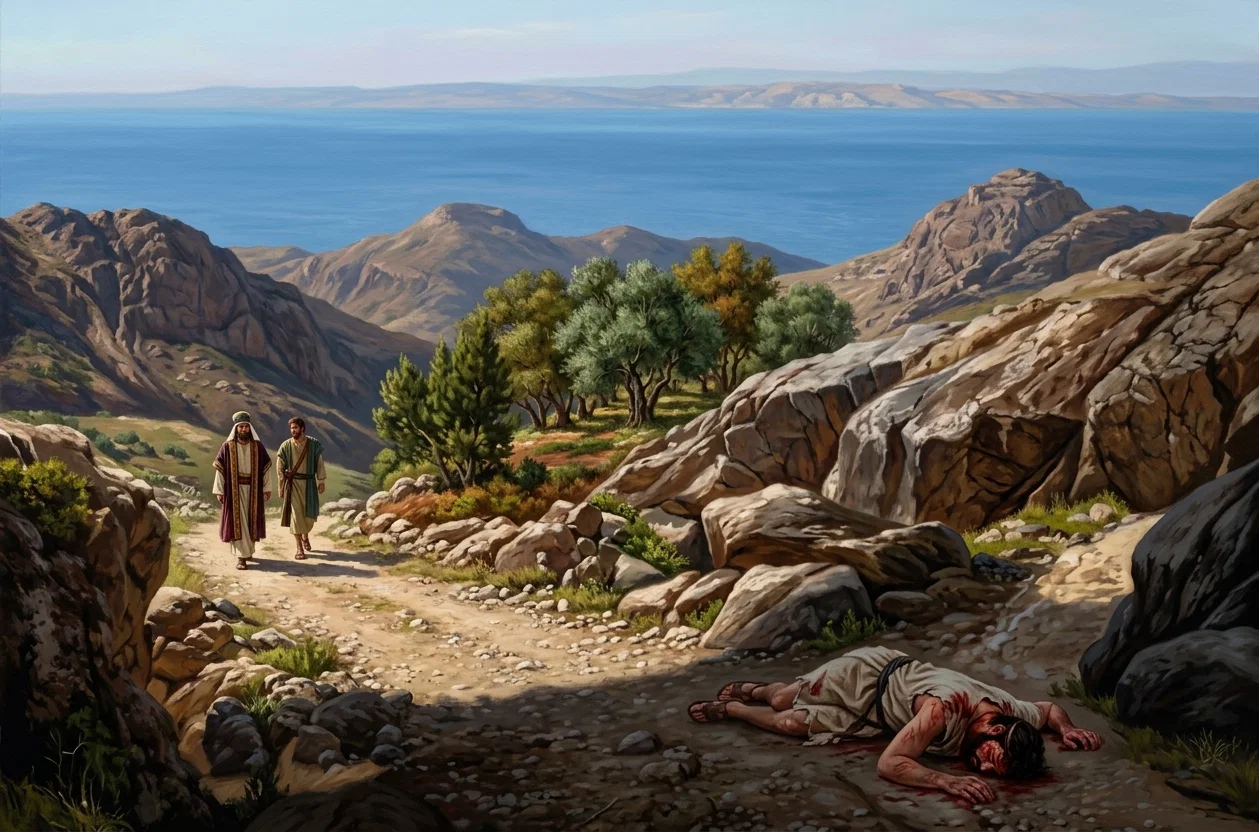
“Robbed and beaten and helpless, and left by the roadside to die.”

Questioning Christ

CERTAIN lawyer came to Christ with the question, “Master, what shall I do to inherit eternal life?” The Saviour answered him, “What is written in the law? how readest thou? And he answering said, Thou shalt love the Lord thy God with all thy heart, and with all thy soul, and with all thy strength, and with all thy mind; and thy neighbor as thyself.” Jesus said, “Thou hast answered right: this do, and thou shalt live.”
But the lawyer, willing to justify himself, asked, “Who is my neighbor?” Then the Saviour related the story of a certain Jew, robbed and beaten and helpless, and left by the roadside to die. Having pictured before His hearers the wounded man’s helpless condition, and his need of sympathy and help, the Saviour continued, “And by chance there came down a certain priest that way: and when he saw him, he passed by on the other side. And likewise a Levite, when he was at the place, came and looked on him, and passed by on the other side. But a certain Samaritan, as he journeyed, came where he was: and when he saw him, he had compassion on him, and went to him, and bound up his wounds, pouring in oil and wine, and set him on his own beast, and brought him to an inn, and took care of him.”
The parable ended, the Saviour laid upon the lawyer the burden of answering his own question. “Which now of these three, thinkest thou, was neighbor unto him that fell among the thieves? And he said, He that shewed mercy on him. Then said Jesus unto him, Go, and do thou likewise.”
The lawyer had thought to find something in the answer of Christ by which to accuse Him. The priests and rulers also were listening for some word by which they could bring a charge against Him. But Jesus read their hearts, and formed His answer in such a way that the purposes of His enemies were defeated.

Removing Perplexities

Much of Christ’s time was spent in explaining misunderstandings and in seeking to clear away difficulties by which Satan was perplexing minds. The answers He gave to the questions that were brought to Him were of more value than silver or gold to those who desired to know the Way, the Truth, and the Life. He clothed His lessons of truth with freshness and a power that could not fail to bring conviction to hearts. Truth had been perverted and mingled with tradition and superstition, until its original purity was almost lost to men. The teachings of Christ swept away the false interpretations. By simple illustrations He showed the value of human kindness, of sympathy and love, teaching that these were necessary to the fulfilment of the law of God. Every effort made by priests and rulers to mystify, the Saviour met with clear and decided explanation of what true righteousness meant. And His lessons were immortalized in the minds of those who had ears to hear, and hearts to understand.

Lesson of the Parable

By the parable of the good Samaritan the Saviour teaches that we are to seek to do good to all men, not only to those who are of the household of faith, but to all who need sympathy and help. The instruction given to the lawyer contains lessons for His people in every age. Let those who would be sure of the mercy and love of God extended to themselves, follow the command of the Saviour, “Go, and do thou likewise.” Our religion is to make itself known in deeds of mercy. When the spirit of unselfish labor for others characterizes our lives, there will be seen the outworking of the love of God that will result in the conversion of heart and the transformation of life and character.
The work of Christ in the world was to reveal the Father. Man must be given a knowledge of God through a revelation of the character of His Son. By coming to earth and taking the nature of man, the Saviour bridged the gulf between heaven and earth, and made it possible for man to understand the character of God and to understand His purpose for mankind. As the Prince of peace, Christ would reconcile man to God and make him understand the relation that existed between him and the Father. Thus He united man with God and with his fellow man, teaching him to see in the poor and the oppressed and suffering the purchase of the blood of Christ, and to value them as the property of God. He taught lessons which, if truly learned, would righten every wrong between man and his fellow man.

Helping Others

“Is not this the fast that I have chosen,” the Lord through His prophet declares, “to loose the bands of wickedness, to undo the heavy burdens, and to let the oppressed go free, and that ye break every yoke? Is it not to deal thy bread to the hungry, and that thou bring the poor that are cast out to thy house? when thou seest the naked, that thou cover him; and that thou hide not thyself from thine own flesh?” And note the inspired promise to those who do all in their power to relieve distress: “Then shall thy light break forth as the morning, and thine health shall spring forth speedily: and thy righteousness shall go before thee; the glory of the Lord shall be thy reward.”
As Christians, we are to have a righteousnessthat represents the character of Christ. We are to feel for our fellow men the same sympathy and compassion that Christ has felt for us. His sympathy, His love, led Him to redeem us at the cost of His life-blood. If we would carry out the great principles that He laid down for His followers, we must love our neighbor as ourselves.

Christ Identified with the Suffering

If the love of God is in the heart, it will surely be revealed in tender love for others. The Lord is honored by our acts of mercy, by the exercise of thoughtful consideration for the unfortunate and distressed. The widow and the fatherless need more than our charity. They need sympathy and watch-care, compassionate words, and a helping hand to place them where they can help themselves. All deeds done for those who need help are done to Christ. In our study to know how to help the unfortunate, we should study the way in which Christ worked. He did not refuse to work for those who made mistakes; His works of mercy were performed for every class, the righteous and the unrighteous. For all alike He healed disease and gave lessons of instruction.
Those who represent Christ in deeds of kindness and mercy will never know until the day of Judgment what good they have done in seeking to follow the example of the Saviour. In heaven a book is written for those who interest themselves in the needs of their fellow beings, a book whose record will be revealed in that day when every man will be judged according to the deeds written therein. Then God will repay every act of mercy done to the poor. Those who have regarded the needs of the unfortunate and have had compassion on the needy will hear from His gracious lips the words, “Inasmuch as ye have done it unto one of the least of these My brethren, ye have done it unto Me.” “Come, ye blessed of My Father, inherit the kingdom prepared for you from the foundation of the world.”

The Church

II. How the True Church is Guided

By C. S. Longacre

Two Extremes

The greatest controversies, the greatest errors, the greatest evils, and the greatest divisions in the church have arisen over the question of how the church is to be guided. Still the question is unsettled and greatly agitated. It has been Satan’s studied policy to overthrow the church, since he did not succeed in overthrowing Christ. If he can not set a good principle aside, then he will pervert it, if possible, by swinging it out of its proper sphere, like a pendulum from one extreme to another.
Thus, from time to time, Satan has succeeded in deceiving the church by driving her, on the one hand, into the extreme of organized church force, centralized in a visible head, and then to the other extreme of disorganized, unsanctified, and independent individualism amenable to no earthly rule or authority outside of personal opinions. Such an individual will brook no disagreement, nor submit to any authority outside of the absolute authority of his independent individualism. The adherents of these two extremes both claim divine sanction for their unalterable positions. They will quote texts galore to sustain what seems so apparent to them. Both claim primitive church conduct as examples to justify their opposite extremes. One thing is apparent — both can not be right and both may be wrong. While one extreme has developed tyranny, the other has produced confusion. Satan’s purpose is met in both.

The Golden Mean

But the grand purpose and accomplishment of the Gospel through the mission of the church lies between the two extremes of organized church despotism and disorganized individual absolutism. The happy medium is a church organization that recognizes Christ as the only and all-sufficient Head, the Bible as the expression of His will, the Holy Spirit as its guide in its varied gifts of administration, and all its constituent officers and members as brethren of equal rank and privileges, none independent of the other, but all members of one body, all subject to one another by a common authority which itself is subject to the common whole.
The Papacy organized itself from and by the visible head down through its ramifications to its members, and made its visible head an absolute, infallible guide for the church by the law of heredity, in the days of Constantine. The primitive church organized itself into its various ramifications from and by its members upward, and made all of its visible officers subject to the whole body instead of absolutely independent by the law of heredity or position, and recognized Christ still as the head, with the Holy Ghost as His only and all-sufficient Vicegerent to guide through the truth the church in all its affairs for all time to come. The Holy Ghost was to come unto all, and upon all who believed, “to all that are afar off, even as many as the Lord our God shall call.” He, when truly received, will guide all into all truth; He will lead all into the unity of the faith; He will make all co-laborers and fellow citizens of the commonwealth of Israel, instead of independent workers, who by the force of their independent personality override their brethren and sacrifice the welfare and interest of the masses and of God’s chosen instruments to their own selfish schemes and interests.

Example of the Primitive Church

Let us take a look at the primitive church. Her methods of organization and administration are an answer to our important question, how the church is to be guided and governed.
After Christ left the church as its visible head, did they choose one to take His place? — No, but He, its visible Head, left His church even without choosing an apostle to fill the place of Judas. He left this for the church as an organized body to settle. It was not settled by a single individual, but the eleven apostles called together the believing disciples who resided at Jerusalem to join them in the first step needed in the administration of the church — the choice of an apostle to succeed the apostate Judas.
Christ did not appoint deacons as such when He first reorganized the church, but as the disciples multiplied, this additional office became necessary in the proper administration of the business of the church in Jerusalem. “Then the twelve called the multitude of disciples unto them,” and set before them the reasons for the necessity of reorganization in the addition of this office in the church to help bear some of the minor responsibilities, and then counseled them thus — “Wherefore, brethren, look ye out from among you seven men of honest report, full of the Holy Ghost and wisdom, whom wemay appoint over this business.” “The saying pleased the whole multitude and they chose” seven, “whom they set before the apostles.” The apostles then prayed and “laid their hands on them.” This incident teaches two important lessons; first, that of diversity of offices, differences of administration, yet mutual and harmonious cooperation of church government; and, secondly, in this division of work it shows the elasticity with which the administration of the church was adapted to circumstances. Thus the church is guided not by the policy of monarchy nor by independent individualism.

The Example of Paul

As another evidence that the primitive church did not believe in the guidance of independent individuals, even when direct revelations were given by the Holy Spirit, is clearly set forth in the case of Paul. He had received a direct revelation from heaven that he was appointed to do a special work, but the same Spirit by whom “the whole body is fitly joined together” also edified the church by a direct revelation, and commanded the church to set apart “Barnabas and Saul for the work whereunto I have called them.” Paul might have said, “I hold my credentials from Heaven, the Lord Himself is my head and gave me my work to do. What do I care whether the presbytery lays hands on me or not! Their action counts but little with me, and is all superfluous.” But no, he submits to the laying on of hands, and writes to Timothy, “Neglect not the gift that is in thee, which was given thee by prophecy, with the laying on of hands of the presbytery.”

Other Examples

The Lord Himself does not work independently of His authorized instruments in the church. The “Angel of God” could easily have told Cornelius what he ought to do, but instead he told him to “call for one Simon,” “he shall tell thee what thou oughtest to do.” Acts 10:6. The churches were all bound together under one general government and met in conference from time to time. This central government was vested in the delegates of the churches. Such a conference was held in Jerusalem, and they tried some of the “false brethren” and disciplined them. They also passed some decrees for the churches, and delegated certain ones to deliver them, and as they went through the cities, they delivered them the decrees for to keep, that were ordained of the apostles and elders which were at Jerusalem, and so were the churches “established in the faith.” Besides the authority of the apostles and elders, it was also the sanction of the Holy Ghost. “It seemed good to the Holy Ghost and to us.” Thus Christ, the true head of the church, still guides the church in its councils, in its decisions for the particular churches scattered abroad, through the cooperative agencies of the Holy Ghost and the delegated brethren chosen by the churches.

Constant Prayer

PRAY often — in bits, with a persistency of habit that betrays a childlike eagerness and absorption. Rise up to question God as children do their earthly parents — at morning, noon, and night, and between times. Ask Him about everything. Be with Him more than with all other persons. Acquire the home habit with Him. Be a child in His hands. Do not fear lest He be too busy to listen, or too “grown-up” to care or to understand. Just talk to Him — in broken sentences, half formed; with crude wishes, in foolish chatter if need be. Make the heavenly Father the center of your life, the source and the judge of all your satisfactions. Be sure to let Him put you to bed, waken you in the morning, wait on you at table, order your day’s doings, protect you from harm, soothe your disquiet, supply all your daily needs.—How to Talk with God.

The Watch of the Church

Is the Bridegroom absent still? Watch, O blood-bought Church of God, Severed from an evil world, Walk thou in the heavenly road. Keep thy garment undefiled, Of the flesh abhor each spot, Cast behind thee all of self, Be time’s vanities forgot. Let the cry be heard, “How long?” Lord, how long shall evil reign? When shall sin be swept away, And this earth be clean again? Lord, how long shall error spread, Truth be trodden in the dust, Hatred flow from tongue and pen, Hatred of the good and just! Hatred of the Christ of God, Of His true and holy word! Mockery of His holy crown, Scorn of His uplifted sword? This the burden of thy cry: When shall end the age of wrong, Error, pain, misrule, and lust, Righteous King and Lord, how long?
— Horatius Bonar.
Continue reading: The Greatest Character in History