“How does my heart keep beating, mama? It was beating when I went to bed last night, and it is beating now. It beats hard when I run.”
“God, my child, controls not only the beating of your heart, but your breathing, and the movements of all your vital organs.”
“Then my ‘telegraph operator’ doesn’t do it at all?” asked Henry, who had well in mind what he had learned about his “will” and the “telegraph wires,” or nerves.
“No, your will can not be trusted to do these things.”
“Why not, if he can do other things?”
“Because you have to sleep sometimes; and even when awake, you have other things to do, and you might forget,” said Mrs. Ayers.
“How good God is!” said Henry, reverently.
“Yes, he certainly shows his loving care for us in making our bodies. If we had to keep our hearts beating, and all the other things going on which are necessary to keep us alive, we could not do anything else. But even if we did give all our time to it, we could not do it; so he does it for us.”
“How does he do it?”
“He has taken such pains in making our bodies that all these vital movements (that is, the movements that must be made just right in order to keep us alive) are controlled by nerves and muscles over which we have no command. You can not say to your heart, ‘Be still,’ as you could say to your foot.”
“No, I know I can’t; for when I ran to school yesterday, it beat so hard it almost,—well it made me feel choked; and when I stood at the door, I wanted it to stop, but it didn’t.”
“But it stopped when you were rested?”
“Yes, but I breathed hard for a long time.”
“Of course you did; for that is one of the ways that we gather strength after any extra exertion; and God made it so. In order that these muscles may act properly, each in its own place, they are managed by nerves that are not connected with the will. For that reason we call them involuntary muscles.”
“Then these—what is it, mama—that long word?”
“Involuntary; that means not under the control of our will.”
“Yes, these involuntary muscles just go right on, attending to their business, and we don’t have to mind them at all. Isn’t that nice? I am glad it is fixed that way.”
“But we can hinder them, my son. Do you remember what I told you about the effect of intoxicating liquors on the nerves that carry orders from the brain?”
“Yes, but these are another kind; does it hurt them, too?”
“Indeed it does; but we do not see the effect quite so readily, though it is more serious.”
“How can that be?”
“It is much more serious to interfere with God’s work in our bodies—our breathing, our digestion, or the circulation of our blood—than it would be to interfere with the moving of a hand or a foot.”
“Yes; because it might not make you die to move your foot, or to keep it still; but if we didn’t breathe, we would die.”
“That is true, and it is these nerves that feel most keenly the action of alcohol; for it hardens them just as it does the nerves of motion, by drinking up the water they contain; and they can no more order their muscles to do the right thing than the other nerves can.”
“Then things would be in a sorry plight, and we could not help ourselves—only just suffer, I suppose.”
“Yes, suffer, until the effect of the alcohol passed away; and our vital organs would be left just that much weaker from the suffering.”
“Well, I don’t want any of it, mama, —not even a tiny little bit!” and he held his two forefingers so close to each other that you could barely see the light between.
“No, not even a ‘tiny little bit,’ my son;” and Mrs. Ayers caught the two fat fingers in her hand, and pressed them earnestly to her lips, just as mothers know how.
San Francisco, Cal.
An Indictment Against Women
A MAN who has mingled much with the business and social world of San Antonio was discussing the drink habit.
“It is all nonsense,” he said, “for young men to say that they can not resist the temptations of the saloon. As far as my experience goes, the saloon-keepers of San Antonio and the men of San Antonio seldom urge a young man to drink. They will say, ‘Will you have a drink with me?’ and if he replies, ‘No; I never drink,’ or, ‘I would like to be excused this time,’ that is the end of it. It is all a mistake about a young man’s being forced to drink by men of the town. He can refuse very easily if he wants to; and when it is once known that a man never drinks, he is seldom asked to do it. But the really hard people to get away from are the women. You can go into a reception where the punch is strong enough to knock you down, and the first woman you meet will say, ‘Do come and have some punch.’
“‘No, thank you, not now.’”
“‘O, yes, just one glass with me.’”
“If by a certain amount of rudeness you are able to escape this woman, the next one you meet will say: ‘This is the most delicious punch. Let me help you.’”
“‘What! Don’t drink punch? What kind of man are you? I assure you this is quite harmless.’”
“A matronly woman comes along and says: ‘You must taste this punch; it is made from my especial recipe, and I am very proud of it.’”
“‘Don’t drink? Well, just this time, to please me. I’ve raised my children on this punch.’”
“‘And so through the evening. A young man who is strong enough to resist the temptations of society has nothing to fear from the saloons.’”
This is the testimony of not one young man, but several, and it is no uncommon thing to hear men and boys say: “Why will women urge a fellow to drink the way they do?”
There is something peculiar about wine or liquors of any kind—you are always urged to take them. You can refuse bread and butter, meat and potatoes, and even coffee, without a word of remonstrance, but never wine.—San Antonio Express.
Suffering and Saintship
By T. H. Nelson.
SUFFERING is the plowshare that breaks up the fallow ground of the heart, without which flowers and fruits of fragrant, tender graces can not be developed in the life. Great saintship and small suffering are seldom found together.—T. H. Nelson.
An Appeal From Africa’s West Coast
By D. C. BABCOCK
D. C. BABCOCK
Ever since I arrived in this field, the land of darkness, I have been greatly perplexed as to the best methods and means to employ in enlightening these people about the soon-coming King. For a time everything seemed to work against us. But we pressed on until the tide turned, and we could begin to see the hand of God in the work. Several times Satan has tried to hinder us; but each time the Lord has given us the victory, for which we praise his name.
We have now reached the close of another year, and are asked to make estimates of the needs of this field for the year 1909. This request has caused me to look the needs over again, and I almost fear to place before you what seems to me necessary in view of the closing work of this message. No living man or woman connected with this threefold message and keeping pace with its rapid development, can doubt that the work will soon close. Looking at it from that standpoint, as a faithful servant of the Lord let me lay before you the present needs of the West Coast of Africa.
First, let me express to you not only my own thankfulness, but that of the brethren and sisters, for the kindness shown us in providing means to carry forward the work on this West Coast. As the result of the past three years’ work, we have about one hundred Sabbath-keepers, also a growing interest which we can not possibly meet with our present facilities. We have scattered much literature over the West Coast since we came here, and this is working like leaven in the hearts of the people. From northern Nigeria, around the coast to Gambia, we receive letters of inquiry about this truth. Last week I received a letter from a young man in northern Nigeria, a Scandinavian by birth, manager of a large company on the Niger River, telling of the interest he has in the book I sent him some time ago. I met him aboard a steamer last September when I was going down the coast. He speaks seven languages, and is a very bright young man. On this same trip down the coast I met several other managers, and an interest is shown by all of them, and they are writing for more reading-matter. The reading-matter has aroused quite an interest all along the coast. We are sending some into Ivory Coast (belonging to the French government), and an interest is awakened there. I have already spoken of a young man over two hundred miles in the interior, manager of a mission station for the Anglican Church, who is now keeping the Sabbath, and has sent for literature for those interested. He writes me that others are obeying the truth, and urges me to visit them as soon as possible. This young man is now paid by the Anglican Church, but they will undoubtedly dispense with his services in the near future.
As I direct my attention to the mission fields in Europe, in Russia, China, Japan, India, and the islands of the sea, I realize that most of them have a written language, generally spoken by the inhabitants, so that by the medium of the printed page the people may largely be warned; but here in West Africa, where there are between two hundred and three hundred dialects, there is nothing that can truly be called a written language. You can see from this that our work must necessarily be accomplished by personal effort. It is true that reading-matter can be used to good advantage by some, but the masses must be reached otherwise.
The enemy is laying plans to defeat the work of the Lord, and unless we can be ready for immediate action, we shall surely lose much. The faith of Islam is spreading in West Africa like wild-fire, and to-day there is scarcely a hamlet where the people are not awakened in the morning by the priests calling the faithful to worship. Ministers professing Christianity are tinctured with Spiritualism; and former practises of the people while yet heathen are now being carried on by men who are graduates from schools in England, with titles of A. B. and A. M. Nothing but the direct manifestation of the power of God can ever arrest the honest in heart in this dark land; and the power of Satan is so great, that, unless we do quickly what it is our duty to do, it will sweep everything before it.
There are not less than one hundred million souls in this territory. Then consider the border of the Nigerias to the south, the Belgium Kongo district, where sixteen thousand slaves within the past two years have had their right hands cut off, as a punishment for refusing to work, it was claimed, but in reality to prevent an outbreak among them because of brutal treatment. If ever Christianity did anything for a dark land, if ever anything was accomplished for those in heathen countries, let us arise now and do something for this neglected field. I do earnestly appeal for a decided move in West Africa the present year.
I know that this land is called “the white man’s grave.” But when our Heavenly Father said, “Go ye into all the world,” he included West Africa, as much as any other region. I know that in past years the way has seemed dark in this field; but the hand of the Lord has been manifest in caring for the workers, and that is a very strong inducement to make a decided move. I have passed through many trying and sad experiences; but I know that my Redeemer liveth, and that this field must be warned quickly. Will you not hear our appeal for men and means that we may go forward in this mighty conflict?
Freetown, Sierra Leone.
China
By J. P. ANDERSON
J. P. ANDERSON
Just before I made my last trip to Moi Lung, I was asked to visit a place on the East River, called Pok Loh, about eighty miles from Canton. As soon as I returned from Moi Lung, I started, in company with a native evangelist, for this place. It took two days to reach it, as the river is very shallow at this time of the year. Sometimes our steam-launch would get stuck on a sand-bar. Then the boatmen would take ropes, and go ashore and pull it off. Traveling under such circumstances is very tiresome, especially for a foreigner. We arrived at the city after dark. After getting coolies to carry our luggage, we started for the main part of the city, which is located a few rods from the river. At the gate they said they would not let us in unless we paid twenty cents (Mex.). The regular price is about one cash, or one tenth of a cent. When they found I could talk Hakka, they let us in for ten cents. The night was spent in an old examination shed, which was in fair condition.
At daybreak I was up, and we started for the country; for the people whom we wished to see, live about ten miles from the city. It was a good long walk over the mountains, without breakfast. We arrived at the place about half-past ten o'clock, and were received like kings. At half-past eleven we had breakfast, which consisted of rice, bean sprouts, bean curd, fish, and fowl. This was eaten with chop-sticks. They enjoyed eating with a foreigner who used chop-sticks.
After breakfast we visited several of the villages, and announced a meeting for the evening. At 9 P. M. we assembled in the courts of a large ancestral hall. We had no song-books, so sang a hymn in English, after which the evangelist offered prayer. Then he preached about three quarters of an hour, after which I talked a while. We closed with singing and prayer. I counted one hundred persons, and believe that there were more present. They listened the two hours very attentively. I had to return to Canton the next day. They wanted some one to teach them the gospel, so I left the evangelist there for another two days, and proceeded to Canton alone. One from this place came and attended our Bible institute. At the last two meetings held there were about one hundred fifty persons present. There would have been more, but it is harvest-time, so all were busy gathering in the rice.
Just how sincere these people are, I do not know; but it is an opportunity14which we shall improve, and whether they accept or reject the gospel, we shall be clear. I hope to call there again soon. These are Hakkas, so I feel more at home among them.
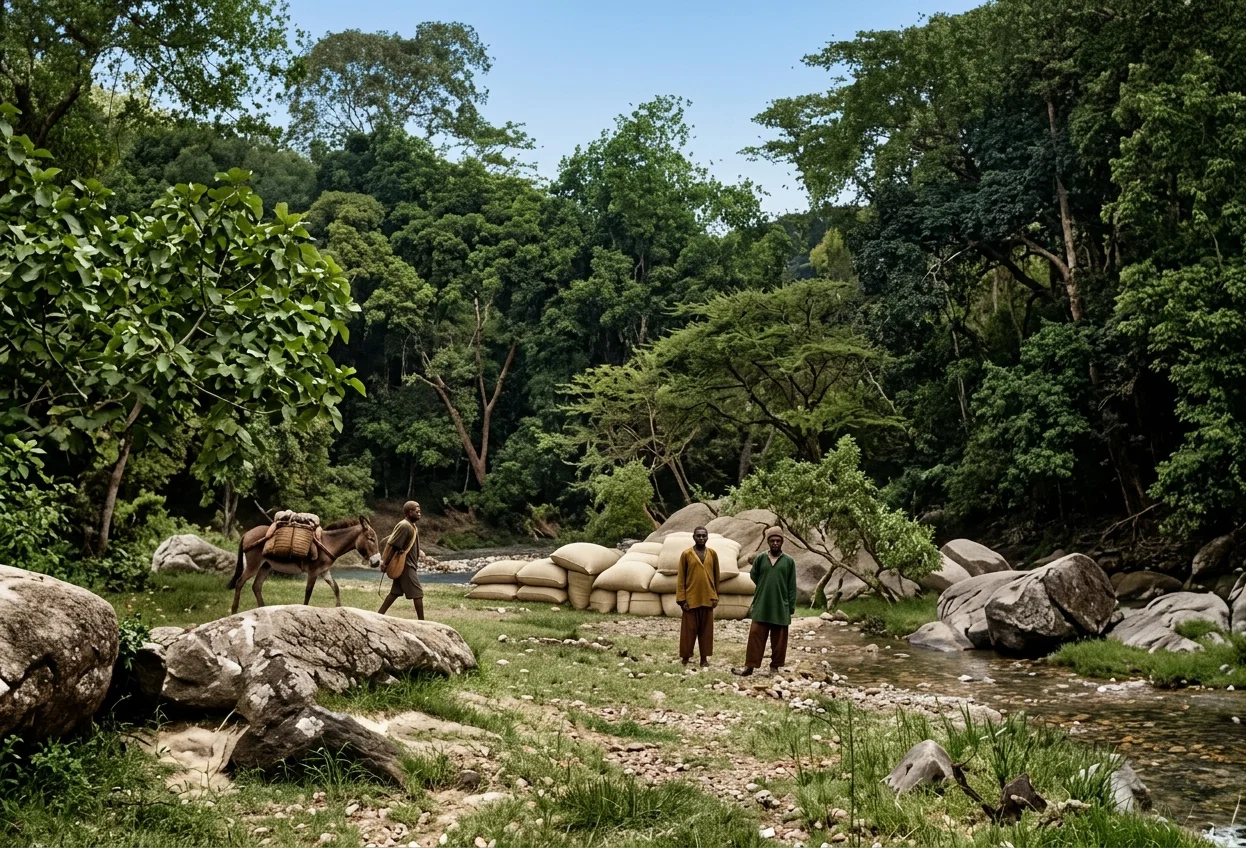
RIVER CROSSING NEAR FRIEDENSTAL MISSION STATION, GERMAN EAST AFRICA
With the language I have done fairly well. I speak and read Hakka, and can speak and understand considerable Cantonese. I think I have found my life-work here. There are ten million Hakkas for me to labor for, and I pray the Lord for strength and wisdom to labor more effectively.
Canton.
German East Africa
By A. C. ENNS
A. C. ENNS
VERY little has been heard of us through the pages of the REVIEW since the beginning of our work in German East Africa. While we do not in any way intend to exclude our work here from the knowledge of our people, for some reason the reporting of it has been neglected in our general church paper. Hereafter we hope to do better.
Our experiences have been varied, as is always the case in African lands. One day we are made happy and hopeful by having six or eight promising youth apply for instruction in the Word of God, with the view of baptism. After a few days we are made sad to learn that their real object is only to receive some small gift, or to be taken under shelter. The government demands every tribe to keep to the highway that passes through the district of that tribe. But the natives abhor this restriction, and of course are punished if they fail to obey the order. Then they wish to be protected by some one who has influence with the officers, and thus they come to their only friends, the missionaries. The natives know that the missionary can believe none but those whom he can trust, so they win his confidence, that they may profit by his recommendations to the very officers.
Thus we have to deal and reckon with disappointments from the beginning. While we have a much larger congregation from the start, compared with the population, than we have in more civilized lands, yet the conversions are probably less. We must always remember that these people do not reason as we do, nor are they touched in the same way. If a man can read, he may be given some Bible truth in print, and he is then constantly under the influence of that, according to the amount of time he spends in reading it. But these heathen can not read. Because of this, the missionary himself must be the open book for them to read, and it becomes necessary for him constantly to stimulate in them the spirit of inquiry, that he may instruct them about the texts they need. Thus the missionary has a much smaller field of influence, because he can not very well duplicate himself.
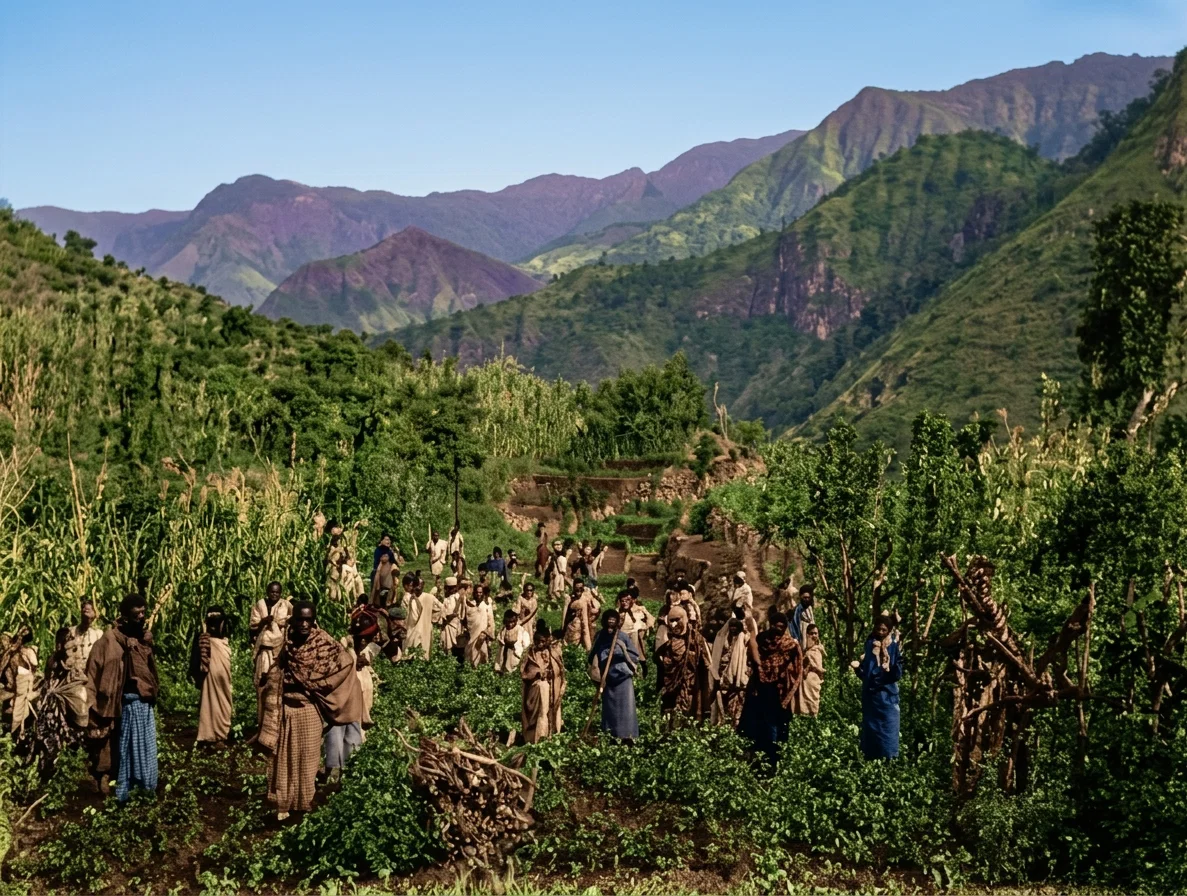
NATIVE GARDENERS AT VUASU, GERMAN EAST AFRICA
Our first-fruits must of necessity be expected from among those who are immediately about us day after day—the house boy, the cook, but most especially the language teacher, because the missionary is constantly questioning him about some text in the Bible, in his work of preparing a sermon or in translating. The next most favored are the children of the school, who, a part of every day at least, are under the immediate influence of the worker. Last of all are those whom he can visit only occasionally, or who come to Sabbath meetings.
It will be seen that our work is not to be judged by the same standard as that in America, or Europe, or any other field where people can read. We are confronted by disappointments from day to day. The young laborer usually comes here with a volume of courage, and many plans. But generally these are seen to be of no value during the first two years, and then the missionary's courage is likely to be severely tested. It is here that the true missionary bows himself, and asks, “Upon what have my hopes been founded?” He learns to wait upon the Lord for help. It must be remembered that the richest pearls are not picked up by the wayside, nor do diamonds lie about in piles, but men search for them, and sometimes find them among a great amount of worthless trash. Diamonds in their rough, unpolished state do not glitter, but look very much like the dirt and pebbles among which they lie. It is only by the patient work of polishing again and again that one eventually finds the worth of the mine. We must never give up in despair. We must continue our patient efforts in laboring for the heathen, and hold to the promise that Jesus gives us: “Lo, I am with you alway.” And keeping this in mind, we shall not only not faint, but shall find some precious jewels for Jesus' crown.
We have had sad experiences with our workers since beginning here. Three were unable to stand the climate, and three others died here on the mission15field. Of the fourteen who have come out in the course of five years, eight are left at present.
In 1903 we began our labors, without any knowledge of the tropics. Nor had we had any help in the written or oral language. We had to feel our way along as well as we could, asking questions by motions with the hands and feet, and by mouth in English, so as to get the meaning of their expressions and the names of objects. If a person is in a strait, he must learn. And so we soon learned to understand and be understood. On the third day we were able to buy land from the native chief. We asked him, “Isanga ili kurora rupia ngah?” which is to say, “How many rupees does this piece of land cost?” The answer came, after a lengthy discussion among themselves, “Rupia mia”—“One hundred.” Thus six words had made the ‘bargain, although we had a long query about what the word mia meant, before we understood; nevertheless, after we knew, we never forgot it. And the next time we learned another word. And so we had to master their words one by one, until we now have all the four Gospels translated, which will go to press as soon as they are recopied on the typewriter. We also have other books—a good grammar, a primer, and a hymn-book containing about sixty hymns—in this native language.
We can report some fruits for our labors. We have been able to baptize six natives, and there are others who will be ready for baptism before the end of this year [1908].
My work has been at Vuasu for the last two years, since I returned from British East Africa, where I went with Elder A. Carscallen, to assist in opening a mission for the British Union Conference. Since then we have put up the buildings here. We have built a stone house at a cost of one thousand dollars; a carpenter shop, also of stone, costing fifty dollars; primitive buildings for the native mission helpers—one for the boys, costing forty dollars, and a hut, for forty dollars, where I had my abode until the stone house was finished. We did not intend to use this building after I moved; but it has been repaired and strengthened, and is now holding over one hundred children, as a school, although they are cramped for room. We have not yet the means to build the much-needed schoolhouse. Our school is at present managed by Brother Max Ponig. I have one class of about sixty regular students, whom I teach in one of the rooms of the house. On account of the crowded condition, it is very unhealthful. We hope to prepare another room to hold my class, for which we have been promised fifty dollars. Then we shall be in good condition to do extensive work.
At present some of the advanced pupils are under instruction in the Word of God, with the intention of being baptized later. Our prospects are very good. Although we have had to learn to wait, we have now something real to look upon, and we rejoice in the realization of what in past years were promises. Our prayer is that the Lord will send still more laborers into this field; for the fields are white for the harvest.
Post Mombo.
The Relation Between the Local Church and the Mission Fields
By T. E. BOWEN
—No. 2
T. E. BOWEN
Boards of Management
The officers of the local church constitute its executive board. These meet occasionally for prayer and counsel in planning the work of the church.
The officers of the local conference, and its committee of five or more men, chosen by the conference itself when in session, constitute the executive board of management of the conference.
The presidents of local conferences, and the managers of institutions within the union, chosen by the union conference in session, with its officers, constitute the committee, or executive board, to direct the work in each union conference territory. This committee meets, when occasion demands, to transact the business of the union conference.
Presidents of union conferences, managers, and other representative men chosen at the session of the General Conference, together with its officers, compose the General Conference Committee, upon whom devolves the direction of the work in all territory throughout the world not organized into union conferences. This territory, strictly speaking, comprises our mission fields; although there are large mission fields embraced within some of the union conference territory, like Australia, and operated by the union conference committee itself.
The Mission Board
Prior to the General Conference in 1903, a number of men elected by the General Conference in session, composed the Foreign Mission Board. This board was incorporated, and at that time had its executive offices in the city of New York. At the General Conference in 1903 it was voted to transfer the work formerly carried on by the Foreign Mission Board to the General Conference Committee itself. This was done to simplify the work and lessen the expense of operation. Therefore, since that time the men composing the General Conference Committee also form the personnel of the Mission Board, the word “Foreign” being dropped from the name at this time, because our work had become so world-wide that really no country was, strictly speaking, now foreign to our work. The New York City office was closed, and the offices of the Mission Board were established in connection with the General Conference work, at that time located at Battle Creek, Mich. All are familiar with the circumstances leading to the removal of the headquarters to Washington.
The men composing the General Conference Committee chosen at the last General Conference session, in 1905, numbered thirty-four. These men are widely scattered, being stationed by their work in all quarters of the globe. Any five members of this committee, including the president or a vice-president, constitute a working quorum, and can meet anywhere and transact business. The minutes of any of these sessions of the committee go to make up the official records of the General Conference between its quadrennial sessions. As most of the correspondence from the mission fields is directed to the general office at Washington, the principal work of the Mission Board is conducted by the officers and members of the committee located there.
The Work of the Board
Many and difficult are the problems constantly coming up for consideration. Continuously the pleas for help come in from the fields, often several letters arriving in the mail from different parts of the earth, all containing earnest appeals for help. Some worker may have been forced to abandon his post of duty, and another is asked to take his place at once. Varied are the demands. But whatever they are, the Mission Board is dependent upon the organized field for the answer to the call—whether it be a demand for men or means. If the former, this usually calls for some tried worker, somewhere in local or union conference employ, to respond. This may mean a new language to be acquired, that the same familiar truths we all hold so dear may be told in a plain, simple manner to the people over in the other country.
And then so much is involved in selecting these workers! Often their places are hard to fill, or the ill health of some member of the family stands in the way. All these things must be carefully considered. And during this time, the field has to wait. These weeks and months of waiting seem very long to the few struggling with the difficulties. In some instances the Board has spent one year, or even two full years, in diligent search for a suitable laborer to answer some specific call.
Thus the Mission Board grapples with these mission problems week by week and month by month. In it all, the men bearing these burdens in connection with the general work, are simply the servants of the church, acting by the delegated authority vested in them by the individual church-members throughout the land,—your servants, under God, set for the finishing of this work in the limits of this generation.
Takoma Park, D. C.
Religious Mottoes on Crackers
DURING the Civil War some godly people, with a good purpose, sent to the hospitals, to be given to the soldiers with their soup, crackers on which were stamped religious mottoes. We can personally testify that the result was often irreverence and profanity.—Christian Register.
Observations at Nashville, Tenn.
By William C. White
The annual meeting of the Southern Publishing Association, which is held early in January, furnishes a convenient time and place for a council to be held by the presidents of conferences, the book men, and other laborers in the three union conferences in the Southern States. The meeting together once a year of representative men from all parts of the Southern field, leads to a oneness of spirit and a harmony of action that foster courage and strength.
This year the meeting of the publishing association was preceded by a book men’s convention, and was followed by a joint meeting of the executive committees of the Southern and Southeastern union conferences.
The meeting of the book men was well attended by canvassers, and also by ministers from all the Southern States, from North Carolina and Florida in the east to Texas in the west. As the result of the faithful and united efforts of the canvassers in the field and the workmen in the factory, the Southern Publishing Association showed a profit from earnings of nearly seven thousand dollars, which augmented by more than three thousand dollars in gifts, brought the net gains of the institution for the year to more than ten thousand dollars. Placing this beside the gains for the year of the Review and Herald and the Pacific Press, we see in the three houses, which have been so heavily handicapped during recent years by the losses resulting from fires and removals, a net gain of more than thirty thousand dollars.
From the first, the Nashville meetings were characterized by broad plans and good courage for the future.
The Nashville Sanitarium
Next to the publishing house, the institution in the South which has received the most attention from our people, is the Nashville Sanitarium. This is now a well-equipped institution, beautifully situated on a ten-acre tract of land about two miles south of the city, on the Murfreesborough pike. It has accommodations for thirty-five patients, and employs about twenty nurses and helpers. Dr. W. A. George, who is chairman of our General Conference Medical Department, is the medical superintendent of this institution. His many years of successful experience as a physician and surgeon in the Nebraska Sanitarium at College View, give assurance that when his skill shall become known in the South, this sanitarium will be largely patronized.
The Food Factory
During the past year the Southern Union Conference has purchased, at a small part of its original cost, a large bakery and health food factory, on the railway line between Edgefield and Madison, about nine miles from Nashville. In company with Elder G. A. Irwin, I visited this place. It is well equipped and ready for work. Sister Josephine Gotzian, who has helped in the establishment of sanitarium work in many places, and Elder Irwin, loaned the union conference the funds required to purchase the plant, and now, as soon as some large-hearted friends of the work will lend them five thousand dollars to be used as a working capital, the wheels of the factory will begin to move. In the West we have five sanitarium bakeries in operation; in the East and South, not one. Here is a plant favorably located for the South and East. There are a score of sanitariums and schools ready to use its products as soon as it can do satisfactory work, and it waits only for capital with which to operate.
The Rock City Sanitarium
One afternoon it was my privilege to visit the property purchased last summer for a sanitarium for the colored people. I had read favorable descriptions of the location and the building, but could realize much better, after a visit, the many advantages of the place.
The location is excellent. It is only one block from a street-car line, and but five or six blocks from the commodious meeting-house of our colored church. The corner lot stands high and dry, one hundred five feet by two hundred ten feet, providing room for the present building and for a nurses’ dormitory when needed. The new bath-rooms were being plastered, and it was expected that within a month the place would be open for patients.
Much of the equipment of the bath-rooms was that which had been used in former years, when, with meager support and amid many discouragements, treatment-rooms were conducted in rented buildings in the heart of the city. The rooms are now furnished, though fitted up economically, will be comfortable and prepared for doing good work.
The furniture for the kitchen, dining-room, parlor, and patients’ rooms was very meager. And as I looked at the twelve or more rooms needing furniture, I thought of as many large sanitariums in different parts of the country, whose physicians, nurses, and other helpers would be willing to pay for the furniture of at least one room in this institution, if they could see the need.
Brother D. E. Blake, and his wife, Dr. Lottie Isbell Blake, are in charge of the work. Brother Blake, while acting as steward, is also pursuing medical studies at the Meharry Medical College. And Sister Blake, while acting as physician and teacher in the institution, will do much work outside.
The opportunities for evangelistic work before Brother and Sister Blake are excellent. Brother Blake has been teaching a large Bible class in the Sunday-school connected with the college; and Dr. Blake has been engaged by the same college to teach hydrotherapy, giving two lectures each week. Some members of her class desire to visit the sanitarium to study the subject further, and to see the methods demonstrated. The opportunity for Christian Help work before Dr. Blake and her helpers is very large.
The Hillcrest School
One day it was my good fortune to catch a ride from the Madison school across country about ten miles to the Hillcrest school, where Prof. Floyd Bralliar and Brother O. R. Staines are working hard to build up and open a school for colored youth, conducted on principles similar to those followed by Brethren E. A. Sutherland and P. T. Magan in their work at Madison.
For a long time our brethren of the Southern Union Conference felt that a training-school for colored youth should be established near Nashville, and when the plans of Brethren Staines and Bralliar were laid before the executive committee, they received the most hearty approval.
The enterprise was incorporated under the Public Utilities act of Tennessee, and the organization was modeled after the plan of the Madison school. The trustees chosen were Elder A. J. Haysmer, Prof. F. R. Rogers, Dr. A. J. Harris, Prof. F. Bralliar, O. R. Staines, H. E. Simkin, and W. J. Pflugradt.
The matter of securing a suitable location was attended with some perplexity. But after thorough search was made, a beautiful place was found about six miles east of Nashville, on the White’s Creek pike. Here, on the borders of a large district occupied mostly by prosperous colored farmers, a ninety-acre tract was found and purchased. About one third of the tract is an oval hill dotted with second-growth trees. This furnishes building sites and pasturage. Back of this hill, and bordered by the creek, are sixty acres of very fertile valley land.
One year before, I had seen this place, when the only buildings were the brick farmhouse of five rooms, and an old, broken-down barn. At the time of this visit there had been added two six-room cottages, and there was timber on the ground for another.
Since returning west I have received several letters from friends of the work in the South, saying that they had thought of helping to build cottages for students at Hillcrest, and asking what I thought of the enterprise. I think that it is an enterprise deserving of our sympathy, and worthy of our encouragement and support.
One year ago last January, we were discussing the advisability of founding an intermediate school and a small sanitarium for colored people near Nashville, at a probable cost of thirty to forty thousand dollars. To-day we have both the sanitarium and the school, at a cost of less than twenty thousand dollars. They are not so large as we might wish, but they are ready for service.