Your ShelfYour Projects

Signs of the Times, Vol. 39, No. 3.

Thoughts for the New Year

Signs of the Times

Jan 16, 1912

Pacific Press Publishing Association · Mountain View, California · Jan 16, 1912

Thoughts for the New Year

LORD, Thou hast been our dwelling-place In all generations. Before the mountains were brought forth, Or ever Thou hadst formed the earth and the world, Even from everlasting to everlasting, Thou art God. Thou turnest man to destruction; And sayest, Return, ye children of men. For a thousand years in Thy sight are but as yesterday when it is past, And as a watch in the night. So teach us to number our days, That we may apply our hearts unto wisdom. O satisfy us early with Thy mercy; That we may rejoice and be glad all our days. Make us glad according to the days wherein Thou hast afflicted us. And the years wherein we have seen evil. Let Thy work appear unto Thy servants, And Thy glory unto their children. And let the beauty of the Lord our God be upon us: And establish Thou the work of our hands upon us; Yea, the work of our hands establish Thou it.

IF YE WILL INQUIRE, INQUIRE YE

This Inquirers' Department is conducted for the purpose of helping those who are studying the Bible. The answers are oftentimes only suggestive. They are never to be considered infallible, only as they agree with the infallible Word. The writer who may answer them does not consider that his opinion is infallible. He will simply give the best that he has, and plead with the inquirer to search the Word. Such questions only will be answered as, to the editors, seem to minister to the good of the readers and to the mission of the paper. We can not answer repeatedly in the same volume questions upon the same scripture. The name and address must accompany question, not for publication, but as an evidence of good faith, and that answer may be made by letter if deemed advisable. No letters are answered which do not contain the name of the writer. It is well always to enclose stamp for reply.

3640—The House Swept and Garnished

What is the meaning of the unclean spirit and the house swept and garnished? What house is this—the body?
The passage in question is found in Matthew 12: "But the unclean spirit, when he is gone out of the man, passeth through waterless places, seeking rest, and findeth it not. Then he saith, I will return into my house whence I came out; and when he is come, he findeth it empty, swept, and garnished. Then goeth he, and taketh with himself seven other spirits more evil than himself, and they enter in and dwell there: and the last state of that man becometh worse than the first. Even so shall it be also unto this evil generation."
The parable is true of the individual; it is true of a church. When an individual is cleansed by the Lord Jesus Christ, and the evil spirit cast out, that is but the beginning of Christianity. If he utterly neglects and refuses to do the work God has for him to do, to let the indwelling Spirit of Christ into his heart for service, even tho the house of his character has been swept and garnished, the evil spirits will come in. Thousands have started out in the Christian life, have received forgiveness of sins, but have shut themselves up to their own selfishness, and in a little while the power of the devil has come into their lives, and they have become worse than ever before.
This is true of a church. It may once have known God's life and power in cleansing; but it may so shut itself up to its own selfishness and self-righteousness, so refuse to go forward and do the work that God gives it to do, that it remains an empty shell, so far as spirituality is concerned, and by its very attitude and condition invites the possession of the devil. Even so it was with the Pharisees.
In further answer to questions, we would say that men do have control of their own mind, independent of spirits, good or bad. God has given to man his own individuality, and yet it is almost invariably true that men are influenced by spirits good or bad continually. When man is not so influenced, he is in more or less perplexity as to which influence he shall follow. God has given His host of mighty angels to be ministers to those who will serve Him. Satan is using his host of evil angels in endeavoring to turn men away from God, and to give themselves to wickedness and sin. Not until man yields wholly to Satan, and wholly rejects God's goodness and favor, do demons come into possession of the human soul. Man of himself has power to resist the possession of the devil, unless he has so yielded himself that he loses the power of will. One of the great curses of hypnotism lies in the subjection of the will to the will of another, creature to creature, until the victim loses the power to resist. God would not have the will of man in subjection to that of any other creature. In subjection to Him, we do not lose reason, and the will is made stronger. Endeavoring to walk in our own independence, we are subject to whims and influences of the source of which we know little. Wholly yielded to Satan, men become insane, possessed of demons.

3642 — Of Equal Authority

A correspondent refers to different parts of the Bible as the writings of Moses, and Paul, and David, the prophets, etc., and says, "Are all these persons of equal character and authority?" F.
No, and yes. All are not of equal character. The one great character of the Bible is Jesus Christ. Another great character is Moses; another, Paul; another, Elijah, who left us no writings whatever. So it was with another—John the Baptist. Samuel was a great prophet. We have quite an extended record of his doings, but very little of what he said or wrote. And so it is with other mighty men of God. All certainly are not of equal character; but the writings which make up the Holy Scriptures, are quite another thing. While in style and in matter character has its bearing, so far as truth is concerned, it has no bearing. In the light of the words which God has given us through the apostle Paul, "All Scripture is given by inspiration of God [literally, is God-breathed], and is profitable." This, we understand, pertains to the original Scripture. Mistakes have been made, doubtless, in copying. Sometimes we find things hard to harmonize. Sometimes numbers seem to be wrong. This in some cases may be easily accounted for in the mistake of some copyist; but granted that we have the right original, all the Scriptures are inspired and all equally inspired. That does not mean that all are equally important. Some are of greater importance than others. The holy law of God as given in the 20th chapter of Exodus is much more important to us than the ceremonial law as given in Leviticus. Our inquirer speaks of the words of Christ; but what proof has he that he has the words of Christ if he denies the inspiration of the writers of the Gospels? Mark was not even one of the twelve apostles; neither was Luke. But it is only by believing in the inspiration of Matthew and Mark and Luke and John that we know that we have the real words of Jesus. David was certainly a man of very questionable conduct at times in his life, and yet twice over in the New Testament we have his words quoted and attributed to the Spirit of God, "As the Holy Ghost saith." Caiaphas, the skeptical Sadducean high priest, said, "It is expedient for us, that one man should die for the people." And John tells us that he said that not of himself, but being high priest that year, he prophesied. There is very much more which can be said, but if the Scriptures are not inspired, and equally inspired, we are left simply to the whims and opinions of men.
— * —
3643 — D. R. M. — Matt. 11:11 — The text in question simply means this,— that the fact that John the Baptist was the immediate precursor, or herald, of Christ Jesus the Lord, gave him a more honorable position than that of any of the other prophets who had lived. The message made the man, and the message which he bore was of tremendous importance to that time, and people, and generation. He had, too, a message to bear that would bring no glory whatever to himself. His prestige and fame would grow dim in the greater work and greater glory of Jesus Christ. He was content to be a voice for God, and rejoiced in fulfilling his work, tho he decreased and the Master's power and influence increased. See John 1.

3639—How Far Faith Goes

Will you be so good as to tell me how far faith goes in the work of perfecting Christian character, and what part one has to do himself; or, in brief, where faith stops and works start?
Faith goes all the way. Faith goes all the way with a person who never sinned; for "without faith it is impossible to please Him." He who is able to overcome anything without faith in God would take glory to himself; and if holy beings who had overcome by their own power were placed together, each glorying in himself, strife and confusion would immediately result. In the glad day of God, when all the redeemed come home, every soul will give honor and glory and praise to Jesus Christ, and to the Father, for all the salvation. Trusting in self in any way narrows heart and mind, dwarfs affection and intellect. Keeping the heart open toward the infinite God must expand both mind and heart. And so it is trusting Christ all the way. At the same time, God would not have us effortless. It is He Himself who has said, "Strive," "agonize," "work," "do," "walk," "run," "fight." It has been happily phrased this way,—that the Christian is to trust the Lord Jesus Christ as if he expected that God must do it all, and that he is to put forth such effort on his own part as if he expected he must do it all himself. He will not put forth the right effort without faith. His works will be the works of faith; he will yield himself to God because God requires it, because he loves Him who has redeemed him. And his whole life will be one constant service to duty, service to love. Let a man once grasp the great and eternal thought that God has redeemed him from eternal death, from sin and its curse, and he will yield every power of his being to the One who has so loved him. He may fail in his service because of ignorance, because of weaknesses which he did not know that he possessed, because of failure to feed upon the Word of Christ, to seek Him by prayer; but he will not turn back; he will persevere if he has faith, and persist to the end. God will not cut him off if he stumbles, or makes mistakes, any more than a father will his little child who stumbles and fails. Our correspondent says that when he takes his eyes off Christ he fails. Truly he does. God wants us to form the habit of having Christ in our life always. God has given him a taste of His blessings; let him persevere. Peter took his eyes off from Christ, and he sank; when he looked to Christ and forgot himself he walked on the stormy sea.

3641 — Seven Women and One Man, Isa. 4:1

Please give an explanation of Isa. 4:1 in the "Signs of the Times."
One of the general meanings given to the text is that on account of the wars and judgments upon Israel, as set forth in the preceding chapters, so many men were destroyed in these various calamities, that but few men and many women were left, and many women would center around one man, and ask to be protected by him, while they were willing to support themselves.
There is another meaning which is given to it — that is, a figurative meaning, that may have an application of worth and a lesson for the people who live in these days; and that meaning is this: The seven women denote the backslidden churches, seven indicating completeness, or fulness. That is, there will be a fulness of backsliding in the last days. The one "man" referring to our Lord Jesus Christ. And yet, while these churches are backslidden, still they will nominally be Christians. They wish the name and the prestige of the one Man, but they say, "We will eat our own bread" (that is, what the human can furnish, instead of feeding upon the Word of God), and we will "wear our own apparel" (that is, to be clothed in their own righteousness and conventionalities, instead of in the righteousness of the Lord Jesus Christ), only we do not wish reproach, and therefore "let us be called by Thy name." How true this is in many individual cases at the present time! How many are really, as taught in the Word of God, not Christians; they do not believe in Christ as a living Saviour, the one atonement for men; and yet they call themselves Christians. Not believing in His vicarious sacrifice, they are not seeking His righteousness, but their own. They are feeding upon their own philosophies and traditions, instead of upon the Word of God; but they nominally call themselves Christians. But we are told in the next verse that there will be a people who will be true to God. "In that day shall the branch of Jehovah be beautiful and glorious." God will have a people who are loyal to Him.

Jacob, Joseph, and the Psalms

Schedule for Week Ending January 27, 1912
Sunday January 21 Genesis 32, 33
Monday " 22 " 35
Tuesday " 23 " 36
Wednesday " 24 " 37
Thursday " 25 " 39, 40
Friday " 26 " 41
Sabbath " 27 Psalms 10, 11, 12
--- * ---
Our readings begin with Jacob's perplexity, yea, agony, as he goes forward to meet his brother Esau. Yet God gave him a vision that His angelic host was with him. Jacob does all on his part to compensate his offended brother in the way of property, humbles his heart before God, and pleads only God's mercy. And then comes the change of name from Jacob (the supplanter) to Israel (the prevailer), and that is the origin of Israel, and true Israel are the prevailers by faith.
We omit the sorry incidents of the 34th chapter as not necessary to the narrative, also those of the 38th. Chapters 37, 39, and onward are one of the beautiful revelations of how God overrules the wrath, the ambitions, the jealousies of men to praise Him. The story of Joseph is a most beautiful narrative of the outworking of God's providence for the true and the faithful. And Joseph's example is a splendid example for young men. Doubtless his early life showed but the flattered and petted boy, but his later life showed that the principles of righteousness had been transmuted into living character.
Psalms 10, 11, and 12 are inspired prayers of God's will toward the children of men. The 10th is not simply the prayer of some one who wishes vengeance upon the wicked, but it is that God will execute justice for the sake of the poor and the oppressed.

"Thou Shalt Love Thy Neighbor"

Thou shalt love the Lord thy God with all thy heart, and with all thy soul, and with all thy mind. This is the first and great commandment. And the second is like unto it, Thou shalt love thy neighbor as thyself.
THE law of God condemns all selfishness, and is at variance with all evil-thinking and evil-speaking. It enjoins upon men and women that kindness, gentleness, and forbearance, that tender guarding of the interests of others, which was revealed in the life of our Saviour. He who takes this law as his standard must carefully heed the words of Christ, "Therefore all things whatsoever ye would that men should do to you, do ye even so to them." By unselfishness of heart and character, by a sincere love for our fellow men, we may show that we are striving to honor our Maker; but if, finding the last six precepts of the law hard to keep, we transgress them by failing to manifest love for one another, by a lack of kind words and actions, we can not, with any truth, claim to be rendering acceptable service to God.
He who earnestly desires to fulfil the will of God must daily look into the law of God, the great moral looking-glass, that he may see himself as God sees him. But too often Christians neglect to do this. The mirror is not looked into as constantly as it should be, and our defects of character pass unnoticed. The command, "Thou shalt love thy neighbor as thyself," is disregarded; we fail to respect the rights of our fellow men. Self, highly estimated, calls for recognition, and we listen to its voice, walking far apart from those we should help, not regarding their wants and woes.
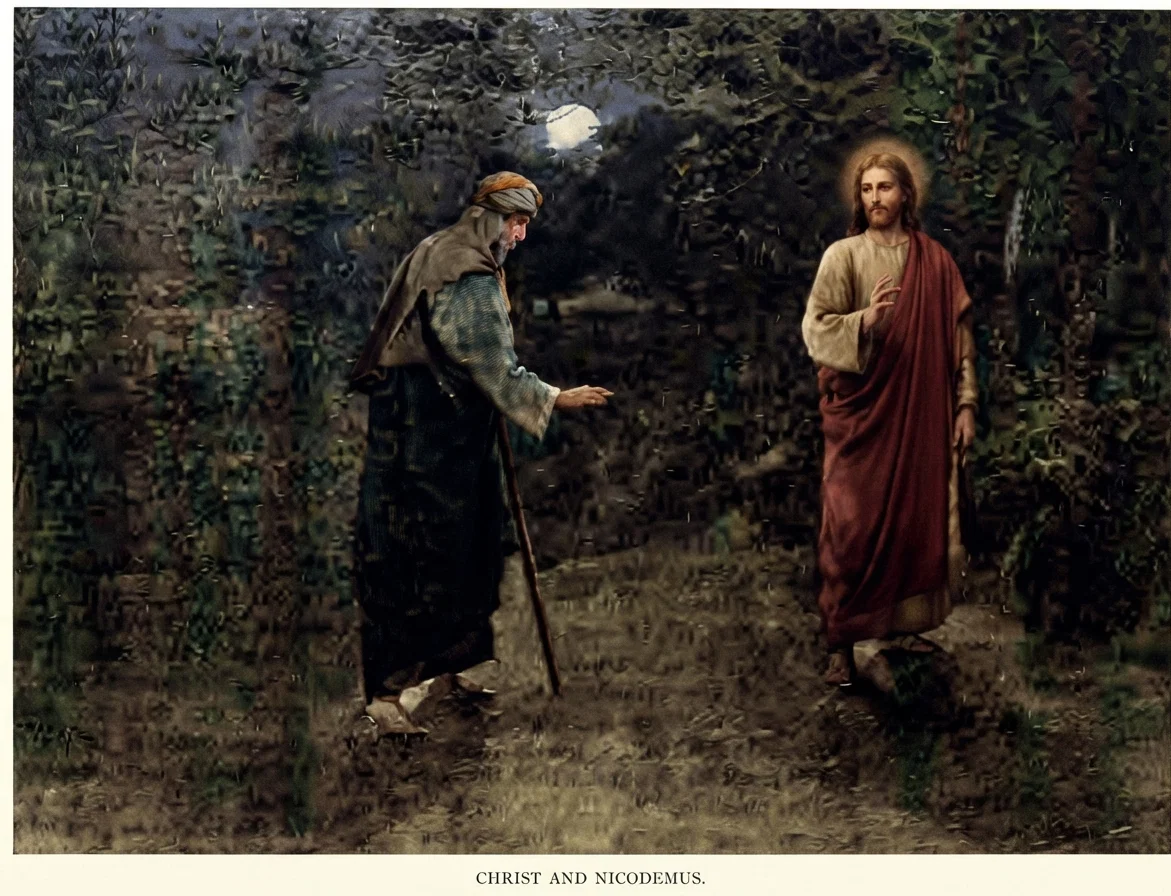
CHRIST AND NICODEMUS.
Many apologize for their spiritual weakness, for their outbursts of passion, for the lack of love they show their brethren. They feel a sense of estrangement from God, a realization of their bondage to self and sin; but their desire to do God's will is based upon their own inclination, not upon the deep, inward conviction of the Holy Spirit. They believe that the law of God is binding; but they do not, with the eager interest of judgment-bound souls, compare their actions with that law. They admit that God should be worshiped and loved supremely, but God is not in all their thoughts. They believe that the precepts which enjoin love to man, should be observed; but they treat their fellow men with cold indifference, and sometimes with injustice. Thus they walk away from the path of willing obedience. They do not carry the work of repentance far enough. The sense of their wrong should lead them to seek God most earnestly for power to reveal Christ by kindness and forbearance.
Many spasmodic efforts to reform are made, but those who make these efforts do not crucify self. They do not give themselves entirely into the hands of Christ, seeking for divine power to do His will. They are not willing to be molded after the divine similitude. In a general way they acknowledge their imperfections, but the particular sins are not given up. "We have done the things we ought not to have done," they say, "and have left undone the things we ought to have done." But their acts of selfishness, so offensive to God, are not seen in the light of His law. Full contrition is not expressed for the victories that self has gained.
The enemy is willing that these spasmodic efforts should be made; for those who make them engage in no decided warfare against evil. A soothing plaster, as it were, is placed over their minds, and in self-sufficiency they make a fresh start to do the will of God.

A Conviction in General

But a general conviction of sin is not reformative. We may have a vague, disagreeable sense of imperfection, but this willavail us nothing unless we make a decided effort to obtain the victory over sin. If we wish to coöperate with Christ, to overcome as He overcame, we must, in His strength, make the most determined resistance against self and selfishness.
Genuine reforms of character are not common. This is an obstacle in the way of spiritual advancement. What work shall be instituted to purify and cleanse self of its moral defilement? What shall be done to awaken those who confess their wrong, and yet never forsake their own way? A man who has professed Christ, sees his old selfish nature rising, and gaining strength with each wrong action. His besetting sins bind him with fetters of iron, and he sees himself under the condemnation of the law. What shall he do? Whatever his calling or profession, whatever his rank or station in life, that man must realize in himself the truth of the words spoken to Nicodemus: "Verily, verily, I say unto thee, Except a man be born again, he can not see the kingdom of God."

They Have a Misleading Acknowledgment

There are many, too many, who claim to be servants of God, but who have no experimental knowledge of Him. Their acknowledgment of Christ is misleading, because they have not faith to believe that He will give them power to overcome their sins. They do not receive Him as their personal Saviour, and their characters reveal hereditary and cultivated defects. Their conduct is not brought into harmony with the law of God, but is influenced by their own inclinations. Selfishness binds them hand and foot. God looks with sorrow upon their bondage. If they would submit to His guidance, the light of His holy Word would flash upon their minds through the Holy Spirit's power, convicting them of sin, of righteousness, and of judgment,—of sin, especially because they have claimed to do God's will, and yet have neglected it. If they receive Christ as their personal Saviour, their sins will be forgiven; for God's Word declares, "If we confess our sins, He is faithful and just to forgive us our sins, and to cleanse us from all unrighteousness." Of Christ it is written, "As many as received Him, to them gave He power to become the sons of God, even to them that believe on His name."
A theory of truth may be taught and accepted, but this is of no avail to save unless the divine power of God is revealed in the life by unselfish actions and kindly words. Are you converted? Is Christ revealed in your daily life? No theory of truth will save you; no partial confessions will avail. With your whole heart you must serve God.
"Be kindly affectioned one to another with brotherly love," writes Paul, "in honor preferring one another." "Examine yourselves, whether ye be in the faith; prove your own selves. Know ye not your own selves, how that Jesus Christ is in you, except ye be reprobates?" "Therefore, brethren, we are debtors, not to the flesh, to live after the flesh. For if ye live after the flesh, ye shall die: but if ye through the Spirit do mortify the deeds of the body, ye shall live." "If the Spirit of Him that raised up Jesus from the dead dwell in you, He that raised up Christ from the dead shall also quicken your mortal bodies by His Spirit that dwelleth in you." "For as many as are led by the Spirit of God, they are the sons of God."

Sin Not Merely What the World Condemns

If men and women will critically examine their conduct, measuring it by the law of Jehovah, they will be enabled to see that sin is not limited to those things which the world condemns, but that selfishness and oppression, even in the smallest degree, are sins against God. They will see that by yielding to their inclinations, and refraining from obedience, they are depriving themselves of the richest blessings God can give.
"A new commandment I give unto you," said Christ, "that ye love one another; as I have loved you, that ye also love one another. By this shall all men know that ye are My disciples, if ye have love one to another." He who fulfils his duty to his neighbor must of necessity love God supremely; but he who has little love for those who are in darkness, who are in great need of the revelation of the love of Jesus, is marked in the courts of heaven as a defaulter. He is weighed in the balances, and found wanting.
Love to God must be brought into our daily life. Then, and then only, can we show true love for our fellow men. When this is done, when Christ is enthroned in our hearts, we manifest by our daily life, by our conversation, by our unselfish interest in one another, by our deep love for souls, that we are doers of the Word of God. The reality of our conversion is marked by a deep, earnest piety, which purifies the soul, and works unceasingly for the good of others.
"Beloved, let us love one another: for love is of God." "Love worketh no ill to his neighbor: therefore love is the fulfilling of the law." "The end of all things is at hand: be ye therefore sober, and watch unto prayer. And above all things have fervent charity among yourselves: for charity shall cover the multitude of sins."

The Testimony of Jesus

By George W. Reaser

III — The Existence of Jehovah Proved by Fulfilled Prophecy

Remember the former things of old: for I am God, . . . and there is none like Me, declaring the end from the beginning, and from ancient times the things that are not yet done, saying, My counsel shall stand, and I will do all My pleasure. Isa. 46:9, 10.
READER, in your own mind, what is the strongest and most convincing manner in which the intelligences of heaven can testify to truth, and to the very existence of the eternal God?

A Personal Appearance of Jehovah to Men Not Consistent

In order that Jehovah might by a personal appearance convince all men in all ages of His existence, He must personally appear to them all, in each successive generation. This, in a sense, would be a standing witness of His existence, and especially if He would perform some mighty works to prove Himself to be the Supreme Being. But it must be apparent that this could not well be possible. Yet He has not left "Himself without witness." For reasons which we will not stop to discuss in this connection, it is a matter of divine wisdom that He has not chosen to give to mortal man a view of His person. But He has chosen a special agent to reveal Himself to mankind, as it is written, "No man hath seen God at any time; the only-begotten Son, which is in the bosom of the Father, He hath declared Him." John 1:18. And the Father and the Son have agreed as to the most effectual way in which the Son could bear witness, which, as we have seen, is by "the spirit of prophecy."

Jehovah Only Can Declare the End from the Beginning

It is within the power of divinity only to make a chart, as it were, of the world's history in advance, and then, in due time and exact order, each specification in the diagram be fulfilled in perfect accuracy of detail. And such has been done, not alone by one line of prophecy, but by more than half a score of such prophetic outlines. And each of these outlines of a portion of the world's history, written centuries in advance of their fulfilment, constitutes a part of the "testimony of Jesus," for "the testimony of Jesus is the spirit of prophecy;" and how else could He witness with such undeniable assurance to the ages?
Each and every prophet, then, who was used of Heaven to employ his prophetic pen in unfolding the plans of Jehovah concerning our world, or to sketch the history of nations or individuals in advance, was simply a mouthpiece through whom Jesus spoke by His Spirit, to give faithful warning of impending events and to witness for God and His truth.
Abstract statements do not supply sufficient foundation for the building of intelligent faith, nor do they alone prove the things of God true. But when God's Word is put in concrete form, as it is by fulfilled prophecy, then do we behold the granite blocks, erected in majestic strength, constituting a monumental structure, standing in all its beauty, as a witness to the ages of the existence of God and of the truthfulness of His Word. Such is prophecy, and such is "the testimony of Jesus," which "is the spirit of prophecy."

Jesus Witnessing to the Fundamental Truth

Jehovah said of Jesus, "I have given Him for a witness to the people." In response to Pilate's question, Jesus said in part, "For this cause came I into the world, that I should bear witness unto the truth." John 18:37. While His answer would comprehend all truth, yet there is essentially a fundamental truth of all truths. Witnessing for this would really embrace all others. The basic truth of all truths is the existence of Jehovah. We may pursue our research for the fundamental truth of all truths to any possible limit, but we can not penetrate beyond the great truth of God's existence. It is "the first cause," the very foundation of the universe, for this primal truth involvesboth the existence and the stability of the universe.
In what way did Jesus witness to this fundamental truth? In answering this question it may be well to consider another; namely, What is the climax of all witnessing? Let the Saviour Himself answer. He says, "Be thou faithful unto death, and I will give thee a crown of life" (Rev. 2:10); and again, "They loved not their lives unto the death" (Rev. 12:11). Persecution reaches its climax at the death of the persecuted, and witnessing for truth reaches its climax at the same point. When Jesus answered Pilate's question, He was standing face to face with death.

Martyrs Witness to Truth

The two quotations last above given refer to the martyrs of Jesus. The hope held out before the martyr is eternal life, based on the fundamental truth that God exists, and will fulfil His promise in bringing him from the dead. This hope sustains him in his loyalty to God, as the fagots are kindled at his feet, and while the cruel flames encircle his body. Every martyr who thus surrenders his life, refusing to renounce his allegiance to truth, thereby reaches the very climax of witnessing to his faith in the existence of God.
None would lay down their lives as Christian martyrs, were it not for their profound faith in the existence and faithfulness of Jehovah, to bring them from the dead to a glorious life in immortality.
Unless we are ready, if need be, to lay down our lives upon the altar of sacrifice to bear witness to truth and to the faithfulness of God to bring us from the dead, we are not faithful and true witnesses. And thus it was with Jesus. In the surrender of Himself to be nailed to the tree, in laying down His life upon the cross, He reached the very climax of all witnessing to the truth of God's existence, and His faithfulness to His promise.
Through David, Christ had spoken these prophetic words: "My flesh also shall rest in hope. For Thou [God] wilt not leave My soul in hell; neither wilt Thou suffer Thine Holy One to see corruption. Thou wilt show Me the path of life." Ps. 16:9-11, with Acts 2:23-32. At the crucial point of the test of His faith, with the Father's presence withdrawn from Him, note His dying words: "Father, into Thy hands I commend My spirit"—the keeping of My life. Luke 23:46. These words were a firm, unshaken expression of His faith in the fulfilment of the prophecy, "Thou wilt not leave My soul in hell," based on the very existence of God. Jehovah proved the truth of His existence and of His faithfulness to His prophetic word in bringing Christ from the dead, and at the same time gave to humanity a risen Saviour, triumphant over death and the grave. This splendid proof was the living answer to Christ's expressed faith in the fundamental truth of all truths; namely, in—

God's Existence

Not only is God's existence proved by this the most brilliant beacon light of all fulfilled prophecy, but "prophecy, unmistakably outlining events beforehand, shows that God is behind the curtain, and that His hand controls and shapes the history and destiny of men." ("Many Infallible Proofs," page 31.) Thus each Bible prophecy fulfilled is the witnessing, "the testimony of Jesus." In fact, each prophecy fulfilled proves God's existence, and leaves unbelievers without excuse.

Things Proved by the Testimony of Jesus

While "the testimony of Jesus" in fulfilled prophecy gives infallible proof of the existence and sovereignty of God, adversely it disproves the claims and assumptions of all rivals. While it establishes beyond reasonable controversy the true Messiahship of Christ, it places the brand of "false christ" or "antichrist" upon each and all who assume to be Christ or "vicars of Christ." In supplying absolute proof of the truthfulness of the Bible, "the testimony of Jesus" undermines the very foundations of all rivals of the sacred Book. The same witness places its official seal upon the true characteristics and manifestations of the Holy Spirit, and declares the manner of working of every false spirit. In proving the true religion of Jesus Christ, it disproves all false religions. While designating and identifying the true church, it sets forth the errors and warns against every false church. It foretells the second coming of Christ, and all associated events. It warns against all fatal deceptions. It is the safest of all safeguards. It declares that Satan will finally be destroyed, and that sin will be forever dethroned. It vividly portrays the future life. How could it be possible for the human family to have any hope whatever of the hereafter, were it not for prophetic promise? And each prophetic promise is an essential part of "the testimony of Jesus."
Continue reading: The Nature of God's Law