Your ShelfYour Projects

Signs of the Times, Vol. 34, No. 26.

GIVE GLORY TO GOD

Signs of the Times

Jun 24, 1908

Pacific Press Publishing Company · Mountain View, California · Jun 24, 1908

GIVE GLORY TO GOD

(Boothroyd's Translation.)
SING to Jehovah a new song; Sing to Jehovah, all the earth. Sing to Jehovah, bless His name; Publish from day to day His salvation. Declare His glory among the nations; Among all the peoples, His wonderful deeds! For great is Jehovah, and greatly to be praised; He is to be feared above all gods! For all the gods of the nations are vain idols: But Jehovah made the heavens. Honor and majesty attend His presence; Power and beauty are in His sanctuary. Give to Jehovah, kindreds of the people; Give to Jehovah glory and power; To Jehovah give the glory due to His name. Bring a present when ye enter His courts; Worship Jehovah with holy reverence. Tremble before Him, all the earth; For He fixed the world that it can not be moved; He judgeth the peoples with uprightness. Say among the nations, Jehovah is King. Let the heavens be glad and the earth rejoice; Let the sea with all its fulness roar: Let the fields, with all that is therein, exult; Let all the trees of the forest sing aloud Before Jehovah; for He cometh, He cometh to judge the earth. The world will be judged with righteousness, And all the peoples according to His truth.

With Our Inquirers

"If ye will inquire, inquire ye."
This Inquirers' Department is conducted for the purpose of helping those who are studying the Bible. The answers are oftentimes only suggestive. They are never to be considered infallible, only as they agree with the infallible word. The writer who may answer them does not consider that his opinion is infallible. He will simply give the best that he has, and plead with the inquirer to search the word. Such questions only will be answered which, to the editors, seem to minister to the good of the readers and to the mission of the paper. We can not answer repeatedly in the same volume questions upon the same scripture. The name and address must accompany question, not for publication, but as an evidence of good faith, and that answer may be made by letter if deemed advisable. No letters are answered which do not contain the name of the writer. It is well always to enclose stamp for reply.

2539.—Essential to Salvation.

Is it necessary for a Christian to have his name written upon the church record in order to be saved? I mean one who has been, and is now, living up to all the commandments of God the best he can? F. E.
The essentials to salvation as given by the apostle Paul are as follows: "If thou shalt confess with thy mouth the Lord Jesus, and shalt believe in thine heart that God hath raised Him from the dead, thou shalt be saved." Rom. 10:9. But such faith means more than mere belief, and such confession means more than mere words. There is a kind of belief which is mere assent to facts, as "the devils believe and tremble," but the belief which the apostle refers to is thus expressed in the following verse: "For with the heart man believeth unto righteousness; and with the mouth confession is made unto salvation." A belief which stops short of righteousness is not the belief which God requires. True faith lays hold upon God's promise and makes it ours; it submits to God's word, it gives up the sin which His word condemns; it embraces as its own the righteousness which the word gives. It yields the heart that the Spirit of God may cleanse it from its sin, and write upon it His own blessed righteousness. And the soul who thus believes will confess Christ; confess Him with the mouth in declaring himself a disciple of the Lord and what the Lord has done for him, and will also confess Him by living the life which the Lord requires. The soul that does that can not be shut out of heaven by any man or any body of men, or by any organization on the face of the earth. But the soul who does that will not want to go on alone.
Jesus Christ is the Head; His body is the church; and those who yield to Him are baptized, and in that baptism are baptized into His church. That makes them members of His body. Of course all that can be done, and the name not placed on the church record, and yet where one does go so far as that, will they not desire to unite with others of the same faith? Now, is it possible that God can save us each alone, and yet He has not chosen that way; He has associated men together in all the ages, in order that the deficiencies of the one may be supplied by the fulness of the other; the defects of the one may be remedied by the strength and completeness of the other.
There are some kinds of plants which must be fertilized thru other plants of the same kind. A hill of corn growing alone in a field may put forth great stalks, and yet its kernels be incomplete. It has not come in contact with other life in the way appointed by the Creator. That is why we find many times that hills of corn in the outskirts of a field rarely bear full ears, while much inferior-looking corn in the center of a field has well-filled ears. Read 1 Corinthians 12, and especially verses 12 to 27, also 1 Peter 4:10 and see if you do not think it best that one should come in the closest union possible with his brethren of like faith, in order that he may help them and be the means of helping others.
Selfishness is developed in the one who is content to remain alone. The sharp corners of our idiosyncrasies and bad dispositions are worn off and rounded out in constant contact with others. We obtain broader charity and greater sympathy in unselfish work for God, associated with others. We learn that our work is not the only work, our soul not the only soul, and thus it is that God has associated us together. The mere record on the church-book amounts to nothing so far as the form is concerned; on the other hand it does associate us together as one body and is helpful in this sense, that the soul feels that he is numbered as one of the family, or on the family record in that place.
One other thought suggested by our querist: God asks us to do not the best we can, but better than we can. If we always did only "the best we can," it would be poor human effort, and would constantly tend downward. It would ever be an excuse that we reached perfection by doing the best we could, and consequently the Lord asks no more of us. Such lives would be sure to degenerate. On the other hand, he who sees before him the perfect in Christ Jesus will grasp the power of God to do all that God requires of him; ever seeing before him the perfect, ever recognizing his own imperfection, ever reaching out for that which lies beyond; and yet with the constant assurance that God gives His own life and power to enable us to do His will.

2540.—Jesus and John the Baptist.

What did Jesus mean by saying to John the Baptist in answer to his question, "I have need of being baptized of Thee, and comest Thou to me?" "Let it be so now, for it is fitting that I should do all things that are right."
Our Common Version reads, "Suffer it to be so now: for thus it becometh us to fulfil all righteousness." See Matt. 3:13-15. In other words, it meant that Jesus took the place completely of those whom He came to save; "was made sin for us who knew no sin, that we might be made the righteousness of God in Him," and counting Himself a sinner for our sakes, He passed thru all things that were necessary to fit Him to become a Saviour for our sakes. Among those things was that of baptism, the marriage ceremony which connects us with the Lord.

2541.—Tithe Paying.

Can one have the faith of Abraham—genuine, saving faith—and not pay the tithe, providing he understands the tithing question? F. H. R.
Probably not; and yet the real question might come over this, Does he understand the tithing question after all? If it is a mere matter of law to him, he does not understand it. If he looks upon it as a matter of real union with God, as partnership with the Lord of heaven and earth, he probably does understand it. How does he see it? God has made man steward of two wonderful and valuable things, time and means. Of the time He demands that man shall in a general way consecrate all to Him, but one-seventh part of that time He demands that man shall specially consecrate to Him. Of his means, while in a general sense the Lord makes him steward of all, and will call him to account for the way in which he uses it, yet in a special sense He has demanded that one tenth of that means shall be yielded to Him, to which man has no right whatsoever. One seventh of time and one tenth of man's income, God has reserved to Himself as tests of the loyalty of His children, tests of the proving of their love. Further than this, God takes all those children who unite with Him into partnership with Himself. Jesus says, "Take My yoke upon you and learn of Me." He yokes Himself up with every believer; He becomes a partner, so to speak, with that believer in all his transactions, and every duty of life. All that we have comes from Him. His is the world and its fulness, and He asks us only one tithe of our means, given unreservedly as first-fruits to His work. With that proper use of means, He promises a great blessing. "Bring ye all the tithes into the storehouse, that there may be meat in Mine house, and prove Me now herewith, saith the Lord of Hosts, if I will not open you the windows of heaven, and pour you out a blessing, that there shall not be room enough to receive it." Now if one has the faith of Abraham, he will see all this in the tithing system if he is properly instructed. If he does not see this, perhaps he has not been properly instructed, and the tithe may not seem to him of binding obligation. If he will look upon it with the eyes of faith, he will see in it great privilege and blessing in proving God, as have thousands upon thousands who have rendered to the Lord that which is His own.

2542.—Why Not Observe Them Now?

Will you please explain in the SIGNS OF THE TIMES in full why the sabbaths and passovers, and seven years, and, in fact, all the Jewish law, is not observed now by Seventh-day Adventists? Was it not a command set forth by God? Ex. 34:22; Lev. 23:34. INQUIRER.
All these laws peculiar to the Jews belong to one of two classes. They were either civil regulations for the Jews themselves in the wilderness, or in their own land, or they were typical and pointed forward to Christ. When the great antitypical Sacrifice was offered upon the cross, all these which pointed forward to that Sacrifice or were connected with its types expired by limitation. There could be no virtue whatever in offering sacrifices when the Sacrifice had come, no virtue in offering the lamb when "the Lamb of God" had died. And all the things which were promised in the feasts and yearly sabbaths were met in Him and took on far larger, greater, deeper meaning than they had hitherto.
And so we are instructed concerning that law of sacrifices and offerings, and all that pertain to that earthly sanctuary of which it was said "which is a figure for the time present; according to which are offered both gifts and sacrifices that can not, as touching the conscience, make the worshiper perfect, being only (with meats and drinks and divers washings) carnal ordinances, imposed until a time of reformation." Heb. 9:9, 10; read also the verses which follow. Certainly such scriptures as these are sufficient for not continuing these typical observances, and, in fact, in the nature of things, it would seem as tho the Scriptures were hardly needed. Col. 2:14-16 indicates the same thing. The ceremonies of the typical law stood for man's sin, as a bond that had been written against him, and these were blotted out, nailed to the cross, as the shadow of the things to come, but the body is Christ. To go back to these ordinances as saving institutions is to make of none effect the offering of Jesus Christ.

2543.—Cain's Wife. Gen. 4:17.

Would you please explain Gen. 4:17. Who was Cain's wife? L. F. W.
This is not really a profitable question, but one that rather ministers to curiosity. Neither is it a difficult question if we will but take into consideration the lapse of years during which the things in Genesis 4 were enacted. We do not know how long Cain lived before he was married. During this time, doubtless, Adam and Eve had many sons and daughters born unto them. See Gen. 5:4. It was one of these daughters of Adam that Cain married. We do not see any reason for taking the ground that some do that a wife was created for Cain the same as for Adam, from his own flesh and bone.

2544.—China.

Has China an older history than ours? L. F. W.
Certainly it has. Our history is not very old. It was only in 1492 that Columbus discovered America, and at the very most the discovery of this land goes back less than a thousand years, when America was said to be discovered by the Norwegians. Chinese history goes back perhaps the farthest of any living nation, and has the longest civilization of any nation now existing. We are not to take all its legends, however, as authentic history; many of them came down thru song and story, and are to be greatly discredited the same as those of Egypt.

Wilt Thou Be Made Whole?

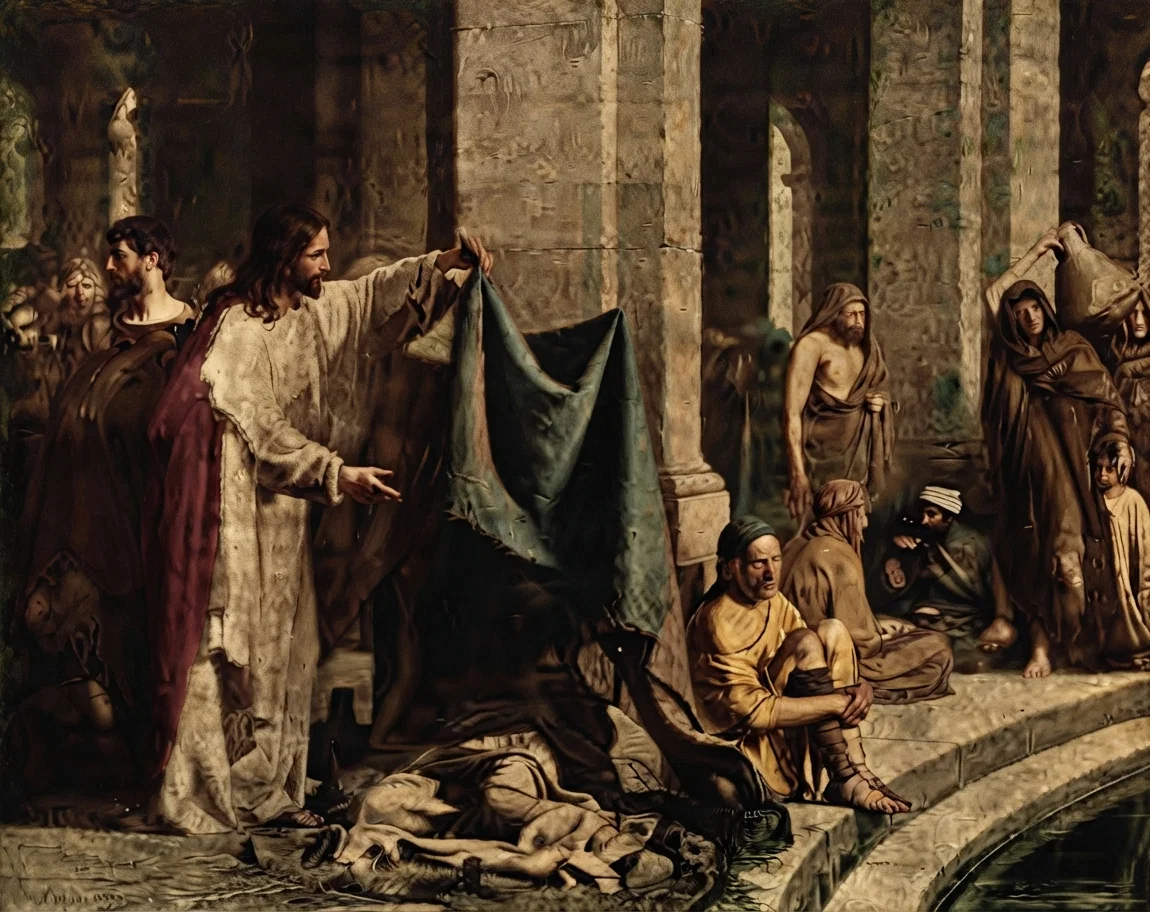
NOW there is at Jerusalem by the sheep market a pool, which is called in the Hebrew tongue Bethesda, having five porches. In these lay a great multitude of impotent folk, of blind, halt, withered, waiting for the moving of the water.
At the Pool of Bethesda.
At certain seasons the waters of this pool were agitated, and it was commonly believed that this was the result of supernatural power, and that after the troubling of the pool whosoever first stepped into the waters would be healed of whatever disease he might have. Hundreds of sufferers visited the place; but so great was the crowd when the waters were troubled that they rushed forward, trampling under foot men, women, and children, weaker than themselves. Many could not get near the pool. Many who had succeeded in reaching it died upon its brink. Shelters had been erected about the place, that the sick might be protected from the heat by day and the chilliness of the night. There were some who spent the night in these porches, creeping to the edge of the pool day after day, in the vain hope of relief.
Jesus was at Jerusalem. Walking alone in apparent meditation and prayer, He came to the pool. He saw the wretched sufferers watching for that which they supposed to be their only chance of cure. He longed to exercise His healing power, and make every sufferer whole. But it was the Sabbath day. Multitudes were going to the temple for worship, and He knew that such an act of healing would so excite the prejudice of the Jews as to cut short His work.
But the Saviour saw one case of supreme wretchedness. It was that of a man who had been a helpless cripple for thirty-eight years. His disease was in a great degree the result of his own evil habits, and was looked upon as a judgment from God. Alone and friendless, feeling that he was shut out from God's mercy, the sufferer had passed long years of misery. At the time when it was expected that the waters would be troubled, those who pitied his helplessness would bear him to the porches. But at the favored moment he had no one to help him in. He had seen the rippling of the water, but had never been able to get farther than the edge of the pool. Others stronger than he would plunge in before him. The poor, helpless sufferer was unable to contend successfully with the scrambling, selfish crowd. His persistent efforts toward the one object, and his anxiety and continual disappointment, were fast wearing away the remnant of his strength.
The sick man was lying on his mat, and occasionally lifting his head to gaze at the pool, when a tender, compassionate face bent over him, and the words, "Wilt thou be made whole?" arrested his attention. Hope came to his heart. He felt that in some way he was to have help. But the glow of encouragement soon faded. He remembered how often he had tried to reach the pool, and now he had little prospect of living till it should again be troubled. He turned away wearily, saying, "Sir, I have no man, when the water is troubled, to put me into the pool; but while I am coming, another steppeth down before me."
Jesus bids him, "Rise, take up thy bed, and walk." With a new hope the sick manlooks upon Jesus. The expression of His countenance, the tones of His voice, are like no other. Love and power seem to breathe from His very presence. The cripple's faith takes hold upon Christ's word. Without question he sets his will to obey, and as he does this, his whole body responds. Every nerve and muscle thrills with new life, and healthful action comes to his crippled limbs. Springing to his feet, he goes on his way with firm, free step, praising God, and rejoicing in his new-found strength.
Jesus had given the palsied man no assurance of divine help. The man might have said, "Lord, if Thou wilt make me whole, I will obey Thy word." He might have stopped to doubt, and thus have lost his one chance of healing. But no, he believed Christ's word, believed that he was made whole; immediately he made the effort, and God gave him the power; he willed to walk, and he did walk. Acting on the word of Christ, he was made whole.
By sin we have been severed from the life of God. Our souls are palsied. Of ourselves we are no more capable of living a holy life than was the impotent man capable of walking. Many realize their helplessness; they are longing for that spiritual life which will bring them into harmony with God, and are striving to obtain it. But in vain. In despair they cry, "O wretched man that I am! who shall deliver me from this body of death?" Let these desponding, struggling ones look up. The Saviour is bending over the purchase of His blood, saying with inexpressible tenderness and pity, "Wilt thou be made whole?" He bids you arise in health and peace. Do not wait to feel that you are made whole. Believe the Saviour's word. Put your will on the side of Christ. Will to serve Him, and in acting upon His word you will receive strength. Whatever may be the evil practise, the master passion which thru long indulgence binds both soul and body, Christ is able and longs to deliver. He will impart life to the soul that is "dead in trespasses." He will set free the captive that is held by weakness and misfortune and the chains of sin.
The sense of sin has poisoned the springs of life. But Christ says, "I will take your sins; I will give you peace. I have bought you with My blood. You are Mine. My grace shall strengthen your weakened will; your remorse for sin I will remove." When temptations assail you, when care and perplexity surround you; when, depressed and discouraged, you are ready to yield to despair, look to Jesus, and the darkness that encompasses you will be dispelled by the bright shining of His presence. When sin struggles for the mastery in your soul, and burdens the conscience, look to the Saviour. His grace is sufficient to subdue sin. Let your grateful heart, trembling with uncertainty, turn to Him. Lay hold on the hope set before you. Christ waits to adopt you into His family. His strength will help your weakness; He will guide you step by step. Place your hand in His, and let Him guide you.
Never feel that Christ is far away. He is always near. His loving presence surrounds you. Seek Him as the one who desires to be found of you. He desires you not only to touch His garments, but to walk with Him in constant communion.

The Help of God.

THE expression "Help of God," may mean either of two things: He helping us, or we helping Him. It is obviously used in both ways in the Bible, and there is but little difference, if any at all, which way it is used; in each case it is a mutual helping each other.
Let us first consider it from the standpoint of helping the Lord. We learn from Judges 5:23 that a bitter curse was pronounced upon the inhabitants of Meroz, because they came not up to the help of the Lord against the mighty. Of course the Lord was victorious in that conflict with the mighty, but the inhabitants of Meroz lost the blessing of a triumph with the Lord, and instead, incurred a bitter curse. The same thing has been repeated in this world over and over again in the case of individuals, peoples, and nations.
Just now the greatest danger of this kind, and the last, too, threatens all nations, peoples, and individuals. Just now the mightiest foe of God and Israel is rallying, equipping and training both nations and individuals for his last battle with the powers and people of light and truth. The Almighty is loudly calling, by a special message, for His church and children to come to His help, in this final conflict between light and darkness, truth and error, Satan and the Saviour.
There is no question as to the final outcome of this greatest battle of battles. Victory will surely come, not to the mighty, but to the Almighty. Israel, helping Israel's God, will surely triumph. But, reader, where stand you? Are you coming up to the help of the Lord against the mighty? The Saviour, the great Captain of our salvation, is calling for volunteers. He will enrol your name with the army of the Lord in the Lamb's book of life. He can make you wholly whole, and wholly holy. Then He will clothe you with the invincible armor of God, the armor of light, the armor of righteousness. Then our righteous All-Father, with an army of righteous soldiers, under the leadership of the Son of righteousness, will cut His work on the earth short in righteousness. You will then hear the divine applause, "Well Done," and enter into the eternal joys of our adorable Redeemer. H. A. ST. JOHN.

"Not Now, but Then."

O WHEN that friend that I have loved and leaned upon, When that kind hand shall fail, and that sweet smile be gone, And I can only dumbly kneel before Thy cross, With Thee my mute lips pleading to repay the loss, Then let me softly, sweetly hear amid the pain, When I shall cry, "Ah, shall I see that face again?" An angel whispering, "Not now, but then."
And when the whole world carelessly shall onward go, And pass me by, and mock at grief it does not know, The joyous laughter falling harshly on my ears, I'll pray, "May it not like my own be changed to tears, Those happy hearts not like my own be rent in twain;" And I shall cry, "When will they understand?" Again Let those sweet words suffice my soul, "Not now, but then."
O, bleeding, broken-hearted, whisper o'er and o'er, "Not now, but then." Dost thou not see that radiant shore, That shines beyond thy sorrow, and the mist of tears, That shines beyond the darkness of the lonely years? Think not thy tears were shed, thy prayers were plead in vain; O, see those patient lips smile from the cross again And as a father answer thee, "Not now, but then." HELENA SMITH.

Nouns Sui Generis and Individual.

FROM the Latin Vulgate down to the present time, our translations of the Bible do not discriminate between nouns sui generis and nouns individual. The noun sui generis is used in the singular number to give the idea of a species or kind of thing without regard to individual things. For example, in the Greek Testament we have two words for life: Zoe is sui generis, is always in the singular number, and means life without regard to individual life. Zoe is God-life. When Zoe is added to Psuche, individual life, then the Psuche, or soul, becomes immortal.
Psuche, or soul—individual life,—is in both numbers. The Lord Jesus did not say that He came to give His life a ransom for many. He came to give His Psuche, His soul, His individual life, a ransom for many. Our Lord looked forward to His resurrection when His life would be renewed by Zoe, the God-life.
The same word is sometimes used in the sui generis sense, and at other times in the individual sense. In 2 Corinthians 5, the words "tabernacle" and "house" are both used in the sui generis. "For we know that if the earthly [kind of] house of our [species of] tabernacle be dissolved, we have a [kind of] building from God, a [kind of] house not made with hands, eternal in the heavens. For verily in this [species of tabernacle] we groan, longing to be clothed upon with our [species of] habitation which is [to come] from heaven; if so be that being clothed [with the heavenly kind of body] we shall not be found naked [bodiless]." See 1 Cor. 15: 44, 48, 49, 53, 54.
E. S. BROOKS.

Prayer for Missionaries

THE only known recipe to make good missionaries is the one prescribed by the Lord of the harvest: "Pray ye that He send forth laborers." They have to be prayed into existence, and when ready must be prayed into the field, and when there, prayed into success and fruitfulness. The kind of prayer needed is the prayer that accompanies sacrifice.—The Rev. N. L. Rockey.

Christ the Prophet

By Charles Lindsay Taylor
WHEN Moses was nearing the end of his life work he said to Israel, "A Prophet shall the Lord your God raise up unto you of your brethren, like unto me; Him shall ye hear." Acts 7:37.
This promise of God thru His servant was ever afterward cherished by the Jewish nation, and when, after centuries of waiting, John the Baptist appeared and the Spirit of God testified so mightily thru his message, his nation sent messengers to him to inquire concerning his person and work. One of the questions propounded was, "Art thou that Prophet?"
John was a prophet, and a great prophet, but he was not "that Prophet." To him had been given simply the work of preparing the people for the advent of that Prophet who, "mighty in deed and word" (Luke 24:19), should bring direct from the throne of God the message of life for the dying world.
As the prophet of God, Christ Jesus occupied relatively the same position that Moses before Him had occupied. He was a man dwelling among men. Like Moses He was the prophet in Israel. By birth He was a Jew, and His personal work while on earth was for that people; "He came unto His own."
Undoubtedly no one who believes the Scriptures will question that Jesus was a prophet. It may be, however, that some will query the thought that He was really like Moses in the exercise of the prophetic gift.
The prophets of the olden time were those who spoke for God; each was a mouthpiece for the Almighty. The messages borne were God's messages, given in God's words, and backed up by His Spirit's power. It was not theirs to choose the time when, the place where, nor the manner in which their work should be performed. They were directly under the control of Jehovah.
Thus we read of Moses that God spake unto him, and the command was given, "Thus shalt thou say unto the house of Jacob, and tell the children of Israel." Ex. 19:3. David said concerning himself, "The Spirit of the Lord spake by me, and His word was in my tongue." 2 Sam. 23:2. To Jeremiah it was said, "Whatsoever I command thee thou shalt speak" (Jer. 1:7); and to His servant Ezekiel the word came, "Son of man go, get thee unto the house of Israel and speak with My words unto them," "whether they will hear or whether they will forbear." Eze. 3:4, 11.
Just so it was with the Lord Jesus. As prophet He received the message from God. His word was not that which His will formed, but that which the Father dictated. He plainly declared, "I have not spoken of Myself; but the Father which sent Me, He gave Me a commandment, what I should say, and what I should speak." "The word which ye hear is not Mine, but the Father's which sent Me." "As My Father hath taught Me, I speak these things." John 12:49; 14:24; 8:28.
Always a man of faith, always submitted to the purposes of God, He was found of the Father always an open channel thru which the waters of life, in messages and deeds of love, could flow forth to the thirsty world.
Likewise it was that the Son of God as the prophet of God wrought out His deeds of mercy for and among His people. He worked by faith. All the mighty miracles of His life were but the outworking of Jehovah who dwelt within Him. "I do nothing of Myself," He said. "The Father that dwelleth in Me, He doeth the works." John 8:28; 14:10. And thus when men beheld His beneficence and love expressed in the feeding of the multitudes, the healing of the sick, the casting out of devils, the giving of sight to the blind, and the raising of the dead, they saw not the human but the divine, not the Son but the Father. To Philip He plainly said, "He that hath seen Me hath seen the Father."
"But," says one, "was He not the Son of God? And could He not have spoken and worked according as He Himself wished?" Yes, He was the Son of God, and He could have done all that He did at the behest of His own will. Such, however, was not His choice. He had come to do the Father's will (Ps. 40:7, 8), thus He willed that even His divine self should be subservient to the Father. He therefore exercised not His own power, but as all men must do who will finally enter heaven, He allowed only His Father's will and power any place in His life.
Upon this point also we hear Him speak: "My meat is to do the will of Him that sent Me;" "I seek not Mine own will, but the will of the Father;" "I came down from heaven, not to do Mine own will, but the will of Him that sent Me." John 4:34; 5:30; 6:38. And in that crucial Gethsemane hour, when the fate of earth trembled in the balance, He could only pray, "Not as I will, but as Thou wilt;" "Thy will be done." Matt. 26:39, 42.
Prophet of Galilee! Wonderful Man He was, and yet what He was man may become. His mind, His Spirit, His power, His will, and His work we may have. As prophet, as God's humble servant among men, He brought God down to men, or, what is more true, He lifted man up to God. And now, because of His experience, all His children may follow Him in knowing God's will and in revealing that will to the world. As Christ was sent, so are His followers sent. John 20:21. To them has been given the spirit of "revelation in the knowledge of Him" (Eph. 1:17), the Spirit which shows them "things to come" (John 16:13), and, as lesser prophets, so to speak, they go with their burning message of life and love, ambassadors to reconcile man to God. 2 Cor. 5:20.
Yea, wonderful Prophet! Indeed we "hear Him," and His message has made us glad.

The Manifest God.

"God lives, I say, God lives to-day." "O soul, how hast thou known?" "'Tis hymned by every bursting bush, 'Tis whispered by the leaves, 'Tis painted in the roseate flush The sunset sky receives."
"God loves, I say, God loves for aye," "O soul, how durst thou hope?" "'Tis thrilled thru every mother's kiss, That soothes a brow of care, Thru hands that work love's ministries, Thru hearts that dream and dare."
"God rules, I say, God rules alway." "O soul, how canst thou tell?" "'Tis written clear in human lives, On history's printed page, The false succumbs, the true survives, And spreads from age to age." —Howard Arnold Walter.

Has It Been Abolished?

"THEREFORE all things whatsoever ye would that men should do to you, do ye even so to them: for this is the law and the prophets."
Notice, Jesus does not say "this is better than the law and the prophets," but "this is the law and the prophets." Thus the teaching of the Old Testament law and the prophets regarding man's relation to his fellow men is all summed up in the Golden Rule.
Is it any wonder that Jesus said He had not come to destroy the law or the prophets? Certainly any one would be in poor business trying to destroy the Golden Rule.
A. DELOS WESTCOTT.

The Comforter.

[H. H. Smith, in the Sunday School Times.]
"I WILL pray the Father, and He shall give you another Comforter, that He may be with you forever." A few months ago, while traveling, I saw a little blind girl come into the car. She was not more than seven or eight years old, and had a very bright face. She had been attending a school for the blind, and was on her way home, yet no friend or relative was with her. You ask how she could travel alone? Very well, indeed, for she was put in charge of the conductor, a kind-hearted man, who lived in the same town she did. When he was not engaged in collecting tickets, he sat by her side and talked with her. She thus reached the end of her journey safely, and I saw her placed in the arms of her loved ones when she reached her station. That conductor was a comforter in the Bible sense of that word, which means "one who is called to another's side to aid him." Do we realize that we are like this little blind girl, in a world where we know not the way, yet the Comforter is our ever-present guide, who is striving to lead us to our heavenly home?
Continue reading: The Beginning of the Inquisition in Portugal