Your ShelfYour Projects

Review and Herald, Vol. 93, No. 16.

GOD'S WAY IS A GOOD WAY

Review and Herald

Mar 30, 1916

Review and Herald Publishing Association · Takoma Park Station, Washington, D. C. · Mar 30, 1916

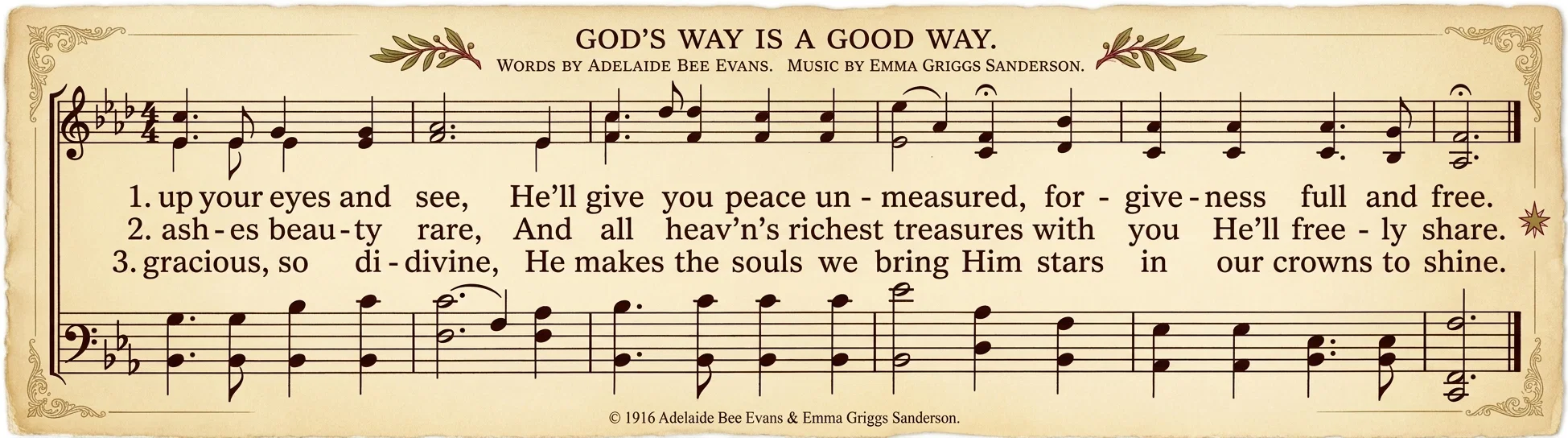
GOD'S WAY IS A GOOD WAY.

ADELAIDE BEE EVANS.      EMMA GRIGGS SANDERSON.
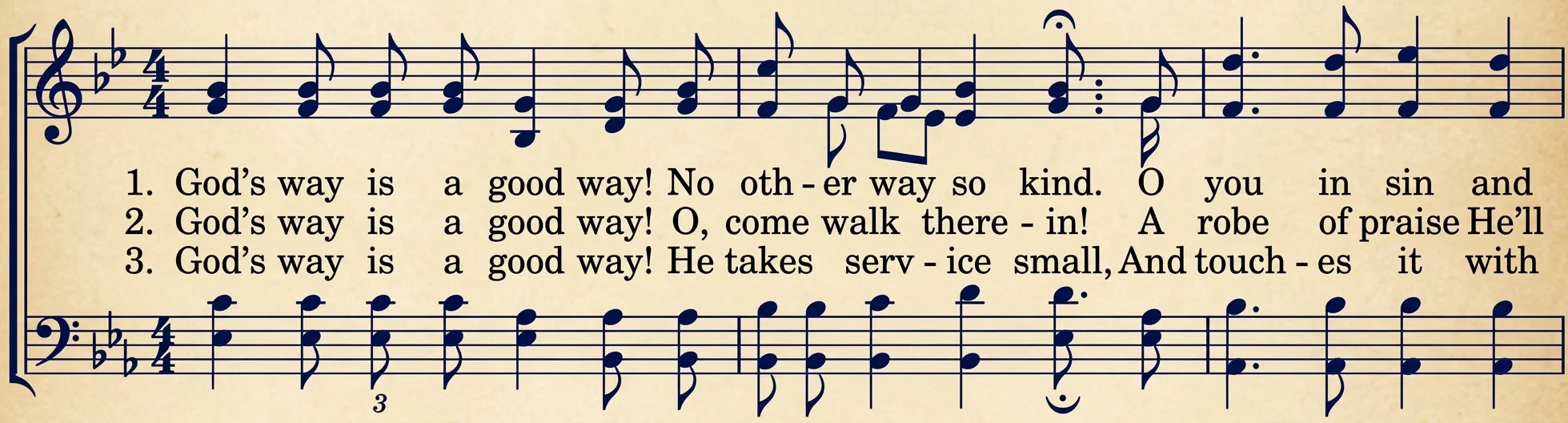
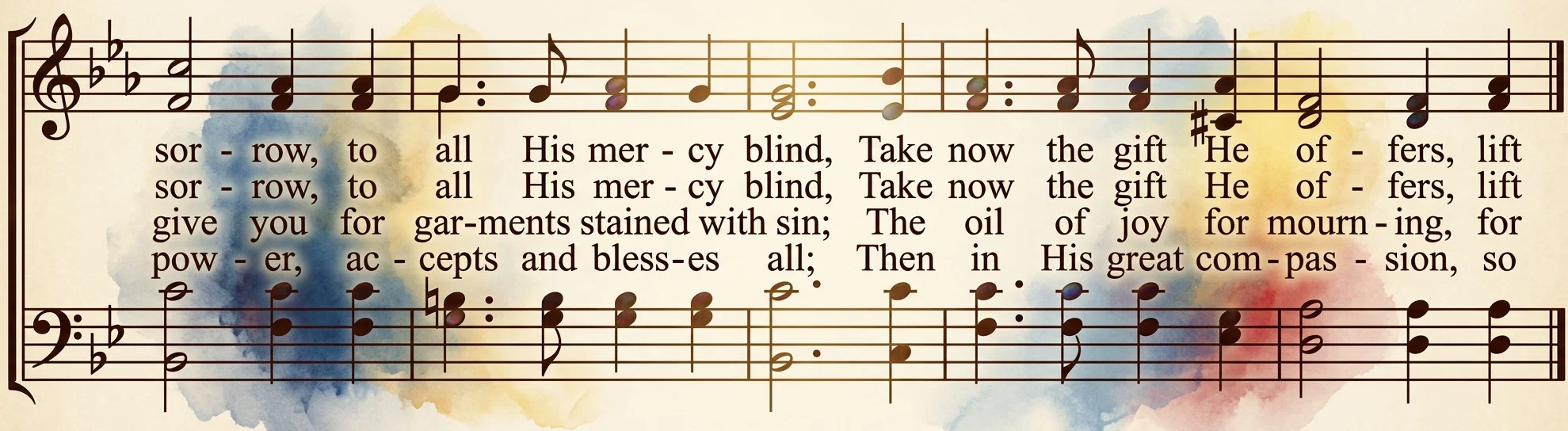
1. God's way is a good way! No other way so kind. O you in sin and sorrow, to all His mercy blind, Take now the gift He offers, lift up your eyes and see. He'll give you peace unmeasured, forgiveness full and free.
2. God's way is a good way! O, come and walk therein! A robe of praise He'll give you for garments stained with sin; The oil of joy for mourning, for ashes beauty rare, And all heav'n's richest treasures with you He'll freely share.
3. God's way is a good way! He takes our service small, And touches it with power, accepts and blesses all; Then in His great compassion, so gracious, so divine, He makes the souls we bring Him stars in our crowns to shine.

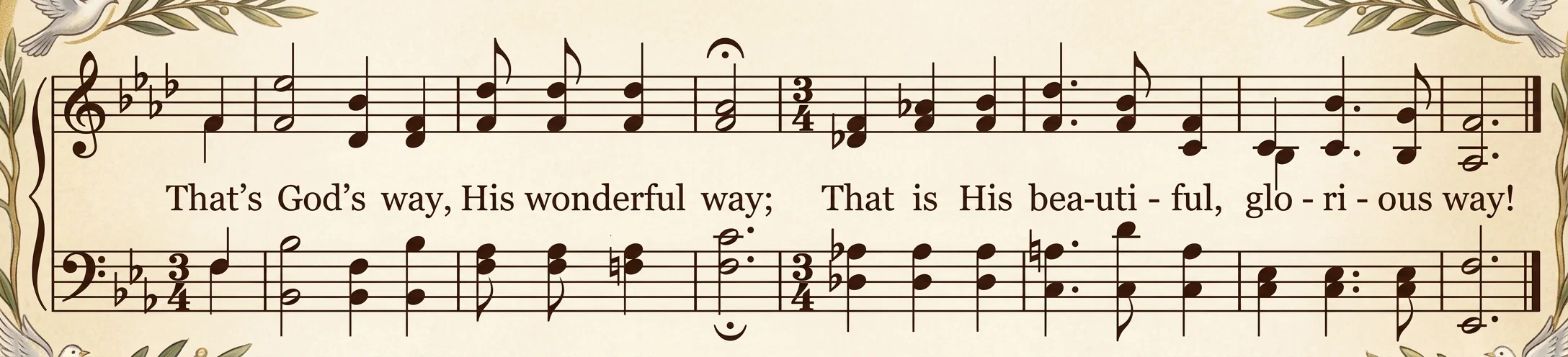
CHORUS.

That's God's way, His wonderful way; That is His beautiful, glorious way!
Copyright, 1916, by Adelaide Bee Evans and Emma Griggs Sanderson.

The Conversion of Peter

ELIZA H. MORTON.
A rabble crew around a fire, and then, A challenge sharp and clear, and then, alas! Alas for Peter! for he turned his back Upon his Lord, and uttered wicked words. O shame! Three times he thus denied his faith. Three times he cursed and swore. O shame! O shame! And then he turned and met an answering look Of love and sad reproach that pierced his heart.
He stumbled forth into the night, but ah, No rest for him! He sought the garden dark, And there he wept and prayed, and then his way Was straight to Calvary. Behind a rock He watched the jeering crowd, and watched the face That haunted all his hours,—the face of Him He loved. He saw the cruelty of men, And felt the nails that crushed through flesh and bone, And in his side he felt the spear they thrust Into his Lord. The horror made his blood Run cold, and yet he dared not cry aloud. He trembled with the trembling earth, and saw The sun refuse to shine. O day of gloom! He saw the pallid body of his Lord Borne from the cross, away, away. He wished That he could gently touch those nail- pierced hands, And help in those last acts of tender love, But he was left alone.
O whither now? His hope was gone, his honor dead. Not one Of those with whom he long had walked, he knew, Would care to grasp his traitor hand. Ah, no! No place for him, and so he staggered forth Into the night; and oh, how long that night! Gehenna, with its lurid flames, was near, And in his soul he felt the awful woe, The tortures of the lost, destroyed at last.
But hark! What sound was that? A figure dark, Fleeing as for life. A swinging rope! An awful crash! And then a stillness strange As death, for Judas lay upon the rocks,— A traitor, dead, and gruesome in his death.
And Peter turned and fled, and sought the room, The upper room, where oft with Jesus he Had met. With trembling limbs before the door He stood, and lo, it opened wide. “Come in! Come in! We need you, Peter, here,” were words That fell like music on his ear, and he Went gladly in, confessing all his sin. “O could I tell him of my love,” he sobbed, “But that can never be.” Compassion filled The hearts of all; for well they knew they, too, Had sinned. The day wore on, that Sab- bath day, A day to be remembered long; also the night; And early ere the sun appeared they rose.
But hark! Another sound of rushing feet; And Mary Magdalene appeared and told Them of an empty tomb, and they went forth; But Peter lagged behind, for in his soul He felt untrue, and cowardly as well. And John, beholding both the napkin and The shroud, each in its place, believed; But Peter wondered in his heart and felt Afraid.
Back to Jerusalem they went, Back to their room. Again the door was swung, And Mary Magdalene appeared with face Aglow. “He is alive! he is alive! I’ve seen him with these eyes! He called my name! And he has sent a message to you all, And, Peter, one for you.” “For me? For me?— No, no, it cannot be.” “Yes, Peter, one For you. He said, ‘Tell Peter.’”
Then adown The stairs again went Peter with a bound, Oft stumbling, for the tears fell fast, and he Was hastening to his Lord. He sought the trees, The olive trees, within the garden where He slept. O would he ever sleep again? Upon the grass he threw himself with sobs, Where Jesus sweat the drops of blood. He clutched The ground, and felt a hand within his own, And heard the old familiar voice in tones Of tender love, and then he knew his sins Were washed away. O blessed hour! O hour Of sweet communion with his Lord! He rose To life anew. All nature echoed but the voice, That voice, the one dear voice in all the world To him,—the voice of Jesus, precious voice!
The years rolled on, and Peter stood, a rock Upon the shore of life, a beacon light To many a soul in sin. And when at length He followed on, e’en to the cross, the hand Was still in his. And he awaits the hour When he shall hear the word “Arise,” and he Will rise to meet his Lord with all the saints In all the ages of the past. Amen!
Portland, Maine.

Freedom’s Song

N. W. VINCENT
OUR Saviour, ’tis to thee, Who died to make us free, To thee we sing. We seek thy love-lit face, O boundless is thy grace, Just, equal all thy ways, Our Life, our King!
Omnipotent thy hand— Rule thou in ev’ry land; Thee we adore. Uplift the sad and poor; When tried, help us endure; Make our salvation sure Forevermore.
Supreme on land and sea, Our Prince and glory be, Our joy and song. In tempest and in calm, Our shield from sin and harm; Beneath us be thine arm, So kind and strong.
Thy gospel we receive, Thy promises believe. Thy Word is true. With thee in sweet accord, We shed thy light abroad, Come soon with thy reward, Our home make new.
Caney, Kans.

Words That Sorrow Cannot Make Right

“How many go forth in the morning That never come home at night; And hearts have broken of harsh words spoken, That sorrow can never make right.”

Two Discarded Practices

MANY aged pilgrims whose hearts still burn with the fervor and enthusiasm of old-time religious devotion, deplore the passing from religious assemblies of the amen corner and of the family pew. With their sorrow we keenly sympathize. We do not feel that the old-time amen corner as such was a necessary accompaniment of church service, but its passing betokens a change in the religious ardor of church worshipers. The regard for present-day proprieties, the fear that they will be thought eccentric, leads many of the children of God to suppress utterances of praise and appreciation which are really born of the Spirit. The result is that many services are attended by a spirit of formality and coldness quite foreign to the atmosphere of Christian liberty and brotherly love.
We should avoid in our services the spectacular and the sensational. It is not necessary by noisy demonstrations to give utterance to religious ardor or enthusiasm, but we believe that every child of God should feel free to express the word of praise, or a hearty amen, during the church service, whenever such expression is appropriate. Failing in this utterance, it is possible for us to quench the promptings of the Spirit.
Similarly the discarded family pew indicates the changed conditions of family and religious life at the present time. We find that for the most part families represented in our church membership occupy no regular place in the church house. Too often the family is broken up, the father and mother seated by themselves, while the children, left without proper supervision, occupy seats in the rear or in the gallery, with their young companions. Under these conditions children receive very little good from the church service, and too often spend the time whispering and laughing, giving annoyance to those who desire to engage in worship. We feel that there is great remissness on the part of some parents in the Seventh-day Adventist Church with reference to this matter. Parents should know what their children are doing during the church service. They should know whether they are giving respectful attention to the word spoken, or whether they are spending their time in a way to annoy the real worshipers.
We believe that just as far as possible and as the seating arrangement of the church will permit, families should sit together, and particularly should boys and girls sit with one or both of their parents. Much advantage would come to some of our churches by the proper consideration of this question on the part of the church officers with the fathers and mothers.

The Cheapness of Human Life

IT has been occasion for frequent remark during the last year that there has been of late a great lessening of moral responsibility, a deadening of the consciousness of sin. This has been attributed to the terrible casualties which have been witnessed by land and by sea during the last two years. We read in the newspapers of the unprecedented slaughter which has occurred on the great battle fronts. Reports of the conflict tell of whole companies’ being decimated by artillery fire; of thousands of corpses strewing the hillside; of thousands of wounded men left on the field of carnage where they fell, unattended and exposed to rain and snow till death mercifully brings an end to their suffering.
Nor does the picture of suffering end with the burial of the dead on the field of battle. Every nation has a rapidly increasing army of maimed and crippled, who, during the remainder of their lives, will keep fresh in the minds of men the horrors of this awful conflict. Regarding this the Boston Post says:—
The editor of the Christian Advocate speaks of the present world suffering, in the following striking language:—
“It is with this ever-increasing population of cripples, of the maimed and helpless, that the warring nations have to deal. The field of industry there has lost hundreds of thousands of its competent workers; some of them return blind, some with loss of the hands trained to delicate mechanical operations, some without legs upon which to stand at the work table. What is to be the future of these men? Already the appeal goes out for world benevolence in aid of their support.”
“War has filled the world today with the voice of bitter lamentation. Happiness has fled from a million homes. Widows, with tear-furrowed faces, stagger under double burdens. Little children, not knowing what it all means, reach out their arms for fathers who will never return. Hearts that were cheerful are now heavy with the somber pall of unassuaged grief.
“The frightfulness of it! Hatred has supplanted brotherly love. Bitterness has thrust out kindness. Vengeance has put a black blot upon sympathy. Cruelty has slaughtered gentleness. Suffering, anguish, and woe are the unmerited lot of millions of innocent men, women, and children. Verily we have come to ‘a day of wrath, a day of trouble and distress, a day of wasteness and desolation, a day of darkness and gloominess, a day of clouds and thick darkness.’”
These and similar terrible scenes which men experience or read about have had their effect, no doubt, in leading to a cheaper estimate of the value of human life. When the rulers and political bureaucracies of the nations sacrifice without hesitation thousands of men in order to gain some slight or temporary advantage over the foe, is it to be wondered at that in the private walks of life men hold the lives of their fellows as of little consequence?
But the rapid increase of crime in countries politically at peace shows that there is a deeper underlying spirit at work paralyzing the moral consciousness of mankind. More than eight thousand murders were committed in the United States during 1915. The low estimate placed upon human life by some of the thugs of society is a startling commentary upon our present-day civilization. Recently a woman in the Middle West who desired to secure revenge upon an offending neighbor, hired an assassin for the sum of five dollars to waylay him and accomplish his destruction. The Washington Post of March 8 tells of an indictment for murder which has just been returned against a gang of men in New York who were employed by a shirt makers’ union to ‘beat up and kill strike breakers.’ One of the quartet admitted that he had agreed ‘to shoot any one desired for one dollar.’
That there exist in many large cities organizations for the purpose of aiding and abetting crime, and of furnishing men to commit crime for others, has long been recognized. The extent to which this system has been perfected is indeedsignificant, and shows something of the great undercurrents which exist in the world at the present time. Two years ago, in 1914, The Macmillan Company, of New York, issued a book, “Violence and the Labor Movement,” by Mr. Robert Hunter. This author is responsible for the following statement of the workings of this criminal system. We quote his remarks from the Literary Digest of April 5, 1914:—
“You have only to call on the telephone any one of hundreds of ‘detective’ agencies to obtain an assassin of the very choicest brand. You should not, of course, ask for a thief or a pickpocket or a murderer. You should ask for an operator or a special officer or a private detective. But, no matter what you ask for, you will get a man carefully selected for his skill in criminal work. You will obtain a man who can shoot straight, an agent who needs no troublesome explanations or detailed instructions. He will be an understanding person, who will comprehend very easily and quickly the nature of the work to be done. Trained in the ways of the underworld, the ‘detective’ will undertake to see that the patron is successful in whatever mischief he wants done. He will steal the correspondence of a business rival, bribe his clerks, burn his factories, or incite a strike among his employees. He will dynamite his works, slug him or any one else, and, in case court work is necessary, he will obtain enough perjured evidence to accomplish almost any purpose whatever. There is, in fact, hardly any conceivable crime that the mercenaries supplied by the American mafia are not capable of committing. And, most important of all, no matter what the agents do, it is understood that they will be fully cared for by the mafia, and protected all along the line by its able attorneys. This American mafia has its agents in every city and town in the country.”
The report of the United Press as published in the Post of March 9, tells of the precautions which have been taken by the millionaires of New York to protect their own lives and the lives of their wives and children against assassins and bomb throwers. It is claimed that some of the leading capitalists of that city are paying out thousands of dollars for detective services in safeguarding their property and the lives of their families. Surely these are evil days into which we are coming,—times, as expressed by the prophet, when men’s “feet run to evil, and they make haste to shed innocent blood: their thoughts are thoughts of iniquity; wasting and destruction are in their paths.”
When for a small pittance a hired assassin can be secured to take the life of his fellow men, where shall safety be sought? With the spirit now taking possession of the hearts of men, it cannot be found even under the most stable government. In the times before us, as iniquity shall increase, our only refuge will be found in God. He alone will prove a shield, our rock of defense, our strong tower into which we may run and be safe.
The Lord declares that his angels are “ministering spirits, sent forth to do service for the sake of them that shall inherit salvation;” and the divine promise is, “The angel of the Lord encampeth round about them that fear him, and delivereth them.” In these days of peril,—peril by disease, peril by accident, peril by the sword, peril from evil men, peril from the elements,—our only refuge is in God. We are not safe a single moment, sleeping or waking, outside of his protecting care. How close we need to keep to him! How free we need to keep ourselves from the contamination of sin, that we may claim the protection of his Holy Spirit! In that protection we may trust and not be afraid. In that blessed companionship we may walk through danger and darkness with confidence and abiding joy. F. M. W.

I am Going to Quit

FREQUENTLY I hear people say they are going to quit this or that wrong habit. But it is not enough to be continually going to quit. The thing to do is to quit. So long as a man is just going to stop sinning, he hasn’t stopped. The thing to do is to stop.
Here is a man addicted to strong drink. He feels his need of deliverance from this terrible appetite, and he says, “I am going to quit.” But he goes on drinking. So long as he is only going to quit, he has not stopped, and he will keep on getting drunk. Going to quit is not sufficient. What this old toper needs to do is to quit; and having quit, stay quit. Then he will be a sober man.
Another man uses profane language. He feels condemned for this wicked habit. He says, “This is not right, and I am going to quit.” But when? Now, or later? So long as he is merely going to stop swearing, he will keep on using the name of God in vain. What he needs to do is to quit. Then he is delivered; and if he stays quit, he will not take the name of God in vain any more.
A brother some time ago was talking with a man who said, “I believe I could be a Christian if I could only quit swearing.” This brother said, “I have been talking with you for two hours, and you have not sworn once. You have quit; all you need to do is to stay quit.” To those who, cost what it will, quit any wrong habit, the Lord promises strength continually, day by day, to conquer the habit and stop committing sin.
Here is a man who uses tobacco. He wishes to be delivered from the filthy, unclean habit. He says, “I am going to quit.” Good! But when? Today? this month? the next? when? We observe that he keeps on smoking; and he will continue to smoke until he reaches the point in his experience where he really quits this dirty habit. When he says, “I quit now,” instead of, “I am going to quit,” then God will give him continual and complete deliverance.
A man can go to perdition and all the time be resolving to quit this or that wrong thing. Going to quit looks toward some time in the future. This will not suffice. The thing to do is to stop now.
Here is a man who is continually criticizing his brethren. He is full of all kinds of envy, jealousy, and evil surmisings. The Spirit convicts him, and he feels that this wicked thing must be gotten rid of. He says, “I know this is a wrong thing, and I am going to quit it.” Very good; but when are you going to quit? Why not quit now? Instead of saying, “I am going to quit,” why not say, “The thing is wrong, and by the grace of God I quit it forever,” then by faith lay hold of the power of God to give you daily and continual victory over the wicked thing?
Take impatience. More people confess defeat on this point apparently than on any other. Some confess this same sin over and over again. At camp meetings or other gatherings, the Spirit convicts them, and we hear them say, “I am going home from this meeting and stop being cross and impatient in my home.” Going home to quit! How long do you plan to be at home before you quit? a week? a month? a year? But why do you wait? Why not quit now? Why not quit before you go home? Stop today, and go home a patient man. There is as much power to conquer your snappy and impatient spirit now as any time; you can have the victory this very hour, as well as when you get home.
The reason we do not gain more victories is because we continually plan to stop at some other time, some other place, or under some other circumstances. This procrastination, putting the matter off, suits the enemy well. He does not care what we are going to do some time in the future; it is deciding to do it now, accepting the promise and claiming a present victory, that he fears. Many expect somehow to gain the victory over every sin sometime before the coming of the Lord. But how? There will be no more power in the future than there is now. If you ever gain the victory, you will have to come to the place where you surrender the will wholly to God and stop the sin. Then why not stop now?
But you say, “I can’t stop.” By faith a man can quit any sin that he wants to quit, and quit when he wants to do so. Cannot God give a man victory over the tobacco habit, over pride, over passion, over impatience, over any sin?—Certainly!But when? Cannot the Lord give us the victory now just as well as next year? We limit God’s power by our unbelief.
The way to have victory is to claim it by faith now; to resolve in the name of God that we are done with that sin which has conquered us again and again. When we say, “Here and now I quit,” that moment we are victors; and moment by moment the Lord is able to give the victory, day after day, week after week, month after month, year after year, till the end of life, or till the coming of the Lord.
Righteousness by faith claims victory over sin now. Victory over sin is not a question of feeling, but of faith. Faith is the victory. When we believe, the victory is ours, a present, living reality.
G. B. T.

Angels: Their Ministry

The one verse of Scripture which, perhaps, most comprehensively sums up the ministry of the angels of God, is this:—
“Are they not all ministering spirits, sent forth to minister for them who shall be heirs of salvation?” Heb. 1:14.
This scripture shows us how truly all heaven is engaged in working for the salvation of this poor world, which has wandered from the fold of God’s universe. It will surely be a time of rejoicing among all the angelic host when Christ, the Good Shepherd, brings back this lost world, cleansed from sin, once more to the fold of God’s perfect creation.
The angels rejoiced when this world was created. The Lord said to Job:—
“Where wast thou when I laid the foundations of the earth? . . . when the morning stars sang together, and all the sons of God shouted for joy?” Job 38: 4, 7.
Before ever this world was created or man upon it, the angels had been created by the eternal Son, in whom all things consist. For angels are not redeemed men, neither do the redeemed in the world to come ever become angels. Angels are a different order of beings from men, of a higher order in creation. The psalmist says:—
“What is man, that thou art mindful of him? and the son of man, that thou visitest him? For thou hast made him a little lower than the angels, and hast crowned him with glory and honor.” Ps. 8: 4, 5.
In the life to come, by the wondrous power of Christ’s transforming grace, redeemed men are to be made equal to the angels, as Christ stated,—
“Neither can they die any more: for they are equal unto the angels; and the children of God, being the children of the resurrection.” Luke 20: 36.
This lifting of sinful man to an equality with the angels, at least in the possession of life and immortality, is an illustration of the gospel principle, “Where sin abounded, grace did much more abound.” Rom. 5: 20. But the declaration of equality with angels is a denial of identity with angels. Angels existed before man, and redeemed man will still be man, distinct from the angelic order, though the associate of angels in the service of God.

Attendants at the Throne of God

When the prophet Isaiah was given a view of the heavenly temple, he saw different orders of angels attending the throne of God:—
“I saw also the Lord sitting upon a throne, high and lifted up, and his train filled the temple. Above it stood the seraphim: each one had six wings; with twain he covered his face, and with twain he covered his feet, and with twain he did fly. And one cried unto another, and said, Holy, holy, holy, is the Lord of hosts.” Isa. 6: 1-3.
Ezekiel beheld them in glory, attending the moving throne of the Almighty. “And the living creatures ran and returned as the appearance of a flash of lightning.” Eze. 1: 14.
Daniel beheld the angelic host gathered in the most holy of the temple above, as the time came for the opening of the work of the investigative judgment, the cleansing of the sanctuary. As the throne of God was set for this final work of Christ’s ministry, the prophet says:—
“Thousand thousands ministered unto him, and ten thousand times ten thousand stood before him: the judgment was set, and the books were opened.” Dan. 7: 10.
Appropriately enough, the angels are associated with the opening of the books of judgment; for they have been the scribes recording the words and deeds and lives of men in the books above.

God’s Messengers

The word “angel” means messenger. To and fro these angelic messengers have gone in the service of their Creator. A view of their ever-watchful service is given in the words of the psalmist:—
“Bless the Lord, ye his angels, that excel in strength, that do his commandments, hearkening unto the voice of his word.” Ps. 103: 20.

Bearers of Tidings.*

They visited Abraham’s tent with warning of Sodom’s overthrow. Genesis 18.
They visited Lot in the city, and urged him to get his family out. Genesis 19.
As Jacob, in fear but repentance, was about to meet Esau, whom he had deceived, “the angels of God met him.” Genesis 32. “This is God’s host,” he said, and he knew that the God of Abraham and Isaac, and his God, also, had not forsaken him.
At a discouraging time in the history of Israel, an angel appeared to Gideon, bringing the message, “The Lord is with thee,” and calling him to the work of delivering his people. Judges 6.
As Daniel’s prayer reached heaven, even while he still prayed, the angel Gabriel, “being caused to fly swiftly,” touched him, and said,—
“O Daniel, I am now come forth to give thee skill and understanding. At the beginning of thy supplications the commandment came forth, and I am come to show thee.” Dan. 9: 21-23.
So close is the communication between heaven and earth.
The gladdest tidings ever brought from heaven to earth since the promise of the Deliverer to Adam in Eden, was brought by angels to the shepherds of Bethlehem. One angel appeared first, saying,—
“I bring you glad tidings of great joy. . . . For unto you is born this day in the city of David a Saviour, which is Christ the Lord.”
Such tidings to earth could never be the mission of one sole angel, when all heaven longed to cry the news to a lost world.
“And suddenly there was with the angel a multitude of the heavenly host praising God, and saying, Glory to God in the highest, and on earth peace, good will toward men.” Luke 2: 13, 14.

Unseen in Halls of Governments.

One incident related in the book of Daniel draws aside the curtain, and shows how angels doubtless often have worked unseen in kingly courts or halls of legislation. Daniel had prayed for three weeks for light in certain matters that the angel Gabriel had begun to unfold to him. When at last the angel came, overpowering the prophet with the glory of his presence, it was nevertheless with a statement of the reason for the delay in responding to his prayer. The angel said:—
“From the first day that thou didst set thine heart to understand, and to chasten thyself before thy God, thy words were heard, and I am come for thy words. But the prince of the kingdom of Persia withstood me one and twenty days: but, lo, Michael, one of the chief princes, came to help me; and I remained there with the kings of Persia. Now I am come to make thee understand what shall befall thy people in the latter days.” Dan. 10: 12-14.

Messengers of Deliverance.

The story of deliverance wrought by angels is too long to tell. One need only think of the angels taking slow-moving Lot by the arms and setting him out of Sodom (Genesis 19); of the angel finding Elijah under a bush in the desert, and first baking a cake for the hungry man before speaking the word to his discouraged heart (1 Kings 19); of Elisha praying that the young man’s eyesmight be opened to see that there were more angels with them round about than all the Syrians encamped against them:
“And the Lord opened the eyes of the young man; and he saw: and, behold, the mountain was full of horses and chariots of fire round about Elisha.” 2 Kings 6: 17.
Angels shut the mouths of the lions when Daniel was cast into their den. Daniel 6. An angel smote off Peter’s irons in the prison at Jerusalem, opened the doors, and led him forth. Acts 12. Amid the dashing spray sweeping over the foundering ship in the Adriatic, Paul the apostle bade the despairing crew be of good courage, “for there stood by me this night the angel of God, whose I am, and whom I serve, saying, Fear not.” Acts 27: 23, 24.
All through the ages, the angels of God have been standing by. Daniel, and Peter, and Paul are dead; but the angels still live. “They are all ministering spirits, sent forth to minister for them who shall be heirs of salvation.” Heb. 1: 14.

Guardian Angels

That means that every child of God is under the guardianship of the angels. “The angel” of the Lord encampeth round about them that fear him, and delivereth them.” Ps. 34: 7.
Thank God, we are never left alone. Every child of God has a guardian angel commissioned by the loving Father to watch over him. Christ said:—
“Take heed that ye despise not one of these little ones; for I say unto you, That in heaven their angels do always behold the face of my Father which is in heaven.” Matt. 18: 10.
This does not mean that trials never will come, or troubles. In the midst of the trial, the angel of the Lord will stand by to strengthen and to bring help from the God of all comfort. It was in the midst of the fiery furnace that the “form of the Fourth” appeared, walking with the three Hebrew children—Jesus himself treading the fiery way with them. And when Jesus, in the days of his flesh, was sinking under the crushing burden in Gethsemane, “there appeared an angel unto him from heaven, strengthening him.”
Our Saviour, who knows the comforting power of angel ministry, is the Captain of the heavenly host, and has commissioned them all as ministering spirits to the heirs of salvation.
When he comes in glory for his people, he will have “all the holy angels with him.” As the voice of Jesus awakens his sleeping saints and they rise immortal from the opened graves,—
“he shall send his angels, . . . and they shall gather together his elect from the four winds, from one end of heaven to the other.” Matt. 24: 31.
The angels who have watched over the heirs of salvation through all the ages, know where they are, and they know how to gather them, with their loved ones, to meet the Lord.
The angels who rejoiced when the Lord laid the foundations of the earth, who mourned when man fell, who have all along been working with Christ, their leader, to rescue the lost, will yet rejoice when the Lord brings home his own. What a day will that be in heaven!
W. A. S.
Continue reading: Signs on the Earth