Your ShelfYour Projects

Signs of the Times, Vol. 28, No. 27.

OUR TALENTS

Signs of the Times

Jul 2, 1902

Pacific Press Publishing Company · Oakland, California · Jul 2, 1902

OUR TALENTS.

Christ’s followers have been redeemed for service. Our Lord teaches that the true object of life is ministry. Christ Himself was a worker, and to all His followers He gives the law of service,—service to God and to their fellow-men. Here Christ has presented to the world a higher conception of life than they had ever known. By living to minister for others, man is brought into connection with Christ. The law of service becomes the connecting link that binds us to God and to our fellow-men.
To His servants, Christ commits “His goods,”—something to be put to use for Him. He gives to every man His work, each has his place in the eternal plan of heaven. Each is to work in co-operation with Christ for the salvation of souls. Not more surely is the place prepared for us in the heavenly mansions than is the special place designated on earth where we are to work for God.
To every man God has given talents, “according to his several ability.” The talents are not apportioned capriciously. He who has ability to use five talents receives five. He who can improve but two, receives two. He who can wisely use only one, receives one. None need lament that they have not received larger gifts; for He who has apportioned to every man is equally honored by the improvement of each trust, whether it be great or small. The one to whom five talents have been committed is to render the improvement of five;he who has but one, the improvement of one. God expects returns “according to that a man hath, and not according to that he hath not.”

The Power of Speech

is a talent that should be diligently cultivated. Of all the gifts we have received from God, none is capable of being a greater blessing than this. With the voice we convince and persuade; with it we offer praise and prayer to God; and with it we tell others of the Redeemer’s love. Not one word is to be spoken unadvisedly. No evil-speaking, no frivolous talk, no fretful repining or impure suggestions, will escape the lips of him who is following Christ. The apostle Paul, writing by the Holy Spirit, says, “Let no corrupt communication proceed out of your mouth.” A corrupt communication does not mean only words that are vile. It means any expression contrary to holy principles and pure and undefiled religion. It includes impure hints and covert suggestions of evil. Unless instantly resisted, these lead to great sin.
Upon every family, upon every individual Christian, is laid the duty of barring the way against corrupt speech. When in the company of those who indulge in foolish talk, it is our duty to change the subject of conversation if possible. By the help of the grace of God, we should try to drop words or introduce a subject that will turn the conversation into a profitable channel.
Our words should be words of praise and thanksgiving. If the mind and heart are full of the love of God, this will be revealed in the conversation. It will not be a difficult matter to impart that which enters into our spiritual life. Great thoughts, noble aspirations, clear perceptions of truth, unselfish purposes, yearnings for piety and holiness, will bear fruit in words that reveal the character of the heart-treasure. When Christ is thus revealed in our speech, it will have a power in winning souls to Him.

We Should Speak of Christ

to those who know Him not. We should do as Christ did. Wherever He was, in the synagogue, by the wayside, in the boat thrust out a little from the land, at the Pharisee’s feast or the table of the publican, He spoke to men of the things pertaining to the higher life. The things of nature, the events of daily life, were bound up by Him with the words of truth. The hearts of His hearers were drawn to Him; for He had healed their sick, had comforted their sorrowing ones, and had taken their children in His arms and blessed them. When He opened His lips to speak, their attention was riveted upon Him, and every word was to some soul a savor of life unto life.
So it should be with us. Wherever we are, we should watch for opportunities to speak to others of the Saviour. If we follow Christ’s example in doing good, hearts will open to us as they did to Him. Not abruptly, but with tact born of divine love, we can tell them of Him who is the “chiefest among ten thousand” and the One “altogether lovely.” This is the very highest work in which we can employ the talent of speech. It was given us that we might present Christ as the sin-pardoning Saviour.

Influence Is a Talent.

Through Christ, God has invested man with an influence that makes it impossible for him to live to himself. Individually we are connected with our fellow-men, a part of God’s great whole, and we stand under mutual obligations. No man can be independent of his fellow-men; for the well-being of each affects others. It is God’s purpose that each shall feel himself necessary to others’ welfare, and seek to promote their happiness.
Every soul is surrounded with an atmosphere of its own,—an atmosphere, it may be, charged with the life-giving power of faith, courage, and hope, and sweet with the fragrance of love. Or it may be heavy and chill with the gloom of discontent and selfishness, or poisonous with the deadly taint of cherished sin.
By the atmosphere surrounding us, every person with whom we come in contact is consciously or unconsciously affected. This is a responsibility from which we can not free ourselves. Our words, our acts, our dress, our deportment, even the expression of the countenance has an influence that no man can measure. Every impulse thus imparted is a seed sown that will produce its harvest. It is a link in the long chain of human events, extending we know not whither. If by our example we aid others in the development of good principles, we give them power to do good; in their turn they exert the same influence upon others, and they upon still others. Thus by our unconscious influence thousands may be blessed.
Throw a pebble into the lake, and a wave is formed, then another, and another; and as they increase, the circle widens until it reaches the very shore. So with our influence. Beyond our knowledge or control, it tells upon others in blessing or in cursing.

Our Time Belongs to God.

Every moment is His, and we are under the most solemn obligation to improve it to His glory. Of no talent He has given will He require a more strict account than of our time.
Every moment is freighted with eternal consequences. We are to stand as minute-men, ready for service at a moment’s notice. The opportunity that is now ours to speak to some needy soul the word of life may never offer again. God may say to that one, “This night thy soul shall be required of thee,” and through our neglect he may not be ready. In the great judgment-day, how shall we render our account to God?
Christ regarded every moment as precious, and thus we should regard it. Life is too short to be trifled away. We have but a few days of probation in which to prepare for eternity. We have no time to waste, no time to devote to selfish pleasure, no time for the indulgence of sin. It is now that we are to form characters for the future, immortal life. It is now that we are to prepare for the searching judgment.

Talents Used Are Talents Multiplied.

Success is not the result of chance or of destiny; it is the outworking of God’s own providence, the reward of faith and discretion, of virtue and persevering effort. The Lord desires us to use every gift we have; and if we do this, we shall have greater gifts to use. He does not supernaturally endow us with the qualifications we lack; but while we use that which we have, He will work with us to increase and strengthen every faculty. By every whole-hearted, earnest sacrifice for the Master’s service our power will increase. While we yield ourselves as instruments for the Holy Spirit’s working, the grace of God works in us to deny old inclinations, to overcome powerful propensities, and to form new habits. As we cherish and obey the promptings of the Spirit, our hearts are enlarged to receive more and more of His power, and to do more and better work. Dormant energies are roused, and palsied faculties receive new life.
The man who received the one talent “went and digged in the earth, and hid his lord’s money.” Just what he did, many to-day are doing. But let them not think that when Christ comes to reckon with His servants, He will be satisfied with the return of that only which was given. He will call for His own “with usury.” The Lord expects every one to increase His gifts. Every provision has been made for us to do this. He who does not improve his talents is regarded by the Lord as a slothful, untrustworthy servant, unworthy of admittance into the heavenly courts.
The denunciations of God are not confined to the most revolting sins. In the day of judgment special reference will be made to the neglect of doing what might have been done, but was not done because of a lack of the qualification Christ died to place within the reach of every one.
Take the case of one who claims to know Christ, but who allows self-seeking to hold the largest place in his life. Busied with the things of self, he forgets God. He fails of improving his talents, and thus disqualifies himself for the sphere of usefulness he might have filled. Through his unfaithfulness, souls are lost. He has disappointed his Master. Upon him must fall the penalty of failing to fulfil God’s purpose. God holds him responsible for the evil resulting from his neglect, for the souls he might have saved had he been faithful to his trust. Every hour spent in careless inaction, in indifference to God’s claims, is an hour lost forever. Every opportunity for service allowed to pass unimproved means an eternal loss. MRS. E. G. WHITE.

“LIKE THE PALM TREE.”

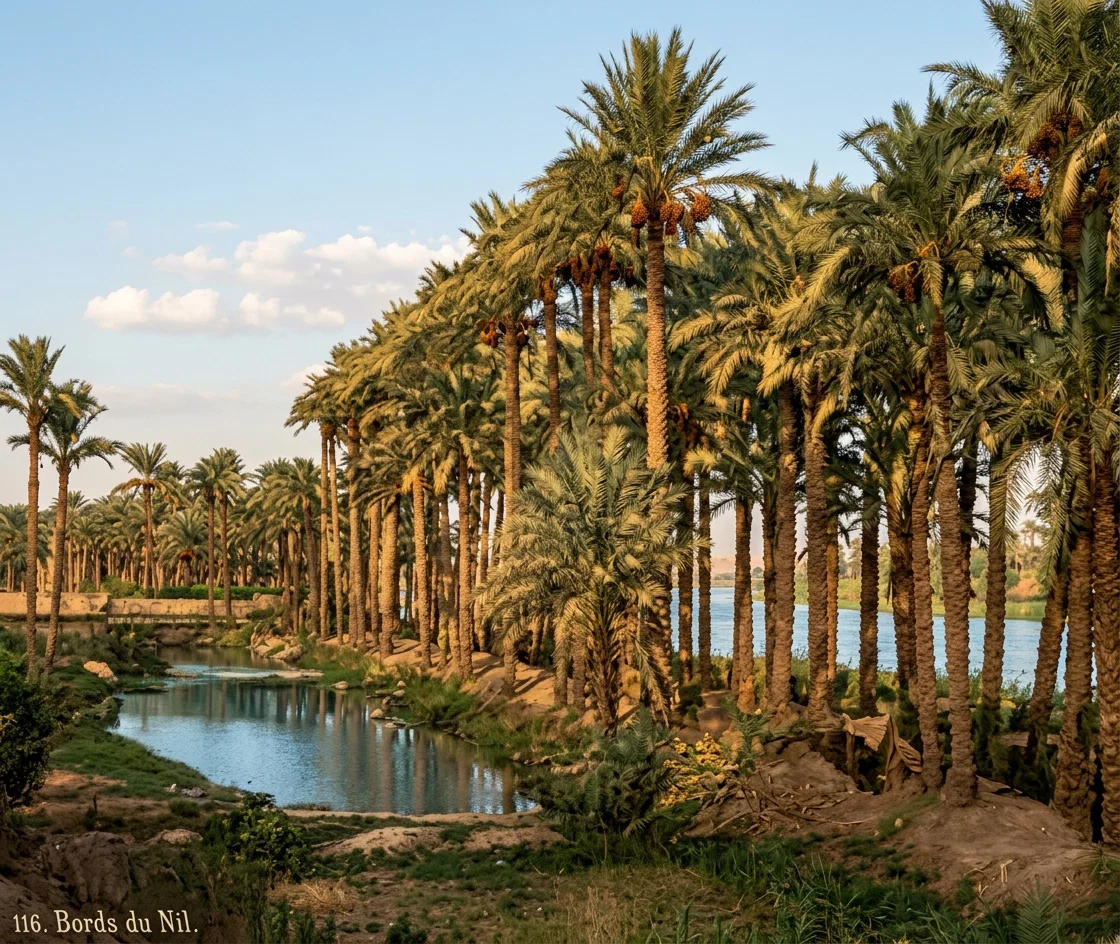
It is said of the righteous that they “shall flourish like the palm tree.” There are many species of palm, of which the stately date palm of Palestine is one. The Holy Land once abounded in these trees. In all parts they grew luxuriantly and fruitful.
Palm Trees on the Banks of the Nile.
“LIKE the palm tree” means much. It flourishes in Egypt on the banks of the Nile, as in our illustration, of course. But it flourishes on higher lands. Its roots reach down and draw from unseen living fountains, and branch and fruit bear witness in a crown of glory at the very top of the tree, nearest heaven. In the desert oasis, where the burning sands are thrown about its trunk, and the fierce sun beats upon its unsheltered crown, the palm tree flourishes. So with the righteous. He drinks from the unseen fountain. And it is not by the river side nor by the pool border that the power of the righteous is manifest. It is not here that he is tested. It is when the fierce heat of relentless temptation and hate and persecution rain their burning torrent upon his shelterless head, when the biting, torrid blasts of the world’s drear desert pile the drifts of scorching sand about his everyday pathway, that the strength of the righteous is revealed. But it is there revealed. The secret of his growth is in God.
“LIKE the palm tree” in fruitfulness is the righteous. Every part of the tree is used. After it begins to bear fruit, it is productive for a hundred years. Even the abortive fruit, that which does not mature, and the date stones ground, are used by the Arabs to feed their camels. From the leaves of the palm are made baskets, bags, brushes, fly-traps, mats, and couches. The trunk furnishes material for cages for poultry, fences for gardens, and fuel for warmth and cooking. Thread is procured from the fibrous webs at the bases of the leaves, and this thread is made into cordage and ropes and rigging for ships. The head of the palm is cut off, the trunk is scooped out, and from the wounded trunk exudes a liquor which is fermented and used for drinking purposes. The delicious fruit—dates—is rich in sugar and nutriment. Date wine and honey are also products of this wonderful tree. The weary caravan of man and beast rest under its shade. So the righteous man is altogether fruitful. Here is enjoined his duty: “Thou shalt love the Lord thy God with all thy heart, and with all thy soul, and with all thy strength, and with all thy mind.” This takes in the whole man. Every purpose of life, every affection and motive, is to be exercised to God’s glory and the good of his neighbor, whom he is to love equally with himself. No part of the Christian is to run to waste. He is not to serve God on one day of the week, but every day; not only in matters that pertain to church or philanthropic matters, but in all his business relations. Like the palm tree he is to be every part useful. It is not only a holy duty, but a gracious privilege.
Thus like the palm tree he is to flourish. Like the palm tree he is ever to be a blessing. It was a blessing to Israel when they came to Elim where were “threescore and ten palm trees.” Num. 33:9. Jericho in its greatness was called the city of palm trees; but when Christ was rejected, the city came to ruin, and as fit symbol of its desolation, every palm tree is gone. The glorified saints are represented as having palms in their hands. The tree was used as a token of victory and peace. “Bethany” meant the “house of dates;” and the abundance of palms was indicated at Christ’s victory of peace and blessing when His way was strewn with palm branches on His entrance to Jerusalem. The palm was used as an ornament on the temple, indicative of the fruitfulness of the children of God, who compose the true temple.
“LIKE the palm tree” is to be “trees of righteousness, the planting of the Lord, that He might be glorified.” Isa. 61:3. So, reader, God would have you to be. The root is of Him. He will graft you into it, that you may partake of its life and fatness. Thus rooting downward in the life-fountains of God, you may bear fruit to the blessing of man and beast and to the glory of God unto everlasting life. “Herein,” says Jesus, “is My Father glorified that ye bear much fruit; so shall ye be My disciples.”

A Day in Heaven

“ONE day in heaven, with its flood of glory and peace, will pay for all of life's little troubles here below.”

LOVE

WE may talk about love; but we can not define it, for in depth and breadth it is as high and as far-reaching as God. For God is love; and we must have the same heart of love within ourselves.
Love is a beautiful adornment. The heathen adorn themselves with gold, and rare stones, and with costly raiment. After all this display, they are no more beautiful in God's eyes than they were before. But he who permits the love of God to fill his heart is a person of rare beauty. God is pleased with such persons, and we feel attracted to them, as we do to the beautiful flowers. The perfume of the flowers is very sweet, and so is the fragrance of love.
When a person whose heart is love-filled speaks with you, his words are like music to the ear. There is in them no malice, no hatred, no evil-surmising, no evil-speaking, no backbiting. These are of another spirit, and can not abide with love. Love is a peace-maker.
Have you ever met love in a sick-room? How welcome it was. Have you met love on a wash-day? Was it not beautiful? And when you met love in the nursery, how it made your heart rejoice.
But when love met a fault in a brother, did it go about telling it, first to one and then to another, thus blazing it abroad?—No, that was not love. Love ever seeks to cover a fault in a brother, just as we would endeavor to cover some very disagreeable fault in ourselves. O, then, let us cultivate the love of God in our hearts, that, when it shall blossom, and bring forth its ripened fruit, like the beautiful flowers it will diffuse its sweet fragrance everywhere.
F. FLOOD.
Alameda, Cal.

Recognizing God’s Presence

“God does not leave a man; He stays right by him, but the man does not always recognize His presence.”

The Coming of the Lord

BY L.A. PHIPPENY

GOD'S ORIGINAL DESIGN FOR THE EARTH.

The proper understanding of the real purpose of the literal coming of the Lord demands a few thoughts concerning God's purposes for our earth, and the origin and presence of sin and its relation to human affairs.
The presence of evil with the good in the world, and the apparent preponderance of the former, is not clearly understood by the majority of mankind at the present day. Probably no person having arrived at years of understanding has failed to reflect upon this great problem and to seek for an answer. But unfortunately the true answer is not widely accepted, because it is to be found only within the pages of a Book which the world with its worldly wisdom is disposed to relegate to the realms of fable and tradition. Erroneous theories and false philosophies have long been in the world, and in some form the doctrines of evolution prevail well-nigh universally.
Certainly it is a relief to the believer in the Word of God to turn from theories that must be unsatisfactory to him to the word of One who has made true His promises to give peace to the burdened souls, and will demonstrate His word in the life of every man who will let Him. A few statements from the Scriptures will serve as a key to unlock what may be mysteries to many:—
“For thus saith the Lord that created the heavens; God Himself that formed the earth and made it; He hath established it, He created it not in vain, He formed it to be inhabited.” Isa. 45:18. “The heaven, even the heavens, are the Lord's; but the earth hath He given to the children of men.” Ps. 115:16. “Lo, this only have I found, that God hath made man upright; but they have sought out many inventions.” Eccl. 7:29. “By one man sin entered into the world, and death by sin; and so death passed upon all men, for that all have sinned.” Rom. 5:12. “And I saw a new heaven and a new earth; for the first heaven and the first earth were passed away. . . . And there shall be no more death, neither sorrow, nor crying, neither shall there be any more pain; for the former things are passed away. . . . Behold, I make all things new.” Rev. 21:1, 4, 5.
What a panorama is here suggested! A world established in righteousness; marred by sin; re-established in righteousness! It is sometimes urged by would-be doubters of the Bible that the presence of sin in the world is evidence of fallacies in its teachings, since they reason that an all-wise God would not permit His purposes to be thwarted. But this assumption is not correct. While sin has seemingly obliged the Creator to modify His operations, and has caused unutterable woe, yet the scriptures just cited reveal the final triumph of righteousness and the ultimate accomplishment of God's plans concerning this earth.
It is difficult for the human mind of the present day, heir to sin and life-long accustomed to the scenes and effects of evil, to picture a world without sin or any of its appurtenances. Take away selfishness, greed, envy, pride, hatred from every heart; in their places put contentment, love, peace, and every good emotion, and what a transformation would be effected in human affairs! What a re-adjustment of industries, trades, and pursuits would inevitably take place! Add to this a life without death, without end of days or approach of decrepitude, and assuredly the ideal age would dawn in all its splendor.
Well, the Scriptures clearly reveal that the earth came without sin from the hand of God, and that the altogether worthy design was that it should continue without sin, without death, without the entrance of evil in any form. It was to have been populated by a sinless race, unmarred by disease, undefiled by the remotest germ of lust,—a race ever rejuvenated by the virtues of a tree of life, a race whose powers of intellect were to develop toward perfection through endless ages. Untold possibilities, little conceived of by the world as it has been, were placed before the man and the woman in the earth's bright, glorious morn.

The Origin and Entry of Sin.

Speaking of sin and the one chiefly responsible among men for its presence in the world, the Scripture, as already noted, places the blame upon “one man,” referring to Adam, the father of the human race. The detailed record is known to all. Briefly it is as follows: A test of loyalty, and for the purpose of developing character, was arranged by the Creator for the holy pair placed in Eden. It consisted simply in their refraining from touching or eating the fruit of a certain tree in the midst of the garden, called the Tree of Knowledge of Good and Evil. Eve wandered from Adam's side, and in a truly remarkable manner was induced to eat of the forbidden fruit. Adam, seemingly in despair, partook with her. This act of disobedience was sin, and sin as an element of their character descended as an inheritance to their posterity.
To the scoffer this test seems like a small thing, a vastly too simple matter for the determining of such tremendous consequences as might follow. The thought is child of the same tempter encountered by Eve long ago, and is wholly unwarranted from the circumstances, or any other consideration. It is human pride to sneer at little requirements. To Naaman the Syrian the invitation to dip himself seven times in Jordan for healing from his leprosy appeared so small a thing as to be contemptible in his eyes. But the fact is that God chooses not hard matters for the testing of men, but the little things of every-day life. Character, like great edifices, is built, not all at once, but little by little, from the boards and nails and small stones of life's workshop. And so the Creator chose, not some prodigious matter for the testing of our first parents, but a simple thing in itself, a test adapted to the simplicity of their estate. There is nothing in the record that intimates, even faintly, that Adam and Eve, in the glory and strength of full manhood and womanhood, with vigorous powers of intellect, associated with angelic visitants from heaven and holding face-to-face communion with their Maker, at first regarded the terms of the test other than just, dignified, and appointed in love and solicitude for their welfare.
Thus in brief the record of sin's entry into human affairs through the parents of the race.
But this is only an after-chapter to the real story of sin's origin. The fuller history, the exceedingly interesting, must not be discussed in this series of articles. We must content ourselves with a few brief statements in the form of propositions, which may be amplified and studied from the Scriptures themselves. Without the instrumentality of a third agent, or personality, the record of the fall of Eve, and then of Adam, would not appear complete, in view of their high mental qualification. So we discern in the tempter, under the guise of a serpent, a personality masterful in shrewdness and the art of deception,—an intelligence which, parleyed with, gains the supremacy. As to the identity of the tempter, and a few further facts concerning the origin of sin and its relation to our earth, the following statements may be made without further discussion here:
1. In the divine administration, love is the ruling, binding force. Subjects are “free moral agents.” In such a government or system, sin is a possibility, tho righteousness only be inaugurated.
2. Sin originated in Lucifer, an angel honored next to Christ as the chief of heaven's angelic host. Pride, fault-finding, and an aspiration to remodel the divine government characterized his sinful course. One-third of the angels joined his cause; and when open rebellion ensued, he and his followers were expelled from heaven. Eze. 28:12-17; Isa. 14:12-14; Rev. 12:7-9, etc.
3. Lucifer (now Satan, the adversary) and his followers were permitted to live and demonstrate his claims as best they might, as an object-lesson to the universe of what sin is. This course only could reveal eternal wisdom and justice; and sin, when demonstrated to the ultimate, in contrast with divine love and righteousness, will be forever shunned, by universal consent and choice.
4. Divine justice indicates that Adam and Eve were apprised of the rebellion in heaven, the nature of sin, and the possibility of temptation by a spiritual power. Their loyalty to God was to be the condition of protection from any kind of assault.
5. To the man was given the earth as his dominion. Under God, he was its head, its ruler. The victory of Satan in Eden gained for him a dominion, and human subjects. Ps. 115:16; 8:6; Rom. 6:16. Henceforth he is called the “god of this world,” the “prince of the power of the air,” etc. 2 Cor. 4:4; Eph. 2:2.
6. The presence on this earth of a malignant usurper with his powerful angels demanded the presence of holy angels to protect God's creatures and the whole creation as far as necessary, and to care for the cause of righteousness in the earth. Rev. 12:12; 1 Peter 5:8; Job 1:9, 10; Ps. 55:18; 2 Kings 6:15-17; Heb. 1:13, 14, etc., etc.
7. Thus behind the scenes, as it were, is being waged a mighty conflict. This world is the battle-field, the demonstrating ground of the principles of righteousness and unrighteousness in opposition.
At this point there comes to view, then, a glorious reason for the personal, literal coming of the Lord, that does not appear until the foregoing facts are grasped as realities. One of God's worlds is now largely dominated by a malignant usurper, who is leaving nothing undone that he can do to retain possession. He will fail, and righteousness will triumph, is triumphing, tho not in the exact manner outlined by many. The earth, lost through sin, has been purchased back, re-conquered by its lawful owner, who will take possession in due time. There is a reality, a literalness to thisthat admits of no figurative interpretation, and a peace and blessedness in its anticipation that outrivals the rosiest dreams of any worldly Utopia. And the redemption draws nigh. Further development of features touched upon in the foregoing will follow in due course.
Continue reading: THE SCEPTER DEPARTS FROM JUDAH