I HAVE read the following paragraph many times, and with each reading the question of individual responsibility in connection with our work is emphasized in my mind:—
“When men of business, farmers, merchants, mechanics, lawyers, etc., become members of the church they become servants of Christ; and although their talents may be entirely different, their responsibility to advance the cause of God by personal effort, and with their means, is no less than that which rests upon the minister. The woe which will fall upon the minister if he preach not the gospel, will just as surely fall upon the business man if he, with his different talents, will not be a coworker with Christ in accomplishing the same results.”—“Testimonies for the Church,” Vol. IV, page 469.
The force of this statement may be understood quite fully by the majority of our people, yet the conviction steals in upon us that there are a great many possessing marked ability to conduct a business successfully, and in a way to accumulate a considerable amount of wealth, who seem not to sense that the embracing of this message and uniting with this great movement calls for any change in their plans or policies regarding the use of their talents and the obligations that a connection with this message entails. The business of every man, as well as his business ability, becomes of far greater importance when he connects with this message. If all who are not directly engaged in the ministry or in missionary work were using their talents, their time, and their means as required by the true spirit of this movement, we are warranted in saying, I believe, that the large amount of money now provided by our people for financing the work would be more than doubled.
Words are dropped from time to time that lead some of our people to feel that it is very wrong to be absorbed to any considerable degree in a money-making enterprise. It is wrong to be overcharged with the cares of this world to the detriment of God’s cause and our spiritual interests, but it is equally wrong to be neglectful in the use of God-given ability to produce for the advancement of God’s kingdom in the earth. “The only means which God has ordained to advance his cause is to bless men with property. He has given them the sunshine and the rain; he causes vegetation to flourish; he gives health, and the ability to acquire means.” The burden of finishing the greatest work ever undertaken in heaven or earth calls for the co-operation of human beings in this way. There are thousands who should do business for the Lord more conscientiously and faithfully, with the full use of every talent, than is practised by men in their selfish pursuits.
If our individual responsibilities were fully comprehended and faithfully discharged in all the minor matters of life by all our people in the churches, how vastly different our financial situation would soon be. The missionaries who are in the field would be greatly encouraged and fully provided for, and the many who should be there could soon be sent to the front. If every church would work to the end of bringing about full and universal faithfulness in the honest and faithful use of every talent and every dollar for the advancement of the cause, a wonderful change would be seen in the progress of the work in the vast needy fields.
Holly, Mich.
L. F. STARR
By L. F. STARR
The Lord’s Supper—No. 3
L. F. STARR
UNSPEAKABLY precious to the church are the words, “As often as ye eat this bread, and drink the cup, ye proclaim the Lord’s death till he come.” The communion service points to Christ’s second coming. It is designed to keep fresh the hope of the church in the minds of the followers of Christ. “But I say unto you, I will not drink henceforth of this fruit of the vine, until that day when I drink it new with you in my Father’s kingdom.” These words of promise inspire in the hearts of his believing children hope of his coming again, and of the meeting by and by in the kingdom of God. These words we are never to forget. The love of Christ, with its restraining power, is to be kept continually in our memory. We see by faith the scenes surrounding his shameful death on the cross, and the glories clustering about his second coming, which express the love of God in our behalf. The Lord is present on every occasion when the humble ceremonies are performed. He is the unseen witness. He reads every heart, with its concealed purposes, its wrong-doings, its sins.
Is any sin cherished? Let it be cut away from the soul by confession. The first look, the first act of contrition and repentance that you direct toward Christ, does not escape his notice. Do not think that you can escape your obligations because you have differences with another. We can not lie unto our own souls; we must meet this obligation. Let us examine ourselves. Let us say with David, “Against thee . . . have I sinned.” And let us say, “God be merciful unto me a sinner.” Do not cast away the name that you bear; do not throw off your obligations; do not repudiate your vows. The Bible tells us that the last state of such a man is worse than the first. Come repenting, thoroughly and sincerely, and not again to take up the same sins as soon as the service is over. The ordinances that point to our Lord’s humiliation and suffering are regarded by many as a form. But they were commanded for a purpose. Our eyes need to be anointed with eye-salve that we may see. We are ever in need of his righteousness. We need often to study the mystery of godliness.
Let all behold, in the infinite sacrifice of Christ, a long-suffering Saviour, who holds out every inducement for all to receive him, repent, and be cleansed from the defilement of sin. “Confess your faults one to another, and pray,” is the12faithful admonition of the Word. We must also understand that because we suppose one to be in error and sin, we are not to divorce ourselves from him, and refuse to have any association with him. The example of Christ will not sustain any one in such conclusions. “The heart knoweth his own bitterness.” We little realize what trouble lies buried in the heart of a fellow traveler; neither do others understand the bitterness of our own hearts. If they did, their criticisms would be less severe.
Many souls might be saved by faithful, kindly efforts on the part of their brethren, but a careless separation of brethren leaves the tempted one exposed to the darts of Satan, and drives him upon the devil’s battle-ground to be wounded and torn by the enemy. To leave the careless, tempted one when we might help him is not Christ’s way of doing. He sought to restore, not destroy. Hear his words: “The Son of man is come to seek and to save that which was lost.” We care not what words may have been spoken between brethren, or what feelings may be in the hearts of believers toward each other; the question is for each one to examine himself first, before eating the supper. As a result of that examination, can you take these material emblems so as to receive the grace you need? Take Christ in his divine atonement for sin; take him by faith, and come with praises on your lips; look up into his face and realize that all is peace between God and your heart, and that to-day he is your Lord and Master. O, let us go into the spirit of communion with our God and communion with his people!
To Some Lilies of the Valley
By Grace Howard
GRACE HOWARD
SWEET little messengers sent like white
doves,
Bearing bright tidings of kindness and
loves,
Radiant epistles of sunshine and light,
Filling my spirit with a quiet delight;
Dear little bells ringing changes so
sweet,
Glad would my heart be could it but
repeat
Half of the music you silently chime,
Till I am thrilled by your anthems and
sublime.
Bright little cups brimming o’er with
perfume,
Spilling it out from each exquisite
bloom
Into my chalice of joy, till it flows
Over in song, and with happiness
glows.
Pure little flowers with pure hearts of
gold,
Giving my spirit a pleasure untold:
Much do I thank the sweet giver for
you,
Praising the Lord who created you,
too.
Maywood, Ill.
Home Environments
By Mrs. Minnie L. Morrison
MRS. MINNIE L. MORRISON
The first eight or ten years of a child's life are spent mostly with its mother, and these are the years when it is most easily impressed. If, as in most families, the entire household cares devolve upon the mother, she can early teach the little one to help. This it is usually happy to do, and by and by when she really needs help, the child will know how to render it. In this way the mother is its constant companion, and is continually teaching by precept and example, “here a little and there a little,” just when the child is in a receptive mood, for there is not much use in trying to instil into a child that in which it is not interested. Therefore one important point is to arouse an interest in that which it ought to know.
But mothers should never forget that example is far more powerful than precept. For instance: if you tell a child that it is not good for it to eat between meals, and in a few days it sees you eating an apple or nibbling at something, which, think you, it will be most likely to follow—what you said or what you did?
It is not the things we intentionally plan for the purpose of producing a certain effect upon our children that have been most powerful in influencing them, but what we said and did when we were “off our guard,” or, in other words, what we really are, is woven into their lives and characters far more than what we study to teach them. Therefore, dear parents, we must ourselves be in the truest sense of the word what we desire our children to become; for every word and act of ours leaves an impression. If we want them to be true, we must ourselves be true.
No mother should allow herself to be so overworked that she becomes nervous and irritable. She owes it to her child and to her family to be always bright and cheerful, and this is impossible when every nerve cries out in pain or weariness. There is no end to a mother's duties, but she can not do everything; so if some things must be crowded out, better let it be some of the tucks and ruffles, the pies and cakes; better have fewer dresses and less fancy work than to neglect the inward adorning of yourself and your little ones. Children's lives should be filled brimful of happiness. Cares and sorrows will come all too soon for the most of them, but the sweet memory of a happy childhood will make them stronger to bear them.
The twilight hour should especially belong to the little ones. If possible, let the father have a good romp with them. Hold them in your arms and rock them; sing to them; tell them sweet stories, and pray with them; and if anything has happened through the day to cause tears, be sure they are wiped away before the little bodies are tucked away for the night. Whatever, dear father and mother, you may have to leave undone, do not fail to “put the children to bed with a kiss and a smile,” for “sweet childhood will linger at best but a little while.” The sweet spirit of a godly home will leave an imprint so softening and subduing in its power that after-years can never efface it. The memories of loving-kindness, tender words of sympathy, and unselfish and thoughtful deeds, will live on in the hearts of those who were blessed by them, and become a blessing in other homes.
A refined spirit puts refinement into the home, though it be only one plain room without an ornament or a luxury. A coarse nature makes the home coarse though it be a palace filled with all the elegance that wealth can buy. No home life can ever be better than the life of those who make it. It is nothing more nor less than the spirit of the parents like an atmosphere filling all the house.
And next in importance to the home spirit, is the house itself, with all that pertains to it, both inside and out. It need not be elegantly furnished, but it should be neat and orderly, having a restful and inviting appearance.
Children are fond of pictures, and if13the pictures be pure and good, they may have a wonderful influence in refining their lives. Prints and engravings can be purchased at small cost, and most people can afford a few of natural scenery and of flowers that will beautify and be inspiring.
There should be books in the home, but they should be selected with the greatest care. No child should be allowed to experiment in literature. The mother should understand the nature of every book that is read by her children. It would be well if she could always read with them. Reading aloud evenings by turns in a family is an excellent habit; for in this way all are interested in the same subject, and what has been read can be discussed at the dinner table to good advantage.
There should also be music in the home, sweet, soul-inspiring music, in which the whole family may join. What pleasure can be purer and more enjoyable! If possible, different members of the family should learn to play, some on one instrument, some on another, and let all join in singing.
Also let the children have different innocent games, and let the parents never get too old to occasionally play with them. God made childhood to be joyous, full of life and laughter, bright and sunny, and it is a crime to try to make children grave and stately.
No father can afford to let his children grow up without weaving himself into the happy memories of their youth. And he can best do this by being a boy with them, and by taking a real interest in all that interests them.
Happy indeed is the father who has so retained the confidence of his children that they will come to him for counsel in the most important affairs of their lives. But in order to do this, he must keep in sympathetic touch with them all the way along.
The companions of your children must not be ignored; for they will have companions, and while it is all right that they should, like the books which they read they should not be left to choose them unaided; for none of their environments plays a more important part than the companions with whom they associate while young.
Children should not be left to play by themselves, but a wise mother will suggest interesting games which they can play in her presence, while she is engaged in some light work about the room.
No doubt many parents look back in sorrow upon their failures, and wish that they might live their lives over again, and that their children, who are now gone from the paternal roof, might be back once more, as they were years ago.
To such let me say, Do not be discouraged; that door is still open, and God's ear is not deaf to your faintest cry, neither is his arm shortened that it can not save. Plead with him earnestly, confessing your mistakes, and he will give you the desire of your heart; for he has promised, “I will save your children.”
College View, Neb.
The Face Reveals the Heart
It is said there is no thought that is good in the mind but soon looks good in the face. Heart qualities are artists that work, indeed, behind the screen, yet at last they strike through the canvas and become manifest in the facial illumination. Contrariwise, in men long inured to vice and crime, sinful thoughts within have so disposed of the facial tissue without, that the countenance has in it something of the wolf, and something of the imp, and something of the crawling serpent.—Newell Dwight Hillis.
Peace, Obedience, Faith
By J. L. Hurlbut
JOHN RUSKIN, in counting up the blessings of his childhood, reckoned these three for first good: Peace. He had been taught the meaning of peace in thought, act, and word; had never heard father’s or mother’s voice once raised in any dispute, nor seen an angry glance in the eyes of either, nor had ever seen a moment’s trouble or disorder in any household matter. Next to this he estimated obedience; he obeyed a word or lifted finger of father or mother as a ship her helm, without an idea of resistance. And, lastly, faith; nothing was ever promised him that was not given; nothing ever threatened him that was not inflicted, and nothing ever told him that was not true.— J. L. Hurlbut.
Our Mission Work in Kafirland
By W. S. Hyatt
W. S. HYATT
THE influence of this mission is being felt far up in the country. The opening of our school has caused a stir among the people. The fourth standard is as far as the common schools of the country take the children, and if they wish more education, they must go to one of the boarding-schools. In these schools they have to pay about five dollars a month for tuition and board; and as money is scarce, but comparatively few can attend. The opening of our industrial school, in which boys and girls can earn their way, made it possible for those who have no money to get more education. This has brought our work and teaching prominently before the people.
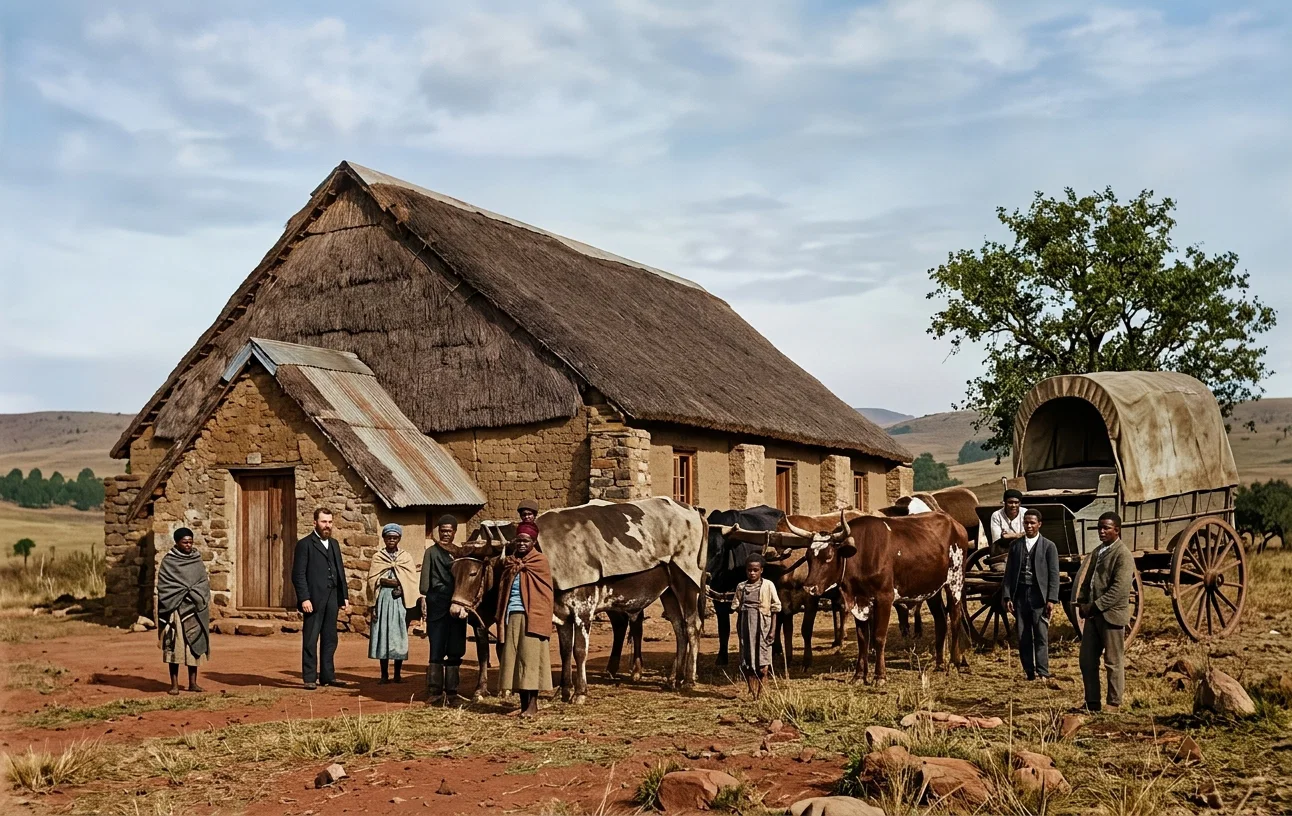
MISSIONARY WAGON AND NATIVE CHURCH
The discussion about our work and the opposition that followed, led many to believe that we are right. Accordingly many parents gave their children to us, saying, “Take our children and teach them the Word of God, and we will follow them.” We have thirty in our school at present, but expect to increase the number soon.
While Elder F. B. Armitage has been in charge of the school work, I have been out among the people, going from village to village in a covered wagon, holding services with the aid of a magic lantern; also doing Christian Help work, and selling and giving away literature. God has greatly blessed our efforts to help the people. We have found that the medical missionary work is indeed the “right arm of the message.”
Wherever we go, the “little wagon” is known, and the people come flocking to us for help. We have given as many as thirty-five fomentations in one day. They come to us with sore eyes, and ears that must be treated, lame shoulders and backs that are hurting them, teeth that must be extracted, and many other complaints. We do what we can for each of these, and seek heaven’s blessing upon our efforts, and the Lord does not disappoint us. This work has astonished the natives, for they have never seen a white man assisting them with his own hands before, and making no charges. Many can not understand it.
We have often heard it said that the native knows not the meaning of the word gratitude. While there are reasons for this saying, still there are exceptions. After giving treatments we have often seen tears of thankfulness flowing from their eyes, and the poor people would catch our hands and kiss them as we were leaving. Several persons told me that they had heard about the love of God from their ministers, but this was the first time that they had ever seen it. O that Jesus may be lifted up in our lives that we may reveal him to this poor people!
This work has led many to search earnestly for the truth. The majority of the people for whom we have labored are known as “School Kafirs,” and are members of one of the many different churches among them. This awakening is causing considerable opposition. Calls are coming to Brother Moko and myself, “Come and help us.” A short time ago a man walked sixty miles to the mission to learn about the Sabbath. Surely the Lord must have a few diamonds in the large amount of débris here. May he give grace and wisdom to find them.
Kenilworth, Cape, South Africa.
West Africa
By T. M. FRENCH
T. M. FRENCH
The third angel's message is onward in West Africa. We are often reminded that the One who never sleeps is directing this last great movement of the everlasting gospel.
Three have just accepted the truth at Waterloo, Sierra Leone, under the efforts of Brother R. P. Dauphin; and Brother C. E. F. Thompson reports three new Sabbath-keepers at Axim, Gold Coast. About two or three weeks ago I visited our mission school at Waterloo, holding examinations, and met with the church. I found a good, healthy growth in both the church and school.
About the first of this year there developed such a demand for our tracts in Freetown that it was thought advisable to raise a tract fund here in the church. I called the church committee together, and laid the matter before them, and it was decided to raise such a fund and place a special order for tracts for use by the church-members. In ordering, I more than doubled the order for our tract society, so we would not be short. The tracts were promptly shipped to us, and as I was unpacking ten thousand tracts on “Who Changed It?” and “What Shall Be the Sign?” the thought came to me that we had enough of these two cheap, yet pointed leaflets for one to every six persons in Freetown. I couldn’t get away from the thought that there should be a general distribution of these tracts.
Accordingly, the next Sunday a campaign was organized, in which nearly the14whole church took part, distributing about six thousand tracts, or twenty-four thousand pages, bearing present truth to the people. The work has been followed with systematic house-to-house work with other of our tracts and papers, until our supply of literature is exhausted. We have now opened cottage meetings, which are held each Sunday, our brethren and sisters conducting them.
The result of our united effort with our literature can be seen on every hand. The city seems stirred over the Sabbath question, even the children are discussing it. Last week the students of the U. W. F. church, at the Tabernacle, gave a public discussion of the Sabbath. Those taking the Sabbath side of the discussion were furnished with our tracts, and gave a good presentation of the subject before a large audience. One of the brethren told me yesterday that he had secured a seat for me at the Buxton (Wesleyan) church, where a similar discussion will be held by the pupils of that school.
The Guardian, one of the leading newspapers in the city, has published several pointed articles on the Sabbath question, and concerning our work. I quote a paragraph from the issue of May 28:—
“Sunday is not the Sabbath, and there is no argument that ought to convince the scholar of Holy Scripture that Sunday is the Sabbath day. It is plainly put down in the Bible that the seventh day is the Sabbath, and Sunday is the first day of the week. If, therefore, Saturday is the seventh day, it is evidently the Sabbath day. The changing of the Sabbath day as a day of rest was done by Constantine the Great, not because of his ignorance of knowing the Sabbath day, but because of his custom during the time he was a worshiper of the sun. Before his conversion, he kept Sunday as a day of rest, and so the law passes through the Roman Church. It was an oversight during the Reformation of the church that the parties concerned in the canonical laws never took any notice of the error. At any rate, the Sabbath day is not Sunday. Sunday was constituted by the English law as an holy day, but that does not alter the commandment: ‘Remember the Sabbath day, to keep it holy.’”
Surely the Lord is stirring up the people over these important truths. If we, though few in number, will but enter the field with our lamps burning bright, as did Gideon’s army, the Lord will stir up the camp of the masses, and we may yet hear voices proclaiming this message from quarters we least suspect. If all our churches would awaken to their responsibilities and privileges, every member becoming a living, active worker, how quickly the world might be warned, and we be gathered home!
We have just opened up work especially for the tribes of Freetown, for the first time. Our work has been almost wholly for the mixed people, or creoles, heretofore. This morning we held our first meeting in the Mendi language. One of our students acted as interpreter, and will also conduct most of the studies for the Mendis. A good company was present, and they all expressed their willingness to hear and obey the message the true God has for them. As we were conducting our services, I thought, “How changed the conditions of that same cottage since a few weeks ago, when we saw a fetish medium writhing under satanic influence.”
We earnestly request the prayers of our dear brethren and sisters in the home land, and, in fact, throughout the world, that we may be wholly guided by the Captain of our salvation in this closing work.
Freetown.
FRANK S. BOND
By Frank S. Bond
Spain
FRANK S. BOND
We have been much encouraged by the cheering reports from the General Conference. We are thankful for the plans to send a large corps of new recruits into the great heathen lands, such as China, India, and Africa. We are glad to be able to send in a report of advancement from this land, which for so many centuries has been bound by the iron bands of Rome.
A VIEW IN THE CITY OF SAGUNTO, SHOWING A PORTION OF THE ANCIENT FORTIFICATIONS
Spain to-day has more than her share of trouble on hand. While she is engaged in what bids fair to be a drawn-out and bloody war in northern Africa, her internal difficulties are also occupying the serious attention of the cabinet. There is great dissatisfaction on the part of the Spanish people. They feel that the war with Morocco is wholly uncalled for, and that the government should adopt measures at once to bring it to a close.
In several of the provinces, during the past few days, the militia has been called out to quell uprisings, strikes, etc. The streets of Barcelona have been turned into a battle-field, heavy artillery being called into action. Quite a number of officials and citizens have been killed or wounded. This general unrest may be the forerunner of a civil war.
In the midst of these turbulent conditions the seed-sowing of God’s truth is going right ahead. We are conducting a series of meetings here in Paterna, with a fair attendance. One man manifests much interest in the message. He has read “Steps to Christ” through, and thinks it a grand little book. He thinks every one should read it, and I quite agree with him.
I spent some time last week in the ancient city of Sagunto, in company with three of our canvassers. The Lord helped us in selling a goodly number of papers. Near Sagunto is a fortified mountain, which is of much interest. That city was besieged by the Carthaginians, under Hannibal, and there one of the bloodiest battles of that famous general was fought. From Sagunto Hannibal marched northward, and then through southern France and northern Italy, and then on down to Rome. Last week four humble soldiers of the cross entered the strongholds of Sagunto. The warfare of the Carthaginians and Romans was carnal, but we carried only “the sword of the Spirit,” God’s Word.
About three weeks ago a young man of Valencia began to obey the truth. He is a tailor, and on account of the Sabbath he has lost his position. We let him begin to sell papers, and he is having excellent success as a beginner. A married sister of this young man, and another woman of Valencia, are much interested in the truth. We hold a study with them each week, and they also are now attending our Sabbath meetings regularly.
The parents of our young brother, upon learning of his decision, became much enraged. They live in the province of Tarragona. They decided that the son should go home, and wrote, offering to send his railway fare. They further wrote that unless he gave up this truth, they would disown him. I am glad to say that thus far he has shown no disposition to recant, but rather a determination to learn God’s truth. We feel that these people should be frequently and earnestly remembered in the prayers of God’s faithful children.
While Spain is, comparatively speaking, a small country, having only about eighteen million inhabitants, we believe the time is near when more help should be sent this way.
Paterna.
Ministers Are Waiting
By William C. White
Waiting
LAST year there were more than a thousand boys and girls in our forty mission schools for Negro children. They love the schools; and through the influence of the instruction received from God-fearing teachers, marvelous changes are wrought in their lives. Urgent calls for more schools come from neglected localities, and we have fondly hoped that work might begin this month in eight or ten more places.
Some of the old schools have begun their work for the season; but in some places the work is waiting for means. The children are eagerly waiting for the schools to open, and the teachers are anxiously waiting for the necessary money to take them to the schools, and to pay for the first week's food.
The Southern Missionary Society, which has been our agency for the management of these schools, is ready to do its part as heretofore, but it is waiting for the usual inflow of funds, that it may send the teachers to the schools with the promise of the usual support.
Ministers Are Waiting
During the last two years about twenty colored evangelists have been employed by our conferences in the Southern States. Some of these are now waiting for funds with which to proceed with their work.
The Sick Are Waiting
There are hundreds of families in Nashville and neighboring towns, where poverty and sickness abide. The sick ones need the care and patient instruction of a missionary nurse. The Rock City Sanitarium aims to be a center from which trained nurses and faithful assistants shall go forth to minister to the sick and needy. There are consecrated young people ready to engage in this work, and Dr. Blake will gladly lead and direct their labors. But they must have food, shelter, and clothing. And this good work is waiting for some large-hearted individuals or churches to supply five or six salaries of twenty-five dollars a month.
The Rock City Sanitarium was purchased, fitted up, and opened for work last year. Those in charge are struggling hard to do good work, and broad fields of labor are opening before them. But we must not forget that the institution is only half paid for, only half furnished, and only half manned.
Where is the farmer who would load a cord of wood onto a two-horse wagon having only two wheels, while the other two wheels were in the wagon shop waiting to be paid for, then hitch on one horse, and haul his wood to the market and sell it? Such a man could say to the Rock City Sanitarium, “We have given you a start, now work your way out.”
The Work at Huntsville Is Waiting
Our contribution to the work among the Negro people of the United States in October, 1908, was nearly ten thousand dollars. The proportion assigned to the Huntsville school was nearly twenty-eight hundred dollars. This was used in paying the salaries of teachers.
The necessity of providing more room for students, better farm facilities, and of building a small sanitarium, where the sick can be cared for and the students trained to be missionary nurses, was presented at a few of the camp-meetings, and about seven thousand dollars was subscribed. Most of this has been paid, and as a result the school has been enabled to complete the boys' dormitory, to put its farm work on a better footing, and to build its sanitarium. And just as the building was ready for the plumbers to put in the heating plant and bathroom fixtures, all work had to stop for lack of means.
We rejoice that some of our churches and some of our young people's societies have promised to furnish rooms in this much-needed sanitarium, but from only a few have the funds been received. Therefore the patients are waiting, the rooms are waiting, and the students are waiting for the education to be gained in the faithful care of the sick.
At the camp-meetings this summer first attention had to be given to the raising of funds for the support of the foreign missions, and the Negro work has received but little attention. We hope that the October offerings will bring immediate and abundant relief.
To church officers, I will suggest that the needs of the Negro work just now are especially large and urgent. Therefore let us endeavor to swell the amount by securing a few large supplementary gifts from those who can afford to give freely. If we could double the amount given last year, it would be none too much to cover the necessities of the work, and set in operation precious and valuable agencies that are waiting.
We can not consent to have a dozen of our mission schools closed. We can not bear to see faithful evangelists held from the field. We must not wait another year for the opening of the Huntsville Sanitarium. We do not want the Rock City Sanitarium to establish its reputation as a place half furnished and half supported. That is not the way Seventh-day Adventists manage their missionary enterprises.
Let us follow the contribution of October 2 with large gifts till each one of these waiting enterprises becomes a working enterprise. W. C. WHITE.
Nebraska Camp-Meeting
By A. T. Robinson
THE Nebraska camp-meeting, pursuant to appointment, was held at Hastings, Neb., on the same grounds occupied last year, the date of the meeting being September 2-12. It was preceded by a workers’ meeting of one week, during which the camp was put in readiness. Three meetings were held with the workers each day during the workers’ meeting. These meetings were considered very profitable by all who took part in the work of preparing the camp.
Elder O. A. Olsen, Prof. P. T. Magan, and Dr. A. C. Selmon were with us during the entire meeting. Elder H. H. Votaw, of India, Elder E. T. Russell, and other Central Union Conference laborers were with us during a portion of the time.
The annual session of the conference was held in connection with the camp-meeting, one hundred thirty-nine delegates being present.
A little less than seven hundred of our people were encamped on the ground. A strong work was carried forward in behalf of the youth and children. The two o’clock hour each day was devoted to some special phase of missionary work. Elders Olsen, Russell, and Magan conducted most of the preaching services. Several revival efforts were made, which met with a ready response on the part of nearly the entire encampment. On Sunday, the closing day of the meeting, an appeal was made in behalf of missions, and $5,452.00 was raised in cash and pledges. At the close of a sermon on the subject of baptism at the forenoon service on Sunday eighteen persons were baptized in the lake adjoining the camp. This was a very pleasing and solemn service, witnessed by large numbers of people seated on the banks of the lake.
Eight meetings of the conference were held, during which there was manifested the utmost harmony and unanimity of action. Many questions were discussed in the fullest and freest manner, and every vote taken was unanimous. The conference officers elected were as follows: A. T. Robinson, president; C. H. Miller, vice-president; M. E. Ellis, secretary; Anna M. Peterson, treasurer. Additional members of executive committee: D. R. Callahan, J. H. Kraft, H. Hansen, A. F. Kirk. Board of trustees Nebraska Conference Association: A. T. Robinson, president; Anna M. Peterson, secretary and treasurer; additional members: L. B. Johnson, D. R. Callahan, Lyman Middaugh.
We all look forward with hope and courage to the year’s work that lies before us. A. T. ROBINSON.