Your ShelfYour Projects

Signs of the Times, Vol. 42, No. 23.

TWO VIOLATED PROMISES

Signs of the Times

Jun 8, 1915

Pacific Press Publishing Association · Mountain View, California · Jun 8, 1915

TWO VIOLATED PROMISES

One Resulted in Disaster—The Other Brought Reformation and Great Reward
By Mrs. E. G. White
WORDS are of no value unless they are accompanied with appropriate deeds. This is the lesson taught in the parable of the two sons. When the father went to the first son, saying, “Go work to-day in my vineyard,” the son promptly answered, “I will not.” Matt. 21:28, 29. He refused to obey, and gave himself up to wicked ways and associations. But afterward he repented, and obeyed the call.

I GO, SIR

The father went to the second son with the same command, “Go work to-day in my vineyard.” This son made reply, “I go, sir,” but he went not. Verse 30.
In this parable, the father represents God; the vineyard, the church. By the two sons are represented two classes of people. The son who refused to obey the command, saying, “I will not,” represented those who were living in open transgression, who made no profession of piety, who openly refused to come under the yoke of restraint and obedience which the law of God imposes.
In the son who said, “I go, sir,” and went not, the character of the Pharisees was revealed. Like this son, the Jewish leaders were impenitent and self-sufficient. The religious life of the Jewish nation had become a pretense. When the law was proclaimed on Mount Sinai by the voice of God, all the people pledged themselves to obey. They said, “I go, sir,” but they went not. When Christ came in person to set before them the principles of the law, they rejected Him.

ANNOUNCED THEMSELVES UNWITTINGLY

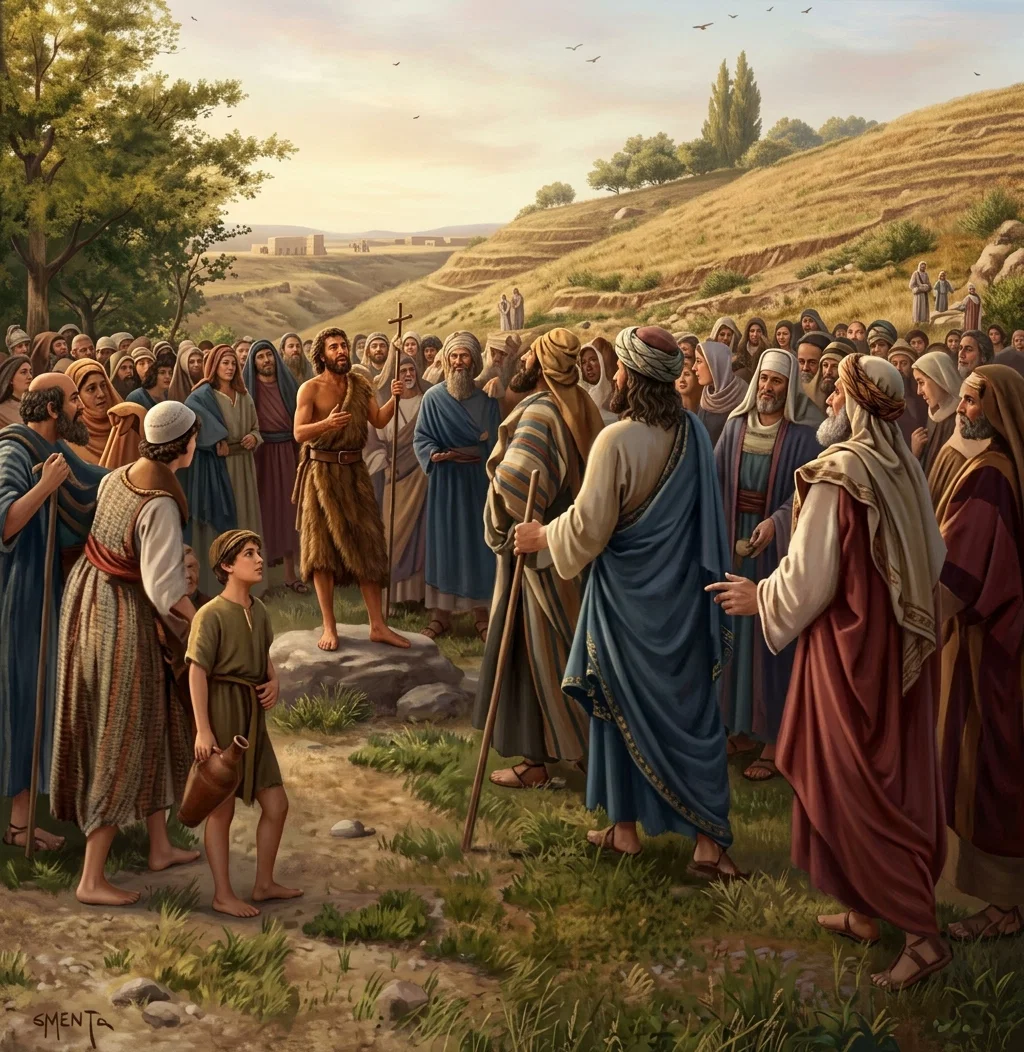
“John the Baptist came preaching truth, and by his preaching sinners were convicted and converted. These would go into the kingdom of heaven before the ones who in self-righteousness resisted the solemn warning.”
In the company before them there were scribes and Pharisees, priests and rulers; and after giving the parable of the two sons, Christ addressed to His hearers the question, “Which of them twain did the will of his father?” Repeating themselves, the Pharisees answered, “The first.” Verse 31. This they said without realizing that they were pronouncing sentence against themselves. Then there fell from Christ’s lips the denunciation: “Verily I say unto you, that the publicans and the harlots go into the kingdom of God before you. For John came unto you in the way of righteousness, and ye believed him not: but the publicans and the harlots believed him: and ye, when ye had seen it, repented not afterward, that ye might believe him.” Verses 31, 32.
John the Baptist came preaching truth, and by his preaching sinners were convicted and converted. These would go into the kingdom of heaven before the ones who in self-righteousness resisted the solemn warning. The publicans and the harlots were ignorant, but these learned men knew the way of truth. Yet they refused to walk in the path which leads to the Paradise of God. The truth that should have been to them a savor of life unto life became a savor of death unto death. Open sinners who loathed themselves had received baptism at the hands of John; but these teachers were hypocrites. Their own stubborn hearts were the obstacle to their receiving the truth. They resisted the conviction of the Spirit of God. They refused obedience to God’s commandments.

CREATED THEIR OWN OBSTACLES

Christ did not say to them, Ye cannot enter the kingdom of heaven; but He showed that the obstacle which prevented them from entering was of their own creating. The door was still open to these Jewish leaders; the invitation was still held out. Christ longed to see them convicted and converted.
The priests and elders of Israel spent their lives in religious ceremonies, which they regarded as too sacred to be connected with secular business. Therefore their lives were supposed to be wholly religious. But they performed their ceremonies to be seen by men, that they might be thought by the world to be pious and devoted. While professing to obey, they refused to render obedience to God. They were not doers of the truth which they professed to teach.
The son who said, “I go, sir,” represented himself as faithful and obedient; but time proved that his profession was not real. He had no true love for his father. So the Pharisees prided themselves on their holiness; but when tested, it was found wanting, “forthey say, and do not.” Matt. 23:3. They had no true love for God or man. God called them to be coworkers with Him in blessing the world; but while in profession they accepted the call, in action they refused obedience.

FALSE PROMISES TO GOD

Self-righteousness is not true righteousness, and those who cling to it will be left to take the consequences of holding a fatal deception . Many to-day claim to obey the commandments of God, but they have not the love of God in their hearts to flow forth to others. Christ calls them to unite with Him in His work for the saving of the world; but they content themselves with saying, “I go, sir.” They do not go. They do not cooperate with those who are doing God’s service. They are idlers. Like the unfaithful son, they make false promises to God.
In profession they claim to be sons of God, but in life and character they deny the relationship. They do not surrender the will to God. They are living a lie.
There is more hope for publicans and sinners than for those who know the word of God but refuse to obey it. He who sees himself a sinner, with no cloak for his sin, who knows that he is corrupting soul, body, and spirit before God, becomes alarmed lest he be eternally separated from the kingdom of heaven. He realizes his diseased condition, and seeks healing from the great Physician, who has said, “Him that cometh to Me I will in no wise cast out.” John 6:37. These souls the Lord can use as workers in His vineyard.

IT WAS NO VIRTUE

The son who for a time refused obedience to his father’s command was not condemned by Christ; and neither was he commended. The class who act the part of the first son in refusing obedience deserve no credit for holding this position. Their frankness is not to be regarded as a virtue. Sanctified by truth and holiness, it would make men bold witnesses for Christ; but used as it is by the sinner, it is insulting and defiant, and approaches to blasphemy.

NO HYPOCRITE, YET A SINNER

The fact that a man is not a hypocrite does not make him any the less really a sinner. When the appeals of the Holy Spirit come to the heart, our only safety lies in responding to them without delay. When the call comes, “Go work to-day in My vineyard,” do not refuse the invitation. “To-day if ye will hear His voice, harden not your hearts.” Heb. 3:7, 8. It is unsafe to delay obedience. You may never hear the invitation again.
And let none flatter themselves that sins cherished for a time can easily be given up by and by. This is not so. Every sin cherished weakens the character and strengthens habit; and physical, mental, and moral depravity is the result. You may repent of the wrong you have done, and set your feet in right paths; but the mold of your mind, and your familiarity with evil, will make it difficult for you to distinguish between right and wrong. Through the wrong habits formed, Satan will assail you again and again.
In the command, “Go work to-day in My vineyard,” the test of sincerity is brought to every soul. Will there be deeds as well as words? Will the one called put to use all the knowledge he has, working faithfully, disinterestedly, for the Owner of the vineyard?

WHAT WE MAY BE

God stands toward His people in the relation of a father, and He has a father’s claim to our faithful service. Consider the life of Christ. Standing at the head of humanity, serving His Father, He is an example of what every son should and may be. The obedience that Christ rendered, God requires from human beings to-day. He served His Father with love, in willingness and freedom. “I delight to do Thy will, O My God,” He declared; “yea, Thy law is within My heart.” Ps. 40:8. Christ counted no sacrifice too great, no toil too hard, in order to accomplish the work which He came to do. At the age of twelve He said, “Wist ye not that I must be about My Father’s business?” Luke 2:49. He had heard the call, and had taken up the work. “My meat,” He said, “is to do the will of Him that sent Me, and to finish His work.” John 4:34.
Thus we are to serve God. He only serves who acts up to the highest standard of obedience. All who would be sons and daughters of God must prove themselves coworkers with God and Christ and the heavenly angels. This is the test for every soul. Of those who faithfully serve Him the Lord says: “They shall be Mine . . . in that day when I make up My jewels; and I will spare them, as a man spareth his own son that serveth him.” Mal. 3:17.

The Corner Stone Laid

IT is quite customary, these days—and how far back the custom may date, we do not know—for some person of note to be present at the laying of the corner stone of great structures—it may be a college, a public library, or some church edifice.
God Himself seems to have been present in this world when the chief corner stone of His church was laid—against which the Master said the “gates of hell” would not be able to “prevail.”
Peter tells about this wonderful event, this corner stone laying, long after the ceremonies were over—some sixty years, if we may rely on chronologists.
Here is his account of it: “Wherefore laying aside all malice, and all guile, and hypocrisies, and envies, and all evil speaking, as newborn babes, desire the sincere milk of the Word, that ye may grow thereby: if so be ye have tasted that the Lord is gracious. To whom coming, as unto a living stone, disallowed indeed of men, but chosen of God, and precious, ye also, as lively stones, are built up a spiritual house, an holy priesthood, to offer up spiritual sacrifices, acceptable to God by Jesus Christ. Wherefore also it is contained in the Scripture, Behold, I lay in Sion a chief corner stone, elect, precious: and he that believeth on Him shall not be confounded.”
Those who choose this solid foundation stone of the corner, and build upon it,—Christ Jesus, the Lord,—need fear no coming storm. The man who builds his character structure upon this Rock, no storm, however fierce, can destroy. Such will be found to have grown to the Rock itself, and become, indeed, a part of that foundation stone. They are, so to speak, riveted to the Rock—Christ Jesus. Blessed, secure anchorage!
Have you found this corner stone, reader? The Father has built His church upon a tried foundation—Christ Jesus, the Son. It has stood the test of ages. Have you built upon Him? If so, you are secure.
T. E. BOWEN.

The Sabbath of Jehovah

By Worthie Harris Holden
*Adown the sky, the sun fulfills his course, And hastens to his rest with eager tread. The fleecy clouds cast round resplendent robes, As through their path his herald rays are led.*
*Sometimes, amid the duties of the hour, The golden gates are folded all unseen; But not to-night, for it is Sabbath eve, And many eyes behold their wondrous sheen.*
*The wheels of daily care are hushed and still; The quiet of His rest, pervading all, Lures heart and voice to blend in anthem sweet To Him whom myriad heavenly hosts extol.*
*Then like a dove His Spirit hovers o’er And hallows every life throughout His day. Around the altar bends each loyal knee, To magnify His name, and praise and pray.*
*The morning beams awake to early call His children to the sacred house of prayer; And angel escorts guard the earnest souls Who seek devoutly for His presence there.*
*The Father’s business claims the hours that lead Too swiftly to another sunset glow, When once again the family altar speaks Beatitudes for blessings here below.*
*The day has passed, with all its holy cheer, And thankful hearts declare its heavenly bliss; For Eden joy of nearness unto God Is bridged to Paradise restored, by this.*
*A sacred calm in benediction bides, As duties of the week claim honor due; And evening after Sabbath knows the peace That lingers still the weary workdays through.*
*So each returning Sabbath day proclaims The week’s unerring cycles well fulfill, To laud our Creator’s mighty power Protecting Israel to Zion’s hill.*

The Pleasure of Doing Good

“THERE is pleasure in contemplating good; there is pleasure in receiving good; but the greatest pleasure of all is in doing good, which comprehends the rest.”

A Matter of Perspective

“LET a man stand with his face in what direction he will, he must necessarily turn his back on one half the world.”

A King's Dream of the Future

A Golden Image Stands Before Him — A Young Hebrew Prophet Called in as Interpreter — The Future of the World Unrolled
By Jean Vuilleumier
This is the first of a number of articles by Mr. Vuilleumier on the prophecies of the book of Daniel. These will be followed by some articles on the book of Revelation. In these turbulent times, we instinctively turn to the words of the prophets to see if they have been inspired to throw any light into the future. These articles will reveal the fact that the prophets have been enabled to read the future as an open book.
EDITOR.
NO more absorbing, no more harrowing thought can come to the thinking men of this generation than that so often voiced by the questions: What is the world coming to? What are we as a nation and as individuals coming to?

HE HAD CONQUERED THE WORLD

There is an answer to these solemn questions. It was given 2,500 years ago, by a young prophet, to a mighty monarch. It has long been written in a document hoary with age. Let me tell you this curious story.
It was in the year 603 before Christ. Nebuchadnezzar, king of Babylon, had just completed the conquest of the known world by the sack of Jerusalem. This proud successor of Nabopolassar was standing at the head of the mightiest empire ever seen since the fall of Nineveh, and he lived in a capital the grandeur of which seems to us fabulous.

A DREAM THAT AROUSED HIM

One night, on his royal bed, the king had a dream which startled him, but which he could not recall. And when his magicians and astrologers could not help him out, Nebuchadnezzar, in his despair, sentenced them to death. At this juncture, the whole dream was revealed in a vision to a young man, a captive in Babylon, the future prophet Daniel, who hastened to the palace of the king. Nebuchadnezzar immediately recognized his own dream, and showered favors and honors on Daniel.
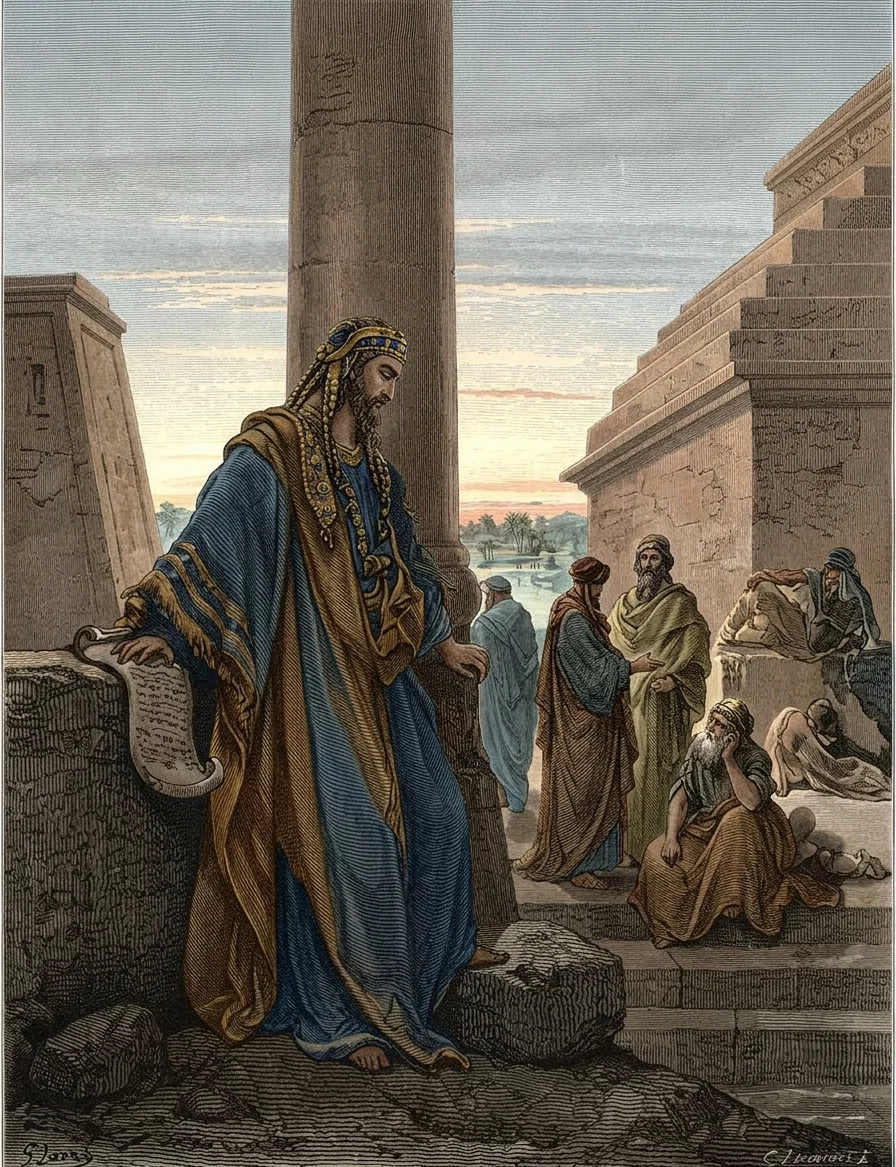
The Prophet Daniel, According to the Conception of Dore
It is this dream and its interpretation that will give us, even after 2,500 years have gone by, the unfolding of the future. Let us hear it, then, with reverence, as Daniel told it to the king.
He begins by revealing the source of this wonderful revelation. “The secret which the king hath demanded,” he says, “can neither wise men, enchanters, magicians, nor soothsayers, show unto the king; but there is a God in heaven that revealeth secrets, and He hath made known to the king Nebuchadnezzar what shall be in the latter days.” Dan. 2: 27, 28.

THE YOUNG PROPHET REPEATS THE DREAM

Then he goes on to say: “As for thee, O king, thy thoughts came into thy mind upon thy bed, what should come to pass hereafter; and He that revealeth secrets hath made known to thee what shall come to pass. . . . Thou, O king, sawest, and, behold, a great image. This image, which was mighty; and whose brightness was excellent, stood before thee; and the aspect thereof was terrible. As for this image, its head was of fine gold, its breast and its arms of silver, its belly and its thighs of brass, its legs of iron, its feet part of iron, and part of clay. Thou sawest till that a stone was cut out without hands, which smote the image upon its feet that were of iron and clay, and brake them in pieces. Then was the iron, the clay, the brass, the silver, and the gold, broken in pieces together, and became like the chaff of the summer threshing floors; and the wind carried them away, so that no place was found for them: and the stone that smote the image became a great mountain, and filled the whole earth.”

HE TELLS HIM THE INTERPRETATION

“This is the dream,” said Daniel; “and we will tell the interpretation thereof before the king. Thou, O king, art king of kings, unto whom the God of heaven hath given the kingdom, the power, and the strength, and the glory; . . . thou art the head of gold. And after thee shall arise another kingdom inferior to thee [the bust of silver]; and another third kingdom of brass, which shall bear rule over all the earth. And the fourth kingdom shall be strong as iron, for as much as iron breaketh in pieces and subdueth all things; and as iron that crusheth all these, shall it break in pieces and crush.” Verses 29-40.
Then comes the interpretation of the feet, of iron and clay, which represented a division of the fourth kingdom into several smaller kingdoms, partly strong and partly weak, mingled among themselves, but unable to “cleave one to another.”

AN ETERNAL KINGDOM THE CLIMAX

And now the vision tells us the end of earthly things: “And in the days of those kings shall the God of heaven set up a kingdom which shall never be destroyed, nor shall the sovereignty thereof be left to another people; but it shall break in pieces and consume all these kingdoms, and it shall stand forever. For as much as thou sawest that a stone was cut out of the mountain without hands, and that it brake in pieces the iron, the brass, the clay, the silver, and the gold.” Verses 44, 45.
Daniel closes with this emphatic declaration: “The great God hath made known to the king what shall come to pass hereafter: and the dream is certain, and the interpretation thereof sure.” Verse 45.

THE WHOLE SUCCESSION OF EMPIRES

We see that this mysterious image is intended to represent the whole succession of earthly empires clear down to the establishment of God’s kingdom. This dream, then, to use the words of the late Professor Gaussen, of Geneva, is really the “great clock of history,” or its “general chart,” or yet its “universal chronology.” Herein is found the “general plan of divine Providence for the government of nations,” “the program of the great drama of empires as the mighty Ruler of all things traced it thirty centuries ago.”
Such a bold claim for a simple dream may seem to some amusingly daring. “When Daniel wrote his book,” says Gaussen, “Persia was a country without power and without fame; Greece was nothing; Italy, less still.

WHO COULD HAVE BELIEVED IT?

“Who could have believed then that the obscure horde of the Persians would overthrow the mighty empire of Babylon, and would seize and hold for a hundred years the scepter of the civilized world? Yea, who could have believed that, after the Persians, the insignificant nation of the Greeks, and especially their barbarian province of Macedon, would rule the earth and carry its soldiers as far as the Indus River? Who could have believed that, after the Greeks, the Italians, from the remotest regions of the West, as they thought, would establish the greatest, the most terrible and enduring of empires; would make of a puny village, called Rome, and built on a small river, called Tiber, the queen of nations, the new Babylon, the so-called eternal city; and that finally this kingdom, divided among ten kings, would last, under this strange arrangement, until the end of time?”

THE MILLENNIUM DESCRIBED

Is the Word in the Bible? — Bounded by the Resurrections of the Righteous and the Wicked — The Judgment Day — Sin and Sinners Destroyed — A Clean Universe
By A. S. Booth
The word “millennium” is used so frequently to-day that one would be led to believe that it is found many times in the Bible; but the facts are that it is not found a single time in that book. The thought of a general blessed time coming, in which the whole world will be converted to Christ, is so closely associated with the word, that one would naturally suppose that to be its definition. However, this is not the definition in any sense. The word “millennium” is coined from two Latin words, mille, thousand, and annus, year,—a thousand years. The doctrine of the millennium is found on the twentieth chapter of the book of Revelation.
The period of one thousand years is mentioned in that chapter six times. It is applied three times to Satan, twice to the righteous, and once to the wicked. In this chapter, the topic of the millennium is made very clear.

SATAN IN THE MILLENNIUM

The verses applied to Satan read as follows: “And I saw an angel come down from heaven, having the key of the bottomless pit and a great chain in his hand. And he laid hold on the dragon, that old serpent, which is the devil, and Satan, and bound him a thousand years, and cast him into the bottomless pit, and shut him up, and set a seal upon him, that he should deceive the nations no more, till the thousand years should be fulfilled: and after that he must be loosed a little season.” Verses 1-3.

THE RIGHTEOUS DURING THE MILLENNIUM

Of the righteous we read: “And I saw thrones, and they sat upon them: . . . and I saw the souls of them that were beheaded for the witness of Jesus, and for the word of God, and which had not worshiped the beast, neither his image, neither had received his mark upon their foreheads, or in their hands; and they lived and reigned with Christ a thousand years. . . . This is the first resurrection. Blessed and holy is he that hath part in the first resurrection: on such the second death hath no power, but they shall be priests of God and of Christ, and shall reign with Him a thousand years.” Verses 4-6.
Referring to the wicked, it is said, “But the rest of the dead lived not again until the thousand years were finished.” Verse 5. Here the thought is presented that after the thousand years, the wicked will live again.

BOUNDED BY THE RESURRECTIONS

The Bible teaches two resurrections, that of the just, and that of the unjust. Acts 24:15; John 5:28, 29. It is left for John, in the book of Revelation, to separate these resurrections by one thousand years. The thousand-year period is bounded by the resurrection of the righteous in the beginning, and that of the wicked at the close.
Christ’s second coming is ushered in by the resurrection of the righteous, and they are caught up to meet the Lord in the air. 1 Thess. 4:16-18. From the air they are received into the city of God. Rev. 22:14. And according to the text, they live and reign with Christ a thousand years.
Jesus said, “If I go and prepare a place for you, I will come again, and receive you unto Myself; that where I am, there ye may be also.” John 14:3. Some would teach this text as though it read, “If I go, I will come again, and be with you; that where you are, there I will be also.” The text, however, does not so read. If a man were to go to Canada and prepare places for us, and should say, before he went, that when he had the places prepared, he would come and receive us to himself, we would expect to go to Canada, and not to remain in the United States.
So the Lord has promised to receive His people to Himself when He comes the second time. The city of God does not come down until the thousand years are finished. Rev. 21:1, 2. God’s people are with the Lord in the city in heaven.

A REIGN OF JUDGMENT

In God’s plans there is always a purpose and a time. During the thousand years, the saints reign with Christ in judgment. Rev. 20:4; 1 Cor. 6:2. The judgment, and the pronouncing of the penalty that will fall upon the wicked, will be so righteous and just that the saints of God will be permitted to enter into that judgment, so that at the end they will be able to say, Righteous, just, and true are Thy judgments, Thou King of saints.
When Christ comes the second time, at the beginning of the thousand years, the wicked who are living on the earth are destroyed. Rev. 6:14-17; 2 Thess. 2:8; Jer. 25:30-34. There is no promise of their resurrection until the end of the thousand years. Rev. 20:5.

THE WORLD A DESOLATION

Thus we see the world is empty as far as man is concerned. Some texts that reveal the conditions of the world during the millennium are as follows: “The great day of the Lord is near. . . . That day is a day of wrath, . . . a day of darkness and gloominess, a day of clouds and thick darkness.” Zeph. 1:14, 15. “The day of the Lord cometh; . . . a day of darkness and of gloominess, a day of clouds and of thick darkness.” Joel 2:1, 2. “I beheld the earth; and, lo, it was without form, and void; and the heavens, and they had no light. I beheld the mountains, and, lo, they trembled, and all the hills moved lightly. I beheld, and, lo, there was no man, and all the birds of the heavens were fled. I beheld, and, lo, the fruitful place was a wilderness, and all the cities thereof were broken down at the presence of the Lord, and by His fierce anger. For thus hath the Lord said, The whole land shall be desolate; yet will I not make a full end. For this shall the earth mourn, and the heavens above be black: because I have spoken it, I have purposed it, and will not repent, neither will I turn back from it.” Jer. 4:23-28.

HOW SATAN IS BOUND

It is in this world in its waste, desolate condition that Satan is confined for the thousand years. He is bound from the standpoint that there is no one to tempt. The righteous are in heaven, and the wicked are in death.Here, where he has caused all the trouble for the human family, tempting them to sin and reject Christ; here, where he has moved the human family to persecute their Lord and Master, and finally put Him to death,—Satan will be bound and confined by the very Word and the very Christ that he has despised.
The adversary has boasted that he could manage a kingdom better than could God; so once, in the end of time, the Lord reduces the earth to the same condition it was in at the beginning, and permits Satan to demonstrate, before the universe, his power. God, when creating all things, simply “spake, and it was; He commanded, and it stood fast.” Ps. 33:9. He created the light, the birds of the air, the beasts of the field, and man.
Satan will be utterly bound. The birds will have fled; the beasts of the field will have perished; the heavens will be black, and his subjects, the wicked, in death. He may command the sun to shine, the birds to return, and his subjects to rise from the dead; but to no avail. He cannot give life to a blade of grass, much less man. The universe beholds his defeat.

THE BEGINNING AND END OF THE MILLENNIUM

At the beginning of the thousand years, the Lord comes with all His angels, to receive His saints. Matt. 24:31-35. At the end of the thousand years Christ comes, and all His saints with Him. Zech. 14:4, 5. The wicked are also resurrected. Rev. 20:5. The city of God comes down. Rev. 21:1, 2. The final drama is now enacted.
God, Christ, all the holy angels, and the redeemed of all ages, are in the city of God. Satan, with all the evil angels, and the host of the wicked, who have been resurrected, are on the outside.
The combined forces of the holy are on one side, and the hosts of sin on the other. The two kingdoms are compared. Both the righteous and the wicked may behold and see that the Lord’s ways have been best. The wicked that have gone down cursing Christ and persecuting His people, now see, when it is too late, and are convinced of truth and the mistakes they have made. God restrains till all see their mistakes.
When God’s Spirit is withdrawn, Satan begins his old work again. Mustering the combined forces of evil, he endeavors to take from the righteous their inheritance, the city of God. God’s justice is then vindicated in destroying Satan and his followers. Fire descends from heaven, and they perish. Rev. 20:9. Again the righteous can say, Amen, Thy ways are true and holy.

A CLEAN UNIVERSE

Then will come forth the new heaven and the new earth, and God “will dwell with them”—the saints. Rev. 21:1-5. The saints having lived and reigned with Him a thousand years, He will then live with them. When God’s plans relative to sin are fully carried out, all will have learned the lesson, the wicked will be destroyed, and “affliction shall not rise up the second time.” Nahum 1:9. “There shall be no more curse.” Rev. 22:3. The universe will be as pure and clean as though sin had never existed.
May God help us that we learn the great lesson, that God’s plans and ways are best. If we do not just understand all things, let us not question the Word, but be patient; and when God’s word triumphs, we shall triumph with it.

“In Everything Give Thanks”

By Flora E. Warren
*They have not greatest cause for praise Who have smooth paths, and cloudless days. There's cause and core, And even more, In this grand rule, that works all ways — All who have tried it find it pays: “In everything give thanks.”*
*Whoever keeps this rule in mind, In storm or calm, will surely find In every road, For every load, Christ is your Helper, true and kind, Strengthens the weary, leads the blind. “In everything give thanks.”*
*We keep so busy day and night, With selfish murmuring, we quite Forget that praise Is due always, For much we count as ours by right. Give God His due, and with your might “In everything give thanks.”*
*He who gave us this rule to keep, Will help us know its blessings deep. Who will each day This rule obey? Remember, there's no time to sleep; For what men sow, they also reap, “In everything give thanks.”*
Continue reading: Where Are the Dead?