The use of the word “impedimenta” in designating the traveler’s baggage, is very significant. The term really means hindrances, and especially those that hinder the feet. The hastening pilgrim often finds his progress stayed indeed by hindering trunks and bags, because of delays in transportation that make him wait when he wishes above all things to speed on.
The literal traveler is not the only one thus hindered. The pilgrim along the daily life-path often finds himself encumbered and impeded. Possessions are to be desired and to be valued, but when they multiply till they overflow all reasonable space, when the things cease to be treasures because there is no place for them, then they become impedimenta. They are hindrances to be removed with resolute hand.
One peculiar snare of womankind is the tendency to keep things. It is not necessarily for sake of hoarding that one refuses or forgets to part with her accumulations, but because of the instinctive reluctance to throw away or to be rid of superfluous belongings. The old tradition that a thing kept seven years turns up useful, is partly to blame for many a moth-eaten store in rag-bag and attic. ‘Maybe I shall want this sometime,’ is the reflection that stays the destroying or the distributing hand, and the ‘things’ are put away again after each house-cleaning rummage.
Then, there are the papers that heap the library table and overflow through the house, to be piled up in closets and on shelves, waiting to be looked over and read again, and scrap-book pieces cut out from them.
The fancy that this will ever be done—any of it—is usually a delusion and a snare. It is as much as mortals can do to read once the papers that come to an ordinary household. Who will ever reread them? Pity ’tis, ’tis true. Some of the best and most inspiring of stirring prose and rhythmic verse float by in the drift of print, and the temptation is strong to island it for a while, in vain hope of going over it again. But the time does not come, and by and by the accumulation is appalling. It would seem often as if the feet were indeed hindered by such impedimenta. It is hard to make a path through.
What is the remedy for the keeping habit? How shall possessions be kept from becoming impedimenta? The only way is to clear up as we go. It takes a deal of determination to do this. The clothes and “pieces” that we may want sometime, but probably never shall, should be relinquished, and given away where they will do good, and while they may. There must be discrimination in such distribution, of course. We are not to make ourselves destitute of all bits and relics, but the congestion must be relieved, the really hindering “things” taken out of the way betimes. There may truly be much sentiment in connection with what has outlived its usefulness, but the thing itself should not be allowed to become a disgrace to its associations. A grimy piece of bric-a-brac or an outworn bit of decoration may have been purchased with pleasure, and may have held its place with pleasant memories, but this only entitles it to that destruction which is honorable retirement, instead of being thrust into a corner to gather more dust and look disreputable still. If things can be bestowed upon waiting and worthy recipients before reaching dilapidation, how much good they may do! There are always those somewhere within reach who have very few “things.”
As for the periodicals, we ought, every one of us, if possible, to keep a paper mission in active operation. There are hundreds of places to send reading-matter. We need to be very resolute with ourselves, and silence the suggestion that “another time” we will read them over. We know we won’t, because we can’t. Let us save at once those treasures too precious to let slip, and pass on the rest with promptitude and regularity. It is vandalism to destroy good papers. Time, trouble, and postage spent in passing them on, will be found a good investment.
Thus our hindrances may become helps.—Julia H. Johnston, in Northwestern Christian Advocate.
The Golden Glory of Tibet
IN the far, far distance, across and beyond flat fields of barley, and here and there the darker line of low-wooded plantations, a gray pyramid painfully disengaged itself from behind the outer point of the gray concealing spur—Lhasa.
Here, at last, the never-reached goal of so many weary wanderers, the home of all the occult mysticism that still remains on earth! The light waves of mirage dissolving impalpably just shook the far outlines of the golden roofs and dimly seen white terraces.
From end to end the plain around the capital is almost without exception a water-sodden morass, on which it is almost12impossible to travel for a hundred yards without encountering a quagmire. The road by which one approaches the capital is a causeway built four or five feet up from the surface of the marsh, and pierced a dozen times by culverts, through which brown, peaty water flows apace. In length the Plain of Milk, in the middle of which Lhasa lies, is about fifteen miles. In width it varies from two to five miles. And in upon it from all sides strike the spurs of vast mountains, which even then, in July, were snow-capped in the morning hours.
Between the palace on our left and the town a mile away in front of us there interposes a mile-wide belt of green. In this Lhasa has a feature which no other town on earth can rival. Between and over the glades and woodlands the city itself peeps, an adobe stretch of narrow streets and flat-topped houses, crowned here and there with a blaze of golden roofs or gilded cupolas. But there is no time to look at this; a man can have no eye for anything but the huge, upstanding mass of the Potala palace to his left. It drags the eye of the mind like a lodestone, for, indeed, sheer bulk and magnificent audacity could do no more in architecture than they have in the palace temple of the Grand Lama. Simplicity has wrought a marvel in stone, nine hundred feet in length, and towering seventy feet higher than the golden cross of St. Paul's Cathedral.
By European standards it is impossible to judge this building. Perhaps in the austerity of its huge curtains of blank, unveiled, unornamented wall, and in the flat, unabashed slants of its tremendous southeastern face, there is a suggestion of the massive grandeur of Egyptian work, but the contrast of color and surroundings, to which no small part of the magnificence of the sight is due, Egypt can not boast. The vivid white stretches of the buttressing curtains of stone, each a wilderness of close-ranked windows, and the home of the hundreds of the crimson-clad dwarfs who sun themselves at the distant stair-heads, strike a clean and harmonious note in the sea of green which washes up to their base. Once a year the walls of the Potala are washed with white, and no one can gainsay the effect. Moreover, a brown yak-hair curtain, eighty feet in height and twenty-five feet across, hangs like a tress of hair down the very center of the central sanctuary, hiding the central recess.
The central building of the palace, the private home of the incarnate divinity himself, stands out foursquare upon and between the wide, supporting bulks of masonry, a deep-red crimson, and, most perfect touch of all, over it, against the sky, are glittering golden roofs.
Just where the dun town encroaches upon the greenery, you may see clearly the famous Turquoise-Roofed Bridge. To the right is the house of the Amban, the Chinese representative in Lhasa, almost completely hidden in its trees, and on the other side rise the steep, unbeautiful walls of the last house in Lhasa to the northeast; to the west of it flashes the corner of Ramo-che, the most sacred of all the temples in Tibet. But when you have marked these historic points, the eye will helplessly revert again to the Potala; it is a new glory added to the known architecture of the world.—Perceval Landon, in The World's Work.
*“We Eat Too Much by Half”*
By Sereno E. Todd
When passing through the last days of boyhood, I frequently heard an intelligent Quaker remark, “We eat too much by half.” As he was very abstemious in all his habits, he lived to an old age, and died while in comparative health, just as an apple fully ripe falls from the stem when it has developed to complete maturity.
After having taken observations for more than fifty years with reference to the wise observation of my Quaker friend, I am fully persuaded that, as a general rule, the Quaker’s maxim is correct. Still, it can not be denied that a goodly number of people do not eat a sufficiency of nourishing food to keep the functions of the body in a healthy and robust condition. But the usual practise is downright gluttony. Untold numbers of both sexes, both old and young, gorge their stomachs, two or three times daily, with heavy and greasy food; and then they fly to enormous doses of “Pain Killer,” or some other poisonous nostrum, with which to rouse the energies of the stomach, and compel it to throw out the hurtful and useless mass of heavy food which can not be appropriated to any desirable purpose.
When the veins are swollen with blood, and every pore of the flesh is filled with the juices which have been extracted from rich food, if more nourishment is forced into the stomach, the mass will not be digested, for the reason that the tissues of the body have no use for any more material to repair the natural waste. Hence the contents of the stomach give uneasiness and more or less pain, because the process of digestion is arrested.
All through life I have observed, when at social gatherings and at some other places, that, while I would eat only so much as my digestive apparatus could manage with comfort, many persons at my side would swallow plateful after plateful until they could not coax the appetite to take any more; then they would be sick for a half month.
In years past I have worked in the harvest-field cradling grain or raking and binding, and at making and securing hay, with men who did not perform as much hard labor as I. They would gorge their stomachs with heavy food three times daily, and take two lunches between meals, while I would take a bowl of bread and milk, two eggs, and some baked apples or stewed pears, and work hard all day, with very little fatigue and discomfort.
When laborers at my side would swallow a quart of switchel every hour, and complain bitterly of the excessive heat and fatigue almost unendurable, I would take a piece of ice in my mouth, or swallow only a few spoonfuls of water at one draught. I ate very little meat and heavy food; yet I could pick up two of these excessive meat-eaters (one under each arm) and carry them off.
I have in mind scores of people, both male and female, who are always on the sick list, from no other cause than gorging their stomachs with enormous quantities of heavy food, such as meat, fish, and eggs, when they would feel well, happy, and cheerful if they would subsist on a plain and simple diet, taken in small quantities.
The human stomach is an organ of the body consisting of many exceedingly delicate and sensitive parts, as delicate as the human eye. When too much food of any sort is forced down into this delicate receptacle, every part will rebel, and cease to act, similarly to a balky horse when the load is too heavy for him. Then, as soon as the stomach can not digest the contents nor expel the unwelcome enemy, congestion will be superinduced, and death will follow in a short time.
Many persons can not understand why it is that to-day one kind of food can be eaten with excellent relish and thorough digestion, without pain or discomfort, whereas to-morrow that same sort of food will not digest, but will simply lie like a stone in the stomach. The true reason is that the stomach has been overloaded, or the energies of the stomach are not able to digest its contents.
When a person feels well and strong, the stomach will digest all that a normal appetite will take at one meal. But when the appetite is not keen, then beware of what you eat. There is very little danger of starving when the appetite is not keen. My wife and I frequently omit supper when the appetite is indifferent; and we always feel better and more refreshed the next morning than if we had eaten a supper that our systems did not need. If a person is weak and feeble, the energies of the stomach will also be feeble. It is impossible to compel the feeble stomach to digest heavy food. We seldom take any medicine. When either of us feels ill, we eat nothing for one or two days. Then we feel well, without any medicine.—Sereno E. Todd, in Journal of Hygiene.
How to Succeed
“I MUST be doing something for the
weary and the sad,
I must be giving forth the love that
makes my heart so glad;
For God so fills my spirit with a joy
that passeth show,
I fain would do his bidding in the only
way I know,
And pray to God that every day I may
some good impart,
Some little act of kindness, some little
word of cheer,
To make some drooping heart rejoice,
or stay some falling tear.”
The Message in Spain
By W. ROBINSON
W. ROBINSON
“THE people of the land have used oppression [“deceit,” margin], and exercised robbery, and have vexed the poor and needy: yea, they have oppressed the stranger wrongfully. And I sought for a man among them, that should make up the hedge, and stand in the gap before me for the land, that I should not destroy it: but I found none.” Eze. 22: 29, 30.
These words accurately portray Spain in its present condition, and I wonder how many who read these lines ever think of leaving their comfortable homes, to “stand in the gap” before the Lord. As he seeks some one to witness for him in Spain, may he not have to say, as once he said of his ancient people, “I found none”?
Since my last report, our experiences here, have been many and interesting, and I wish those in England and America who are so anxious to regard the Roman Catholic system with sympathy, could have been here during the last month. In Protestant countries the very best side of the great counterfeit is seen, but here the “beast” can be seen in all her shameful reality.
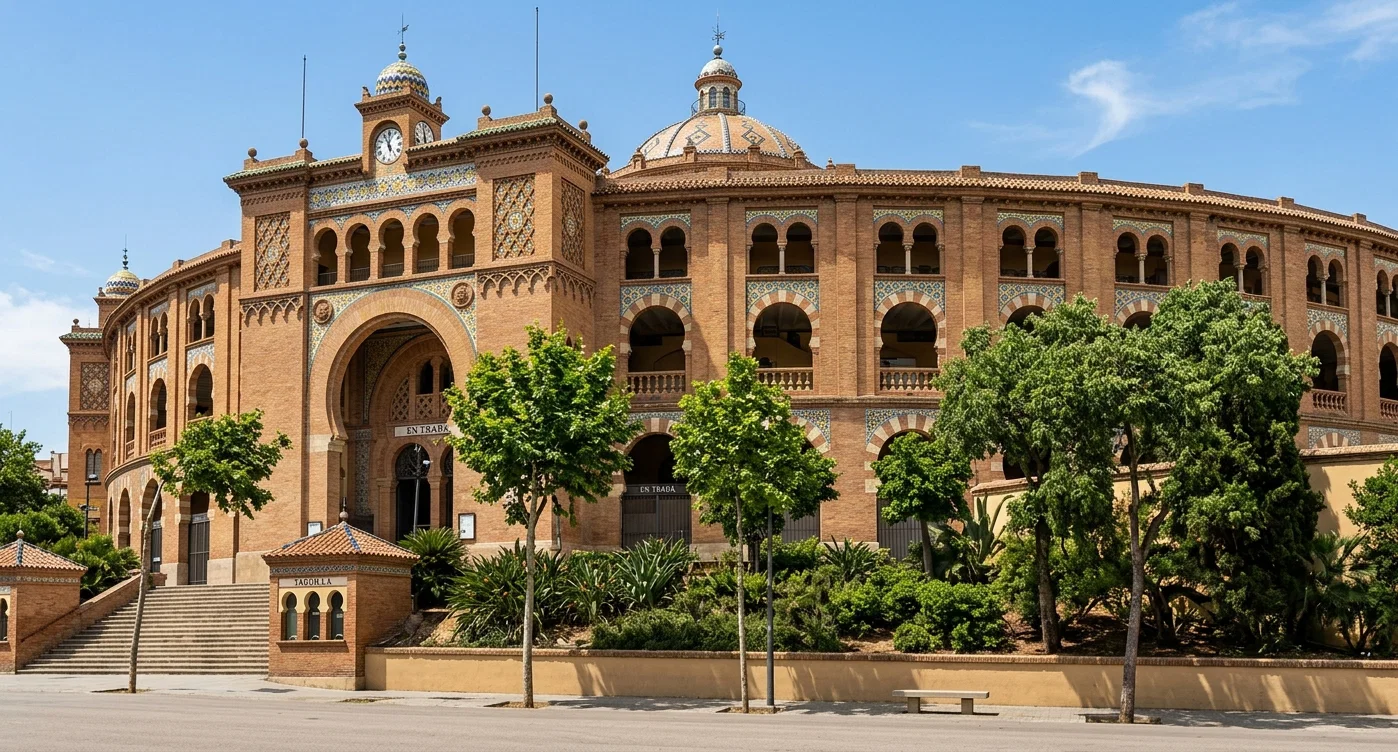
Recently the church of England opened its new building in Barcelona for the benefit of the English colony and all English-speaking people. That very morning a long article appeared in the chief papers, from the bishop of Barcelona, protesting with all his power against such a procedure. He claimed that the law of Spain does not allow any Protestant place of worship to have symbols of Christianity exposed to the public gaze outside the edifice; that the only true church was the Roman Catholic, and that all others, whether Lutherans, Calvinists, or anything else, were all enemies of true religion, and should not be countenanced under any consideration; that all who were not of the Roman Catholic Church were heretics, and should be treated accordingly. But, despite all his raving, a letter came to him from King Alfonzo XIII, expressing his sympathy, and assuring him that the Protestant chapel would not be opened unless all exterior signs were taken down. Accordingly, the cross that had been placed in front of the church was removed, the building was opened, and the service was conducted in peace. This Protestant victory has caused quite a stir in this place, and, of course, at present there is an unusual degree of bitter opposition toward the “heretics.”
AMPHITHEATER AT BARCELONA, WHERE THE BULL-FIGHTS ARE HELD
A little while afterward we went, in company with a Roman Catholic lady with whom we are working, to her church, to hear the sermon of a distinguished priest. This man, too, raved against all Protestants, saying that their places of worship were synagogues of Satan, etc., and affirming that it was Protestants who burned the Roman Catholic martyrs in Austria in the sixteenth century, and who were being beatified that night.
While canvassing for our literature recently I was interrupted by another priest, who wanted to know what authority I had for propagating such doctrines; he abused me with all the words at his command. Presently I asked him if he thought the Inquisition was of the Lord. He said, “Yes,” and that it would be a good thing again, under certain conditions.
The Roman Catholic lady previously mentioned was anxious for us to converse with her priest about the studies we had given her, and as we failed to see him the last time we went with her, at her request we went with her this morning again, for we are anxious to win her for the truth. We realized that perhaps it was not the best thing to do; but fearing she would lose confidence in us if we refused to go, we decided to accede to her request, although we had been warned not to go. This man is an eminent German prelate, and, as he was once a Protestant, our friend thought we could not do better than talk with him upon Bible subjects, which she told us she was incompetent to do.
We met the man in his vestry, and at first he told us he had plenty of time at his disposal, if we were not in any haste. Finding that he occupied all the time in telling us how he became a Roman Catholic, I interrupted him, saying that I had some questions to ask. However, he continued a long time, and eventually came to a point where I began to object, and when I asked him some questions, he said he could not answer me in the little time left, and that he was already called for. We finally parted, being more persuaded than ever that they do not wish any one to question their doctrines. What the church says, we are expected to believe.
But people who are not church-goers are tired of Roman Catholicism, and there was actually a revolution in Valencia not so very long ago, when about fifty people were killed and wounded, the priests being armed with revolvers. Surely the night of Spain’s oppression is far spent, and we believe we can hear the watchman say, “The day of her religious liberty is about to dawn.”
Last month six English war-ships visited this port, and about two thousand of the men came on shore. We seized the opportunity to distribute our literature, and soon engaged in friendly conversation with two of the men. They told us some very interesting things about their new war-ship, which was launched only last year. It is fitted up with all the latest improvements (?), and has guns that fire shots weighing over eight hundred pounds, a distance of seventeen miles, with such accuracy that there would be no possibility of missing the target. These remarks reminded us of the violence like that of the days of Noah which will precede the coming of the Prince of Peace. We had some spiritual talk, and prayed with these men, and gave them some reading-matter on present truth.
We are glad to be able to say that our meetings are now better attended than formerly. Our landlady, who is a woman of means, has visited us twice, and listened with profound attention, though the ignorance displayed by even well-to-do people regarding the Bible is sad. Let every reader pray for her. If she renounces Roman Catholicism, she will at once become an outcast of society, and be regarded as one possessed with the devil. Nobody in a Protestant country can realize the difficulties that attend our work in Spain, and we are longing for the Lord to work in a special manner.
In my last I referred to a man who14said he received his first Bible lesson from me. I am glad to say he continues to manifest a good interest in the Bible. He told me last week that he had not ceased reading the Scriptures since coming to our house. He also comes to our Sabbath meeting, and we believe he is walking in the light.
Lately we have been holding some meetings in part of a large stable where a poor coachman lives, in this city. We go every week, and the interest is increasing. We therefore look for some good results.
Barcelona, Spain.
Newfoundland and Labrador
By F. A. TRACY
F. A. TRACY
“THEY that go down to the sea in ships, that do business in great waters; these see the works of the Lord, and his wonders in the deep.” “Let them give glory unto the Lord, and declare his praise in the islands.”
Newfoundland, the most ancient of England's colonial possessions, was discovered by John Cabot and his son Sebastian, in the reign of Henry VII, 1497, and Aug. 5, 1583, was formally taken possession of by Sir Humphrey Gilbert, in the name of Queen Elizabeth, and incorporated into the realm of England.
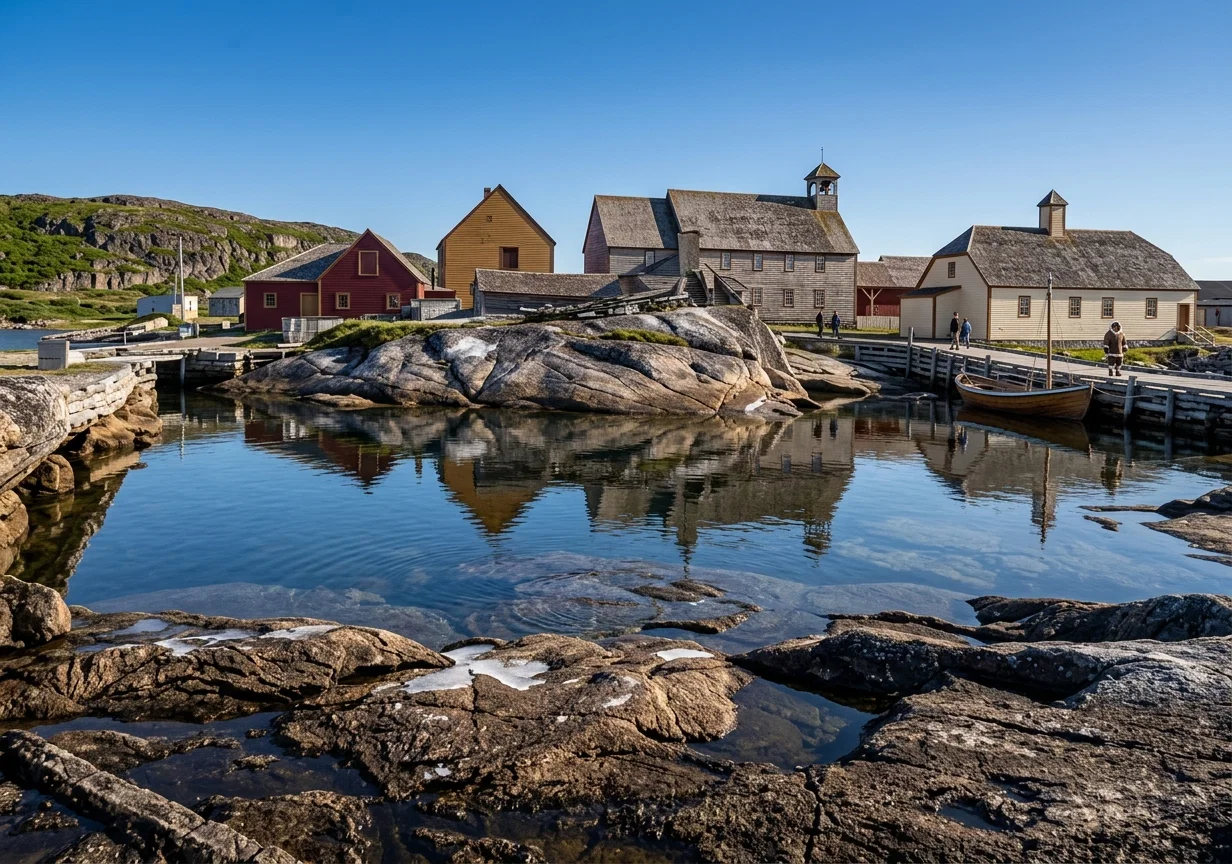
HOPEDALE (LABRADOR) MORAVIAN MISSION
The coast is everywhere rocky, massive, and abrupt, rising in some places to a perpendicular height of seven hundred to one thousand feet. The banks of Newfoundland are large submarine plateaus, lying to the east and southeast of the island. The Great or Grand Bank is the most extensive submarine elevation known to exist in any ocean. It is six hundred miles long, and two hundred miles broad. Off the shore of these banks is the natural home of cold-water fish, as the cod, etc., which have been frequented by Europeans for the purpose of the cod fishery, ever since the year 1500. The codfish is more abundant here than in any other portion of the globe. The fishery gives employment to about one half the population of 202,000.
Owing to its insular position, the climate of Newfoundland is much modified by the surrounding ocean. It is cooler in summer, and less rigorous in winter, than any part of the adjacent continent within the same parallels of latitude. Its chief drawback arises from the presence of the arctic ice, which usually drifts along the east and northeast coasts during the months of February, March, and April, chilling the atmosphere, but coming laden with myriads of seals, which are one of the chief sources of wealth to the colony.
The seal fishery gives employment to about ten thousand men during the months of March, April, and May, and is vigorously prosecuted by powerful steamers built expressly for contending with the ice from the arctic regions. The annual average value of this fishery is about one million dollars.
Newfoundland, up to the beginning of the present century, had little to commend it as a field of enterprise to the farmer. Before that time the cultivation of the soil was held to be a penal offense. The direction of capital was oceanward, not landward.
The whole of the interior is one vast game park for the sportsman. With the exception of one small town on the railway, there is no inland settlement on the island.
St. John's is the center of nearly all the trade of the country. The population numbers thirty-five thousand. There are only two other towns of importance. The rest of the population is scattered along the shore, in small settlements.
The standard of present truth has been planted in St. John's about nine years, and we have a neat little church building, with a membership of twenty-seven. There are no Sabbath-keepers in other parts of the island, and very little work has been done in what are called the “outports.” Though our work is small, and we have no general council or conference meetings to attend, we rejoice to have a part in the closing work of the gospel.
Separated from Newfoundland by the Straits of Belle Isle is Labrador, under the jurisdiction of Newfoundland, having an area of one hundred and sixty thousand square miles. It is one of the most barren and desolate regions in the world. The northern part is the proper home of the Eskimos, who number about fourteen hundred. The southern part is sparsely settled by European colonists, who numbered in 1891, 2,706. The Eskimos live almost entirely by fishing. They are nearly all Christianized and civilized, through the praiseworthy exertions of the Moravian missionaries. The Moravians, or Unitas Fratrum, have had missions established on this coast since 1765.
While so much work and effort is being spent on pleasant, populous places of the world, I wonder if Jesus will come while we neglect to follow the noble missionaries who have gone before and given to this people the message, or are they included in the “every people” of Rev. 14:6?
After living in Newfoundland nearly one year, and learning something of the country, we wonder if any one will come over and help us in “hasting the coming of the day of God.” Our faith is strong in him.
St. John's.
Hungary
By J. F. HUENERGARDT
J. F. HUENERGARDT
The people of God are always glad to hear that the message has reached a new people, and is being proclaimed in another tongue. Last summer, we were able to report to our brethren the organization of our first Slavonian company of believers in Hungary; this summer, we are already able to see the work advance among the Servians.
History students will know that Hungary is a part of that territory which was for hundreds of years the battle-ground of nations. Before, during, and for some time after the division of the Roman empire—and especially in the fourth and fifth centuries A. D.—Hungary was, so to speak, everybody’s and no man’s land. This is the reason so many different peoples and languages are found here.
The work was first begun among the German-speaking people. Soon after, however, some Hungarians embraced the truth, then a few Russacasiens; after that some Slavonians; and now we hope soon to organize the first group of Servian believers. Several are already keeping the Sabbath, and supporting the cause of God according to their ability. For this we are especially thankful to the Lord, and our hearts are filled with hope that we shall soon find some who will be able to begin the work in Servia—about the only country in Europe which Seventh-day Adventist workers have not yet entered. It is a sad fact that other Christian denominations have also left this country almost untouched. Brother Todor, one of our Hungarian Bible workers who speaks the Servian language quite fluently, is now working among the Servians in Hungary. We hope and pray that there may soon be developed workers who will be able to labor in Servia proper.
On my last trip among the Servians in Hungary, I found a man who, several years ago, heard of people who kept the seventh-day Sabbath. He at once wrote letters to Hamburg and other large cities in Germany; but not being able to address the letters correctly, he had no success in finding us. He then wrote to Budapest and several other cities in Hungary, but with no better results. At last, through the agency of the Bible15Society, he received my address in Budapest, and so wrote to me. This man now rejoices in the truth, and through him others have accepted it.
On this same occasion I visited a community where a number of Servians and Slavs came together to inquire about the truth. These people have been keeping the Sabbath for a number of years, but were not yet clear on the tithing question and health reform. We prayerfully discussed these questions in several meetings, but without success. Finally the Spirit of the Lord led us to relate the experience of this people in the early days. I told them that at the beginning of this movement many were united on the Sabbath question, but would not unite on account of divers questions upon which they could not agree. This had proved a great hindrance in the cause of God, and delayed the work. The Lord, however, gave his people the spirit of prophecy, according to the Scriptures. Eph. 4: 11-14; Rev. 12: 17; 19: 10. By this spirit of prophecy he brought union and harmony into the lives of his people, and organization. The tithing system and all other truths were accepted. Our past experience has shown us that the Lord has blessed his people since, and I would advise them also to believe in the Lord and in his prophets, that they might be prospered.
This brought a sudden change over the whole meeting, and even the one who most strongly objected, declared: “I will not contend against the Lord.” We thank the Lord for these victories, and hope soon to be able to report greater success.
I will close with just a word to our American brethren and workers in the large cities of America, about our little Hungarian paper, Az Arato. We would like to call your attention to the many Hungarians who emigrated to Chicago, Cleveland, Cincinnati, Philadelphia, Boston, New York City, and other important cities of the States. We will gladly send addresses of families who have already heard the truth here, and will also distribute copies of our paper among them. We have twenty millions of people here in Hungary, and only a few workers to spread the message. We need your prayers and help, dear brethren. Who will respond?
Rakosszentmihaly, Raikoczy utcza 11, Via Budapest, Hungary.
New York
By S. H. LANE.
WE are now running five tents in this State. The meetings are fairly well attended. Our canvassers are doing well. They are selling from five hundred to eight hundred dollars' worth of books each month. Their deliveries are good. They sold three hundred and six dollars' worth last week. Some good souls are embracing the truth.
We have purchased a school farm of two hundred acres, and have it paid for. We held the Tunesassa local camp-meeting on it, and the campers cleared, during the meeting, nearly six acres of the land. We now have two acres and a quarter in potatoes and buckwheat.
Five persons were baptized at the close of the meeting. There were about one hundred and fifty in attendance. The meetings were of a deep spiritual nature. The only drawback to the meeting was the almost constant rain, but all were cheerful and happy. On Sundays the outside attendance was good, considering the falling rain. One young lady living near the ground became deeply interested, and desired to embrace the truth; but her father threatened to turn her away from home if she did. However, she was baptized.
S. H. LANE.
Mexico
By Geo. M. Brown
SINCE my last report to the REVIEW some changes have taken place in our field. Brother John Harzman has removed from Cuautla to San Luis Potosi, with a view of following up the interest that had been developed there through the work of Brother Bodwell and the circulation of the paper.
Brother Blachley, who is still engaged in the Bible work, is now living in Lerdo, State of Durango, and Sister Blachley and the little girl, nine years old, have been selling papers and tracts with good success. In the adjoining towns of Gomez Palacio and Torreon some are keeping the Sabbath, and others are deeply interested. It is planned to increase our field work by releasing Professor Caviness from the details of the printing of our paper, and he will soon go to Lerdo to develop the interest that has sprung up there.
One lady has recently begun the observance of the Sabbath in Tacubaya, and we have good reason to believe that her husband will soon join with her. This is a part of the visible results of the work of Brother Pedro Godinez, a Mexican who has been employed by the mission for the last few months.
I am now at Guadalajara, where I find the brethren and sisters of good courage. Brother M. V. Erkenbeck, who has been doing faithful work in the selling of the little paper, reports many interesting experiences, and says that he believes that there is a constantly increasing number of persons who are becoming interested. The Catholic clergy have warned the people against our paper, and have tried to keep them from reading it, but Brother Erkenbeck's sales continue to be as large as before.
One fanatical man threatened to stab our brother, and several times our native Brother Don Cruz Lopez has been threatened in a similar way. It takes courage to carry forward the work under such circumstances, and we thank God that he has raised up men of courage to do this work. We pray for more. We trust in God, and hope to be counted worthy to suffer affliction for his sake.
GEO. M. BROWN.
Burma
By L. F. Hansen
INSEIN.—We are glad to be in Burma. This is in some respects the most hopeful of the Indian provinces. Here are several Burmans who are working hard to publish the truth. When Brother Meyers came to Burma three years ago, he met a Burman who had been a Sabbath-keeper for two years. Two of her brothers are joining in her work. One especially, whose name is Mong Mong, you have doubtless heard of. He works from the love of the truth.
Burma is practically a Baptist field, but doors are open to other denominations. Methodists, Presbyterians, Church of England, and Catholics are all permanently established. And now we have secured a permanent meeting hall in what was formerly a Baptist church. Our people and our friends are all much encouraged over this step. God moved in a marked manner in our behalf. We realize the truth of this saying, “I have placed before thee an open door, and no man can shut it.”
We learned many bitter lessons in Calcutta in regard to securing suitable living quarters. Here we profited by these lessons, and did not rest until we were sure that our company was in a healthful, cheery location. I know that, through zeal for the work and a self-sacrificing spirit, we sometimes wrong the cause by neglecting these matters; and many a noble soldier of the cross has laid his armor down all too soon from sacrificing absolutely necessary personal comforts. The Lord opened up the way for us to live in one of the suburbs of Rangoon, and we are grateful for our situation. In some parts of India it is less malarious and less enervating to live on the second floor. Here in Burma almost everybody lives on the second floor; for the houses are built on high posts, raising them from twelve to fifteen feet from the ground.
The Burmans are neat and clean, independent, and attend to their own business. They are of the Mongolian race, and in many things remind one of the Chinese. The latter, however, are not wanting, for nearly all mechanics and tradesmen are Chinese. The Burmans follow literary pursuits, that is, the men. The women are famous for their ingenuity in housekeeping and producing wherewith to do. In fact, they are reported to far excel the men in ability to acquire wealth. All can read.16Even in Judson’s days, this was the case. The Burmans, of all the Eastern people, seem ready for the gospel; and the past experience testifies to this. Burma has to-day many thousands of believers in Jesus Christ. May the Lord of hosts arise and capture India quickly.
L. F. HANSEN.
North China Mission Progress
REPORTING the increase of work in the North China mission, the missionaries of the American Board make the significant statement that, instead of the Boxer movement destroying missionary operations in China, it has “set it forward a quarter of a century.” During the last year they received six hundred and ninety-nine persons into the church, and have a thousand more on probation. They add: “How we worked and prayed and waited in the old days for a single convert! And here are more than a thousand knocking at the door of the church.”