The recent action of a Roman Catholic priest, at Irvington, N. Y., seems likely to lead to results quite beyond his calculation. He will have served both his own church and Protestantism, if what he has written to Miss Gould awakens Christians of every name to reconsider the relative place and value of the English versions of the Bible. Still more is it to be desired that the true position of Romanism and Protestantism with reference to the Bible in all languages should be clearly understood. There is a true sense in which it may be said that the Bible, and the Bible only, is the religion of Protestants. Would to God it were true of Roman Catholics in equal measure. But in spite of Father Early’s easy assurances, historical fact establishes the negative. It is quite true that individuals, and sometimes even high ecclesiastics, have sought a better way than that which prevails in the Roman Church ordinarily, and especially since the Council of Trent. The prohibitions and restrictions with which that council hedged up Bible reading were practically prohibitive of any large use of it by the common people. Even scholars were forbidden by its decrees to read versions of the Old Testament made by “heretics,” unless they obtained permission of the bishop, and no scholar was allowed to read such versions of the New Testament under any circumstances. This was the culmination of a succession of precedent deliverances, the sum total effect of which was to make the Bible very largely an unknown book to the mass of the people. For instance, as early as 1080 the king of Bohemia asked Pope Hildebrand if he might have the offices and prayers of the church performed in Slavonian, which was then the common language of the north of Europe. The pontiff replied indignantly refusing, on the ground that it was the will of God that his Word should be hidden lest it be despised if read by every one.
In 1220 the Council of Toulouse, held under the presidency of Romanus, cardinal and pope’s legate, forbade the laity even to possess any of the books of the Old or New Testaments, except perhaps the Psalter, and having any of these translated into the vulgar tongue was strictly forbidden. It is noteworthy that this is the council that first established the Inquisition, whose horrid cruelties, continuing for centuries, deluged Europe with blood, and left a scar on the face of the world, which time has not yet obliterated. This hideous institution aimed inter alia at the suppression of Bible reading on any large scale in the vernacular language. The reason for all this is plain. Free Bible reading means private judgment. This Rome denies always. It is all very well to say, as Roman apologists are fond of doing, that they simply desired to keep the Bible in the custody of the church, and secure correct translations under proper ecclesiastical guarantees. This is doubtless an admirable ideal, but has it been sincerely followed by the authorities of the Roman Catholic12Church? The whole of history refutes so monstrous and absurd a claim. Our English Version is a case in point. Father Early avers—and doubtless believes—that the Protestants had no Bible before the reign of Henry the VIII. Why had they none? Whose fault was it that they had none? It might be said that there were not many Protestants to have any Bible, but there were multitudes of people in the Roman Church groaning under the intolerable bondage of a corrupt priesthood, who earnestly desired to read the Bible for themselves. How much aid were they given by pope or prelate? Apparently Father Early has never heard of John Wycliffe, one of the greatest of the schoolmen, a master of Baliol College, who has had no superior since in his intellectual acumen, his heroic courage, and the extent of his influence. The Protestants—that is, the Lollards of his day—had his translation of the Bible more than a century before Henry the VIII. It could not be printed, and was not until long after his death, by reason of the same intolerant spirit which modern apologists for Rome exhibit, even while they deny that it ever existed. He succeeded, however, in giving his translation a considerable circulation in manuscript, and we need not rehearse here how his body was dug up and burned, and his ashes cast into the Swift, a neighboring brook. “And thus,” as quaint Thomas Fuller wrote, “this brook hath conveyed his ashes into Avon, Avon into Severn, Severn into the narrow seas; they into the main ocean. And thus the ashes of Wycliffe are the emblems of his doctrine, which now is dispersed all the world over.” Then came William Tyndale, a century and more later, who took up the noble task that Wycliffe had begun, and laid the foundation of our English Bible. Is it necessary to tell over again the heroic story of his struggles and his sufferings, of whom the world was not worthy,—how his Bibles were burned, and he was hounded through the earth, and at last suffered at the hands of the Roman Catholic authorities at the stake, for the offense of putting the Bible into a language that the people could understand? These are facts, so well known that it ought to be unnecessary to restate them. One might as well deny that the American colonies revolted from Great Britain in 1776, as deny the dreadful truth that pope and council and Inquisition have persecuted to the death men and women for daring to translate or to read God’s holy Word. Nevertheless, it ought not to be forgotten that there has been a better side to Roman Catholic practise. The Douay, or Rheims, Version, illustrates this. It was made under the auspices of the Roman Catholic College at Douay, and at Rheims, under the leadership of Cardinal Allen, an English scholar, for the avowed purpose of supplanting the heretical versions, which it bitterly denounces in the preface. The publication of such a version under papal authority, may, therefore, fairly be quoted as an evidence of the occasional acceptance by Rome of Protestant practise different from her own. There is, however, one sentence in the preface to the Douay Version which betrays the animus with which the work was undertaken: “Perhaps indeed it would have been more desirable that the Scriptures had never been translated into barbarous tongues. Nevertheless, at the present day when either from heresy or other causes, the curiosity of men—even of those who are not bad—is so great, and there is often also special need of the Scripture in order to refute our opponents—that it is better there should be a faithful and Catholic translation than that men should use a corrupt version to their peril or destruction.”
Here we have the essence of the Roman Catholic position, stated by its most intellectual exponents. It may be summed up thus: Never translate the Scriptures into the “barbarous tongues,” unless you are driven by your Protestant adversaries to do so. If to this were added the further rubric, Never allow even your own translation more than a very limited circulation, the case would be fairly stated. In proof of the justice of the latter assertion, we may cite the testimony of the editor of the Tablet,—a Roman Catholic periodical,—who mournfully confessed, in a somewhat recent issue, that whereas the American Bible Society had issued the year before one million five hundred thousand copies of the Scriptures, careful investigation had satisfied his mind that the Catholic Church in America had not bought in a year twenty-five thousand copies of their own Bible. If they have bought so many, it is probably in excess of the average for the last thousand years. The meager circulation of the Scriptures in Roman Catholic countries is undoubtedly due to the general attitude which has been taken by the ecclesiastical authorities. Our King James Version—whether in its original form, as published in 1611, or in what may fairly be called its Revised form, as now published both in England and America—is a monument to the heroic patience of the Protestant saints, who from Tyndale’s day onward, pushed forward the perfecting of an adequate translation. Protestants indeed had no publicly recognized version before the time of Henry VIII, and that monarch himself, whom Romish apologists now sneer at, at first forbade the circulation of Tyndale’s Version. But after Tyndale came Coverdale, with his Bible, 1538-1553, and then Matthew’s, which is to be believed to have been the work of John Rogers (also burned to death at Smithfield in 1537), and then Taverner’s in 1539, and then the “great Bible” also in 1539, and Whittingham’s in 1557, and then the wonderful Genevan Version in 1560, and the Bishop’s Bible in 1568—a glorious linguistic pedigree for the great classic masterpiece of 1611. The breadth of scholarship, the faithfulness to the letter and spirit of the inspired originals, the masterful comprehension of the labors of preceding translators, have extorted reluctant homage, even from our Catholic opponents, in favor of the King James Version—a veritable king it is among books and among translations.
It is worthy of special mention at this time that the Catholic, or Douay, Version, exercises recognizable influence upon the King James Version. An Irish scholar, Dr. Carlton, of Dublin, has recently drawn out in considerable detail the influence of the Rheims, or Douay, Version, on our English Version. The revisers of 1881 in their preface refer to the evident traces of the influence of the Catholic Version on King James. This was as it ought to have been. It is fully congruous with the spirit of Protestantism, and, alas, as clearly opposite to the spirit which usually dominates the Catholic Church. The Douay scholars unfortunately made their translation from the Latin Vulgate. A translation of a translation can never compete with one from the original. But they were scholars, conversant with the Greek of the New Testament, at least. They found it impossible to shake off the defects of the Vulgate altogether, and the flavor of Roman Catholic doctrine is unmistakable in their work.
Within the limits of such an article, it is impossible to go more into detail. The naive confession quoted above from the preface of the Douay Version, is often sadly illustrated in the experience of our modern Bible societies. Rome makes no vernacular translations ordinarily except when she is forced to do so by an aggressive evangelizing Protestantism; then she does. This is true in Italy, where after papal denunciation leveled at Bible societies, the papacy itself has come to Protestant ground in so far that they have organized a Bible Society—a society that is of St. Jerome, that has made a fairly good New Testament vernacular version in Italian, and circulated it at cheap prices in Italy. “Shades of the Inquisition,” avenge the outrage! In Brazil similar things have been attempted in Portuguese, and in France also some time ago. The preface to the Italian translation refers to Protestants as our “separated brethren.” God be praised for such a sign of the return of some Roman Catholics to the ancient practise of giving the Bible to all that be of the household of faith. May our “separated brethren” of the Church of Rome be led to give up Bible burning as they have been compelled to give up the burning of Bible translators. Meanwhile let Protestants put into our hands, who are charged in the Bible Society with this work, on behalf of all the churches, a larger support to enable us to give the Book to the people of every tribe and tongue.—John Fox, D. D., Secretary of the American Bible Society, in the New York Observer.
Where the Saviour Leadeth Me
By M. V. Thomas
WHEN days are dark and dreary,
And the light of hope is gone,
And my soul would fain grow weary
Ere the work of life be done,
Then speaks a voice to me,
“As thy day thy strength shall be.”
And, trusting, I will follow
Where the Saviour leadeth me.
When the way is filled with danger,
And my heart grows faint with fear,
I would wander forth a stranger,
His tender voice I hear:
“Come, put thy trust in me;
I will be a shield to thee.”
And, trusting, I will follow
Where the Saviour leadeth me.
Whene’er the sky is lowering,
And earth is filled with gloom;
And the mists of doubt o’erpowering
Hide all beyond the tomb,
Then the promise comes to me
Of pardon full and free,
And, trusting still, I follow
Where the Saviour leadeth me.
— M. V. Thomas.
God’s Heroes
There is a yet harder and higher heroism to live well in the quiet routine of life; to fill a little space because God wills it; to go on cheerfully with a petty round of little duties, little vocations; to accept unmurmuringly a low position; to smile for the joys of others when the heart is aching; to banish all ambition, all pride, and all restlessness in a single regard to our Saviour’s work. To do this for a lifetime is a greater effort, and he who does this is a greater hero than he who for one hour storms a breach, or for one day rushes onward undaunted in the flaming front of shot and shell. His works will follow him. He may not be a hero to the world; but he is one of God’s heroes; and, though the builders of Nineveh and Babylon be forgotten and unknown, his memory shall live and be blessed.—Canon Farrar.
A Comforting Word
THE Bible speaks to us; it answers our questions; it comforts us with its sweet promises; it is a companion, a living friend into whose society we can go when we will; and find sympathy. The Bible is God’s Word, and, when God speaks, it is as the ever-living and the omnipresent One. It is like a letter,—everything in it is special, personal; meant for you, for me. It speaks so sweetly and clearly that a child can understand its blessed words of life. It tells us all we need to know of the great mystery of his providence and grace. It becomes our Bread of Life when we love, believe, obey.—Selected.
What Is Truth?
We search the world for truth. We cull
The good, the pure, the beautiful
From graven stone and written scroll,
From the old flower-fields of the soul,
And, weary seekers for the best,
We come back laden from our quest,
To find that all the sages said
Is in the Book our mothers read.
— Selected.
The Welcome Back
By Eliza Cook
SWEET is the hour that brings us home,
Where all will spring to meet us;
Where hands are striving as we come,
To be the first to greet us.
When the world hath spent its frowns for the day,
And care hath been sorely pressing,
'Tis sweet to turn from our roving path,
And find a fireside blessing.
O, joyfully dear is the homeward track,
If we are but sure of a welcome back!
What do we reck on a dreary way,
Though lonely and benighted,
If we know there are lips to chide our stay,
And eyes that will beam love-lighted?
What is the worth of your diamond ray,
To the glance that flashes pleasure:
When the words that welcome back betray,
We form a heart’s chief treasure?
O, joyfully dear is our homeward track,
If we are but sure of a welcome back!
— Eliza Cook.
MRS. ANNA L. COLCORD
By Mrs. Anna L. Colcord
Cleanliness
MRS. ANNA L. COLCORD
(Concluded)
VENTILATION, especially of the sleeping rooms, may also be considered under the laws of cleanliness. The breathing of foul, impure air enfeebles the body, and causes a feeling of stupor and mental depression. It costs no more to breathe pure, fresh, invigorating air than it does to breathe close, impure, vitiated air, for it is one of God's free gifts, and if we do not have it, it is our own fault. Health and activity are dependent upon the vitalizing action of pure air upon the blood. The little birds that flit so rapidly through space breathe an abundance of pure air; while the sluggish toad that sits contentedly in the quagmire breathes almost none at all.
The young colored student of Tuskegee Institute showed good, practical common sense when she took for the subject of her graduating essay, “The Proper Care of the Bedroom.”
Besides being an essential to health and prosperity, there is also a moral aspect to cleanliness. The connection between the mind and the body is intimate. One acts and reacts upon the other. The mind is more or less influenced by the outward surroundings. It is impressed and educated by what is seen as well as by what is heard. Habits and customs weave themselves into the whole character. Purity and elevation of thought will naturally result from habitual purity and cleanliness of body and home. High thinking and low living do not go together. Clean thoughts and unclean habits and surroundings are not compatible with each other. The body is the temple of the soul, and should be kept in a proper condition to be a fit residence for the indwelling of the Holy Spirit.
Our senses are given us for a purpose. Wherever there are foul odors and unsightly views, we may know a work of cleansing needs to be done. Order and cleanliness are twin sisters. They go hand in hand. Those who allow heaps of rubbish to accumulate about their houses are lacking in both good order and due regard for health. It is an easy matter to fall into disorderly habits; to allow sticks, pieces of broken boards, piles of tin cans, rubbish, and the like to lie about. All this is obnoxious to good taste. A person of orderly mind will seek to remedy such defects. Even a bent-over post he will endeavor to straighten up.
The spirit of cleaning up is catching. The story is related of a little girl from a back alley who at school was induced to wash her hands and face. Seeing her improved appearance, the whole family began to wash up. The neighbors, noticing the improvement of the family, began to tidy up. Before long the whole alley was cleaned up; and all as the result of one little girl washing her hands and face. Even little children catch the spirit. When they see older ones making a raid on the rubbish, of their own accord they will join in and help in the work.
It is an old saying that cleanliness is next to godliness. But we think the statement may be improved, and the truth more nearly expressed in saying that “cleanliness is godliness.” Cleanliness is purity, and to be pure is to be like God. God designs that we shall be clean. When he brought his people out of Egypt, he gave them explicit instructions in regard to cleanly habits and wholesome sanitation. No impurity was to be allowed in the camp. All refuse or decomposing matter was to be either buried or burned. And as God does not change, he can be no less particular with his people in this respect to-day.
Of all people in the world Christians ought to be the most cleanly. And of all Christians in the world, we who have received such an abundance of light and instruction on these matters, should be models. Everything around our dwellings should be clean and neat. Sinks, sewers, drains, vaults, etc., should be frequently and thoroughly disinfected. Dry earth, coal ashes, air-slacked lime, and raw carbolic acid (a poison) diluted with water, make good disinfectants. Decayed fruit and vegetables should not be allowed to remain in the cellar. Weeds, burs, and rubbish should be destroyed. For these no disinfectant is equal to fire. Anything like vermin should not be tolerated. Every plant has its parasite, every living thing its pest. All parasites, pests, weeds, thistles, and thorns are the result of sin. And just in accordance as we hate sin, so we should hate these, and endeavor to exterminate them. A person who can sit contentedly amid squalor and dirt, can remain contentedly in sin. It is not enough that we have a knowledge of the laws of health and temperance. We must put into practise what we know, or our knowledge is of no account.
In our person we should be models of purity and cleanliness. Especially should we see that everything about us is scrupulously clean on the Sabbath, when we come to appear before the Lord.
The Lord has told us in his Word that no filthiness or uncleanness should exist in our midst, and has admonished us to cleanse ourselves from all filthiness of the flesh and of the spirit, perfecting holiness in the Lord.
The thought that we are soon to enter heaven and associate with the pure and holy angels should inspire us to habits of pure and holy living.
The Latest Methods of Dealing with Consumption
By Lawrence F. Flick
It is not surprising that the employment of the elements of nature, such as pure air and sunshine, should be beneficial in the treatment of pulmonary diseases, but perhaps only in recent years has their importance been fully appreciated. In former years patients suffering from a variety of diseases were believed to be at least aided by proper ventilation of the sick chamber, if not by the sun’s rays. It has been recognized, however, and especially by physicians who have devoted their attention to a careful study of the disease, that tuberculosis can be cured by what is popularly termed the “open air treatment,” provided it has not reached a stage which is too far advanced. I believe I am justified in making this assertion by the results which have thus far been obtained in institutions especially constructed and equipped to aid nature in her work of restoring health. Some of the sanatoriums of this class, intended especially to receive sufferers from pulmonary complaints, have been in existence long enough to prove that the method is no longer an experiment, and the man or woman who takes advantage of it before the system is too seriously affected has far more a fighting chance for complete recovery.
Perhaps an outline of what has been accomplished at the White Haven Sanatorium may be of interest in this connection. When White Haven was opened on the Pennsylvania hillside, the buildings consisted of a tumble-down old barn and a very dilapidated small farmhouse located on a tract of two hundred and fifteen acres of mountain land. The Free Hospital for Poor Consumptives, which established it, had no money on14hand with which to begin a well-equipped sanatorium, and there was no prospect of getting any in the near future; so it was decided to begin in the humblest way, and depend upon Providence for the financial resources as the work developed. A few comfortable single beds of ordinary hospital pattern and make-up were put on the barn floor for the patients; a little room in the farmhouse was plainly furnished for the superintendent, and another for the cook; a small kitchen range was secured, and placed in a very primitive kitchen; a table and a few benches were made out of old boards for dining-room furniture, and a few dollars were expended for kitchen and dining-room utensils. This was practically the entire equipment, and the cost was but a trifle.
When the board of managers talked over the matter of opening the sanatorium, it was thought that under no circumstances could the capacity of the institution be increased beyond twenty-five beds during the first year. It was soon found, however, that this limitation could not be adhered to. The most urgent appeals came from everywhere, and as it was possible to pay the bills at the end of each month, a few beds were added from time to time. At the end of the first fiscal year, there was a capacity of eighty beds, but in spite of this increase there was a waiting list of over one hundred patients, and the pressure for admission was greater than it had been at any time. During the first year there were one hundred and fifty-six admissions. Of these, sixteen remained less than a week, and eighteen more less than a month, making a total of thirty-four who remained less than a month. Some left because the place was too primitive, some because the weather was too cold, or because they were afraid to sleep in a draft, some because the associations were not good enough, and a few had to be discharged for breach of discipline. The results which were obtained, however, during the first year were far beyond expectation. A majority of the patients who remained over three months either recovered their health sufficiently to return to their avocations or are making rapid progress toward that condition. Quite a large percentage of the patients left as soon as they were well enough to go to work, promising to keep up their treatment at home. Some of these have done well, and it is quite possible that, with the knowledge they have gained at the sanatorium and the habits of life which they have formed, they will progress to recovery while pursuing their callings. In age the patients ranged between nine and sixty years. The majority were of the age of greatest activity and usefulness in life; namely, between twenty and fifty years.
The treatment at the White Haven Sanatorium has been outdoor life, a carefully selected diet, regulation of exercise, and medication for the improvement of nutrition. The patients practically are kept in the open air for the twenty-four hours, irrespective of weather. At night all the windows in the pavilion are kept open, so that the air circulates freely throughout the sleeping apartments. Drafts are disregarded. Ample bed-covering is supplied to keep the body warm, and in cold weather bed-warmers are furnished the patients. In daytime the patients either sit out of doors or work. The camp life is one of the unique features, but thoroughly enjoyed by the patients. The summer camps amid the trees are near enough to the buildings to allow the latter to be easily reached when the dinner hour comes round. In them congenial groups pass most of the day in chatting, reading, or with games, the women often busying themselves with needlework of some sort. Each camp represents a little social club, where it is easy to forget one’s ills amid the cheerful surroundings. Very simple structures are they. Any material available is used for the roofs and walls. Planks or boughs fastened to convenient forest trees may form the sides, the trees being used for posts. Usually the southern side is left open; for they are merely intended as shelters in inclement weather, so that the inmates are to all intents and purposes in the open air. If warmth is required to make the camp comfortable, a small wood stove or perhaps an open fireplace is provided. During the winter months it must not be supposed that the camps are deserted, nor is outdoor recreation abandoned. Patients whose condition will allow them to go into the woods spend much of the time in these shelters, wearing sufficient clothing and wraps to prevent becoming chilled. The exposed side of the huts is not closed in winter, and it is often necessary to make a path through the snow to reach them.
While the camps, as already stated, are very popular during the period between May and December, a large number of those who are members of the community live under canvas; for tents are put up about the permanent buildings, and inhabited until the snow comes. As to the “winter” camps, not a few have been constructed by patients, with such tools as were available. They have used not only axes and saws, but even their penknives, and have gladly performed the labor in order to secure these resorts, where they may receive not only the benefit of nature, but enjoy the society of friends. . . .
When patients contract colds, as they occasionally do when some one comes into the sanatorium with a cold, they are at once put to bed, and kept there until they are over the acute stage. Colds always come in epidemics, passing through the entire sanatorium. As a precautionary measure the sanatorium has printed notices at the entrances to the grounds requesting people with colds to remain off the premises. The pulse and temperature of each patient are taken and recorded night and morning, and the weight is taken and recorded once a week. These records give an indication for the regulation of diet and exercise, and are carefully studied for that purpose. Patients who have rise of temperature and disturbed pulse-rate are not permitted to take any exercise. Unless a patient gains weight, his diet is incorrect, and an effort is made to correct it.
The sanatorium was opened ostensibly for incipient cases. It was impossible, however, to limit admissions to this class; first, because not enough of such cases could be secured, and second, because the pressure for the admission of other cases was too great to be withstood. Advanced cases were cautiously admitted, and upon it being found that they did well, the doors were thrown open to all subjects who did not show a rapid downward tendency. Of one hundred and fifty-six admissions in one year, there were only fifteen who might be termed incipient cases. Sixty-three had both lungs involved, and about ten per cent of the entire number had at least one other organ or tissue involved besides the lung.
A study of these and other patients, however, taught some valuable lessons: (1) that tuberculosis is curable under the most primitive conditions, provided the patient is kept out of doors and given plenty of the right kind of food. The comforts of life are of secondary consideration, and exposure to weather and cold may be disregarded; (2) that for successful sanatorium work patients should be carefully classified and kept apart according to the stage of the disease; (3) that tuberculosis is seldom recognized until it is far advanced, and that many patients continue to work when they have more than one important organ of the body involved; (4) that incipient cases recover in a very short time, and advanced cases require a long time for complete recovery.—Lawrence F. Flick, M. D., in The Independent.
A Dozen Good Rules
By Hope
We were struck lately by the orderly behavior of a large family of children, particularly at the table. We spoke of it to their father, and he pointed to a paper pinned to the wall, on which were written some excellent rules. We begged a copy for the benefit of our readers. Here it is:—
1. Shut every door after you without slamming.
2. Don’t make a practise of shouting, jumping, or running in the house.
3. Never call to persons up-stairs or in the next room; if you wish to speak to them, go quietly where they are.
4. Always speak kindly and politely to everybody if you would have them do the same to you.
5. When told to do or not to do a thing by either parent, never ask why you should or should not.
6. Tell of your own faults and misdemeanors, not of those of your brothers and sisters.
7. Carefully clean the mud or snow off your boots before entering the house.
8. Be prompt at every meal.
9. Never sit down at the table or in the sitting-room with dirty hands or tumbled hair.
10. Never interrupt any conversation, but wait patiently your turn to speak.
11. Never reserve your good manners for company, but be equally polite at home and abroad.
12. Keep no secrets from your parents.
—Hope.
The First Public Proclamation of the Third Angel's Message in Rome
By Chas. T. Everson
CHAS. T. EVERSON
LAST Sunday evening the first public proclamation of the third angel's message took place in the city of Rome. In a beautiful hall situated across the street from the Palace of Justice, and almost within the shadow of the Vatican itself, the first note of the final message was sounded in the seat of the beast. In the congregation that gathered for this first meeting there were present a president of a theological seminary of Rome, a Baptist minister, a lawyer, a leading journalist, and two ex-Catholic priests, one of whom has been a Jesuit professor.
Not the least interesting person was the preacher who gave the first discourse on this message which concerns itself so directly with the worship of the beast. It is quite significant that the first sermon of the third angel's message delivered in the seat of the beast was preached by a young man who was himself educated for the priesthood of the Catholic Church. This young man represents the first results of our work in the city of Rome, and is the first person to be converted to the truth in the city of Rome itself.
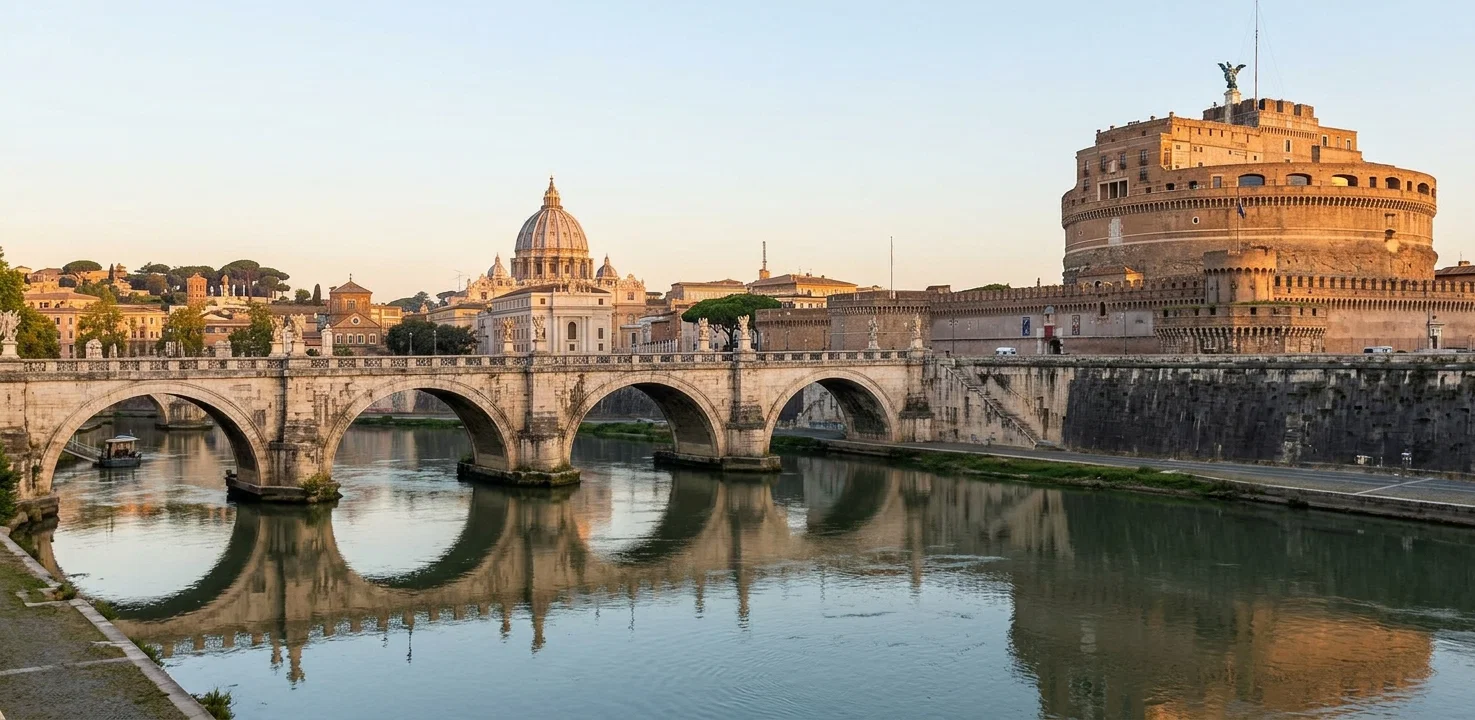
THE TIBER, ST. PETERS, AND CASTLE SANT’ ANGELO
His mother placed him under strong Catholic teaching when he was but a mere boy, with the purpose of making a priest of him. And the instruction of his youth had a powerful effect upon him, so that he regarded all Protestants, and especially Luther, in a very unfavorable light, and considered the Italian government a robber because it had taken Rome from the pope. When only seventeen years old, he preached in the Catholic church in a regular series of meetings which took place every day before large congregations, even the bishop being present at times.
He is well educated, having attended the higher schools and the University of Florence, and studied six years for the Catholic priesthood at their seminary. He got an insight into the corruption of the church suddenly one morning, which dissuaded him from entering the priesthood, and he began the study of the classical course at the university. During his course at the university he was married, and converted to the gospel.
Some time ago he came to Rome that he might fit himself to enter the work of the Lord. By providential circumstances he came in contact with us, and after holding studies with him, he was thoroughly convinced of the truth, and is now heart and soul in it. His wife is also enthusiastic in the truth. Being a fluent speaker in the Italian, and a very intelligent man, he is indeed a Godsend to the work in Italy, where we have no one who can well present the truth in the Italian language before a Roman audience. He also has some means of his own, although for two years he has been working at his own expense in the missionary work. It means much to have a man of refinement and education connected with the work in a city of classical culture like Rome. Brother Lattoni has many acquaintances among the Catholic priests, one of whom, a very intelligent professor, is becoming convinced that the Church of Rome is not the true church, and is thinking quite seriously of leaving it.
One indication that the first effort in Rome was not without its effects is the fact that at the close of the service a lawyer came forward and asked to buy a Bible that he might study these things. It takes years of hard study to become an attorney in these countries, and when men of such standing begin to inquire into these truths, it shows that there is a power in this message to attract the educated class.
There is another lawyer with whom I am studying the message at our home, and he just marvels at the wonderful things he is hearing in these studies. He says that a person does not need faith to believe in these wonderful prophecies; for he can see that they are true. The great difficulty with most of the people is that they have lost faith in religion; but this message is fitted to restore their faith in the gospel.
When I presented the Sabbath question to the young man whom I have just mentioned as being the first convert here, he said that if it be possible to found one doctrine upon the tradition of the Church of Rome, referring to Sunday observance, then it is possible to found all the doctrines upon the traditions of Rome, and that simply means being a Catholic. This shows that it is possible for men educated within the walls of the Roman Church to get clear visions of the truth.
A number of others are interested in the truth, and from the way the work is opening up here, we feel sure, as we have felt from the very beginning, and even before we came, that the Lord will do great things in Rome. We are so busy that we are forced to refuse offers that would seem to be quite auspicious in the development of the work. For example, I have been asked by the Young Men's Christian Association to help them teach about forty intelligent young men in their language course, and this would bring me in contact with some excellent young Italians who might be influenced for the truth, but my time is so occupied that I had to refuse the offer; for we are working with such a small force here in Italy that each one is taxed to his utmost capacity. Surely Italy needs help if we shall follow in the openings that God is making for us.
The accompanying illustration represents the Castle of Sant' Angelo, which was built by the Roman Emperor Hadrian A. D. 136, and was used during the Dark Ages by the popes for a fort. There was a passageway built from the Vatican to this castle, and in times of danger the popes could flee for safety to this castle. It is but a short distance from this castle to our meeting hall.