Your ShelfYour Projects

Review and Herald, Vol. 89, No. 17.

A GOOD PROPOSITION FOR AGENTS!

Review and Herald

Apr 25, 1912

Review and Herald Publishing Association · Tacoma Park Station, Washington, D. C. · Apr 25, 1912
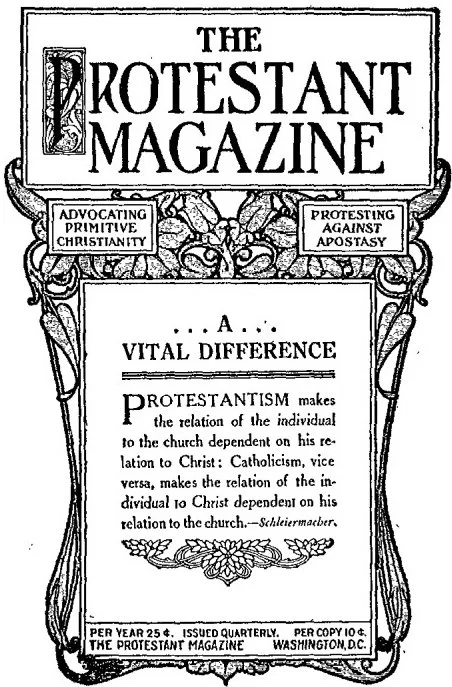
Cover Design in Two Colors

A GOOD PROPOSITION FOR AGENTS!

PRICES: 25 cents a year, 10 cents a copy; 5 to 40 copies, 5 cents each; 50 or more copies, 4 cents each. Send 10 cents for sample copy. Better still, send $1.00 for 20, or $2.00 for 50. Discount to agents on yearly subscriptions.
A few of the following bound volumes are for sale: Vols. I and II (1909-10), in one, cloth covers only, each, $1.75; Vol. II (1910), paper covers only, each, 50 cents; Vol. III (1911), cloth, 90 cents, paper, 50 cents. All post-paid.

“Rome and Marriage” and “Catholic Prisons” Number

An Arsenal of Information

Recent despatches and interviews published in the leading American dailies, show that Rome's eye is upon the “Protestant Magazine.” She fears our fearless yet dignified propaganda.
A letter from Rome to the New York “Sun,” July 11, 1892, reveals the plan of the Papacy for America: “What the church has done in the past for others SHE WILL NOW DO FOR THE UNITED STATES.”

PARTIAL CONTENTS

Double Frontispiece — Photograph of Holy Cross Church Baptism Certificate (Perth Amboy, N. J.), Showing Rome's Insult to American Marriage Laws. Protestantism and Catholicism (cover). A Girl's Escape From a “House of the Good Shepherd.” Rome and Marriage Laws. The Mediation of Christ. Reply to Attack by “Catholic Truth Society” Upon This Magazine. Cardinal O'Connell Above Governor Foss? Chillingworth's Famous Statement. The Privilege of Peter. The Pope's Decree Forbidding Catholics to Sue Criminal Priests. “Another God Upon Earth.” Rome Capturing America. Is America to Become Catholic? Protestantism in the Sixteenth Century, and — Other timely articles, news notes, etc.

SPECIAL OFFER ON TEN, ONE YEAR

Ten copies, one year, to one address, or to 10 separate addresses, only $1.50, or 15 cents each. Sender may include his own name as one of the ten. This number should be placed in the hands of every editor, attorney, clergyman, city and county official, and public-school teacher in your county. We can furnish the names and addresses.

Order Through Your Tract Society

If you do not know your Tract Society address, send to “The Protestant,” Washington, D. C.

EARN YOUR OWN SUBSCRIPTION

By sending us two new subscriptions at $1.00 each, you may earn your own yearly subscription.
Send $2.00 for 50 copies; sell 20 to get your money back; then sell or give away the other 30 copies in the interests of true health reform.

PRICES

$1.00 a year, 10 cents a copy; 5 to 40 copies, 5 cents each; 50 or more copies, 4 cents each.

THE MAY NUMBER OF

LIFE & HEALTH

NOW READY!

“California’s Big Trees” Cover, in Three Colors
Sixty-Seven Articles                                 Over 40 Illustrations
An intensely practical as well as a beautiful and instructive number. Its articles are VITAL TO HEALTH!
Questions and Answers.—In this new and popular department the editor replies to questions asked by subscribers. SUBSCRIBE NOW. Send $3.00 for 5 years; $2.00 for 3 years; or $1.00 for one year.

PARTIAL CONTENTS

Frontispiece, Avalon, Santa Catalina Island, California.
God’s Great Out-of-Doors, by George Wharton James.
Bournville, the Garden Village, by G. H. Heald, M. D.
How to Escape the “White Plague,” by A. B. Olsen, M. D.
Keeping Young in Looks, by William J. Cromie.
Faulty Foot-Wear, X-ray photographs of normal and of deformed feet.
Nuts and Nut Foods, by George E. Cornforth.
Typhus and Typhoid.
“Prohibition Does Not Prohibit.”
Questions and Answers.—Sour-Milk Tablets—Yeasts and Ulcers—Exercise for the Voice—Cold-Sores—Water Test—Flies and Typhoid—Tuberculosis, Human and Bovine—Ivy-Poisoning—Pimples—Hookworm Treatment—Greasy, Falling Hair.
Current Comment.—“Personal Liberty”—Contaminated Oysters—Overeating Menaces the Race—Smallpox and Vaccination, etc.
The Saloon and Insanity.
Treatment of Simple Catarrh.
Diseases in Public Roller-Towels.
Leprosy in New York, and many other articles.
Single bound volumes for 1908, 1909, 1910, and 1911, half leather covers only.
Each, post-paid ........$1.75

Send All Orders Through Your Tract Society

If you don’t know your Tract Society address, ask “Life and Health,” Washington, D. C.
Cover Design Printed in Three Colors

Voices of the Night

ARTHUR W. SPAULDING
It is very dark. This path I tread is very narrow, This path of duty that goes on and on. Out in the dark I hear the tinkling of sweet waters; The fragrance of strange flowers wafts in, is gone; And music, sprinkled from the velvet wings of evening, Perfumes and cools the harsh-caressing air; What hinders that I cease the never-ending journey, And seek repose, and make an end to care?
Be still, my child! The path you tread, in truth, is narrow, But on that path alone there shines a light. The tinkling waters run to deep and foul morasses: You only perish if you pierce the night.
But what! Shall I shrink cow'ring from the darkness' terrors? Shall I be frightened at a fancied dream? 'Tis true, this path alone with light is fully flooded, But in the dark are other lights agleam. Who knows but in some vale a little cottage nestles, Where smiling gardens open wide their charms, And there might I find refuge from the pilgrim's sorrow, And meet no more the pilgrim's dread alarms?
My child, it is a dream delusive you are dreaming; The lights you see are fleeting, false, and fell. The one true refuge from the griefs of duty's pathway Is found when you have trodden duty well.
If, then, I may not leave this narrow, trodden pathway, Nor heed the wooing of the perjured night, If weary eyes and staggering limbs must still press onward, And keep the path, and stay within the light, May I not see the end of duty, know its pleasure, Breathe balm that comes not from forbidden fields, Be strengthened for the stumbling and the beating bruises, And taste the nectar that stern duty yields?
Yes, yes, my child! Do thou but lift thy downcast glances, And see the glory where this pathway ends; And straightway all thy rue in foretaste sweet shall vanish, And easy be the pain thy Father sends.

Medical Missionary Work

MRS. E. G. WHITE
Medical missionary work is the pioneer work of the gospel. It is the door through which the truth is to find entrance to many homes. A demonstration of the principles of health reform will do much toward removing prejudice against our evangelical work; and the Great Physician, the originator of medical missionary work, will bless all who thus seek to impart the truth for this time.
God’s people are to be genuine medical missionaries, ministering to the needs of soul and body. It is their privilege to lead men and women to see in Christ the Great Physician, who understands their every need, and who, if they will come to him, will save to the uttermost. With the knowledge gained by practical work they are to go out to give treatments to the sick; and as they go from house to house, they will find access to many hearts. Many will be reached who otherwise would not have heard the gospel message. Physical healing is bound up with the gospel commission.
When Christ sent out his disciples on their first missionary journey, he said, “As ye go, preach, saying, The kingdom of heaven is at hand. Heal the sick, cleanse the lepers, raise the dead, cast out devils: freely ye have received, freely give.” And when at the close of his earthly ministry he gave them their commission, he said, “These signs shall follow them that believe: In my name shall they cast out devils; . . . they shall lay hands on the sick, and they shall recover.”
Of the disciples after Christ’s ascension we read, “They went forth, and preached everywhere, the Lord working with them, and confirming the word with signs following.” Luke is called the “beloved physician.” He labored in connection with Paul in Philippi; and when Paul left there, Luke stayed on, doing double service as a physician and a gospel minister. He was indeed a medical missionary. His medical skill opened the way for the gospel to reach many hearts.
The divine commission needs no reform. Christ’s way of presenting truth can not be improved upon. The Saviour gave the disciples practical lessons, teaching them how to work in such a way as to make souls glad in the truth. He sympathized with the weary, the heavy-laden, the oppressed. He fed the hungry and healed the sick. Constantly he went about doing good. By the good he accomplished, by his loving words and kindly deeds, he interpreted the gospel to men.
Brief as was the period of his public ministry, he accomplished the work he came to do. How impressive were the truths he taught, how complete his life-work! What spiritual food he daily imparted as he presented the bread of life to thousands of hungry souls. His life was a living ministry of the word. He promised nothing that he did not perform.
He presented the words of life in such simplicity that a child could understand them. Men, women, and children were so impressed with his manner of explaining the Scriptures that they would catch the very intonation of his voice, place the same emphasis on their words, and imitate his gestures. The youth caught his spirit of ministry, and sought to pattern after his gracious ways by seeking to assist those whom they saw in need of help.
Just as we trace the pathway of astream of water by the line of living green it produces, so Christ could be seen in the deeds of mercy that marked his path at every step. Wherever he went, health sprang up, and happiness followed wherever he passed. The blind and deaf rejoiced in his presence. The face of Christ was the first that many eyes had ever looked upon; his words the first that had ever fallen upon their ears. These, restored, followed him. His words to the ignorant opened to them a fountain of life. He dispensed his blessings abundantly and continuously. They were the garnered treasures of eternity, the Lord’s rich gift to man.
Christ’s work in behalf of man is not finished. It continues to-day. In like manner his ambassadors are to preach the gospel, revealing his pitying love for lost and perishing souls. By an unselfish interest in those who need help they are to give a practical demonstration of the power of the gospel. Much more than mere sermonizing is included in the preaching of the gospel. The evangelization of the world is the work that God has given to those who go forth in his name. God calls for thousands to work for him, not by preaching to those who know the truth for this time, but by warning those who have never heard the last message of mercy. Let them work with a heart filled with an earnest longing for souls. Let them do medical missionary work. Thus they will gain access to the hearts of people, and the way will be prepared for a more decided proclamation of the truth.
Who are laborers together with Christ in this blessed medical missionary work? Who have learned the lessons of the Master, and know how to deal skilfully with souls for whom Christ has died? We need, O so much, physicians of the soul who have been educated in the school of Christ and who can work in Christ’s lines. Our work is to gain a knowledge of him who is the way, the truth, and the life. We are to interest people in subjects that concern the health of the body as well as the health of the soul. Believers have a decided message to bear to prepare the way for the kingdom of God. The great questions of Bible truth are to enter into the very heart of society, to reform and convert men and women, bringing them to see the great need of preparing for the mansions that Christ is preparing for all that love him. When the Holy Spirit shall do its office work, hearts of stone will become hearts of flesh, and Satan will not work through them to counteract the work that Christ came to earth to do.
Henceforth medical missionary work should be carried forward with greater earnestness. Medical missions should be opened as pioneer agencies for the proclamation of the third angel’s message. How great is the need of means to do this line of work! Gospel medical missions can not be established without financial aid. Every such enterprise calls for our sympathy and our means, that facilities may be provided to make the work successful.
A special work is to be done in places where people are constantly coming and going. Christ labored in Capernaum much of the time because this was a place through which travelers were constantly passing, and where many often tarried.
The Saviour sought the people where they were, and placed before them the great truths of his kingdom. As he went from place to place, he blessed and comforted the suffering, and healed the sick. This is our work. Small companies are to go forth to do the work to which Christ appointed his disciples. While laboring as evangelists, they can visit the sick, praying with them, and if need be, treating them, not with medicines, but with the remedies provided in nature.
There are many places that need gospel medical missionary work, and there small plants should be established. God designs that our sanitariums shall be the means of reaching high and low, rich and poor. They are to be so conducted that by their work attention shall be called to the message for these last days.
The tender sympathies of the Saviour went out for fallen, suffering humanity. Those who would be his followers must cultivate compassion and sympathy. Indifference to human woe must give place to lively interest in the suffering of others. The widow, the orphan, the sick, and the dying will always need help. Here is an opportunity to proclaim the gospel,—to hold up Jesus, the hope and consolation of all men. When the suffering body has been relieved, the heart is opened to receive the heavenly balm. Those with whom the Comforter dwells, who draws from him knowledge and strength and grace, will impart his consolation.
In both the home and the foreign field, prejudice, false zeal, and miscalled piety must be met; but there are also hearts that God has been preparing for the seeds of truth, and these will hail with joy the divine message when it is presented to them.
Many are suffering far more from maladies of the soul than from diseases of the body, and they will find no relief until they come to the well-spring of life. The burden of sin, with its unrest and unsatisfied desires, lies at the foundation of a large share of the maladies the sinner suffers. Christ is the mighty Healer of the sin-sick soul. These afflicted ones need to have a clearer knowledge of him whom to know aright is life eternal. They need to be patiently, kindly, and earnestly taught how to throw open the windows of the soul to the sunlight of God’s love. Then complaints of weariness, loneliness, and dissatisfaction will cease. Satisfying joys will give vigor to the mind and health and vital energy to the body.
There is missionary work to be done in many unpromising places. Now is our time and opportunity to do this work. We have an important work to do, a work that will not wait, a work that can be accomplished only in the power of the Spirit and under the guidance and direction of Christ. God expects believers to take up this work, and to do it with earnestness and diligence. Let every believer at this time show himself a laborer together with God. The Lord will work with the one who will yield heart and mind and powers to his control. To all who will be led by the Spirit he will impart his righteousness.

Our Place in God's Plan

C. B. STEPHENSON
“LORD, what is man, that thou takest knowledge of him! or the son of man, that thou makest account of him!” Ps. 144: 3.
In the creation of man, God had in view for him a glorious existence, a life that would measure with his own sinless, immortal life. Man was created in the image of his Maker, to fill a special place in the great family of God.
In his “eternal purpose,” God has a definite position for every soul; and by grace and heavenly wisdom all who will, may find and occupy it. When that has been done, there is a settled, fixed state of mind and contentment of heart, peace with God. There will be no question as to the calling of God. It will be known by experience that God gives to every man his work. The carpenter specially prepares every piece of timber for its place in the house. It will not fit any other place, and can not be used anywhere else. So if we are not willing to occupy the position or place, in other words, to do the work, Heaven designs, we shall be of no value, and therefore will be cast out as worthless material, and can not become a part of the great building.
The only true view of life is to reckon it in the light of eternal standards. “In all your reckonings reckon eternal things.” There must be a constant calling into the soul more and more of the life of Christ. We must feed upon it, drink it, hour by hour. There must be a continual inflow of the heavenly life, and a constant outflow of the earthly. We must by grace reach the standards from which man fell by sin. To give this opportunity, Adam was not cut off immediately. This is why God makes “account of him.” The Lord was so desirous that we find our place in his plans, that none perish and come short of it, that he gave his only begotten Son to die for us. This is why he takes “knowledge of him.”
It is only as we make progress in the Christian life that we make a success of our time on earth. It is not the abundance of material things we accumulate that gives standing in heaven, but the righteousness of Christ we possess, and the proper use of the things we have. Our distance from God is measured by the sinfulness of the heart. “Your iniquities have separated between you and your God.”
The one great question that confronts every soul is that of dealing with sin.If sin is overcome, man is again given his appointed place in the heavenly family. If sin overcomes, man's eternal separation from God is complete. Then what can compare to the question, “What shall I do to be saved?” Jesus Christ has provided for every man a perfect life, and freely offers it to all. This life meets absolutely the mind of God for us, and by receiving it we are restored to our place in God's family on earth. There is no other way of reaching the high calling of the Lord. We are “accepted in the Beloved.”
Every one who is born into the kingdom of grace has a place to fill in the development of the plan of redemption. No more sure is there a place prepared for us in heaven, than there is a special place for us to work on earth. Paul would have no doubt been lost if he had refused the heavenly calling. He says, “Woe is unto me, if I preach not the gospel.” 1 Cor. 9:16. In “Testimonies for the Church,” Vol. VII, page 30, this statement is made: “And every one who is added to the ranks by conversion is to be assigned his post of duty. Every one should be willing to be or to do anything in this warfare.”
To this denomination has been committed the proclamation of the last gospel message to a fast-dying world, a world that is drifting farther and farther from God. All heaven is interested in this great crisis. Angels are hurrying to and from this earth. The angel of mercy is folding her wings soon to take her flight forever, we are told. Then how shall we stand in the great judgment if we are inactive and indifferent in such a time? We read again: “When church-members put forth earnest efforts to advance the message, they will live in the joy of the Lord, and will meet with success.”—Id. We are responsible to God and man for the light we have in advance of the unsaved. We are exhorted to owe no man anything. How shall we answer in the judgment if we have not paid our obligations to our fellow men? If a woe would have been visited upon Paul for neglecting the heavenly calling, shall we escape, if guilty?
If we have found our place in this last great work and are fulfilling the purpose of our life, the account being made of us will be pleasing to God, and will give us a place in the eternal purpose and family of heaven.
Atlanta, Ga.

Daniel 7 and 8

MRS. M. E. STEWARD
EARTHLY kingdoms are represented in prophecy by wild beasts, because they embody so much of both brute force and passion.
Daniel saw three symbols:—
1. Winds (Dan. 7: 2, 3), meaning wars. Jer. 25: 32, 33. “In the latter days ye shall consider it perfectly.” Jer. 23: 20.
2. The great sea, representing “peoples, and multitudes, and nations, and tongues.” Rev. 17: 15.
3. Four beasts, symbolizing kings, or kingdoms. Dan. 7: 17. They arise from among the nations, by means of war.
The Bible names the first three of these great empires:—
1. Babylon. Dan. 2: 38.
2. Medo-Persia. The bear of Daniel 7 and the ram of Daniel 8 come next to the lion; God calls them Media and Persia. Dan. 8: 20.
3. Grecia. The leopard of Daniel 7 and the goat of Daniel 8 are identical. The Scriptures name them Grecia. Dan. 8: 21.
Three specifications regarding these kingdoms:—
1. The lion is the king of beasts; so Babylon stands at the head of universal empires. The eagle’s wings signify the towering ambition of Nebuchadnezzar, his unwavering purposes, and the rapidity of his conquests. The flight of an eagle is exceedingly high, unwavering, and swift.
2. The two horns of the ram denote the union of two nations, Media and Persia. The Persians came to the throne last, but rose highest. The ribs in the mouth are interpreted as denoting peculiar cruelty toward three provinces, Babylon, Lydia, and Egypt. Isa. 13: 17, 18.
3. The leopard is a fleet animal. As this did not fully represent the rapidity of Alexander’s movements, four wings of a fowl were given to the leopard.
Three illustrious men were at the head of these empires:—
1. Nebuchadnezzar, the first king of Babylon, was a brave, proud, and sometimes cruel general; wise in statesmanship, in science, and art. Despite his ambition and self-will, Nebuchadnezzar had a principle of moral integrity which was receptive to divine teachings. God gave him three very impressive lessons: (a) his dream of Daniel 2. The dream accomplished three things,—exposed the false systems of his so-called wise men, revealed the true God, and taught him the infinite superiority of the kingdom of heaven over earthly governments; (b) his experience in the case of the three Hebrew children in the fiery furnace, which convinced the monarch that there was a higher King than himself; Daniel 3; (c) the loss of his reason for seven years, which led him to realize his utter weakness in the hands of the supreme God. Daniel 4. We may well believe that Nebuchadnezzar henceforth acknowledged and worshiped the true God.
2. Cyrus, king of Medo-Persia. There are three interesting things about Cyrus: (a) his sagacity in conquering Babylon; (b) the fact that the prophet Isaiah called him by name and mentioned his wonderful acts one hundred fifty years before his birth. Learning of this,—Josephus says by reading Isaiah,—Cyrus believed in the true God, and, contrary to Oriental usages, he gave the Jews permission to return to their own land, and out of his own revenues furnished means for rebuilding Jerusalem and its temple; (c) he was a vegetarian; he was brought up in a shepherd’s tent, on bread and
cresses, and despised the luxuries of the table.
3. Alexander, king of Greece, was the reverse of Cyrus. He was called great on account of his military achievements. But he was very cruel in war, and he was so intent on self-gratification that it has been well said of him, “He who conquered the world was himself conquered by wine.” He drank to excess, and died of a resultant fever, in his thirty-second year. After Alexander’s death, his kingdom was divided among his four principal generals, symbolized by the four heads of the leopard and the four horns of the goat.
Sanitarium, Cal.

Morsels

PHILIP GIDDINGS
“Let your light so shine before men, that they may see”—What? See light? No!—“your good works.” Let your faith so shine that men may see your faith?—No! your good works. Your faith is to shine upon your good works, and your good works reflect back the faith in exact image of those works. Let your creed so shine before men that they may see your deed,—see your creed in deed form,—and be led to glorify your Father who is in heaven.
Sign to duty, and whatever difficulty comes, do not resign, but re-sign. Repeat the resolution. Like a postage-stamp well mucilaged, stick fast to your letter till you arrive at your destination. And when you have the will, God will open the way. However thick or high the wall that would turn you aside from duty, go through or leap over.
Quit yourselves like men; don’t quit being men. The difficulty of the task is to prove sincerity, prove faculty, and classify result. Repeat not the terrible mistake of some who knew not the time of their visitation when they said, “Away!” to what was the only way.
We are marching to one of two opposite ends,—the goal or the gaol,—the winning-post, or the whipping-post. You and I will finally hear, “Come, ye blessed,” or “Depart from me, ye cursed.” Which it shall be then is being decided now by you and me.
Though we have prayed, preached, and prophesied, it will be of no avail unless we practise the ways of God. Unless we practise as we preach, and have our works in harmony with our prayers, we shall find disappointment instead of reward. We have prayed out, preached out, prophesied out,—not in,—and “truth in the inward parts” we had not. It was all out, and out we shall be at last.
It is possible to preach others into the kingdom, and preach ourselves out,—make of ourselves castaways.
Roseau, Dominica, West Indies.

The Hour of Prayer

PRAYER has an “hour,” it has a place, in our life; it is no more to be crowded out than the most vital practise of receiving one’s daily food.—Charles Cuthbert Hall.
Continue reading: Editorial