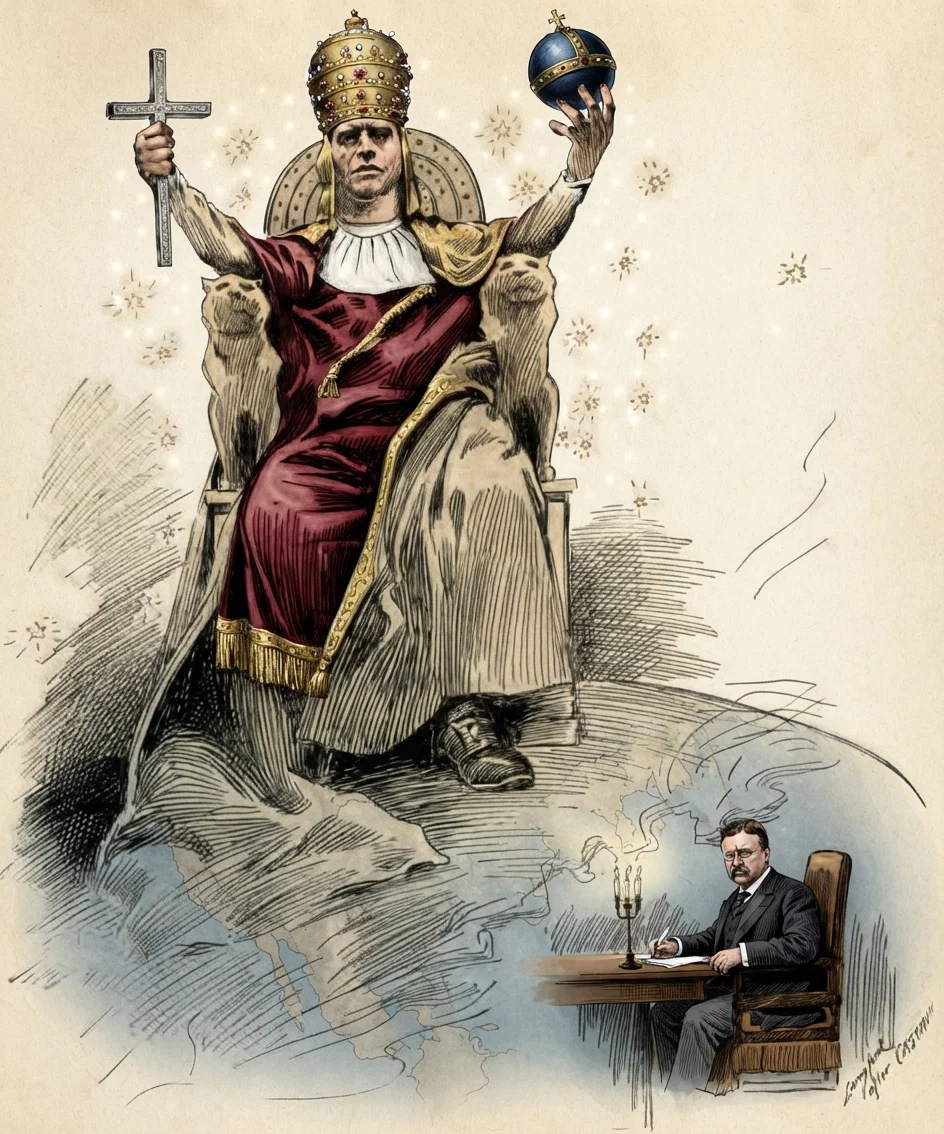
PRESIDENT ROOSEVELT continues to add to his list of appointments of Roman Catholics to office. The latest appointment of this sort has been that of Mr. Daniel W. Baker as United States Attorney for the District of Columbia. This appointment was announced on July 12. Mr. Baker is a Washington lawyer and a member of the law faculty of the old Roman Catholic Georgetown University, where his legal education was acquired.
Dream of the Pope, the Dominion of the World. (Courtesy of Frank Leslie's.)
He is a son of the founder of Calvert College at New Windsor, Carroll County, Md., and his college education was received at the Roman Catholic Mount St. Mary's College, Emmetsburg, Md., in which institution his father was a professor.
It is said that "the President practically decided to appoint Mr. Baker as soon as he learned that he was a candidate."
Since the announcement a short time ago that the present incumbent was to go out of office on the 1st of August, the position had been keenly sought by a number of candidates. The others were able and well-known lawyers, but were doubtless handicapped by being in competition with a Roman Catholic, for there is reason to believe that the President is partial to Roman Catholics in such cases.
Another recent appointment by the President of a Roman Catholic to office has been that of Mr. Charles J. Bonaparte as Secretary of the Navy. Mr. Bonaparte is sometimes spoken of as the leading Roman Catholic layman of the country. "He is a very zealous Roman Catholic and an intimate friend of Cardinal Gibbons," says Mr. James Creelman, who interviewed Mr. Bonaparte immediately following his appointment. Mr. Creelman writes of "his devotion to the Catholic Church and the zeal he has shown in its interests," and says "he has been criticized sharply for having influenced President Roosevelt to allow public funds to be used for Roman Catholic schools in the Indian country."
Another recent appointment of this sort has been that of Dominic I. Murphy, "one of the leading Catholics of the country," as consul at Bordeaux, France. Mr. Murphy was formerly editor of the New Century, a Catholic periodical published in Washington, and it seems that his appointment was a reward for service rendered the administration as a Roman Catholic in that capacity. Writing of the appointment, which was made in May, the Washington correspondent of the New York Evening Post said:
The President's appointment of Dominic I. Murphy as consul to Bordeaux is representative of a sense of obligation which Mr. Roosevelt has very strongly felt. Mr. Murphy is one of the regular organization Democrats who supported Mr. Roosevelt in the columns of the New Century, a small Catholic weekly in this city, on the Catholic issue in the Philippines at a time when friends of the friars were threatening to make it highly difficult for the administration to settle ecclesiastical questions overseas. The administration, through Governor-General Taft, who visited Rome on his way out, treated the Catholic orders with great liberality, and this was recognized by a number of Catholic editors of Democratic affiliations. No one can ever charge the President with lack of gratitude for this support. About the first known of Mr. Murphy's adherence to the Roosevelt cause, outside of his immediate circle of friends, was his appointment as secretary of the Panama Canal Commission. When the old board with which he had been attached was reorganized he was left in a somewhat anomalous position. There was no call for a secretary in the new organization, as it had its own plans for doing that part of the work. Moreover, the decision to move headquarters from Washington to Panama was very disquieting to Mr. Murphy, who did not feel himself a yellow-fever immune. It has long been known that he was "looking for something else." Cardinal Gibbons of Baltimore visited the President in Mr. Murphy's behalf.
And of course the cardinal's visit to the President in his behalf secured for Mr. Murphy the "something else" for which he was looking. In an interview published last fall for the purpose of influencing Roman Catholics to vote for Roosevelt, Mr. Murphy said that he had "for a long time favored the Philippine policy of the administration," but that at first he "was inclined to doubt the wisdom of the course pursued by our government in the Philippines," as he "had read so much about our Catholic interests being unfairly treated in our new possessions." But after a "thorough investigation" of the matter he found "that President Roosevelt was treating the Catholic Church in the Philippines with eminent fairness." He declared that "as a Catholic I would not like to see the Philippine Islands turned over to the Filipinos," and impressed the point that the interests of the Catholic Church in the Philippines, and in this country as well, would be promoted by maintaining the Roosevelt administration. That administration has had much of such Roman Catholic support because of its attitude and course "on the Catholic issue in the Philippines;" and it is very true that "no one can ever7charge the President with lack of gratitude for this support."
He seems to have tried to show his gratitude at every possible opportunity, by appointing to office, and in other ways favoring Roman Catholics. Last fall while the Presidential campaign was in progress an Irish-Catholic-Democratic weekly of New York City published very conspicuously upon its first page—under the display headings, "He Is Good Enough for Us," "Why Our People Like Roosevelt"—the following list of Roman Catholic appointments by the President:
Appointed Archbishop Ryan, of Philadelphia, and Mr. Charles J. Bonaparte, of Baltimore, on the Indian Commission.
Appointed Bishop John L. Spalding, of Peoria, on the Coal Strike Commission.
Appointed Lawrence O. Murray, D.C.L., of New York, assistant secretary of the Department of Commerce and Labor.
Appointed Ex-Secretary of State, John T. McDonough, of New York, as territorial judge of the Philippine Islands.
Appointed William A. Byrne, of Delaware, assistant United States district attorney.
Appointed Joseph Murray, of New York, deputy superintendent of immigration.
Appointed Eugene A. Philbin, of New York, district attorney of New York County.
Appointed Edward J. Sullivan, of New York, United States consul to Trebizonde.
Appointed Charles H. McKenna, of Pittsburg, as judge in Porto Rico.
Appointed Dominic I. Murphy secretary of the Panama Commission.
Appointed full quota of army and navy chaplains to which Catholics were entitled, the first time in the history of this country.
Appointed a majority of Catholics on the Supreme Court of the Philippines.
Appointed Catholic secretary of education of the Philippines and 3,700 Catholic teachers out of a total of 4,500.
Appointed twenty Catholic governors of provinces of the Philippines out of a total of twenty-six.
Since the publication of this list the President has appointed Prof. Charles P. Neill, of the Catholic University at Washington, head of the Bureau of Labor. Mr. Neill had been previously appointed by the President to a responsible position in connection with the Coal Strike Commission. An appointment not included in the list is that of Robert J. Wynne, a Roman Catholic, to the Postmaster-Generalship, since appointed consul-general at London. Another appointment not included was that of General Davis, said to be a Roman Catholic, as governor of the Panama Canal Zone. It is said that the President's private secretary, Mr. B. F. Barnes, is a graduate of the Georgetown University, which is an ultra-Catholic institution, the instructors as a rule being Jesuits, and also that his former secretary and now Postmaster-General, Mr. Cortelyou, is a LL.B. of that institution.
Of course there is no impropriety in appointing men to office who are Roman Catholics; the impropriety is in appointing them to office because they are Roman Catholics. And it is just this feature that draws attention to Mr. Roosevelt's appointments of Roman Catholics to office; circumstances indicate quite strongly that the religious affiliation of the appointees had much to do with the appointments; that appointments of men who are Catholics have been made with regard to the Roman Catholic element, and as a sort of favor and compensation to that element. Roman Catholics seem to view the matter in that way, and therefore they need not be surprised if other people take the same view of it.
Washington, D.C., July 16, 1905.
PREPARING FOR ARMAGEDDON.
By Editor
IN a Turkish paper called the Vakit, the editor says:
We shall do our utmost to keep England's support; but at last, if we do not succeed in it, then it is very easy to know what we have to do. When Europe will not look at us, then we shall lay aside all the European customs which we have adopted, and enter on our old way; from the boy of thirteen to the old man of seventy-five, every one of us will be armed, and we shall defend by the will of God, and by the daring of the old days, the country we have held for five hundred years. And if the issue should come to this, as Islamism is not confined to Turkey, then we will blend all the different Moslem races into one; the Moslems of India, of Central Asia, of the Caucasus, of Africa, and of Algeria will come forward, and we shall again take measures which we once adopted for the conquest of Jerusalem. We shall send proclamations everywhere, and declare a general war against Christendom. . . . Then it will not be possible to subjugate 120,000,000 Moslems by 90,000,000 soldiers. If the Moslems all over the world rise to defend their sacred religion, and if the treasure accumulated every year at Mecca is disposed of for the protection of the Mohammedan faith, then the scenes of ancient European wars, where the Moslems were both victorious and destructive, will be repeated, and the progress and civilization of centuries will be destroyed.
This may be one of the elements in the great battle of Armageddon, tho we doubt whether the discordant elements of Moslemism can be so united. However, they can cause great trouble, and will doubtless. But if we read prophecy aright, Jerusalem will eventually fall into the hands of the Papacy and not into the hands of Moslemism.
SUNDAY ENFORCEMENT NOTES AND COMMENT.
By Editor
A CRUSADE against all classes of stores that keep open on Sundays was recently inaugurated at McKeesport, Pa., and all storekeepers who have been in the habit of keeping open on Sunday fear prosecution. The first case tried resulted in conviction.
PUBLIC notice was given by Mayor Nye of Moorhead, Minn., on June 17, that in deference to the wishes of the people in that neighborhood baseball games must hereafter cease in the vicinity of the normal school.
THE Young People's Union, comprising twenty-five societies representing as many local Protestant churches, has voted to protest to Governor Utter against baseball games on Sunday at Rocky Point and elsewhere, and to request him to close all the shore resorts in Rhode Island on Sundays. The local union numbers about 1,500 persons, and will endeavor to have other young people's unions in the State take similar action.
AN order forbidding druggists to sell on Sunday any of the articles the sales of which on Sunday are prohibited by law was recently issued by the authorities of Concord, N. H. Among the articles enumerated were newspapers, confectionery, cigars, etc.
IN complete compliance with a resolution passed by the council at the request of the local churches of Moultrie, Ga., the municipal officers have served notice that in future the Sunday-closing laws will be most rigidly enforced. Prescription clerks who have to fill prescriptions on Sunday will be required to enter the drug stores alone and close the door behind them.
The Japanese peace envoy is now in the United States, and the Russian envoy is now on his way across the Atlantic. They will meet at the home of President Roosevelt, where a formal reception will be tendered them. The negotiations will be conducted at Portsmouth, N. H. There is a feeling on the part of the Japanese envoy and staff that the close of peace negotiations will close the war. Japan will demand that the province of Manchuria be given back to China; that Japan be given a free hand in Korea; that an indemnity to cover Japan's war expenses be paid by Russia. At least, these are the demands going the rounds of the press, and interviews with the spokesman of the Japanese peace commission would lend color to this report.
The commissioner of insurance for the state of Massachusetts in his annual report on insurance conditions in the United States, makes a most scathing arraignment of some of the greatest insurance companies in this country, principally the Equitable Life Insurance Company, the Mutual Life Insurance Company, and the New York Life Insurance Company. He recommends that the legislatures take up the matter of compelling these great concerns to deal honestly with their patrons.
To boycott Chinese commerce is the plan proposed by the Bureau of Commerce and Labor in retaliation for the Chinese boycott of American goods. Americans purchase in China annually about thirty million dollars' worth of goods, and sell to China in the same period about sixty-three million dollars' worth. It is stated that the Chinese Government will never again agree to sign a treaty with America which shall exclude any Chinese citizens from this country.
The dispensary system of controlling the liquor traffic, which has been in vogue for some time in South Carolina, has been declared a failure; and because of its failure the prohibition forces are being strengthened in that state. It is expected by those who are instrumental in establishing the dispensary system that it will soon be voted out.
The Swedish cabinet, on July 25, resigned in a body as a protest against the dissolution of the union with Norway. The cabinet holds that the secession of Norway was unlawful, and should not be recognized by Sweden, except under conditions which many feel that Norway would not agree to accept.
Policy-holders of the Equitable Life Insurance Company are asking that a receiver be appointed for the concern, and that its $417,000,000 of assets be divided among those holding policies. This has come as a result of the exposures of graft and fraud recently made.
Commander R. E. Peary has sailed again for the North Polar regions in search of the pole. His steamer, The Roosevelt, was built especially for Arctic work of this kind, and the explorer declares his complete confidence in the success of the undertaking.
The flaxseed market has been cornered by the Standard Oil Company's manager. Consequently the price of linseed oil is to be advanced 40 cents per gallon.
The body of John Paul Jones—or what purports to be his body—arrived at the naval academy grounds, Annapolis, Md., on July 24, and will find its last resting-place there.
The British fleet will patrol the Baltic Sea in the near future as an offset to the naval demonstration of Germany in Scandinavian waters recently.
SUNDAY LAW IN MISSISSIPPI.
By Editor
HAVING been indicted by the grand jury for working on Sunday, Brother George E. Case, elder of the church at Fort Bayou, and his brother, were brought before the court at Scranton, Miss., May 9. They had requested the churches in the conference to make their case a subject of prayer, and were encouraged by a visit from Brethren S. B. Horton (president of Louisiana Conference) and F. R. Shaeffer. A subsequent letter to Brother Shaeffer tells the outcome. We give the following extract:
"Court was called at 2 o'clock. The judge began the work of selecting jurors, and then instructed them in regard to Sunday laws. At first I thought we were going to have a hard time. The judge said to the jury: 'Now I want you to understand that we are not here to make laws, but to enforce them; and if the laws are wrong, then let those who made them change them. But we are here to enforce them while they are on the statute books.'
"He said a good deal about breaking the Sunday law in hunting, fishing, playing base-ball, opening saloons, etc.; but said nothing about ordinary labor. Finally a few cases were heard, and the jurors were given a recess for the rest of the day.
"I went to the judge, and asked permission to speak to him, and he granted me a hearing. I told him we had a case before the court, and asked him if he could not dispose of it, as we were anxious to go home, and take care of our crops. He asked what the charge was, and I told him, 'Working on Sunday.'
"He said, 'All right, I will look it up in a few minutes. So I thanked him, and waited. In about fifteen minutes he called the case, and the crier called for the witness. Only the one witness who had made the charge was present; the other one kept out of the way. The charge was read, and the judge said: 'Working on Sunday, eh? A man ought to be commended for working in this country;' and the audience laughed.
"Then a lawyer took the witness into the anteroom, and when they came back the charge was read again, and there was another laugh. A lawyer, Mr. Ford, volunteered to defend the case free of charge, but the judge said that we were free to go home. We had not said a word after the case was called, and it did not cost us a cent, excepting our personal expenses. We attribute it all to the providence of God, in answer to the prayers of the brethren and sisters of Mississippi."
FORETOKENS OF OUR LORD'S RETURN
By Prof. George W. Rine
BY PROF. GEORGE W. RINE
TYRANNY OF COMBINED MILLIONS.
(Continued from last week.)
Predatory Harvester Trust.
The trust buccaneers are ever on the lookout for new seas of trade whose treasure-laden argosies will yield rich plunder. Of all the piratical ships that have swept the commercial ocean in quest of black-flag booty, there has been none to maintain at the mast-head of its rapacity a keener lookout for rich loot than those who are exploiting the farming communities. It could hardly be expected that a prey so numerous and easy as the agricultural classes would be overlooked. In stating that the production of American farms, in round figures, is each year $4,900,000,000, is to show how opulent is the agricultural field for trust exploitation. It is about three times the gross earnings of all the railways, and nearly four times those of all the mines. To produce that yearly crop the farmers spend annually $100,000,000 for implements and machinery. It was for the conquest of that $100,000,000 that the harvester trust was conceived and put into operation, in August, 1902.
The trust is known as the International Harvester Company, and was incorporated at Trenton, N. J. In the picturesque phrasing of Alfred Henry Lewis, its mission is tersely sketched: "Being thus launched at those old familiar shipyards of modern piracy, the New Jersey-Trento Yards, the harvester trust, without reserve or setback, has marauded agriculture ever since."
Mr. Lewis insists that there is no exaggeration in saying that the harvester trust, from that colossal bonanza of $100,000,000, pockets a yearly profit of more than $40,000,000, eighty per cent. of which may be counted as sheer rapine, attained by methods that would shame a footpad, and are wholly criminal in the eye of the law. That is to say that of the $40,000,000 profit, $32,000,000 is naked plunder. The truth of this ugly charge is established by the fact that since the farmers have been compelled to buy their implements from this predatory monopoly they must pay $32,000,000 more annually than they did before the birth of the octopus.
This trust-monster, tho not yet three years old, has sucked in practically all competing concerns, so that it now controls more than nine-tenths of the farm-implement trade; and by methods of extortion, constriction, and law-breaking, it so dominates the market situation as to compel what little opposition still survives to do business at a loss. That little opposition is inexorably doomed. As soon as this $120,000,000 trust was on its feet and ready to prosecute its ebon mission, its first thought—ever the first trust thought—was to kill off innocent, helpless rivalry. The most effective and expeditious move in doing this was to begin life as a lawbreaker. "This need not cause a shock," says Mr. Lewis, "it should be kept constantly before one, as a defense against shocks, that the great purpose of trust conception is crime, and to destroy competition by defying the law."
The trust spirit is to secure to itself a monopoly by whatever methods, fair or foul, may lie nearest at hand. To this end its first effort is addressed to the railways. If it can wrest from the common (?) carriers a rebate in rates and thus have its products distributed at a lower cost than can its rivals, that will be all the lawless advantage it requires to effect its sinister ends. "It can use that rebate, as a thug uses cord and crease, to stab and strangle competition." Like most trusts, this one cares as little for law as a cow does for a cobweb. Was it not ordained to walk through the law? By such Satanic means has this ravenous mastadon of trade attained its pitiless power to crush, to destroy, and to feed and fatten on its victims! So we see again that the honest, hard-working farmer is systematically mulcted every year to the tune of $32,000,000, solely for the purpose of enabling one marauding band of commercial adventurers to indulge its lust for blood-money.
The Beef-Trust Vampire.
Lack of space precludes my giving anything like a full sketch of the malodorous history of the clutching "combine" known as the Beef Trust. A few bold strokes must suffice. This band of exploiters, like its brethren, has grown rotund on the cryptic, miracle-working rebate on transportation rates. In short, Mr. C. E. Russell declares: "We may as well face the plain truth, that if all the men that have taken or have tried to secure illegal rebates were to be imprisoned, some of our business streets would look lonely indeed."
With this trust monster, as with others, we shall see that the trail of the rebate serpent lies through lawlessness, through the spoliation of great populations, through business panic, through embezzlements, ruined lives and homes, and through suicides, all the way up to the throne of our national god, Success.
In order to make themselves the absolute masters of all those who breed and feed cattle and other stock to supply the demands of the world's markets, the great packers of the whole country drew together into a compact, steel-bound trust. This having been effected, they were in a position to dictate the prices they would pay for stock on the one hand, and the prices the consumer must pay for dressed meat on the other. They were also rich enough to say to the railway companies, "Give us the rates we want or we will build our own railways." "Henceforth the bid of one firm was the bid of all. One market was all markets."
The change was revolutionary. All the profits and a great deal more dropped away from cattle-feeding. The farmer continued to feed cattle at great losses, confidently expecting a speedy return to old normal prices. But the winter of his discontent never ended. The flush and inspiration of the long-looked-for spring of fat prices seems as remote as ever. You must understand that the business had become enormous; millions of capital had been invested in it. Yet the entire industry was, in practise, at the mercy of only one buyer.
From July, 1903, to July, 1904, the average loss on every head of cattle fattened and sold was eight dollars. The resultant catastrophe fell chiefly on the Middle West. The Iowa State officials report that "the total losses of the cattle-feeders in Iowa in 1904 was $12,500,000. In 1903 and 1904 forty banks in Iowa failed, . . . and at least seven bank officers committed suicide." They declare that even in times of national business depression and panic there has been no such record as this.
In its annual review of the progress of the state, the South Dakota Historical Society makes this startling statement: "The machinations of the Beef Trust almost destroyed the flourishing live-stock industry of South Dakota." The secretary of the society has estimated the losses in 1904, to South Dakota cattle-men, at $10,000,000. As a direct result of the failure of scores of banks in each of the Middle West states, thousands of local business firms were driven into bankruptcy. Similar havoc was wrought in other states; but the coffers of the trust marauders are bursting out—not with new wine,—but with the economic life-blood of the people of the Middle West.
The Meaning.
It would be easy to fill a book with the story of the tactics of these mighty despoilers of the common people; but I must forbear. The facts herein given are only a tiny bundle of typical illustrations of the conditions which prevail throughout the economic world. The sole aim of this short discussion is the enunciation and enforcement of a most solemnly important truth—a truth foretold by prophets.
Read thoughtfully the second chapter of the prophecy of Habakkuk, and note that verses 1, 2, 3, 8, 14 and others, show convincingly that the chapter covers a prophecy which has its application primarily in the closing years of the Christian age; that is, when the Christ is about to come again—to come as King of kings, in power and great glory.
In this prophecy, the Holy Spirit paints a character-sketch of the typical man of the last days. In verse five and onward we read regarding this characteristic man: "Who enlargeth his desire as Sheol [the grave], and he is as death, and can not be satisfied, but gathereth unto himself all nations. . . . Wo to him that increaseth that which is not his! . . . Because thou hast plundered many nations, all the remnant [the last] of the peoples shall plunder thee. . . . Wo to him that getteth an evil game for his house, that he may set his nest on high, that he may be delivered from the hand of evil! Thou hast devised shame to thy house, by cutting off many peoples, and hast sinned against thy soul."
Sheol, or the grave, is ever yawning; it is never filled, is never satisfied. Death still claims its victims by multiplied millions. Death knows no limit. Even so, declares the inspired prophet, will be the men who control the marts and money tables at the time that the "vision, . . . hasteth toward the end, and shall not lie." Do not the facts adduced in this fragmentary article show that men are to-day moved and actuated and pitilessly swayed by the demon of greed? Was there ever an age so marked by ruthless, clutching avarice—an avarice literally insatiable, as is Death? Are the multi-millionaires satisfied, contented? No, indeed! We all know that the more they get the hotter burns their passion for more. Like the horse leech, they cry "Give! give!" "and can not be satisfied."9It is admitted by all publicists that there are persons who, within a period of twenty to twenty-five years, have amassed from one hundred to seven hundred millions of dollars' worth of property. Dr. Gladden and other great thinkers emphatically declare that these men could not possibly have acquired such enormous fortunes honestly. This is the consensus of judgment on the part of all serious men. Now note the prophecy: 'Wo to him that increaseth that which is not his! . . . Wo to him that getteth an evil gain for his house!' Is this end-of-the-age prophecy realized in this our day?—Yea, verily; and with what accuracy, and to what practically unlimited extent! How grateful we should all be to our Father, for the beacon light of prophecy! Will we believe? and live and watch and work in harmony with such belief?
FIFTY REASONS FOR SABBATH OBSERVANCE.
By D. T. Bourdeau
BY D. T. BOURDEAU.
FORTY-SEVENTH. We observe it because when our Lord is about to return to our world, He pronounces as blessed those who keep the commandments of God. Rev. 22:12, 14: "And, behold, I come quickly; and My reward is with Me, to give every man according as his work shall be." "Blessed are they [continues the Saviour] that do His commandments [those of His Father], that they may have right to the tree of life, and may enter in through the gates into the city."
Forty-eighth. We observe it because striking signs of the second coming of our Lord having appeared in the sun, moon, and stars, in answer to many predictions of prophecy, the winds of war are restrained that the seal or sign of authority "of the living God" may be put in the "foreheads" (or in the hearts or spirits, the forehead being the seat of the intellect) of "the servants of our God." Rev. 7:1-3: "And after these things I saw four angels standing on the four corners of the earth, holding the four winds of the earth, that the winds should not blow on the earth, nor the sea, nor on any tree. And I saw another angel ascending from the east, having the seal of the living God; and he cried with a loud voice to the four angels, to whom it was given to hurt the earth and the sea, saying, Hurt not the earth, neither the sea, nor the trees, till we have sealed the servants of our God in their foreheads."
A seal is a sign of authority, and in this passage the word seal is derived from the Greek term sphragis, which signifies "seal; . . . impression made by a seal." It also means "a sign, a mark," as does the word "sign" in the Hebrew of Ex. 31:17: "It [the Sabbath] is a sign between Me and the children of Israel forever; for in six days the Lord made the heavens and earth, and on the seventh day He rested, and was refreshed." Here, as in verse 13, etc., "sign" is applied to the Sabbath. (For definitions of Greek terms, see "Dictionaire Grec-français," par "Alexandre;" "Greenfield's Greek Lexicon to the N. T.," etc.) It is evident that the seal mentioned in Rev. 7:1-3 is the Sabbath; the only part of the law that makes known the Author of the law, the extent of His dominion, and His right to rule,—characteristic meanings of seals used by earthly rulers.
Those who are sealed are servants of God and children of Israel. Now it is impossible to be true servants of God and true children of Israel without believing in our Lord Jesus Christ; and it would be very inconsistent to limit here the expression, "the servants of our God," to those who are Israelites in the sense of being natural descendants of Jacob. Therefore true Christians are here referred to, whether they are or are not descendants of Jacob.
And this reason is not invalidated by the Biblical truth that we are sealed by the Holy Spirit. Eph. 4:30, etc. The Spirit of God is the agent by which the Sabbath as seal, or sign, of the living God is put in our foreheads or graven in our hearts, that we may love and observe it with all the precepts of the law of God.