Of those who have received their training, or the greater part of it, at the college, Drs. Geo. Thomason, J. F. Morse, F. J. and E. F. Otis, E. L. Eggleston, N. G. Evans, Lillian Eshelman, Etta Kirby, Julia White, R. H. Harris, and Elsie B. Merritt are at present connected with the Battle Creek Sanitarium and the American Medical Missionary College.
Dr. J. F. Allen is in Tacoma, Wash. Dr. Lillian Boyer, after over two years' connection with the Battle Creek Sanitarium, is now at work among the churches under the direction of the Wisconsin Conference.
Dr. Alice Conway Parker is a physician at the Boulder (Colo.) Sanitarium.
Dr. I. A. Dunlap is practicing at Walla Walla, Wash., and teaching in the science department of Walla Walla College.
Dr. and Mrs S. P. S. Edwards are doing a similar work in Emmanuel Missionary College at Berrien Springs.
Dr. J. W. Erkenbeck is medical Superintendent of Guadalajara Sanitarium, Mexico.
Dr. J. E. Froom is in charge of a growing pioneer branch institution at Moline, Ill., Dr. Amy Hawke assisting.
Drs. W. L. and Eva M. Gardner are opening up work in Salt Lake City, Utah.
Dr. O. M. Hayward is carrying heavy responsibilities as superintendent of the medical missionary work in the Southern Union Conference.
Dr. C. O. Prince and Dr. Clara Beckner12are connected with the Drs. Nicola at the South Lancaster Sanitarium.
Dr. W. R. Simmons is superintendent of the Portland (Ore.) Sanitarium, with Drs. S. L. and Myrtle E. Lockwood as assistants.
Dr. A. Q. Shryock is in charge of the branch sanitarium at Seattle, Wash.
Dr. Carrie Staines is at the College View (Neb.) Sanitarium.
Dr. A. A. Zipf is doing medical missionary work in Iowa.
Dr. Evelene Helman, who has also done efficient work at the Battle Creek Sanitarium, is in California, availing herself of the opportunity for a much-needed vacation. However, she is doing more or less medical missionary work.
Dr. L. J. Otis is building up a branch work at Paducah, Ky.
Dr. and Mrs. P. M. Keller are in Australia.
Drs. C. P. and Anna B. Farnsworth, after some months at the sanitarium in Guadalajara, Mexico, have assumed the responsibility of the branch work in Madison, Wis.
Dr. D. E. Garvin, until recently superintendent of the sanitarium at Keene, Tex., also an instructor in the Keene Academy, is in Colorado, being obliged to go there on account of his wife's health.
Dr. A. W. George is doing successful work in Little Rock, Ark.
Dr. Lydia Kynett is connected with the work in Chicago.
Dr. Elsie Martinson is assisting Dr. Hayward in the Southern Conference, and is located at Graysville, Tenn.
Dr. J. D. Shively is medical superintendent of the Des Moines (Iowa) Sanitarium, and Dr. Emma A. Perrine is lady physician there.
Dr. Maui Pomare, returning to New Zealand, was appointed medical commissioner to his people, the Maoris.
Dr. Jean Vernier is connected with the work of the college in Chicago, and is in charge of the dispensary work on Halstead Street.
Dr. A. J. Hetherington is also connected with the Chicago work.
Dr. Lyra E. Hunt, now Mrs. W. A. George, is assisting her husband in the medical work at the College View (Neb.) Sanitarium.
Drs. A. E. and Carrie Lemon are at St. John, New Brunswick, where they have found a wide and promising field of labor.
Dr. Ruth Merritt is at work among the churches in the Ohio Conference.
Dr. A. R. Satterlee has been called to the New York Conference.
Dr. H. E. Truex is associated with Dr. W. A. George at College View.
Dr. W. W. Worster is connected with the Boulder Sanitarium.
Dr. Silas Yarnell is associated with the work at Spokane, Wash.
Dr. R. L. Mantz has charge of the work at Council Bluffs, Iowa.
Of the class just graduated, most of the members are taking a much-needed rest before entering upon definite work in their chosen profession. Several may connect with the work at the Sanitarium, others have had their minds fixed on foreign fields during more or less of their course.
The list is as follows: Maud L. Atherton, Clarence F. Ball, Cæsar A. Bauer, Mary E. Britton, John E. Colloran, John E. Cooper, Maude Edgerton, William J. Erkenbeck, Mary I. Goodison, Pliny F. Haskell, Lottie C. Isbell, John M. Keichline, Elizabeth M. E. Kerr, Bertha E. Loveland, Harry W. Miller, Maud J. Otis, Vahan Pampaian, Eunice Rand, Frank C. Richards, Arthur C. Selmon, Eulalia S. Sisley, Maude A. Thompson, Dr. Wilbur O. Upson, Alfred M. Vollmer.
Of those who matriculated with this class—
Dr. John S. Reekie completed his course at Kingston, Ontario, and is already on his return to New Zealand, to engage in mission work there.
Drs. Edward Gyles and A. H. Barrows completed their course at Jefferson College, Philadelphia. Dr. Gyles is assisting Dr. A. J. Read, of the institution in Philadelphia, Pa.
Dr. Sophia Brunson spent her last year at Cleveland. Dr. Brunson had been a missionary to Japan for several years.
Dr. J. J. Bell, of the class of 1901, spent his fourth year at Jefferson College, and then completed work in the medical department of Dublin University, in one year, in order to qualify for work in Ireland, where he is at present starting sanitarium work.
The growth of the college and its work has been so quiet and unobtrusive that it has scarcely been recognized except by those more directly connected with it, but a glance at the preceding list of students scattered already over the United States, from the Atlantic to the Pacific, and from New Brunswick to Texas, besides those in more distant fields, shows something of the significance of its influence.
In spite of the embarrassments under which it has labored, and the obstacles it has had to overcome, God has wrought a good work through it; and if those connected with it maintain their consecration, a greater work is before them.
The Chicago Part of Our Medical School Work
By David Paulson
DAVID PAULSON, M. D.
WHEN our board decided to establish a medical missionary college, there were many perplexing questions to be answered at once. The most important of these were, first, Is the necessary number of competent teachers available? and second, Can we enlist the interest of a sufficient number of young men and women who possess the necessary educational and missionary qualifications to begin a four years’ course of training in a school that has no graduates, and consequently no record or standing among the medical profession? It would not have been surprising if a large number of medical men had treated this effort with contempt, but we have been happily surprised to find that, with scarcely an exception the best men in the medical profession have regarded this enterprise favorably, and a number of the very ablest physicians not only at the beginning, but since then, have volunteered to assist us in our educational work.
Dr. Bayard Holmes, one of Chicago’s leading surgeons, has given instruction in his specialty each year since the school was organized. Dr. Sarah Hackett Stevenson, a prominent medical educator in this city, has for several years given our classes most valuable lectures. Dr. Walls, who is at present secretary of the Chicago Medical Society, has for the last four years been one of our regular instructors, and has taken a deep interest in the work of our medical school. One or two other medical men have given short courses upon subjects which they were specially qualified to present.
Our students have the same opportunities as those of other schools to attend the valuable clinical lectures and demonstrations that are daily given at the great Cook County Hospital.
As we have three well-patronized medical missionary dispensaries of our own, our students have unusually favorable advantages to study thoroughly the various and complicated manifestations of disease, and to learn the best methods of dealing with them.
Each of our students takes special interest in some particular patient in our hospital. He notes carefully the prescriptions that are made by our physicians, and critically observes the result. If the case demands it, he makes many critical tests to determine accurately the exact nature of the disease, at the same time seeking to take a spiritual interest in the patient. As a result of such work, some have been converted.
In addition to these general medical opportunities, regular classes are conducted by our physicians, from three to five hours daily, covering all the different kinds of medical work that are taken up in the best medical schools, and in addition, placing special emphasis upon rational methods of treating disease.
To show that our students have attained to a high medical standard in their training, it is only necessary to state that, with a very few exceptions, they have satisfactorily passed the State medical examinations, even in those States where such examinations are the most rigid and severe.
The development of this great enterprise has not been accomplished without encountering perplexing difficulties, but one by one these have been surmounted. Our school, after a most rigid investigation, was admitted into the American Association of Medical Colleges, and there has been no time in the history of the school when it was prepared to do such thorough and efficient work as it will be able to do the coming year.
Nearly forty earnest, consecrated, well-educated young men and women could be admitted at the beginning of the next school year. Even ordinary professional medical work is taxing13and trying, and the average physician’s life is not a very long one; but genuine medical missionary work is particularly taxing and trying. The medical missionary is in continual contact with not only the physical ills and ailments of humanity, but with their moral deformities. To deal with the latter requires greater skill and wisdom than to deal with the sick former.
The man or woman who is graduated from our school, who is qualified to bear responsibilities, will soon be loaded down with hundreds of duties that the average physician never expects to assume; and while thus weighed down, like a cart beneath the sheaves, unless the Lord specially preserves him and gives him more than ordinary strength, he will soon pour out his life upon the altar of service.
For this reason, only those should begin a course of medical training who have some definite indication that they are being called by the Lord. What the world needs is not professional missionaries, but men and women who have been baptized with the missionary spirit for service.
The Battle Creek Sanitarium
This institution was incorporated in 1866, and it is therefore nearly thirty-six years since it began its work. It is but reasonable to inquire what has been accomplished since its organization. If we turn to figures for an answer to our question, we find the number of people visiting the Sanitarium increasing every year. The years from 1866 to 1897 show an aggregate of 25,755 patients, of whom 3,785 received treatment free or nearly so. The gain during the last five years has been much more rapid. The number of patients in 1900 was 3,248, and in 1901 nearly 5,000, taxing the facilities of the institution to the utmost, especially during the summer, when the monthly register ranged from 650 to 1,050. The roll of those receiving treatment free or nearly so, averaged one hundred and sixty-five a month throughout the year. This brings the aggregate up to between forty thousand and fifty thousand.
Surgical work did not occupy a prominent place in the work of the institution for many years, nor has there ever been an effort made to constitute it a specialty, though a large number of important operations have been performed, the policy of the work being to resort to it only when other means were unavailing. Most of the surgical work has been done since 1888, when the then new Hospital afforded increased facilities for such work. Five thousand two hundred and sixteen operations have been performed, of which more than one half have been free.
From 1891 to 1899 a number of beds were supported by individuals and conferences for the treatment of the very poor, the donors furnishing enough to meet board and room, and the Sanitarium supplying medical care and treatment. After a time these beds numbered fourteen or fifteen, and as many as fifty patients were received in the course of a year. This plan was, however, abandoned in 1899, for various reasons, though there was thereby no lessening of the charitable work of the institution, which continued until the Hospital was burned last February.
These figures mean that thousands of sick people have received more or less physical benefit from their stay at the Sanitarium; that thousands whose lives would have been cut short in the midst of their usefulness have been restored to life, and that thousands of others have been lifted from invalidism into lives of happy activity. But this is not all, and not the greatest part. It means that all these have come more or less closely into contact with the truths for these last days, and have had an opportunity to learn of them. It means that they have had the principles of physical righteousness daily and hourly set before them, in many cases for weeks and months. At the table, the medical offices, at parlor lectures, in schools of health, in the cooking school, in the gymnasium, in the dress parlors, where hundreds of women have gone to have the shackles of custom stricken off, the better way of living has been presented, not simply from the standpoint of selfish interest, but from the highest of all considerations, that of man's relation to God and of his hope of eternal life. In all these places, physicians, nurses, and other workers have kept constantly before the patients the fact that God is the only healer, that science and the wisdom of men and the multiplicity of appliances are nothing except as divine power works through the instrumentalities used for the restoration of sin-sick bodies, and that the power that can heal the body is waiting to save the whole man, soul as well as body. Many a tired, discouraged soul has here found its way back to God, and some who have delayed too long to find bodily cure have found peace in God, and have blessed the day when they came to the Sanitarium.
Have all these definitely accepted present truth? — No, not even a large proportion; but all have had opportunity. In many instances they know what it is, and when the final test comes, they cannot plead ignorance. Not all who have fully accepted the message have stood as conspicuously before the people as did Mrs. S. M. I. Henry, but there are others more or less actively engaged in the Lord's work whose first knowledge of the truth came to them through the same instrumentality.
As for those who have recognized the divine origin of the health principles, and have committed themselves to them, and are living and working in harmony with them, they are many, and from all walks in life, from the highest to the lowest, and they have exerted their influence in behalf of as much of the truth as they have recognized. We leave such with him who is able to lead into all truth those whom he recognizes as his own.
At no time since the early days of the institution has it been without a chaplain, and sometimes it has had two, who have conducted daily worship with both helpers and patients, services at the beginning and close of the Sabbath and on the Sabbath day, besides the mid-week prayer meetings, and for a number of these later years the noonday prayer meeting at the Hospital. The Sabbath school has met regularly since the organization of the Sanitarium family. This is attended not alone by helpers, but by patients, the nurses and physicians having endeavored to encourage their patients to attend it.
For years the chaplain or some of his assistants have given Bible studies each week, at the request of interested patients. The large rack near the mail window was kept filled with tracts, and many thousands of pages have been distributed each year through this medium, not thrust into indifferent hands, but taken by those who, from interest or curiosity, wished to investigate.
By many the religious opportunities of the house are greatly appreciated. Letters come from former patients, speaking of the privileges enjoyed and the helpful influences received. ‘I am a better woman for having known you. Besides the physical help given me, you and your co-workers have helped me to a higher estimate of life. I can never go back to my old ways again. I thank God for what the Sanitarium has done for me.’ Thus writes one to her physician or nurse. ‘Life means a different thing to me,’ says another. ‘I am holding on to what I learned there, and shall always have a good word to speak for your work and the workers.’
As we turn over some of the records of the past few years especially, we see mention of victims of the liquor habit, the morphine and the tobacco habit, to say nothing of wrong habits of life in many other ways, who, after trying other means in vain, have here found freedom from their slavery, and in most of these cases they have recognized the divine power that through the treatments and care has operated for their healing, and to which they must look for strength to stand hereafter.
Some time ago a young man suffering with consumption was brought to the Sanitarium. His mother, a worldly woman, but devoted to her son, expressly insisted that he should not be approached on the subject of his spiritual condition. His nurse, an earnest Christian, who could not bear to see a soul slipping out of reach without an effort to save him, had asked to pray with him, but met with a curt refusal from the patient himself. But night after night when he had finished his treatments, and was about to lie down in the room to obtain what rest he could while watching, he bowed by the side of his cot and pleaded silently with God for the soul of his patient.
The young man went home to die, and the nurse was sent with him. His mother asked for another nurse, but the patient urged that this one should accompany14him. One evening as the nurse knelt as usual, to his surprise the young man asked him to pray aloud. He did so, not only that night, but every night afterward. As the end drew near, the patient said one evening as the hour of prayer came, “Pray for me to-night, and pray harder than you ever did before.”
A few days later he requested the family to gather to see him. He gave a message to each, and pleaded with them to become reconciled to Christ. He pleaded especially with his mother, that she would accept Christ, and meet him in the better life.
And this is not an isolated instance by any means. Talk of mission fields, when souls come right to our doors because they want spiritual help! Talk of scattering the truth, when people congregate by the thousands every year within the sound of it! Tell of efforts to reach the various classes, when men and women of all walks in life come and go; when ministers, lawyers, politicians, state officials, representatives of army and navy, physicians, lecturers, missionaries from all over the world, natives of many countries and representatives of many races, gather here of their own accord, knowing that we are a peculiar people. May God forgive us that we have not better improved our opportunities, and help us to work in the future as we never have done in the past.
Into this broad field of activity the fire came last February, sweeping away the most important of our buildings and equipment. Necessarily it checked the work. From a financial point of view it seemed most disastrous. But the fact that the shock set in vibration chords of sympathy all over this country, and even in foreign lands, showed, as nothing else could, how far the influence of the Sanitarium extended. The disaster and the experiences that followed served to demonstrate the real work the institution had been doing, and its motives, as an uninterrupted course of prosperity would not have done.
Meantime the buildings that remained have been fitted temporarily but conveniently for their work, and are filled to their capacity, and the cottages are filling up also. The cool weather has doubtless prevented a rush which would overtax the present capacity, but nearly two hundred and fifty patients are cared for in the present buildings. The charitable work was necessarily largely interrupted, but only temporarily, as some of the buildings now in use will be available later for that purpose, and will give larger opportunities in that direction.
Meantime the new building is steadily rising out of the ashes of the old, and with God's blessing on the work and the workers, will do a grand work in the closing of the gospel message yet to go to all kindreds and tongues and peoples.
The Sanitarium as an Educational Center
By George Thomason
GEORGE THOMASON, M. D.
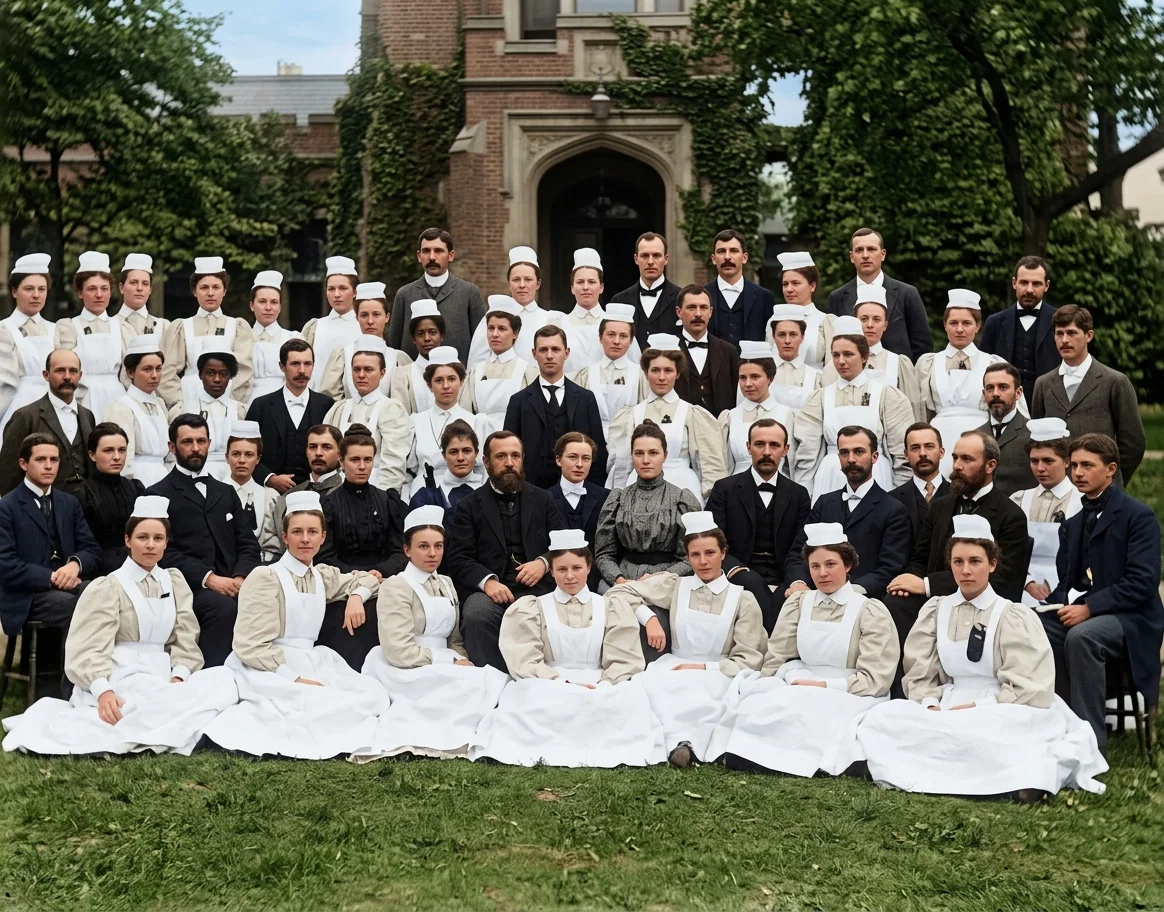
A GROUP OF PHYSICIANS AND NURSES AT THE BATTLE CREEK SANITARIUM
It is the constant aim of those in charge to make the Sanitarium indeed a “city that is set on a hill,” from which light and blessing may go out to those living in darkness and distress because of ignorance of physical laws. No effort is spared to make the educational advantages the predominating feature of Sanitarium work; and in this educational work, a class of people is reached which could, perhaps, be reached in no other way. Practically, at all times at the Sanitarium can be found ministers, lawyers, physicians, governors, and United States senators and representatives. Never are persons more readily influenced by righteous principles than at the very time when they are suffering most the consequences of violating natural laws.
The basis of all the instruction is that man is a temple in which God dwells, and hence the importance of a clean body as a fit dwelling for the Holy Ghost. The end and object in the mind at all times is to lead the patient, through a knowledge of natural laws working in the spiritual world, to a full recognition of God, and to a yielding of the body as a temple of God, and all the members as instruments of righteousness.
We will enumerate a few of the special educational opportunities afforded by the Sanitarium:—
Education of Patients.—While the advantages which come to patients healthwise from the treatment and attention which they receive while at the Sanitarium are important, it is regarded as of vastly greater importance that these patients receive a knowledge of the principles which have been violated in bringing them from a state of health to one of invalidism, and that they be instructed in the manner of righteous living which will enable them, after returning home, to obviate the causes that led to their sickness.
The patient's entire program, from the time he rises in the morning until he retires at night, is so arranged that he is really working in a training school. If at the table, he is in his eating carrying out carefully outlined directions given by his attending physician as to the proper combination of foods, food values, and all the fundamental principles of diet. If in the bath room, while receiving the treatment he is at the same time learning the method of applying these treatments, many of which are extremely simple, and of such a character that they may be carried out afterward at home. In the gymnasium he is learning systematic, graduated exercises15for a perfect and symmetrical development of the muscular system.
In addition to these, the almost daily lectures, and the opportunities of personal conversation with the physicians and nurses, who are thoroughly imbued with the importance of the educational work, enable the patient in a comparatively short time to become familiar with the principles which, if followed out, will enable him to reach a point of practical immunity from the host of prevailing diseases.
A School of Health.—Such a school is constantly in operation at the Sanitarium, and is free to all patients. The work consists of daily lectures, demonstration of simple treatments, a cooking school fitted up with all culinary conveniences, where patients may, under a competent instructor, prepare foods in a healthful, tasty, and appetizing manner. Frequently almost the first statement made by patients on their arrival is that they understand that a school of health is conducted to which they may have admittance, and that they desire to avail themselves of this privilege, wishing not only to become well, but to learn how they may regulate their mode of living so as to keep well after leaving the institution.
A Nurses' Training School.—A training school is constantly maintained, into which is received only those young men and women who have a live, Christian experience, and who have decided to devote their lives to medical missionary work in home or in foreign fields. In this school hundreds of young people have received a training that has enabled them to go out and fight valiant battles in the cause of God and humanity.
The training of a medical missionary requires weeks and months of patient effort on the part of both student and teacher. Each day the students are brought in contact with wonderful truths as shown in the various workings of God in man, thus constantly receiving fresh glimpses of the love of God, and inspiration to talk of this love to patients with whom they are in daily association.
Many touching incidents might be enumerated in which patients, with but a feeble hold upon life, have been brought to a saving knowledge of him who said, “I am come that they might have life, and that they might have it more abundantly.”
After receiving their training, nurses are prepared to go out to do pioneer, self-supporting missionary work, entering, with the principles of the soul- and body-saving truth, homes otherwise practically inaccessible. The experiences of the medical missionary in this country and in foreign fields abundantly prove the truthfulness of this statement.
No greater opportunity for impressing men and women with divine truth is offered than in the case of a person, who, sick and suffering, longs for relief from distress. The constant, loving, faithful attention of a devoted Christian nurse day after day, soon inspires love and confidence in the heart of the patient for the nurse, and rare indeed it is that an unconverted patient fails to respond to the still, small voice, listened to and heeded because of the prayers and heart-to-heart talks of a consecrated nurse.
The Training of Hygienic Cooks.—No less important than the training of nurses is that of hygienic cooks, who are in just as true a sense medical missionaries. The demand for hygienic cooks is constantly increasing. A systematic and thorough course of training is given to this class of students, both at the Sanitarium and in connection with hygienic cafés established in various large cities. The influence of this work is rapidly extending. For example, at the café established by sanitarium workers in connection with the University of Chicago, at the present time five hundred meals are daily served to students, teachers, and professors of the university. The same is true of the University of Wisconsin, at Madison, where three hundred persons in connection with the university are being fed daily at the café. Such cafés have been established in a number of the large cities of the country, and this department of sanitarium educational work is rapidly growing to extensive proportions.
Chautauqua Work.—Omitting to mention the numerous small schools of health conducted in various parts of the country, an important feature of sanitarium work is the sending out during the summer of companies of physicians, nurses, and cooking-school teachers to various large Chautauquas in the different States. For several summers the Sanitarium has conducted quite an extensive work in this way. At these Chautauquas immense audiences of all classes of people congregate, often to the number of eight or ten thousand in daily attendance; and as a regular part of the program, lectures are delivered and demonstrations given on subjects pertaining to scientific cookery, rational treatment, dress reform, and all the leading distinctive features of our work. Because of the opportunities thus afforded, hundreds and thousands are led to live in harmony with the principles of physical righteousness, and thus their hearts are prepared for the greater gospel in its fullness.
Literature.—It is only necessary merely to refer to this part of the educational work. It is well known how extensively circulated have been the thousands of pages of books, periodicals, and pamphlets published in increasing numbers from year to year, since the establishment of the Sanitarium idea. Hundreds and thousands of patients who have visited the Sanitarium, when asked the question as to what led them to come to the institution, have replied that, having read literature setting forth the principles of the institution, they were led to have confidence in the work, and decided to come and take treatment, and learn further of the Battle Creek idea.
Health Foods.—It is also only necessary simply to mention this department of the work. Every package of health foods is a missionary visitor. It helps to indicate the way toward a better life. The same might be said of the health foods as of the health literature in reference to patients visiting the Sanitarium, as testified by a number of patients.
Correspondence.—This is no small part of the educational work of the institution. Hundreds of letters come every week from all parts of the world, containing appeals for suggestions for the relief of all classes of maladies. These letters are from persons who are unable to visit the Sanitarium for treatment. Each of these letters receives careful perusal and a personal response, with definite and simple suggestions as to diet, treatment, exercises, and all matters pertaining to the physical as well as the spiritual man. Not one of these appeals ever passes unnoticed, and the many scores of letters received afterward, expressing gratitude for the help received, give abundant evidence that this department is a help and an encouragement to those who might otherwise be left in suffering and distress because of lack of knowledge.
In this article we have not attempted to outline definitely and specifically all the educational features of sanitarium work, as this would not be possible in the brief space of one article. It must be apparent to all, however, that, with sanitariums established in nearly all parts of the world, from each of which goes out an influence for the uplifting and healing of fallen and suffering humanity, and representing, as they do, a complete gospel having the power to preserve blameless soul, spirit, and body, sanitarium enterprises occupy a unique place in the closing work of the world's history.
The St. Helena Sanitarium
By Abbie M. Winegar
ABBIE M. WINEGAR, M. D.
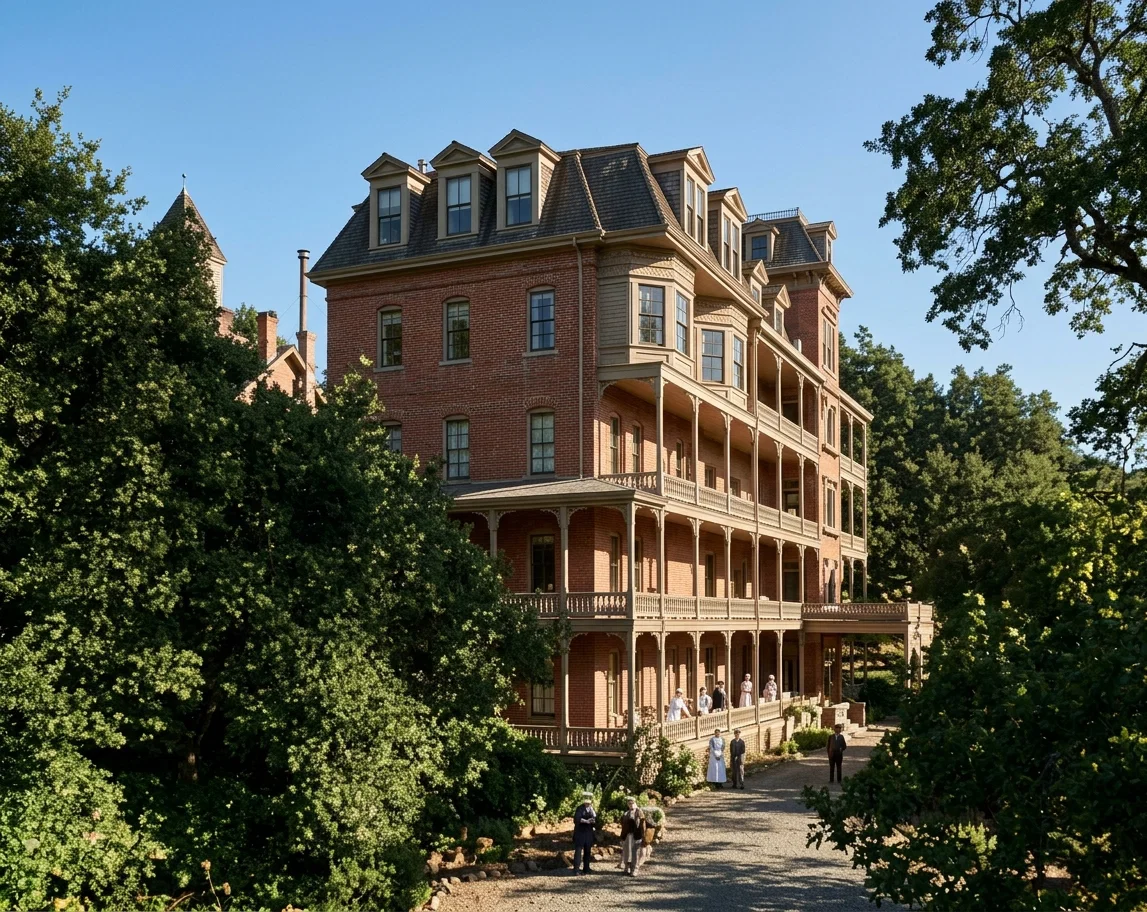
The St. Helena Sanitarium is beautifully located in the Napa Valley, one of the most picturesque valleys in Napa County, which is generally acknowledged to be one of the most beautiful counties in the State of California.
The sanitarium, established in 1877 for the promulgation of the gospel of health, and as a place where the sick could be treated by rational methods, was the second institution of its kind in our country.
Since its beginning, it has passed through many and varied experiences, some of victory, others of apparent defeat; but notwithstanding all the hindrances and perplexities which so often attend a work of its kind, the16institution has grown, and the life-giving principles, which have made it all that it has been and is, though at times apparently obscured, have ever triumphed, and the blessing of God has attended it.
One of the principal objects of the institution has ever been to educate the people in principles of health, and to train young persons who could go out and teach the grand truths of “saving health among all nations.”
The first regular training course for nurses was organized in 1892, and consisted of a short term of six months; but before the close of this term, the regular two years’ course was established. The first class was graduated in 1894, and each year since a number of young people have been graduated.
Year by year the course of study has been improved, and new departments have been added.
While it is not the purpose to close the door to any worthy young person, yet only those are admitted who have given their lives to medical missionary work. The educational standard has also been raised, and all students who now enter the school are required to pass an entrance examination.
A class of nine was recently graduated from the school. Three members of the class were not of our faith at the beginning of their course,—two having never made a profession, the other being a member of the Methodist Church,—but we are rejoiced to say that the three have identified themselves with us, and were baptized the Sabbath following the graduation. Every member of the class is fully given to the Lord, and all hold themselves in readiness to go wherever the Lord may direct and the board may indicate.
The number of nurses now in the institution is seven graduates, ten seniors, and eighteen juniors. The first year class, which has just entered, numbers twelve; and probably six or eight more have been accepted, but have not yet entered.
The spiritual interests of our family are most excellent, and there is a spirit of earnestness among the young people which is an inspiration to all. Morning worship is daily held with our workers. This often takes the form of a social meeting, and it is gratifying indeed to see our whole family on their feet at once to bear testimony to God’s goodness.
A Bible study is held every day at one o’clock. This is also a time when special requests may be given for prayers either for the family or for patients.
An enthusiastic young people’s meeting is also held every Sabbath afternoon, in which the young people themselves are held responsible for the work, thus seeking to develop laborers, who, when they go out as missionary workers, may be prepared as leaders of the people.
A school of health is carried on for the patients, in which special instruction is given in the various subjects pertaining to health, dietetics, cookery, healthful dress, exercise, ventilation, and all kindred subjects.