All of the exceeding great and precious promises of the Word of God are for us personally; God gave them to us when he gave Christ to us.
“For all the promises of God in him are yea [yes], and in him Amen [so be it], unto the glory of God by us.” 2 Cor. 1:20.
Now when we say, “Yes, Lord,” to every promise given, “I thank thee for giving me this word,” God says, “So be it unto you.” And thus we glorify God by taking him at his word, and trusting him fully and unreservedly to fulfil all his good promises to us.
The value of any promise — and of all promises — is measured by the ability and faithfulness of the promisor to keep it. The one who promises beyond his ability to fulfil is only awakening false hopes; and when it is found that he is unable to keep his word, discouragement and disappointment follow. No one has a right to make promises beyond his ability to fulfil.
God is divine, and thus is able to make divine promises. God ever lives to fulfil his promises, and his memory never fails. Our best earthly friends sometimes, oftentimes, forget their good promises, but not so our Heavenly Friend; as it is written, “There hath not failed one word of all his good promise.”
Because he is God, because he is good, because he is faithful and true, he will fulfil his word. He could not remain God, and fail in keeping his promise. More sure and steadfast than rocks or hills, than suns or planets, is his word.
And the very thing promised is in the promise itself. As the tree is in the nut, all hidden away and apparently lifeless in its hard, unpromising shell, so the very thing God promises is in the promise itself. But it must needs be planted in the heart and mind. Left in the printed page, it is like the seed hidden away in chest or drawer. But grasped by faith, and planted in the moistened soil of the heart, it manifests its divine life and fulfils itself and produces itself. Then let us select the promise containing just the help we need,—be it forgiveness, cleansing, healing, purity, or power,—believing the word spoken, was spoken for us, that it is divine, and that God lives to make it alive in us; and it will be so. It is so.
New York City.
Comfort
By H. A. STEINHAUER
H. A. STEINHAUER
BRETHREN and sisters in the Lord,—those of you who are in trouble of any kind, be of good cheer! Remember that to the Christian nothing happens; everything is either ordered or permitted; and this by your best Friend, the Lord God Almighty.
If ordered, it must surely be for our good. If simply permitted, it will still be for our good, as “all things work together for good to them that love God.” Rom. 8:28.
And I think I may safely add, that if we love God and lean hard on his supporting arm, sooner or later, when the chiseling necessary is accomplished, our dear, almighty Father will either take the evil thing away, cause it to cease, or so alter circumstances that it may no longer grieve or annoy us. Praise his name!
Battle Creek, Mich.
Partakers of the Holy Ghost
By A. SMITH
A. SMITH
THE Holy Ghost can not affiliate with cherished sinful conditions. He only “that hath clean hands, and a pure heart,” can receive the Holy Ghost, except as a convictor or reprover of sin. He can not dwell in the heart of one who indulges in evil speaking, foolish talking, or jesting. See Eph. 4:29-31; 5:1-4.
The message is sometimes presented with a fervor and pathos approaching tears; and then, when the messenger is off duty, there follows a relaxation to the extent of laughing and trifling, which makes an observer wonder if the serious mood was put on only for the occasion. This deadens spirituality, and grieves the Spirit. A meek and quiet spirit is always of great price in the sight of God. 1 Peter 3:4.
The habit, often indulged, of turning the incidents of daily life into mirth-provoking remarks is very blighting to the growth of the spiritual life. The Holy Ghost can not dwell in such a life. Christ indulged in no such practises; and one in whom the Holy Spirit dwells will walk as he walked. 1 John 2:6; 1 Peter 2:21, 22. Every dishonest deed of the life must be put away by confession and restoration as far as possible, before the Holy Ghost can come into the life as a sanctifying, working power.
The Lord is willing and waiting to give the Holy Spirit to them that ask him. Luke 11:13. But the first office of the Spirit will be to drive the traffickers out of the temple. John 2:15, 16. It will not be eloquence of diction or force of argument that will speedily bring the message to a close, but the power and pathos of Spirit-filled lives.
Grandville, Mich.
Duty Made a Pleasure
By Phœbe Cary
DON'T do right unwillingly,
And stop to plan and measure;
'Tis working with the heart and soul
That makes our duty pleasure.
— Phœbe Cary.
No, Don't!
By T. H. JEYS
T. H. JEYS
DEAR fathers, don't scold. The shoes will grow old, and the clothing wear out. 'Tis by no means at all worth scolding about. Your burdens will be like the sands of the sea, and nothing is what you might wish it to be; you'll be jostled and pressed, and perplexed and distressed; you'll wish for a place and a period of rest. The children won't do as you might wish them to; all things will run wrong, and the prospect look blue. But, fathers, don't scold! O don't scold!
Dear mothers, don't scold. There'll be dust on the carpet from John's dirty feet, and Mary and Polly will fail to be neat. They'll make a great racket; for quiet you'll plead; and after you've spoken, they'll fail to take heed. All over the garden the chickens will scratch; the seeds will not sprout; the eggs will not hatch; the doors will blow open; the house plants will freeze; John's suit will wear out at elbows and knees. But, mothers, don't scold. O don't scold!
Dear brethren, don't scold. Brother A is too slow; Brother B is too fast; Brother C never sees till the chance has gone past; Brother D is contrary, F and G are perverted; H, I, J, and K are not soundly converted; while all of the rest, whether child, man, or woman, are all full of faults, decidedly human. In short, to come quickly and right to the point, — the world, and all in it, are quite out of joint.
But, brethren, don't scold. O don't scold!
“He Shall Not Fail Nor Be Discouraged”
SCHOOL was out, but one boy lingered. When the room was cleared, he made his way to the teacher’s desk.
“Well, John, what is it?”
“It’s no use,” said John, the tears choking his words, “I just can’t do these examples. I don’t understand a thing we have been trying to do, and my work is all wrong. If it wasn’t for having the other boys laugh at me, I would go back. I can’t get anything right.”
“Let me see your paper,” said the teacher. “See, this one is right.”
“Maybe it is, but I don’t know how I did it, and the rest are all wrong.”
“No, here is another that is almost right. You began well, and made just a trifling mistake. Let us correct that, and see how well it will come out.”
It would be too much to say that the teacher showed John how to do the work. He was too weary and discouraged to understand very much of what she showed him. But one thing he understood—the teacher had confidence in his ability to succeed.
“She thinks I can do it, and I believe I can,” was about the way he put the case. “The teacher is a brick! She has faith in me.”
That the teacher was not discouraged about him rebuked his own discouragement concerning himself, and gave him power to succeed. He was not a brilliant scholar, but he was a faithful student—a worker who needed just the encouragement his teacher gave him, to add hopefulness and outlook to the work.
Years afterward, in a time of perplexity and doubt, the lesson came back to him. He had suffered disappointment, and his faith was sorely tested. He was tempted not to try again. Then he found the prophetic words, “He shall not fail nor be discouraged.”
“I wonder if that means that God has faith in us,” he asked. “That is what it seems to mean. ‘A bruised reed shall he not break, and the smoking flax shall he not quench. . . .’ He shall not fail nor be discouraged.’”
His own lamp had been burning dimly enough, and sometimes had given smoke instead of light. He had been bruised, wronged, disappointed. Had God any oil for a lamp so nearly dry? Could God bind up so bruised a reed? Would God count himself to have failed if one poor man like him should let his light flicker and go out, or if a reed so bruised should die?
“He shall not fail nor be discouraged.” The words came back to him with the clear ring of assurance. He remembered the day when he stood, a big boy, ashamed to cry, but humiliated and discouraged, before the teacher’s desk, and how her faith in him had given him faith in himself. Man that he was, he sobbed again before the Great Teacher who giveth to all men liberally and upbraideth not:—
“O God, if thou art not discouraged concerning me, I will not give up in despair of myself!”
Whenever periods of depression have come upon him since then,—and there have been many of them,—he has recalled these words, and they have always helped him, until now the habit of courageous fighting has become fixed, and a clear faith and a hopeful spirit mark his every-day life.—Selected.
Why He Lost His Friends
He was always wounding their feelings, making sarcastic or funny remarks at their expense.
He was cold and reserved in his manner, gloomy, pessimistic.
He was suspicious of everybody.
He never threw the doors of his heart wide open to people, or took them into his confidence.
He was always ready to receive assistance from his friends, but always too busy or too stingy to assist them in their time of need.
He regarded friendship as a luxury to be enjoyed, instead of an opportunity for service.
He never learned that implicit, generous trust is the very foundation-stone of friendship.
He never thought it worth while to spend time in keeping up his friendships.
He did not realize that friendship will not thrive on sentiment alone; that there must be service to nourish it.
He borrowed money from them.
He never hesitated to sacrifice their reputation for his advantage.
He was always saying mean things about them in their absence.—Success Magazine.
Don't Part in Anger
“Did Mrs. Schmidt always have that sad, earnest expression?” I asked my mother once after observing for quite a while the pale, quiet woman who came every week to help with the work.
“No,” was the response, “thirty years ago, just after her marriage, and even before that time, she was one of the jolliest persons, always ready for a joke, but unfortunately also headstrong and ready to contradict. Her husband was a good and noble man. He worked in a laboratory, just outside of the city, but he was very sensitive and easily hurt. On that account many a little quarrel ensued; the wife thought she must cure her companion of this sensitiveness, and kept on quarreling and contradicting vigorously, even though she meant no harm by it. She always had the last word.
“One morning such a scene had taken place between husband and wife. After the kind-hearted man had left for his work and gone quite a distance, he retraced his steps, for, undoubtedly, he lamented the occurrence. Seeking his wife, who was in the kitchen, he said: ‘Marie, let’s part as friends; forgive and forget. Give me a kiss, and all will be well. I fear I’ll not succeed well with my work, if we do not.’
“But the wife remained obdurate and turned away, not even giving him a hand-shake. She thought that in this way she could cure him of his sensitiveness.
“He did not return alive. In the evening four men brought him home as a corpse. I have never seen her laugh again. She would have been willing to give years of her life, if she could have recalled her actions of that time. And all of us, who were witnesses of her sorrow and self-reproaches at that time, will well heed: Never leave each other without righting disputes and quarrels that may have arisen. Who knows but that there may be only a step between that moment and death.”—Lutheran Standard.
The Glorious Coming
O WEARY laborers in the field,
Hope on and sing, nor heave a sigh;
The happy day is drawing near,
“The glorious coming draweth nigh!”
Work on and spread the precious news,
Proclaim it wide to low and high;
Be swift the Master’s call to heed,
“The glorious coming draweth nigh!”
Gird on thy armor for the strife,
Go forth and on thy God rely;
Turn not, nor falter, but trust on,
“The glorious coming draweth nigh!”
Be strong, but true; go far and wide,
Till all shall Jesus magnify;
Be holy, spotless, like thy Lord,
“The glorious coming draweth nigh!”
Then hasten to the harvest-fields,
The days are passing swiftly by;
The “little while” will soon be gone,
“The glorious coming draweth nigh!”
— Selected.
Spain
By Frank S. Bond
FRANK S. BOND
On May 22 King Alfonso XIII arrived in the city of Valencia. His object in coming here at this time was to assist in the inauguration of a great six-months' exposition which has just opened.
For several months, extensive preparations have been going on. The city authorities gave orders that all property holders might paint their houses without securing licenses from the municipal body. As a result of this order, a remarkable cleaning-up has taken place. Hundreds of houses which before presented anything but a pleasing aspect, are to-day fairly shining in their new and charming coats of paint.
The exposition was to have opened May 1; but at that time many of the buildings to be used were unfinished. Then it was decided to open May 18; but for a number of days prior to this, heavy rains fell, making the exposition grounds and the streets of the city very muddy, so it was again decided to postpone the king's coming.
There are many to-day who profess to be followers of God's Word, and yet are endeavoring to put off far in the future the coming of the Son of man. It was possible for the citizens of Valencia to send a message to Madrid, asking the king to postpone his coming, because of the mud. There are many who would, were it possible, send a hold-over message to the throne of God. But to the prayers of such God does not listen. They are out of harmony with the law which governs his eternal kingdom, and to him the petitions of such are an abomination. Prov. 28: 9. “For yet a little while, and he that shall come, and will not tarry.” Heb. 10: 37.
When the gospel work is finished, King Jesus will come, and all the forces of evil combined can not delay his coming.
Only a beginning has been made in Spain, and thus far only a little fruit has developed. These people are thoroughly steeped in the superstitions of Romanism, and it is with difficulty that God's Word can enter their lives. My brother and I are doing what we can to get the message before the people. Our native helpers have distributed thousands of papers and tracts. We believe that if we continue sowing, we shall in the end see an abundant harvest.
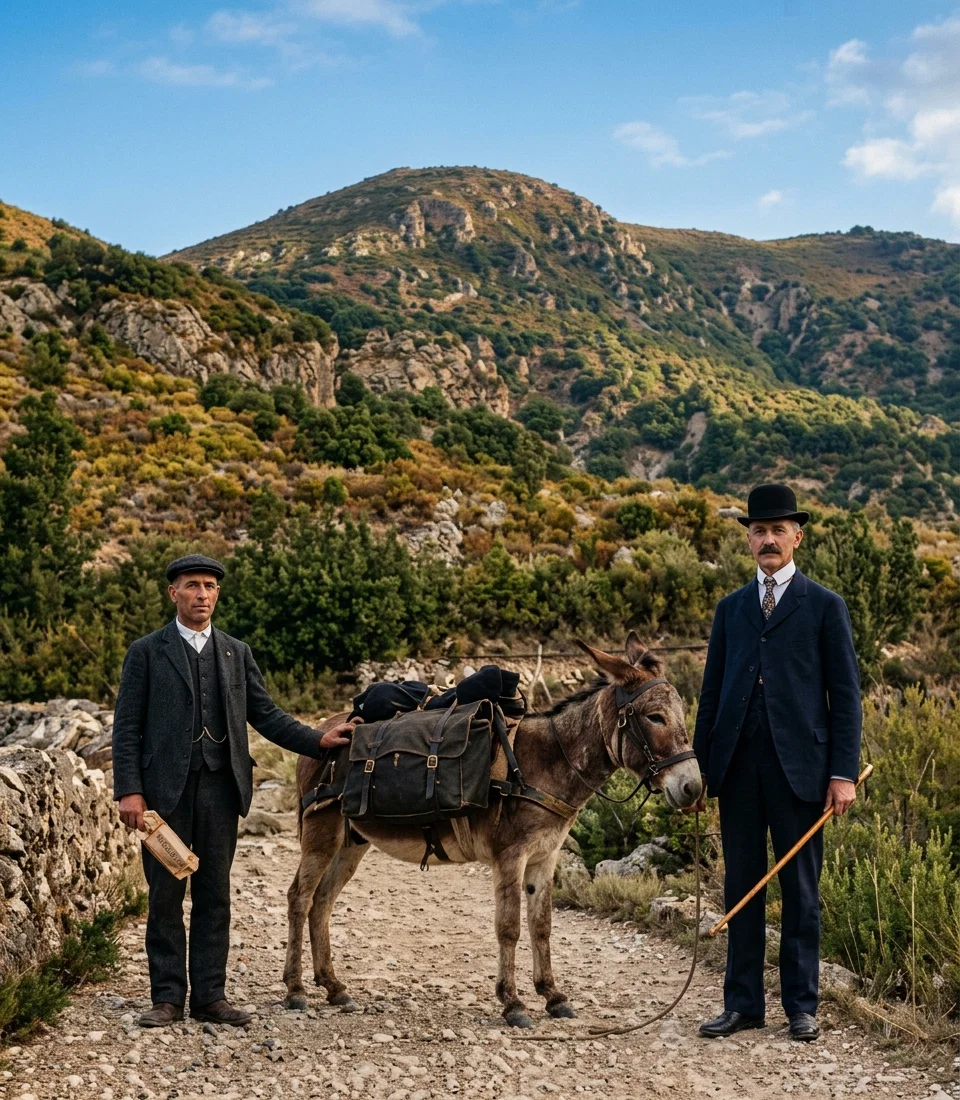
THE “BURRO EXPRESS”
The worker in this country meets with many difficulties, and especially is this true of the colporteur. Spain is a very mountainous country, and in some parts many of the inhabitants have never seen a cart or wagon, much less a railway train. The eighth of this month [May] I had the privilege of baptizing a young man in just such a place as this. Only to-day I received a letter from this brother, and I am sure it would do your heart good to see how intelligent he is in the message, and how determined he is to be faithful. We rejoice to see the truth gradually entering the dark, out-of-the-way places of earth. Soon the words of the Saviour in Matt. 24: 14 will meet their final fulfilment.
While at the place previously mentioned, I went on a tour with one of our canvassers, into the province of Castellon. Our journey lay through wild and rocky mountains. Much of the trail is very steep, and we were ascending and descending the greater part of two days. We traveled on foot and by the “burro express.” For the two of us, we had one burro, and we took turns riding him. In the accompanying picture the writer is at the right, and Brother Salvador Iserte is at the left. We thought a great deal of our long-eared companion. He was a faithful, sure-footed little fellow, and brought us safely to our journey's end.
If any of our American canvassers who are accustomed to traveling by express-trains feel that they would like to share our joys, we would give them a welcome to this field. We can offer an abundance of populous territory which has never had any of our literature.
Valencia.
The Work in the European Division
By L. R. CONRADI
L. R. CONRADI
THE first quarter's report of the European fields shows another advance step in the work in this part of the Master's vineyard. There were 807 members added by baptism and otherwise. Of this number, 543 were in the German Union Conference; 111 in Russia; 78 in Scandinavia; 66 in Great Britain; eight in the Latin Union Conference; and one in the Levant Union Mission. There were three conferences that had over 70 additions each—the South German Conference, 91; the Rhenish, 90; and the East German, 74. The total membership in Europe is now 17,845, against 17,362 at the end of 1908, or a net increase of 483 for the quarter.
There appear upon the list for the first time these new fields: In the German Union Conference, the Middle German Conference, and the Galician and Adriatic missions; in Great Britain, Wales and South Scotland as conferences, and the North Scotland Mission; in the Russian Union Conference, the Little Russian, the Siberian, and the Central Asiatic missions; and in the Latin Union Conference, northern France as a mission field, three new conferences and seven new missions.
As far as the tithe is concerned, we also see God's blessing in its increase. The German Union Conference heads the list, with $30,000—the largest sum of tithe this field ever gave in one quarter. The quarter's tithe for Europe is $47,600, or $11,200 more than for the first quarter of 1908. The offerings amount to $6,250, giving us a total income of about $53,850.
We have 124 ministers, and 260 other evangelical workers; and 491 canvassers reported their sales during the quarter, amounting to $50,130.
In April, Brother Rhode, the foreman in our Hamburg pressroom, went to assist the Brazil publishing plant, while Brother Raessler and wife of Germany, and Brother Morse of England, went to the Victoria Nyanza field in East Africa, and Brother Kunze of Germany connected with the work in the Pare tribal Mission, German East Africa. We have learned that these persons reached their destination safely. We have received the happy news that fifteen more (among whom are the first three native East African women to receive the rite at our hands) have been baptized in the German East African Mission, and that twenty others have offered themselves as baptismal candidates.14
Our missionaries reached the Victoria Nyanza territory none too soon, as other societies were already sending their men there. We have secured two new sites for mission stations on the British side of the lake, and one on the German side, giving us a total of five new stations; but to man these we must send reinforcements this fall. Brother E. Kotz, who has faithfully labored in German East Africa more than four years, safely reached Hamburg on the fourteenth of May. During his stay, we hope to publish the Gospels in the Chassu, at the Hamburg House.
We hope erelong to secure a permanent site for the Abyssinian Mission, and if possible to do more to enter that country.
As to our institutions: The second school building at Friedensau is completed, and awaits its dedication in July. The Scandinavian Union School building at Skodsborg is nearing completion, and its dedication will probably be in September. In Stanborough Park a few new cottages have been erected, and our brethren there are now getting ready to put up the college building.
While we desire to see greater things accomplished in every way, yet we are grateful to God for his goodness in helping to extend the work in the European field, and hope that our brethren will remember its needs in their prayers and gifts.
Hamburg.
Burma
By R. R. COOK
R. R. COOK
The third year of our stay in the India Mission field is fast passing away. We feel thankful that it has been our privilege to have a part in the work in this great needy land; and as we look back over the years that have passed, we find that the hardships, the difficulties, and the disappointments are covered, as it were, by a thick veil of God's rich and abundant blessings and the glorious experiences that have been ours.
BELIEVERS PRESENT AT A BAPTISM IN BURMA
Since coming here to Rangoon we have seen wonderful evidences of God's power to impress hearts and to keep them in the truth. Some have stepped out against great opposition, knowing that it would mean the loss of their position, but relying wholly on the sure promises of God. They have not been disappointed. It means much in this land to lose an appointment, where conditions are so different from those in the States; but as the power of God is not limited, or controlled by conditions, their faith has been rewarded, and many have been strengthened.
A RURAL SCENE IN BURMA
We have had some interesting experiences during the past few weeks. Not long ago, a telegraph operator employed in the government telegraph office in Rangoon began to obey the truth. He met with much opposition and ridicule on all sides. He had been an open scoffer before, and was also noted for his very hasty temper. But the power of God wrought a great change in his life, and his influence is felt among his associates in the office. It was not long until one who had opposed him most began to investigate, and then to obey. In the early morning a short time afterward I had the pleasure of baptizing the latter, with two others who had been studying the truth for some time, in the beautiful Royal Lakes near Rangoon. Five of his friends were present at the rite, and expressed themselves as being very much impressed with the beauty and solemnity of the scene. They attended the church that night, and also the prayer-meeting on Wednesday night. They have now formed themselves into a class, and are studying the truth. They have also bought some books to study. We hope that soon some of these will obey the truth.
The message is onward in Burma. We must haste to keep pace with it and fill the many calls of those who are interested. The book and tract work has become quite a prominent feature here. Mrs. Cook is kept quite busy answering correspondence and mailing tracts, books, and papers to those who write in from all parts of Burma. Brother Stevens, in Upper Burma, is sending out thousands of pages of literature, and selling many of our books and periodicals. As he holds quite an important position, he meets many influential persons, and is bringing the truth before many. We are thankful for this beacon light, and we pray that the little company there may stand true and firm unto the end. Dr. Ollie Oberholtzer, in the southern part, sees her work advancing and enlarging, even though she is alone and unaided. Brother R. A. Beckner is putting in long hours on the study of the Burmese, and is beginning to get hold of this difficult language. Just before Elder H. H. Votaw left for America, he had a large number of tracts printed in Burmese, for both Christians and Buddhists, which literature we are disposing of as opportunity offers.
It was with feelings of sadness that a little company gathered on the wharf at Rangoon, to bid Elder Votaw Godspeed on his long journey to America. Our prayer is that more laborers may be sent to teach the truth in this land where so many are ready to receive it. We pray daily for the work in America, and we ask that you will remember this field before the throne of God, that he may give power to our labors and direct in all our efforts for the salvation of souls.
My wife and myself and two little boys have enjoyed very good health since coming to India, but we are looking forward to a trip to the mountain mission this year. It will soon be two years since we spent a month there.
Rangoon.
New York City
By G. B. Starr
Quite contrary to our expectations, the providence of God, through the voice of the General Conference, directed our steps to this great city, the metropolis of the United States.
Joining Sister E. G. White in Philadelphia, we spent one week there at the sanitarium, in counsel with the city and sanitarium workers. Coming to New York with Sister White, on Friday, June 18, we found a meeting in progress at Sixty-eighth Street, and the conference workers and church-members in attendance. Elder and Mrs. S. N. Haskell and Elders E. W. Farnsworth and C. S. Longacre were conducting the services. Sister White joined them, and spoke once on the Sabbath, and notwithstanding the combined noise of two elevated and one surface street-car lines, she succeeded in making herself heard.
On Sunday, June 20, a general meeting was held at Newark, N. J. About three hundred of our people were in attendance, including the conference officers, ministers, and workers of the New Jersey Conference. The people came early, and the hall was filled to its utmost capacity. Finding the people in waiting nearly three quarters of an hour before the appointed time, Dr. D. H. Kress and I improved the time to talk to them on the love and mercy of God and his great plans to fit his people to reflect his glory and finish his work. Sister White then spoke with more than usual freedom. She stood the long carriage ride from 17th St., New York, to Newark, N. J., well; and after lunch at the hospitable home of Elder W. H. Smith, rode back again to New York. In the afternoon Dr. Kress and the writer again spoke to the people, blending in perfect harmony the medical-evangelistic truths of the third angel's message. It was a good day, and will enter into the life experience of all in attendance.
After the departure of all the general laborers, Mrs. Starr and I were left alone, with a small interest at Sixty-eighth St., New York City. The noise was a great strain upon my voice, but the Lord helped me, and in spite of my fears I was enabled to make the people hear. We succeeded, however, after a long and diligent search, in finding a quiet and well-located allotment at One Hundred Eighty-seventh St. and St. Nicholas Ave., where the tent is now located, with an increased attendance of intelligent people. About two hundred were present on Sunday night.
Dr. D. H. Kress is with us, and is speaking every night with much freedom, and the people express their unqualified appreciation of the blending of the medical and evangelical truths. It seems to meet a want they have long felt. Usually we each speak from twenty-five to thirty minutes at each service.
We are expecting Dr. Lauretta Kress and a trained nurse this week, to unite with Mrs. Starr in a school of health.
It has cost a considerable sacrifice to release the Drs. Kress for this work. But the Lord has shown us that the medical and the evangelistic work should be united in the effort in behalf of New York City, and we have confidence in moving out in the path that he points out. We see a great work and a great future before us. In later articles we will speak of the needs of New York City.
We have had two baptisms in the Hudson River since our arrival here. Nine persons were baptized. Five of these were taking their first stand; four were rebaptisms. All have united with the church.
We are happy, and of good courage, and in good health. Pray for the work in New York. G. B. STARR.
Central New England Camp-Meeting
By E. W. Farnsworth
THE largest camp-meeting held for several years in Central New England was held in Nashua, N. H., June 24 to July 4. There were one hundred ten tents pitched on the ground, and quite a number obtained rooms in houses near by. About four hundred of our people were in attendance at the meeting at some time while it continued. Some came the first week, and then returned home to let others of the family or church attend.
This meeting was quite well provided with laborers. Sister E. G. White, Elder W. C. White, Elder S. N. Haskell and wife, Elder H. J. Edmed and wife from South Africa, Dr. D. H. Kress from Washington, D. C., and other laborers from the union and local conferences were present.
Two years ago the conference voted to hold its annual meeting separate from the camp-meeting, and by this means nearly all the business of the conference had been eliminated from the camp-meeting. On this occasion the whole time was given to the study of the Word, and the consideration of the message for our time and its advancement. Sister White spoke five times with great freedom. Elder Haskell conducted Bible studies each morning, and also held meetings at other times. Elder Edmed gave several very interesting missionary talks, while Dr. Kress's addresses were very helpful along health lines. The physicians and nurses from the Melrose Sanitarium assisted much by addresses and demonstrations.
Brother F. M. Dana, with other helpers, did good and faithful work for the children and young people. Brethren R. J. Bryant and H. C. Wilcox did earnest and successful work in behalf of the publishing department, while Prof. B. F. Machlan and Elder C. S. Longacre labored hard to interest all in the education of our young people. The good spirit of the Master was present in all the meetings. The laborers had good liberty in preaching the word. Forty-one were baptized. About two thousand dollars was raised for home and foreign missionary purposes. The attendance of people from the city16was not large, but increased till the close. After the meeting closed, Elder F. W. Stray, with other helpers, remained to develop the interest. The camp-meeting for 1909 will long be remembered as a good and fruitful one. Some were converted to God, a large number were encouraged and edified, and all returned home with brighter hope and stronger faith.
E. W. FARNSWORTH.
India
By J. L. SHAW
J. L. SHAW
ON my return from southern India I spent two weeks in Lucknow, and then came on to Mussoorie. Our printing-office in Lucknow is getting nicely started, and we have procured a small engine with which to run the press. It has taken some effort and expense to locate both the printing and mission offices at that place, but there are many advantages in having the printing-office in such a publishing center, in close proximity to the hills, only thirteen hours' ride taking us to Dehra Dun at the foot of Mussoorie.
Our public meetings in Lucknow have been well attended during the cold season. Just what will be the results, we do not know.
Dr. H. C. Menkel and his associates are in Mussoorie getting ready for the season's work. They are starting a small class for nurses this year. There will be five or six in this class. We hope in time to train missionary nurses for work in this field.
Elder W. W. Miller is expecting to come to Mussoorie to take charge of the public effort here this season. I think we shall have a good attendance, and hope to see some fruits as the result.
Brother and Sister L. J. Burgess have received a warm welcome in the Garwhal district, where they are opening up a school among the people in the mountains. There seems to be a demand there for school work, and the people have pledged quite a little toward the erection of the building. They are going forward with the work with their own means until the mission shall be able to help them.
April 1.
Chinese Women Receive Medical Diplomas
RECENTLY the Presbyterian Board gave medical diplomas to seven young Chinese women graduating from their medical college at Canton. The mayor was present, and delivered an address. In closing he said: “May you female students all pluck up your courage.” This event will no doubt serve to encourage bright Chinese lady students all over China to persevere with their studies, and gradually to take that place in the empire that they are capable of filling in professional lines of work, as well as socially.
Trusting Again in God’s Power
By Henry van Dyke
WAS it long ago, or was it but yesterday, that we prayed for strength to perform a certain duty, to bear a certain burden, to overcome a certain temptation, and received it? Do we dream that the divine force was exhausted in answering that one prayer? No more than the great river is exhausted by turning the wheels of one mill. Put it to the proof again with to-day's duty, to-day's burden, to-day's temptation. Thrust yourself further and deeper into the stream of God's power, and feel it again, as you have felt it before, able to do exceedingly abundantly. Remember and trust.—Henry van Dyke.
Brazil
By H. S. PRENER
We came to Sao Paulo the first of April. The city is cosmopolitan, progressive, and resembles many of our large American cities. It is situated on a high plateau, approached from the coast by climbing a steep mountain range. Although we are not far from Rio de Janeiro, the altitude makes this city more agreeable.17
My methods of labor among the Brazilians are the same as those used at home with the Family Bible Teacher. The special number of our large monthly magazine, with a cardboard cover and printed invitation, is used on the first visit. Other numbers are loaned on the succeeding weeks, and the first are kept in circulation. This plan is also being followed in Rio de Janeiro.
Sao Paulo is a large city, yet up to a few months ago it did not have a representative of our message. Our native canvasser, who is nobly assisting, found two—a man and woman—in the same section of the city, about a mile apart, keeping the Sabbath. The man had been a Sabbath-keeper for more than four years, and both had begun its observance from individual study of the Bible. Surely this is most encouraging—only a week in the field, and the Lord reveals two Sabbath-keepers. Other striking incidents prove that we are being led by an unseen hand; and the knowledge of being where God wants us to be, is truly comforting.
We have made our home in the vicinity of these interested people, and purpose following up this splendid opening. House-to-house work in a Catholic community is not easy, but it is the only all-successful method of working large cities the world over. We are laboring for a young Brazilian civil engineer, who calls at our home daily for Bible study and English.
Our central school at Sao Bernardo, our Brazilian headquarters, will soon be open. Elder John Lipke, the principal, will take the young men into our city every week to sell books and periodicals. We look forward eagerly to this; and as fishers of men, rejoice in the opportunities that lie before us to seek out honest, sincere hearts among this great Catholic multitude.