Your ShelfYour Projects

Signs of the Times, Vol. 40, No. 4.

Our Bible Band
Earlier text: Followers of God

The Ottoman Empire

A Chronicle of Its History
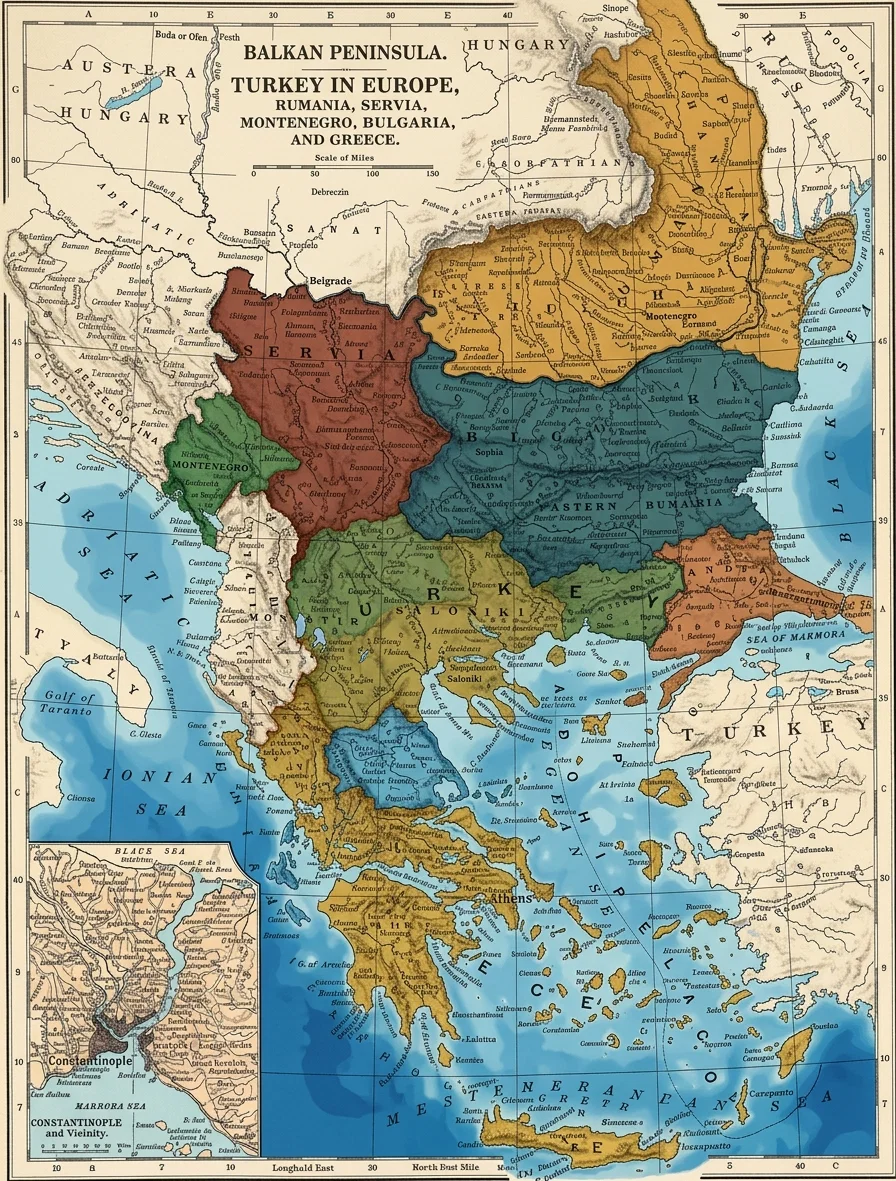
INASMUCH as there is a great interest now over the Eastern Question, as the outcome of the Balkan war is not yet decided, and may not be for some time, we have thought that it would be of interest to our readers to present a map of not only European Turkey but Asiatic Turkey as well, with a brief chronicle of the history of the Turkish Empire, simply stating the facts in order that these may be held in mind by those who are studying the question, and a good map to enable them to locate the boundaries of the new Turkey, if there be any new Turkey left in Europe after the allies and powers are through with her. Next week we will give a map of Asiatic Turkey.
The Ottoman Empire was founded by Osman, or Othman, from which the empire received its name, Ottoman. This founder lived between the years 1288 and 1326. The beginning of the nation was simply a tribe of Turks which had moved westward from their home in Iran in Asia.
Othman's son and successor, Orkhan (1326-1359), continued the strong, aggressive policy of his father. He was really the organizer of the kingdom. His capital was Brusa, the ancient capital of Bithynia. He gained a foothold in Europe in 1354 by taking the little peninsula of Gallipoli. He began an organization of his army by exacting a tribute of children from conquered Christian peoples. These he reared as Mohammedans and trained under rigid military discipline, and developed them into that tremendously powerful fighting machine, the Janizaries.
He was succeeded by Amurath I (1359-1389), under whom the Ottoman realm became a European as well as an Asiatic power. This king conquered Adrianople in 1361, and made it his capital.
Shortly after this, about all that was left of the Byzantine Empire was Thrace, Macedonia, and parts of Greece. Amurath greatly extended the Turkish dominions in Asia Minor, and in 1389 he broke the power of Servia in the battle of Kossovo. Servia at this time held considerable power eastward to the Black Sea, south of the Danube.
His son Bajazet I (1389-1402) succeeded him. He began his reign with the conquest of Bulgaria and a war against Wallachia, conquering a crusading army of Hungarians, Poles, and French under the command of Sigismund, king of Hungary, in 1396. Bajazet was taken captive in 1402 by Timur the Tartar, who swept over Asia Minor. In 1413 his youngest son became sultan, Amurath II, who reigned from 1421 to 1451. He extended the Turkish dominion over Macedonia, conquered a part of Greece, waged successful wars with the Hungarians, and sought to conquer the Albanians, but without much success. He gained a notable victory over the Hungarians under King Ladislaus and Hunyady in 1444. Mohammed II reigned from 1451 to 1481. Under his reign Constantinople was taken May 29, 1453, and the Byzantine or Eastern Empire of Rome came to an end.
An offshoot from the Greek Empire was that of Trebizond, and that was conquered in 1461. About the same time Morea, the southern peninsula of Greece, was conquered. The capital was transferred from Adrianople to Constantinople. History notes that at this time, cruel as they were in battle, the Turks allowed the Christian churches to maintain their organization in Constantinople. In 1456 Mohammed undertook to secure Belgrade, the key to Hungary, but Hunyady, the great Hungarian patriot, was victorious. A few years later Servia was incorporated into the Turkish Empire, and Bosnia was subjugated. In 1470 Euboea was wrested from the Venetians, and in 1475 the Tartar ruler of the Crimea became a vassal of the Ottoman sultan. Albania, which had maintained its independence so long under Scanderbeg, was at last subjugated.
An endeavor to seize Rhodes in 1480 was defeated. For a little while the Ottomans obtained a foothold in Italy. Mohammed II was succeeded by Bajazet II (1481-1512). Very little occurred during his reign, but under Selim I (1512-1520) great conquests were won by the Turkish Empire. He was successful in Persia, conquered Syria in 1516, annexed Egypt in 1517, and assumed the guardianship of the sanctuary of Mecca. Moldavia also became tributary to the Turkish Empire; Wallachia had previously submitted. Algeria fell under his power just at the close of the reign of Selim.
He was succeeded by Solyman the Magnificent (1520-1566). Under him the Turkish Empire reached the height of its power. Belgrade and Rhodes were taken respectively in the years 1521 and 1522. A victory was won over the army of Louis II of Hungary, in 1526, followed by a succession of campaigns against the house of Hapsburg in Austria. In 1529 they had gone so far west as to besiege Vienna. Hungary was then a Turkish province. In the great middle or Mediterranean Sea there was none to dispute them. Venice had been stripped of her possessions in the Morea and the Archipelago. Tripoli yielded in 1551. However, in 1565 a large Turkish force was beaten by the defenders of Malta.
Following Solyman came Selim II (1566-1574). He put forth a special effort to obtain the Island of Cyprus from the Venetians, which caused a league to be formed between Venice, Spain, and the pope, whose combined fleets defeated him in the battle of Lepanto, 1571. Nevertheless Cyprus was taken by the Turks. Yemen, the capital of which is Mecca, was subjugated in the reign of this sultan, and the Spaniards came were driven from Tunis, which yielded to Turkey. But the defeat at Lepanto was the beginning of the decline of the Turkish Empire. Men were led to believe that after all the Turkish fleet was not wholly irresistible. But she continued to win victories on land.
Under Amurath III (1574-1595), a successful war was waged with Persia in Armenia, followed by another with Austria which continued through the reign of Mohammed III (1595-1603), extending into the reign of Achmet I (1603-1617). Persia won a great victory over the Turks in 1605, even seizing the province of Bagdad, which was regained by Amurath IV (1623-1640).
In the meantime, the Venetians had been building up their fleets, and in 1656 appeared in the Dardanelles and defeated the Turkish fleet.
Turkey's greatest land defeat, however, really a decisive one in marking her decline, was in 1683, the chief figure of which was John Sobieski, king of Poland. That was the beginning of the end of Turkish power in Eastern Europe. After this crushing defeat Austria, Poland, and Venice waged aggressive warfare against the Ottoman Empire. The Turks were driven out of Hungary, the city of Buda which they had held for a century and a half was lost, John Sobieski overran Moldavia and Wallachia, and the Venetians successfully invaded the Morea.
In 1696 Peter the Great of Russia wrested Azov from them. The Turkish army was almost annihilated by Prince Eugene of Austria in 1697, and in the Peace of Karlowitz in 1699, Turkey was forced to give up all of Hungary between the Danube and the Theiss, to restore to Poland a great part of the Ukraine acquired in 1672, and to surrender the lower peninsula of Greece to the Venetians. Turkey waged a successful war in 1711, under Sultan Achmet III, against Peter the Great of Russia, who surrendered Azov. In 1715 they reconquered the Morea from the Venetians. The next year the struggle with Austria was renewed, with Austria victorious. In the Peace of Passarowitz in 1718, the Turks were compelled to cede a part of Servia with Belgrade, and parts of Bosnia and Wallachia to Austria, the Morea still remaining in their hands.
Russia took the aggressive in 1736, attacking the Ottoman Empire by seizing Azov and invading the Crimea, followed by the capture of Ochakov (1737), and a victorious advance into Bessarabia and Moldavia. Austria united with Russia in this in 1737, and the two together cooked up a scheme for the division of Turkey. This was foiled by the defeats, however, inflicted upon the Austrian armies by the Turks. In the Peace of Belgrade in 1739, Austria relinquished the Servian and Wallachian territories acquired in 1718, Russia concluded a peace in which she had made but a little gain.
In 1768 Turkey ventured upon a war with Russia, under Sultan Mustapha III, believing that her safety lay in checking Russia's advance; but the Russians marched victoriously through Moldavia and Wallachia, defeated the khan of the Crimea, won a victory in Bessarabia, and advanced into Bulgaria, where they were checked by the Turkish fortresses.
In 1770 the Russians burned the Turkish fleet at Tchesme. Peace was concluded in 1774, Turkey renouncing her suzerainty over the Crimea and other Tartar territories in the region of the Black Sea, and according to Russia a sort of protectorate over Moldavia and Wallachia, and the free navigation of the Turkish waters. What crippled Turkey in this war was the revolt of the Mameluke governor of Egypt.
Another war occurred with Russia in 1787. Austria profiting by this, seized the opportunity to enter Turkish territories, and fresh disasters befell the Turks. The Russian general Potemkin stormed Ochakov in 1788, and the allies won a great victory at Fokshani in 1789. Belgrade and Bender were captured in the same year, and Suvaroff besieged Ismail in 1790. Austria withdrew from the war, under pressure from Prussia, and the czar made peace with Sultan Selim III, in which the Dniester was made the boundary between the Russian and Turkish dominions.
France took Turkey in Egypt and Syria in 1798, but came no farther north than Acre. In 1801 the English drove the French from Egypt, and it was restored to Turkey.
In 1804 the oppressed Servians rose against the Turkish power. Internal troubles followed, largely from the growing power of the Janizaries.
In 1806 a war with Russia followed, and the country between the Dniester and the Pruth was ceded to Russia. Servia was again subdued, but the people rose again shortly after, and achieved a partial independence.
Greece threw off the Turkish yoke in 1821, and secured its independence through the intervention of the European powers in 1827 to 1829.
A revolt of the Janizaries occurred in 1825. This was met by Sultan Mahmud, and the next year thousands of the famous fighting organization were slain.
In 1828 and 1829 Russia again waged war against Turkey, advancing as far as Adrianople. Russia was also successful in Armenia.
In the Peace of Adrianople of 1829, Turkey surrendered to Russia the northeastern coastland of the Black Sea, and transferred to that power her suzerainty over the tribes of the Caucasus, while Russia was accorded a protectorate over Wallachia and Moldavia.
In 1831 internal war between the sultan and the Turkish viceroy, Mehemet Ali of Egypt, occurred. Mehemet would probably have succeeded in conquering the Ottoman Empire had it not been for the intervention of the powers, England, Russia, Austria, and Prussia. Efforts had been made more or less since Selim III to reform Turkey internally, but these were not very successful.
In 1853 Russia's attitude brought on another war with Turkey, the results of which would probably have been disastrous to the Ottoman Empire if England and France and Sardinia had not joined together to humble Russia. This resulted in the well-known Crimean war. In 1855 Sebastopol fell.
A treaty of Paris (1856) restored to Turkey the command of both sides of the lower Danube, excluding the czar from his assumed protectorate over the principalities of Wallachia and Moldavia, and closed the Black Sea against all ships of war. The two provinces above named secured almost complete independence, and were united into the principality of Rumania. The Porte coming into the family of European nations, made a proclamation of equal civil rights to all races and creeds in the Turkish dominions, but this was soon followed by a massacre of Christians in the Lebanon and at Damascus, which provoked again western intervention in 1860.
While it was thought that the treaty of Paris had settled for all time the Eastern Question, Russia reopened it again in 1871. When Germany and France were at war, Russia declared that she felt herself no longer bound by the provisions of that treaty which forbade her to have a fleet in the Black Sea. Russia's action was sanctioned by a London Conference. In 1866 to 1868 Turkey had great difficulty in suppressing an insurrection in Crete, and in 1875 the government repudiated a part of its obligations, the entire debt amounting to nearly $600,000,000.
A revolution broke out in Herzegovina in 1875, stirred up no doubt by Russian emissaries. In 1876 a fearful massacre of Christians and Bulgarians took place. Abd-ul-Aziz the sultan was deposed. His nephew, Amurath V, was placed on the throne, but reigned only three months, and was deposed as an imbecile; and his brother, Abd-ul-Hamid II succeeded to the throne.
Servia and Montenegro declared war against the sultan in 1876, but Servia was utterly defeated, in spite of Russian help. The European powers met at Constantinople, endeavoring to help matters, and a Turkish parliamentary constitution was adopted, a mere blind, however, on the part of Abd-ul-Hamid. Russia declared war again, under the pretense of enforcing the demands made by the powers in 1877, the Turks fighting bravely to defend themselves, but yielding in 1878 when the Russians were almost before the walls of Constantinople. The powers again intervened, the treaty of San Stefano was signed on March 3 of that year, and the whole Eastern Question was adjusted at what is called the Congress at Berlin, Russia being forced to content herself with a much less radical disruption of the Turkish Empire in Europe than she had endeavored to bring about.
In 1883 Great Britain took practical control of Egypt, altho it is still nominally a Turkish dependency.
September, 1885, the prince of Bulgaria proclaimed the annexation of Eastern Rumelia, and the Turkish government recognized the action.
In 1895 and 1896 there were massacres of thousands of Armenian Christians, which the local officials of the Ottoman government seemed to acquiesce in, and the protests of Europe had little effect on Abd-ul-Hamid. War between Greece and Turkey broke out in 1897, but Greece was soon conquered and was compelled to pay an indemnity of $18,000,000 to the Ottoman government. Crete was practically lost to Turkey by the powers taking charge of it,—Great Britain, Russia, France, and Italy, in 1898.
In 1908 the Turkish provinces of Bosnia and Herzegovina were formally annexed by Austria. In response to Turkey's protest, the assumption of $12,500,000 of the Ottoman debt was accepted by Turkey.
In 1909 the independence of Bulgaria was recognized by the Porte. For this Russia assumed $9,000,000 of the Ottoman national debt.
In 1908 the Young Turk revolution broke out. Those at the head of it evidently designed to give Turkey a much better and more stable and modern government, but it has been with great difficulty that they have existed. The old prejudices of years are not overcome by constitutions, and the Young Turk cabinet was really overthrown in July of last year.
In September, 1911, the Turko-Italian war broke out over Italy's seizure of Tripoli. As a result of trouble in the Balkans, and having no navy to meet the Italian sea forces, Tripoli was yielded to Italy, Italy assuming $400,000 annually of the payment of the Ottoman public debt, in compensation for the loss of revenue from Tripoli.
In October of last year Bulgaria, Servia, Montenegro, and Greece, allied together and began war against Turkey, and that war has continued up to the present time, altho at this writing there is a meeting of peace delegates in London to endeavor to settle it. Nearly all of European Turkey has been conquered by the allies. Turkey wishes to retain Adrianople, her ancient capital. The allies demand that Adrianople shall be given up. If this is accomplished, it will leave Turkey the barest strip of land along the borders of the Sea of Marmora and the Straits of Dardanelles, including the peninsula of Gallipoli. At last advices Rumania was threatening Bulgaria, giving the Turk hope that she might retain Adrianople, but on the other hand, the inhabitants of Adrianople and the Turkish army that holds it, are on the verge of starvation, and can hold out but a few days more, it is said.
This recital of mere facts, showing the increase and decline of the Turkish Empire, we have taken largely from that excellent work, “The International Encyclopedia.” It will help our readers to form something of a just basis of the Turkish Empire in the past and present. That power which God suffered to enter Christendom as a scourge to an apostate church certainly did her work, so far as the scourge was concerned, but the lesson seemed to have been poorly learned on the part of those who were so severely punished. Next week we will give a map of Turkey's possessions in Asia, and somewhat of the resources of the empire in that continent.

Prepare War.

We are told that the United States battle-ship “Pennsylvania” is the greatest vessel of its kind floating, or will be when she is launched. The length is 600 feet on water-line, over all 618 feet, breadth 97 feet ½ inch, draft 28 feet 10 inches, displacement 31,400 tons, and speed on four-hour trial 21 knots. It has for a heavy battery twelve 14-inch guns; besides this four submerged torpedo tubes supported by a torpedo defense battery of twenty-one 5-inch guns. Fully equipped for service, the cost is estimated at $12,000,000. It will be armed with 18-inch plates. Engines, reciprocating, or turbines, with oil-burning boilers of the water-tube type. This is called by some a “peace persuader,” but when the time of Armageddon comes, the “Pennsylvania” will be in use, if she does not grow old and is replaced by some larger monster before that time.

Powder Trust Dissolution Begins

The dissolution of the great powder trust began January 2, under the decision of the Supreme Court of the United States. Will it be another Standard Oil dissolution?

Archbishop Noel Named Dominica President

The new president of Dominica is Archbishop Noel, appointed as provisional president of the republic for a term of two years.

Homesickness — No. 1

By Mrs. L. D. Avery-Stuttle
I SHALL not undertake a description of this most peculiar malady, because to those who never experienced its nauseating pangs, my language would be quite unintelligible; while to those who have tasted its abject misery, tho for only a day or an hour, my very best and most vivid description would seem weak and tame.
To experience one throb of this unique misery, is never to forget it. It leaves its own indelible record upon the quivering tablet of our heart; and until the heart ceases to beat, that record of abject misery is never effaced. For every other disease in the whole catalog, there is a multitude of panaceas; but for this, there is only one remedy — home.
I do not suppose that any one was ever genuinely homesick if he had never known the satisfying delights of home. It may be in the country, where the songs of the wild birds make sweet music among the orchard trees, and the old grove with its tangle of wild grape-vines just back of the barn, echoes to the shrill sound of childish laughter; or it may be in the crowded city, amid the hum and thrill of busy life, where the screech of the locomotive and the factory whistle break, like a clamorous babel, upon the sensitive ear of the unaccustomed.
It may be in the heart of the tropics, where sunshine and beautiful birds and brilliant flowers and babbling brooks and trailing mosses and blossoming trees ravish the eye and the ear, and compel the admiration of the most careless and unappreciative; or it may be among the snow huts of the fur-clad Eskimo; but if it be home—“sweet, sweet home”—it is the dearest spot on earth.
Mud hut or palace, high or low, rich or poor, well furnished or bare and comfortless, if it is only home, there is something about it which appeals to the heart’s affections as nothing else can.
Years ago, I remember reading about a sailing vessel which went to the coasts of Greenland. When he returned home, the captain brought with him a native from that far-away land of snow and ice. He was an intelligent old man; but all his life had been spent amid storms and tempests; and the country of sunshine and flowers, to which, with wide-eyed astonishment he was so suddenly introduced, had no charm for him. He remained an unhappy and an unwilling guest until the vessel again started on its Northern trip. A short distance from land, the lonely, homesick wanderer was taken with a fatal malady. Day after day he lingered, constantly turning his hungry gaze toward the distant North. If he could only live to see it once again—his native land! Storm-tossed and tempest-riven, it had no terror for him. It was only beautiful; it was home.
“Are we almost there? do you see the icebergs?”
They were his last words, spoken in piteous appeal to his shipmates. Poor, homesick, hungry heart! he never again saw the icebergs.
The Almighty, in His infinite wisdom, has made us so; and I am glad He has. But I tell you, “home” means something more than four walls; it means warmth and light and sunshine and good cheer and tenderness and sympathy and love. Perhaps I ought to have said that this is what home should mean, and what, by the grace of God, it may mean to the Christian.
The faded pictures, cheap and unvarnished, which hang upon the low, musty walls of the humble miner’s cabin amid the mountains of solitude, are as dear to the children of that home, as are the expensive paintings of the masters, to the surfeited child of wealth.
The old-fashioned chromo and the poorest woodcut, appealed to my childish eye as veritable achievements of art; and I have never seen anything since, that seemed half so beautiful as the simple little cards bearing the words, “Reward of Merit,” which I received in childish ecstasy.
Ah! the old schoolhouse and the old home! The front door, which looked toward the north, was painted red, and there were tall hollyhocks back of the house, under the bedroom window. It would not have been called a beautiful home by the fastidious stranger; but in and out of that same red door my childish feet have played. Every foot of the old home farm is rendered sacred by a thousand hallowed memories.
Just north of the house is the old sugar-bush. Do you remember how we used to pour the piping hot sirup over our saucers of snow? Never such delightful nectar as that which came from that old sugar-bush! Here in this secluded nook is the playhouse. Can you not almost see the groups of happy, childish faces, flashing in and out from among the shady retreats?
Do you see that winding path? Let us follow it. Notice that large gray boulder close by the fence: it is quite smooth and flat on the top side. How natural it looks! Ah, many and many a time, in the old days, has my mother taken my little hand and quietly led me along this same winding path to this same gray rock, and there knelt in humble prayer, commending her little girl to God.
The faithful mother has gone, now; but the fragrance of a beautiful life, filled with deeds of Christian piety, seems to grow sweeter as the years go by; and I grow homesick for that country of blessedness—that land where farewells are never spoken.

Sensible

A MOTHER was asked why it was that her girls were so proficient in home work, cooking, baking, and all that pertains to good housewifery. Her reply was: “I have let my children work for me from the time they were babies and sat in a high chair beside me, while I baked pies or mixed bread. Of course they bothered me in my work, and teased me for dough, but that was the way they learned everything. And that is where mothers generally fail in this respect. They put the children off in another room, or send them out to play ‘out of the way,’ whereas these little ones might be taught right along. My little girls learned to make pies in this way. They had little pie tins and tiny mixing bowls, and their pies were made in exact imitation of mine. When I made bread they also made little loaves in their pans, and their tiny biscuits were as cute as could be. When I ironed they also ironed on a chair beside my ironing table, and their small fat-irons were put to good use on ironing day. So it was with all my work. They worked along with me, and it often was as much pleasure for me as for them, and they were always lively company. Among their toys for Christmas or birthday presents were those tiny imitations of my culinary tools as mentioned above; also little brooms, sweepers, tiny tubs, wringers, washboards, and the like. And the nearer they were like the real article, the better the little girls were suited. “When I made a pudding they had to watch the proceeding; when I cooked anything, or canned, or pickled, they helped do what they could. They were a bother many times. When I was in a hurry it took patience to answer their numerous questions, and wait on them; but it paid in the end, for my girls can do everything in the domestic line, and I am proud of them. Many a time when mother is late in getting home from some meeting or call, or when she is very tired or indisposed, what a comfort it is to know that these little girls, not yet in their teens, can get a meal as quickly, neatly, deftly, and as cheerfully as the most experienced and capable housekeeper of forty or fifty.”
One of the unfavorable features of this age of school-going, is the failure of mothers to educate their daughters in practical housekeeping. This is an irreparable loss to any woman, as she finds when she has to stand as the head of her own family. Her knowledge of science, art, and literature will never take the place of the knowledge of practical housewifery. This almost lost art in house education, is one of the most prolific causes of loss of health, happiness, and wealth. Of the two, the good, neat, agreeable, practical housekeeper and cook of ordinary intelligence, or the graduate of many schools, is the queen of the home. Mothers be wise.—Observer.

Leaving Things Behind

You can not follow one thing without coming away from something else. . . . If you are moving onward, some things must be left behind. What are “the things which are behind” in your life?—Frances Ridley Havergal.

Harsh Words Leave Scars

“HARSH words are like drops of vitriol; they burn all that they touch, and leave everywhere little scars.”

Getting the Best Out of Oneself

“Nor getting the better of another person, but getting the best out of one's self, is success.”

Shared Sorrows and Pleasures

“A SORROW shared is a sorrow divided; a pleasure shared is a pleasure doubled.”

Notes and News

Enterprise, Oregon, is following the plan of consolidation in its church enterprises, or at least it is endeavoring to. A recent article tells us that three of the four Protestant churches in that town consolidated at a mass-meeting of members held in the Baptist church. The fourth church, the Baptist, wanted another week to consider. The proposition is, that one pastor will serve the Union church, holding services in the house of worship best suited for the purpose. If the Baptists unite, we are told that that church will be taken, as it is the newest, largest, and most modern, the pastor to be selected with the view of utmost efficiency. Doctrinal differences will not be considered. The board of control will consist of three members from each of the constituent churches, making a board of twelve members if all unite. Leaders in the movement are very enthusiastic. The article tells us they will plan concerning entertainments and amusements of all sorts, for old and young. The other three churches are the Presbyterian, Methodist, and Disciple. Of course, if these various bodies have no doctrines which they hold as essential, it would be the very best thing to fall into line in one congregation. Church government is all that would naturally hold the Congregationalists and Presbyterians apart; but what about baptism with the Disciples and the Baptists? Is this non-essential? If so, what a mistake the latter have made during all these centuries!
Will some of our Enterprise friends tell us whether or not the Baptists have taken action on this?
Dr. Thomas D. Wood, professor of physical education in the Columbia University, teachers' college, declares to the United States Board of Education that there are 20,000,000 school children in this country, not less than 75 per cent of whom need attention for physical defects which are prejudicial to health, and partially or completely remediable. Several million have two or more handicapping defects,—400,000 have organic heart disease; at least 1,000,000 have, or have had, tuberculosis; about 1,000,000 have spinal curvature, or some other deformity; those having defective hearing are numbered at 1,000,000; while 5,000,000 have defective vision, and an equal number suffering from malnutrition; over 10,000,000 have defective teeth. Surely this is anything but a cheerful report of the hope for future men and women of the country, and they certainly are in a condition which demands some kind of treatment. Take, for instance, the six or seven millions that have enlarged tonsils, adenoids, or enlarged cervical glands, furnishing good ground for bacteria of throat and other contagious diseases.
One of the great drawbacks in California, during all its years, is that its lands have been held in too large tracts, altogether. In the north-west, land holdings are small; consequently the country is settled by more people, there is more uniformity. California's large holdings have crowded out a vast population. It would seem that the land in some way ought to be regulated by law. Just recently, we are told, a great realty deal, involving 90,000 acres, has been engineered by Mr. Patrick Calhoun, of the United Railroads of San Francisco, and a syndicate of California and Eastern capitalists. Now if it is the object of this to subdivide into small tracts, giving water to each one, and sell at a reasonable rate, it is a good thing, but if it means that this syndicate is to hold this large piece of property, it certainly is not good for the state.
Child labor has well been called “the modern barbarism,” especially when it is carried to the extremes that it has been found to be in connection with some cheap labor institutions in the country. For instance, Mary Elizabeth Chamberlain, a Vassar graduate, reports, from personal observation in visiting canneries in New York state, that children as young as four years of age were kept at work from 4 A.M. to 10 P.M., snipping beans and husking corn, with their little split fingers wrapped in bandages, falling asleep at their tasks, and some crying through pain and fatigue, only to be whipped by their parents and compelled to remain at work. And conditions, we are told, in the tenement factory work in New York City are worse than in the canneries. This surely ought to be stopped.
This is a day of big things. It is reported that a canal to cost $10,000,000 will be built at Priest Rapids, on the Columbia River, which will generate from 75,000 to 100,000 horse-power. The big ditch will be over 200 feet wide at the bottom.

Second Coming of Christ

Thousands believe in a second coming of Christ, but are confused as to how He will come. The sixteen page tract “Manner of Christ’s Coming,” Bible Students’ Library, No. 124, will assist greatly in a careful study of this subject. Single copy, post-paid, 2 cents; $1.00 a hundred. This office.
An outline of the messages presented in the Revelation, and especially the one mentioned in the fourteenth chapter, is clearly given in Bible Students’ Library, No. 188, “The Gospel Message for To-Day.” Price for single copy, post-paid, 2 cents; $1.00 a hundred. This office.
“Heralds of His Coming,” Apples of Gold Library, No. 85, gives an outline of the unmistakable signs of the nearness of Christ’s coming. Increase of riches, of crime, of knowledge; last-day scoffers; signs in sun, moon, and stars; peace and safety cry; preparation for war; great spiritual declension,— are some of these evidences. This popular tract, a copy, 3 cents, post-paid; a hundred, $1.50. This office.
As a brief work to assist in the study of any phase of Christ’s prophecy relating to His second coming, we can recommend nothing more highly than the pamphlet “An Exposition of Matthew 24.” You will appreciate its simple, thoro, direct manner of explanation. Contains 94 pages, and costs only ten cents, post-paid. This office.

Sabbath

The Apples of Gold Library tract No. 45, “Historical Facts and Incidents Relative to the Sabbath and the Sunday,” presents the most vital points from history in chronological order. They are the facts that one longs for in his study of the Sabbath. Single copy, post-paid, 3 cents; $2.00 a hundred. This office.
Doubtless the tract “Elihu on the Sabbath” has brought light on this question to more earnest inquirers than any other tract published. It is a simple, logical review that we can heartily recommend for your personal study and distribution. Price, $1.00 a hundred; single copy, post-paid, 2 cents. This office.

Sanctuary

“Christ Our Advocate,” a pamphlet which can be secured at this office for ten cents, is an invaluable aid in studying the sanctuary question. It explains the building and purpose of the earthly sanctuary, patterned after the heavenly, and pictures the present work of Christ, “Our Advocate,” in the heavenly sanctuary. The great prophetic 2,300 day period is thoroly explained, as are also prophecies relating to the conditions in the world during the time that the heavenly sanctuary cleansing work is going on.

Signs of the Times Magazine

(Published Monthly)

The Magazine with the Message

DEVOTED to the study of present-day affairs, world-wide. The place of these events in the great plan of God as revealed in His Word. The right setting for each.
The Bible furnishes the only dependable solution of present world problems. You ought to know their meaning. Several evenings of real, uplifting study for thinking people every month. There is a satisfaction in studying these subjects of world-wide import from this standpoint. It is the satisfaction of knowing — knowing something that can be depended upon.
The SIGNS MAGAZINE is $1.00 a year. Ten cents in coin or stamps will bring you a current copy.
Signs of the Times Magazine
Mountain View - - - California
The Message Is in the Contents

STANDARD HOUSEHOLD LUBRICANT

For Everything About the House that Needs Oiling.

Standard Household Lubricant is put up in a can that is itself an oiler—cannot break, as a bottle may.
Always ready for use. Just the right oil for sewing machines, baby carriages, door hinges, locks, etc. Never gums or corrodes.
Get a tin of Household Lubricant today—have it at hand when you need it.
Put up in 4 oz. and 8 oz. lithographed tins.
Dealers Everywhere
Standard Oil Company
(Incorporated)
461 Market Street  San Francisco
Continue reading: Places for Investment