“Let it be ever kept in mind that the great object of hygienic reform is to secure the highest possible development of mind and soul and body.”
2. Two classes who misrepresent health reform.
“Two classes were presented before me: First, those who were not living up to the light which God had given them. They started in the reform because somebody else did. They did not understand the system for themselves. There are many of you who profess the truth, who have received it because somebody else did, and for your life you could not give the reason. This is why you are as weak as water.”
“Another class who have taken hold of the health reform are very severe. They take a position, and stand stubbornly in that position, and carry nearly everything over the mark.”
“There are some who go to extremes. They must eat just such an amount and just such a quality, and confine themselves to two or three things.”
3. Important to remember.
“People can not all eat the same things. Some articles of food that are wholesome and palatable to one person may be hurtful to another. So it is impossible to make an unvarying rule by which to regulate one’s dietetic habits.”
4. The consistent course.
“Those who advocate unpopular truth should be most consistent in their lives, and should be extremely careful to shun everything like extremes. They should not labor to see how far they can take their position from other men, but otherwise, to see how near they can come to those whom they wish to reform, that they may help them to the position which they themselves so highly prize.”
“We must go no faster than we can take those with us whose consciences and intellects are convinced of the truths we advocate. We must meet the people where they are. Some of us have been many years in arriving at our present position in health reform.”
“Changes should be made with great care; and we should move cautiously and wisely. We want to take that course which will recommend itself to the intelligent men and women of the land.”
The Teeth of Our Children
By D. H. Kress
D. H. KRESS, M. D.
“The teeth of the rising generation was the concern of a deputation from the educational committee of the Dental Association, which recently interviewed the New South Wales minister for public instruction. The deputation was introduced by Mr. Broughton, M. L. A., and was comprised of Dr. Arthur, M. L. A., Dr. Lever, Dr. Henry Peach, and Mr. Martin, the general secretary of the A. N. A. The deputation made three requests: First, that competent dentists should be permitted to make an examination of the teeth of the school children, and make a report on the matter for the information of the department, and also with a view to having those children whose teeth were defective treated at the Dental Hospital. They were also asked that a song which they produced, and which has teeth for its romantic theme, might be sung in the schools, this being, they contended, a very effective way of impressing certain desirable precepts about the care of the teeth on the juvenile mind. In addition they asked that an essay which they had prepared should be embodied in the reading books.”
At Strassburg, in Germany, from July, 1900, to Jan. 31, 1901, a systematic examination was made of the mouths of all children attending the communal schools, the ages being from six to fourteen years. Ten thousand and five children were examined, among whom only 430 had completely healthy mouths (4.29 per cent), 9,575 possessed among them 102,456 bad teeth, 51,219 being missing, most having already been extracted because of decay.
The causes of dental decay are many, but there is no doubt that the use of flesh foods, both directly and indirectly, is responsible for a large percentage. Small particles of meat get between the teeth, and encourage the growth of destructive germs. It is well known that the same germs that cause decay of flesh also cause decay of bone, and, therefore, destroy the teeth. It is necessary that the mouth should be kept entirely clean, and free from fragments of flesh foods, and this can be most easily accomplished by putting nothing of the kind into the mouth. The sound teeth of our ancestors may be attributed to the fact that their habits and food were of such a nature as to build up healthy bones and sound teeth. The Japanese and Chinese, who live largely upon rice and other grains and fruits, give us a remarkable example of constitutional preservation of sound teeth. The absurdity of the theory held by a thoughtless few, that flesh food is necessary to supply the system with bone-making material, is shown by Thoreau in referring to the farmer, who says: “You can not live on vegetable food only, for it furnishes nothing to make bone with, walking all the while he talks behind the oxen, which, with vegetable-made bones, jerk him and his lumbering plow along in spite of every obstruction.”
Seldom do we see or hear of swollen cheeks, or the formation of abscesses due to decay of teeth, among the animals that are left free to select and eat the foods furnished by the vegetable kingdom. Dental decay is also uncommon in countries where people live upon the products of the earth. This is conclusive proof that all the elements needed by the human system are stored up in these simple foods. It is a peculiar fact in highly civilized countries that where meat eating is common, dental decay prevails. This is not wholly due to the lodgment of flesh between the teeth, forming culture beds for the bone-destroying germs, but it is due principally to the fact that the flesh foods themselves are deficient in bone-forming elements.
A little thought will convince the most skeptical of this. After the vegetarian animal has eaten the food containing both muscle and bone-forming elements, the food is digested and absorbed; the bone-forming elements are then stored up as bone in the creature, while the muscle-forming elements are stored up as muscle tissue, or beefsteak. Beefsteak contains, therefore, only the muscle-forming elements, and must be deficient in bone-forming elements.13
But, says one, are not the bones of the flesh eaters as large as the bones of vegetarians?—Yes; but they lack something. The one who lives largely upon meat may have normal-sized teeth or bones, but they are of an inferior quality, and readily decay. In countries where dental decay is common, hip-bone diseases and other bone diseases are also common. It is the quality of the dental structure that is at fault. Teeth decay for the same reason that fruits decay. The decay does not depend upon the size of the fruit, but the quality. When fruit decays, we recognize that it is of little value merely to fill the decayed cavities of the fruit; we conclude that the tree is poorly nourished, or some needed element is lacking in the soil. The intelligent gardener recognizes this, and begins to dig around the tree, and adds to the soil the elements that are lacking to properly nourish the tree. This is the only way to improve the fruit. When dental decay is present, it is because the bone-forming elements are deficient in the food. To remedy this evil it is necessary to go about it just as intelligently as does the gardener. We must put into the food that which is lacking. Until this is done, dental decay will continue in spite of the multiplication of dentists, and vigorous use of tooth brushes, pastes, and powders.
Dr. Winters says:—
“One of the most unfortunate evil consequences of an early and liberal meat diet is the loss of relish it creates for the physiological foods of childhood—milk, cereals, and vegetables. Meat, by its stimulating effect, produces a habit as surely as does alcohol, tea, or coffee, and a distaste for less satisfying foods. The foods which the meat-eating child eschews contain in large proportions certain mineral constituents which are essential to bodily nutrition and health, and without which the processes of fresh growth and development are stunted. These mineral constituents can not be introduced into the system in an assimilable form except in organic combination with an albuminous molecule; and in such combination they are found in sufficient proportion to meet the child’s needs only in certain vegetables, fruits, and cereals.”
Tides of the Year
By James Mac Arthur
THE Spring-tide has a merry ring
With song-birds flitting near,
With forest decked with virgin flowers,
With garden roses dear;
With trees abloom in loveliest dress
And nature all astir—
'Tis Heaven's creative hand to bless
With earth a worshiper.
What gladness comes with Summer-tide,
Far-reaching out meanwhile,
Its skies but frown to bless the earth,
To wear a rainbow-smile;
Its wealth of early fruitage gives
To life a hearty zest;
Its days, though long, seem far too few,
For we by them are blest.
When Autumn-tide would show her hand,
Queen of the garnering time,
She, too, can ply a magic wand
Like womanhood in prime.
Though sober clad, what tints are hers
Of delicacy rare!
The fading leaf has charms though brief;
We love the Autumn air!
Should leaden sky and murky cloud
And keen night-frosts betray
The secret that all seasons must
To Winter-tide give way.
O'er seeming waste of drift and snow,
Fantastically bright,
There's yet a power to fascinate,
A wintry cold delight.
—James Mac Arthur.
Her Company Voice
By Susan Teall Perry
“WHO is that in the parlor, Nellie?” asked the little sister.
“Nobody but mama and Fred,” replied Nellie.
“O, yes, there must be some one else,” rejoined the little girl, “for mama has her company voice on.”
It was a little squib under the heading of “Fun,” which a member of the family read aloud from the paper. The circle about the table who heard it smiled, and one said, “That’s a good joke.” But a more thoughtful member turned it over and over in her mind. She was the mother, and she admitted to herself that it was more than a joke—that in many instances it was sober truth. It came home to her heart with great significance; for she acknowledged to herself that “company voice” was entirely too often put on when in the presence of those outside the home circle. We wish to appear at our best before those whose good opinions we desire to gain. But with those who love us, how often we speak in irritable, harsh, quick tones.—Susan Teall Perry, in the Evangelist.
Eat More Fruit and Less Meat
An eminent authority says, “If you want to live long, retain your youth, and increase your brain tissues, eat plenty of apples. They are rich in phosphates. Phosphoric acid is probably the nearest approach to the ‘elixir of life’ known to the scientific world.” Ripe, raw apples contain more phosphates in proportion to their bulk than any article of food, fish not excepted. They are also a sedative, and when eaten in the evening, have a tendency to induce sleep. The apple eater’s brain is clearer and his nerves steadier than the beef eater’s.
A physician of many years’ experience and observation, states that he doubts if a healthy adult, or a normal child past infancy, could eat enough fresh, ripe peaches to produce illness. He explains that they act directly upon the liver and kidneys, carrying off dangerous secretions by exciting these organs gently to the discharge of their proper functions. They cool the blood and nourish the whole system.
The grape is another nutritious food. Its digestibility and value can be estimated by the fact that physicians order unfermented grape juices in cases of typhoid fever. It is a common occurrence to see farmers’ wives who are “tired out” and “run down” by the hard work of summer, regain their vigor when the grapes are ripe. “Wait till the grapes ripen,” as one farmer’s wife replied, “and I will be myself again.” She knew by experience that the grapes were her cure. We read about the “grape-cure” in some European countries. In some parts of Germany, France, and Switzerland, schools are dismissed for ten days or a fortnight, and the larger part of the population lives in the vineyards. They eat all the grapes they can devour, the only accompaniment being bread. This diet for a few weeks would surely do the average family good. Good white or brown bread, with butter and grapes, would supply all the needs of the body.
I imagine that I hear some one remark, “How does it come that most of the sickness comes when fruit is ripe, more especially among children who are always eating fruit?” This sickness is not caused by eating fresh, ripe fruit, but green apples, spotted peaches, stale plums, and unripe pears. For example, oranges are wholesome and very easily digested, but an unsound orange contains absolute poison. There are cases of death caused by eating rotten oranges.
Fruit cooked wholly without sugar, and sweetened while hot, makes a very palatable dessert. Fruit desserts are more economical than pies and puddings, even without taking doctors’ bills and drugs into account.—Ohio Farmer.
Golden Silence
AMONG the heedless brutalities of daily life is a habit of brusque and indiscreet candor. “What a hideous bonnet you have! pray, where did you get it? You look like a fright!” I heard one sister say to another, and I felt most indignant. The bonnet may or may not have deserved the comment; that was a matter of preference; but the young woman capable of so rude a remark should have been made to wear a penitential sheet, with holes for her eyes, until she had learned better manners. “You are looking very ill,” if repeated often enough, will make even a well person a temporary invalid; and where disagreeable truths will do no good, and no principle is involved in their expression, it is best not to utter them. Silence is sometimes—not always, but often—golden.— Selected.
A Gallon a Day
At a very early date samurai (Japanese nobles) discovered the value of drinking a very considerable quantity of cool, pure water in every twenty-four hours. The amount consumed to-day by the average disciple of jiu-jitsu (physical training) will reach the gallon mark. Ice water was not known to the ancient Japanese as a summer beverage. It is not in favor to-day. All that is required is that the water shall be cool enough to be agreeable to the taste. Summer drinks, composed of shaved ice covered with fruit sirups, have crept into the life of the larger Japanese cities, but their use is not extensive, and the student of a jiu-jitsu school will have none of them. He is better taught.—Hancock’s “Japanese Physical Training.”
A Song in the Heart
KEEP the sunshine of a living faith in the heart. Do not let the shadow of discouragement and despondency fall upon your path. However weary you may be, the promises of God will, like the stars at night, never cease to shine, to cheer and strengthen. The best harvests are the longest in ripening. It is not pleasant to work in the earth, plucking the ugly tares and weeds, but it is as necessary as sowing the seed. The harder the task, the more need of singing.—Royal Path of Life.
God-Appointed Work
By Jean Ingelow
I AM glad to think
I am not bound to make the world go
round,
But only to discover, and to do,
With cheerful heart, the work that God
appoints.
— Jean Ingelow.
The Shang-tsai Mission, Honan, China
By H. W. MILLER
H. W. MILLER
ONE year has swiftly glided by since we arrived in China, and we are glad to report that at this time we have four mission stations in Honan, instead of one.
THE SHANG-TSAI HSIEN MISSION
Until the first of September, 1904, we remained at Sin-tsai Hsien, where we were engaged in the study of the language, devoting a portion of our time to examining and treating the sick, and conducting a few meetings during the last three months.
Owing to our small corps of workers, and the large number of cities yet unentered, we decided that the time had come when we should open other stations, dividing our force. We would thus be able to occupy two new stations. “There is that scattereth, and yet increaseth.” What we regret most is that there are so few in this field to scatter. At present we have only two workers in a station, and are able to supply only four cities. If we had a hundred workers, and placed two at each mission station, we could not supply every city of Honan, with its twenty-two million inhabitants. And Honan is only one of the eighteen provinces of China. We have simply begun work in China. Enlarged plans must be laid for carrying the gospel to this great empire, which holds one fourth of the population of the world.
While conditions are most favorable for missions in China of any time during the last half century, still for us to find a suitable location in a strange city was not an easy task. And should success depend on our efforts alone, the result would be failure. But we have the same merciful God here to help us in time of need.
In the first place, there are very few houses for rent, as China is very densely populated, there being four hundred and fifty people to the square mile in this section. Another difficulty is to find the real landlord, as nearly every piece of property belongs to three or four persons, and as many more claim an interest. It is important that the renter secures the consent of all, else the slighted will have what the Chinese call Seng-ki, which means that the so-called injured party would station himself in front of the renter’s place, in the most conspicuous location, where he would remain for a day, or until taken away, and at the top of his voice be heard reviling and cursing the landlord and the renter, and making numberless threats. Such an affair would certainly be avoided by a missionary.
To this is added the difficulty of dealing through middlemen, which are about as numerous as the landlords. A Chinaman will seldom do business face to face. Therefore, he has a spokesman, who communicates his terms to another middleman, who is supposed to be the spokesman of the renter, the renter, in turn, communicating his terms to his middleman. In nine cases out of ten, these middlemen will misconstrue the statements, in order that a small purse may fall to them. Our being even yet hampered in the language, would give the men a good opportunity to attain their object. And it is safe to say that a Chinaman almost always takes the chance.
Of the few places for rent, only a small number can be secured by a foreigner, as in a place which foreigners have not entered, the natives are very superstitious. If there happens to be a grave of an ancestor on the property, it is impossible to rent, buy, or lease. So what the foreigner usually finds at his disposal is the property of an opium-smoker, who has sold every available article and made no repairs, and, in order to get more money, will rent to a missionary. But such places are usually undesirable.
A captain can not steer his vessel in a storm unless it is in motion. God asks us to move, and he will direct. Leaving our Sin-tsai station, we traveled seventy-five miles northward, through the most densely inhabited portion of the Great Plain. On account of the extreme heat, we did most of our traveling at night. Arriving at Shang-tsai Hsien, the teacher we had sent before met us, accompanied by a friend who is a native of this city. He had called upon me several times at Sin-tsai Hsien, where we first became acquainted with him. He expressed himself as greatly delighted with the idea of having a mission in his home city, and said he knew of a place which could be secured.
Mrs. Miller and I were much pleased with the city, as it was located in a region densely populated; and, being only twenty miles distant from the railroad, we shall be enabled to transport our supplies much more cheaply than formerly, which will be quite an item when we are enabled to start the printing work. Considering it from all standpoints, the location and city met our expectations.
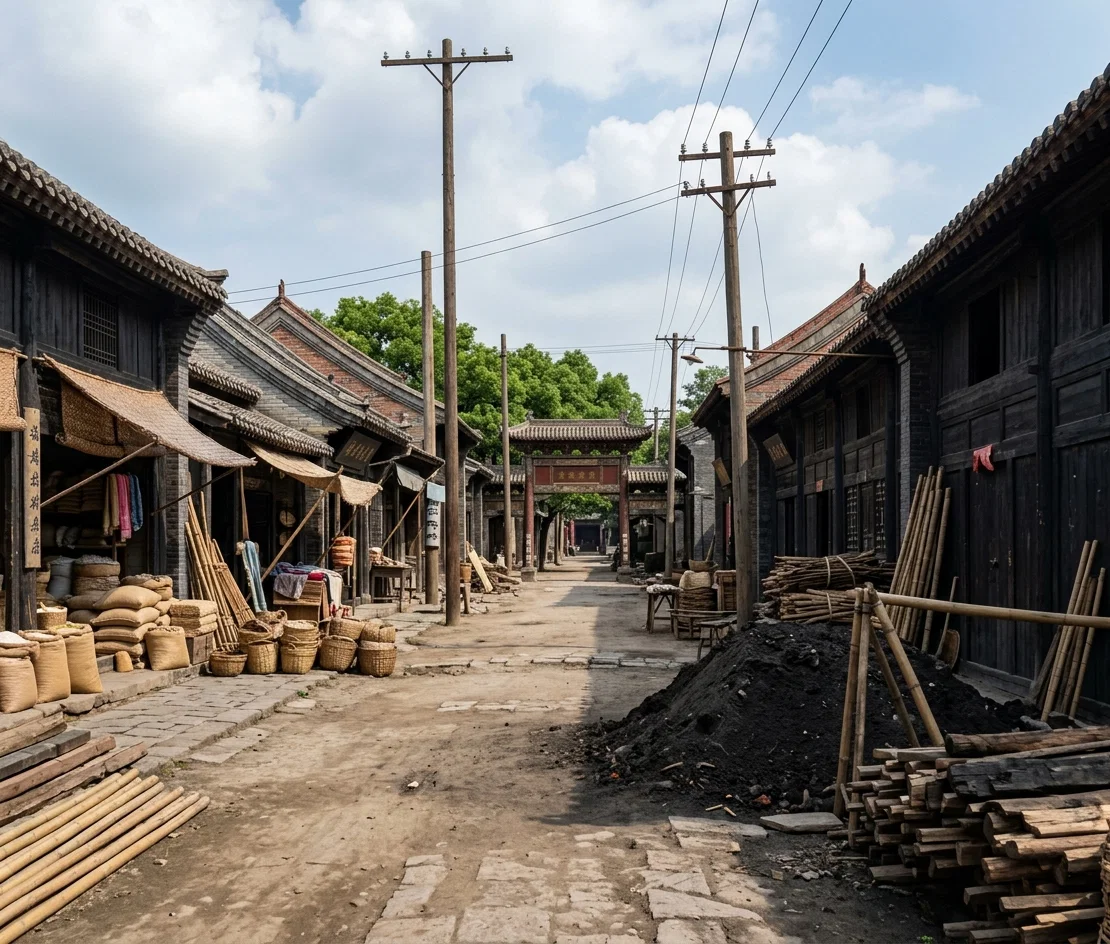
A STREET SCENE IN SHANG-TSAI HSIEN, LOOKING NORTH
FROM THE MISSION
I told the teacher and his friend that we would go with them and look at the place which they had found, as our past experience has convinced us that a Chinaman’s and a foreigner’s ideas of a suitable location are often at variance. But they quickly replied that it would be a mistake for me to look at the place; for then the landlord would learn that I wanted it, and they were afraid he15would not be willing to rent to a foreigner, and if he were, would ask a large price. Then they suggested their plan, which was for them to rent the place, and after the contract was signed, turn it over to us. They would state the terms to us as the landlord stated them, and we could decide what we would do.
These men seemed very sincere, and to them this was the best plan, as the Chinese idea of a business contract is after this order. Unless a contract is as crooked as a serpent, it is not Chinese legality. We informed them that securing a place in which to live was not our principal object in coming to Shang-tsai, but, instead, to gain the people’s friendship. Moreover, we told them that if our God desired us to locate here, he would give us the place by all fair means, and we wanted it on no other terms. Their countenances changed, as they could not understand how God could change the heart of the owner.
We then asked them to go to the owner with the message that we had come to this city to establish a mission where the sick could be treated, and where the gospel would be preached, and if we should rent his property, it would be used for that purpose. The landlord replied that our being foreigners made no difference to him, and that we should come and see the property, and if we desired it, it was for rent.
On looking over the compound, we were surprised to see how well it was adapted to our work. It had a large five-room front facing on the principal street, a picture of which we enclose. Two of these apartments would make excellent rooms for a dispensary, and the other three for a street chapel. Just back of this building, and extending at right angles to it, are two rows of buildings similarly constructed. The foremost rooms on either side will answer nicely for a boys’ and girls’ school. These rooms are the same size—fourteen by thirty feet. To the rear of these are good living-rooms for two or three families, besides room for the printing-press.
The houses are all of brick, except one. And it will not require a large amount of repair to put them all in order. We were able to rent this place for fifty dollars a year, which was less than we had hoped for. We have the privilege of renting it for ten years. The landlord pays for part of the needed repairs. He also expressed himself as glad to have this property put to such use, and desired to attend our meetings.
The fact that the property was vacant, and that we were able to do business with one man, and that directly, and the rapidity with which we secured it, were marked evidences to us that God had gone before and prepared the way; and we are glad to take charge of the mission in this new field, knowing that so far God has led. We pray that as the work goes forward here, we may continue to see the hand of God leading in a clear and definite way.
Since moving here we have been living in one room, while the remainder of the compound is being repaired. We have had inquirers calling on us daily, and the meetings held have been well attended. On every hand we have seen nothing so far but a friendly spirit from the officials, business men, and citizens. There is a demand for a boys’ and girls’ school at once; and we should soon set our printing-press in operation. To accomplish this, we need more workers. The very fact that God has prepared a place to receive new missionaries is evidence to us that more are coming soon. One million a month are going to their graves without a knowledge of the true God.
Shang-tsai Hsien, Honan, China.
Kolo Mission, Basutoland
By Mrs. J. A. Chaney
MRS. J. A. CHANEY
We arrived at the mission May 25, and are quite well and contented. We find the climate good, and thank the Lord that we have been called here. There have been many frosty nights, with bright, sunny days.
Since our arrival we have been very busy. We have had thirteen or fourteen regular meetings a week, besides a number of others held from time to time at the kraals. The regular early morning meeting held at the church has an average attendance of about fifteen. At this meeting we have singing, Scripture reading and study, and a season of prayer, in which a number take part. Wednesday evening we have the regular midweek service. Thursday there is a regularly appointed women's meeting. This meeting is held for the study of health principles, sewing, etc. Friday evening we hold a service at the church at sunset, when we usually give a portion of the time for testimonies. Sabbath morning we have the Sabbath-school, followed by preaching service or a Bible study. Sabbath afternoon we go to the home of Sister Kalaka, where we have a study of the Sabbath-school lesson. This is well attended, and frequently some are present who are not of our faith. Our Sabbath-school held at the church is following the lessons from the Youth's Instructor. We are also continuing the studies in the Little Friend.
We hold three evening meetings each week with our English-speaking brethren, Murry and Spokane Kalaka, endeavoring to assist them in their effort to become fully established in the truth, and better prepared to engage in the Lord's work. We have been having some precious studies in Christian education, which has not been carried on in our school before. Mr. Chaney and I both expect to assist in the school. Mr. Chaney met two young men at Mafeteng last week, and invited them to our school, and a few days ago they came on foot, twenty miles, to inquire more fully regarding the school, as Mr. Chaney had had no interpreter while speaking with them before. We hope to awaken a real interest here, and make this a training-school for workers. Please pray for our success. About two weeks ago one of our number, an elderly woman, was laid to rest until Jesus shall call her home. We had given her some treatments; but she was very old and feeble, and had been ailing for some time. Mr. Chaney made her a neat casket, and she was laid away in the little native cemetery a short distance from here. The Lord blessed in conducting the funeral service, and we trust hearts were touched who know not God. There were two or three chiefs present, and a large number of strangers.
On Sunday, eight days ago, Mr. Chaney took with him our interpreter, Murry Kalaka, and went out to spend the day in the kraals, laboring with the people for the salvation of souls. I took Spokane Kalaka to interpret, and went on the same mission to other kraals. We all had a blessed day. One of the chiefs referred to before, who has been attending our meetings, was led to give his heart to the Saviour. This brought great rejoicing to our hearts. Chief Jacob was a great drinker, and the temptations for such are especially great in Basutoland.
At one kraal I visited, there were about twelve present at a meeting, although it had not been announced. Among these was a chief of the Basutos. But, best of all, there was present the Chief of all chiefs,—the Lord himself,—and hearts were touched at his presence. Before leaving, I told them of our school, and its plan and object. The chief seemed pleased with the plan, and said he would use his influence to get the people to attend.
From there we went to another kraal where a very old couple lives. They said they were not Christians, but wished to be, and much desired a changed heart, but that they had been waiting for years for God to change their hearts, and they had not seen him do it yet. When I asked them to give their hearts to him, they said they did not see how they could give him their hearts when they could not see him take them. But after showing them the promises of God, and giving them illustrations of accepting and giving without seeing in this world, the old woman laughed with joy, and said, “I see it now.” It was with joy that we saw these two surrender their hearts to the Saviour by faith in his word. The woman seemed too full of joy to control her feelings. She said that years ago she and her mother had decided to seek the Lord in prayer, but that when she began to pray, she heard a strange noise about her head, and that she had been afraid to pray ever since. Pray for these.
Entiela, son of the woman who died, has given his heart to the Lord, also. I had visited his mother at his place, and had prayer with them, and talked with him. After his mother grew worse, we visited her, administering to both body16and soul, although there seemed little that we could do. At this time he began to attend our meetings, and gave his heart to God. He had attended some of Brother Freeman's meetings some time ago. He gives evidence that his conversion is genuine, and seems very earnest. His wife had formerly opposed our people; but she told me, voluntarily, that her husband was such a changed man since he gave his heart to Jesus, that she was glad he became a Christian. She said she was going to attend our meetings now.
About two weeks ago I took Spokane as interpreter, and walked around the mountain to see one of our girls. After we had walked for one hour and a half, two native men overtook us, and informed us that the girl was not at home. After a few words, the way opened for a talk concerning divine things. From the place where we stood on the mountainside, we had a beautiful view across the valley of the rugged mountain ranges and peaks beyond. I asked them to sit down with me on some stones near the edge of a high bluff while I told them of the beautiful earth made new. We sat there for about forty-five minutes as we studied these things from the sacred Book, and it made my heart leap for joy as I saw their intense interest. One man said he was going to come to our meetings. Some days after, he met Murry, and told him of our study, and said he would attend services at our church.
It is precious to meet souls who are hungry for truth. There is so much to be done, but so few to do it! We have found much necessary work to be done on the little mission farm, as well. Mr. Chaney has been very busy, endeavoring to get things in proper shape. The little house of three rooms is built of sun-dried brick, and plastered inside and out. It has no floors except the earth, and this we have found necessary to work over, leveling it, filling in, etc. There is a rough shed with thatched roof, attached to the house just at the kitchen door, for the mission cart, which Mr. Chaney expects to take down as soon as he can get another built for the cart.
The soil on the mission grounds has had only a very light surface cultivation, and very near to the surface is a hard subsoil, which will prevent almost anything from growing, and it will take a great deal of hard work to get it into a condition to raise anything on it. The trees that have been set out are badly stunted.
The place, of about eight acres, is surrounded by a stone wall, or fence, with many other stone fences partitioning it. The water is quite a distance from the house.
The Lord blessed our efforts in Bloemfontein, where we stopped on our way here. Mr. Chaney delivered books to the value of about one hundred and ten pounds, and received orders for a few more, which are not yet delivered. I sold five hundred and fourteen copies of the Sentinel and twenty-five books, and gave fifteen Bible readings. The profits on the books Mr. Chaney sold were sent to the South African Union Conference, to be applied on the Basuto Mission. The profits of the South African Sentinel were sent there also, for the benefit of the printing work.
We are much interested in the Washington work, and thank God with you for his directing hand.
Thanks From Japan
By H. KUNIYA.
[AFTER a talk on Japan by Dr. Myrtle Lockwood, at the College View council, a collection was taken for the first Japanese church, which the Kobe believers were endeavoring to build. The doctor secured other offerings for this purpose at other places also. It is for this special help that the thanks are expressed. In the meantime, twenty-five dollars more has been given by the Boulder Sanitarium family, who made up the offering Thanksgiving day. It will be seen that our brother expresses himself in a foreign tongue, but we print his letter as received.—MISSION BOARD.]
I wish to express thanks to brethren in America for your great kindness to send us help to build the church in Kobe. When our church organized last January, we had meeting in small rented room. Soon more members join, then too small, so rented larger room. But large room cost much money, so we began to hope for own church building; but this cost much money also.
We prayed to God often, and Dr. Lockwood and I often counseled together, What shall we do? At last a carpenter brother found a building which we can buy for two hundred fifty yen [a yen is fifty cents]. We thought good, but owner break promise, so we can not buy. Then we called church meeting. Some thought we are small number and poor and can not build, but when they find seventy yen given, they encourage, and give until we have one hundred twenty yen, also promises for twenty-two yen every month until all paid.
When I went to Korea, building just beginning; but when I came back, all finish, and we had dedication while Elder Field was with us.
We thought the building should cost about four hundred yen, but cost more than five hundred fifty, and it seemed like it must be long, long time before we could pay all.
But when letter came from Sister Lockwood with money from American brethren, we are very glad and happy.
It cause much wonder among other churches that seventh-day people build so soon, and have so many members in short time. I wish to say much, but can not express very well, but will remember your kindness forever.
Your brother in Christ,
H. KUNIYA.
Mission Notes
THE Church Missionary Society is about to build and equip, at Khartum in the Sudan, a girls’ school, in memory of General Gordon.
A MISSIONARY of the Presbyterian Church of England describes ten days’ touring among the villages near Chiang Hoa, Formosa, and adds: “It is a great comfort to be able to roam all over a heathen country, and yet seldom be more than a mile from a Christian dwelling.” The progress of the kingdom is emphasized by this sentence.
PRESBYTERIAN missionaries report that in Japan, Buddhism is studying and adapting Christian methods, forming Young Men’s Associations, establishing great schools, inviting Christians, and even missionaries, to take place among the lecturers to the students. The Buddhists are hoping to capture the secret of the energy and the power of Christianity. When they have found the secret, they will no longer be Buddhists, but Christians.
AN old and influential Japanese priest is said by Mr. Schumaker (A. B. M. U.) to have discussed in a temple lecture Christian work for women in Japan. “In Tokyo,” he said, “there are about seventy-five girls’ schools. Of these, about fifteen are Christian, and only one is Buddhist. Mark well my prophecy that in forty years Japan will become Christian!” The man may have spoken as foreseeing calamity, but few who watch Japan can doubt his foresight.
PRINCE RAMAZAN, one of the relatives of the native king of Toro, Uganda, Central Africa, is a boy of fifteen, and a Mohammedan. Because the Mohammedans of that region are very ignorant, a Christian lad has been employed to teach him to read and write. This has led the prince to write to the prime minister of Uganda, asking to be educated as a Christian. His letter contains this passage: “This is a very bad religion; it is a religion of death. I want to become a Protestant, and join Mr. Hattersley’s school for chiefs.” The boy wants education; he may find Christ.
A BAPTIST missionary in Japan tells of a scene before the communion table, when a Japanese Christian, with strong emotion, insisted on confessing a sin before he would partake of the Lord’s supper. The sin was this: “In the rush and hurry of wheat harvest and of setting out rice plants, my mind was distracted with the work, and for two days I did not take time to compose it to think upon the loving-kindness of my Lord. . . . That I should have been so ungrateful overwhelms me with shame and confusion of face.” Missions are worth while when they bring to us from converts in the far East words that stir the secret springs of our own life.