Signs of the Times, Vol. 33, No. 21.

IN THIS ISSUE

Signs of the Times

May 22, 1907

Pacific Press Publishing Company · Mountain View, California · May 22, 1907

IN THIS ISSUE

WITH OUR INQUIRERS

Questions 2084 to 2094 . . . . . . . . 2

SECOND ADVENT SYMPOSIUM

The Second Coming of Christ . . . . . . 3 What Christ's Coming Means to the Ungodly 4 The Great Day of the Lord . . . . . . . 5 The Appearing of the Kingdom of Christ in the New Earth . . . . . . . . . . 6 Straight Up Before . . . . . . . . . . . 7 Search the Scriptures . . . . . . . . . . 7

EDITORIAL

Christ Our All in All . . . . . . . . . 8 The Old Paths . . . . . . . . . . . . . 8 Peaceful, Wise, Harmless . . . . . . . . 8 The Coming of Christ . . . . . . . . . . 9 The California Sunday-Law Advocate Again 9 Chinese Famine Fund . . . . . . . . . . 9 Growth of Imperialism . . . . . . . . . . 9

OUTLOOK

America's Great Peace Parliament . . . . 10

MISSIONS

Christian Influence in China . . . . . . 12

HOME

Studies in the Christ-life at Brother Eldred's 14

POETRY

Shall We Know Each Other? . . . . . . 7 The Christ-Child in the Temple . . . . 14

With Our Inquirers

"If ye will inquire, inquire ye."
[All questions to this department will be answered which to the editors will minister to the general good of the readers and to the mission of the paper. The same question can not be answered repeated in the same volume. The name and address must accompany question, not for publication, but as an evidence of good faith, and that answer may be made by letter if deemed advisable. It is well always to enclose a stamp for reply.]

2084.—Matter of a Creed.

Have the Seventh-day Adventists a creed? If so, what is it? B. N.
The only creed the Seventh-day Adventists have is the word of God. They have no other; they desire no other.

2085.—Question Concerning Mr. Gamble.

Was Mr. Gamble at one time a Seventh-day Adventist? B. N.
No; he was not. He has been a regular orthodox Methodist, so far as we know, all his religious life, and yet there are a great many orthodox Methodists who can hardly approve his aberrative views on the Sabbath question.

2086.—Sodom and Gomorrah; Is Their Punishment Completed?

"Then the Lord rained upon Sodom and upon Gomorrah brimstone and fire from the Lord out of heaven" (Gen. 19:24; Luke 17:29); "and turning the cities of Sodom and Gomorrah into ashes condemned them with an overthrow, making them an ensample unto those that after should live ungodly" (2 Peter 2:6); "are set forth for an example, suffering the vengeance of eternal fire" (Jude 7). In view of these scriptures and Rev. 20:9, have not the inhabitants of the cities of the plains that were alive and consumed with their overthrow met their punishment? H. P. F.
No. Passages in Eze. 16:53, 54, and Matt. 11:23, 24 would indicate that the people of those cities are coming into judgment in the last day. The cities themselves are utterly destroyed and will never be restored. In that way they show an example to the world of what the eternal fire will do; it will consume all that upon which it preys. The final punishment of the incorrigible is in the second death. Rev. 20:12-14.

2087.—Cursing the Fig-tree. Mark 11:13, 14.

Please explain Mark 11:13, 14. Why would the Saviour curse a tree for not having fruit when it was not the time for fruit? S. A. S.
The very apeariance of the tree indicated that it bore fruit. It had leaves, and the fact that it had leaves indicated that it ought to have fruit, as the fruit on the fig-tree appears before the leaves. In other words, it made a profession of fruit-bearing, but bore no fruit. In that way it was a type of the Jewish Church, and as a type of the Jewish Church it was cursed by our Lord. In fact the very curse was in it in the very nature of things, not in the fig-tree but in the church, and what Jesus did to the fig-tree shows just what would come to a church which made high professions but bore no fruit.

2088.—The Resurrection.

Is it correct to say that the resurrection of Christ did not establish the resurrection of the dead, but was the evidence of it? Was Christ's body immaterial after the resurrection? S. A. S.
What established the resurrection of the dead was not the resurrection of Jesus, but the power that was behind that resurrection, and that is the righteous life. "In the way of righteousness is life." Prov. 12:28. He was raised from the dead because it was not possible for the grave to hold Him. Acts 2:24. And all that were ever raised before Him were raised by virtue of what Christ did and was doing—the offering that He made. So, taking His resurrection to stand for the power over sin, as set forth in Rom. 1:1-4, it did establish the resurrection of the dead; and thus the apostle Paul argues in 1 Corinthians 15, "For if Christ hath not been raised, your faith is vain; ye are yet in your sins. Then they also that are fallen asleep in Christ have perished."
In answer to the second question we would say that it depends altogether on what is meant by immaterial. If by material is meant this gross, earthly, sinful, mortal body, Christ's body was not material. If by material is meant composed of substance, then Christ's body was material; it was a substantial body. He could say, "Handle Me, and see; for a spirit hath not flesh and bones, as ye see Me have." Sometimes we would be able to agree with people if we knew just what they meant; so one of the first things to learn is the meaning of the terms used. In heaven we have a more "enduring substance," and those who enjoy that substance are themselves substantial, more so than the corrupt, material earth; but when this earth shall have been freed from sin, it will be material in the sense of having substance, but it will not be corruptible material; it will be a living earth.

2089.—The Holy Spirit.

Do Seventh-day Adventists believe that the Holy Ghost is the third person in the Godhead, and is therefore God, as the Methodists believe, or do they believe that the Holy Spirit is only an essence or attribute? Which does the main body believe? S.
It is impossible for us to define the belief of the Seventh-day Adventists in regard to the Spirit of God. Without question they believe the Holy Spirit to be the third person of the Godhead, but as to just how that person is to be understood is a question we can not answer for the body. There has been no definite, formulated belief regarding the Spirit. In broad terms Seventh-day Adventists believe the Bible and what the Bible says of the Spirit of God. Wisely they have not attempted to define just exactly what that great, infinite Power is. The great anxiety of Christians ought to be to be possessed of the life-power of God thru the Spirit.

2090.—The Moyer-Haywood Case.

Is it the duty of a Christian to refrain from expressing sympathy for the accused, who, it would seem, are being persecuted for the sake of principle, rather than prosecuted for crime? Being ourselves a liberty-loving people, I feel as if every man's liberty is equally dear. V. S.
It is very difficult to say anything on such a question as this without being misunderstood. As to the guilt of the men named we do not express any opinion. We do not know. We believe they ought to have a fair trial before the law. They are presumed to be innocent until they are proved guilty. It would seem that the way they have been taken and held is altogether irregular. On the other hand the inflammable utterances made by the organization to which they belong, before and since their arrest, does not tend to a peaceful settlement of the question. We have personally heard men talk who are in sympathy with the organization to which these men belong until one's blood would run cold as to what they think should be done to this one and that one and the other one who were possessed of money or who differed from them. With such sentiments as that no true Christian can sympathize. It was at a time when the worst of the Cæsars were ruling that the word of God came to Christians, "Fear God; honor the king." We believe of the men that they ought to have a fair trial, the same as every other citizen, and as truly as any other we sympathize with them in their suffering, and especially with their families. We have no sympathy with principles which would overturn government in general and weaken proper authority. The worst of governments is better than anarchy. But the Socialists and anarchists have just as much right to express their principles as have the Antinomians in religious circles, for really the worst of all anarchists is the one who contends that God's law is abolished and that man is law to himself. Presumably this will not help our inquirer, yet we can not take sides in the matter.

2091.—The Serpent of God. 3:1.

Does the word of God really teach that Satan employed a beast of the field as a medium in the temptation of Eve? Rather, is it not one of the names given to Satan himself, indicative of his low, beastly, and dangerous character? A SUBSCRIBER.
The account of Genesis clearly indicates to us that the serpent was used as a medium. In that way the woman was thrown off her guard. Yet it was not the serpent but the devil behind the serpent who did the work. In using the serpent as his first medium, however, the term is applied to him, and is so used in Rev. 12:9, as "that old serpent," because he was the real tempter.

2092.—The Archangel.

Is not the Archangel Michael the executive of the Holy Spirit, the one that overshadowed the virgin Mary, etc.?
If you will read the account in the first chapter of Luke it was not the angel Michael but the angel Gabriel. Michael means "who is like God." Archangel means "chief of all the angels." Such was the Son of God before He became man. He "who is like God" became the Archangel, and then stepped lower down and became the Lord Jesus among men. Jude 9; 1 Thess. 4:16, and Dan. 12:1 show very clearly that Michael is Christ. Gabriel is doubtless His angel (Rev. 1:1-3), the one who instructed the prophets. But as to saying that any one angel is executive of the Spirit of God, that is limiting it to the capacity of that angel. All God's angels are ministers, and all God's children upon whom and in whom is placed His Spirit are also ministers or servants, just the same as every member of the whole body of man is the executive of the mind of man.

2093.—Is It Right to Buy Smuggled Goods?

I have seen professed Christians buy goods that were smuggled from foreign countries to this country, getting them so much cheaper than if they purchased them at the store. Now is it right or is it wrong to purchase such goods? D.
The word of the Scripture is, "Render to all their dues; tribute to whom tribute is due; custom to whom custom." "Wherefore ye must needs be in subjection [that is, to earthly powers], not only because of the wrath, but also for conscience' sake. For for this cause ye pay tribute also." See Rom. 13:5-7. "Be subject to every ordinance of man for the Lord's sake." 1 Peter 2:13. There are those who do not count smuggling crime, and yet the government has so made it, and Christians ought to heed the ordinances of the government and pay to the government the tribute, unjust tho it may seem, that is due. We may buy smuggled goods not knowing, and in such a case we are not responsible, but if we buy smuggled goods knowing that they are smuggled, we are by that made partakers of the crime.

2094.—A Matter of Tithing.

Is it the duty of a wife who has an unbelieving husband to tithe the funds put into her hands for general use when he bitterly opposes it?
No. If she has funds that are her own she has a right to tithe them. Funds which are not her own, but are considered her husband's and for the general use of the household, it would be a great deal better for God's cause to leave untithed rather than bring unnecessary strife in that way. While the loyal heart is always pleased to render to God that which is His own, and feels deprived of a blessing if it can not do it, at the same time it is not wise for a wife to go contrary to the will of her husband in these respects. God's cause can better get along without the small amount of means that would thus be given than to have the duty made compulsory. Of course it is the duty of every one to render to the Lord the tithe, but for that the husband is chiefly responsible, and the Lord does not demand it of him against his will.

The Second Coming of Christ

What Does It Mean to the Righteous?
By Abdiel
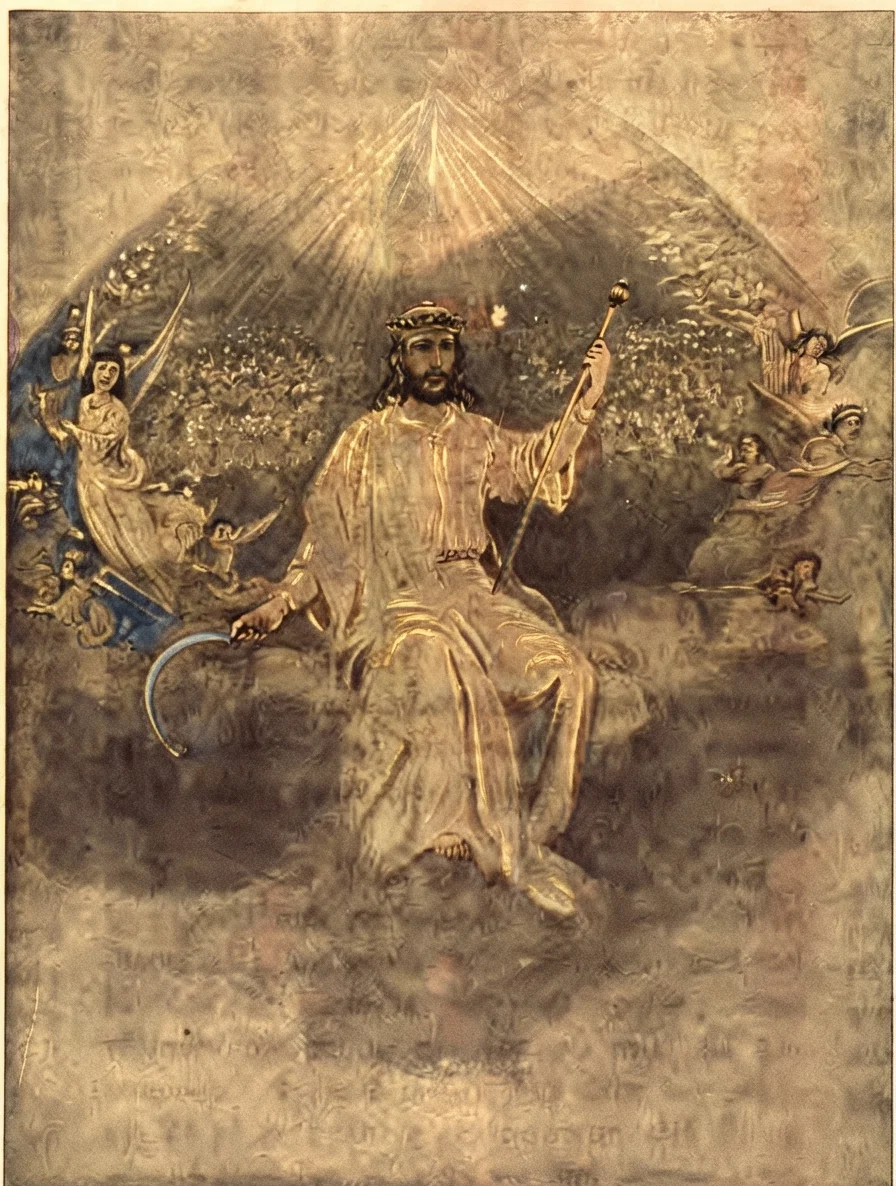
It was clearly set forth in our last issue that the second advent of Christ is a literal, personal, visible coming. "This same Jesus will come again;" He will come as He went away. A cloud of angels received Him as He ascended. When He returns, He will come in a cloud, with all the holy angels. At His first advent He came in the lowliness and weakness of humanity, to suffer and die. When He comes again, He will come in all the transcendent glory of the Godhead, increased by the myriads of angels who reflect and refract and augment that glory. The covering which in mercy has veiled the glory of God and the presence of His angels, so that men might not perish in the insufferable splendor, will be removed, Christ will come as a conqueror, and men shall "see Him as He is."
"There is a King of glory, Ere long on earth to rise, Sung in prophetic story, Descending from the skies; The Babe of Bethlehem, 'tis He; It is the Man of Calvary,— Not crowned with thorns and gory, But crowned with glory now; Not crowned with thorns to-day, Not mocked and led away, But crowned with everlasting glory now."
That coming has been the hope of the church from dying Adam and translated Enoch to John on Patmos and the waiting church who keep the sayings of John. Why should they thus look to that event. Why should it be called "the blessed hope and appearing of the glory of the great God and our Saviour Jesus Christ"? Titus 2: 13. Why should Jesus assure them so positively, "I will come again"? John 14: 1-3.
Because at Christ's coming all the hopes of the Christian shall meet their fruition. They are blessed here by the presence and power of His Spirit. The earnest of the future, God's pledge of future inheritance, His sealing of sonship, are ours here. But the pain, the sin, the sorrow, the tribulation, the utter sadness of life, the separation of death, are here also. The better world lies beyond. The "reward" is at the end of earth's probation when the harvest is reaped. For not till then do God's children of all ages, with few exceptions, find the joy of His glorified presence. But then, when Christ comes, the righteous dead will be brought back from the sleep of the grave; the righteous living, who have thru grace formed an incorruptible character, will receive from the glorified Master an incorruptible, immortal body. And therefore it is written:
“Through the open scroll of heaven that shall fold and roll aside, We shall see the Man of Sorrows, who for love was crucified, 'Mid the untold hosts of heaven, King of Kings, and glorified.”
"For the Son of Man shall come in the glory of His Father with His angels; and THEN HE SHALL REWARD EVERY MAN according to his works." Matt. 16: 27.
"But I would not have you to be ignorant, brethren, concerning them which are asleep, that ye sorrow not, even as others which have no hope. . . . For this we say unto you by the word of the Lord, that we which are alive and remain unto the coming of the Lord shall not prevent [precede, go before] them which are asleep. For the LORD HIMSELF SHALL DESCEND FROM HEAVEN WITH A SHOUT, with the voice of the archangel, and with the trump of God; and the DEAD IN CHRIST SHALL RISE first: then we which are alive and remain shall be caught up together with them in the clouds, to meet the Lord in the air, and SO SHALL WE EVER BE WITH THE LORD. Wherefore comfort one another with these words." 1 Thess. 4: 13-18.
"Now this I say, brethren, that flesh and blood can not inherit the kingdom of God; neither doth corruption inherit incorruption. Behold, I show you a mystery: We shall not all sleep, but we shall all be changed, in a moment, in the twinkling of an eye, AT THE LAST TRUMP; for the trumpet shall sound, and THE DEAD SHALL BE RAISED INCORRUPTIBLE, and WE [the living] shall be changed. For this corruptible must put on incorruption, and this mortal must put on immortality. So when this corruptible shall have put on incorruption, and this mortal shall have put on immortality, THEN shall be brought to pass the saying that is written, Death is swallowed up in victory. O death, where is thy sting? O grave, where is thy victory?" 1 Cor. 15: 50-55.
How clearly do these Scriptures tell the story! When the Son of Man comes, the rewards will be given. When the heavens shall be aflame with His glory, and His mighty voice and trumpet shall resound thruout the earth, those who sleep in Him shall arise to immortality, and those who live in Him shall be immediately changed to the same glorious condition, and together they will rise to meet Him in the air, physically triumphant over the power of earth's attraction as they have triumphed over the sins of the world. Then will be seen more of the fulness of the victory of Jesus Christ ringing forth in the triumphant shout, "O death, where is thy sting? O grave, where is thy victory?"
To that glorious event looked the patient Idumean patriarch. His longing that His words of faith might be recorded, God has answered. In his deepest affliction he cried:
"O that my words were now written! O that they were printed in a book! That they were graven with an iron pen and lead in the rock forever! For I know that my REDEEMER LIVETH, and that HE SHALL STAND AT THE LATTER DAY UPON THEEARTH; and tho after my skin, worms destroy this body, YET IN MY FLESH shall I see God; whom I shall see for myself, and mine eyes shall behold, and not another [a stranger]." Job 19: 23-27.
No, not to one child of His will Christ be a "stranger." We may never have seen Him as He walked the earth, healed the sick, unstopped deaf ears, cleansed the leper, comforted sin-sick souls. But we shall know Him. Men have tried to paint Him; and beautiful conceptions have been given. We have as a consequence beautiful Jewish, Italian, German, Dutch, Russian, Flemish, and English faces. Probably not one looks as the Master did, but He was a Saviour to every race and nation. And divine grace will write upon the heart of him who will yield to Christ the Master's image. We may not outline it or limn it upon canvas; but when we see Him, if we are faithful, we shall know Him as our great, infinite best Friend.
With prospective kingdom and God's constant blessing even amid trials, the world brought no satisfaction to David; for only Christ's coming could:
"As for me, I will behold Thy face in righteousness; I shall be satisfied, WHEN I AWAKE, WITH THY LIKENESS." Ps. 17: 15.
Isaiah, the great evangelical prophet, sings of the hope of Israel:
"Thy dead men shall live, together with my dead body shall they arise. Awake and sing, ye that dwell in dust; for thy dew is as the dew of herbs, and the earth shall cast out the dead." Isa. 26: 19.
Paul writes to the children of God:
"For our citizenship is in heaven; whence also we WAIT FOR A SAVIOUR, the Lord Jesus Christ; WHO SHALL FASHION ANEW THE BODY OF OUR HUMILIATION, that it may be conformed to THE BODY OF HIS GLORY, according to the working whereby He is able even to subject all things unto Himself." Phil. 3: 20, 21.
And this is the assuring testimony of the "beloved disciple:"
"Beloved, now are we the sons of God, and it doth not yet appear what we shall be; but WE KNOW THAT, WHEN HE SHALL APPEAR, we shall be LIKE HIM; for WE SHALL SEE HIM AS HE IS. And every man that hath this hope in Him purifieth himself, even as He is pure." 1 John 3: 2, 3.
That is what Biblical hope in Christ's second coming will do. It will not lead to time-setting or fanaticism. It will not lead to worldliness, or dishonesty, or insincerity, or impurity, or sin in any form. It will not make good politicians, but it will make better men and women, better boys and girls, better citizens, better neighbors. It will give calmness and peace amid all earth's trials and turmoils. It is an anchor to the soul both sure and steadfast.

The Second Coming of Christ

What Does It Mean to the Ungodly?

THOSE who do not love Christ do not wish to see Him. This is a fact which every soul will appreciate. The little boy who has disobeyed his father does not care to see his father. The criminal does not care to meet the sheriff. Adam, after sinning, endeavored to hide from God. So men who are not acquainted with Christ do not care to meet Him in His transcendent glory.
Yet there is no cause on His part why they should feel thus. God loves the sinner, tho He hates the sin. He loved the sinner so much that “He gave His only-begotten Son,” in order that the sinner might be saved. Listen to what the unchangeable God, who “is no respecter of persons,” said to sinners of old:
“Say unto them, As I live, saith the Lord Jehovah, I HAVE NO PLEASURE IN THE DEATH OF THE WICKED; but that the WICKED TURN FROM HIS WAY AND LIVE: turn ye, turn ye from your evil ways; for why will ye die.”
Jesus was manifest not only to destroy the devil, but the works of the devil—sin. Heb. 2: 14; 1 John 3: 8. All mankind are sinners; all have come short of His glory. Rom. 3: 23. It is sin and sin alone, which has marred God’s image in them; and it is the purpose of Christ’s mission to destroy sin in the sinner and to save the sinner.
There is but one alternative to salvation, and that is destruction. Righteousness only is fit to survive forever. “In the way of righteousness is life.” Prov. 12: 28. No man possesses that righteousness in himself; therefore, Christ brings it to him in the Gospel—“the power of God unto salvation,” because it brings righteousness. Rom. 1: 16, 17. “Sin, when it is fullgrown, bringeth forth death.” James 1: 15. “The wages of sin is death.” Rom. 6: 23. “The soul that sinneth, it shall die.” Eze. 18: 4. This is the universal testimony of Scripture and history. Men may teach and imagine and fancy otherwise, but the declaration of God’s word stands; the finished fruit of sin is death.
God gives the sinner the choice between life and death—in the choice between God’s way and sin’s way. If the sinner chooses the way of God, our Lord Jesus Christ, Christ comes into the heart, and dwells there. Gal. 2: 20. Thus the erstwhile sinner comes to know the Master—know Him as a Saviour from sin, a Friend in trouble, a Counselor in difficulty, a mighty Helper all along the way. Surely he will love Christ’s coming; and will say, as the Master appears, “Lo, this is our God; we have waited for Him, and He will save us.” Isa. 25: 9.
But if we have chosen sin, what hope have we when Christ comes. If we choose Him, we identify ourselves with Him, and become a part of His body, a member of His church. If we choose sin, we become a part of the “body of sin,” and must perish with the sin.
His desire is that we shall welcome Him in His truth into our hearts and lives, and let His presence—the glory of His goodness—destroy the sin therein. If we will not let Him destroy sin in us, we identify ourselves with the sin, and when He comes in all His burning glory, all that is of sin shall perish, and we also, by our own choice.
And this is what Christ’s coming means to the ungodly. Therefore we read in His word:
“For the wages of sin is death; but the gift of God is eternal life thru Jesus Christ our Lord.” Rom. 6: 23.
“For many walk, of whom I have told you often, and now tell you even weeping, that they are the enemies of the cross of Christ; WHOSE END IS DESTRUCTION, whose god is their belly, and whose glory is in their shame, who mind earthly things.” Phil. 3: 18, 19.
“And then shall that Wicked be revealed, whom the Lord SHALL CONSUME WITH THE SPIRIT OF HIS MOUTH, AND SHALL DESTROY with the BRIGHTNESS OF HIS COMING [the forthshining of His Presence].” 2 Thess. 2: 8.
“And these shall go away into EVERLASTING PUNISHMENT; but the righteous into life eternal.” Matt. 25: 46.
“And to you who are troubled rest with us, WHEN THE LORD JESUS SHALL BE REVEALED FROM HEAVEN with His mighty angels, in flaming fire taking vengeance on them that know not God, and that obey not the Gospel of our Lord Jesus Christ; WHO SHALL BE PUNISHED WITH EVERLASTING DESTRUCTION from the presence of the Lord, and from the glory of His power; when He shall come to be glorified in His saints, and to be admired in all them that believe, (because our testimony among you was believed), in that day.” 2 Thess. 1: 7-10.
“Be not deceived; God is not mocked; for whatsoever a man soweth, that shall he also reap. For he that soweth to his flesh shall of the flesh REAP CORRUPTION; but he that soweth to the Spirit shall of the Spirit reap LIFE EVERLASTING.” Gal. 6: 7, 8.
Much more testimony might be given; surely these will suffice to the Bible believer, unsaved sinner, tho he be. When Christ comes, He will not come in one way to the wicked and another to the righteous. It will be the same Jesus, with the same merciful, unchangeable character. In His children He will meet His own image morally, and they will be changed from glory to glory. The wicked will then have rejected every overture of mercy, and in his life will be only sin and the love of sin. The same sun that ripens the wheat ripens the tares. The same light which heals the living flesh, sloughs off the dead tissue. The same glory of Christ which changes the righteous to immortality brings death to the sin-loving wicked.
Sinner, Jesus died to save you from that sin; died that you might give up the sin, and that He might live in your life; died that you might be victor over sin; died that His coming might be to you a joy and blessing, infinite and eternal. Receive Him now, that He may receive you then. “Behold, now is the acceptable time; behold, now is the day of salvation.” “To-day, if ye will hear His voice, harden not your heart.”
Continue reading: The Great Day of the Lord