Pacific Press Publishing Association · Mountain View, California · Aug 16, 1910
"IF YE WILL INQUIRE, INQUIRE YE."
By Editor
This Inquirers' Department is conducted for the purpose of helping those who are studying the Bible. The answers are oftentimes only suggestive. They are never to be considered infallible, only as they agree with the infallible Word. The writer who may answer them does not consider that his opinion is infallible. He will simply give the best that he has, and plead with the inquirer to search the Word. Such questions only will be answered as, to the editors, seem to minister to the good of the readers and to the mission of the paper. We cannot answer repeatedly in the same volume questions upon the same scripture. The name and address must accompany question, not for publication, but as an evidence of good faith, and that answer may be made by letter if deemed advisable. No letters are answered which do not contain the name of the writer. It is well always to enclose stamp for reply.
3219.—A Question of Conscience, Principle, and Expediency
By Editor
If a young woman marries a man that is supposed to be reformed from drinking intoxicating liquors, or promises her before marriage that he will not drink, and did not drink after he made the promise until after they were married, do you think that in the sight of God it would be right for that young woman to depart from him, not seeking a divorce; or should she stay and bear with him, hoping that he could be made better by the wife living with him? HAWAII.
This is one of the hard, hard questions which it is impossible for one to settle for another. In the first place any young woman whatsoever is taking an awful risk when she agrees to marry a man who has been a drunkard and drinks right up to nearly the time of his marriage, breaking only for a short time because he feels he can secure the woman in no other way. We would like to plead with the girls of the world to put him on a longer, stronger test than that. A man never is safe who will not give up such habits, not because of the girl's sake whom he hopes to win, but from the evil of the thing itself.
Secondly, of course she married him with the expectation that the habit would be given up. That does not form a part of the marriage ceremony. In that she takes him for better or for worse; but in the worse of course she did not expect that he was going to become a drunkard. Yet she is united with him, and in the marriage sense they are one flesh. He has proved false to his promise to her; shall she prove true to her marriage vow, and continue to live with him?
This is a matter which she herself must settle. Is he cruel? Is her life in danger? Does he make existence intolerable and unbearable? Is there prospect that children will be brought into the world with the drunkard's mark upon them? These are things that should be considered; and if these are probabilities, we see no reason why she should not separate from him, not in the way of divorce, as she suggests, but a final separation. But if on the other hand he is not cruel, if he is truly endeavoring to reform, it may be possible that she herself can help him on in that way. If so, she must have his cooperation; and there are many ways in which help can be gotten by right living, by placing before him right food, by making home pleasant, the most inviting place in the world, by inducing him if possible to leave off the other habits which he may have that would feed the drink appetite. One of these is tobacco; another is strong, stimulating foods, highly seasoned food. To the drunkard, flesh-eating is a stimulant; so also is the drinking of strong tea or coffee, and the use of hot condiments, like pepper. If he is anxious and willing, he does not know how much these reforms would help him in overcoming the appetite. These are the denials on his part; then if he will seek God, God will come in with His great grace and give him victory. Can she help him to win such victory? See 1 Cor. 7:10-16. There may be principles there which will aid our inquirer. May God give her and others of whom she stands as a type special wisdom and grace; for this is not one lone letter or one lone case, there are many such all over the land.
3220.—The Final Separation
What does Luke 17:34-37 mean? And when does it take place? Please explain. G. N.
The passage in question refers to the time when probation shall close and a division will take place between those who are the Lord's and those who are not. It is the time referred to in the parable of the wheat and the tares in Matthew 13, when the harvest is ready for the reaping, when the tares are bound in bundles. The tract "The Great Day of the Lord" shows us just when this time will occur in relation to the Lord's coming. Probation will close, our Lord will have done all that can be done in His priestly ministrations for humanity, about one year before He comes the second time. During that year the plagues will be poured out upon those who have rejected Him and His Gospel; and it is to this time, when our Lord leaves His mediatorial work, because there is nothing more that He can do, that He refers in the passage in question. "I tell you, in that night there shall be two men in one bed; the one shall be taken, and the other shall be left." Taken by what? How taken? The last verse of the passage throws light upon this: "And they answered and said unto Him, Where, Lord? And He said unto them, Wheresoever the body is, thither will the eagles be gathered together." The margin of the Revised Version is "vultures." The wicked are likened to dead carcasses; the vultures to the plagues. The "seized" or "taken" will be the seizing or taking by the plagues. The thought is that there will be just as decided division then among classes as is shown in the illustration. Two women shall be together; the one shall be seized by the plagues, the other will be left to be gathered a little later by the angels when the Lord shall come. See Matt. 13:38-43. It will be noted in that explanation of the parable and the tares that the tares are first gathered. It is then clearly evident that the division can be made. It is later than that and in a different way altogether that the Son of Man shall send forth His angels and gather the righteous. See also Matt. 24:31, "And He shall send His angels with a great sound of a trumpet, and they shall gather together His elect from the four winds, from one end of heaven to the other."
3218.—The So-Called New Bible—Oahspe
By Editor
A friend hands us a letter in which this so-called new Bible is said to be the history of this earth from the day it was first populated to our own time, carrying us back to nearly eighty thousand years ago; in which Jehovah is said to be the supreme ruler of the universe, while God is merely a superintendent of an inhabited world. The letter goes on to say that it teaches wonderful things regarding the use of vegetables for food instead of meat, etc.
The teaching of this new Bible is akin to Mormonism. Its design is to exalt man instead of the salvation which comes through our Lord Jesus Christ. We have the true history of man, the creation of man, the fall of man, the redemption of man, and the great future of redeemed man set forth in the Holy Scriptures. The Scriptures have demonstrated and are demonstrating daily their truth. To turn from them to any of these other great schemes which men have devised is like turning from the cool snow-waters of Lebanon to the polluted and broken cisterns of humanity. In every false religion that exists, there will be found sooner or later and more or less the one thought of self-salvation—man his own saviour; man a god. It is one of the sure evidences that the religion is false. It is some form or other of the first temptation which came to humanity, "Ye shall be as God." So far as proper living is concerned the Bible teaches that just as truly as any other book which has ever been written, and does not teach it by degrading man to the beast or by elevating the beast to man. It teaches it because the proper living, the proper care of body, soul, and spirit, will glorify God. It is not a wonderful thing to give up flesh-eating. There are thousands upon thousands who have done that and have followed it for years to advantage. Oahspe or any other book or system of religion teaches nothing good but what may be found in the Word of God, and they have connected with them more or less of evil which is condemned by that Word.
3221.—Beginning of the Judgment
By Editor
Does Christ begin with His judgment on those who have joined the church? If so, at what time does He commence to judge the heathen, or those who know not God, or are non-church-members? G. N.
As to the fact of His beginning the judgment with His own, we have two statements in Holy Scripture. One is found in Eze. 9:6, where the destroying angel goes forth to visit punishment upon the wicked. It is said that they began at the "ancient men which were before the house;" that is, the professed people of God. In 1 Peter 4:17 we read the statement, "For the time is come that judgment must begin at the house of God: and if it first begin at us, what shall the end be of them that obey not the Gospel of God?" That would probably be true from generation to generation as the cases are considered in the judgment; but just when the time is that the Lord will begin with the righteous of one generation or the wicked of one generation or of all generations we do not know. He has not revealed that to us. In fact He has indicated that none are to know those times which the Lord keeps to His own purpose. One admonition to His children always is to be ready.
3222.—The One Thousand Years
By Editor
Rev. 20:6 says that those who are raised from the dead at the first resurrection are to be priests of God and of Christ during the one thousand years. What are they doing during the one thousand years?
G. N.
This perhaps can best be explained by 1 Cor. 6:2, 3. "Do ye not know that the saints shall judge the world? and if the world shall be judged by you, are ye unworthy to judge the smallest matters? Know ye not that we shall judge angels?" And again in the same epistle, fourth chapter and fifth verse, "Therefore judge nothing before the time, until the Lord come." God has not set men to be judges here; but when the time comes that His own people are made immortal and their minds are enlightened so that they can see clearly in the light of God, then will He associate them with Himself in the examination of the books of record during the one thousand years when the earth lies desolate, and the judgment then written will be executed at the end of the thousand years. Then will those who have had faith in God during all the perplexities and seeming inconsistencies of this life, see that God has done all things well, and will join in that song referred to in Rev. 15:3, "Just and true are Thy ways, Thou King of ages."
The Brothers of Jesus
By Editor
3223. — The Brothers of Jesus. — A. K. — The general and natural supposition, it would seem to us, would be that the brothers of Jesus were older than Himself. See Mark 6:3. “Is not this the carpenter, the Son of Mary, the Brother of James, and Joses, and of Judah, and Simon? and are not His sisters here with us?” James and Joses and Judah and Simon were well known. They had known them for some time. Christ was only one of their younger brothers, not as well known as were His older brothers to them. Evidently He must be the same as those who are older in the same family. Then, too, His brothers seem to have been older in that they essayed to direct or counsel Him in His work. See John 7:3.
Man's Sin and Saviour
By E. J. Hibbard
By E. J. Hibbard
VI. The Sanctuary, an Object-Lesson
HAD our ancestors lived in the midst of the most degraded forms of idolatry from the year 1694 A.D. to the present, and had we with them been liberated from slavery to the nation that had enforced such religion upon us; and had that deliverance come but yesterday,—then should we be prepared to understand the condition of the Israelites the year they were rescued from Egyptian bondage, civil and spiritual. Surrounded by idolatry, superstition, and sin, two hundred and fifteen years, what havoc had it wrought!
It will be remembered that the idolatry of Egypt was not confined to image worship, for the Egyptians worshiped all nature, from the sun and its supposed attributes of reproduction, to the lowest animals and insects which fill the earth or air. And in the ten plagues with which God persuaded Pharaoh and the people that they should let Israel go, He humbled the gods of Egypt as well. The River Nile; the frogs; lice; swarms of flies; a very grievous murrain upon their sacred bulls and other cattle; "a boil breaking forth with blains upon man, and upon beast, throughout all the land of Egypt;" "hail, such as had not been in Egypt since the foundation thereof;" locusts; darkness; death of all the first-born, both of man and beast,—these showed that the God of the Hebrew slave controlled everything that the Egyptian worshiped, and did with it whatsoever He chose. Thus Egypt lay desolate, her people bereft, her gods powerless; for they were no gods at all.
And away from idolatry, as well as out of Egypt, God would lead His people. To accomplish either, and especially the former, God must dwell among them and be their God indeed. It would take no small amount of training to correct the errors of Egypt and remove the impress caused by two centuries of contact with idolatry and sin. And this matter was too important and critical to hope for its accomplishment in any ordinary way.
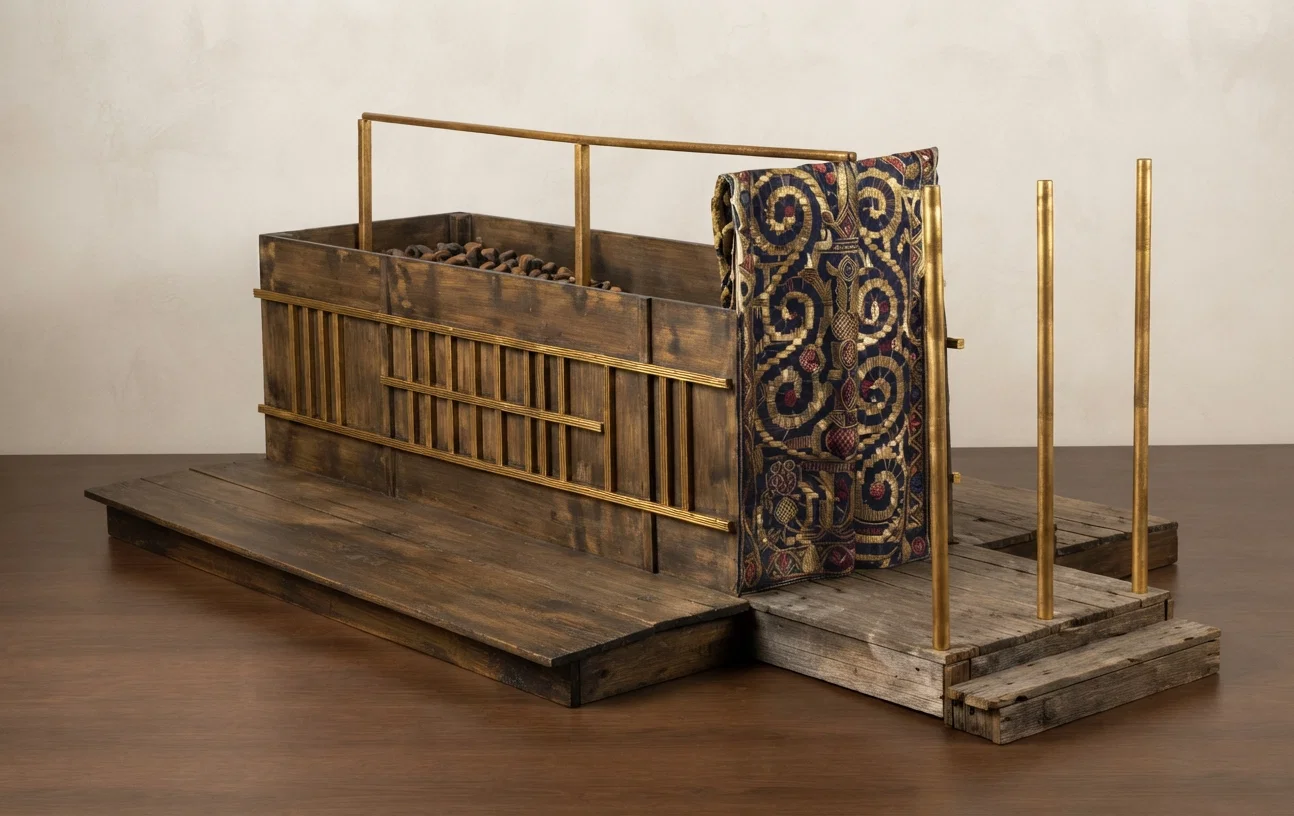
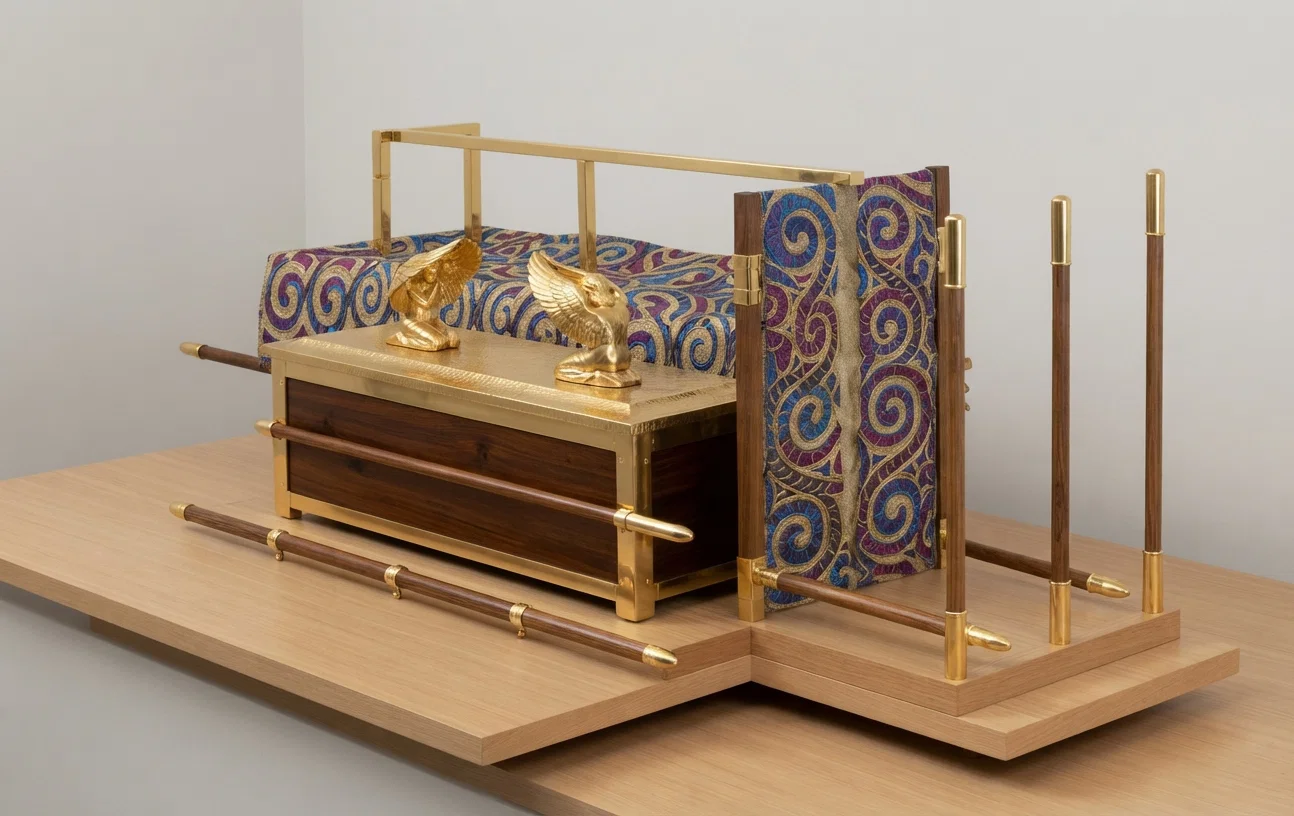
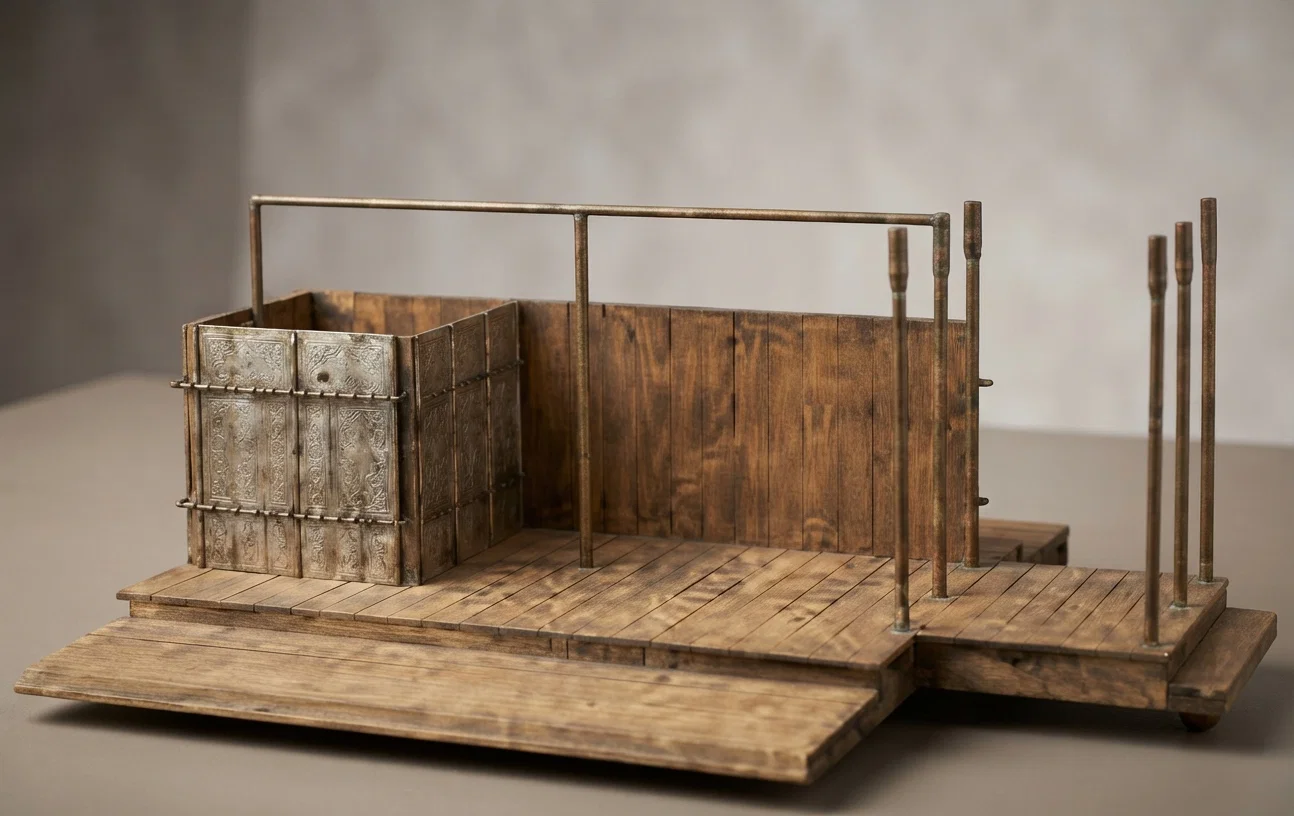
The Erection of the Tabernacle. Second stage. From "The Tabernacle—Its History and Structure," by Caldecott.
In the pillar of cloud by day, and the pillar of fire by night, their Deliverer led them in person. He it was who opened for them the Red Sea, that they might go through "dry-shod." At His command, the waters returned, destroying the Egyptian host. He was the Branch, the Rock, and the Bread from heaven, who satisfied their hunger and allayed their thirst, from the day they left the flesh-pots of Egypt until they ate the new "parched corn" in the promised land.
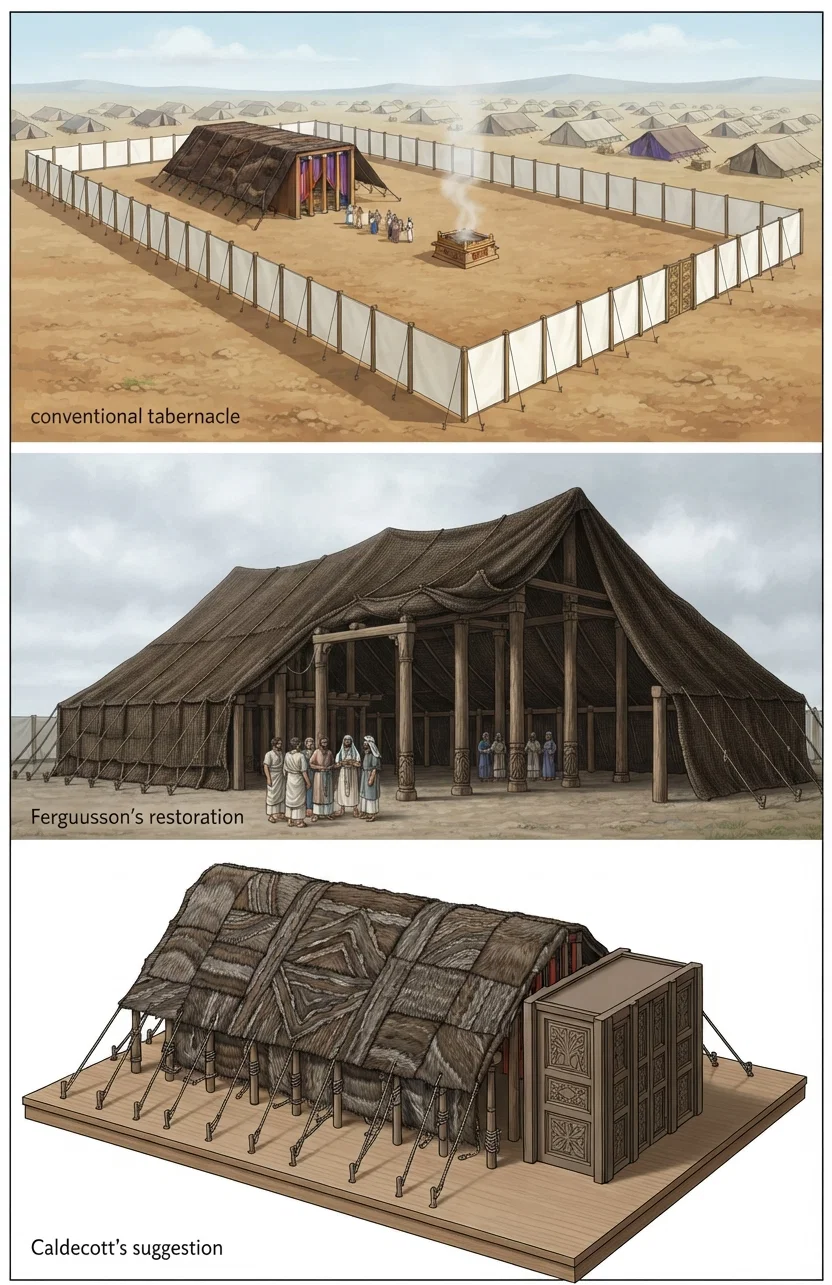
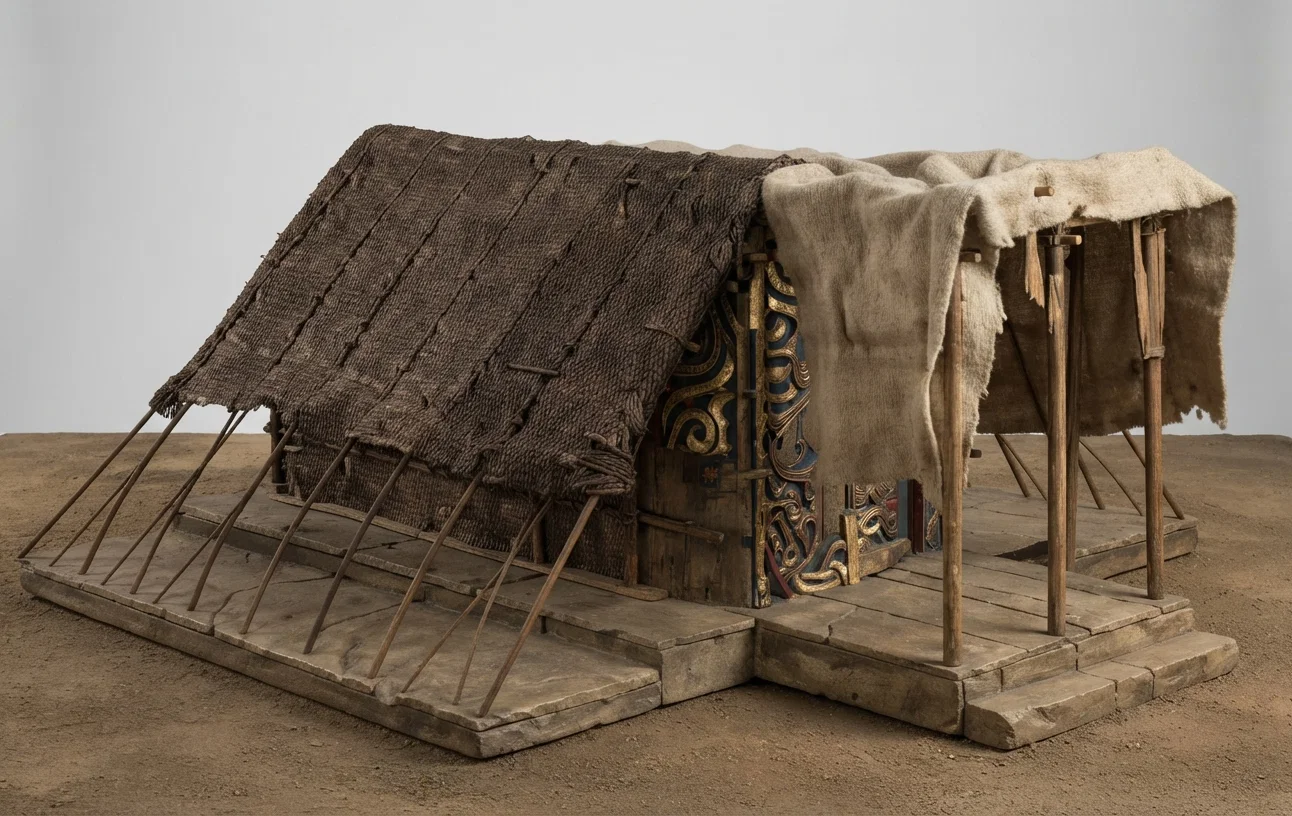
Three Views of the Tabernacle. The first is the conventional tabernacle similarly pictured by so many different persons. Secondly, Fergusson's restoration; the lower one as suggested by Rev. Mr. Caldecott.
It was with Him at Mount Sinai, the third month out of Egypt, that they entered into covenant that they would obey His voice "indeed" and keep His covenant. And when all the people heard that voice, in peals of thunder which shook the earth, they heard the Ten Commandments; "and He added no more."
The Erection of the Tabernacle. Third stage. From "The Tabernacle—Its History and Structure," by Caldecott.
Very soon after this, "the Lord spake unto Moses, saying, Speak unto the children of Israel, that they bring Me an offering: of every man that giveth it willingly with his heart ye shall take My offering. . . . And let them make Me a sanctuary; that I may dwell among them." Ex. 25:1-8.
In this sanctuary, and by the lessons it taught, their God purposed to dwell with His people, and teach them the heavenly way.
Even Then the People Sinned
But notwithstanding their experience thus far, their idolatry was so deep-rooted that Moses had been gone scarce forty days in the mount, receiving instructions concerning this sanctuary and its services, before they demanded, and Aaron made for them, the golden calf, or bull, the symbol of Egyptian sun worship—the worship of the elements of reproduction. And with becoming respect to this form of debasement, the people, with undraped bodies, on Moses' return, were singing and dancing with idolatrous glee. Ex. 32:18-25.
And for a time the matter hung in doubt as to whether their God could consistently carry out His purpose in respect to the sanctuary, His dwelling-place among them.4In fact, under the circumstances, the three thousand of the impenitent and defiant ones had been slain by the sword at God's command, the fate of the others hung so much in doubt, that the Lord at first refused to go farther among them.
The Erection of the Tabernacle. First stage. From “The Tabernacle—Its History and Structure,” by Caldecott. It will be seen by this that Mr. Caldecott’s plan of the tabernacle works out somewhat differently from those of other artists and investigators. The folding around of the curtain in front in his idea makes a sort of porch at the entrance.
The "tabernacle of the congregation," in which He had been wont to meet the leader of His people, was removed from the midst of the camp, and it looked as if their Deliverer was about to remove from them entirely. God can not live in the midst of sin, nor in a camp of practising sinners. To sin God is a consuming fire. It is thus that God's presence in the midst of a people who hold to sin, must needs consume both sin and sinner. But blessed is the fact that, to the one who hates sin, and desires a separation, to such a one God consumes the sin and converts the sinner.
And through the intercession of the Spirit of God, and that of Moses, Israel repented, and humbled their hearts, and God forgave them. And after this, it was possible again that their Lord should dwell among them. Now the plan of God in reference to the sanctuary could consistently be carried out.
Purpose of the Sanctuary Service
Accustomed as they had been, in Egypt, to an elaborate ceremonial, the Lord saw fit Himself to establish one. But His was not a ceremonial without meaning. Every detail of this remarkable structure, its furnishings, its priesthood, were but "a shadow of good things to come." But this we reserve for our consideration next week.
"And Moses said unto the children of Israel, See, the Lord hath called by name Bezaleel the son of Uri, the son of Hur, of the tribe of Judah; and hath filled him with the Spirit of God, in wisdom, in understanding, and in knowledge, and in all manner of workmanship; and to devise curious works, to work in gold, and in silver, and in brass, and in the cutting of stones, to set them, and in carving of wood, to make any manner of cunning work. And He hath put in his heart that he may teach, both he, and Aholiab, the son of Ahisamach, of the tribe of Dan. Them hath He filled with wisdom of heart, to work all manner of work, of the engraver, and of the cunning workman, and of the embroiderer, in blue, and in purple, in scarlet, and in fine linen, and of the weaver, even of them that do any work, and of those that devise cunning work." Ex. 35: 30-35.
In this manner were men prepared from the midst of a nation of slaves, whose occupation had been only to make bricks and possibly to lay them, to perform in the most skilful manner the most delicate work as above described.
The tabernacle proper was thirty cubits long, ten cubits wide, and ten in height. It was enclosed with boards set on end, and secured by two tenons at the end fitted into sockets of silver. Each board was ten cubits in length, and a cubit and a half in width, and overlaid with pure gold.
The coverings of the tabernacle were four in number. The inner was of fine twined linen, curiously wrought with cherubim, in the most exquisite needlework. Next this outward, were curtains of woven goats' hair, then the rams' skins dyed red; and last of all, a covering of badgers' skins. This made the outer part very plain and uninviting; but it was all glorious within, for here the surface of the walls was of polished, glittering gold, reflecting the cherubim-wrought curtains, the golden furniture, and the priests who served therein.
Symbol of the Abiding God
The tabernacle was divided, by means of a veil, or curtain, into two apartments, called the "holy" and the "most holy." In the first, at the right as one entered, was seen the table of showbread; at the left the seven-branched golden candlestick, which was kept constantly burning, for the tabernacle had no windows. Just before the veil which separated the two apartments, was the altar of "perpetual incense;" while within that veil, in the "holiest of all," was found only the ark of God, containing the ten commandments within, the book of the law in its side, and this covered with the mercy-seat and the cherubim of gold, and over this the symbol of the abiding presence of God. At the door of the tabernacle stood the altar of burnt offering; and between it and the tabernacle, the laver which held water for the purifying of the priests' hands and feet, the last thing before entering the sanctuary; for nothing impure might enter there.
The Erection of the Tabernacle. Fourth stage. From "The Tabernacle—Its History and Structure," by Caldecott.
Surrounding all, at a proper distance, was a curtain-enclosed court. On the four sides of this were the twelve tribes pitched in camp, and God dwelling in the midst, His glory filling the tabernacle.
Here the Divine Presence communicated with Moses, and from hence Moses carried the word to the people. Here did the priests serve in making atonement for sin. Of its significance, we have not further space in this paper to make mention; but as it wraps within itself the entire Gospel, in type, we are sure all will desire to study, in future articles, something of its meaning.
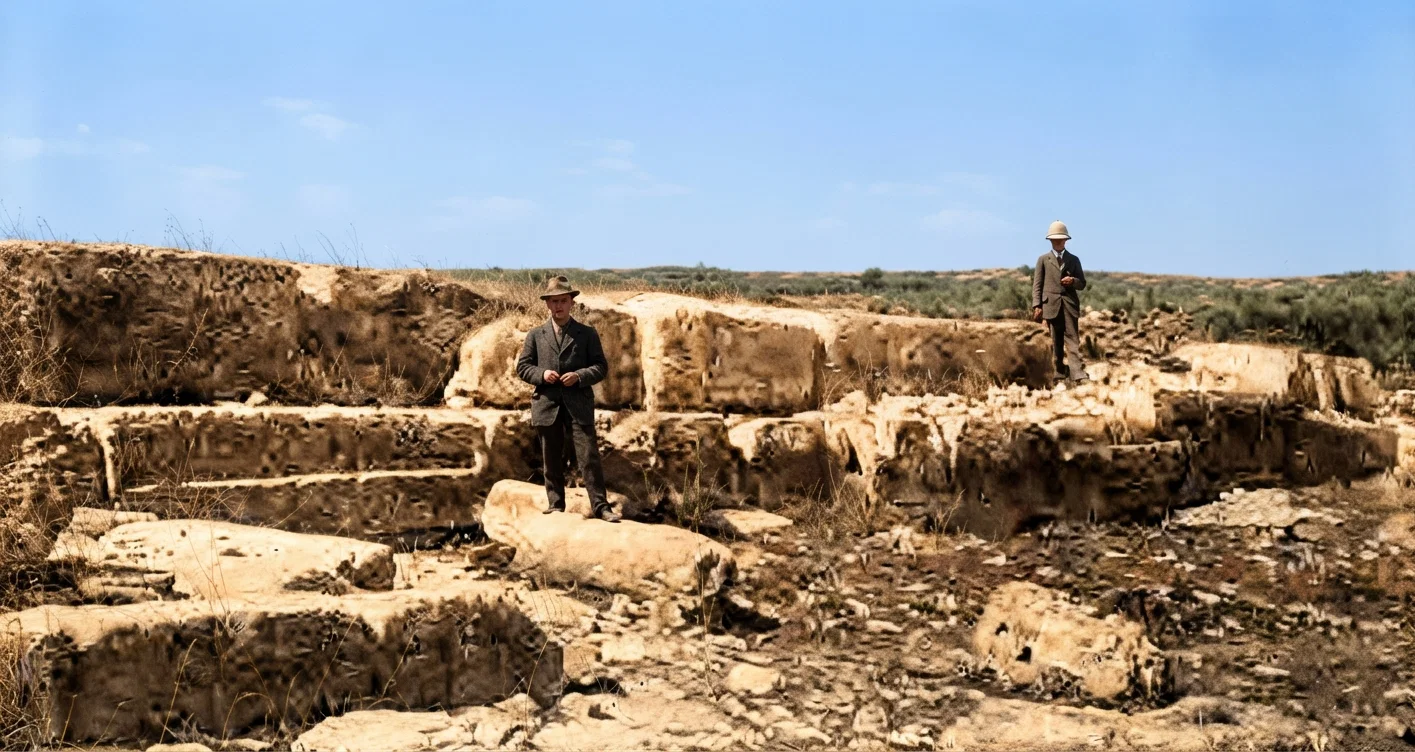
The Ramet Enclosure. Ruins found at Rama, Palestine, where Samuel had his altar. The Rev. W. Shaw Caldecott declares in his "Tabernacle—Its History and Structure," that the measurements of this ruin correspond perfectly with the measures of the sanctuary, and therefore he concludes that this ruin was once the structure in which the sacrifices were carried on in the days of Samuel before the temple was erected. He also determines from this that there were two cubits used; the ordinary one, 14 4-10 inches, and the great cubit, 18 inches.
The Revelation
By Isaac Williams
THERE is no book which we are so invited to read as the Apocalypse, and that with a blessing attached, "Blessed is he that readeth." And perhaps it might with humility be suggested whether the unearthly beauty of this book, its divine simplicity and pathos, the wonderful arrangement of its parts, its deep and hidden analogies, its secret references to all the other scriptures, and to different parts of itself, the poetical imagery and painting, challenging admiration and setting below it all the works of worldly genius — whether all these things may not be intended to arrest our otherwise unwilling attention to matters so obscure and mysterious, subjects for the most part awful and sad, and truths from which our nature recoils.
There is no book more engaging, even humanly speaking, in its composition: formed of images most striking and beautiful; philosophy clothed in divine language, and replete with hidden harmonies of wisdom; and in its artistic structure so exquisite, that it has been well said, "The very wit and artifice seem not to be human but angelical." The style is such that men might speak of it as they did of the prophet Ezekiel, "as a very lovely song of one that hath a pleasant voice." There is no book which so repays the study of it from the manner in which it is interwoven throughout with all the other scriptures, illustrating them and deriving light from them, and amply repaying all care and research with knowledge that satisfies. All these things seem as if they were intended to engage our attention in this book. And the same reasons of wisdom and goodness for which the Holy Spirit has so strongly invited us to this study, have no doubt induced the evil one to direct his arts to draw us away from it. Nor is it strange that he who has labored to render the sacrament of divine love the great cause of strife in Christendom, should lead men to make this wisdom of God to appear "foolishness," and this His guide for the dark days to be darkness itself.—Isaac Williams, 1889.
Change
"A CHANGE of character accomplishes more than a change of climate."
God's Forgiving Love
By Ellen G. White
By Mrs. E. G. White
LET no Christian seek to excuse himself in sin on the ground that others who have claimed to follow Jesus have committed the same errors. Your sin is none the less heinous because others have been guilty; and your manifest duty is to confess your sin to Jesus Christ, your Intercessor. Take the weight of your wo to no human being. You have one Mediator, Jesus Christ the righteous. In contrition of soul go to Him and tell all your sins. The promise is sure, "If we confess our sins, He is faithful and just to forgive us our sins, and to cleanse us from all unrighteousness." John says: "My little children, these things write I unto you, that ye sin not. And if any man sin, we have an Advocate with the Father, Jesus Christ the righteous." "That ye sin not"—here is where you bring yourself into condemnation when you continue to sin. But in the strength of Christ cease to sin. Every provision has been made that grace should abide with you, and that sin may appear to you the hateful thing it is. But if any man sin, he is not to give himself up to despair, and talk like a man who is lost to Christ. "If any man sin, we have an Advocate with the Father, Jesus Christ the righteous; and He is the propitiation for our sins: and not for ours only, but also for the sins of the whole world."
Exercise Faith This Moment
The temptations of the enemy will come; but shall we give him the advantage to break down all the barriers, by yielding one iota from the strictest principles of integrity? If we yield in the least, he will follow one temptation with another, until we shall go directly contrary to the plainest statements of the Word of God, and follow the mind and will of Satan. Satan and his confederacy of evil angels is ever on the alert to see by what means they may ensnare and ruin souls who have enlisted under the blood-stained banner of Prince Emmanuel. You did run well for a season, you did taste and see that the Lord is good, but when you fell into sin you walked in darkness. When you yielded to temptation, you must have ceased to look unto Jesus, the Author and Finisher of your faith. But, having confessed your sins, believe that the Word of God can not fail, but that He is faithful that hath promised. It is just as much your duty to believe that God will fulfil His Word, and forgive your sins, as it is your duty to confess your sins. You must exercise faith in God as in one who will do exactly as He has promised in His Word, and pardon all your transgressions.
How may we know that the Lord is indeed our sin-pardoning Redeemer, and prove what is the blessedness, the grace, the love there is in Him for us? O, we must believe His Word implicitly, with contrite and submissive spirit. There is no need to go mourning and ever repenting, and under a cloud of continual condemnation. Believe the Word of God, keep looking unto Jesus, dwelling upon His virtues and mercies, and there will be created in the heart an utter abhorrence of that which is evil. You will be among those who hunger and thirst after righteousness. But the more closely we discern Jesus, the more clearly we shall see our own defects of character. As we see our failings, let us confess them to Jesus, and, with true contrition of soul, cooperate with the divine power of the Holy Spirit to overcome all evil. If we confess our sins, we must believe that they are pardoned, because the promise is positive: "If we confess our sins, He is faithful and just to forgive us our sins, and to cleanse us from all unrighteousness." Let us no more dishonor God by doubting His pardoning love.
Inspiration of the Bible
By Arthur V. Fox
By Arthur V. Fox
AUTHENTICITY refers to the writer of a book, credibility to its matter, genuineness to its preservation, authority to its sanction, inspiration to its origin. The last applies in a particular sense to the Bible. There are various opinions in regard to the extent in which the Bible is inspired. Some think the Bible inspired merely as poetry is; some hold it to be inspired simply so far as they deem it God-worthy; a third class holds that portions only of the Bible are inspired, as the Pentateuch and Isaiah; a fourth, that all Scripture is inspired but not equally—distinguishing between superintendence, direction, and suggestion, as distinct and progressive steps; a fifth class, professing a belief in plenary inspiration of all Holy Scripture, practically denies it by giving to human writing, or an instinctive sentiment, or an inner light, an equal authority.
The first is open infidelity; the second, masked infidelity; against the third we maintain that all Scriptures are inspired; against the fourth, that all are equally so; against the fifth, that all are peculiarly so.
The doctrine we teach is, that as the word of man is by the breath of his mouth, so the Word of God is by the breath of the Almighty. Primarily, the text refers to the Old Testament; but as the apostles ranked the New Testament with the Scriptures, we may embrace in the proposition the whole Bible. But what is the Bible?
We answer, The canonical Scriptures in the original tongues. That these are fully inspired we argue, (1) from the necessity of the case. We are doomed to endless disquiet unless we have an infallible standard of truth. There are only three things in which we can look for such a standard,—reason, the church, and revelation.
With all Christians the first is out of the question, and with all Protestants the second is also. We have no standard if not in the written Word. If the words of Scripture are not approved by God, there is no written revelation. No being is responsible for a document which he has not dictated, or at least inspected and approved: and if God has dictated, inspected, and approved the Bible, it is verbally inspired; if not, then, tho the prophets were inspired, we have no revelation — we have nothing but the book.
That the book is verbally inspired in part is clear from the following circumstances: In some instances the writers predicted coming events which they did not comprehend; in others they searched to know what or what manner of time the Spirit that was in them did signify. We may argue its inspiration also from the prophetic nature of the Scripture. Not a book of the Old Testament or New that is not prophetic in part. Prophecy—prediction—refers to what is beyond the range of human minds. Here man must rely verbally upon the divine mind for guidance,—an error in mode or tense would be an error in fact, and a leak for the faith which might sink the church.6The Inspiration of the Word Is Indicated by the manner in which sacred writings are introduced and closed, and quoted by sacred writers. David says, "The Spirit of the Lord spake by me, and His Word was in my tongue." 2 Sam. 23: 2. "And these are the words that the Lord spake." Jer. 30: 4. "For the Lord spake thus to me." Isa. 8: 11. "Hear this word that the Lord hath spoken against you." Amos 3: 1. "Speak with My words unto them." Eze. 3: 4, 11. Thus opening they close with such words as these: "The mouth of the Lord of Hosts hath spoken." How are they quoted by the apostles? "But those things, which God before had showed by the mouth of all His prophets." Acts 3: 18.
God the speaker and man the instrument, not man the speaker and God the assistant. The New Testament writers divide the Old Testament into the law and the prophets, but quote both as of equal authority—both as prophetic. The ceremonial law was indeed prophetic in all its parts; the history of the Jews was typical.
The Psalms are full of predictions; the authors of all the books were invested with the dignity of prophets.
"This scripture must needs have been fulfilled, which the Holy Ghost by the mouth of David spake." The New Testament Scriptures are full of predictions, and their authors are said to speak by the Spirit.
Inspiration of the Bible
(Continued from page 5)
In the words of Holy Writ we may conclude. "The law of the Lord is perfect, converting the soul: the testimony of the Lord is sure, making wise the simple. The statutes of the Lord are right, rejoicing the heart: the commandment of the Lord is pure, enlightening the eyes. The fear of the Lord is clean, enduring forever: the judgments of the Lord are true and righteous altogether." Ps. 19: 7-9.