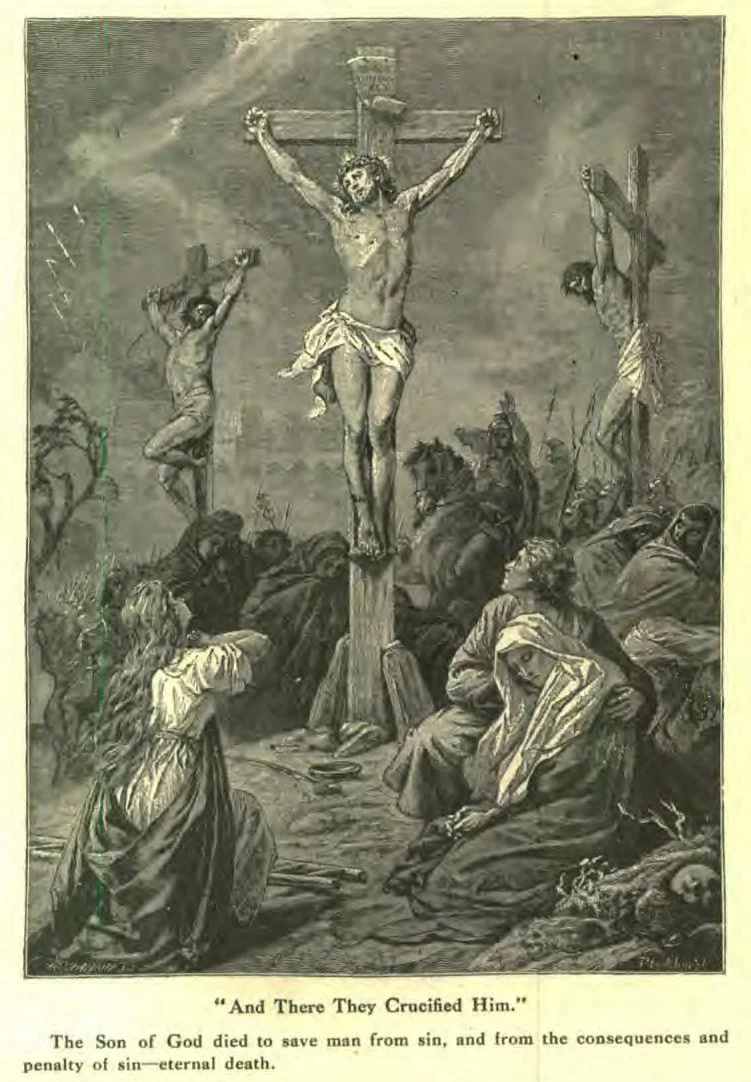
"But He was wounded for our transgressions, He was bruised for our iniquities: the chastisement of our peace was upon Him; and with His stripes we are healed."
[All questions to this department will be answered which in the editors will seem to minister to the good of the readers and to the mission of the paper. The same question can not be answered repeatedly in the same volume. The name and address must accompany question, not for publication, but as an evidence of good faith, and that answer may be made by letter if deemed advisable. 'It is well always to enclose a stamp for reply.]
2422.—The Beginning of the Day.
How can people upon various portions of the globe know at what moment to begin a Sabbath analogous to the first seventh day of creation without knowing the relation of the sun to the earth when the sixth day closed? The point of actual time between darkness and light would not suffice as a criterion in a strict construction of the dictum as applied to a round world. J. M. C.
It is not actual time in the sense of time measured by chronometer, or clock, that the true Sabbath-keeper is to observe the day, but as measured by the sun. When sunset comes, the day begins; the sixth day closes at sunset, the seventh day begins as the sixth day closes. Whether the Jew of the time of Christ lived in the longitude of Babylon in the East or the longitude of Spain on the West, he did not begin the Sabbath until it reached him, at sunset. If we recall correctly, there is about three hours' difference in time between these localities. He did not ask himself when the sun was setting what the time was at some particular degree of longitude; he saw that the day was ending and another was about to begin with him; and that was the day for which God asked consideration at his hand. When the Lord gave the Sabbath, He knew that the world was round; when He made man upon the earth, of course He knew the same fact. To all men scattered all over the world God gave the Sabbath, regulated as recorded in His word. See Acts 17:24-26; Mark 2:27.
What is meant by the earth being reaped? It reads as tho those who had gotten the victory over the beast and his image stood on the sea of glass before the plagues were administered.
To understand Revelation you must remember that it is a presentation of a series of visions. Where the expression occurs, as it does frequently, "After these things," it does not necessarily mean that the things shown come after, but that John was shown them after. Verses 1 to 5 of chapter 14 belong really with chapter 13. Chapter 13 shows the earthly power that will persecute God's children, and chapter 14:1-5 shows the victory over that earthly power. Then we have another prophecy beginning with verse 6, presenting the great Threefold Gospel Message, and the events that follow that. Verse 14 refers to the coming of the Lord. But before He comes the plagues will begin to be poured out, as indicated in verse 10. These plagues, however, do not cease, nor will they cease, until all the wicked and all allied with wickedness are destroyed; for "in them is filled up the wrath of God." When Christ comes, a twofold reaping will take place—He will gather His own children, and He will also send angel-reapers to gather the harvest of those who have utterly rejected Him. After that comes the desolation of the earth. Chapter 15 is another prophecy taking up the plagues specifically, but before that awful outpouring of wrath is described, the Lord reveals the fact (verses 2-4) that His own children will be saved from these awful calamities.
Did Paul mean in 1 Tim. 1:15 that he was then the chief of sinners? G. R.
He certainly did not mean that he was at that time the active chief of sinners, nor are we to gather from the expression that he himself ever was the chief of sinners; yet that was the conviction of his own heart, just as it is the conviction of many other hearts who feel truly condemned when they themselves are revealed in the light of Christ's holiness. That sense of unworthiness seemed to abide with Paul. Of himself he was a poor sinner, yea, the very chief, but in Christ he found mercy. That will be true of every believer. He will never boast of himself; if saved, he is a sinner saved by grace. But this does not mean that Paul was going on in sin. With a sense of his own unworthiness and Christ's power, he was pressing on to the mark of the prize of the high calling of God in Christ Jesus. See Phil. 3:8-16. This expresses Paul's experience; it ought to be the experience of every Christian.
2425.—The New Jerusalem and Its Resting-Place.
Does the New Jerusalem rest on the Mount of Olives (Zech. 14:4), or does it float on the billows of fire as the ark floated on the waters? J. R. L.
From Zech. 14:4, it would seem that when the Lord shall come at the end of the thousand years, His feet shall stand upon the Mount of Olives. The very touch of His presence divides the mountain in twain, making a very great valley, purifying its material by His touch and fitting it for the place of the New Jerusalem when it descends. Of course there will be beneath this the very melting of the elements, as stated in 2 Peter 3:10. The foundation of the city with its surroundings, called "the camp of the saints," rests upon the fiery mass. Farther than this we can give no information.
2426.—Calling upon the Name of the Lord. Gen. 4:26.
What is meant by the expression, "Then began men to call upon the name of the Lord"? Had not men called upon the Lord previous to that time? No. 616.
Calling upon the name of the Lord would seem to refer* to a time when men were organized under the name of the Lord; that is, the children of Seth called on the name of the Lord, or, as the margin reads, "to call themselves by the name of the Lord." They were God's children, the sons of God. See Gen. 6:2. Surely they had called upon the Lord before this. Abel died a martyr for his faith. But men at that time seem to have associated together in calling upon His name.
2427.—Eating of Swine's Flesh.
Please explain what the hog was intended for, as you do not believe it should be used as food. We read that everything that God made was very good. Thousands of professed Christians eat pork; are they not verily guilty? F.
When everything came from God's forming, creating hand in the beginning, it was very good. We have no question as to that, but man, the prince of earth under God, yielded to sin, and man's yielding to sin affected the whole creation. So we read in Rom. 8:20, "For the creation was subjected to vanity, not of its own will, but by reason of him who subjected it." Man, the higher creature, yielded to sin, and that involved all the lower creation, and brought a curse upon all the animal creation below man. We know that it is not now "very good," for God has distinctly pronounced some of it unclean, in Leviticus 11, and elsewhere. Why not accept what He says? This is no arbitrary declaration on God's part; the swine is not simply unclean because He says it is, but that is the very nature of the swine itself since sin entered our world. Before sin entered, it was not God's plan that man should eat flesh foods. We have no reason to believe that the swine has in anywise changed its nature since the Lord pronounced it unfit for food. There are doubtless many honest people who eat it. They are transgressing physical law, and are ignorant that they are. They will meet the consequences in bodies that are more subject to disease and decay.
God asks of His children that they shall follow the light which He gives them. Those who turn from that light, knowing it to be light, are walking in darkness. Those who presume upon God's mercy are unworthy of His mercy; and yet it is true that He still calls after man when he has long sinned against Him. The sin may be a matter of ignorance, and yet man may be in a measure convicted of it. At such a time as that it ought to be considered. If it is not, the Lord still blesses perhaps in spite of the sin, but deeper conviction will come to the sinner, and the Lord will continue to convict until the soul yields the sin and accepts Christ, or utterly turns away.
2428.—Fire from Heaven.
Please explain Rev. 13:13, "And he doeth great wonders, so that he maketh fire come down from heaven on the earth in the sight of men." What will be the appearance of the fire mentioned above, and what will be the result of the descent of the fire? Who will see it? Will it be a consuming fire? No. 237.
This is something of which we have little knowledge. The purpose of the bringing of the fire down from heaven in the sight of men is to deceive; that is the object of the beast-power. The very appearance of the fire itself may be deceptive, anything which will accomplish the purpose of deceiving the people. It probably will not be a consuming fire, and doubtless will be that which may be seen by any one, inasmuch as it is designed to deceive all. Anciently when God answered by fire, in the time of Elijah, He did it to show that He was the true God. In the latter days Satan's agencies will evidently use a counterfeit so as to endeavor to deceive the people of the world into believing the false to be the true. The true test for God's people at that time will be His truth, and the moral conduct consequent upon living that truth. The Ninety-first Psalm declares to His people, "His truth shall be thy shield and buckler;" and of this people it is said, "Here is the patience of the saints; here are they that keep the commandments of God, and the faith of Jesus."
Does the law mentioned in these passages mean the Ten Commandments? A. T. N.
It does. Man is not justified by law. Because he is a sinner, that law condemns him; he is under the law, under its condemnation. When that sin is forgiven thru Christ Jesus, man is taken out from under the condemnation of the law, and is no longer a sinner in the sight of God. His sins are forgiven. The writing of the law by the Spirit of God has begun in his heart. He is not above the law, neither is he then under the law, but he is with the law, and that law bears testimony to the righteousness which he has received by faith. Rom. 3:21, 22. See the tract, "Under the Law, or Under Grace,"¹ in which this subject is much more fully explained. Address this office.
2430.—G. L. P.—Foreordination.—It is very clearly taught in the Bible that all good things were foreordained of God. He did not foreordain evil. Evil is caused by God's creatures taking themselves out of His normal way. We have not space in this department to discuss the question, but if our inquirer will send for the little tract entitled, "Bible Election," price one cent, that information and much more connected with it will be given. Address this office.
2431.—O. H.—The expression, "Cleanliness is next to godliness," does not occur in the Bible. By some it is ascribed to John Wesley. In his ninety-second sermon, on "Dress," is found this expression, "Certainly this is a duty, not a sin. Cleanliness is indeed next to godliness." But his use of the phrase seems to indicate that he had quoted it from some one before him.
2432.—A. D. F.—Rich Man and Lazarus.—For an explanation of this, see tract with above title, published by Pacific Press, or chapter, "A Great Gulf Fixed," page 269, in "Christ's Object Lessons." We have not space properly to explain the parable in this department.
Christ the Teacher and Healer
By Ellen G. White
By Mrs. E. G. White
Communion with God.
“Come up unto Me into the mount,” God bids us. To Moses, before he could be God’s instrument in delivering Israel, was appointed the forty years of communion with Him in the mountain solitudes. Before bearing God’s message to Pharaoh, he spoke with the angel in the burning bush. Before receiving God’s law as the representative of His people, he was called into the mount, and beheld His glory. Before executing justice on the idolaters, he was hidden in the cleft of the rock, and the Lord said, “I will . . . proclaim the name of the Lord before thee,” “merciful and gracious, slow to anger, and abundant in loving-kindness and truth, . . . and that will by no means clear the guilty.” Before he laid down, with his life, his burden for Israel, God called him to the top of Pisgah, and spread out before him the glory of the promised land.
Before the disciples went forth on their mission, they were called up into the mount with Jesus. Before the power and glory of Pentecost, came the night of communion with the Saviour, the meeting on the mountain in Galilee, the parting scene upon Olivet, with the angel’s promise, and the days of prayer and communion in the upper chamber.
Jesus, when preparing for some great trial or some important work, would resort to the solitude of the mountains, and spend the night in prayer to His Father. A night of prayer preceded the ordination of the apostles and the Sermon on the Mount, the transfiguration, the agony of the judgment hall and the cross, and the resurrection glory.
The Privilege of Prayer.
We, too, must have times set apart for meditation and prayer and for receiving spiritual refreshing. We do not value the power and efficacy of prayer as we should. Prayer and faith will do what no power on earth can accomplish. We are seldom, in all respects, placed in the same position twice. We continually have new scenes and new trials to pass thru, where past experience can not be a sufficient guide. We must have the continual light that comes from God.
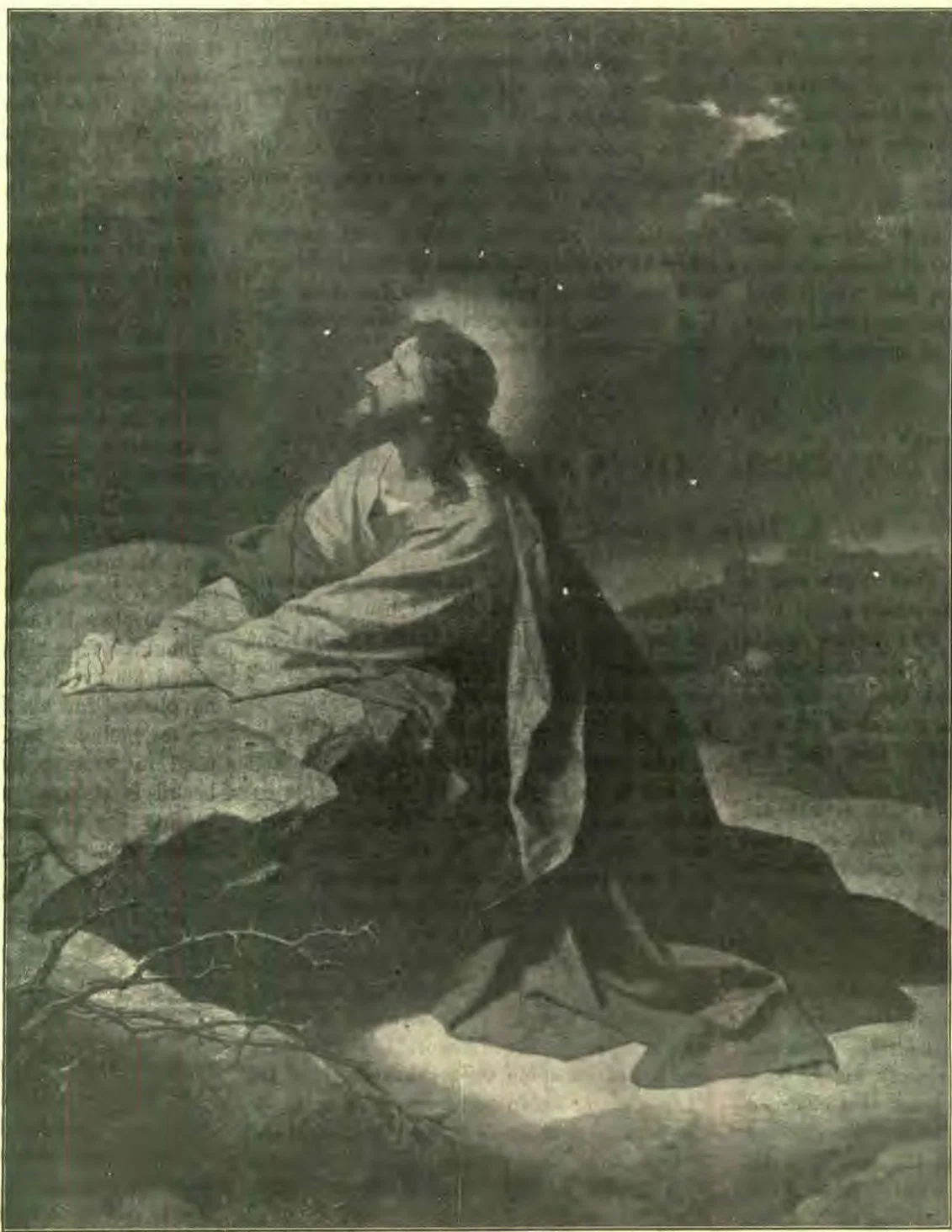
The Master's Agonizing Prayer in the Garden of Gethsemane.
Christ is ever sending messages to those who listen for His voice. On the night of the agony in Gethsemane, the sleeping disciples heard not the voice of Jesus. They had a dim sense of the angels’ presence, but lost the power and glory of the scene. Because of their drowsiness and stupor, they failed of receiving the evidence that would have strengthened their souls for the terrible scenes before them. Thus today the very men who most need divine instruction often fail of receiving it, because they do not place themselves in communion with heaven.
The temptations to which we are daily exposed make prayer a necessity. Dangers beset every path. Those who are seeking to rescue others from vice and ruin are especially exposed to temptation. In constant contact with evil, they need a strong hold upon God, lest they themselves be corrupted. Short and decisive are the steps that lead men down from high and holy ground to a low level. In a moment decisions may be made that fix one’s condition forever. One failure to overcome leaves the soul unguarded. One evil habit, if not firmly resisted, will strengthen into chains of steel, binding the whole man.
The reason why so many are left to themselves in places of temptation is that they do not set the Lord always before them. When we permit our communion with God to be broken, our defense is departed from us. Not all our good purposes and good intentions will enable us to withstand evil. We must be men and women of prayer. Our petitions must not be faint, occasional, and fitful, but earnest, persevering, and constant. It is not always necessary to bow upon our knees in order to pray. Cultivate the habit of talking with the Saviour when alone, when walking, and when busy with daily labor. Let the heart be continually uplifted in silent petition for help, for light, for strength, for knowledge. Let every breath be a prayer.
As workers for God we must reach men where they are, surrounded with darkness, sunken in vice, and stained with corruption. But while we stay our minds upon Him who is our Sun and our Shield, the evil that surrounds us will not bring one stain upon our garments. As we work to save souls that are ready to perish, we shall not be put to shame if we make God our trust. Christ in the heart, Christ in the life, this is our safety. The atmosphere of His presence will fill the soul with abhorrence of all that is evil. Our spirit may be so identified with His that in thought and aim we shall be one with Him.
Power of Prayer.
It was thru faith and prayer that Jacob, from being a man of feebleness and sin, became a prince with God. It is thus that you may become men and women of high and holy purpose, of noble life, men and women who will not for any consideration be swayed from truth, right, and justice. All are pressed with urgent cares, burdens, and duties, but the more difficult our position and the heavier our burdens, the more we need Jesus.
It is a serious mistake to neglect the public worship of God. The privileges of divine service should not be lightly regarded. Those who bear responsibilities need to place themselves where they will be deeply impressed by the Spirit of God. They should have as much greater anxiety than do others for the aid of the Holy Spirit and for a knowledge of God as their position of trust is more responsible than that of others.
Nothing is more needed in our work than the practical results of communion with God. We should show by our daily lives that we have peace and rest in the Saviour. His peace in the heart will shine forth in the countenance. It will give to the voice a persuasive power. Communion with God will ennoble the character and the life. Men will take knowledge of us, as of the first disciples, that we have been with Jesus. This will impart to the worker a power that nothing else can give. Of this power he must not allow himself to be deprived.
We must live a twofold life,—a life of thought and action, of silent prayer and earnest work. The strength received thru communion with God, united with earnest effort in training the mind to thoughtfulness and caretaking, prepares one for daily duties, and keeps the spirit in peace under all circumstances, however trying.
The Seal of God
By A. Delos Westcott
By A. Delos Westcott
IT is believed by some that God's seal is the Holy Spirit, while others assert that it is the Sabbath. The writer would agree with both of these classes and would add the further statement that God's seal is His name. Then as the climax of all this, he would state emphatically that God has but one seal.
Some of the readers of this article are doubtless ready to exclaim, "How can these things be!" To make this matter clear is the purpose of the following paragraphs:
The Holy Spirit Necessary.
No ordinance of the Gospel, either in the Old Testament or in the New, is of any value whatever without the accompaniment and cooperation of the Holy Spirit. Take circumcision. It was not simply an outward form. Unless the man's heart was changed, it was wrong to say that he was circumcised. "Circumcision is that of the heart, in the spirit, and not in the letter." Rom. 2:29. In Lev. 26:41, the Lord speaks of His people having "uncircumcised hearts;" and in Deut. 10:16, He says, "Circumcise therefore the foreskin of your heart." See also Jer. 4:4; Phil. 3:3. Circumcision was a seal of righteousness by faith, which is the righteousness of Christ, received by the agency of the Holy Spirit. Circumcision, therefore, consisted in an outward ceremony accompanied by a change of heart wrought by the Holy Spirit. Yet there was but one circumcision, altho two elements were necessary to meet the requirement.
Both an Outward and an Inward Work.
Take baptism. The Scriptures teach that we are to be baptized with water (Acts 8:35-39); and they also say, "Ye shall be baptized with the Holy Spirit." Acts 1:5. Both are necessary, but this does not make two baptisms, for the Scriptures say plainly "one baptism." Eph. 4:5.
It is the same with every ordinance of the Gospel. There is an outward work and an inward work. The outward work is man's part, the inward work is God's part. God's part is done thru the agency of the Holy Spirit. Man must be willing to do his part to the best of his knowledge and ability, then God's part will be wrought with man. In speaking of an ordinance, sometimes only man's part is referred to, and sometimes only God's part; but it takes both parts to make the complete ordinance.
In the case of God's seal, the Sabbath is the outward part—man's part—and the giving of the Spirit to sanctify is God's part. The Sabbath is rightly called God's sign, or seal, and the Holy Spirit bears the same title.
"Ye were sealed with that Holy Spirit of promise." Eph. 1:13. The Holy Spirit is "the earnest [pledge] of our inheritance" (verse 14), and so is the Sabbath (Isa. 58:13, 14). The indwelling Spirit tells us we are the children of God, that we belong to Him. The Sabbath tells us the same thing. "And hallow My Sabbaths; and they shall be a sign between Me and you, that ye may know that I am the Lord your God." Eze. 20:20. Those who are sealed with God's Sabbath and the Holy Spirit together have their Father's name written in their foreheads. Rev. 14:1.
Sign and Memorial.
A thing is called a sign because it calls attention to, or represents, something. A memorial does the same thing. Therefore they are used in the same sense in the Bible. See Ex. 13:9. The Jewish version of Ps. 111:4 reads, "He hath made a memorial for His wonderful works." Now we know that just as soon as His works were finished, God made the Sabbath, and the fourth commandment tells us for what purpose. Therefore it is plain that the Sabbath is God's memorial. God's name is also called His memorial. "And God said moreover unto Moses, Thus shalt thou say unto the children of Israel, The Lord God of your fathers, the God of Abraham, the God of Isaac, and the God of Jacob, hath sent me unto you: and this is My name forever, and this is My memorial unto all generations." Ex. 3:15.
As it was stated in the beginning that God has but one seal, so it may be stated here that He has but one memorial of Himself. This is true because God has chosen the Sabbath to represent His name. We can understand this readily by a simple comparison.
A man may have several different ways of signing his name. When he wishes to sign his name to a document or book, he spells it out with letters, but when he desires to place his name upon a horse or other animal, he uses his sign, or mark, commonly called his brand. He may choose anything he pleases for his brand, and it may have no resemblance to the characters ordinarily used in writing his name; yet when this brand is stamped upon an animal, it represents the owner's name as truly as the letters with which he spells it upon paper.
God's Name on the Individual.
When God desires to place His name upon an individual, He offers him His sign, or mark, which is the seventh day. As the Sabbath is the sign of sanctification, and as it is the Holy Spirit that sanctifies (1 Cor. 6:11; 2 Thess. 2:13), it is therefore certain that the Sabbath and the Holy Spirit go together. God has blended the Holy Spirit and burial in water together to form "one baptism;" and He has blended the Holy Spirit and the Sabbath together to constitute His seal. "What God hath joined together, let not man put asunder."
As God's Sabbath represents His name, we should naturally expect that a spurious or counterfeit Sabbath would be chosen to represent the name of the opposing power. And so we find it; for in Rev. 14:11 the5mark of the beast is called "the mark of his name."
God's name and God's character go together. Therefore those who would bear His name must first possess His character. Likewise the character of the beast and his name go together. As the beast is agent of Satan, of course the name, the mark, and the character belong to Satan. So the question resolves itself into this: Shall we accept God's character and the mark of His name? or shall we take Satan's character and the mark of his name?
The Manifestation of God's Character.
God has manifested His character to the world in the person of Jesus Christ. "For God, who commanded the light to shine out of darkness, hath shined in our hearts, to give the light of the knowledge of the glory of God in the face of Jesus Christ." "For in Him dwelleth all the fulness of the Godhead bodily." "But we all, with unveiled face reflecting as a mirror the glory of the Lord, are transformed into the same image from glory to glory, even as from the Lord the Spirit." "For whom He did foreknow, He also did predestinate to be conformed to the image of His Son." In the Syriac New Testament, it reads, "He sealed them with the likeness of the image of His Son."
This is what it means to have the seal of God. This is the purpose and work of the Holy Spirit. This is the character which God has set His Sabbath to represent. It is no use to accept the Sabbath without the Holy Spirit; and where the Holy Spirit abides, the character will be seen.
The Sabbath is therefore a sign of the character of Jesus Christ in the believer. No one has a right to the sign unless he has the character; and no one can have the character who is unwilling to accept the sign when he knows what it is. Thousands of people to-day have the character who do not have the external part of the sign. This is because they do not yet understand it. As soon as they understand, they will accept the sign, or they will begin to backslide and lose the spirit and character of Christ. So to all those who have the sign without the character, I will say, Accept the character, or you will ere long give up the sign. And to those who have the character without the sign, I would say, Accept the sign or the time will certainly come when you will lose the character. "For if we sin wilfully after that we have received the knowledge of the truth, there remaineth no more sacrifice for sins." Heb. 10:26.
WHAT for, away up there where few could see it? Why be so very particular in hidden places? But this was God's house, everything must be perfect. God sees. He knows all the secret things. Our bodies are the temples of the Holy Spirit, or should be. Have we any hidden lily work to do? How much of it have we wrought?—Alas! not much. The fact is we are all more or less spotted and marred. We all have faults, we all know it, but we look thru a diminishing glass at our own faults and thru a magnifying glass at our neighbor's faults. Why should we do this when we know the precious truth of the Gospel so well? When is the church to be without "spot or wrinkle, or any such thing,"—holy, blameless? God help us, we are not ready.
O fellow pilgrims, hasten! Repentance first; then conversion; then for the lily work. We have a pattern—the "Rose of Sharon," the "Lily of the Valley." Let us keep our eyes fixed on Him, and all our doings subject to His approval. Let us grow like Him, or we who are delaying His coming, and the mighty conflict, will soon be shaken out. O, let us hasten while we may.
LUCIUS CALKINS
The Sabbath and Sunday Legislation
By B. F. Kneeland
Which Day Is the Sabbath? Is It a Matter for Legislation?
READ a few statements from eminent theologians:
"The current notion that Christ and His apostles authoritatively substituted the first day for the seventh is absolutely without authority in the New Testament."—The Rev. Lyman Abbott, in "Christian Union," Jan. 19, 1882.
"It is true there is no positive command for infant baptism. . . . Nor is there any for keeping the first day of the week."—"Methodist Theological Compendium," page 103.
"There was and is a commandment to keep holy the Sabbath day; but that Sabbath was not Sunday. It will, however, be said with some show of triumph that the Sabbath was transferred from the seventh to the first day of the week, with all its duties, privileges, and sanctions. Earnestly desiring information on this subject, I have studied for many years. I ask, Where can the record of such a transaction be found?—Not in the New Testament, absolutely not. There is no Scriptural evidence of the change of the Sabbath institution from the seventh to the first day of the week."—The Rev. E. T. Hiscox, D.D., in the "Examiner," Nov. 16, 1893.
"You may read the Bible from Genesis to Revelation and you will not find a single line authorizing the sanctification of Sunday. The Scriptures enforce the religious observance of Saturday, a day which we never sanctify."—Cardinal Gibbons, "Faith of Our Fathers," page 111.
Many similar statements from other eminent authorities might be given. But the Sabbath is a question of religion and not of politics, and the dragging of it into the political arena is un-American and against the best interests of Christianity. Read the following from Dr. Adam Clarke:
"No other kind of constraint [than the prayers, entreaties, etc.] is ever recommended in the Gospel of Christ. Any other kind of compulsion is anti-Christian, can only be submitted to by cowards and knaves, and can produce only hypocrites."—Notes on Luke 14: 23.
Alexander Campbell says:
"To compel men destitute of faith to observe any Christian institution such as the Lord's day, is commanding duty to be performed without faith in God. Therefore to command unbelievers, or natural men, to observe in any sense the Lord's day is anti-evangelical or contrary to the Gospel."—"Memoirs," vol. 1, page 528.
Would to God that the words of that grand evangelist, Charles H. Spurgeon, might ring again from our pulpits:
"I am ashamed of some Christians because they have so much dependence on Parliament and the law of the land. Much good may Parliament ever do religion except by mistake! As to getting the law of the land to touch our religion, we earnestly cry 'Hands off! Leave us alone.' Your Sunday bills and other forms of act-of-Parliament religion seem to me to be all wrong. Christ wants no help from Cæsar. I should be afraid to borrow help from government; it would look to me as if I rested on an arm of flesh, instead of depending on the living God."
The demon of drink is just as diabolical on one day as another. Would you send a man to the electric chair for murder committed on Sunday, and release him if it was done on Monday? If liquor-selling is wrong, and I believe it is, it is just as wrong on Tuesday or Saturday as it is on Sunday, and should be stopped on all days. But the call for Sunday laws is because of the religious character of the day. The appeal for legal support of this religious institution reminds one of the words of Benjamin Franklin: "When religion is good, it will take care of itself; when it is not able to take care of itself, and God does not see fit to take care of it, it is evidence to my mind that its cause is a bad one."
Civil laws enforcing a false Sabbath will never change God's law nor abrogate its claims upon every human being. "The seventh day is the Sabbath of the Lord thy God."
B. F. KNEELAND.
Trenton, N. J.
Life's Battle.
By Flora E. Warren
THE battle grows fiercer, O soldier;
The by-paths are filled with our foes;
Our Captain is bidding each soldier
"Make a rush" and be in at the close.
The armor is waiting—behold it!
The names are now being enrolled
Of those who will fight for King Jesus—
The children, the youth, and the old.
Fear not for your weakness, O soldier,
Nor pitfalls and snares on the road;
An angel will journey beside you;
The Captain will carry your load.
As with sword and with shield and with helmet,
We fight for the One we adore,
The ranks of the foe will be scattered
Like a ship in the hurricane's roar.
Think not of the needs of the journey;
"My God" all "in glory" bestows;
Press in, for all heaven is waiting
For those who are in at the close.
FLORA E. WARREN.
The Rich Freight of Prayer
MR. SPURGEON has a fine thought on prayer. He says, "It may be your prayer is like a ship, which, when it goes on a very long voyage, does not come home laden so soon; but when it does come home it has a richer freight. Mere coasters will bring you coals or such like ordinary things, but they that go far to Tarshish return with gold and ivory. Coasting prayers, such as we pray every day, bring us many necessaries, but there are great prayers which, like the old Spanish galleons, cross the main ocean and are longer out of sight, to come home deep-laden with a golden freight."—The Christian Worker.
Be a Bold, Brave, True, Honest Man
BE a bold, brave, true, honest man. If you know a thing is right, do it. If you have a solemn conviction, dare to utter it in the fear of God, regardless of the wrath of man.—John B. Gough.