Your ShelfYour Projects

Review and Herald, Vol. 89, No. 18.

THINE, NOT MINE

Review and Herald

May 2, 1912

Review and Herald Publishing Association · Takoma Park Station, Washington, D. C. · May 2, 1912

THINE, NOT MINE

WORTHIE HARRIS HOLDEN
More than I know I need Thee, More than I see I fail, Naught but Thy power can keep me, Naught but Thy grace prevail
On Thy compassion resting, Thou wilt my soul defend; Humbly my want confessing, Thou canst Thy succor lend,
Conquering then through weakness, Thine will the glory be; So may I bide in meekness Till I Thy beauty see.

“Rome and Marriage” and “Catholic Prisons” Number

An Arsenal of Information

Recent despatches and interviews published in the leading American dailies, show that Rome’s eye is upon the “Protestant Magazine.” She fears our fearless yet dignified propaganda.
A letter from Rome to the New York “Sun,” July 11, 1892, reveals the plan of the Papacy for America: “What the church has done in the past for others SHE WILL NOW DO FOR THE UNITED STATES.”

PARTIAL CONTENTS

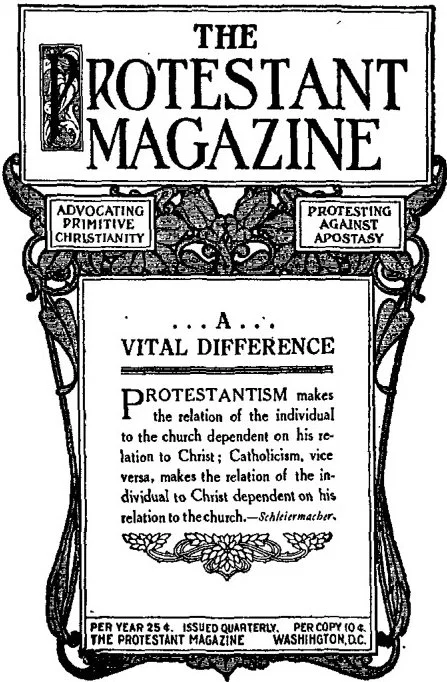
Double Frontispiece — Photograph of Holy Cross Church Baptism Certificate (Perth Amboy, N. J.). Showing Rome’s Insult to American Marriage Laws. Protestantism and Catholicism (cover). A Girl’s Escape From a “House of the Good Shepherd.” Rome and Marriage Laws. The Mediation of Christ. Reply to Attack by “Catholic Truth Society” Upon This Magazine. Cardinal O’Connell Above Governor Foss? Chillingworth’s Famous Statement. The Privilege of Peter. The Pope’s Decree Forbidding Catholics to Sue Criminal Priests. “Another God Upon Earth.” Rome Capturing America. Is America to Become Catholic? Protestantism in the Sixteenth Century, and — Other timely articles, news notes, etc.

SPECIAL OFFER ON TEN, ONE YEAR

Ten copies, one year, to one address, or to 10 separate addresses, only $1.50, or 15 cents each. Sender may include his own name as one of the ten. This number should be placed in the hands of every editor, attorney, clergyman, city and county official, and public-school teacher in your county. We can furnish the names and addresses.

Order Through Your Tract Society

If you do not know your Tract Society address, send to “The Protestant,” Washington, D. C.
Cover Design in Two Colors

A GOOD PROPOSITION FOR AGENTS!

PRICES: 25 cents a year, 10 cents a copy; 5 to 40 copies, 5 cents each; 50 or more copies, 4 cents each. Send 10 cents for sample copy. Better still, send $1.00 for 20, or $2.00 for 50. Discount to agents on yearly subscriptions.
A few of the following bound volumes are for sale: Vols. I and II (1909-10), in one, cloth covers only, each, $1.75; Vol. II (1910), paper covers only, each, 50 cents; Vol. III (1911), cloth, 90 cents, paper, 50 cents. All post-paid.

THE MAY NUMBER OF LIFE & HEALTH NOW READY!

“California’s Big Trees” Cover, in Three Colors
Sixty-Seven Articles  Over 40 Illustrations
An intensely practical as well as a beautiful and instructive number. Its articles are VITAL TO HEALTH!
Questions and Answers.—In this new and popular department the editor replies to questions asked by subscribers. SUBSCRIBE NOW. Send $3.00 for 5 years; $2.00 for 3 years; or $1.00 for one year.

PARTIAL CONTENTS

Frontispiece, Avalon, Santa Catalina Island, California.
God’s Great Out-of-Doors, by George Wharton James.
Bournville, the Garden Village, by G. H. Heald, M. D.
How to Escape the “White Plague,” by A. B. Olsen, M. D.
Keeping Young in Looks, by William J. Cromie.
Faulty Foot-Wear, X-ray photographs of normal and of deformed foot.
Nuts and Nut Foods, by George E. Cornforth.
Typhus and Typhoid.
“Prohibition Does Not Prohibit.”
Questions and Answers.—Sour-Milk Tablets—Yeasts and Ulcers—Exercise for the Voice—Cold-Sores—Water Test—Flies and Typhoid—Tuberculosis, Human and Bovine—Ivy-Poisoning—Pimples—Hookworm Treatment—Greasy, Falling Hair.
Current Comment.—“Personal Liberty”—Contaminated Oysters—Overeating Menaces the Race—Smallpox and Vaccination, etc.
The Saloon and Insanity.
Treatment of Simple Catarrh.
Diseases in Public Roller-Towels.
Leprosy in New York, and many other articles.
Single bound volumes for 1908, 1909, 1910, and 1911, half leather covers only, Each, post-paid ............ $1.75

Send All Orders Through Your Tract Society

If you don’t know your Tract Society address, ask “Life and Health,” Washington, D. C.
Cover Design Printed in Three Colors

EARN YOUR OWN SUBSCRIPTION

By sending us two new subscriptions at $1.00 each, you may earn your own yearly subscription.
Send $2.00 for 50 copies; sell 20 to get your money back; then sell or give away the other 30 copies in the interests of true health reform.

PRICES

$1.00 a year, 10 cents a copy; 5 to 40 copies, 5 cents each; 50 or more copies, 4 cents each.

A Missionary Movement

R. C. PORTER
WE are a missionary people. Great light has been entrusted to us. It has not been given us to hide under a bushel, but to enlighten the people of this generation, that they may properly view their privileges and understand their perils. The Lord has commissioned those who love him more than earthly things, that to carry this light to their fellow men. Their commission requires them to forsake all and carry the message “to every nation, and kindred, and tongue, and people.” Persecution is but a favoring gale to speed the message on its way. Half-hearted service is not acceptable to God.
Those who go to their farms or their merchandise merely for worldly gain are excused from service now, and they will be excused when those who operate their farms and conduct their business in the interests of the Lord’s work, enter upon their reward in the kingdom of God.
It is the greatest honor that can be bestowed upon fallen man that God should regard man as his representative to bear his message to others. “Behold, what manner of love the Father hath bestowed upon us, that we should be called the sons of God: therefore the world knoweth us not, because it knew him not.” 1 John 3:1.
The people of the world have altogether another standard of honor. Their viewpoint is wholly worldly. Accordingly, their ambitions and plans for life are worldly.
The contrast that should exist between the plans and ideals of the worldling and those of the Christian is as striking as that between light and darkness; between God and mammon, or Christ and Belial.
From “Testimonies for the Church,” No. 33, pages 15, 16, I quote the following:—
“I feel urged by the Spirit of the Lord to tell you that now is your day of privilege, of trust, of blessing. Will you improve it? Are you working for the glory of God, or for selfish interests? Are you keeping before your mind’s eye brilliant prospects of worldly success, whereby you may obtain self-gratification and financial gain? If so, you will be most bitterly disappointed. But if you seek to live a pure and holy life, to learn daily in the school of Christ the lessons that he has invited you to learn, to be meek and lowly in heart, then you have a peace which no worldly circumstances can change.
“A life in Christ is a life of restfulness. Uneasiness, dissatisfaction, and restlessness reveal the absence of the Saviour. If Jesus is brought into the life, that life will be filled with good and noble works for the Master. You will forget to be self-serving, and will live closer and still closer to the dear Saviour; your character will become Christlike, and all around you will take knowledge that you have been with Jesus and learned of him. Each one possesses in himself the source of his own happiness or wretchedness. If he will, he may rise above the low, sentimental feeling which makes up the experience of many; but so long as he is self-inflated, the Lord can do nothing for him. Satan will present ambitious projects to daze the senses, but we must ever keep before us ‘the mark for the prize of the high calling of God in Christ Jesus.’ Crowd all the good works you possibly can into this life. ‘They that be wise shall shine as the brightness of the firmament; and they that turn many to righteousness as the stars forever and ever.’”
Individuals who hoard earthly treasure will cast it out in most bitter disappointment when Christ comes, “because it is the stumbling-block of their iniquity.” Eze. 7:19.
How different is the life of the one who is wholly devoted to God, and whose whole ambition is swallowed up in the finishing of the work and preparing to meet his returning Lord. One thus consecrated meets all the perils of the last days with unwavering confidence, and with his eyes fixed upward, from whence he expects his help, he seeks not worldly gain for self, but seeks souls for his Master’s kingdom. When his work is finished and Christ comes, he is not disappointed. He looks up with the same confidence in God with which he labored, saying, “Lo, this is our God; we have waited for him, and he will save us.”
From the Master come the words, sweeter than any earthly melody, thrilling with unspeakable joy the heart of every one faithful to God: “Come, ye blessed of my Father, inherit the kingdom prepared for you from the foundation of the world.” “Thou hast been faithful over a few things, I will make thee ruler over many things: enter thou into the joy of thy Lord.”
Unfaithful stewards of entrusted earthly goods shall perish with their earthly treasures. Those only can share the joy of the Lord who have shared in his spirit of self-sacrificing labor.
When Christ comes, accompanied by all the holy angels, only those who have made a covenant with God by sacrificewill be gathered. Hoarded treasures that should have been used in the proclamation of the message will then burn their flesh, as it were fire.
Those who shine now in worldly adornment and earthly glory will wail in disappointment outside the gates of the holy city when the faithful ones enter into rest. Those who now devote themselves unreservedly to the work of carrying the message will then shine as jewels in the kingdom of God. “And they that be wise [“teachers,” margin] shall shine as the brightness of the firmament; and they that turn many to righteousness as the stars forever and ever.”

The Things I Miss

An easy thing, O Power Divine, To thank thee for these gifts of thine! For summer's sunshine, winter's snow, For hearts that kindle, thoughts that glow, But when shall I attain to this— To thank thee for the things I miss?
For all young Fancy's early gleams, The dreamed-of joys that still are dreams, Hopes unfilled, and pleasures known Through others' fortunes, not my own, And blessings seen that are not given, And never will be this side heaven.
Had I, too, shared the joys I see, Would there have been a heaven for me? Could I have felt thy presence near Had I possessed what I held dear? My deepest fortune, highest bliss, Have grown, perchance, from things I miss.
Sometimes there comes an hour of calm; Grief turns to blessing, pain to balm; A Power that works above my will Still leads me onward, upward still, And then my heart attains to this— To thank thee for the things I miss.
— Thomas Wentworth Higginson, in Walla Walla Daily Bulletin.

Sanitariums as Centers of Influence and Training

MRS. E. G. WHITE
The Lord has ordained that sanitariums be established in many places to stand as memorials for him. This is one of his chosen ways of proclaiming the third angel’s message. By this means the truth will reach many who, but for these agencies, would never be lightened by the brightness of the gospel message. In the presentation of truth, some will be attracted by one phase of the gospel message and some by another. We are instructed by the Lord to work in such a way that all classes will be reached. The message must go to the whole world. Our sanitarium work is to help make up the number of God’s people. Through this line of missionary effort infidels will be converted. By the wonderful restorations taking place in our sanitariums many will be led to look to Christ as the healer of soul and body.
Self-sacrificing workers, who have full faith in God, should be chosen to take charge of these institutions. Wise men and women, acting in the capacity of nurses, are to comfort and help the sick and suffering. Our sanitariums are to be as lights shining in a dark place, because physicians, nurses, and helpers reflect the sunlight of Christ’s righteousness.
It is the glory of the gospel that it is founded on the principles of restoring in the fallen race the divine image. The Godhead was stirred with pity for the race, and the Father, the Son, and the Holy Spirit gave themselves to the working out of the plan of redemption. In order fully to carry out this plan, it was decided that Christ, the only begotten Son of God, should give himself an offering for sin. And in giving Christ, God gave all the resources of heaven, that nothing might be wanting for the work of man’s uplifting. What line can measure the depth of this love? God would make it impossible for man to say that he could have done more.
The establishment of churches and sanitariums is only a further manifestation of the love of God, and in this work all God’s people should have a part. Christ formed his church here below for the purpose of showing forth through its members the grace of God. Throughout the world his people are to raise memorials of his Sabbath,—the sign between him and them that he is the One who sanctifies them. Thus they are to show that they have returned to their loyalty, and stand firmly for the principles of his law.
Sanitariums are to be so established and conducted that they will be educational in character. They are to show to the world the benevolence of heaven. Though Christ’s visible presence is not discerned, yet the workers may claim the promise, “Lo, I am with you alway, even unto the end of the world.” He has assured his followers that to those who love and fear him he will give power to continue the work that he began. He went about doing good, teaching the ignorant, and healing the sick. His work did not stop with an exhibition of his power over disease. He made each work of healing an occasion of implanting in the heart the divine principles of his love and benevolence. Thus his followers are to work. Christ is no longer in this world in person, but he has commissioned us to carry forward the medical missionary work that he began; and in this work we are to do our very best. For the furtherance of this work institutions for the care of the sick are to be established, where men and women suffering from disease may be placed under the care of God-fearing physicians and nurses.
In our sanitariums truth is to be cherished, not banished nor hidden from sight; and from them the light of present truth is to shine forth in clear, distinct rays. These institutions are the Lord’s agencies for the revival of a pure, elevated morality. We do not establish them as a speculative business, but to help men and women to follow right habits of living. Those who are now ignorant are to become wise. Suffering is to be relieved, and health restored. People are to be taught how, by exercising care in their habits, they may keep well. Christ died to save men from ruin. Our sanitariums are to be his helping hand, teaching men and women how to live in such a way as to honor and glorify God. If this work is not carried on in our sanitariums, those who are conducting them will make a great mistake.
Christ came to this world bearing a message freighted with redemption. To all who receive him as a personal Saviour he gives power to become the sons of God. “The Word was made flesh, and dwelt among us, . . . full of grace and truth. . . . And of his fulness have all we received, and grace for grace.” All who become the sons of God are possessed of his nature. They dwell in Christ as Christ dwells in God. Converted to the truth, imbued with the Holy Spirit, they are under the transforming influence of divine grace. The life of self-indulgence they once lived is changed to a life of service. Knowing the power of his grace, they are commissioned and qualified to bear the message of salvation to a sinful world, and to make known his grace and truth. As they consecrate themselves wholly to God, the grace they impart will be continually renewed in increased measure.
God has qualified his people to enlighten the world. He has entrusted men with faculties that adapt them to extend their efforts and accomplish a work that will belt the world. Sanitariums, schools, printing-offices, and kindred facilities are to be established in all parts of the world. But this work has not yet been done. In foreign countries many enterprises that require means must yet be begun and carried forward. Let all do their best, making their boast in the Lord, and blessing others by their good works.
Christ cooperates with those who engage in medical missionary work. Men and women who unselfishly do what they can to establish sanitariums and treatment-rooms in many lands will be richly rewarded. Those who visit these institutions will be benefited physically, mentally, and spiritually. The weary will be refreshed, the sick will be restored to health, and the sin-burdened will be relieved. In far-off countries thanksgiving will be heard from the lips of those whose hearts are turned from the service of sin unto righteousness. And by their songs of grateful praise a testimony is borne that will win still others to the truth. The conversion of souls to God is the greatest work, the highest work, in which human beings can have a part. In the conversion of souls, God’s forbearance, his unbounded love, his holiness, and his power are revealed. Every true conversion glorifies him, and causes the angels to break forth into singing.
Upon every truly converted soul—every one who believes in Christ as the world’s Redeemer—God has laid the obligation of cooperating with him who gave his life for a perishing world. To every one who is at ease in Zion, he says: Arise, and put your shoulder to the wheel. Bear spiritual burdens. Clear the atmosphere of the soul, that the Sun of Righteousness may shine through you to the people of other tongues, revealing to them a living, testing truth. Let your light so shine that those who are perishing in their sins may learn of God’s goodness and mercy and love.

Thoughts From an Old Book

W. T. BARTLETT
The rise of the health reform movement in recent years has been responsible for no small addition to the output of literature, much of it, no doubt, very helpful and valuable to the student of physical culture. For myself I have lately found considerable interesting information in an effort to ascertain what the oldest of books had to say on the subject.
I find that it represents our physical construction, and very credibly so, as the product of much skill on the part of the Maker. One contributor to the volume expresses his sense of the fact in this language: “I am fearfully and wonderfully made: marvelous are thy works; and that my soul knoweth right well.” He goes on to speak of his bodily material as wrought into members and fashioned in execution of a plan that comprisesin itself so many and so unsearchable thoughts that it would be as hopeless to recount them all as to number the sands of the seashore. This is doubtless one reason why it takes so many books and pamphlets to-day to open up to us the science of hygiene and dietetics.
I find in the old Book a general insistence on the idea that its Author is none other than the Architect of the human frame, and that his counsels must be followed closely if the organism is to be preserved in proper condition and efficiency. The words of the Book are referred to by one pithy writer as life to those that find them, and health, or medicine, to all their flesh. He also asserts that to fear the Lord and depart from evil will prove health to the organs of digestion and to the marrow of the bones. I do not know that many modern writers study physiology in this interesting way, but I have noticed that some do dwell upon the close connection between mind and body, and hold that the health of the one is favorable to the health of the other. So it is possible that some who suffer bad health might find improvement in mending their ways. If the old Volume is correct in its account of our making, and the reason why we were made, it certainly would be only natural that health should depend in an important measure on our respecting the wishes and intentions of our Maker.
He seems, according to the narrative, to have succeeded at one time in keeping a large body of men, women, and children in excellent condition for forty years, except for occasional outbreaks for which he does not appear to have been responsible. At the beginning of that experience he laid down the law of health in these words: “If thou wilt diligently harken to the voice of the Lord thy God, and wilt do that which is right in his sight, and wilt give ear to his commandments, and keep all his statutes, I will put none of these diseases upon thee, which I have brought upon the Egyptians: for I am the Lord that healeth thee.”
I do not know that we can afford, even in this twentieth century, to dismiss the venerable proposition with contempt. If we ourselves had found some other way of banishing disease, we might; but with so much ill health ravaging our country, in spite of our large and well-equipped body of medical men and sanitary inspectors, we at any rate are not the ones to heap scorn on the old suggestion. The plan seems to be particularly favorable, too, for people of small means, who have to be contented with a meager bill of fare, according to this quotation: “Ye shall serve the Lord your God, and he shall bless thy bread, and thy water; and I will take sickness away from the midst of thee.”
Of course, the reference to this somewhat limited bill of fare may mean that the Lord finds it easier to bless bread and water than some of the preparations that he sees on our tables. Or it may be specially for the encouragement of those who indulge an unbelieving suspicion that if a man did begin to keep all the commandments and statutes of the Lord, and do what was right in his sight, he would soon be reduced to bread and water.
There is one good feature about the system of health culture recommended in the old Book. It does not fix your mind on yourself and your own health, but requires you rather to think of the health of others if you seek it for yourself. “The tongue of the wise is health,” it says. Most of us are convinced that the statement inverted is true enough, for it certainly makes us feel ill to hear some people talk. Here is another hint: “A good report maketh the bones fat.”
If one is conscious that his own bones lack fatness, he is not, however, to wait until some one comes along to cheer him up. There is a more expeditious method. Get to work to cheer some one else. “Deal thy bread to the hungry.” “Bring the poor that are cast out to thy house.” “When thou seest the naked, cover him.” “And thine health shall spring forth speedily.” “And the Lord shall make fat thy bones.”
There certainly seems to be a practical, good-natured, warm-blooded element in the commandments of the Lord, and some personal testimonies in the Book suggest that considerable satisfaction can be derived from them, if only one regards their essential principle, and does it for the good of others rather than his own. Here is one hearty testimonial:—
“How excellent is thy loving-kindness, O God! therefore the children of men put their trust under the shadow of thy wings. They shall be abundantly satisfied with the fatness of thy house; and thou shalt make them drink of the river of thy pleasures. For with thee is the fountain of life.”
London, England.

Two Methods of City Work

S. N. HASKELL
There are two distinct methods of city work. The one that has been followed almost exclusively for many years is dependent almost entirely upon preaching. When a man goes into a country town and pitches his tent, he has a small audience, and is able to visit all the families that attend his meetings. Those who accept his message become strong, stanch Sabbath-keepers because the worker has visited the homes from day to day, has studied the Bible with the people around their own tables, and instructed them face to face. For this reason, the country churches generally stand firm. But a man who goes into the city and hires a hall has larger audiences, as a rule. People come in from different parts of the city, and it is almost impossible for the minister to visit them. The city work is more strenuous than the country work, and a minister who preaches every night in the noise and bustle of a city has not the same strength to visit that a worker has in a quiet country place.
A man working in the city usually has a company of workers associated with him, who spend a good portion of the day in distributing circulars and inviting people to the meetings. Each night they are all supposed to be present in the hall or tent to welcome those who attend the meetings. They have very little time to hold Bible readings in the families. Some Bible readings may be held in the afternoons, but not with entire families, as the man of the household is not usually at home in the afternoon, neither are the young people of the family. As a result of such meetings, a number may take their stand for the truth.
It is twenty-five years since I opened up city work in London, England. Since then I have paid a great deal of attention to the city work, and I have noticed that where large companies are brought out simply by preaching, after a few years many of them are lost to the church, even as in the parable the seed that was sown by the wayside was eaten by the birds of the air, and that among the stones withered in the sun because it had no root in itself. These people come out largely through preaching instead of through individual study of the Bible, and therefore, when adversity comes, they do not know how to stand firm on the Bible alone. I have not only studied the situation from the standpoint of experience in city work for the last twenty-five years, but I have carefully studied the Testimonies, and have adopted the plan that we are working upon here in Portland, Maine,—the plan that we have worked upon for many years in other cities,—not to be odd or strange from my brethren, but simply because I think it is the plan that God recognizes, and the plan that will bring out the firmest and strongest Sabbath-keepers.
Our plan is to have not more than three public meetings a week,—Sunday night service, preaching on the Sabbath, and one other evening meeting. We usually make the week-day evening a health meeting. Our plan has always been to connect with us a company of workers. Portland is the first place, for the last twenty-five years, in which we have labored without having from eighteen to twenty workers with us. Here we have had only a few. We spend considerable time training these workers, teaching them how to study the Bible for themselves, and how to teach others the art of studying the Bible. The Testimonies state that the worker who teaches ten others to work accomplishes much more than if he himself did the work of ten persons. Our plan is to have regular Bible study every day with the workers in the home, teaching them that the Bible is their strength, that they can not win souls and place them on a firm foundation by argument, by oratory, or by natural talent, but that it is the Bible alone, with the Spirit of God, that will convert souls.
As the workers in their visits from house to house bring people up to the deciding point, we make a practise of going with them, and often give the readings on testing truths, thus teaching them how to help others over the deciding point.
In order to make the two methods of work plain, I wish to draw a comparison. A minister is holding meetings in a city. In his congregation there are, on an average, fifty persons not of our faith. These come and listen. Not more than half, if any, bring their Bibles with them. They listen to an argument, and go home. Very seldom the entire family is there; the father may be at the meeting, and the mother at home with the babies.
On the other hand, we have twelve or fifteen Bible workers in the city. These Bible workers hold one Bible reading each evening. Their audiences average from two to seven. They sit down in the home with the father, mother, and young people, and perhaps some neighbors and friends. Each individual has his own Bible, turns to every reference, reads it, is asked questions in regard to it, has the privilege of asking questions of the Bible worker; and when the reading is finished, each one present has a clear, concise understanding of the subject; and not only do these persons understand the subject, but they know where it is found in the Bible, and they know that they have read it themselves out of the Bible. It is far more to them than simply going to the church to hear a sermon preached. When the twelve or fifteen Bible workers finish their work in the evening, they have taught an audience as large as would have been in the hall or tent, if not larger; and instead of simply listening, each one of that audience has read the truth out of his own Bible. They perhaps have had the very same subjects presented that would have been presented by the minister, but they have gained a hundredfold more than they would have gained by simply hearing a sermon on the subject. Besides these evening readings, the workers have been visiting and reading with the people during the day. If the minister in charge of the work visits with these families, he will bind off and strengthen the work of the Bible worker; and if he does not have to preach every night in the week, he is free to do much visiting, and his work in visiting in connection with the work of the Bible worker will bring out a company that will stand much stronger, will be far more firmly established, than any company could be that came out simply by hearing sermons preached.
Now we put it in another way. We will say that as the result of preaching every night in the week for a number of weeks a goodly number, twenty or thirty, take their stand to keep the Sabbath. In that series of sermons perhaps one or two evenings were devoted to spiritual gifts, but all of those twenty or thirty persons did not happen to be present the night that subject was presented; they perhaps missed it altogether. There were also one or two evenings devoted to the subject of health reform, but a reasonable number of the converts happened to be absent those nights, so they have very little knowledge of those subjects. Tithing was also presented one or two evenings, but a number were absent then, and so on through the series; and when the company is brought into church fellowship, a certain number are comparatively weak on tithing, others weak on the health reform, others weak on spiritual gifts, etc.; while on the other hand, a company brought in largely by Bible readings missed no subjects, because the Bible worker gave every subject to them carefully and clearly, and they had opportunity to ask questions and to study into every subject thoroughly. Therefore, when they come into church fellowship, they are settled and established on every point of faith, and make much more reliable, substantial church-members than do those who are not.
Consider another phase of the subject. The minister who preaches every night in the week, gives six or seven subjects to his audience each week, and they are often given so rapidly that they are only half digested, as it were. On the other hand, with the house-to-house, Bible-reading work, the Bible reader holds one Bible reading a week with the family. While it takes much longer to cover all the points of faith, that family has a week to study and investigate and to think over each subject presented. The subject is thoroughly digested before another is taken up. While it takes much longer to make a showing of results, yet it can be shown, by comparing the final results of the two methods, that the personal house-to-house work establishes a much firmer, stronger church. Again, the latter method is not so expensive. A number of Bible workers in a place should sell much literature. If they are paid by the conference for Bible work, the commission on their sales comes back to help pay their expenses. Bible workers who are properly instructed will sell many books in families where they are holding Bible readings. If the workers are not paid by a conference, they may make their work largely self-supporting by the literature they sell while conducting the Bible readings.
We do not discount preaching in any way, but believe in giving preaching its place with personal house-to-house work for souls. The two should be combined; either without the other is weak.
We read of Paul's preaching great sermons; but if you study the book of Acts carefully, you will find that as a rule he did not preach oftener than once a week. Acts 13: 42, 44; 16: 13; 17: 2; 18: 4. At Corinth, Paul preached every Sabbath for a year and a half, but in the meantime he was “teaching the word of God among them.” Acts 18: 11. And as the result, a strong church was raised up, and at least two of the Jewish converts were trained by him to be faithful house-to-house Christian workers, and were sent to open up the work in Ephesus. Acts 18: 2, 18-28.
Paul usually had workers connected with him in training; and sometimes when the persecution was so bitter that Paul was driven out, these quiet house-to-house workers were left behind, to build up the work. Acts 17: 14. Timotheus and Erastus were sent before him into Macedonia to prepare the way. Acts 19: 22. Paul had a company of seven with him when he went into Asia. Acts 20: 4. Paul did not leave all the house-to-house work to be done by his faithful fellow laborers, but he himself taught from house to house as well as publicly. Acts 20: 20. Women united with Paul in this house-to-house work, and he speaks of them as fellow laborers in the gospel. Phil. 4: 3; Rom. 16: 3. No doubt that in Paul's day, as now, women could often enter homes where men could not gain access. It was doubtless this thorough house-to-house work that so firmly established those churches that they stood faithful in the midst of persecution.
Portland, Maine.

The Mighty Word

G. B. THOMPSON
THIS is an age of infidelity. Error is dispensed sugar-coated. Unbelief stalks about in disguise. Skeptics in angel robes sow doubt, and increase uncertainty in many hearts. Blind leaders multiply, and lead the blind from the highway of truth into the ditch of error. The authenticity of the inspired Scriptures is assailed, leaving the world on a trackless, shoreless sea without chart or compass. It has become old-fashioned to believe in the Bible as our fathers did. Many, some of whom stand in high places in religious circles, I regret to say, prate about its errors and sneer at the idea of its being an inspired, infallible guide.
But the old Book still stands, and wields a power in human hearts and homes. There is one argument its enemies can never overthrow. Before it they stand dumb. It is the kind of men and women produced by reading and following its instruction. Why these clean lives? Why this transformation from sin to purity? Why this fixed purpose, this unswerving devotion to principles of right? A noted skeptic is said to have been converted by the question, “Was your mother also a skeptic?” The thought of her pure life of love and unselfish duty, so different from his own depraved nature, broke his heart. He knew some power had changed her heart.
And this is not a new thing. Looking back over the centuries, we find it has always been the same. While sin, holding the generations in its grasp, has dragged its victims, shackled and fettered, down into perdition, a noble band, chosen of God, elect and precious, in every age and clime have walked in freedom another path. With pure lives and trusting hearts, by faith they have triumphed over the world, the flesh, and the devil; regardless of obstacles, and in spite of temptation, in the face of poverty, hardship, sorrow, persecution, prison walls, and death itself, they have conquered. Looking back over the centuries in review of all that the Book of God has wrought in individual lives and in the nations themselves, we are encouraged to believe in it still.
Takoma Park, D. C.
Continue reading: The Deity and Divinity of Christ