Slowness of Travel—The Colonial Stage—Postal Facilities Newspapers and Books—Severe Laws and Punishments—Intemperance Common—Farm and Household Labor—Schools and Education.
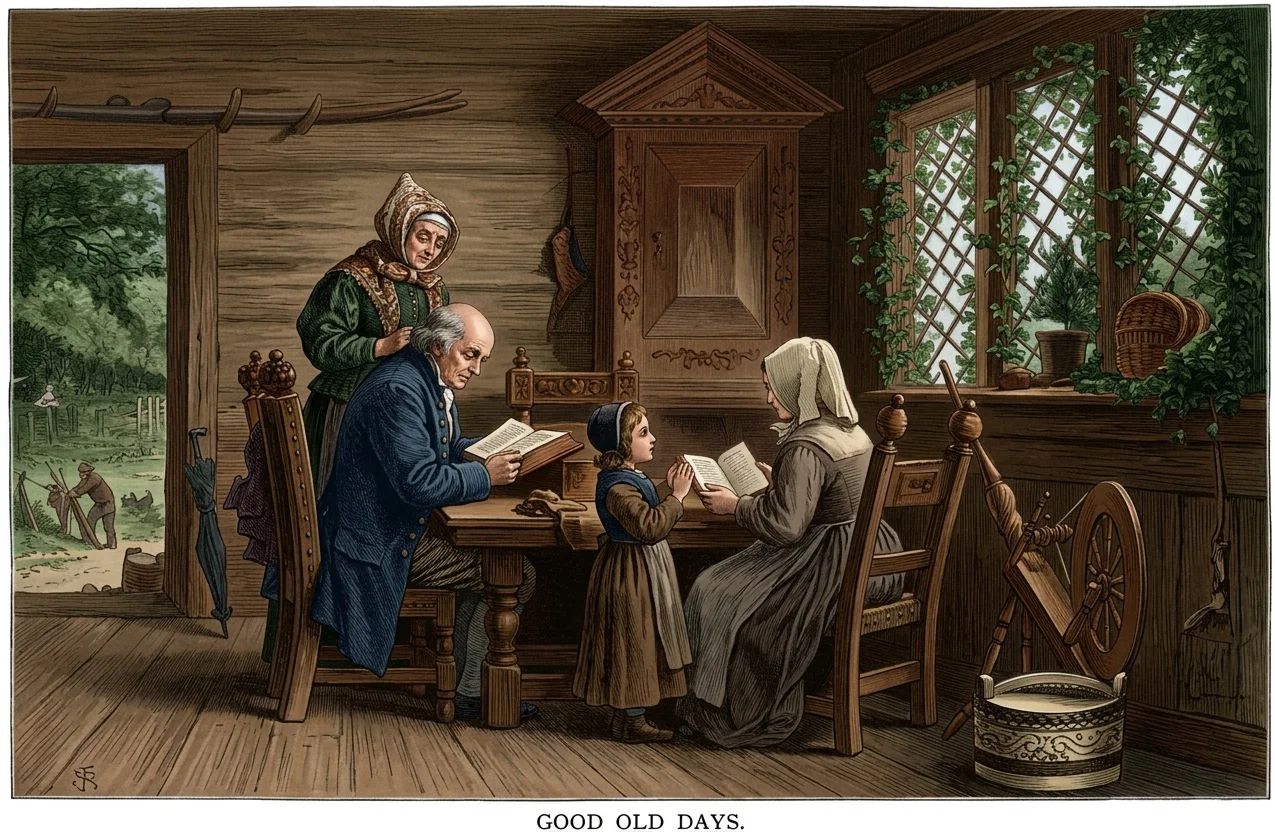
GOOD OLD DAYS.
TRAVEL in those days was an exceedingly tardy process compared with the speed with which we move through space at the present time. The boat and sailing vessel served fairly well for water travel; but on land, travelers were obliged to make their way on foot or horseback. Wheeled vehicles were little used, and the condition of the roads did not invite their rapid increase. It took three days to make a journey by vessel from New York to Philadelphia, if the wind was fair. To traverse the ninety miles overland between these two cities consumed as much time. A wagon made the trip twice a week. In 1766 stages were put on which covered this distance in the unprecedented time of two days. Their remarkable speed gained them the name of "flying machines." To-day this distance is made in two hours, and inventors are promising us still greater speed. In Pennsylvania great wagons, known as Conestoga wagons, and drawn by six or eight horses, hauled the produce of the interior to Philadelphia. At a later date it is said that there were more than ten thousand wagons used in the trade with Philadelphia.
The postal system was necessarily very tardy. Benjamin Franklin, when appointed postmaster-general, made a tour of the country in his chaise to perfect the system. It took him five months to complete the journey, but the same route could now be covered in five days. In 1672 a mail route was established between New York and Boston, the round trip being made once a month. As late as 1790 there were only five mails a week between New York and Philadelphia, and a letter was two days on the journey. Between New York and Boston mails were sent three times a week in summer and twice in winter. The mails were usually carried on horseback, a saddle-bag being sufficient to carry the small number of letters and papers sent. Even after 1789, it cost 8 cents to carry a letter 40 miles, 10 cents for 90 miles, and 25 cents for 500 miles. At that time there were 75 post-offices in the country, and 1,875 miles of post routes. There are now over 400,000 miles.
The lack of facilities for travel was paralleled by other deficiencies in colonial life. The newspaper, to us one of the first necessities of existence, was almost unknown to our forefathers. In 1750 there were only seven newspapers in the colonies. These were weeklies, the whole contents of which would not cover a single page of one of our modern sheets. And their circulation was correspondingly small. The first daily newspaper, the American Daily Advertiser, of Philadelphia, was issued in 1784. Books were as rare as newspapers. There were few American authors, and the works of these were principally upon theology. Afterwards, during the Revolutionary period, works and9pamphlets upon political subjects came into vogue. Imaginative writings were almost unknown. The only writer upon general subjects whose works are still read, was Dr. Franklin. His "Poor Richard's Almanac," with its pithy sayings and bits of homely wit and wisdom, was one of the favorite works of colonial days, and has stuff in it still worthy of perusal in this book-deluged age. Libraries had been founded in the large cities, but they were as yet far from rich in books. In truth, so far as reading matter is concerned, the life of our forefathers was as barren as in various other directions. A new book now often scarcely serves for a day's reading. It there often had to serve for a year.
The laws in colonial times were very severe. At one time in New England there were twelve crimes for which the penalty was death. In Virginia there were seventeen. Minor offenses were punished in a severe and often brutal manner. The whipping post was in frequent requisition. The stocks and pillory were employed as ordinary punishments. In the former the feet and sometimes the hands also, of the offender, were confined in holes in a sliding frame. In the latter his head and hands were similarly confined. While thus exposed to public derision, it was considered fair sport for the brutal public to pelt the helpless delinquent with mud or rotten eggs, or even with harder and more hurtful missiles. Imprisonment for debt was of every-day occurrence. The poor debtor, who perhaps had just recovered from a long illness, might be thrust in prison for the debts incurred during his sickness, and kept there among the vilest malefactors. The secrecy with which punishment is now inflicted, was then preceded by the utmost publicity. The criminal condemned to death was paraded through the streets as a public spectacle, and then hanged before a dense throng of curious spectators, who flocked to an execution as one of the choice shows of the time.
Among the prominent customs of colonial times, we can not omit that of hard drinking. Drunkenness was so common as scarcely to be noticed, wine and brandy being drunk profusely at genteel tables, while with the common people rum took its place. At every social gathering spirits formed a common beverage, and there could not be a house raising or harvesting without a heavy jug of strong liquor to comfort the laborers. Hard cider was a common drink in the eastern colonies. In the middle and southern colonies, peach brandy was abundantly consumed. In every house of any pretensions the decanter of wine or spirits was a part of the furniture of the sideboard. The jug of rum took its place in humbler mansions. Everybody drank, from laborer to minister, and, to be intoxicated in genteel society, was so common as to excite no comment. To-day, in the best circles, such a habit would lead to social ostracism; then it was viewed as a permissible weakness.
In old colony days men worked hard to produce results far below those now achieved by the same labor. Agriculture was the principal pursuit, manufacture being strangely opposed by the English Government. But the tillage of the field was performed with very rude and imperfect tools compared with those now employed. The plow in use was heavy and clumsy, being made of wood, with thin plates of iron nailed on to form the mold-board. These strips of iron were often obtained by straightening old horseshoes. The grass was cut with a scythe, the grain with a sickle. The threshing was done on the barn floor with a flail, or, in a more primitive period, the grain was trodden out by cattle. Labor-saving agricultural tools and machines were absolutely unknown.
What crude manufactures the country then possessed were mainly the result of household labor. Hats, shoes, clothes, and harness were made at home. Nails were hammered out on a rude anvil in the winter months. Every house had its spinning-wheel, and the loom was a common article of furniture. On these, flax and wool produced on the farm were carded, spun, and woven into the "homespun" cloth, from which the clothing of the day was largely made. While the men were toiling in field and barn, the women were employing the hours that could be spared from household duties in labors of this kind. Leisure from work was almost unknown in the farmhouse, and few hours in the week could be given to entertainment or mental cultivation.
Mental cultivation was, however, not quite neglected, and the colonies had schools, and from the start it was maintained in New England that it was the duty of the state to educate its children. But the schools were few and poor, the text-books crude and imperfect, and the education to be obtained very narrow. Boys were taught to read, write, and "cast accounts." Girls were taught even less. Many were not educated at all, and to read and write were far from universal accomplishments.
Writing-books were usually home-made from foolscap, and ruled by the pupil himself. He also had to whittle out his own slate pencil, while the making of quill pens took up no small part of the teacher's time. Another large fraction was occupied in the use of the switch, then deemed an indispensable aid to education.
This brief epitome of colonial conditions will serve in a measure to show how our forefathers lived in the days before the railroad and labor-saving machinery. It is, indeed, almost impossible to put ourselves in their place, and conceive what a slow and dull process life must have been with none of those conveniences which seem almost a part of the constitution of the universe to us.
How to Breathe
By E. H. Matthewson, M. D.
STEPS TO HEALTH. NO. 3.
How to Breathe.
IF the blood does not freely circulate in all parts of the body we do not get the full benefit of the oxygen it contains. It is therefore necessary to breathe in a way that will stimulate the circulation of the blood. If the shoulders are thrown back, the chest forward, and we use the muscles of both the chest and abdomen, the full regular movements will aid the heart in forcing the blood to all parts.
If we find that we do not use the chest or abdomen sufficiently when we breathe, but are only taking shallow inspirations, it is our duty to make a constant effort to breathe as deeply as possible, always taking the erect position mentioned, and keep the practice up till it becomes natural to us.
One of the valuable results of a brisk walk on a cool winter's morning is the increased breathing which we are compelled to do. Cool bathing also stimulates breathing and10quickens the circulation, while overheated rooms would be detrimental to both.
Deep breathing greatly stimulates the circulation, besides providing us with a much larger quantity of pure air; and if our breathing be shallow, the circulation must of course be feeble, and the poison which would otherwise be thrown out, would be carried again to all parts of the body, and we would be doubly poisoned.
It is the custom in Chili to have no openings in the room for either the escape of smoke, impure air, etc., or for the admission of pure air, with the exception of the kitchen, and during the damp season they use burning charcoal, which renders the air unfit for use, and is a great cause of disease. Our rooms should admit of free circulation, that the air may be carried away after we have received its good quality and a new supply brought to us.
When we first enter a close room, we notice its offensive odor and its stagnating depressing effect; but after a time we become accustomed to it. If the room be warm, we soon feel sleepily and exhausted from the effect of the poison it contains. We can not always therefore depend on our feelings, but should see to it that the circulation is as free as possible.
The temperature of the room should also be looked after, as air above seventy degrees is weakening or debilitating to all parts of the body. We have found, therefore, that deep breathing of pure air, in free circulation and of proper temperature, is essential to our health and vigor.
Having the right quality and quantity of air, we will be somewhat stimulated by it; but the amount of food and air which is carried to all parts of the body, will depend largely on the strength of the circulation. This will be considered next week.
"TRY IT ON ME."
WE were in the midst of an interesting series of meetings in New York. Among those attending from no promising motives was Mr. Olin, a lawyer of marked ability and influence in the town.
One evening at the close of the sermon, when an opportunity was given for remarks, Mr. Olin rose, and in a bold and defiant tone, said:—
"Mr. Earle, I have heard you speak repeatedly in these meetings of the 'power of prayer,' and I don't believe a word of it; but if you want to try a hard case, take me."
I said, "Mr. Olin, if you will come to the front seat, we will pray for you now."
He replied, "I will do nothing of the kind; but if you have 'power in prayer,' try it on me."
Before closing the meeting I requested all who were willing, to go to their closets at a given hour, and pray earnestly for Mr. Olin; and I requested him to remember at that hour that we were praying for him.
The second or third evening after this Mr. Olin rose in one meeting, and urged us to pray for him. I asked him if he would come forward and let us pray for him. He said:—
"Yes, anywhere, if God will only have mercy on so great a sinner."
In a few days he was a rejoicing Christian, and soon after sold his law books, and became a preacher of the Gospel. He is now a presiding elder in the Methodist Church.—Incidentals.
Walking With God
"The man who walks with God can not keep step with the devil."
A NOVEMBER SCENE.
By Rosalind Young
BY ROSALIND YOUNG.
OVER the mountains a vail is spread,
A vail of misty blue,
And rain-clouds hang darkly overhead,
Hiding the sun from view.
A frosty sharpness is in the air,
Its chilling effect is seen
On many a tree that now is bare,
Tho once they were robed in green.
The birds are calling from tree to tree,
Warbling their cheery song;
But Winter will hush the rich melody,
And his coming will be ere long.
The fields that of late were with verdure green,
Now are empty, and brown and bare;
A hush as of grief hangs over the scene,
And stillness reigns everywhere.
But behind the dark clouds over the hill,
And beyond the misty blue,
The sun in his glory is shining still,
And his beams will one day break through.
And though stern Winter, the fields and trees
Will bind as with iron chain,
Yet not for long will be days like these,
For Summer will come again.
The earth will wake at the call of Spring,
The flowing streams will obey,
The birds in the tree-tops glad will sing,
The gardens with flowers be gay.
And thus sometimes in this life of ours,
Dark clouds overshadow our way,
And hope, with her cheering, enlivening powers,
Gives scarcely a glimmering ray.
Our sun is behind a dark cloud drawn,
Its light and its warmth depart,
Our hopes are withered, our joys are gone,
And a chill rests on the heart.
We droop, and oft in our sadness pine,
Our senses are numb with pain,
But just one touch of the Hand Divine,
Awakens our joys again.
St. Helena, Cal.
AN ANSWER TO PRAYER.
IGNAUS, an Arctic mail-carrier, whose six dogs died in one night from some poison in the frozen fish which was part of the supplies, was a hundred miles from a trading post and the cold 40 degrees below zero.
Broken-hearted after his dogs, the poor fellow would have given up and died had he not a wife and little babe awaiting him at the end of his route, but even the thought of those who were dear to him failed sometimes to keep his mind from wandering.
Before, he had the variation of talking to the dogs, who seemed almost human. Now, no sound except the crackling of the ice, no sight but snow, snow, snow, in great stretches of dazzling whiteness; its crisp crust, many feet thick, seemed as solid as a glacier.
At last the poor fellow felt that he could not bear it any longer. He had lightened the load on his sledge, and drew it after him by day, and slept in his fur bag on it at night.
He cried to the Great Father in agony of pleading, "O, leave me not alone so long; send some one, O, send some one, or I die!"
Once more at night he lay down in his fur bag and slept. But what was this pushing him over? Ignaus opened his eyes, and there stood over him a great bear. Evidently the brute was curious; he had never seen anything like this before. Strangely enough Ignaus was not frightened. He rose and fed the bear with frozen fish from the sledge, the creature acted like a great wild dog, and when satisfied lay down on his side while Ignaus satisfied his own hunger; then when he started on his walk again the bear trotted beside him.
Surely the Great Father sent him, thought Ignaus. At night again he fed the bear, and the two lay down again side by side, the warmth of the shaggy brute putting new life into Ignaus.
When within five miles of the trading post, suddenly the bear turned toward a great forest in the distance and Ignaus saw him no more.
When he reached the post, the president, when he heard how Ignaus had come across the vast solitudes of ice and snow without his dogs, said, "He is the bravest man of the north; surely the good God sent the bear to save his reason."—Home Guard.
OVERCOMING CIRCUMSTANCES.
THE secret of a happy, useful life is to accept cheerfully what may seem to be adverse circumstances, and then set resolutely to work to get the better of them. The following incident carries its own lesson:—
A physician whose life had been made beautiful with good deeds and a high faith, said once:—
"If I have been happy or useful in the world, it is due largely to the effect on my mind of a chance question from a stranger.
"I was a poor boy and a cripple. One day, standing on a ball field, I was watching the other boys with bitterness and envy. They were strong, healthy, well clothed and well fed. Some of the mothers of the players sat in carriages, waiting to see the game, intending to drive their sons home, when it was over. I looked at them with an angry scowl, sick at heart. A young man standing beside me, and seeing, no doubt, the discontent in my face, touched my arm.
'Say, bub! You wish you were in the place of those boys, eh?' he said.
'Yes, I do!' I broke out. 'Why should they have everything, and I nothing?'
'He nodded gravely. 'I reckon God gave them money and education and health to help them to be of some account in the world. Did it ever strike you that he gave you your lame legs for the same reason—to make a man of you?'
'I did not answer, and he turned away. I never saw him again. But I couldn't get his words out of my mind. My crippled leg—God's gift? To teach me patience and strength?
'I did not believe it. But I was a thoughtful boy, taught to reverence God, and the more I thought of it the more it seemed to me the stranger had told the truth. I did believe that God pitied me—and at last came to feel that it would please him if I rose above my deformity, and by it were made more manly and true. It worked on my temper, my thoughts, and at last upon my actions. Gradually it influenced my whole life. Whatever came to me I looked upon as God's gift for some especial purpose. If it were a difficulty, he gave it for me to struggle with, to strengthen my mind and faith; if it were a helpless invalid cast on me for support, or even a beggar, I thought—God has given me another chance to do his work.
"The idea has sweetened and helped all of my life. I wish I could find the man who gave me this password which has lifted my life to a higher plane and has led me constantly to the Source of all good."—Selected.
WITH HIM.
By Frances Ridley Havergal
Just to leave in His dear hand
Little things,
All we can not understand,
All that stings!
Just to let Him take the care,
Sorely pressing,
Finding all we let Him bear,
Changed to blessing.
This is all, and yet the way
Marked by Him who loves thee best!
Secret of a happy man,
Secret of His promised rest!
—F. R. Havergal.
A REMARKABLE CITY.
CALUMET, Mich., according to a writer in the Pulpit of the Cross, is a place of 25,000 people. It is situated on the top of a bleak plateau, 600 feet above Lake Superior. As early as the 19th of October (the date of writing) a snow-storm was in progress, and to all appearance winter had set in after the most approved fashion. The sole industry of the place is mining. Here are located the famous Calumet and Hecla mines, the largest copper mines in the world. Some of the shafts sink to a distance of a mile underground and it is very wierd to see a "skip" load of miners shoot down into the bowels of the earth and to watch the fading glimmer of their lamps until a bend in the shaft loses them to sight. The machinery of the company has cost millions of dollars, and all of it is built on a gigantic scale. The output from the mines here controls the copper market of the world.
To the credit of the Calumet and Hecla Mining Co. be it said that they never have had a strike, and their employees are probably the best paid and housed class of miners in the United States. Furthermore, to the credit of the miners be it said that they are very religious and well behaved. Calumet boasts, it is said, of only one policeman and a constable, and neither of them is overworked.
A TINY STEAM ENGINE.
It was more than twenty years ago—in 1874—that an ingenious mechanic, D. A. A. Buck, of Worcester, Mass., made his marvelous miniature steam engine. This liliputian wonder in the line of mechanics was so small, says the St. Louis Republic, that its boiler, pumps, governors and all other necessary attachments, occupied a space only seven-sixteenths (7-16) of an inch in diameter, or less than the area of an old-fashioned silver three-cent piece. This little engine was only five-eighths (5/8) of an inch in height, yet it contained 148 distinct parts, nearly all of which were silver and gold. It was held together by 52 screws, the smallest of these being but one one-hundredth of an inch in length. This miniature engine, small as it was, had all the valves, gearing, etc., that are to be found on the ordinary horizontal engine. Three drops of water were sufficient to fill the boiler to overflowing! The entire engine weighed but fifteen grains when rid of its base plate. The diameter of the cylinder was but one-sixteenth of an inch; length of stroke three fifty-seconds of an inch.
Several years ago—in 1868—a mechanic at Hull, England, constructed an engine that weighed three and one-half ounces, and which was at that time thought to be a mechanical marvel. In 1876 Levi Taylor, of Indianola, Iowa, constructed an engine which weighed but twelve grains.—Selected.
A BANK OF THE YEAR 600 B. C.
THE very earliest banking firm of which there is any record was that of Egibi & Son, an institution which carried on advance, exchange and general financial business in Babylon in the year 600 B.C. Knowledge of this firm is obtained from certain records on clay tablets which have been found in recent excavations made by a party of English and French archæologists near the site of the ancient city above mentioned. Bills of credit, drafts, etc., in the form of small burnt clay tablets, each bearing the characteristic signature of Egibi & Son, have been found in many other parts of Asia Minor, and it is believed that close study will prove that some of the clay tablets found in tombs and pyramids in Egypt will finally prove to be Egibi "negotiable notes."—Selected.
GOSPEL WORK IN PERU.
THE Missionary Review of the World for November, publishes the following in regard to Gospel work in Peru, from Mr. A. R. Stark:—
"During the past twelve months Peru has been traversed by missionaries and colporteurs, north, east, and south, from its center, Lima; and we find that the people are docile, and not only gladly listen to the Gospel, but many will spend their last cent in purchasing a Bible. It is soul-stirring to see many of these poor people living in miserable bamboo-cane huts, searching every corner of their rude dwellings to find a few cents with which they may obtain at least a portion of the Scriptures. There are, however, discouragements and difficulties to meet. Through the influence of priestcraft four men have been expelled from different towns, and another has had his Bibles burnt. Yet we are convinced that the time is opportune for evangelizing. The great difficulties we encounter in the evangelization of Peru lie in the opposition from dominant priestcraft; these recent events show that priestcraft is prepared to make a desperate struggle to maintain its dominancy.
"Perhaps few fully understand the position of the missionary in Peru. The national constitution in its Article IV. declares that 'the nation professes the Roman Catholic religion, the state protects it, and does not permit the public exercise of any other.' There is, however, a clause under Article IV. which defines public worship and opens a way for the private exercise of it. True, it is ambiguous, but that there is no law against propaganda or private worship was made evident in the case of Rev. F. Penzotti, of the American Bible Society, who was tried for the supposed illegality of worship and propaganda. The trial was carried through all the grades of tribunals, including the Supreme Court of the nation, no law being found under which he could be condemned. This took place in 1890-91. That case settled the fact that there was no law against propaganda or private worship, and now that the Supreme Government of Peru has offered to indemnify us for the outrage we suffered in Cuzco, it is made more evident.
"It has been interesting to notice the effect of the ejection of the missionaries from the ancient capital of the Incas. It has stirred up the public mind on religious subjects more than any other event since the imprisonment of Señor Penzotti; it has opened the eyes of many, as never before, to the abuses of Romanism, and it has led some representatives of the lower house to consider the advisability of reforming the constitution in favor of liberty of worship. . . . If the fires of Smithfield led to the emancipation of England from papal sway, what shall we say of the eight months' imprisonment of Señor Penzotti in Casa Mata, Callao; the riots in Cocachacra, when two colporteurs were on the eve of being stoned to death; the burning of the Bibles, and narrow escape of the men from Ayacucho; the ejection of the first two Protestant missionaries from Cuzco; the banishment of a colporteur from Sicuani; and, lastly, the burning of Bibles and expulsion of colporteurs from San Miguel? One by one these steps are destined to break the power of religious tyranny, hasten the downfall of corrupted priestcraft, and are preparing the way for the spread of the glorious Gospel.
"Perplexing as the outlook may be, a foundation for the Gospel, deep and solid, is being laid, with such a strength that no power shall be able to overthrow. The living, transforming word of God is being scattered in this idolatrous land. In many homes it is being read, and may we not believe that it will make many wise unto salvation? The more we comprehend the situation the more profoundly are we convinced that Peru's deepest need is not more education or civilization, but living witnesses who will carry the living word of God into the homes and hearts of the people. Nothing can take its place in uprooting the superstition, the cold indifference, and the widespread infidelity, and in introducing righteousness and peace and justice. If Paul's heart was stirred by seeing the idolatry of Athens, should not ours be stirred by the fact that the whole country, yea, the whole continent, is 'wholly given to idolatry'?"
THE PREACHING OF BETSEY LEE.
BETSEY LEE was poor and old;
Through summer's heat and winter's cold,
Like a policeman on his beat,
She daily trod the crowded street.
Sometimes she offered homemade wares
To travelers on the thoroughfares;
Sometimes she asked in stately halls,
Where priceless paintings decked the walls,
For honest work, whereby to earn
A loaf of bread; or she would turn
A willing hand to aid distress;
Thus many lives did Betsey bless.
Year after year 'twas much the same,
Except that she grew deaf and lame;
Yet always honest, faithful, true,
The dwellers on the street all knew
That Betsey Lee would sooner die
Than beg or steal or tell a lie!
Full many gave her kindly word,
Which, I am sure, in heaven was heard;
And many a one who passed her by
Wondered that she should never sigh,
While every day the rich and great
Lamented o'er their bitter fate.
They wondered, too, why Betsey Lee
In everything some good could see.
Some thought it strange that Betsey took
Her chief delight in God's blest book;
Why she on Sabbaths always went
To church, and there, with heart content,
Communed with God; nor had a care
That others passed her with a stare
Because her clothes were not in style.
She heeded not their sneering smile.
I'll tell you why: Long years before,
Down to the river's winding shore,
Where wretched hovels filled the square,
And oaths and curses rent the air,
A missionary came one day,
To sow some seed beside the way.
A thoughtless crowd it may have been,
Of rogues and roughs and river men—
About the same as by the sea
Our Saviour taught in Galilee.
I know not whether many heard,
And learned, that day, to love God's word;
But this is certain; from that hour
Poor Betsey knew the Spirit's power;
From that day lived the Gospel plan
Of love to God and love to man.
Now Betsey wasn't learned at all;
But she could spell out, on the wall,
The golden texts the teachers wrote,
And all those texts could rightly quote;
Tho when the words were hard and long,
She sometimes got the meaning wrong;
And Betsey's heart was warmed and cheered
When short and easy words appeared.
The text she loved the best of all
Was very short—the words were small—
'Twas this: "Go ye and preach." Said Betsey Lee,
"That's plain and simple, just for me."
So day by day, as Betsey went
About her work, she preached content—
Preached faithfulness and love and hope—
Her every act for Jesus spoke.
She didn't wait for sunny days;
'Mid storm and cloud she sang God's praise.
Her life the sermon was she preached,
And many a heart her Gospel reached.
If poor old Betsey Lee could tell
The story of the cross so well,
With scarce one talent in her power,
With poverty her only dower—
Pray what will Jesus say, when we
Before our Judge meet Betsey Lee?
—Gospel in All Lands.
The Christian and Ripening Corn
"THE Christian is like the ripening corn; the riper he grows the more lowly he bends."
Mission Work on the Island of Nias
REV. EDWARD KREILE, writing of the mission of the Rhenish Society on the island of Nias, a little westward of Sumatra, describes the situation as follows:—
"Notwithstanding the comparatively small size of Nias, it is an important mission field, not only on account of its dense population, but also because the Niassans extend into some of the other islands. Nias promises more and more to become a second Sumatra, and is at present one of the most hopeful territories of the Rhenish missions, having only become so, however, within a very few years. Inspector Schreiber called to mind at the last Barmen anniversary, that when he was still a missionary in Sumatra, a government officer very friendly to missions argued with him at length that the Barmen Board could do nothing more to the purpose than to recall the missionaries from Nias; and, in fact, Nias was formally regarded as one of the most difficult and hopeless fields. Even in 1892, when the mission completed its first quarter of a century, there was little to be heard except admissions of the small results.
"Then it was as if, with the jubilee year, a wholly new spirit from above had begun to breathe over the valley full of dry bones. The number of the Christians has, in the last five years, risen from 706 to 1,813—that is, has almost tripled—and even as we are writing thus, letters come in announcing numerous baptisms of heathen at several stations. Whole heathen villages, which had long closed themselves against all influences of good, now declare that they wish to cast away their idols. It is said that pits are dug in the middle of the village street destined to receive the ancestral gods. This takes place not only in the lately-opened west, in the region of the stations of Fadow and Lahagu, but also in the elder eastern stations, where, for instance, Missionary Cramer, working outward from Gunong Sitoli, can draw one heathen village after another into the net of his activity; where Missionary Sundermann is on the point of establishing a new station, some two leagues to the west of Dahana; where, in particular, Missionary Thomas, working from Gumbuhumene as a center, has won almost the whole region around for the Gospel.
"In the very promising west, where, we may remark by the way, the mission has also contributed largely to secure to the greatly tormented land outward peace and security against its enemies, especially from the south, the attempts to found a third and a fourth station have thus far failed when near accomplishment, among other reasons because no missionary forces were to be had. Here, also, grave and momentous problems await their solution, especially as between the more thinly peopled north and the uncommon density of the population in the south of the island, where a solitary missionary grave reminds one of a fruitless attempt made years ago, and thereby of a painful tragedy in the Nias mission. Thus Nias, in the coming years will call for a very peculiar attention, and therewith also for a special enlargement of the missionary force."