Notes and clippings from the daily and weekly press
—The commercial fleet of Hamburg consists of 750 steamships and 640 sailing vessels, a total tonnage of 1,700,000. The crews number 131,000 men, 30,000 more than ten years ago.
—Prof. Willis I. Moore, who has for many years been chief of the government Weather Bureau, was summarily dismissed from office recently by President Wilson on charges of gross irregularities and misuse of power.
—A monumental gateway and doors in artistic wrought iron for the Carnegie Palace of Peace at The Hague have been contributed by Germany, and are now on exhibition at Berlin. The two large portals contain designs symbolic of peace.
—Only about one per cent of the total wealth of the United States is invested in church property, but, according to Dr. Booker Washington, over eight per cent of the wealth of the Negroes of the country is invested in this way. They have 35,000 churches, with 3,700,000 members.
—According to the officers of the Public Health Service at Washington, the ordinary stable-fly has been conclusively identified as the carrier of the dread infantile paralysis. A report just issued gives the results of experiments carried on with animals inoculated with the virus of the disease.
—Serious efforts are being made to establish a Jewish university in Jerusalem. As the vast majority of Russian Jewish students are not admitted to the Russian universities, and there is a feeling against them in other countries also, this move is strongly urged by leading Jews of the Continent.
—Mississippi has passed a law intended to do away with the tipping nuisance. The law imposes a fine of $100 on owners of hotels or restaurants who permit their employees to take tips. It also provides for a fine of $50 for the waiter who takes the tip, and $50 for the person who gives it.
—One fish in New Zealand has had the honor of having a law passed by the legislature for his especial protection. It is the big dolphin called Pelorus Jack. He is fifteen feet long, and is of a light-bluish color, whereas most dolphins are black. For thirty years he has accompanied every steamship through the narrow and dangerous French Pass in Pelorus Sound.
—Excavations carried on in the peninsula south of San Francisco by Prof. Harold Heath, of the zoological department of Stanford University, indicate that this part of the continent was once inhabited by a race of giants. Skeletons of men of unusual height have been unearthed. A prehistoric village covering nearly two acres has been the scene of these investigations, yielding stone hammers, bone awls, and ornaments which reveal a considerable advance in artisanship and civilization.
—Clayton Cooper, in a recently published work, gives the college statistics he has gathered in this country. Sixty per cent of the students are church-members; one in every seven attends the Bible classes of the Y. M. C. A. The others, it is supposed, go to the Bible classes of their respective churches. The students gave to foreign missions last year $146,000. Six hundred graduates went as foreign missionaries in 1910.
—A new station which is ready for the reception of immigrants has been dedicated at New Orleans, La. In its dimensions and also in the completeness of its equipment it is second only to the immigrants’ station at Ellis Island. The government has spared no expense in the erection of this group of magnificent buildings. The dedication was attended by prominent officials from Washington, by Governor Hall of Louisiana, and by the immigration and agricultural commissioners of several Southern States.
—New York has just enacted a law providing for State aid to students. Five State scholarships in each legislative district in the State will be established, and each holder of a scholarship will receive from the State $100 a year for four years, to be applied toward the payment of the tuition fee of the college attended, which must be within the State. The scholarships are to be awarded according to the school standing of the students. As there are 150 assembly districts, this will give 750 scholarships each year, so that there will be eventually 3,000 students constantly in receipt of aid from the State.
—Chinese scholars, after making a study of all the alphabets of the world with reference to their adaptability to the language-sounds of their people, have formulated a new alphabet of forty-two characters. The new alphabet is unusually strong in vowels, apparently having one letter for each vowel sound, and so simplifying pronunciation. Five vowels have been taken from the Latin, four from the Greek, four from the Russian, one from the Chinese, and two are elongated signs, and seven are reversed ideographs. Fourteen consonants are Latin, three Russian, and two Greek. With these it is declared to be possible to write all the words used in any part of China. An effort is to be made at once to introduce the new alphabet into official circles.
—Working under the Mann act, the federal authorities are expending every energy to prevent interstate traffic in women for immoral purposes. Already a large number of persons have been convicted under this statute. A new move has been made by the authorities in order to stamp out this form of vice, in ordering a card-index classification of immoral women. Officials are at work on this index in the large centers of the country. When completed, it will give full information concerning each inmate in the levee districts. The records will be kept in local offices, and also at Washington. With this in hand, the authorities will have evidence upon which to base prosecutions against any of these women who are shipped from one State to another.
—“Swan Girl,” a squaw, planted an orchard of a dozen apple-trees in the Yakima Valley fifty-one years ago. For forty-nine years under her cultivation the trees have borne fruit, and a new, unknown variety of apple has been produced. Her orchard is said to be the oldest with a continuous bearing record.
—According to the Philadelphia mayor’s vice commission, which has been investigating social conditions in that city, there is spent annually in Philadelphia alone over six million dollars for vice. And that city is no exception to the rule. Similar conditions may be found in every large city in the land. It is but one more indication of the times in which we are living, and of the fulfilment of our Saviour’s prophecy that the last days should be like unto the days of Noah and the days of Lot.
—The fire tax in the United States, according to recent statistics, is about three dollars per capita of the population. Every year $250,000,000 in property is destroyed by fire in this country. This sum is sufficient to build a Panama Canal every two years, to give 250,000 young men a business start of $1,000 each, to pay the national debt in four years, to support the United States Army and Navy for a year, and to pay the entire pension list. If all the buildings burned in one year in the United States were placed close together on both sides of a street, they would reach from Chicago to New York City. It is estimated that at least seventy-five per cent of these fires are preventable.
—“The British post-office has finally decided not to admit claims to compensation on account of registered mail lost on the ‘Titanic.’ Under an international convention an indemnity of fifty francs (ten dollars) is payable to the owner of any registered letter or package lost in transit to any foreign country through negligence on the part of the mail service or transportation line; and if negligence had been admitted in case of the ‘Titanic,’ the amount payable as compensation would have been something like $3,960,000, which would have fallen eventually on the steamship company. But the post-office has somewhat tardily taken the ground that the loss was ‘due to causes beyond control,’ and is now sending out notices to claimants to that effect.”
—Following the example of the United States, the commonwealth of Australia, made up of seven states, is to have a capital city in a federal district laid out by order of the nation. Canberra is to be the name of the new city, which is to take the place of Melbourne, the temporary capital. The Yass-Canberra district, as that part of the country has been known, was taken over by the general government in 1911. It is on the Molonglo River, some distance from the coast. For the laying out of Washington, Pierre Charles L’Enfant, a French officer who had come to this country with Lafayette, was selected. And now, after one hundred years, it is to the United States that Australia turns for the plans for Canberra, the design of Walter Hurley Griffin, of Chicago, being selected after an elaborate competition. His scheme is, generally speaking, like that of Washington, with important modifications.
Camp-Meetings for 1913
ATLANTIC UNION CONFERENCE
New York, Rome ............ June 17-20
Massachusetts, Lowell ............ June 26 to July 6
CANADIAN UNION CONFERENCE
Quebec, Ayer's Cliff ............ June 12-22
COLUMBIA UNION CONFERENCE
Eastern Pennsylvania, Allentown (Emmanuel Grove) ............ June 19-29
NORTH PACIFIC UNION CONFERENCE
Western Oregon, Portland ............ June 19-29
NORTHERN UNION CONFERENCE
Minnesota, St. Paul ............ June 17-23
North Dakota, Bismarck ............ June 23-30
South Dakota, Sioux Falls ............ June 23-30
SOUTHEASTERN UNION CONFERENCE
Georgia ............ July 31 to Aug. 10
South Carolina ............ Aug. 14-24
North Carolina ............ Aug. 21-31
Cumberland ............ Sept. 4-14
Florida ............ Oct. 2-12
SOUTHWESTERN UNION CONFERENCE
South Texas ............ June 26 to July 6
North Texas ............ July 10-20
Arkansas ............ July 17-27
West Texas ............ July 31 to Aug. 10
New Mexico ............ Aug. 7-17
Oklahoma ............ Aug. 21-31
Annual Meeting of the Michigan Sanitarium and Benevolent Association
By E. L. EGGLESTON
THE sixteenth annual meeting of the Michigan Sanitarium and Benevolent Association for the year 1913 will be held in the chapel of the Battle Creek Sanitarium, on North Washington Avenue, Battle Creek, Mich., Thursday, June 26, 1913, at 3 P. M., standard time, for the election of trustees and the transaction of such other business as may properly come before the meeting.
By order of the board of trustees.
E. L. EGGLESTON, Acting Secretary.
New York Conference Association
By W. H. HOLDEN; F. N. JOHNSON
NOTICE is hereby given that the New York Conference Association of Seventh-day Adventists (incorporated) is called to convene in Rome, N. Y., on the Seventh-day Adventist camp-ground, at 9 A. M., June 23, 1913, for the purpose of electing officers and transacting other necessary business.
W. H. HOLDEN, President;
F. N. JOHNSON, Secretary.
New York Conference
By W. H. Holden; F. N. Johnson
NOTICE is hereby given that the next annual session of the New York Conference of Seventh-day Adventists will be held in connection with the camp-meeting in Rome, N. Y., June 17-29, 1913, for the purpose of electing officers and transacting necessary business. The first meeting will be held at 7:30 P. M., June 17, and the first two days will be devoted to transacting conference business exclusively. Every delegate should be present at the first meeting.
W. H. HOLDEN, President;
F. N. JOHNSON, Secretary.
Western Oregon Conference
By H. W. Cottrell; J. L. Kay
THE eleventh annual session of the Western Oregon Conference of Seventh-day Adventists is hereby called to be held at Portland, Oregon, in connection with the annual camp-meeting, June 19-29, 1913, to enjoy a spiritual feast and to transact such business as may be the pleasure of the delegates. Conference will organize for work Friday, the twenty-seventh, at 9 A. M. Each church is entitled to one delegate for the organization and to an additional one for every fifteen members.
H. W. COTTRELL, President;
J. L. KAY, Secretary.
Pennsylvania Sanitarium and Benevolent Association
By A. R. SANDBORN; S. D. HARTWELL
THE annual meeting of the Pennsylvania Sanitarium and Benevolent Association will be held in connection with the Eastern Pennsylvania Conference and camp-meeting at Emmanuel Grove, near Allentown, Pa., June 19-29, 1913, the first meeting to be held on Monday, June 23, at 2 P. M., for the election of trustees, and the transaction of any other business that should properly come before the meeting.
A. R. SANDBORN, President;
S. D. HARTWELL, Secretary.
Western Oregon Conference Association
By H. W. Cottrell; C. E. Olcott
The Western Oregon Conference Association of Seventh-day Adventists (a legal corporation) is hereby called to meet on the camp-ground in Portland, Oregon, Thursday, June 26, 1913, at 10 A. M., for the purpose of electing a board of five trustees, whose offices shall continue for one year, or until their successors are elected and are qualified, and of transacting such other business as the delegates may desire. The accredited delegates to the religious body are the delegates to the association.
By order of the board of trustees.
H. W. Cottrell, President;
C. E. Olcott, Secretary.
Pennsylvania Tract and Missionary Society
By H. M. J. RICHARDS; S. D. HARTWELL
THE annual meeting of the Pennsylvania Tract and Missionary Society will be held in connection with the Eastern Pennsylvania Conference of Seventh-day Adventists, on the Emmanuel Grove camp-grounds near Allentown, Pa., June 19-29. The first meeting to be held on Monday, June 23, 1913, at 9 A. M. This meeting will be for the election of constituent members for the ensuing year, and for the transaction of any other business that may come before the meeting.
H. M. J. RICHARDS, President;
S. D. HARTWELL, Secretary.
The Minnesota Conference Association
By G. W. WELLS; H. R. GAY
THE Minnesota Conference Association of Seventh-day Adventists will meet on the camp-ground in St. Paul, Minn., at 9:30 A. M., Friday, June 20, 1913, for the purpose of electing officers for the ensuing year and of transacting such other business as may properly come before the delegates. The regularly accredited delegates to the conference are delegates to the association.
G. W. WELLS, President;
H. R. GAY, Secretary.
South Dakota Conference Association
By C. M. Babcock; J. G. Ortner
The constituency of the South Dakota Conference Association of Seventh-day Adventists will hold the first session of its annual meeting at Sioux Falls, S. Dak., at 11 A. M., June 24, for the purpose of electing its officers and transacting such other business as may come before the meeting. All regularly appointed delegates to the conference are delegates to the association.
C. M. Babcock, President;
J. G. Ortner, Secretary.
North Dakota Conference
By C. J. Buhalus; D. D. Kurtz
THE tenth annual session of the North Dakota Conference will convene in connection with the camp-meeting at Bismarck, N. Dak., June 23-30. The first meeting will convene Tuesday morning at ten o'clock.
As the announcement is already late, it will be necessary for our churches to elect their delegates at once. Delegates' credentials are sent to each church, and should be filled out after the election. If any church fails to get the credentials, it should not wait for them, but send the names of its delegates to D. D. Kurtz, Cathay, N. Dak.
Each church is entitled to one delegate for the organization, and to one additional delegate for each ten members. Every delegate should be at the first meeting of the conference.
C. J. BUHALUS, President;
D. D. KURTZ, Secretary.
Upper Columbia Mission Society
By P. A. HANSON; E. W. CATLIN
The fifteenth annual session of the Upper Columbia Mission Society of Seventh-day Adventists will be held in connection with the conference at Colfax, Wash., June 19–29, for the election of officers and transaction of such other business as may properly come before the society at this time. All regularly accredited delegates to the conference are delegates to this body. The first meeting will be held on June 24, at 10 A. M.
P. A. HANSON, President;
E. W. CATLIN, Secretary.
Southern Idaho Conference Association
By A. M. Dart; A. C. Bird
The regular annual session of the Southern Idaho Conference Association of Seventh-day Adventists will be held on the camp-ground at Boise, Idaho, for the purpose of electing the board of five trustees and transacting any other business pertaining to the association. The first meeting will be held at 10:30 A. M., July 11, 1913.
A. M. Dart, President;
A. C. Bird, Secretary.
Publications Wanted
THE following-named persons desire late, clean copies of our publications sent, post-paid, for missionary purposes:—
Leslie Littell, Putnam, Tex. REVIEW, Signs, Watchman, and tracts.
Miss Myrtle Lyons, 4028 Avenue P, Galveston, Tex. A continuous supply of papers and tracts for use in depot reading-racks and ship mission work.
Miss Bertha B. Friesen, Burrton, Kans., Box 325. Life and Health, Signs, Watchman, Temperance Instructor, and especially the Protestant Magazine.
Obituaries
By A. J. Clarke; T. Godfrey; W. W. Steward; Clifford A. Russell; C. L. Taylor; Daniel Nettleton; H. S. Prener; J. W. Boynton
KELLOGG.—Albert Kellogg was born in Flint, Mich., April 7, 1836, and died at Cedar Lake, Mich., March 20, 1913, aged 76 years, 11 months, and 13 days. He accepted present truth in 1853, and from that time until his death was a firm believer in the third angel’s message. He died in the hope of soon seeing his Lord.
A. J. CLARKE.
COLLETT.—Sarah Frances Collett, of Montesano, Wash., died April 17, 1913. She was born in Illinois, Feb. 15, 1850. In 1896 she heard and accepted the third angel’s message, and from that time until her death was a consistent Christian. Her faith in the soon coming of Jesus was unwavering. She is survived by her husband and two stepchildren.
T. GODFREY.
LATHAM.—Warren William Latham was born in Columbia County, Wisconsin, Oct. 14, 1900, and died at Milton, Oregon, March 29, 1913. Warren gave his heart to God and was baptized in October of 1912. He fell asleep peacefully in Jesus, and now awaits the call of the Life-giver. His parents and two sisters survive, but they sorrow not as those who have no hope.
W. W. STEWARD.
LANGDON.—Maryette, daughter of Robert P. and Caroline Thompson, was born in Warren County, Pennsylvania, May 2, 1842. During her early years the family moved to Michigan, living for some time at Berrien Springs. In 1856 she removed to Mendon, Mich., where two years later she was married to John B. Langdon. For forty-seven years the deceased lived upon the farm which by their united efforts was literally hewed out of the forest. One of their two children is left to mourn. Comforting words were spoken at the funeral service from 1 Thess. 4:16-18.
CLIFFORD A. RUSSELL.
STECK.—Julius H. Steck was born near Bellville, Tex., June 25, 1867, and died at Sanitarium, Cal., April 27, 1913. He was an ardent lover of present truth, and until the very last maintained a most intense devotion. The last four years of his life were spent in the St. Helena Sanitarium. His wife and three children, together with many friends, are left to mourn.
C. L. TAYLOR.
CARPENTER.—Emma Ridall Carpenter, wife of A. J. Carpenter, died at Shine, Wash., April 17, 1913. She was born at Wilkes-Barre, Pa., Oct. 16, 1844. Some fifteen years ago Brother and Sister Carpenter embraced present truth through reading our publications. The deceased was a patient sufferer for several months before her death, and fell asleep trusting in Jesus for resurrection and life eternal. She leaves a husband and two daughters. The writer spoke words of comfort from 1 Cor. 15:26.
DANIEL NETTLETON.
KELLER.—Robert Gabriel Keller was born Nov. 30, 1841, and died April 24, 1913, near Fort Worth, Tex. He leaves a devoted wife, one son, and two daughters to mourn their loss. Brother Keller was converted and united with the Seventh-day Adventist Church in 1885, and until the last was a faithful, devoted Christian. He fell asleep with full confidence of having a part in the first resurrection. The funeral service was conducted by the writer, assisted by Elder G. F. Watson.
H. S. PRENER.
WORTHEN.—Mary L. Boyd Worthen was born in Dorchester, N. H., Nov. 5, 1840, and died at her home in Lynden, Wash., May 3, 1913. She was married to Charles F. Worthen Oct. 12, 1859. To this union were born twelve children. Two sons and two daughters, with their aged father, survive. In early life the deceased gave her heart to God, and was baptized by Elder James White in 1857, uniting with the Seventh-day Adventist Church at Charleston, Vt. She faithfully observed the Sabbath of the Lord for about fifty-seven years. The family moved to Washington about eight years ago. Sister Worthen was indeed a mother in Israel. Her home was always open to the stranger, and her heart ever responded to the cry of the needy. The writer conducted the funeral services, assisted by Pastor Jones (Methodist).
J. W. BOYNTON.
(Atlantic Union Gleaner please copy.)
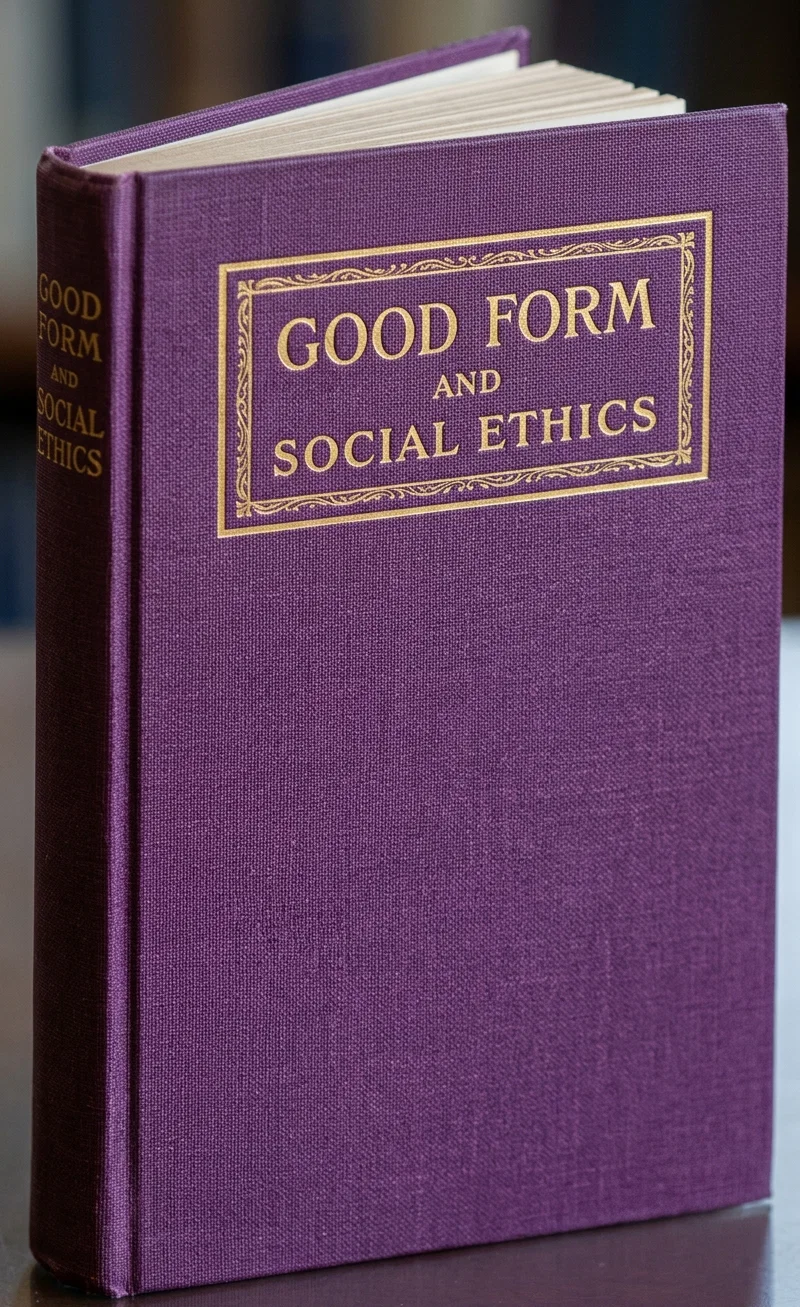
Good Form and Social Ethics
By Fannie Dickerson Chase
A NEW BOOK
By FANNIE DICKERSON CHASE
The first copies of this book are now ready for delivery, and being the only book on the subject printed by our publishing houses, a large sale has been predicted. It covers all phases of the subject of good form in a practical manner, and the author’s appreciation of the power of illustration has led to the recital of many incidents, which emphasize the subject under consideration and render the book intensely interesting.
There are chapters for “everybody, everywhere,” as indicated by a few of the titles:—
The GentlemanThe Host or HostessIn the HomeAt ChurchOn the StreetThe Home GirlThe Business GirlThe Social GirlConversationInvitations
There are also chapters on such subjects as kindness in speech, punctuality, the forgetting habit, and a chapter to ministers, the writing of which was suggested to the author by a member of the General Conference Committee.
The book is bound in attractive purple cloth, stamped in gold. Price, 75 cents.
Review and Herald Publishing Association, Washington, D. C.
Correction to Western Oregon Conference Notice
By Editor
WE reprint in this issue the notice of the Western Oregon Conference in order to rectify an error which appeared in the notice as previously published. The mistake was in the number taken as a basis for the appointment of delegates.
Elder Wilcox at the Conference
TAKEN ill while on his way to the Conference, Elder M. C. Wilcox, editor of the Signs of the Times, was confined to his room during the greater part of the first Conference week. His friends were glad to welcome him to the delegation Wednesday.
Death of Elder G. A. Irwin
By Editor
We stop our presses to record the sad death from heart failure of Elder G. A. Irwin, which occurred May 23, five days after his arrival at the Conference. His death at the age of sixty-nine removes from this work a devoted and valuable worker, and brings to a close a long and useful life. Further particulars, with a sketch of his experience in connection with this movement, will be furnished later.
The Conference Departmental Meetings
It is in the departmental meetings, which are held each day at 4:30 P. M., that many of the hard problems of the Conference are threshed out. In these meetings papers are read and addresses given dealing with different phases of the work, followed by free discussion of plans and policies. As the result of this free consideration, resolutions will be adopted passing on to the general committee on plans recommendations regarding the prosecution of the department work for presentation to the Conference in session.
Conference Dining Arrangements
The culinary and dining arrangement for the accommodation of the Conference has elicited well-merited commendation. The food is of excellent quality, well prepared, and liberally and efficiently served. From sixty to ninety minutes is sufficient to furnish meals to the 1,500 to 2,000 patrons of the cafeteria, hence there is no tedious waiting. Brother E. G. Fulton, who has this work in charge, is rendering a distinct and valuable benefit to the Conference by his faithful and painstaking efforts.
Progress and Sacrifice in Europe
IN his excellent report of the progress of this movement in European countries, Elder L. R. Conradi stated that the message is now going in forty different languages and dialects in his field, and that there are believers in the message in still other tongues. This truly shows that the message is reaching out to all nations, kindreds, tongues, and peoples. One sad note was sounded in the word which Brother Conradi brought, and that was in reference to the death of nine noble workers during the last quadrennial period, who have sacrificed their lives in the European Division. But these all died in a triumphant faith, and we believe that even in death will prove a savor of life.
Being Made Tame
ELDER J. P. ANDERSON reported that in one of the villages in his territory some of the heathen appeal for a Christian teacher, in order that they might become “tame,” as they express it. This word is truly expressive of the changed condition that the grace of God will bring about in man’s nature. The apostle Paul employs the same thought when he speaks of the good olive graft taking the place of the wild.
Every man outside of the Lord Jesus Christ is wild and untamed, even as the wild animals of the forest. It is only by a change of his evil heart, forsaking his evil propensities, and taking on the meekness and gentleness of the Lord Jesus that he becomes tame. We should make it the prayer of our hearts, even as it is the desire of these heathen inquirers, that God will tame us through the grace that there is in the Lord Jesus.
The North American Foreign Department Report
The following corrections should be made in the report of the North American Foreign Department, prepared by Elder O. A. Olsen, which appeared in the REVIEW of May 22:—
The last clause in the second paragraph should read, “the Danish-Norwegian Division, with Elder N. P. Nelson as superintendent, who soon after fell at his post in death; Elder L. H. Christian was later appointed to fill the position of superintendent.”
Under the heading “Present Status of Our Work,” paragraph six should give the membership as 8,000 instead of 7,405.
At the close of the third paragraph on page seven, the words, “This is not saying that the school does not need further financial assistance for better equipment and further improvements,” should be added. In the fifth paragraph on the same page the value of the property should be $75,000 in place of $95,887.
Veteran Delegates at the Conference
This Conference is constituted of a large number of delegates whose heads have grown gray in this movement. Elders J. N. Loughborough, S. N. Haskell, O. A. Olsen, G. A. Irwin, A. C. Bourdeau, J. O. Corliss, R. A. Underwood, H. W. Decker, H. W. Cottrell, C. P. Whitford, William Covert, and C. P. Whitford, William Covert, D. T. Shireman, George I. Butler, J. W. Raymond, and others might be mentioned. These devoted men who have long borne the heat and burden of the day are still sources of inspiration and enthusiasm to their associates. Long may this movement have the benefit of their godly counsel.
Publishing Department Exhibit
In the dining-hall of the Foreign Mission Seminary, visitors at the General Conference find an interesting exhibit, prepared by the Publishing Department, illustrative of the world-wide scope of its work. The United States is represented by tastefully decorated booths supplied with books produced by the Review and Herald, Pacific Press, International, and Southern Publishing Associations. The publishing work in Australia, Great Britain, Germany, China and Japan, Switzerland, Mexico and South America, and Scandinavia and Finland, is also well represented. The two mottoes “Our Field—the World” and “Two Million Dollars for 1913” tell us of the aim of our earnest colporteurs and canvassers.
Condensed Reports of the Conference
By Editor
As nearly as we can estimate, about two thirds of the readers of the REVIEW are subscribers to the General Conference Bulletin. This, therefore, leaves a large number of our readers without the excellent reports which are being brought before this gathering, also the proceedings of the regular Conference session. It is for the benefit of these that we shall give, for the next few weeks, a condensed report of the proceedings of the Conference. The full official reports appear in the Bulletin, and to this journal we must refer our readers who desire a complete account of the doings of the Conference and of the addresses that are delivered.
Spiritual Interests of the Conference
THE spiritual interests of the present Conference are particularly marked. Bible studies are held daily. Important lines of prophecy are made the subjects of the evening discourses. The early morning hour is one of praise and prayer. In six different divisions the camp is gathered. After a short, impressive lesson the time is occupied in praise and supplication. Separate meetings are held for children and youth.
A Sawdust Carpet
A THICK layer of sawdust covers the floor of the large pavilion at the General Conference. This constitutes a noiseless carpet, and serves greatly to lessen noise ordinarily occasioned in large public assemblies.
Words from Sister E. G. White
By Editor
THE good words addressed to the Conference by Sister E. G. White, as published in this issue, will be read with interest.