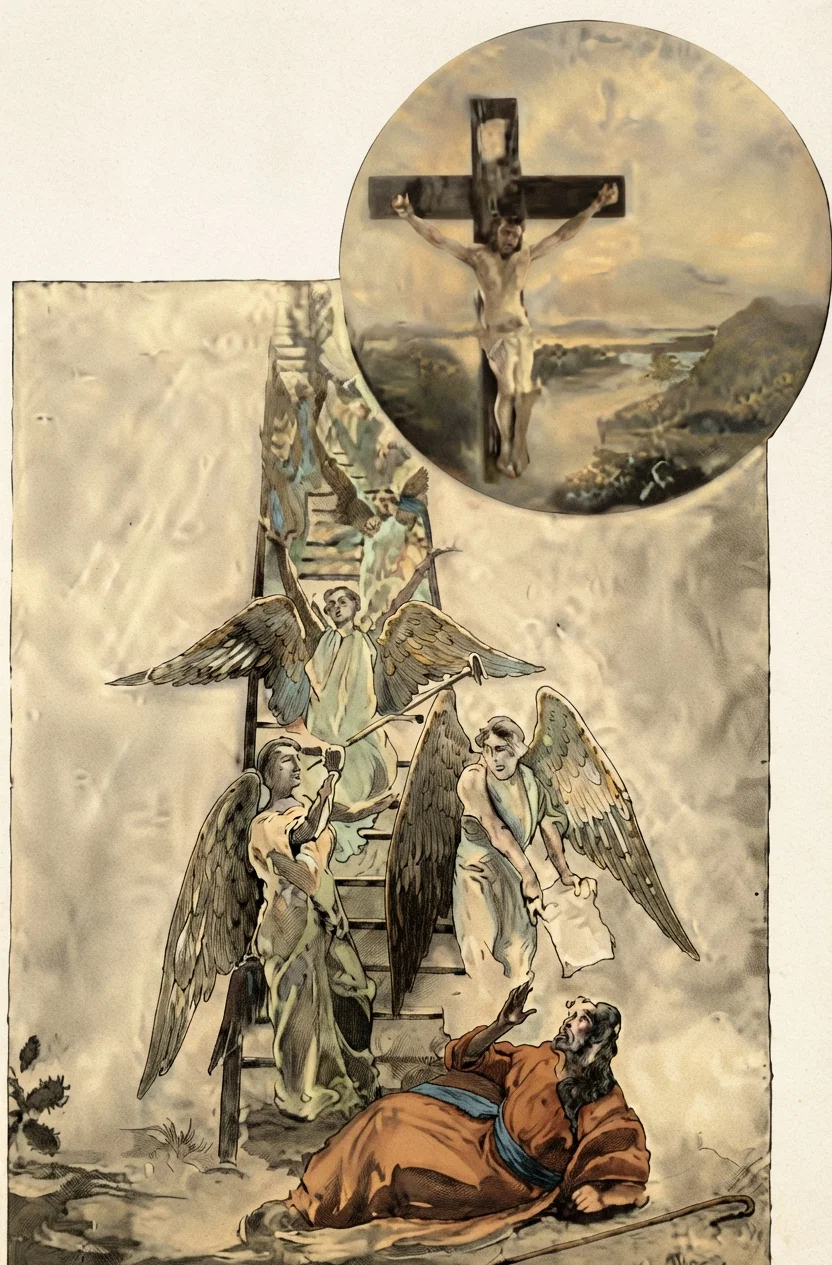
"And he dreamed, and behold a ladder set up on the earth, and the top of it reached to heaven; and behold the angels of God ascending and descending on it." Gen. 28:12.
"And He saith unto him, Verily, verily, I say unto you, Hereafter ye shall see heaven open, and the angels of God ascending and descending upon the Son of Man." John 1:51.
In his dream Jacob saw a ladder reaching from earth to heaven, and this mystic ladder constituted the means or channel of the angelic communication between heaven and earth. The angels of God ascended and descended upon it. The angels we knew, and that they are sent to earth and return to heaven we knew. But what the ladder was upon which they made their journey we knew not until Jesus revealed it unto us. He says that the angels of God ascend and descend "upon the Son of Man."
A most important truth is herein communicated unto us. It is that there is no channel of communication between earth and heaven, except through our Lord Jesus Christ. Elect angels come to earth on errands of judgment, comfort, instruction, love, and mercy; and return again, all under the direction of their great Commander, the Archangel, the head over all the angels—the Son of God.
So we see that the holy angels minister to Christ by going and coming according to His good pleasure. But we should remember for our admonition, comfort, and encouragement, that these same holy angels minister to saints on earth. While it is true that the mystic ladder reaches to heaven, and the God of Abraham stands at the top of it, lovingly interested in seeing His angels ascending and descending by the loving direction of His beloved Son whom He has made the Mediator, or connecting link between heaven and earth; it is also true that at the bottom of the ladder, on the earth, are the helpless but trusting saints. So, while it is true that these holy angels would not come to earth if Jesus did not send them, it is also true that they would not come to earth if His people did not need them. Hence, it is evident that the cause for the existence of the ladder is on earth as well as in heaven.
It is through this divinely-appointed instrumentality that God is with His people, and keeps them in all places. Gen. 28:15. How comforting to the believer is this great truth of the ministration of holy angels. How blessed the thought that these holy messengers are enabled to come to our aid through the kindness and love of God our Saviour; that they are lovingly subject to His behest; and that He loves us with an infinite love.
H. A. ST. JOHN.
The Higher Thought Within
By Emerson
WITHIN every man's thought is a higher thought—within the character he exhibits today a higher character.—Emerson.
FACT AND GOSPEL.
By Alexander Maclaren
PAUL turns a historical fact into a historical Gospel by the common term or explanation which he appends to it—Jesus Christ died; a beautiful story, a touching martyrdom; but if that is all you have to say, it is no more a Gospel than any of the obituaries in tomorrow's newspapers will be. He died. Yes, and we are to take that fact apart from all theory; as they tell us nowadays we ought to do, as being the Gospel for the world? There is no power in it, and there never has been; and there never will be a quickening, elevating, cleansing, life-giving power in a so-called Gospel, however it may be adorned, which begins to falter and stutter when it goes on to say, “died for our sins.”
There is only one way by which it is possible that Christ's death should be regarded as being for our sins, and that is, that it takes them away because He is the Lamb of God whose sacrifice expiates the sin of the world, and because He imparts His blood, the principle of His life, to all those who open their hearts to receive Him, and that thence it pulsates through their veins and cleanses them from all sin.
And so, dear friends, a Gospel without a Cross is a Gospel without power, and the one thing that the church needs is not a mere narrow, traditional repetition of old-fashioned formulas consecrated by antiquity, and made weak sometimes thereby, but a fresh, vital, ever-renewed apprehension of the eternal fact,—which is young through all the ages, and through all the ages is the fact on which the world's redemption is built,—Jesus Christ died for our sins, and rose again the Conqueror and the King.—Alexander Maclaren.
Manners as Shadows of Virtues
By Sydney Smith
MANNERS are the shadows of virtues, the momentary display of those qualities which our fellow-creatures love and respect.—Rev. Sydney Smith.
"SPEAK YE UNTO THE ROCK."
By L. D. Santee
AT Rephidim Moses was to smite the rock, now, he was but to speak to it. Num. 20:1-13. But Moses, for the first and only time in his life, added to, and changed the command of his God. Moses was the meekest man upon the face of the earth (Num. 12:3), but this once the people "provoked his spirit, so that he spake unadvisedly with his lips." Ps. 106:33.
True, he "took the rod from before the Lord, as He commanded him," but in the heat of his spirit, stirred to indignation that a second time the people should accuse both God and him so falsely, he said, "Hear now, ye rebels; must we fetch you water out of this rock? And Moses lifted up his hand, and with his rod he smote the rock twice."
Was this sin? God counted it so; and for this sin Moses was not permitted to lead God's people into the promised land. God forbid that we should lower His standard of sin. Turning to 1 Cor. 10:11, we read: "Now all these things happened unto them for ensamples [margin, "types"]; and they are written for our admonition, upon whom the ends of the world are come." As we study God's dealings with them, we remember that they were types, and we ask, What lesson does it contain for us?
As "God is no respecter of persons" (Acts 10:34), and, as surely as Moses lost the earthly Canaan on account of disobedience, so surely disobedience on our part will cause us to lose the heavenly Canaan. The command was given to Moses, "Speak ye unto the rock," and his disobedience cost him his life.
God has given us a command equally plain and explicit. Here it is: "Remember the Sabbath day, to keep it holy. Six days shalt thou labor, and do all thy work; but the seventh day is the Sabbath of the Lord thy God; in it thou shalt not do any work." It is unchangeable. "My covenant will I not break, nor alter the thing that is gone out of My lips." Ps. 89:34.
Is this command condemning you? or does it witness your obedience? It will be kept in the new earth. Will you be there to keep it, or will your disobedience lose you the heavenly Canaan?
Remember Moses on Mount Pizgah, looking sorrowfully on a land that he was never to enter. Will his experience be yours? or will the judgment find you among the company that are keeping "the commandments of God, and the faith of Jesus." Rev. 14:12. "So speak ye, and so do, as they that shall be judged by the law of liberty." James 2:12.
L. D. SANTEE.
THE CURSE OF INTEMPERANCE.
By L. D. Avery-Stuttle
"LOOK not thou upon the wine when it is red, when it giveth his color in the cup, when it moveth itself aright. At the last, it biteth like a serpent, and stingeth like an adder."
"Now you are going to give us a sermon on intemperance, are you? I'm tired of listening on that subject, its quite hackneyed. I guess I'll step out."
Wait, young man, and you, young woman, and you, old man, and old woman, too, if you will. I am not in a mood for sermonizing today. I am just going to tell you a story.
"Well," says John, "I'm glad of that. I don't care to be preached at; I'm fully able to take care of myself. But I should consider it very rude to refuse to drink a glass of wine offered me in the name of hospitality and kindness."
But, young man, true courtesy never demands the surrender either of self respect, or of conscience. Listen:
A few weeks ago I was stopping at the home of a very dear friend who was passing through the deep waters of affliction. Other friends came in for an afternoon visit, until quite a number were present. After a while, those of the party who had recently been deeply afflicted, naturally grouped themselves into a pathetic little circle, each one tearfully repeating the last fond words of the dear departed, or telling sadly, and with falling tears, of the grief and loneliness of those whose hearts had been left bleeding and torn by the grim messenger.
But there was one sad-eyed old lady who only sat apart and wept in silence. The others might repeat their tales of sorrow, and receive the tear of sympathy, but she only pressed her lips together the more tightly in a mute and comfortless grief. The luxury of unrestrained mourning which solaces itself with the words of sympathy offered by those sharing a common sorrow might not be hers; for hers was no common sorrow.
At last I learned her trouble. A few short months ago she had a boy, the darling of her heart. "Ben was such a good boy," she sobbed, as she confided to me her trouble, "so kind-hearted and generous; everybody loved him. But I wasn't careful enough about the company he kept. He had but one fault, had he, father?" she asked, turning to the sad-eyed old man who shared her sorrow; "just one fault; he learned to love strong drink. We didn't find it out until the habit was pretty firmly established, and then it seemed too late. We used to talk with him and plead with him, father and I, but he only declared there was no danger, that he could break off when he liked. Every time he went to town, I'd sit at home and cry till he came back.
"At last one night they brought him home to me—my poor boy, he had been murdered in a drunken brawl. Think of it! the last breath he drew was tainted by the vile stuff which laid him low. O, don't you remember, father," she continued, turning to the old man again, "don't you remember the first prize Bennie ever took at school, how proud we felt?"
"Yes, and I remember the first pair of pants you ever made him, mother," and the gray-bearded lip quivered pathetically. "But now he's gone. O, I warned him, I warned him; I wanted him to stay at home with mother and me the very night they killed him, but he would go; he went with the red danger-light flashing in his eyes; he did it presumptuously. The last breath he drew was the tainted breath of a sot."
"O, don't, father!" protests the poor mother. "Of course we warned him, you and I, but we weren't half in earnest about it; and we prayed, but we weren't half in earnest about that, either. I see it now, when it's too late. If I could only have him back, my poor boy! I'd plead with the Almighty as I never did before. O, I'd save him! I'd save him! but it's too late—too late now."
I felt that it was impossible for human lips to comfort grief like this. But I said to myself, I will tell the story to others. And now I ask, What, what shall we do?
My heart goes out toward the young; for I am persuaded that we who are older know but little about the peculiar temptations which beset the young man and woman who lives in this hour of peril, when the devil is come down with great power, knowing that he hath but a short time. And I feel like praying: O pitying Christ! lay the burden for souls upon my heart, and help me to speak or write something which may touch the stony hearts of the parents.
O, the fathers and mothers are not half in earnest about the salvation of their sons and daughters! They say, "Yes, it's too bad. John is unconverted, and is forming a taste for strong drink, and Julia is choosing the downward road—too bad!" Then they sigh and turn away.
Is this the way they would act if John and Julia were in a burning building, or if they were in a canoe above the rapids of Niagara? Would the mother fold her hands and say, "It's too bad!" Would the father turn carelessly away and say, "I can't help it! I never could influence those children." Would they? Would you? Ah, you would move heaven and earth to save them from a natural death; what are you doing to save them from eternal death? In the name of the pitying Christ, I ask you, What?
L. D. AVERY-STUTTLE.
THE END OF SELF-SERVING.
"Cause Unknown."
[One day last week, said a Chicago Evening Post of some time ago, a bridge tender and two stalwart police officers fished from the murky water of the river, the body of a well-dressed, middle-aged man. The remains were conveyed to the morgue, were never identified, and went finally to the potter's field or to the dissecting room of some medical college. In the pocket of the coat found on the corpse, was a stained and crumpled paper, upon which the following was scrawled in lead pencil. What a lesson it is of the purposeless life! What a picture of the soul that lived for self! What an object-lesson of the heart without Christ!]
I am standing on the threshold of eternity at last.
As reckless of the future as I have been of the past,
I am void of all ambition, I am dead to every hope,
The coil of life is ended and I'm letting go the rope.
I have drifted down the stream of time, till weary, sore, oppressed,
And I'm tired of the motion, and I simply want to rest.
I have tasted all the pleasures that life can hold for man;
I've scanned the whole world over till there's nothing left to scan.
I have heard the finest music, I have read the rarest books;
I have drunk the purest vintage, and tested all the cooks.
I have run the scale of living and sounded every tone,
So there's nothing left to live for, and I long to be alone.
Alone and unmolested, where the vultures do not rave,
And the only refuge left me is the placid, quiet grave.
I am judge and jury mingled, and the verdict that I give
Is, that minus friends and money, it is foolishness to live.
In a day or two, my body will be found out in the lake;
The coroner will get a fee, the printer get a "take."
The casual verdict, "Suicide from causes yet unknown,"
And Golgotha draws another blank, a mound without a stone.
To change the usual verdict, I will give the reason now,
Before the rigid seal of death is stamped upon my brow;
'Tis the old familiar story of passion, love, and crime,
Repeated through the ages since Cleopatra's time—
A woman's lips, a woman's eyes, a siren all in all;
A modern Circe fit to cause the strongest man to fall;
A wedded life, some blissful years, and poverty drops in
With care and doubt and liquor, from whisky down to gin.
The story told by Tolstoi, in comparison with mine
Is moonlight unto sunlight, as water unto wine.
The jealous pangs I suffered, the hideous nights of wo,
I pray no other mortal may ever undergo.11
But I've said enough, I fancy, to make the reasons plain—
Enough to show the causes of a shattered heart and brain.
What wonder, then, that life holds not a single thread to bind,
A wish or hope to live for, or an interest in mankind.
Already dead but breathing—a fact that I regret—
A man without desire, excepting to forget;
And, since there is denied me one, why should I linger here,
A dead leaf from the forest of a long-forgotten year.
So au revoir, old cronies, if there's a meeting place beyond,
I'll let you know in spirit, and I know you will respond.
I am going now old comrades, to heaven or to hell;
I'll let you know which shortly—farewell, a long farewell.
STOP AND THINK.
By Eben E. Rexford
My boy, when they ask you to drink,
Stop and think.
Just think of the danger ahead,
Of the hearts that in sorrow have bled
O'er hopes that were drowned in the bowl,
Filled with death for the body and soul.
When you hear a man asking for drink,
Stop and think.
The draught that he drinks will destroy
High hopes and ambitions, my boy;
And a man, who the leader might be,
Is a slave that no man's hand can free.
O, this terrible demon of drink!
Stop and think.
Of the graves where the victims are laid,
Of the ruin and wo it has made,
Of the wives and the mothers who pray
For the curse to be taken away.
Yes, when you are tempted to drink,
Stop and think
Of the danger that lurks in the bowl,
The death that it brings to the soul,
The harvest of sin and of wo,
And spurn back the tempter with, "No."
—Eben E. Rexford.
THE DEVIL'S KINDLING WOOD.
THIS is what Rev. C. M. Southgate, of Worcester, calls cigarets, and the term is none too strong. In one of his admirable sermons, entitled "A Plain Talk with the Boys," occurs this passage in regard to smoking:
Do you want to know where a boy usually begins to be fast? With a cigaret. It is the lad's first step in bravado, resistance of sober morality, and a bold step in disobedience. Just now take the matter on the scientific side. Tobacco blights a boy's finest powers, wit, muscle, conscience, will. Nations are legislating against it. Germany, with all her smoke, says, "No tobacco in the schools." It spoils their brains and makes them too small for soldiers. Knock at the door of the great military institutions of France; "No tobacco" is the response. Try West Point and Annapolis; "Drop that cigaret" is the word. Indeed, smoking boys are not likely to get as far as that. Major Houston of the marine corps, who is in charge of the Washington navy-yard barracks, says that one-fifth of all the boys examined are rejected for heart disease, of which ninety-nine cases in one hundred come from cigarettes. His first question is: "Do you smoke?" "No, sir," is the invariable reply. But the record is stamped on the very body of the lad, and out he goes. Apply for a position in a bank. If you use tobacco, beer, cards, the bank has no use for you.
Business life demands fine brain, steady nerve, firm conscience. Watch the boys. See one sixteen years in age, twelve in size, twenty in sin, and he smokes, probably chews and drinks. Babes of seven or eight are at it. The vice increases. I could pile up statistics by the hour, testimony from the highest medical authority, of the misery preparing and already come. The use of cigarets increases enormously, but only increases the use of stronger tobacco. In August, 1889, 16,000,000 more cigars were made in this country than in the year before, and the firm that made this statement credits the increase to the cigaret, and the fault to careless parents.
Tobacco is murdering many a lad. Where they do not fairly kill, cigarets are the devil's kindling wood. They start a craving for stimulants that liquor is the quickest to meet. And why is it that "fancy" pictures go with them as prizes unless licentiousness comes next? But can't a man smoke and be good, be a Christian? I suppose so. But by the time tobacco has killed a few more generals like Grant, and a few more emperors like Frederick the Noble, and a few more business men and bright boys, a smart boy may get it through his head that it doesn't pay. And not till the smart boys quit will the poor and the dull let it alone. The highest style of man does not smoke, will not submit to its slavery nor be responsible for the example.—Congregationalist.
GRAND CANYON
OF ARIZONA
"A whole chaotic underworld. Most sublime scene on earth. A mile deep, 13 miles wide, 217 miles long, and painted like a flower."
The great round world has nothing like it. A railroad to the rim. Excellent hotels: El Tovar, Bright Angel, and Grand View. Passengers going via Santa Fe may stop over at Williams for side trip to the Canyon. Round trip fare $6.50. Ask for pamphlet, "Titan of Chasms."
FRED W. PRINCE, city ticket agent,
649 MARKET ST., SAN FRANCISCO, CAL.
CONTROLLING NATURE.
AMONG the interesting steps in modern progress has been the control and development of plant life. People now living can remember when the number of edible fruits and vegetables was far less than at present, and even those that could be grown were vastly inferior to what we now have. For example, our parents knew nothing of the tomato except as a curious ornament in the garden. Sweet corn was hardly better than the commonest field sorts. All oranges had seeds. Celery was little known and poor in quality. In the flower bed, the magnificent pansy has replaced the insignificant heartsease from which it was developed, and the sweet pea traces its origin to the common garden vegetable. The practical results are accomplished by men operating largely for the love of the work, like Luther Burbank in California, and Eckford in England, as well as by the great seed merchants, D. M. Ferry & Company, of Detroit, Mich., who are not only eternally vigilant to hold what ground has been gained, but have a corps of trained specialists backed by ample means to conduct new experiments. The results of their experience can be found in their 1906 Seed Annual which they will send free to all applicants.
NOAH'S ARK A PERFECT SAILING VESSEL.
A COPENHAGEN engineer has built a vessel as near as possible like Noah's ark, altho only about one-tenth its actual size. The descriptions in the Bible have been followed, and the outlines taken from the most ancient representation known of the ark, which is given on a coin of 300 B.C. Recently a trial trip was taken, and the ark, which is of 200 tons' burden, behaved splendidly. The vessel is declared by marine experts to be not only the simplest kind of vessel possible, but also a masterpiece of shipbuilding, upon which the latest developments of the craft could devise no improvement.—Manhattan (Kan.) Republic, Aug. 3, 1905.
TRIFLES FOR THE CURIOUS.
THE following sentence contains all the letters of the alphabet:
John P. Brady gave me a black walnut box of quite small size.
Ezra 7 : 21 contains all the letters of the alphabet except "j":
"And I, even I, Artaxerxes, the king, do make a decree to all the treasurers which are beyond the river, that whatsoever Ezra, the priest, the scribe of the law of the God of heaven shall require of you, it be done speedily."
And the entire alphabet is in these lines, viz.:
God gives the grazing ox his meat,
He quickly hears the sheep's low cry,
But man, who tastes His finest wheat,
Should joy to lift His praises high.
—Anon.
MUSTACHE GUARD
Fits any drinking vessel and converts it into a mustache cup.
Made of Wessel silver. Guaranteed not to change color. Sent to any address for inspection. If it suits you, send 30 cents. If you don't want it, return it. The retail price is 50 cents. The reduced price is just to introduce it. Order quickly. Alfred Mallet, Elkbridge Sta., Baltimore, Md.
Millennial Text-Book
MILLENNIAL TEXT-BOOK.—Every known reference, over 500 arranged according to events, adapted for instant reference or profound Bible study; result of 12 years' search. Mailed for 10 one-cent stamps, or a dime. Eugene A. Brown, Phoenix, Ariz.
YOU WONDER WHY
a Bank in Mountain View wants to have you write for information about the town? Well, HERE'S THE SECRET: Some day you will come to California. We want you to come to Mountain View. Then incidentally we want to do your Banking Business. See the point? Write to us if you want to know about Mountain View. Address
BANK OF MOUNTAIN VIEW
Mountain View, Santa Clara County, California
A MOST USEFUL HYMN BOOK
DEVOTIONAL SONGS
By three famous composers,
Doane, Kirkpatrick & Main
ONE-HALF NEW SONGS THAT WILL NEVER GROW OLD.
ONE-HALF OLD SONGS THAT WILL ALWAYS BE NEW.
256 pages, cloth, $25 per 100; 30 cents each by mail.
A returnable copy for examination will be mailed upon request.
Published by the publishers of the famous "Gospel Hymns."
THE BIGLOW & MAIN CO., New York or Chicago.
Ferry's Seeds are best because 50 successful years have been spent in their development—half a century of expert care in making them superior to all others. We are specialists in growing flower and vegetable seeds. 1906 Seed Annual free. D. M. FERRY & CO., Detroit, Mich. FERRY'S SEEDS
IMPORTANT TO TRAVELERS
The WASHINGTON-SUNSET ROUTE announce the opening of their through line via New Orleans. Personally conducted cars, San Francisco to Washington, D. C., via Coast Line and Los Angeles, tri-weekly. Tickets at lowest rates to Washington, Baltimore, Philadelphia, New York, New England, and all Eastern points. Through the Old South. Quick time. Best service. Write Phil K. Gordon, 633 Market St., San Francisco, for full information.
A HURRICANE IN THE SOUTH SEAS.
By B. J. Cady
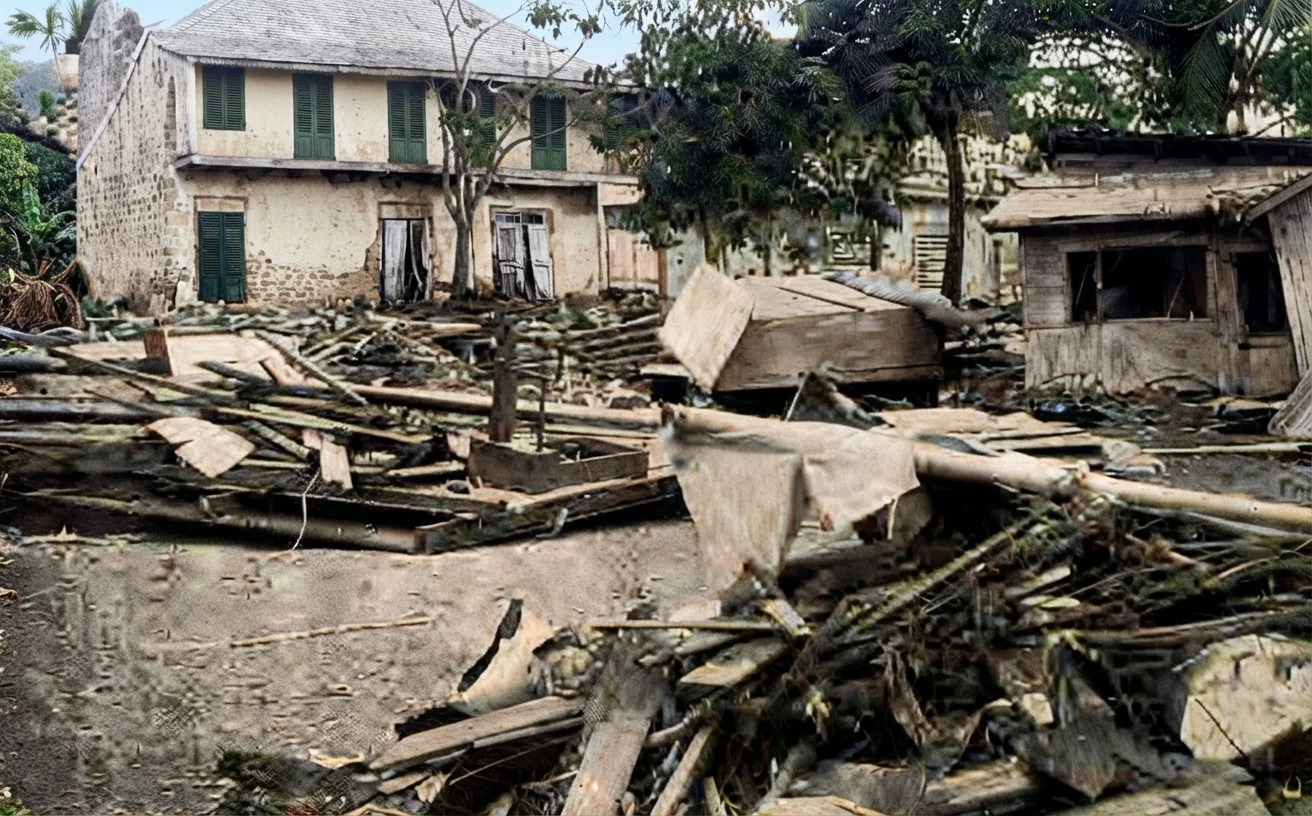
THE Society Islands and Tuamotu Archipelago have recently been visited by a hurricane, the like of which has never been known here, as far as we have been able to ascertain. During the night of February 7th, and the day following, the wind did its work in the vicinity of the Society Islands. The mountains of Tahiti are high, and during the night the wind came from such a direction that it was shut off from the city of Papeete by the mountains, so it was quite calm and still here. The raging sea outside was driven in on the side of the island where there was no wind, and as the reef is low outside of Papeete, the sea soon began to rise. The most of the large business houses are along the water front. In the evening the sea was up in the road, and young people were riding along the street in canoes, and having considerable sport over it. But it kept rising higher and higher until eight o'clock the next morning, when the wind changed to a position where it struck Papeete. This seemed to drive the sea back, for it soon commenced to go down quite rapidly.
But in those few hours, the sea had wrought quite a change in the appearance of things along the beach. The waves had battered against the buildings and gradually broken the weaker and less substantial ones. Some were washed all to pieces, and many others were moved from their foundation, and more or less injured. The heavy stone buildings still remained, but their great doors had been broken open by the waves, and goods washed away or damaged. Thousands of dollars worth of goods were destroyed that night. After it was over, the road along the beach was impassable, being filled with the débris, and in some places the road itself is washed away.
Nothing was left of the office of the American Consulate but the flag-staff. The re-organized Mormon Church people were very unfortunate. I think that every house in their little colony was broken down, besides their church and mission house. Many people were left homeless. Some remained in their homes as long as they could, and then fled, passing through water up to their necks, and others had to swim for their lives. Providentially, only two lives were lost in this place. These islands have been passing through some hard times since the fall in the price of vanilla and pearl shells some time ago, so the government is not in a condition to help its poor, as they might under other circumstances; but they took a part of them into government buildings, and did something toward supplying their wants.
Our church and mission house in Papeete are situated far enough from the sea so as not to be affected by this calamity. We felt very thankful for this, and believe the providence of God was in our locating where we did.
A Scene in Papeete after the Storm. The large building in the background was moved from its foundation.
In other parts of Tahiti and the Leeward Islands, the wind did the most damage. Many houses were blown down, roofs were blown off, and trees were uprooted and broken off. I think what is felt the most in these parts is the loss of the food-bearing trees,—breadfruit, coconut, banana, etc. On Raiatea, one man lost sixty breadfruit trees, and another, thirty. Another man lost over two hundred coconut trees. The loss to our plantation at Avera was very small. Only about twelve of our coconut, and three breadfruit trees were blown down. The roofs of some of our out houses were blown off, but the larger buildings remained intact. Much fruit, both green and ripe, was blown from the orange, mango, lime, coconut, and breadfruit trees, and of course this is a little loss. But we all feel very thankful for the protecting care of God, and that it was no worse. Our people in general suffered the least. These words from the forty-sixth psalm seem to have been written for just such times as these: "God is our refuge and strength, a very present help in trouble. Therefore will not we fear, tho the earth be removed, and tho the mountains be carried into the midst of the sea; tho the waters thereof roar and be troubled, tho the mountains shake with the swelling thereof." We know that these things must come, but God is our refuge.
Tuamotu Islands.
The saddest part of this is the news that comes from the Tuamotu Islands, which are nearly all low and almost on a level with the sea. They were devastated by the wind and sea, and on one of the largest, ninety-five people were either drowned or killed. Many went into the Catholic church for safety; it being a stone building, they thought it would withstand the sea; but the wall was broken by the waves and fell in on them, crushing many to death. A man-of-war has twice visited these islands, and brought many of the people to Tahiti, as they lost their homes, clothes, and everything, and have nothing to live on there. All buildings and nearly all of the coconut trees are now gone, and the islands are nothing but dreary wastes of bare sand.
Four schooners, belonging to merchants and traders of Tahiti, are missing. One has just been heard from, two of the native sailors having arrived. They tell how the vessel went down, and they made a raft, and finally all were washed away but these two. One was a large vessel, and had quite a number of Europeans on board. Nothing has been heard from it, but at last they have discovered a piece of a vessel supposed to be a remnant of this one. A large English vessel was overtaken by the storm, and finally washed on the reef of one of the Tuamotu Islands, a complete wreck. Ten of their men were lost, and the rest have reached Tahiti by means of a small native boat.
We believe that this is one of the many signs given to show that we are living in the last days. It is a warning given in mercy to cause people to pause in their mad race after worldly gain and pleasures, and consider eternal things. Tho many will not heed the warning, I am glad to say that some have been led to think more seriously of their relation and duty to the Creator. B. J. CADY.
WHAT OF THE DAY?
WHAT of the day, do you ask?
Then assuredly know
That the day which began weary ages ago
Speeds on to an issue sublime;
And the King whose glad coming draws hourly near,
Will, haply, when least you expect Him, appear,
And the blessed long-prayed-for Sabbatical year
Usher in, in the fulness of time.
Will you hasten the day?
Will you labor and pray?
Will you thrust in the sickle and reap while you may
The plenteous harvests that lie
Waiting still for your hand
In every land
And rip'ning 'neath every sky?
Will you gather the stones for this temple divine?
And the gems in the crown of His glory to shine
Brighter far than the sun?
And then, when He comes, bowing low at His feet,
With rapture unspeakable, hear Him repeat,
"Well done, thou good servant, well done."
—Anon.
A Pure Heart, a Fountain of Health
"A PURE heart is a fountain of health, but a hundred diseases spring from the poisoned fountain of a corrupt and polluted soul."