Your ShelfYour Projects

Signs of the Times, Vol. 28, No. 14.

DEATH OR LIFE? WHICH?

Signs of the Times

Apr 2, 1902

Pacific Press Publishing Company · Oakland, California · Apr 2, 1902

DEATH OR LIFE? WHICH?
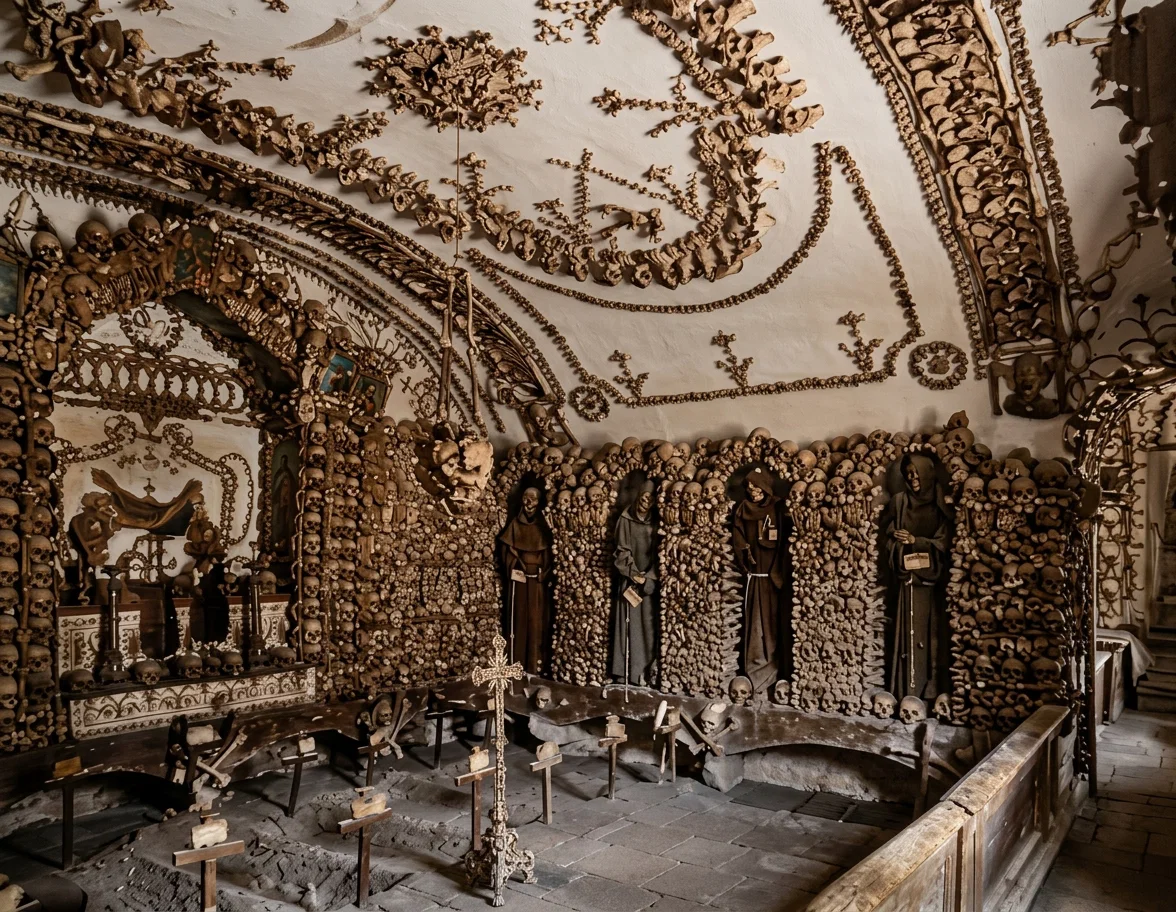
IT is a negative lesson which we present in our illustration this week. It is not a pleasant one. Negative pictures in moral character, spirituality, are never pleasant when we see them in their cold nakedness. It is only for the striking lesson and the blessed contrast that we can consent to place upon this page the gruesome illustration. But study the lesson, reader; it may do you good, and the picture can not hurt you, if you take it aright.
THE CATACOMBS OF THE CAPUCHINS, ROME.

The Way of Death.

BONES, bones, bones! Skulls and vertebræ, femur, tibia, and fibulæ; phalanges, humerus, radius, and ulna; long bones, short bones, flat bones, and bones of all sorts! Bones for walls, for doorways, for altars, for ornaments, and the whole ghastly structure lighted up by a chandelier of bones! Ghastly skeletons stand in the doorways clothed in priestly robes, and hideous skulls grin and glare from floor to ceiling. Surely it is a gloomy, ghostly, gruesome, charnel-house, albeit it is fitted up as a chapel.
READER, this is a view of a chapel in the catacombs of the Capuchin monks, and the bones are supposed to be those of early Christian believers, saints, and martyrs. The Capuchin monks are an offshoot of the order of the Franciscans. The chief thing about the order in the beginning was a capuche, or hood, which a Franciscan monk heard or believed was worn by St. Francis, different from what the Franciscans later adopted. He was greatly impressed by this discovery, and proceeded to Rome, where he obtained permission from Pope Clement VII. to wear the pyramidal capuche and the long beard, to live a hermit, to preach where he liked, and report once a year. Two others got hold of the idea of the original genuine hood and the strict rules of St. Francis, and they obtained the same permission as the first. They afterward became independent of the Franciscans. In 1543 its vicar-general, finding no salvation in its dead forms, became a Protestant, which almost resulted in the abolition of the order; but under a pledge from its members of “the most absolute submission to the wish of the pope, the most complete abnegation of all individual opinions,” it was suffered to live. While the world was being lifted toward education and refinement, the Capuchins expressed the ignorance, the credulity, and the coarse sympathies of the masses. (See Schaff-Herzog Cyclopedia, art. “Capuchins.”)
THIS illustration of the catacombs of the Capuchins is a fair expression of that religion, belief, or credulity which seeks aid or salvation from the dead forms of the past. From time immemorial, when men departed from God, they have sought salvation in dead forms. Their ideas of God have been seen in the worship of the heavenly bodies, in beast, and bird, and creeping thing. Men, made in the image of God, have bowed to all these living creatures, the existence of which was but for abrief day. They have believed the bodies of these creatures to possess the souls of men dead. Worse than this, they have written their faith in a god in cold, dead stone images, that can neither hear, nor feel, nor see, nor speak, and bowed before them. Men have crept to the cold crypts and dark caverns of the earth to hear the voice of some spirit or demon or saint, which superstition placed between them and God. Men—breathing, thinking men—have gathered up rags, clothing, rings,—something that a “holy” man once touched,—his mouldy, decaying bones, his dank, dark sepulcher,—to find virtue, healing, salvation. So professed Christians have striven, and sought, and fought, for the dead cross upon which Christ hung, the nails that spiked Him to the tree, the rock-tomb in which He lay. And since there were not enough of these, the graves, and relics, and bones of His followers have fed the insatiate thirst of human credulity, born in dead creeds and nourished on pagan superstition. O, it is pitiful! It is sad beyond expression. As in our illustration death is impressively emphasized by the oft-recurring skull and cross-bones, so over all this worship of form, this homage to the lifeless past, is written large, Death, death, death. Yet how many are following the way of death, rejoicing in the touch of an oxidized nail or a crumbling bone.

The Way of Life.

There is another side. God is a living God; nay, He is the living God. “With Him is the fountain of life.” From Him comes all life. He is goodness itself; for God is love. In His love He has given His life in Jesus Christ for a dying world. It is poured out from the great central fountain, so that all may drink and live. Jesus Christ is the Bread of Life. With outstretched, open hands He offers the loaf of life, and invites to eat. Listen to His invitation: “Ho, every one that thirsteth, come ye to the waters, and he that hath no money; come ye, buy, and eat; yea, come, buy wine and milk without money and without price.” This is the voice of God through the “evangelical prophet.” Listen again to His voice through the prophet evangelist: “And the Spirit and the bride say, Come. And let him that heareth say, Come. And let him that is athirst come. And whosoever will, let him take the water of life freely.” The storehouse, the fountain, is free for all.
God’s church is a living church. Her face is set to His throne. Her eye is single to His illuminating beams. She but looks into the rent, empty sepulcher to know that her Lord is not there, that He is risen, and is going before, and bids her to follow. She will not defend outworn creeds, or childish beliefs, or the past’s failures or mistakes of any kind in the clearer light of to-day. She thanks God for the clear light shining from the same Word in which half blinded eyes groped dimly yesterday, and which a clearer future vision will make to-day seem dim.
His work is onward. The path by which He leads His people may lie through the valley of the shadow of death; but it is the path of life, and there are no stopping-places for life’s pilgrims there. The Master of life has filled no sepulchral caverns, ornamented with bones, for worship or rest. No “sacred crypt” conceals “holy relics” from which the faithful may draw virtue by the way. No creed of iron bands or rock walls hedges her way. Life bursts the bands, and breaks the wall, and passes on to life more abundant.
Nevertheless the Living Church is loyal to her King and His Word. Subtle, solemn philosophy may whisper through his gray beard, and suggest that her course is folly; the reception, the constant inflow of life proves it the wisdom of the Ancient of Days. Youthful Science may shout and smatter of childish error’s way; the following of the eternal Guide-book demonstrates it the way of everlasting truth. Reader, the two ways are before you. Will you have the cold forms, the bloodless stones, the lifeless creeds, the decaying bones of a dead past? or will you have the warm, heart-throbbing, life-giving, ever-expanding truth of God?

PETER, ANEAS, AND DORCAS.

THERE is something in the association of certain names that brings helpful thoughts. Peter, whose name stands first in the list at the head of this study, had had the privilege of gaining a most wonderful experience by personal contact with the Lord Jesus. On one occasion when, in company with the other disciples, he was sent out to witness for His Master, power was given him to heal the sick, cast out devils, and even to raise the dead. Matt. 10: 5-8.
Whatever else he and the others did while on these tours, we know that the seventy did cast out devils; for it is recorded that when they returned from one of these journeys, they boasted that even the devils were subject to them through the power of Jesus’ name. Luke 10: 17. During the three years of this experience, the disciples must have gained considerable boldness in speaking the word by which to relieve the sin-distressed multitudes with whom they came in contact.
Their confidence must also have been strengthened by the Saviour’s words on that memorable night following the day of His resurrection, when He said to them all, “As My Father hath sent Me, even so send I you.” John 20: 21. Upon the strength of this assurance, after the ascension of the Lord they went forth to their life-work. Pentecost, and other succeeding occasions at Jerusalem where infinite power was displayed through humanity, testified to the constant fulfilment of this promise.
But at the period under consideration in this study, Peter was to leave the earlier scene of his many victories over the flesh and the enemy of righteousness, to move out into broader fields. Would the same power attend him there as had testified through him at Jerusalem in the midst of his old associates? From his steady course of action in his new field, we must believe that he thought so. Coming to Lydda on his journey, he found there a man who had kept his bed for eight years, so badly had he been afflicted with palsy. Without the least hesitation, the apostle said to him, “Æneas, Jesus Christ maketh thee whole; arise, and make thy bed.” Acts 9: 34.
Not only did these words gladden the heart of the afflicted one, but their power thrilled his whole physical system, and he knew that Peter’s words were confirmed in heaven. And he immediately arose from his bed, perfectly free from disease. The news of this notable case soon spread throughout that whole region, causing all the people there to turn unto the Lord.
The record of such cases as this should cause much reflection among believers of to-day. It seems that the Lord led Peter to the place for the very purpose of healing the palsied man, that through the divine power thus manifested the people of that region might believe on the name of Jesus. That being the means then used by which to convert the heathen, why should we suppose that such an effective method would be abandoned for mere logic, which the heathen so readily counteract by their own subtle reasoning? Why should not the herald of the cross now use, in order to convince the heathen of the power of Christ to save, means which they may not be able to gainsay? Even tho he may not be able to heal a malady by his word alone, he may use healing remedies, which will do the work, and he can then give God the glory before the one so healed. Such work could not fail to impress the veiled mind of the most hardened sinner.
But Peter’s work being finished in the region about Lydda, another opening was quickly presented for him to carry the power of God to others. At Joppa, which was not far from Lydda, there had dwelt a good sister, Dorcas. She had been one of the principal missionaries in that place, having given much of her time to visiting the sick, making garments for the poor, etc. This good woman was taken sick and died, and the affliction caused the disciples great grief. But after they had prepared the dead for burial, the brethren heard that Peter was at Lydda, and sent for him, asking him to hasten his coming to them.
On arriving at Joppa, Peter was taken into the chamber of the dead, where the women of the company were weeping aloud. His mind was quickly settled as to what to do. Putting all the visitors out of the room, he kneeled and prayed, then turning to the body said, “Tabitha, arise.” The power of these words brought life to her hitherto pulseless body; her eyes opened, and, beholding Peter, she sat up. At this, Peter extended his hand and helped her to her feet; then he called in the people whom he had before ejected, and presented her to them alive.
Again God was glorified; the news of this event soon spread throughout Joppa, causing many to believe in the saving power of Christ and so Peter was led to remain in Joppa a long time, in order to instruct the people in the way of the Lord. J. O. CORLISS.

TRUSTING

[R. M. Offord, in New York Observer.]
I do not ask Thee, Lord, to be explaining The many mysteries of my life to me; I only ask Thee, Lord, for grace sustaining To bear the burden which seems fit to Thee. I am content to trust Thy loving leading; It were not trust, if I could trace the way. No good thing shall this life of mine be needing; Thou wilt provide the manna day by day.

Withholding From God

“What is more foolish or more sinful than withholding from God that which is His due? So long as we do not surrender entirely to Him, He can not bless us. The smallest chain of the heart shut against His sovereignty shuts the doors of blessing against us. It is vain to expect peculiar mercies from God so long as we have not yielded to Him the last talent, the last impulse. Even our withholding of gold from God may withhold His glory from us. When shall we learn that we can never cheat God? We only cheat ourselves. God repays a thousandfold for all that we give Him.”

RESTORATION from BABYLON

BY ALONZO TREVIER JONES

THE SUCCESS OF THE SAMARITANS.

At the death of Cyrus king of Persia, Cambyses his son, the Ahasuerus of Ezra 4:6, immediately succeeded to the throne of the empire. The Samaritans who had so persistently carried on their work of obstruction by hired counselors and others “all the days of Cyrus,” continued it all the days of Cambyses—about seven years.
At the very beginning of his reign, in addition to the work of their hired counselors, the Samaritans took the bold step of presenting to Cambyses, the son of Cyrus, a formal and written accusation against the Jews: “In the days of Ahasuerus, in the beginning of his reign, wrote they unto him an accusation against the inhabitants of Judah and Jerusalem.” Ezra 4:6.
There is no known record that any notice at all was taken of their accusation. Even though any notice was taken of it, it is certain that their efforts were still in vain. The victory gained over them in the three weeks’ contest at the Persian court in the first month of the third year of Cyrus, still held all the days of his son Cambyses. This shows that there was real meaning in Gabriel’s words that at the end of the three weeks’ contest at the court of Persia he held the victory with not only the king, singular, but plural,—with the kings of Persia. From this it is plain that Cambyses, the heir apparent to the throne, was in that council through that three weeks’ contest, and therefore when the contest was ended and the victory was kept, it was victory not only as respected Cyrus and the time being, but also respecting Cambyses and the years to come. The victory was kept with the kings of Persia.
There was a second son of Cyrus, named Smerdis; but Cambyses caused him to be secretly murdered. Indeed, this was accomplished with so much secrecy that the great body of the people believed that he was still alive. This gave opportunity for conspiracy and the rise of a usurper, whose real name was Gomates, but who claimed before the people to be Smerdis, the son of Cyrus. This occurred at the capital of Persia while Cambyses was absent on his expedition in the conquest of Egypt. The original account runs thus:—
Cambyses the son of Cyrus was king. . . . This Cambyses had a brother, named Smerdis (Bardiya); they had the same mother and the same father. Afterward, this Cambyses killed Smerdis. When Cambyses killed Smerdis, the people did not know that Smerdis was killed. Then Cambyses went to Egypt. The people became bad; and many falsehoods grew up in the provinces, as well as in Persia, as in Media, as in the other lands. And then a man, a Magian, named Gomates, from Pasargadæ, near the mount named Arakadris, there he arose. On the 14th day of the month Viyakhna, thus he says: To the people he told lies, and said, “I am Smerdis, the son of Cyrus, the brother of Cambyses.” Then all the people revolted from Cambyses, went over to him, and the Persians, and the Medes, and the other nations. He seized the kingdom. On the ninth day of the month Garmapada he took the royalty from Cambyses. . . . Gomates the Magian deprived Cambyses as well of the Persians, as of the Medes, as of the other nations; he did according to his own will, and seized the royalty over them.—Darius, in “Records of the Past,” Old Series, vol. VII, pp. 89, 90.
Cambyses, returning with his army from Egypt, went as far as to Syria, and was there met by one of the many heralds whom Gomates had sent into all the empire publishing “proclamation to the troops that henceforth they were to obey Smerdis, the son of Cyrus, and not Cambyses.” Cambyses, believing now that his secret murderers of Smerdis had really played him false; and that thus Smerdis was really alive and reigning in the capital, immediately killed himself (Darius): “having reigned, in all, seven years and five months, and left no issue behind him, male or female.”—Herodotus. This was the end of July, 522 B. C.
As before stated, Gomates, this false Smerdis, was a Magian. His usurpation was a part of a conspiracy of the Magian priests to make predominant the Median element in the mixed national religion of Media and Persia. And the Gomates the Magian reigned as Smerdis the Persian, yet he was but the tool of the Magians to swing back the predominant element in the imperial religion from the Persian to the original Median. The difference was more sectarian and merely priestly, than fundamental and popular; but it furnished an opportunity that was instantly seized by the Samaritans and their hired counselors to make effective their determination to stop the work on the temple at Jerusalem.
Accordingly, no sooner was it known in Palestine that the new king reigned, than the Samaritans wrote to him a new and extended accusation against the Jews. For this Gomates, the false Smerdis, was the Artaxerxes of Ezra 4:7–23.
“In the days of Artaxerxes wrote Bishlam, Mithredath, Tabeel, and the rest of their companions, unto Artaxerxes king of Persia; and the writing of the letter was written in the Syrian tongue, and interpreted in the Syrian tongue. Rehum the chancellor and Shimshai the scribe wrote a letter against Jerusalem to Artaxerxes the king in this sort:—
“Then wrote Rehum the chancellor, and Shimshai the scribe, and the rest of their companions; the Dinaites, the Apharsathchites, the Tarpelites, the Apharsites, the Archevites, the Babylonians, the Susanchites, the Dehavites, and the Elamites, and the rest of the nations whom the great and noble Asnapper brought over, and set in the cities of Samaria, and the rest that are on this side the river, and at such a time. . . . Thy servants the men on this side the river, and at such a time. Be it known unto the king, that the Jews which came up from thee to us are come unto Jerusalem, building the rebellious and the bad city, and have set up the walls thereof, and joined the foundations. Be it known now unto the king, that, if this city be builded, and the walls set up again, then will they not pay toll, tribute, and custom, and so thou shalt endamage the revenue of the kings. Now because we have maintenance from the king’s palace, and it was not meet for us to see the king’s dishonor, therefore have we sent and certified the king; that search may be made in the book of the records of thy fathers: so shalt thou find in the book of the records, and know that this city is a rebellious city, and hurtful unto kings and provinces, and that they have moved sedition within the same of old time; for which cause was this city destroyed. We certify the king that, if this city be builded again, and the walls thereof set up, by this means thou shalt have no portion on this side the river.”
That letter is a most subtle and deceptive mixture of truth and falsehood. It was true that the city of Jerusalem had in old time been rebellious and seditious to the eastern kings; and that because of that, the city was destroyed. It was true that the imperial records at Babylon would confirm all this. But it was not in any sense true that such was the intention in now rebuilding the city, or that such would be the result of its rebuilding. This attributed intention of the Jews, and this surmised result of the rebuilding of the city, was nothing else than the revealing of their own secret purpose, when at the very first they offered to join the Jews and help in the building of that very city; and which they would have carried out to the full as soon as the city should have been finished, as certainly as they had been allowed to join in the building of the city.
Such a subtle mixture of lies and truth would have been well calculated to deceive any new king; and when it came to the false Smerdis, the tool of the reactionary priests, it only the more readily had its intended effect. “Then sent the king an answer unto Rehum the chancellor, and to Shimshai the scribe, and to the rest of their companions that dwell in Samaria, and unto the rest beyond the river:—
“Peace, and at such a time. The letter which ye sent unto us hath been plainly read before me. And I commanded and search hath been made, and it is found that this city of old time hath made insurrection against kings, and that rebellion and sedition have been made therein. There have been mighty kings also over Jerusalem, which have ruled over all countries beyond the river; and toll, tribute, and custom was paid unto them. Give ye now commandment to cause these men to cease, and that this city be not builded, until another commandment shall be given from me. Take heed now that ye fail not to do this: why should damage grow to the hurt of the kings?”
This letter was of course exceedingly gratifying to the rebellious, seditious, and officious Samaritans. Accordingly, “when the copy of king Artaxerxes’ letter was read before Rehum, and Shimshai the scribe, and their companions, they went up in haste to Jerusalem unto the Jews, and made them to cease by force and power.”
“Then ceased the work of the house of God which is at Jerusalem.” Then the Samaritans laughed, and congratulated one another, and especially themselves, and strutted, and crowed, and chanticleeringly rode around among the Jews, asserting their power. But even in their most exalted moments they never dreamed of what it really was over which they were so gleeful and so perfectly satisfied. They had no idea of what it was in reality into which they had so persistently, and at last so triumphantly, pushed themselves. In about six months there was another turn in imperial affairs. In the eighth month of his reign the false Smerdis, Gomates the Magian, was slain by Darius the Persian and six companions; and Darius the Persian, of anciently kingly race and descent, reigned in the Medo-Persian Empire. The Magian scheme was annihilated; the Persian element was once more predominant; the tide turned again in favor of the Jews, the rebuilding of the temple and the city went on, and by the power which they had invoked the Samaritans were compelled to help in the good work. This was exceedingly galling to them; but they had persistently pushed themselves into it, and there they must stay; they had been exceedingly glad when the power which they had invoked worked altogether their way; they could not fairly complain when that same power worked altogether the other way.
[The next article is “The Work of Haggai and Zechariah.”]

A LAY DISCURSUS ON THE SOUL

BY PROF. J.A.L. DERBY

THE PHYSICAL PHENOMENA OF SPIRITISM.

Scientific View.

Assuming that the Bible teaching, when arrived at on any subject, is the end of controversy, and having found that it contains no such doctrine as the consciousness of the soul in death, no burden of proof rests upon us to vindicate further, either morally or scientifically, the Sacred Scriptures against the phenomena of Spiritism. We accept in toto the Biblical view of this question, and regard it as sufficient and decisive. But as there are some who, rejecting Holy Writ as final umpire, will appeal to the manifestations of Spiritism as scientific evidence of the truth of its claims, we shall, before saying the finishing word on the moral view, throw in a few reflections on the scientific phase. Exclusive of all moral bearings, are the apparent marvels of Spiritism proof of its supernatural origin? That is, are they inexplicable on any established laws of science?
Second, if so, can they be demonstrated to be the work of discarnate persons, once inhabitants of earth?
In regard to the former question, it must be said that no one, not even the most deluded spiritist, dares to deny that when mediums have been subjected to strictly scientific observation, the majority of them have been proved to be mere charlatans, perpetrating upon the religious credulity of their dupes their miserable tricks of slight-of-hand, or legerdemain, not as professional magicians, claiming nothing except unusual skill in deceiving the senses, but parading their feats as manifestations of the workings of spirits of dead men. Great numbers of them have deliberately done so, and have been detected and exposed. Such as these deserve only the severest reprobation. Any human being who will thus trifle with the deepest and most sacred instincts of our nature, answering with a fiendish trick the longings of love for one word or touch or look from the dear departed; who will make a mock of the earnest yearnings for knowledge of what lies beyond by supplying, as an assurance of future existence, a painted gauze mask exhibited in a dim light, or a phosphorescent sheet, draping the form of the montebank—such a person would offer gall and vinegar to a crucified Christ.
I know of a man whom a court of justice compelled to pay one hundred thousand dollars to a lady with whose affections he had trifled. Decide, if you please, what are the deserts of the wretch who would, in the name of religion, shamelessly and cruelly insult the profoundest instincts of our being.
Thus much for the trickster who preys upon the most confiding, and therefore most deceivable, part of our nature.

The Physical Phenomena.

There are two phases of Spiritism, quite distinct in general, but shading into each other at certain points. These phases are the physical and the psychical. To the former belong rappings, slate-writings, movement of objects without human aid, materializations, and kindred phenomena. The latter includes all manifestations of a more particularly mental nature; as trances, inspirational speaking, etc. In regard to the first, so many Spiritists have been exposed as artful performers of mere hocus-pocus, that scientists generally are disposed to dismiss with contempt the whole class as frauds.
Professor Jastrow, of the University of Wisconsin, illustrates this class of scientists. He says (italics ours):—
When magic spells and wonder-working potions were believed in, what we would now speak of as a trick was surrounded with a halo of awe and mystery by the sympathetic attitude of the spectators. The most complete parallel to this in modern times is presented by the physical phenomena of Spiritualism; and so many of the manifestations presented by performing mediums in evidence of Spiritualism have been exposed, and proven to be conjuring tricks, that it is no longer an assumption to consider them in this connection.
The reason for this conclusion on the part of the professor is, doubtless, that he is influenced chiefly by the experience of the Seybert commission,—an experience, be it admitted, which would, if taken alone, be quite likely to persuade almost any one of the baseless nature of the claims of the Spiritist cult.
This commission was the result of a bequest by one Seybert, a Spiritist, to the University of Pennsylvania, for the investigation of Spiritism. There were ten members. It is perhaps a little singular (but nevertheless a very forcible proof of the extent of intentional fraud, formerly, at least, practised by purveyors of Spiritism) that, in pursuit of their purpose, in six years of work they met not one genuine medium. Of them Professor Jastrow says:—
They examined many of the most famous mediums and the manifestations that contributed most to their fame. Their verdict, individually and collectively, is the same regarding every medium with whom they saw anything noteworthy: gross, intentional fraud throughout. The mediums were treated with the utmost fairness and courtesy; their conditions were agreed to and upheld; every one, in each kind of manifestation, was caught in the act of trickery, or else the trick was repeated and explained by one of the commission. This testimony goes far to justify the substitution of “trick” for “manifestation,” of “senseless cant” for “Spiritualist explanation,” of “adroit conjurer” for “medium.”
Nevertheless, over against this conclusion must be placed the volumes and volumes of testimony of a different sort contained in the reports of the Society for Psychical Research, an association composed of more members, more distinguished than the Seybert Commission, and whose experiments cover a much longer period.
If we reply to the professor’s conclusions by exhibiting the vast number of these manifestations, given under the strictest test conditions, that have not been shown to be conjuring acts, he answers by saying that men, even experts, are easily deceived. This is, indeed, but a denial of the competency of any amount of evidence; in reality, the revival in another connection of Hume’s famous argument against miracles: “A miracle is impossible; therefore no amount of evidence can establish a miracle.”
However, as courts of justice consider even circumstantial evidence as sufficient to hang a man, we fear that our scientific friends will have a long, tedious job, in the face of positive testimony like the following, to convince common sense that the undisputed wonders of Spiritism have no evidential value.
Professor Crooke, scientist and chemist, inventor of the Crooke’s tube so familiar in connection with the X-ray, “arranged scientific apparatus by which to test the question as to whether there was any force at work in the presence of Home [a medium] other than conscious or unconscious muscular power. He proved beyond question that there was;” and this was done under conditions which made it simply absurd to suggest that Home practised on him a mere trick.
[The discussion of the same phase of the subject will be continued next week.]
Continue reading: The Curse of Drunkenness