It is one of God's kind laws, that obedience in a lower sphere always brings rewards in a higher sphere as well. To obey God in the body finds recompense in the body, to be sure, but also in the soul. No one can be temperate without getting a clearer eye for it, a finer skin, stronger muscles, and a steadier pulse. But then, too, it is impossible to be temperate and not see more of God, enjoy finer impulses, a quicker energy, a sturdier will. God always pays at compound interest, a splendid return for a trifling service.
But is temperance a trifle, an easy matter, a slight task? Does it not rather imply self-control, strenuous self-denial? One would think so to hear some men talk, but they are the intemperate men. To one who has never used tobacco it is no hardship not to use it; he loathes it. A man who has never used alcoholic liquors can pass the doors of a thousand public houses, with not the least desire to enter them. Daniel and his friends ate their simple fare with a greater relish than the other youths had for their richer viands, and so they grew fairer to the eye. A truly temperate man can feel it a self-denial to be temperate; it is his choice and his pleasure.
But suppose that, as is the case with all of us at some points, we have already begun to be intemperate? How can we make our way into the power of a temperate life?
First, want to. No one can be cured of drunkenness of any kind until he really wants to be cured. He will remain a drunkard at heart until he takes the full cure, and ceases to look longingly after his sin, to see how close he can get to it without falling into it again.
Second, keep away from temptation. If your sin came through the dance, do not even look at a dance again. If from gambling, do not touch a pack of cards, even when no stake is played for. If from strong drink, do not even read the papers that advertise liquors.
Third, fill your life with heavenly interests. Hard work is one of the best specifics against intemperance.
Fourth, and finally the first of all in importance, do not trust in your own strength. Appetite is a fearful thing. God is the only One that can master it, as any one may prove. There is no depth of sensuality, of passion, of folly and despair that His mercy can not sound. No drunkard can enter the kingdom of heaven, but the kingdom of heaven can enter any drunkard, if he will.
AMOS R. WELLS.
Eggs for Hatching
By C. H. Tyrrell
From BARRED PLYMOUTH ROCKS and BLACK LANGSHANS at reasonable prices. Illustrated circular of valuable information free.
C. H. TYRRELL, Sioux Rapids, Iowa
JOHN WESLEY AND THE POWER OF PRAYER.
It has been said that prayer is the stepping-stone to acceptance with Christ. It is more, it is the key to the heart of God. But we are sometimes inclined to think that the number who pray with a view to receiving a definite answer to their prayers are very few. Yet on no subject is the Bible more explicit and emphatic. Again and again are we enjoined to ask with the expectation of the realization of our request. What, for example, could be plainer? “What things soever ye desire, when ye pray, believe that ye receive them, and ye shall have them.”
Among the men who were accustomed to receive answers to prayer, and whose testimony to its efficacy and power should be a constant source of encouragement to us, is John Wesley.
John Wesley, with some of his co-workers, had been laboring in the Norman Islands and had appointed a day to be at Bristol. Taking passage with Mr. Clarke, Dr. Coke, and Joseph Bradford, in an English brig which had touched at Guernsey on its voyage from France, they left Guernsey with a fine, fair breeze and every prospect of making a quick passage. In a short time the wind died away, and a contrary wind arose and blew with great force. Mr. Wesley was in the cabin reading; and hearing the bustle on deck, occasioned by putting the vessel about, he put his head above deck and inquired the cause. Being told that the wind was contrary and they were obliged to tack ship, he said, ‘Let us go to prayer.’ At his request, Coke, Clarke, and Bradford prayed.
“As they concluded, Mr. Wesley broke out in fervent supplication, which seemed, says Dr. Clarke, to be more the offspring of strong faith than mere desire. He said: ‘Almighty and everlasting God, Thou hast Thy way everywhere and all things serve the purposes of Thy will; Thou holdest the winds in Thy fists and sittest upon the water-floods and reignest a king forever—command these winds and these waves that they obey Thee, and take us speedily and safely to the haven where we would be,’ etc. The power of his petition was felt by all. He rose from his knees, made no kind of remark, but took up his book and continued his reading. Dr. Clarke went on deck, and to his surprise, found the vessel standing on her course with a steady breeze, which did not abate, but carried them at the rate of nine or ten miles an hour, until they were safely anchored at their desired port. Mr. Wesley made no remark on the sudden change of the wind. ‘So fully,’ says Dr. Clarke, ‘did he expect to be heard, that he took it for granted he was heard. Such answers to prayer he was in the habit of receiving, and therefore to him the occurrence was not strange.’—Volunteers’ Gazette.
POOR THING!
She can swing a six-pound dumb-bell,
She can fence and she can box,
She can row upon the river,
She can clamber ’mong the rocks.
She can do some heavy bowling,
And play tennis all day long;
But she can not help her mother,
’Cause she isn’t very strong!
—Life.
RELY ON YOURSELF.
NOTHING better could happen to the young man who has the right kind of gift than to be thrown on the world and on his own resources. A well-to-do judge once gave his son one thousand dollars, and told him to go to college and graduate. The son returned at the end of the first year, his money all gone, and with several extravagant habits. At the close of the vacation the judge said to his son,—
“Well, William, are you going to college this year?”
“I have no money, father.”
“But I gave you one thousand dollars to graduate on.”
“It is all gone, father.”
“Very well, my son, it is all I could give you; you can’t stay here; you must now pay your own way in the world.”
A new light broke upon the vision of the young man. He accommodated himself to the situation. Again he left home, made his way through college, graduated at the head of his class, studied law, became governor of the State of New York, entered the cabinet of the President of the United States, and has made a record that will not soon die, for he was none other than William H. Seward.—Anon.
GOING DOWNHILL.
I HAPPENED to overhear two men talking about a third man the other day, and one of them said, sympathetically, “Poor George! he seems to be going downhill all the time.”
“Yes,” was the reply, “he does. It is a pity that some one can not turn him around, and start him up the hill of life again.”
The conversation set me to thinking of something that that noble American woman, Mrs. Mary A. Livermore, wrote recently. It was this:—
Some years ago I resolved to cultivate habitual cheerfulness under all circumstances. It has not been an easy task, but I have succeeded; and now, drifting on to my eightieth birthday, burdened with heavy cares, stripped of those nearest and dearest to me by death, I am not sorrowful. I am not going “downhill,” as people say of the old, but “uphill” all the way, and I am sure that life is better farther on.
The fixed habit of cheerfulness is a great help in climbing the hill of life. You will find that the people who are “going downhill” are almost invariably morbid, and that they are steadily looking down instead of up. One always goes downhill much faster than one goes up; and when you see a man who is going downhill, you may be sure he will reach the bottom very soon if he does not turn right-about face, and start uphill again. It is never “better farther on” to those who are going downhill. It is never well with them at all. The lowlands of life are unhealthful for both body and soul. It is better to keep looking and climbing upward.—Selected.
E-Z WASHING TABLETS
By Alfred Mallett
Wash clothes as white as snow without rubbing. Contain nothing injurious to the clothes or hands. They are wonderful. Send ten cents for samples for three washings. Agents wanted everywhere.
ALFRED MALLETT, 710 E. 171 St., New York
LESSONS BY MAIL ON MEDICAL ELECTRICITY OR HOW TO USE THE BATTERY
By Prof. G. L. Abell
By Prof. G. L. Abell, Member of the Board of Directors of the Electro-Medical Society of San Francisco
Learn how to use the battery and treat yourself. Many diseases are quickly cured by the proper application of electricity. The course embraces the treatment of every organ and part of the body. The lessons are written in plain language and are illustrated. Course, five dollars. Send for circular. Address,
PROF. G. L. ABELL
School of Chemistry and Electro-Therapeutics
36 Geary St., San Francisco, Cal.
PURE FOOD MAKES PURE BLOOD
A mill that enables your cook to do the work of three mills in one combination mill, is up-to-date and economical. It grinds grains, makes nut butter, cuts up meats, figs, dates, pulverizes coffee, drugs, salt, etc.
Price $4.00
For circulars, terms, etc., address *_WILL T. DAWSON, Battle Creek, Mich._* 117 Manchester Street
Saving's Bank Free
SEND YOUR ADDRESS TO THE Pacific Newspaper Union, 927 Market St., San Francisco, and secure free, a beautiful Nickel Saving's Bank, also full particulars regarding the new Three Volume 1902 International Encyclopaedic Dictionary which is now being furnished to readers of this paper for only Five Cents a Day.
CHICAGO IN LESS THAN 3 DAYS
From San Francisco at 10 a. m.
Chicago, Union Pacific & Northwestern Line
DOUBLE Drawing-Room Sleeping Cars, Buffet, Smoking and Library Cars, with Barber, Dining Cars—meals a la carte. Daily Tourist Car Service at 6 p. m., and Personally Conducted Excursions every Wednesday and Friday at 8 a. m. from San Francisco. The best of everything.
R. R. RITCHIE
617 MARKET ST. GEN. AGENT PACIFIC COAST
PALACE HOTEL SAN FRANCISCO
OR S. P. COMPANY'S AGENT
THE THIRD ANGEL'S MESSAGE IN THE RUSSIAN EMPIRE.
By Estella Houser
IN this vast empire with one hundred and thirty-five million people, the third angel's message makes slow but steady progress.
It is now about fifteen years since this field was first entered, but until six years ago labor was entirely confined to the southeastern and rural parts of the country. Churches are scattered from Rumania on the west far into Siberia on the east. Hundreds have emigrated into other countries, but there are still more than seven hundred in this part of the empire who love the appearing of our Lord.
In 1895 a minister was sent into the north, and soon churches were organized in several of the leading cities along the Baltic. Thus a large mission field was developed in this part of the empire, where there is a mixed population of nearly forty millions of people. The great Russian capital has over a million inhabitants, and there are several large cities of three hundred thousand or more.
As this field was separated from the southern by a stretch of more than twelve hundred miles over territory wholly unentered with this message, it was impossible for one superintendent to do justice to both fields, so at the German Union Conference held in the fall of 1901 steps were taken to divide the territory, organizing a conference in the south and a mission field in the north.
The force of workers in the mission field is composed of one ordained minister, two licensed ministers, and three Bible-workers. As limited as is this number when compared to the vastness of the field and its needs, for lack of means they are unable to keep all in the field all the time. Much more could be done if sufficient means were at the command of those who have the oversight of this work.
Literature is very much needed for the many peoples represented here. This was illustrated in the Sabbath-school held during the meeting at which the mission field was organized. There were four nationalities in the seven classes. Besides these there are nine millions of Poles and five millions of Jews who must be reached, for whom they have neither literature nor laborers in their own tongue.
But notwithstanding the great need, the brethren feel that an advance step was taken when the organization was effected. They will do all within their power to carry forward the work in their own field; but we who have many more advantages must stand by them loyally.
In southern Russia the financial outlook is a little brighter. Their tithes and offerings last year amounted to nineteen hundred dollars, and the brethren have pledged themselves to support their workers.
Because of the drought, the Russian Government has been compelled to aid its people in at least nineteen provinces. Our own brethren have not had full crops the past year; but they are not suffering for the necessaries of life, and are taking hold nobly to support this work. But their greatest need is financial aid.
During the conference in southern Russia two ministers were ordained, and fifty were added to the church-membership by baptism and otherwise.
As the workers go forth to preach the message in the several tongues of the country, and the brethren and sisters take up their work with renewed courage, let us not overlook this field, remembering it in its great need, in our prayers and in our offerings.
Mission Board Office. ESTELLA HOUSER.
THE RUSSIAN CHURCH.
By E. J. Burnham
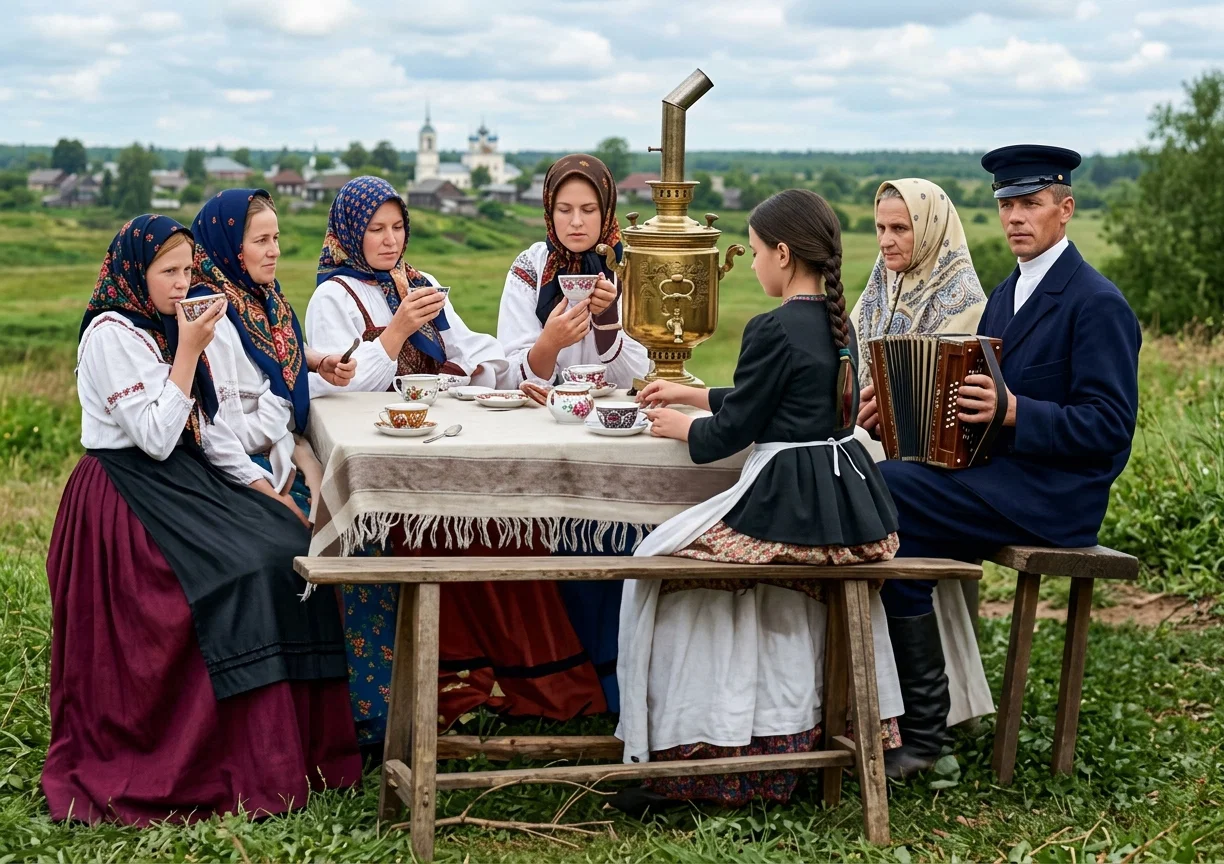
A Russian Tea Party.
The Russian State Church is an offspring of the Greek Church. Sometime in the ninth century the Greek Church sent missionaries into what is now Russian territory, but no permanent results seem to have followed. In the succeeding century, in 955, the Princess Olga, at that time regent of Russia, went to Constantinople, and was baptized into the Greek faith; but the wild tribes of the Russian steppes still worshiped their idols.
Princess Olga’s grandson, Vladimir I., having united under his rule the provinces that formed the nucleus of the present Russian Empire, decided to choose a religion, not only for himself, but for his subjects as well. He investigated the claims of the Catholic, Greek, Mohammedan, and Jewish faiths; and it is said that he was led to choose the Greek Church from the “enthusiastic accounts” given by his ambassadors of the splendor of the services in the church of St. Sophia at Constantinople. Vladimir went to Constantinople. The grand and imposing Greek ritual seemed all that could be desired, and his choice was made.
The royal convert demanded in marriage the hand of the Princess Anna, sister of the emperors Basil and Constantine. Vladimir was already well supplied with wives. He had a “great number,” we are told. But that was no bar to his marriage with a Byzantine princess. If she objected to being one of many, it was easy to dispose of the others. They could be banished from court, or even killed if it was necessary. Emperor Basil was not a little embarrassed by the proposed alliance. He was unwilling to send his delicately reared sister, who had all her life been accustomed to the refinement and luxury of the brilliant court at Constantinople, to a country of barbarians, even tho it was to share a grand ducal throne. But Anna was quite willing to become a royal missionary, with a good prospect of bringing a nation to her faith.
When Vladimir returned to his court at Kief on the Dnieper, he had the images of Peroun and other national gods of the Russians thrown into the river. It is said that the people cried a little over the loss of their gods; but they were baptized at the command of their prince, and lo!—
“The whole land became a Christian land,
In the old gods no more trusting and believing.”
Thus was Russia Christianized. Since that time through all the changes of Mongol invasions and of the conquests by which Russia has grown into the mighty empire of the north, the Greek Church has remained the established Church of Russia.
The Russian Church long acknowledged the primacy of the Greek Church, and with more or less loyalty the authority of the patriarch at Constantinople. The fall of Constantinople in 1453, and the growing power of Russia, prepared the way for a complete separation, which, however, was accomplished gradually.
During the reign of Peter the Great (1689-1725), the patriarchate was abolished, and the czar has since been the head of the church; but its government is in the hands of the Holy Synod, the members of which are appointed by the czar and are partly priests and partly laymen. The members of the synod must take an oath to “be loyal to the czar and his successors, and to recognize the czar as the highest judge in the synod.” It follows without saying that “the synod is subject to the czar and receives his orders.”
The presiding officer of the synod is the oldest metropolitan; but the procurator-general represents the czar, and has the right of veto. Thus “the constitution of the synod and of the Russian Church in general is such that it places the clergy under the authority and supervision of the government, and makes it subservient to the interests of the powers that be.”
It is a rule that political religions are intolerant, and the Russian Church is no exception to the rule. When, in the latter part of the eighteenth century, the ancient kingdom of Poland was divided, several provinces fell to the share of Russia. Many people of these provinces were United Greeks; that is, they were of the Greek faith, but united to Rome. Catherine II. was on the throne at the time, and so good a proselyter was she that during her reign about 7,000,000 of these “schismatics” were gathered into the “true fold;” and so consistently has the policy then entered upon been carried out, that in 1879 the United Greek Church was declared to be nearly extinct.
In the reign of Alexander I. a very earnest attempt was made to convert the Mohammedans and pagans in his dominions; and it is said that it was made worth their while to be converted. Under Alexander’s son and successor, Nicholas I. (1825-55), “schemes were formed and extensively supported for the consolidation of all the tribes of the vast empire into one language and one religion.” They have not succeeded, however.
According to the “World Almanac” for 1901, there are in Russia 73,000,000 adherents of the Orthodox or Russian Church. There are also 19,000,000 non-adherents, including Roman Catholics, Protestants, Jews, and Mohammedans. Of these the Jews and Protestants have been more than once the victims of cruel persecution. For the czar is quite too likely to act on the advice Augustus is said to have received from Maecenas: “By all means and in every way yourself reverence the divinity after your country’s manner, and compel others to do so; and all who follow strange customs in this matter, both hate and punish.”13
As in Russia it is a crime to propagate any but the established religion, that country is one of the hardest in the world for the Gospel message to enter. But even in that unpromising soil, the seeds of Bible truth have found lodgment, and are bearing fruit that in the great day of days will appear to the glory of God.
E. J. BURNHAM.
REST IN THE LORD
By Margaret E. Sangster
O, The blissfulness of resting in the goodness of the Lord,
O, the happiness of taking, as He speaks it, every word;
Tho' the clouds may hang above us, and the winds go wailing by,
There is light and comfort for us when He guides us with His eye.
Just to seek the Father's blessing, as we do the Father's will,
Just to listen for His whisper when the house is very still,
And amid the throng to hear Him saying, "Child, go forth for Me,"
Is, through strife and storm and battle, to be sure of victory.
Poor or rich, or young or aged, on His faithful love we lean,
In the secret of His presence we are evermore serene;
Nothing that He sends can harm us, nothing that He does can chill
That responsive love upspringing, glad and swift to learn His will.
Father, as the days are hastening, and our heaven nearer grows,
From the matin-song till even brings the sweetness of repose;
On Thy tenderness we're resting, in Thy wisdom is our trust,
Since Thy everlasting goodness stoops to glorify our dust.
—Margaret E. Sangster.
THOUGHTS SUGGESTED BY THE STUDENT VOLUNTEER CONVENTION.
By J. W. Collie
[From our own correspondent.]
It would be impossible for an individual to sit for five days in a great convention like the one just closed at Toronto, and not be impressed with the significance of the Gospel message and what it will accomplish for the world. Speaker after speaker who had spent years in these far-distant lands told what the story of the cross was doing, and showed the effects of Mohammedanism, Buddhism, and all the other heathen systems,—that heathenism degrades woman, sets her aside as being unworthy of any place but that of a slave and a servant, and also that Christianity is the only religion that makes provision for a child. Pathetic instances were told of the little slave children gathered up by slave-traders in Africa, branded upon their little cheeks, and made to suffer every imaginable cruelty.
But time and space will not allow me to enter into a history of the world's great need,—of the millions in far-distant lands who do not know Christ, and the millions in our own home country who are going down to death because of intemperance, vice, gambling, and other evils, and to contrast with this great need the expenditures of the civilized nations of earth on things that are hindering rather than hastening the work of the Gospel.
The United States and England have spent enough in the wars in the Philippines and South Africa to keep 40,000 missionaries at work for the next generation. One church in New York City is putting up a fifteen-million dollar cathedral, the cost of which would keep a thousand missionaries at work for fifteen years. The spirit of sacrifice in the early church has been lost sight of, and to-day the church and the world walk hand in hand.
Personal Observations.
The message from the returned missionaries from darkened India and China, from Africa and Japan, from Korea and South America, was that the opportunity just now for the presentation of the Gospel is most favorable. In a wonderful way the “open door” stands invitingly before the church, giving it opportunity to carry to those sitting in darkness the marvelous light of the Gospel. The man and the hour are made to meet, and we are facing a wonderful to-morrow, facing a crisis, and our duty lies plain and marked before us.
An Intelligent Service.
The times demand from every child of God the very best service that can be given. If we are not stirred by the needs of a world sunken in sin, by the facts that stand out so prominently to-day; if we do not feel “woe is me” if I do not do my part in making known the story of Calvary, then we need to feel alarmed, and question very closely our religious experience. It should be no longer a sentimental feeling of waiting for impressions as to the field we should enter; but the calls to all these fields are manifest in the opening providence of God, and where the need is the greatest, and our talents can be used, that is the place to which we should go.
But it is clearly evident that the necessary qualification to-day for those who will do effective work for God is the Christ-life lived and manifested in devotion and earnestness, with a faith that will look beyond all the hardships before us, and see the end of the race and the reward of the faithful.
The Neglect of the Church.
This is the sad picture we are obliged to look upon to-day. The professed church of God, to which has come light and knowledge and great spiritual blessing, is indifferent to a large extent to the plaintive calls of millions of our brethren and sisters. Individuals are interested, mission boards are interested; but the church, that should be looking for the return of the Saviour, is indifferent and asleep. The admonition is, “Awake! awake!” The fact that the world lies in darkness should be an incentive to the true child of God to press out into the great harvest-field, and work with activity and zeal.
Our Duty.
It is the duty of the people of this generation to make known the Gospel in this time. The Christian workers of the past or the future can not do the work allotted to the Christians of this day, and therefore there is the need of personal responsibility being manifested. The command from the lips of the Master, “Go,” is to every blood-bought man and woman; and the “Lo, I am with you,” is conditioned upon our obedience. We are not responsible for success; but we are responsible for obedience.
Looking at the work before us from a human standpoint, it is an impossibility; but we turn away from the feeble, futile efforts of man, and the gracious words of the Lord come to us with comforting assurance, “Every valley shall be exalted, and every mountain and hill shall be made low; and the crooked shall be made straight, and the rough places plain: and the glory of the Lord shall be revealed, and all flesh shall see it together; for the mouth of the Lord hath spoken it.” We have a right to expect great things, for we serve a great God, who is abundantly able to do far above that which we think or ask for.
Like Elijah we are to ask for rain in this time of the latter rain, and if we can only realize that the energies of God are released by prayer, we shall not let go until we see the cloud of promise arising. It may be no larger than a man's hand at first; but soon the rain-drops will fall, and we shall have showers of blessing. J. W. COLLIE.
OUR WORK AND WORKERS.
A THREE weeks' institute was commenced at Syracuse, N. Y., on the 1st inst.
A FEW weeks ago Brother L. W. Perry organized a Sabbath-school at Florence, Mo.
THREE converts to the faith are reported at Dayton, Tenn., by Brother B. T. Walker.
IN the Reporter, Brother O. A. Hall notes the conversion of eight persons at Red Cloud, Neb.
A CANVASSERS' institute is now in session at Milton Junction, Wis., to continue till the 10th inst.
THREE persons have accepted the truth through the Bible-work of Sister Cora Rapp in St. Louis, Mo.
ON account of increasing membership, the brethren in Lincoln, Neb., have decided to erect a new house of worship.
A GERMAN Sunday-school of forty members was recently organized in St. Louis, Mo., by Brother Gellert, who is laboring among the people of that language.
OVER twenty thousand copies of Present Truth, our London paper, are being sold and otherwise distributed every week.
AN unusual canvassing spirit is manifest in Oklahoma. A canvassers' institute was attended by forty-five earnest students.
LABOR by Brethren G. A. Larson and A. R. Sharke, at Abia, Iowa, has brought three to yield themselves to obedience, and set many others to earnestly considering what they must do to be saved.
THE brethren at Cape Town, South Africa, commenced a church-school on January 29, amid general rejoicing. The school opened with twenty pupils, and Miss Helen Hyatt of Kenilworth as teacher.
A NEW church building has been erected at Uitenhage, South Africa, and the dedication was made the occasion of a meeting including February 7-9. Brethren H. J. Edmed and D. F. Tarr conducted the services.
THE oldest Seventh-day Adventist is Sister Susan Bright, a member of the Topeka, Kansas, church. She was born in 1789, and is therefore in her 113th year. She accepted the truth four years ago at the age of 108.—Virginia Messenger.
BROTHER L. F. STARR reports to the Workers' Bulletin that “about twenty persons have taken their stand for the truth of God” at Cedar Rapids, Iowa. He also reports fourteen converts in connection with the school at Marshalltown.
IN the Fortnightly Visitor (Cape Town, South Africa) Brother J. M. Freeman tells of an interesting return trip from Cape Town to Basutoland. He reports a good time on the journey to Bloemfontein distributing papers to the block-houses. The children and others on the train were interested in what he was doing, and asked for papers to give to the soldiers. Altho he had large parcels, he was far short of having enough.
A REQUEST has been made by the General Conference that Sabbath, April 5, be set apart as a special day of prayer, and a study of the medical missionary work, in view of erecting a medical college for the training of workers in this line of the Lord's work. It is not designed to take up a collection, or make a special pull for money, but simply to interest the people in the missionary-acre enterprise.
A REPORT in the Welcome Visitor tells of an excellent work in Waterford, Ohio. Brother L. C. Sheafe was urged to come and hold meetings with the church. At the second meeting it was demonstrated that the little church of 150 seating capacity would not hold the people who desired to attend. Persons not of our faith offered to pay for a hall, and the offer was accepted. The people came from all quarters, some coming fifteen miles. One Sunday night some went away for want of even standing room.
IN connection with meetings held in Erie, Pa., we find this item in the Keystone Gleaner, from Brother M. Lukens:—
A gentleman of some means, who has never made any profession of religion, raised his hand for prayer on a recent Sunday night. A few days later his young son was taken very sick, and the man and his wife spent the night in seeking the Lord for the restoration of their boy. God heard and answered their prayers. This made such an impression on the man that the next day he sought the Lord for the forgiveness of sin, and, like Jacob, would not cease pleading until he received the blessing. He has sold out his business, and has since refused a position that would pay him $25 per week because he could not keep the Sabbath and hold it. He is now awaiting baptism.
UNDER date of Skagway, Alaska, March 2, Brother T. H. Watson writes concerning the work there as follows:—
Our public meetings have been very well attended, and the interest from first to last has been excellent. After the meeting was well under way, Brother Dart came for a season, and we greatly appreciated his presence and help. Several have accepted the message and others are deeply interested. We are now holding Cottage Bible-readings, and the Lord is blessing. We have planned to open public studies for permanent work. This country is open for our medical mission and health food branches, and we are planning to press forward on these few lines. We gave a demonstration in the way of a hygienic meal, and it was well-pleasing to note the interest it aroused. We now have many calls for health foods. One great drawback to this field is the high rates of transportation. Many of our staple foods could be manufactured here. This would greatly aid in the way of expense. This work could well be conducted in connection with a sanitarium or even small treatment rooms. As the spring opens up, the rush is for the “inside,” as it is termed here, meaning the gold fields along the Yukon River. The miners all seem to take to our work, and are anxious for some of the foods to take in with them.
AN IDOL THAT COULD NOT GET OUT OF BED.
A LITTLE lassie from a heathen home had been for a short time attending a missionary school. The idols in her home had been regilded. One day the “Goddess of Mercy” was missing from her place. After some searching it was found in the schoolgirl’s bed. When asked how it came there, she explained that she had heard at school that idols were pieces of wood; so she thought she would try for herself if this were so, and she took down the idol to sleep with her, in order that she might see whether it was wise enough to get up out of bed in the morning when she got up. It was rather clever of a little mite of eight years of age, at least so her grandfather thought, and he saved her from the beating her mother was going to give her. But her strange act, and the reason she gave for it, was the subject of talk in the home, and the next Sunday the whole family came to church.—Selected.
Children Fund Missionary Work in Mindanao
CHILDREN in the Sandwich Islands have raised $10,000, with which to inaugurate missionary work on the island of Mindanao, in the Philippines. Some sentiment enters into their gift, since they aim to do for others what missionaries from the United States have done for them. They have asked the American Board to undertake the administration of the proposed Philippine effort, but that body has tacitly promised not to enter upon Philippine work at present, but to confine itself to the Caroline Islands and the Ladrones.—New York Christian Advocate.
PUBLICATIONS WANTED.
J. REID desires a continuation of papers for mission work in Tacoma, Wash. His address has been changed to 1311 North Tenth Street.