SINCE our last article on this, to the Pacific Coast, great enterprise, the Exposition has been opened, and the attendance for the first ten days has been about two-thirds as great as that of the Chicago Fair during the same time, very much larger in proportion to the cost and extent of the Exposition. But while the Midwinter Fair is much smaller than that of Chicago, it will have many attractions which the Chicago Fair did not have. In fact, one of the greatest attractions of the Midwinter Fair to the people in the East will be that it is held right at a time when the East is slumbering under the snow, and there are thousands of people who will be only too glad to leave the frost for a time and view the beauties of California—
"Where the leaf never fades in the still blooming bowers,
And the bee banquets on through the whole year of flowers."
Those who have already come from the East state that there are thousands who will visit California this year, and the railways have extended the time limit of excursion from the East to thirty days.
It would be impossible to speak of the many attractions which the managers of the Midwinter Fair present before the public. One of the most horrible conceptions and "attractions," if such it may be called, is the representation of Dante's "Inferno," or the infernal regions. The entrance to this horrible place is a great dragon's head, fifteen feet in height, with bat-like wings protruding from either side, and the entire front is gilded to look like burnished gold. Out of the center of the lower part of this monster head, so to speak, projects a long red tongue, like that of a dragon, and onto this the ones must step who care to venture in, and step on the teeth in the dragon's lower jaw into the subterranean regions. The interior arrangement of these "infernal regions" is rendered remarkably effective by the highly colored stalactites which hang from the walls, and which seem to extend for miles, almost, away in the distance. This perspective is produced by means of mirrors on every hand, and never before has there been a better utilization of the looking-glass for illusionary purposes. Hidden lights are made use of to add to the effects of the scene, and intricacies of passage are also brought into play. Although it is said there is much that is grotesque and uncanny in every part of this arrangement, there is nothing that is disgusting or terrifying. Of course the whole thing is based on the old traditional ideas of what hell is, and, while it may serve to take away the impress of the tradition from people's minds, it will hardly have the effect of leading them to the truth.
The Firth wheel is another concession of interest. It is 120 feet in diameter, and from the upper part of the wheel one is fully 150 feet from the lowest levels of the ground, and gets a very good bird's-eye view of the Exposition. It is of safe construction and easy motion. Another thing which will attract many, and which will indeed be of interest, is the Hawaiian Cyclorama of Kilauea, or the burning volcano. It is said to be a very realistic picture, and has been much improved since it was shown in Chicago. Another very interesting feature, at least to many of the younger generation, will be the '49 Mining Camp, which will give the people of the present day something of an idea of how men lived back in the early days of California, although it is questionable as to its moral influence. But among the most interesting things to Eastern visitors will be the displays of fruits and flowers by the various counties of California. One of the great exhibits within the Exposition was opened on January 20; this was the Northern California citrus fair. It is held in a special building erected by the northern and central counties of California. In it may be seen the citrus fruits, such as oranges and lemons, in clusters, in jars, in heaps and piles, in the construction of buildings and various designs on every hand. It was opened thus early because the orange growers say this is the time to show their fruit to the best advantage. The orange growers in the southern part of the State, however, believe that their exhibit will show better later on in the season; and the citrus fair of Southern California will not be opened until the middle of February.
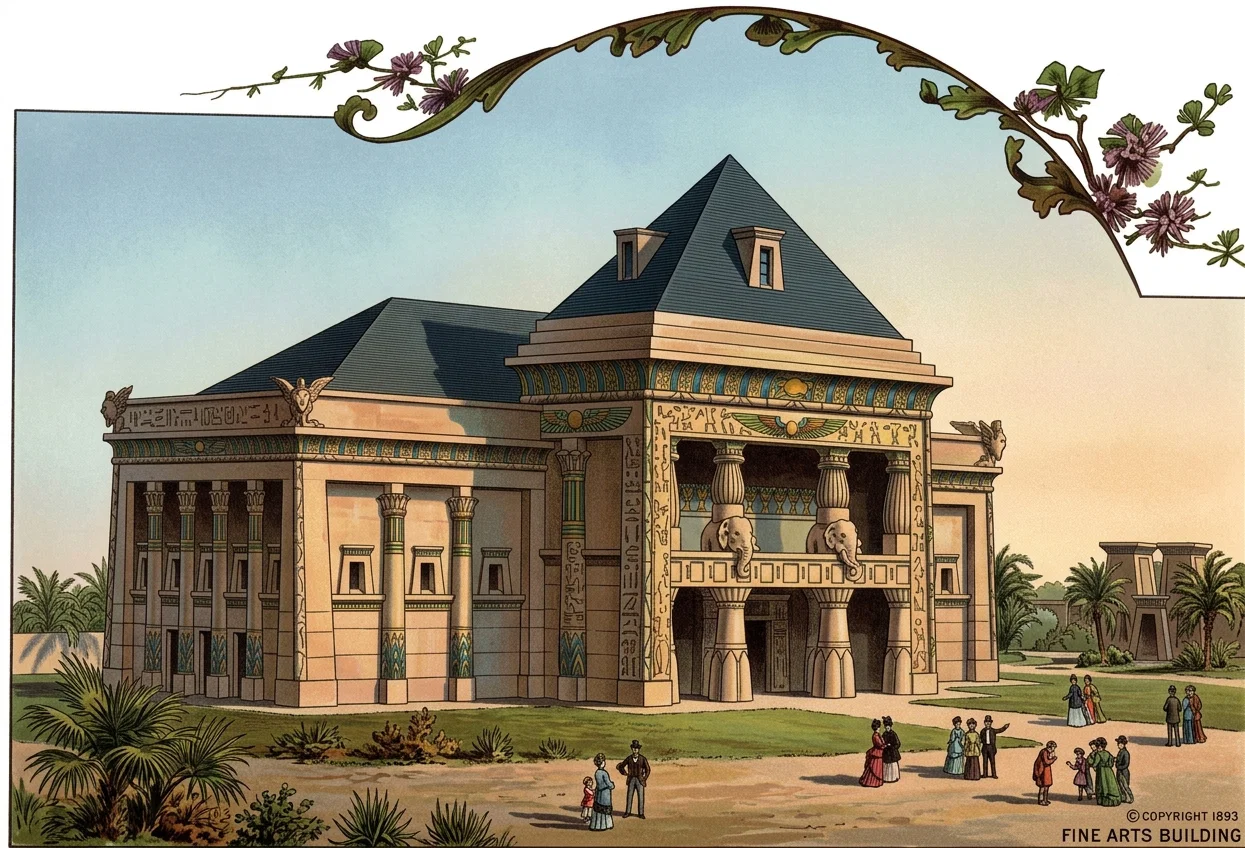
FINE ARTS BUILDING.
The management of the Fair have gotten out one of the finest views of the ground on paper ever placed before the public in an enterprise of this kind. It has been posted at every railway station in the United States, and in many other places, in order that the public who may never have the opportunity of visiting the great Exposition may get an idea of what it is like. It is a lithograph from the painting by Charles Graham, the noted artist who made the picture of the World's Columbian Exposition. There is this difference, however, Mr. Graham made that picture from the plans and ideas of the projectors, but this was sketched on the grounds after nearly all the buildings were in progress of erection, and when the location of every building had been positively settled. This bird's-eye view will give an accurate picture of the Midwinter Fair. Its five main buildings are grouped around the grand central court, 1,000 feet in length, in the midst of the 200 acres of the Golden Gate Park. From the center of the court rises the electric tower, 272 feet in height, and one from the top can see 76 different concessional structures, several of which really inclose half a dozen buildings each.
The Exposition at Chicago was variously called "The White City" and the "Dream City." The name of this has not yet been decided upon, the two leading terms thus far being the "Palm City" and the "Sunset City." The latter name, however, seems to have the greatest favor.
On the opening day 72,248 passed through the turnstiles into the grounds. The grand stand, erected for the occasion, seated 7,000 people, and tens of thousands more gathered on the greensward in front of the speaker's platform. The president of the day, James D. Phelan, made his address. Rev. Wm. Ford Nichols, D.D., bishop of the Episcopal Church, offered prayer. The Governor of California, Hon. H. H. Markham, made the address and welcomed the visitors. W. H. L. Barnes, the orator of the Pacific Coast, made the speech of the day, and Mrs. M. H. De Young, wife of the director of the Fair, pressed the electric button which set the machinery in motion. The day was warm and beautiful, many taking off their overcoats and using them as cushions for their seats.
Since the opening day there has been an average attendance of over 8,000. Renewed efforts have again been put forth to close the Fair on Sunday, but the Sunday attendance thus far has been the best. It will, however, have this effect, the pressure which the Sunday people bring to bear will no doubt be the means of covering some of the exhibits; but as to closing the Fair, it is probably questionable. On the whole, the Midwinter Fair will doubtless be a grand success from a worldly standpoint. It contains many things which will be of interest and instruction to all who may be able to attend it, and it is for that purpose that our readers may wish to avail themselves, doubtless, of the privilege. It will also have elements of evil; in fact, it is a miniature world. We hope that all our readers who may be able to attend it may be able to shun the evil.
HE LEADETH ME.
By Henry Burton
BY THE REV. HENRY BURTON, M.A.
"He leadeth me;" I know that lesson well,
For He Himself hath taught me,
As on and on, through ways I could not tell,
His loving hand has brought me;
And so I lean upon His arm and rest;
His love is changeless, and His ways are best.
"He leadeth me;" sometimes I broke away,
Straying afar all blindly;
But still He followed me by night and day,
And called to me so kindly,
Until I turned, with bleeding feet and sore,
And promised I would leave Him nevermore.
"He leadeth me" upon the mountain bare,
Amid the clouds and thunder;
Then, in the sunshine of the valley fair,
I follow on and wonder.
But be it up above or down below,
It must be right, for He hath willed it so.
"He leadeth me" 'neath ever-changing skies,
The raining and the shining;
And through the night I only close my eyes,
And wait without repining;
'Tis sweet to trust Him when I cannot see,
And in the dark to feel He cares for me.
—Christian Advocate.
THE EFFECT OF TOBACCO ON HEALTH.
By E. L. Hart
BY E. L. HART.
"THINK of ancient Greece, of her glory in arts, arms, and song, of her poets, sculptors, architects, after whom the modern toil in vain. We do but follow in their track with halting steps and slow, and yet they lived their lives, and thought their deathless thoughts, and gave immortal beauty to the silent stone without tobacco."—Quarterly Journal of Science.
"In 1492, when Columbus arrived at the island of St. Salvador, some of his sailors who went ashore returned saying that they had seen some natives roll up a kind of dry leaf, set fire to one end, and inhale the smoke."
"This same habit of smoking tobacco was then a gift of savages to civilized men, and, strange to say, whilst the good works of civilization advance so slowly, this fetid herb, borrowed from the naked aborigines of the New World, has overrun the whole of the Old World in the space of three centuries."—Dr. Drysdale.
"If you get a medical opinion in favor of a pipe, it is the opinion of a man who indulges in it. An unbiased and unprejudiced opinion in favor of tobacco is yet to come."—Prof. Max Muller.
"Surely, if the dictates of reason were allowed to prevail, an article so injurious to the health, and so offensive in all its forms of employment, would speedily be banished from common use."—Dr. Prout.
Our forefathers looked upon smoking as a luxury seldom to be indulged in till the work of the day was done. Most men nowadays who have adopted the habit, regard it as a necessity, and their pipes as inseparable companions.
Nicotine, the active principle in tobacco, is a poison, and cannot be inhaled with impunity. A most moderate indulgence in the weed is harmful, whilst its excessive use is often fraught with disastrous consequences.
In dealing with the question of "Smokers and Smoking," it should be remembered that isolated cases do not form correct data for argument. There are men of refined stamp who smoke, and men of the lowest caliber who do not. Men who are apparently in good health and will never own to a headache enjoy their pipe and cigar, and men are often in doctors' hands who never touch either. One man will say tobacco has been the bane of his life, whilst another will strongly assert it has been his greatest boon. There are many inveterate smokers who, to superficial observers, suffer in no particular in consequence of the habit. It is, nevertheless, true that smoking is physically, mentally, and morally injurious to the constitution, and that the use of tobacco is incompatible with a high standard of health and vigor.
Smoking is one form of self-indulgence and selfishness. It dulls a man's sense of the rights of others, and destroys the natural susceptibility of his mind, causing him to be morose and indifferent to the rights of others. It may here be remarked that the ill effects of smoking upon a man's nature are negative rather than positive, soothing into forgetfulness his sense of duty and moral rectitude, and rendering him unmindful of those existing ends which it should be every man's aim to remove.
Dr. Copeland says:—
"Tobacco weakens nervous power, favors a dreamy, imaginative, and imbecile state of existence. The smoker ultimately not only becomes partially but generally paralyzed in mind and body; he is subject to tremors and numerous nervous ailments, and has recourse to stimulants for their relief."
The evil results of overindulgence in strong drink are more positive, arousing the baser passions, and causing a man to break the rules of decency and order.
These traits vary according to the disposition and temperament of the individual, and are in proportion to the extent of his indulgence. Of course there are smokers who are not drinkers, and vice versa; with the majority, however, the habits go hand in hand, for smoking creates a desire for stimulants, and when the habit of drinking is first acquired, the false solace of tobacco is found desirable.—Journal of Hygiene.
(To be continued.)
SOUTH AMERICA AS A MISSION FIELD.
In a paper read before the Congress of Missions at Chicago, Rev. Thomas B. Wood, D.D., of Peru, gives some interesting points concerning the physical and moral development of the southern continent, from which we take a few paragraphs:—
South America has 7,000,000 square miles of surface. Over 6,000,000 square miles are good for immigration—double the territory of the United States. It has no great tracts under perpetual snow like North America, Europe, and Asia, nor any great deserts like those of Arabia, Africa, and Australia. It has 35,000,000 inhabitants—only a little more than half the present population of the United States. Thus it is one-fourth as densely populated as this country—about what this country was two generations ago. No other tract of good land exists so large and so unoccupied as South America.
The coasts are all compassed by steam navigation already well developed, second only to that of the most populous parts of Europe and the United States. Its interior is nearly all accessible through rivers, the mightiest on earth, with navigation established for thousands of miles, the beginnings of the mightiest river traffic in the world.
The railway systems are well commenced to connect the waterways with every part of the territory. The Andes have been scaled at two points at heights of 14,500 and 15,500 feet, the highest railway passes in the world, and the highest points where steam is now at work. Railways will gradually pass the Andes at many points, opening up vast and rich territories lying near the sea, but hitherto shut off from the sea by a mountain wall. This barrier once vanquished by modern railway progress, South America will become the most accessible of all continents.
Ten young republics are absorbing the immigration as fast as it can come, and vying with each other to attract it. The United States never offered such inducements to foreign settlers as those countries are now offering. No other part of earth is bidding so high as South America for Europe's surplus millions. South America has the advantage of a climate that makes all parts of it available and all its coasts accessible. Its low latitudes are offset by its great altitudes, giving it a temperate zone character over the most of its250area, wholesome and inviting for Europeans.
The streams of emigration from Europe are now turning from the United States to South America. The first drift in that direction dates from forty or fifty years ago, soon after the independence of those countries from European rule. A steady flow dates from about thirty years ago, and for the last twenty years it has been an increasing tide, reaching every part of the continent in greater or less degree.
This movement will progress more rapidly there than has ever occurred here, and on a scale unknown in history. The European influx into the United States never reached two per cent of the population in any year, and never averaged above one per cent in any decade. In the Rio de la Plata countries the increase by immigration from Europe has averaged two per cent per annum for the last twenty years. Steam and electricity have shortened distance. Europe is more populous than ever. South America is twice as large as Europe, and invites the immigrants not only along its eastern shores, but everywhere.
There are two dominant languages, but they are so closely allied that they seem merely dialects of one. It has ten nations, but currents of thought and feeling, as well as the movements of immigration, flow across their frontiers as freely as the rivers or the winds. The uprising for independence swept the entire length of the continent in the space of a few weeks. Important movements anywhere agitate the whole.
It has everywhere dominant the Latin civilization and culture and the Roman Catholic religion, with North American republic government and free institutions. No other territory so vast has such uniformity of moral conditions. They have all the same historic traditions, the same political and social aspirations, the same peculiar tendencies, and, with all, a consciousness that they form a family of nations whose interests are common and whose destiny is one. No other portion of earth presents this peculiarity on so vast a scale.
It must stand in history as the youngest and the vastest and the densest of all the transplantings of European humanity to virgin soil. After the two Americas and Australia are developed, there will be no territory left in which to repeat the operation. The engrafting of European elements on other stocks may go on in many lands, but to develop them from their own roots on new ground will never be possible again unless a new continent should arise. To evangelize this new development of the highest types of mankind is the work of missions in South America.—Gospel in All Lands.*
TRY IT YOURSELF.
OVER five hundred veterinary surgeons have signed a paper condemning tight check-reins as painful to horses and productive of disease, causing distortion of the windpipe to such a degree as to impede respiration. They mention paralysis of the muscles of the face, megrims, apoplexy, coma, and inflammation, as some of the results of its use. The over-checkrein will often cause a horse to become knee-sprung. It destroys the delicate sensitiveness to the bit which is most desirable in guiding a horse.
Dr. Kitching says: "If a horse pulling a load has his head held in by a checkrein, he cannot throw his weight into his collar, and is hindered from giving his body that position which is most natural and effective."
He goes on to speak of the consequent strain of his limbs and muscles, and the injury caused by the constrained position of the head, whereby the breathing and circulation are affected, and the horse made restless, irritable, and uncomfortable. He says: "The check-rein inflicts unceasing torture upon the animal in another way. By holding the head upwards, it puts the muscles of the neck on a constant strain. They become painfully uneasy and tired. If the horse cannot bear it, he rests the weight of his head upon the rein, and his mouth is violently stretched. Thus he only exchanges one torment for another. To sum in a word, the checkrein lessens a horse's strength, brings on disease, keeps him in pain, frets and injures his mouth, and spoils his temper."—Selected.
No Other Man Can Do Your Work
No OTHER man can do your work.
ABOUT THE SENATE.
TWENTY of the United States senators served in the Confederate army during the war, and sixteen in the Union army. The man with the longest time to serve is Edward C. Walthal, of Grenada, Miss., who has been reelected by the Legislature of the State for the term ending in 1901. The most cultured senator is Henry Cabot Lodge, of Massachusetts, who is an author, artist, linguist, scholar, and society man. The handsomest is Charles H. Gibson, of Maryland. The most senatorial is Alfred H. Colquitt, of Georgia, whose father and grandfather sat in the Senate before him. The haughtiest is J. Donald Cameron, of Pennsylvania, whose unique distinction is never to say a word in the Senate unless he moves to adjourn. The richest, now that Stanford is dead, would seem to be John P. Jones, of Nevada, who bestows gold dollars on the beggars of Washington. The one most celebrated outside of his own country is John Sherman. The most abused is Matthew Stanley Quay of Pennsylvania. The most punctilious is Calvin S. Brice, of Ohio, who changes his shirt three times every day. The most temperate is David B. Hill, of New York, who neither smokes, drinks, swears, gambles, nor eats dainties. The strongest is William B. Allison, of Iowa, who could almost fell an ox with his fist.—Commercial Gazette.
THE DAY OF GOD.
By F. L. Hosmer
Thy kingdom come,—on bended knee
The passing ages pray,
And faithful souls have yearned to see
On earth that kingdom's day.
But the slow watches of the night
No less to God belong,
And for the everlasting right
The silent stars are strong.
And, lo! already on the hills
The flags of dawn appear;
Gird up your loins, ye prophet souls,
Proclaim the day is near,—
The day in whose clear shining light
All wrong shall stand revealed,
When justice shall be throned in might,
And every hurt be healed;
When Knowledge hand in hand with Peace
Shall walk the earth abroad,—
The day of perfect righteousness,
The promised day of God.
—F. L. Hosmer.
MISSION FIELD NOTES.
By Editor
THE newspapers of Japan do not give the most encouraging reports of the proceedings of the recent Parliament to those who desire to see Japan a self-governing country. About a year ago Japan's House of Representatives elected, with what was said to be remarkable unanimity, a president, whom it has now expelled with a two-thirds vote. This was not because of any change in the character of this official, because his opponents bear strong testimony both as to his ability and the manner in which he has discharged his duties. His expulsion seems to have been brought about wholly through political entanglements, and the proceedings of the Parliament thus far show that Japan is hardly equal to the test of self-government. There is another thing which has also been manifest in the recent Parliament, and that is that there is a determination to keep foreigners from residing outside the treaty ports. One of the bills recently introduced contains the following provision: "Any Japanese subject who, by any device whatsoever, holds land in trust for an alien, shall be liable to major imprisonment for not less than one day and not more than one year, with a fine of not less than twenty yen and not more than two hundred yen." The bill further provides similar penalties for those who hold buildings in trust for foreigners.
THE Government of Turkey has at last consented to permit women to practice medicine in that empire. This has come about largely through the efforts of the United States Minister. The first lady to avail herself of this privilege is Dr. Mary P. Eddy, of the American Presbyterian Board, whose medical diploma has been indorsed by Turkish authorities. She will practice medicine in Syria. This permission will doubtless be granted to others.
IN a recent work issued by the Fleming H. Revell Company, entitled "Reality versus Romance in South Central Africa," the writer, James Johnson, M.D., who has made the journey across South Africa from ocean to ocean, unaccompanied by white men, and without firing a shot, presents some friendly criticisms on "self-supporting" and "faith missions." He thinks that the whole scheme is a grand mistake, and says that his preconceived ideas of Bishop Taylor's missions and those of the Plymouth Brethren in Central Africa, received a great shock. He feels that they can in no sense be called successful.
MANY of our readers know how favorably the rose-colored reports of Hinduism, Buddhism, and Mohammedanism were received at the Parliament of Religions, and the speakers of the representatives of those great religions were many times cheered to the echo. Mrs. Isabella Bird Bishop, in an address at a missionary anniversary in Exeter Hall, London, November 1 of last year, tells quite a different story. She says:—
I think we are getting into a sort of milk-and-water view of heathenism, not of African heathenism alone, but of Buddhism, Hinduism, and Mohammedanism also, which prevail in Asia. Missionaries come home, and they refrain from shocking audiences by recitals of the awful sins of the heathen and Moslem world. When traveling in Asia it struck me very much how little we hear, how little we know, as to how sin is enthroned and deified and worshiped. There is sin and shame everywhere. Mohammedanism is corrupt to the very core. The morals of Mohammedan countries, perhaps in Persia in particular, are corrupt, and the imaginations very wicked. How corrupt Buddhism is! How corrupt Buddhists are! It is an astonishment to find that there is scarcely a single thing that makes for righteousness in the life of the unchristianized nations. There is no public opinion interpenetrated by Christianity which condemns sin or wrong. There is nothing except the conscience of some few who are seeking after God "lest haply they might feel after Him who is not far from every one of us." And over all this seething mass of sin and shame and corruption hovers "the ruler of the darkness of this world," rejoicing in the chains with which he has bound two-thirds of the human race.
As to the effect which Buddhism, Hinduism, and Mohammedanism have upon the women of the oriental countries, take the following from Mrs. Isabella Bird Bishop, who has seen these results with her own eyes:—
Just one or two remarks as to what these false faiths do. They degrade women with an infinite degradation. I have lived in zenanas and harems, and have seen the daily life of the secluded women, and I can speak from bitter experience of what their lives are,—the intellect dwarfed, so that the woman of twenty or thirty years of age is more like a child of eight intellectually, while all the worst passions of human nature are stimulated and developed in a fearful degree, jealousy, envy, murderous hate, intrigue, running to such an extent that in some countries I have hardly ever been in a woman's house or near a woman's tent without being asked for drugs with which to disfigure the favorite wife's infant son. This request has been made to me nearly two hundred times. This is only an indication of the daily life, of whose miseries we think so little, and which is a natural product of the systems that we ought to have subverted long ago.
The Island World
By Charles Marion Tyler
OF THE PACIFIC OCEAN.
BY CHARLES MARION TYLER.
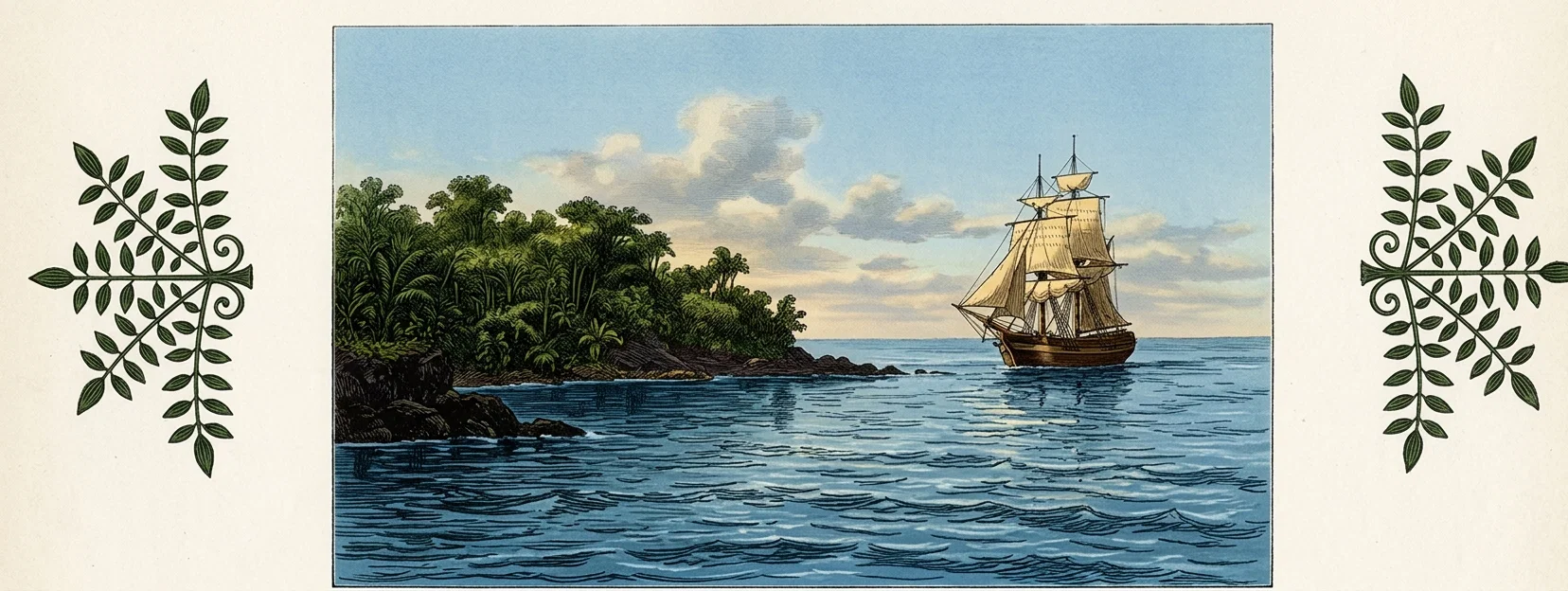
Comprehensive sketches of all the principal Islands and groups of Islands in the Pacific Ocean. Written in interesting descriptive style, with illustrations and handsome colored plates.
With the universal interest now manifested in the destiny of this vast island world, no library is complete without such a work, and this is the only one that comes anywhere near being complete.
300 pages. Cloth binding. Price, $1.25.
Address, PACIFIC PRESS PUB. CO., Oakland, Cal.
THE SABBATH QUESTION
By John Nevins Andrews
IS THE
LEADING SUBJECT OF THE DAY.
THE GREAT DEMAND OF THE HOUR, FROM THE PULPIT AND THE PRESS, IN SOCIAL CIRCLES AND IN LEGISLATIVE HALLS, IS
That the Sabbath be more strictly observed. To assist the intelligent-minded of our land to have correct views of this important question, a book has been prepared which thoroughly discusses the Sabbatical institution in every conceivable phase. Such is the valuable work entitled
"History of the Sabbath and the First Day of the Week."
BY ELD. J. N. ANDREWS.
This great and exhaustive work is the result of ten years' hard labor and historical research. The book contains 548 12mo pages, and is printed in clear type, on good paper, and is well bound. Price, post-paid, $2.00.
Address, PACIFIC PRESS, Oakland, Cal.
TEN LECTURES ON
By John Harvey Kellogg
NASAL CATARRH
By J. H. Kellogg, M. D.
Treats of the Nature, Causes, Prevention and Cure; and Diseases of the Throat, Eye and Ear, due to Nasal Catarrh, and gives a
CHAPTER OF CHOICE PRESCRIPTIONS.
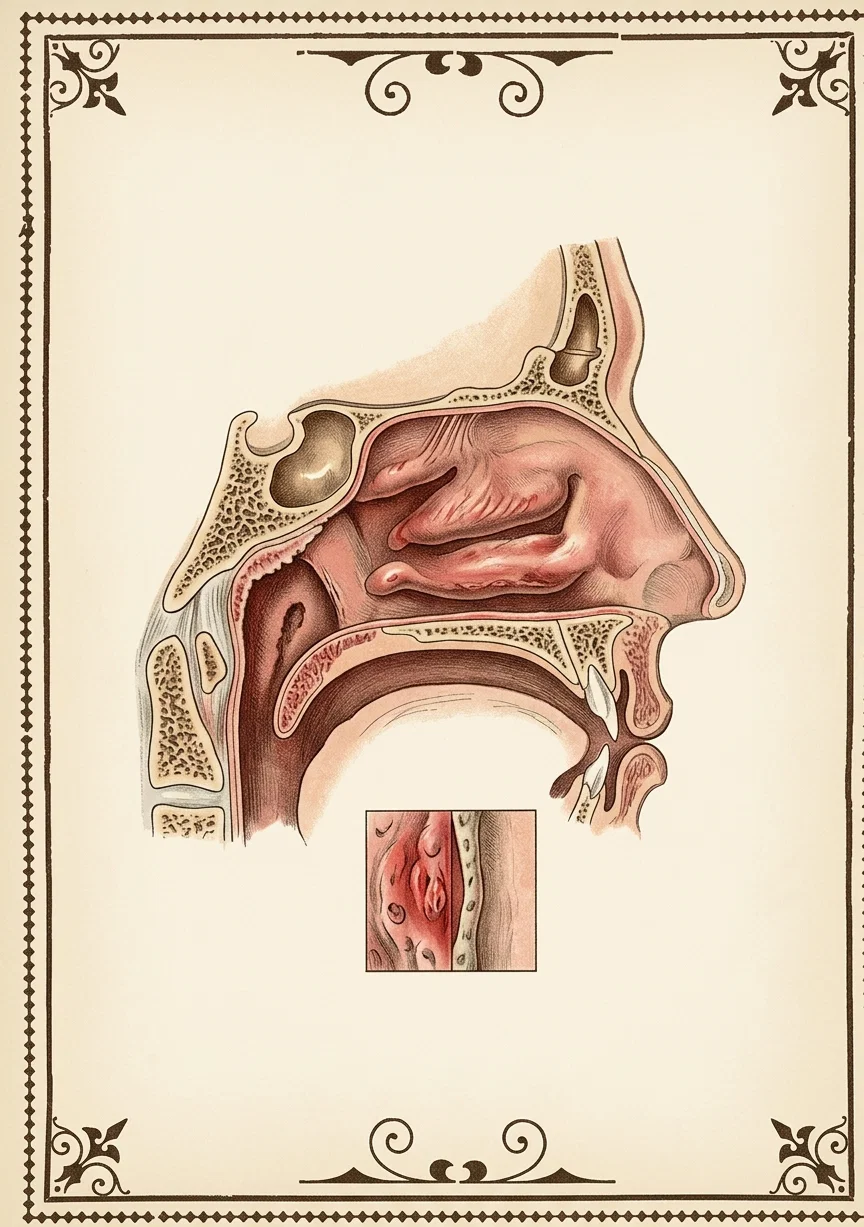
The work contains 120 pages and is embellished with a colored frontispiece, and six beautifully-colored plates, besides many illustrative cuts of the throat and nasal cavity.
Prices: Cloth, 75 cents; Paper Covers, 50 cents.
PACIFIC PRESS PUBLISHING CO.,
OAKLAND, CAL.,
OR 43 BOND ST., N. Y.