Your ShelfYour Projects

Review and Herald, Vol. 89, No. 47.

They Call Us to Deliver
Earlier text: Note and Comment

Those Who Seem to Escape Discipline

Those who seem to escape from discipline are not to be envied; they have farther to go.—A. C. Benson.

Annual Chesapeake Conference and Canvassers' Institute

THE thirteenth annual session of the Chesapeake Conference was held in Walbrook Hall, Baltimore, Md., Oct. 10-17, 1912. Seventy-nine delegates responded to the first roll-call, thus denoting that each church had one or more representatives present. In addition to these, there was of course a large attendance of those who were not delegates. A spirit of harmony prevailed throughout the meeting. All felt that the Lord directed in the selection of the place for the meeting. The weather was all that could be desired.
Previous to the holding of the conference proper, a canvassers' institute was held October 7-10. Elder I. G. Bigelow and F. E. Hankins had these meetings in charge. Fifteen canvassers attended this institute. The time of this meeting was very profitably spent, and the canvassers left for their fields of labor full of courage. A meeting was set apart for the purpose of hearing the canvassers relate their experiences, which was edifying and was greatly enjoyed by the delegates and other members present.
On October 6, Elder F. C. Gilbert of South Lancaster, Mass., came to Baltimore and conducted meetings for three successive evenings. From the standpoint of a converted Hebrew, he explained the Jewish customs and traditions, and gave the real meaning of many of the rites and ceremonies in connection with the Passover, which made the sacrifice of Christ much more real to those who had the privilege of listening to his discourses. He also conducted a series of helpful morning studies before the canvassing class, on “How to Read the Bible.”
The annual report of the president, Elder R. T. Baer, gave marked evidences of prosperity and divine blessing upon the work the past year. A gain of eighty in membership was reported.
The treasurer's report showed excellent gains. The increase in the tithe for 1911 over the year 1910 was $1,382.38. There was a gain also in the general trust fund receipts. For the first eight months of 1911 the tithe receipts were $4,596.33. For the corresponding eight months of this year the tithe was $6,310.58, a gain of $1,714.25, with a gain likewise in the general trust funds.
But while there has been a financial increase in the conference, there has also been a corresponding increase in the urgent calls from the various parts of the field for laborers. This is as it should be. Nothing runs of itself. The answer to these calls came when several new Bible workers were enlisted to enter the field. Mrs. F. W. Paap was called to labor in Baltimore, Md., Brother H. W. Peden being released to take up the work in Hagerstown. Also Miss Emma S. Newcomer, who for several years has efficiently filled the position of secretary and treasurer of the conference, was released to engage in Bible work in Wilmington, Del. Special calls were made for two ordained ministers, one for the east shore of Maryland and one for the city of Cumberland. The needs are so great and the calls so imperative that men must immediately be supplied for these fields.
The same set of officers was elected to continue their duties for the ensuing year with the exception, as noted before, of the release of Miss Newcomer, her place being filled by Brother W. T. Durst. The following-named persons were elected to compose the executive committee: R. T. Baer, R. H. Martin, F. W. Paap, T. L. Thruenler, and G. R. Apsley.
Several important resolutions were passed, which received earnest and serious discussion. Possibly none was more important locally than the project to build a church valued at about ten thousand dollars, in the northwestern section of Baltimore. A splendid lot has been secured in the very heart of an excellent residential section surrounded by business houses and business offices of good character. Many of the business and professional men of the community, as well as the friends and sympathizers of the church, have manifested a great interest in this project.
The preaching services in the evening were largely attended, the seating capacity at times being taxed to its utmost. There is without question a deep interest on the part of the people in that community in the truths of the prophetic portion of the divine Book. The outlook for the work in the Chesapeake Conference and in the city of Baltimore is most excellent. I was pleased to be at this meeting and note the spirit and progress of the work. From time to time, there were also present Elders A. G. Daniells and W. A. Spicer and Prof. W. W. Prescott, of the General Conference, as well as Elder R. T. Dowsett, of the Columbia Union. These all rendered excellent help, which was greatly appreciated.
B. G. WILKINSON.

Graysville, Tenn.

During the week October 19-26, there was conducted a revival for the Graysville church and the Southern Training-school, by Elder W.-H. Branson, which was probably the most successful revival in the history of the work here. From the first, it was evident that great blessings were in store for us. Throughout, the meeting was characterized by deliberateness and earnestness, and at no time was there any excitement or affectation. God's gracious Spirit directed and governed from first to last. The one purpose was that lives should be wholly surrendered to God. This touched the Christian and the unconverted alike. It was refreshing to see so general and hearty a response. In our school family there were thirteen conversions. Many more were reclaimed who had backslidden, besides a reconsecration on the part of all Christian students for some definite place of usefulness in God's work.In this reconsecration for more acceptable service the teachers heartily joined. By deep repentance and earnest confessions God was glorified, and new hopes and purposes were born in our lives.
The church shared equally in these blessings of the week. As is usual when an entire consecration to God, a definite dedication to his service, is the standard, the struggle on the part of some was hard; but very nearly all finally reconsecrated themselves and claimed victory and deliverance.
On the last afternoon of the revival effort nineteen were baptized, including six who were rebaptized. The last meeting on Saturday night, by letter and on profession of faith, twenty-nine united with the church at Graysville. On the following Monday night, after a very earnest sermon by Elder C. B. Stephenson, in which he admonished all to stand fast in the liberty gained, eleven others joined, subject to letter. The Graysville church rejoices in her new members, and desires to be a blessing to them as well as to have them be a blessing to her.
The future prospect for the school and church is bright indeed. Deep gratitude is expressed by all, students and local patrons alike, for the spirit which thus far has characterized the school.
H. S. MILLER.

Autumn Leaves

PEARL WAGGONER
Beautiful, beautiful autumn leaves, Coming so merrily down, Wist ye not that the woodland grieves, Losing its beauteous gown?
Like as the children from school set free Gambol with laughter and shout, So do ye dance in your blithesome glee, Rollicking madly about.
Beautiful leaves of the autumn-time, Scattered so wide-cast and free, Filling the earth with a glory sublime, Still our example be;
For ye remind us that far and near, Thickly as leaves, forsooth, We should be scattering words of cheer, Messages of the truth,
Till, like it now with your glow is aflame, Leaves of the autumn-time, Earth shall be filled with the Saviour’s name, Hearing this message sublime.
Beautiful, wonderful leaves so bright, Tinted with red and with gold, Beautiful lessons are brought to light By your anthem so sweet, so bold.
Hinsdale, Ill.

King William’s Town, South Africa

It has been ten weeks since I returned to King William’s Town, to follow up the work where we had our tent-meeting last season. Brethren Moko and Burton had left two colored women keeping the Sabbath, and I had promised to look after them and get them better established in the truth. The first Sabbath they were the only ones present. I told them that if they expected me to have meetings with them, they must have their children present, and also invite in their friends and neighbors. The next Sabbath there were fourteen out, and I organized a Sabbath-school, and held a meeting with them. As the result of this work, five other women are keeping the Sabbath.
The calls for Bible readings in private homes among Europeans have been more than I could possibly fill. I have been giving nineteen Bible readings a week lately, besides holding two meetings. We hold a Sabbath-school and meeting for the Europeans on Sabbath afternoon. This school numbers but eleven.
One woman who was a Catholic has recently begun keeping the Sabbath, and is teaching the Bible truths to her children. She has much persecution in her own home. Two Dutch women who had given up the Sabbath have been reclaimed recently.
MRS. E. R. WILLIAMS.

Our Participation in the Temperance Crisis in West Virginia

THERE is at the present time before the people of West Virginia the question of an amendment to the constitution looking toward the establishment of State-wide prohibition. Section 46 of Article 6 of the constitution of West Virginia provides that laws may be passed regulating or prohibiting the sale of intoxicating liquors within the limits of the State. In harmony with this provision, the last legislature submitted to the voters of the State for ratification or rejection an amendment striking out this section, and inserting in lieu thereof the following: “On and after the first day of July, One Thousand Nine Hundred and Fourteen, the manufacture, sale, and keeping for sale of malt, vinous or spirituous liquors, wine, ale, porter, beer, or any intoxicating drink, mixture or preparation of like nature, except as hereinafter provided, are hereby prohibited in this State. Provided, however, that the manufacture, and sale, and keeping for sale of such liquors for medicinal, pharmaceutical, mechanical, sacramental, and scientific purposes may be permitted under such regulations as the legislature may prescribe.”
The liquor people are endeavoring to make the taxpayers understand that all taxpayers who possess $10,000 worth of property or more will have to pay a tax of $6.50 on each $10,000 worth of property if prohibition goes into effect. Of course they do not say anything about how much taxpayers have to pay for prisons, policemen, courts, hospitals, and asylums. It is true that some State revenues arising from the licensing of liquor will be cut off, but many expenses of taking care of the product of the licensed saloon will also be cut off, and the saving will likely take care of the loss of revenue. This is but a sample of the active and insinuating work that is being done by those who are financially interested in the manufacture and sale of intoxicating liquors. On the other hand, those who desire to have clean and virtuous neighborhoods have organized themselves together for the purpose of persuading the people to vote for the adoption of this amendment. Elder F. H. Robbins, president of the West Virginia Conference, has been chosen as a member of a committee which will work for that purpose.
Naturally, the Columbia Union and the West Virginia Conferences desired to have a part in this important campaign. In counsel with the General Conference brethren, it was decided that the Columbia Union Conference contribute cash to pay for papers and the time and expense of a special lecturer to visit the State, and push forward the circulation of the Temperance Instructor. In addition, the General Conference generously donated for this special work, while the little conference of West Virginia gave liberally. The publishers also joined in this campaign. To begin the work 20,000 copies of the special number of the Youth's Instructor were purchased. About 30,000 in all were finally circulated. Elder Robbins writes that he thinks this paper will help greatly inbreaking down prejudices and in opening many places for the further presentation of the truth.
It is impossible at this writing to report the full results of the campaign. We trust, however, that the united co-operation of all will be successful in bringing to pass State-wide prohibition, and in opening up hearts for the favorable presentation of the blessed truths of the third angel's message.
B. G. WILKINSON.

Graduation Exercises of the Caterham Sanitarium

The sixth class of trained nurses was graduated from the Caterham Sanitarium last July. A large number of guests and friends of the institution and the nurses gathered in the gymnasium at half past six o’clock, and partook of a bountiful supper given in honor of the graduating class. After singing the graduation hymn, “I’ll Go Where You Want Me to Go,” prayer was offered by Elder S. G. Haughey.
After some brief but none the less interesting and instructive remarks by Brother W. C. Sisley, chairman of the meeting, Dr. C. H. Hayton, superintendent of the Stanborough Park Sanitarium, Watford, gave the graduating address. Dr. Hayton held up to the audience the example of Christ, the Great Physician and model Medical Missionary. He related several incidents in the life of Christ showing that the Master went about doing good, healing the sick, comforting the sorrowing, and speaking words of good cheer and hope. He went about his Father’s business. The doctor told the graduates that the Lord uses human instruments to-day, and that we all have certain responsibilities, and these responsibilities increase in proportion to the educational advantages and the training that one receives. He said that they would have ample opportunities; for sickness, suffering, and disease abound in the world, and sadness and sorrow are found on every hand. He expressed the hope that they would be faithful and true to their high calling, and would be the means of relieving much suffering and accomplishing great good for the kingdom of God.
THE CATERHAM SANITARIUM
Before presenting the diplomas, Dr. A. B. Olsen gave a very brief address dealing with some of the qualities of the successful nurse. He dwelt particularly upon the importance of quietness, the quiet walk, quiet movements, quiet speaking, and the quiet but none the less skilful management and handling of the patient. He said that many nurses give little heed to one of the most important of all qualities, quietness and silence. Some nurses have a good deal to say to their patients about previous experiences with other patients, and gossip of various kinds, and this was deprecated. He then extended a hearty welcome to each member of the graduating class on joining the medical missionary ranks, and presented nurses’ diplomas to the following graduates: Miss Mabel R. Barras, Mr. David E. Delhove, Miss May Gibbs, and Miss Cordelia F. Harris. After a pianoforte solo by Mrs. Leechman, the benediction was pronounced by Elder W. T. Bartlett.
The new graduates have had no difficulty in obtaining work. Indeed, there is a dearth of trained nurses in the United Kingdom to-day, and we are not in a position to meet all the calls that come to us. There is an urgent call for a young man to go to South Africa to assist in the sanitarium work there, and we hope that one of our graduates will be able to accept this call.
A. B. OLSEN, M. D.

Among the Mountaineers of Virginia

It was arranged that the closing exercises of our twenty-day institute at Lucas Hollow, near Stanley, should come on the fourth of July, with the hope that some seeds of truth regarding religious liberty might be sown in the hearts of those attending. Never, since the settlement of the Hollow, had there been a celebration, and the children did not know the difference between the Fourth and any other day.
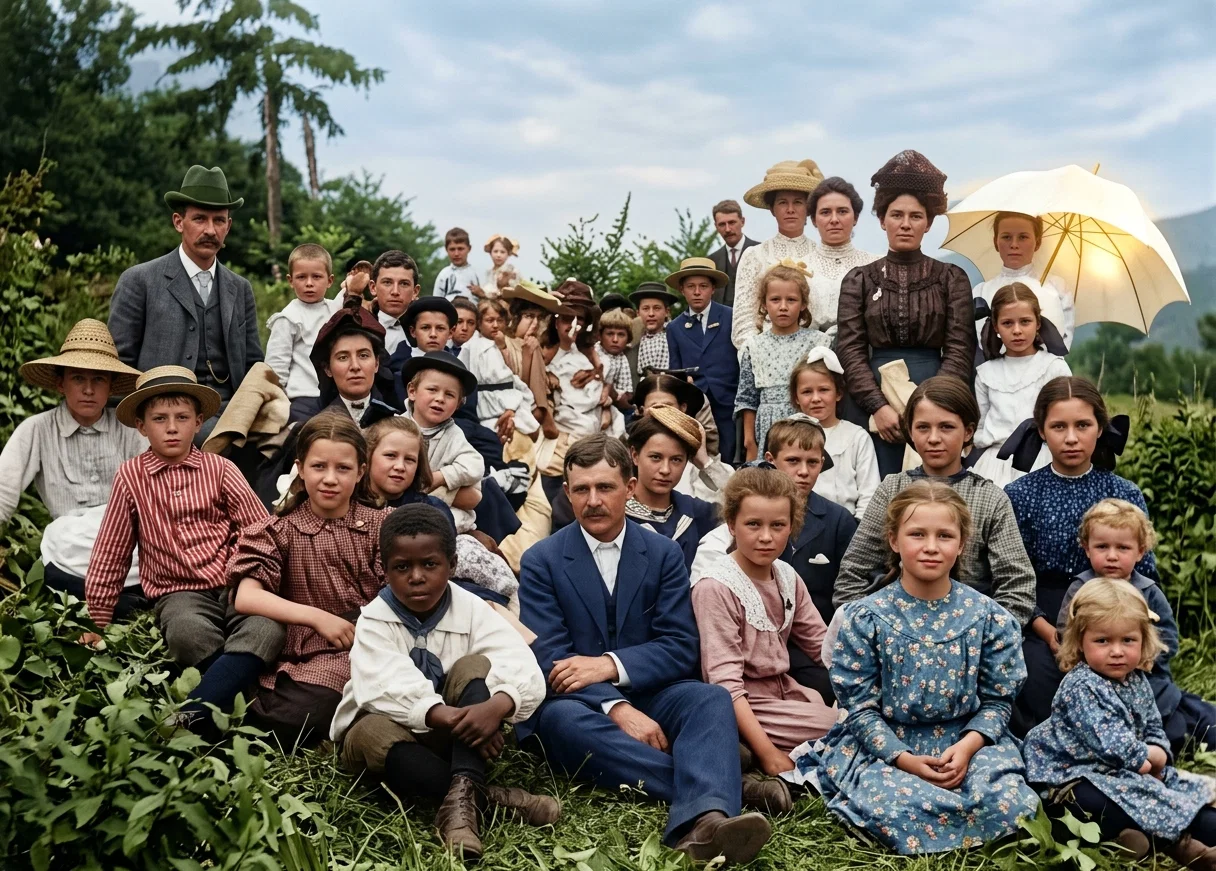
SCHOOL PICNIC AT RILEYVILLE, VA.
These mountaineers are a liberty-loving people, and our program seemed to be much appreciated. Several young persons from the Stanley church came up to assist us; and as patriotic songs were sung, and the Declaration of Independence was read, the audience cheered again and again. The children readily responded to the questions asked them, in an oral test, on different subjects which we had studied together. As some of the leading events in the history of our country were given, the people seemed to grasp the idea that this is a great nation, and that our religious liberty must be carefully preserved.
Later in the summer I went by invitation to Mountain View District, near Rileyville. A number of persons have recently accepted the truth there, and they were anxious to learn the principles of healthful living. It was a pleasure to conduct cooking classes, and at our “last day” picnic dinner no chicken, pork, nor beef was served. The meal was pronounced a complete success.
The ten-day institute was held in a little log schoolhouse. At its close, the children were able to answer one hundred Bible questions and one hundred fifty on geography. Aside from this, they had been drilled in spelling and grammar. We closed by giving an illustrated lecture, and the audience seemed highly pleased as the pictures—Bible scenes, and views from Europe and our own country—were thrown upon the screen. They expressed their appreciation of our efforts, and said it was the first time any one giving free instruction and entertainment had ever visited their mountain. We told them that if they would only love and serve our dear Saviour, we should feel amply repaid for all our efforts. This is truly a blessed and inspiring work.
MRS. MATTIE HAMILTON WELCH.

Visiting Old Friends

ON the evening of September 13, my wife and I received a telegram calling us to Claude, Tex. Our daughter, who was visiting there, had met with a serious accident. While this sad experience called us from home, we had some pleasant visits on our way back to Pennsylvania.
I saw once more the old homestead in Jasper County, Missouri, where father settled forty years ago. I had the privilege of preaching in the school district where in 1874 I first heard this truth. We also visited friends in Nevada, Mo., and met a number of persons who accepted the truth through my efforts during the early years of my ministry. They are still rejoicing in "the blessed hope." While there, I held two services in the First-day Adventist church where I was converted to God.
What a glorious message we have! May the Lord soon come in mighty power, and the saints be gathered home, is my prayer. J. W. WATT.

The W. C. T. U. Convention

The thirty-ninth annual convention of the National Woman's Christian Temperance Union was held in the White Temple, Portland, Oregon, Oct. 19-25, 1912. This was in many respects an intensely interesting gathering. There were not only a large number of the leading women of the United States present, but a number from other nations.
The forenoons were given up to conference work, devoted to studying the different departments of the union. Under this were such subjects as temperance and labor, medical temperance, franchises, evangelistic work, the Bible in the public schools, Christian citizenship, scientific temperance instruction. The afternoons were devoted to assembly work.
The woman who had charge of "the Bible in the Public Schools" department was not in attendance at the convention, yet its consideration resulted in a very spirited discussion. A number did not favor having the entire Bible used, but wanted a book that contained extracts collated from the Scriptures. One woman asked if the children were to listen to a reading of the Scriptures, and comments by Jews, Catholics, and infidels? This question seemed to be rather pertinent. The opinion prevailed, however, that the whole Bible should be used, and that a strong effort should be made to have it placed in the public schools. The statement was made that since the Bible had been excluded from the schools, crime had increased many fold.
Considerable time was spent in considering woman suffrage. The opinion seemed to prevail that if the women were allowed to vote, most of the ills of mankind would be remedied. One afternoon was devoted entirely to the suffrage question.
Quite a stir was made in the convention when the news spread that a circular against woman suffrage, written by Rev. Clarence True Wilson, was being circulated through the audience. So tense was the feeling against Dr. Wilson for his views on this question that a memorial of censure against him was adopted by the convention. This was to be submitted to the board of bishops, soon to meet. Dr. Wilson's article is simply a statement of his reasons for not favoring woman suffrage, and statistics from equal suffrage States proving, as he thought, that the woman's vote would not help the cause of temperance. Viewed from the standpoint of an interested spectator, it would seem that while it was not courtesy for the opponents of equal suffrage to circulate their literature through the convention, there was danger of the W. C. T. U. members manifesting an intolerant spirit toward one who dared disagree with them. Again, from the standpoint of a student of prophecy, one is led to wonder what spirit will be manifested toward those who differ with them on the Sunday question or any other measure which they might consider a reform. It was freely stated from the rostrum time and again that Dr. Wilson's attitude on this question placed him in the company of gamblers, brewers, and reprehensible characters in general.
The same officers were chosen for the year to come as officiated the past year.It was an interesting gathering of noble, talented women, many of whom feel deeply over the awful scourge of intemperance and crime that is desolating the world. We could but pray that God would bless their efforts to stay the monster drink, and that he would keep them from forgetting the great mission for which their union was born, and prevent the enemy from causing their efforts to be swallowed up in any secondary or side issue. It was also the prayer of the writer that many of them might be brought to the light of God's great message for this generation, which message not only contains the true light on temperance, but every good word and work. W. F. MARTIN.

Speaking in Jewish Synagogues in Urumiah

BROTHER H. DIRKSEN, of Persia, writes that he has had the privilege of speaking several times in a Jewish synagogue in Urumiah, and has received invitations to speak in others.

Press Work in the Southeastern Union

As an encouragement to others to write for the press, and as a testimony of God's opening providences in the newspaper work, it is a pleasure to recount the experiences of the recent camp-meeting season in the Southeastern Union Conference.
The first camp-meeting in this union was held July 25 to August 4, by the Georgia Conference, at Barnesville, Ga. Before this meeting convened, there were prepared about one thousand copies of an article containing announcements of all the camp-meetings in the union, mentioning the names and positions of the laborers who would be present and telling where they came from, giving the name of the denomination holding the meeting and stating considerable of what it believed, calling attention to the different departments of work to be represented and to their growth, etc. These copies were prepared at union conference headquarters, and arrangements made so that they would be sent out to the papers about one week before the camp-meetings in the different States.
Through the Newspaper Annual the names and addresses of all the daily and weekly papers in the union conference were obtained, and envelopes were addressed to them, in each of which an announcement of the camp-meetings was enclosed. Before the Georgia meeting, about 275 of these were mailed, reaching every paper in the State. We had the pleasure of seeing many papers that had used the entire article, and heard of many that we were unable to obtain. I think all the daily papers of the State, about twenty-eight, used the announcement. It contained about a column and a half of matter.
This same plan was followed with every other camp-meeting in the union, with excellent success. About a week before each meeting, announcements covering that particular meeting were sent to all the papers in the State, and a great number were published. From this one article alone, hundreds of thousands of people in this union have had opportunity to acquaint themselves with the two great principles of the message,—the keeping of the commandments of God, and the second coming of Christ. We feel grateful to God for the success he has given in this work.
From the Georgia meeting daily reports were furnished to the Macon Telegraph and the News; to the two papers of Savannah, the Press and News; to three papers in Atlanta, the Georgian, the Constitution, and the Journal; to the Cordele Rambler, the Griffin News and the Sun, and one or two others. Many of these were used, some in full, others only in part.
From Columbia, S. C., daily reports were sent to the two papers of Charleston, the Post and the News; the two papers of Spartanburg, the Herald and the Journal; and the two papers of Columbia, the State and Record. All these reports, as far as we could ascertain, were published; and as these papers cover practically the entire State of South Carolina, the people of that State probably know more about Seventh-day Adventists to-day than ever before, and more of the message they are bearing to the world.
The North Carolina meeting was held in Gastonia. Mails were such as to make it impossible to connect with any papers except the two in Charlotte, the Observer and the News. These were sent daily reports, which were published. It is to be hoped that our work with the newspapers will grow to such importance that it will be considered when the location of the camp-meeting is being discussed, and that the meeting will not be located in some inaccessible place.
The Cumberland camp-meeting was held in Sweetwater, Tenn., August 22 to September 1. Previous announcements were sent out, and many were published. Daily reports were furnished from the camp-meeting to the two papers in Knoxville, the Journal and the Sentinel; to two papers in Chattanooga, the Times and the News; and to two papers in Johnson City, the Staff and the Comet. I think everything that was sent out was published, including a long summary of the report of the statistical secretary of the General Conference for 1911.
Two preceding announcements were sent out before the Florida meeting, which was held at Ocala, October 3-14, and were published. During the meeting daily reports, with some photographs, were sent to the two papers in Tampa, the Tribune and the News; to two papers in Jacksonville, the Times-Union and Metropolis; and to the local daily, the Ocala Banner. All these were published and read all over Florida.
During the effort held by the writer in Atlanta, daily reports of the sermons were sent out to all the papers of the State of Georgia, many of which printed parts of them. That this work has its effect may be seen from the fact that a number of letters were received from those who read these reports in different parts of the State, from others in other States, one from as far away as Calais, Maine, making further inquiries concerning the truth.
In the effort I am holding in Ocala, Fla., the Banner has received daily reports of the sermons preached, and has published them in its daily issue, and in its weekly issue it reprinted every report during the entire week, making almost a solid page of sermons every week. These papers circulate throughout all this section of Florida.
So prominently have Seventh-day Adventists been kept before the people of Florida that at least one paper has been led to comment upon this fact editorially. While its comments were not very friendly, it does bear witness to the wisdom of the Press Bureau work.
CARLYLE B. HAYNES.

A Decrease in Illiterates

THE total number of illiterates in the United States in 1910 was 5,516,693, or 7.7 per cent as against 10.7 per cent in 1900. The white illiterates were 3,184,954, or 5 per cent as against 6.2 per cent in 1900. The Negro illiterates were 2,228,087, or 30.4 per cent as against 44.5 per cent in 1900.
In 1910, white illiterates in the Southern States numbered 1,410,406, or 7.1 per cent as compared with 11.7 per cent in 1900.
In 1910, Negro illiterates in the Southern States numbered 2,133,961, or 33.3 per cent as compared with 48 per cent in 1900.
The per cent of illiteracy in 1900 and 1910 for the Southern States is as follows:—
PER CENT PER CENT
1900 1910
Louisiana 61.1 48.4
Alabama 57.4 40.1
South Carolina 52.8 38.7
Georgia 52.4 36.5
Mississippi 49.1 35.6
North Carolina 47.6 31.9
Virginia 44.6 30.0
Arkansas 43.0 26.4
Tennessee 41.6 27.3
Kentucky 40.1 27.6
Florida 38.4 25.5
Delaware 38.1 25.5
Texas 38.2 24.6
Oklahoma 37.0 17.7
Maryland 35.1 23.4
District of Columbia 24.3 13.5
In 1900 there were four States—Louisiana, Alabama, South Carolina, and Georgia—with an illiteracy of over 50 per cent. In 1910 only one State, Louisiana, with 48.2 per cent, remained above 40 per cent.
The last census figures show that Negro illiteracy has decreased as follows:—
1870 ............79.9 per cent 1880 ............70.0 " " 1890 ............57.1 " " 1900 ............44.5 " " 1910 ............30.4 " "
The per cent of illiteracy in the States that have put forth the least effort to educate the Negro children is as follows:—
Louisiana ............48.4 per cent Alabama ............40.1 " " South Carolina ............38.7 " " Georgia ............36.5 " " Mississippi ............35.6 " "
Texas, on the other hand, shows 24.6 per cent of illiteracy, and the District of Columbia 13.5 per cent.
A. J. HAYSMER.

Field Notes

At the close of a series of meetings at Friend, Wasco Co., Oregon, five persons united with the church at that place.
Six persons have accepted the truth through the efforts of Elder A. F. French. They will unite with the church at Marceline, Mo.
Elder W. F. SCHWARTS writes of the organization of a Sabbath-school of forty-two members in Dubois, Pa., and the baptism of twelve new believers at Johnstown.

A Threatening Danger

STATING in an introductory paragraph that “the Seventh-day Adventists are the stanch advocates of an absolute divorcement between church and state,” Tobias Schanfarber presents in the Chicago Israelite of November 9, an abstract of a recent address by Elder K. C. Russell in that city, which we reprint:—
“Let governmental recognition of religion once be established in this country and there will always be religious organizations ready to take advantage of it and turn the power and influence of government to their own ends. While statesmen have been absorbed with other problems, the enemy of the principle of the American idea of civil government has been sowing the tares of the union of church and state, which is destined to yield an awful harvest of religious intolerance and persecution.
“The leading organization which is proposing this wicked principle is known as the National Reform Association, and has its headquarters at Pittsburgh. Its purposes are crystallized in Article II of its constitution, which says, in part: “To secure such an amendment to the Constitution of the United States as will declare the nation’s allegiance to Jesus Christ and its acceptance of the moral laws of the Christian religion, and to indicate that this is a Christian nation, and place all the Christian laws, institutions, and usages of our government on an undeniably legal basis in the fundamental law of this land.’
“Such a declaration will by no means make all the people in the nation religious. It will produce faith in no one; nor will it increase by a single individual the number of Christians in the nation; nor will it give any guaranty or assurance that the rights and liberties of the people under it will be respected. Rather may it be taken for a signal of oppression.”
The following comment is made upon the position taken by Elder Russell:—
“Mr. Russell has certainly a correct conception as to what would be the ultimate outcome were the hopes of the National Reform Association realized. They would hurt and not help the growth and development of the nation. One of the elements that has helped this nation forward has always been the complete separation of church and state. No unholy hand should seek to form an alliance between them, and thus subvert the spirit of the Constitution and nullify much of that for which the fathers of this country fought and wrought.’”

Resolutions Adopted

THE religious liberty work was considered at the recent annual session of the Massachusetts Conference, and action was taken as follows:—
“Whereas, We believe the teachings of the Roman Catholic Church and the Federated Churches of North America and their allied interdenominational organizations, relative to the relations that should exist between religion and the state, are subversive of the fundamental principles of the gospel; therefore,—
“Resolved, (1) That it is our urgent duty and Christian privilege to present in such contrast the teachings of the gospel with those of these churches and organizations that the danger may be apparent, and that all men may be admonished to sustain the right and turn to God with all their hearts; and,—
“That we request our laborers to carefully note the current events wherein these principles are involved, and be prepared to make use of the printed page, the public rostrum, the public press, and such other agencies as may be available; and,—
“(3) In order that our laborers may receive assistance, and their effectual cooperation be assured, the conference religious liberty secretary shall devote whatever time is necessary, directly, to coordinating, studying, and leading out in this work in the Massachusetts Conference; and,—
“(4) That we advise the liberal use of the magazines Liberty and Protestant, both by our magazine workers and by the members of our churches; and,—
“(5) That we concur with the recommendation of the last General Conference Council relative to placing ‘American State Papers’ in public libraries and in the hands of State officials, legislators, attorneys, and public men; and,—
“(6) That our conference religious liberty secretary may be kept informed relative to all matters of interest to his department, we approve an arrangement whereby each portion of our conference territory shall be assigned to some individual who will be responsible to watch the public press and report all items of importance involving the principles of religious liberty.”
The brethren of the Chesapeake Conference in their recent annual session at Baltimore did not overlook the present situation and the action demanded by it. Among other resolutions, these were adopted:—
“Resolved, That we recognize in the present aggressiveness of the Roman Catholic Church and in her persistent efforts to use the government to gain her ends, a call to emphasize, with even greater earnestness than in the past, the great principles of religious liberty upon which this government is founded, and the entire separation of the church and the state.
“Resolved, That we recommend and encourage a large circulation of the Protestant Magazine as one of the best means of placing before the people the true principles of Protestantism and a return to the original truth of the gospel.”
At a meeting of the Ohio Conference Committee, held October 29 and 30, this recommendation was adopted:—
“Owing to the rapid advancement of the Papacy and its influence in governmental affairs, and recognizing the need of having these encroachments brought to the attention of the Protestants of our State,—
“We recommend that all the workers in this conference make an effort to place the Protestant Magazine in the hands of the ministers of all Protestant churches.”

State and Church

Reports, Notes, and Comments Pertaining to the Current History of Religious Freedom, and the Campaign “to Make America Catholic.”
Conducted by the Religious Liberty Association.
W. W. PRESCOTT                                         SECRETARY
Continue reading: As a Catholic Sees It