Your ShelfYour Projects

Signs of the Times, Vol. 24, No. 4.

A Gracious Invitation

Signs of the Times

Jan 27, 1898

Pacific Press Publishing Company · Oakland, California · Jan 27, 1898

A Gracious Invitation.
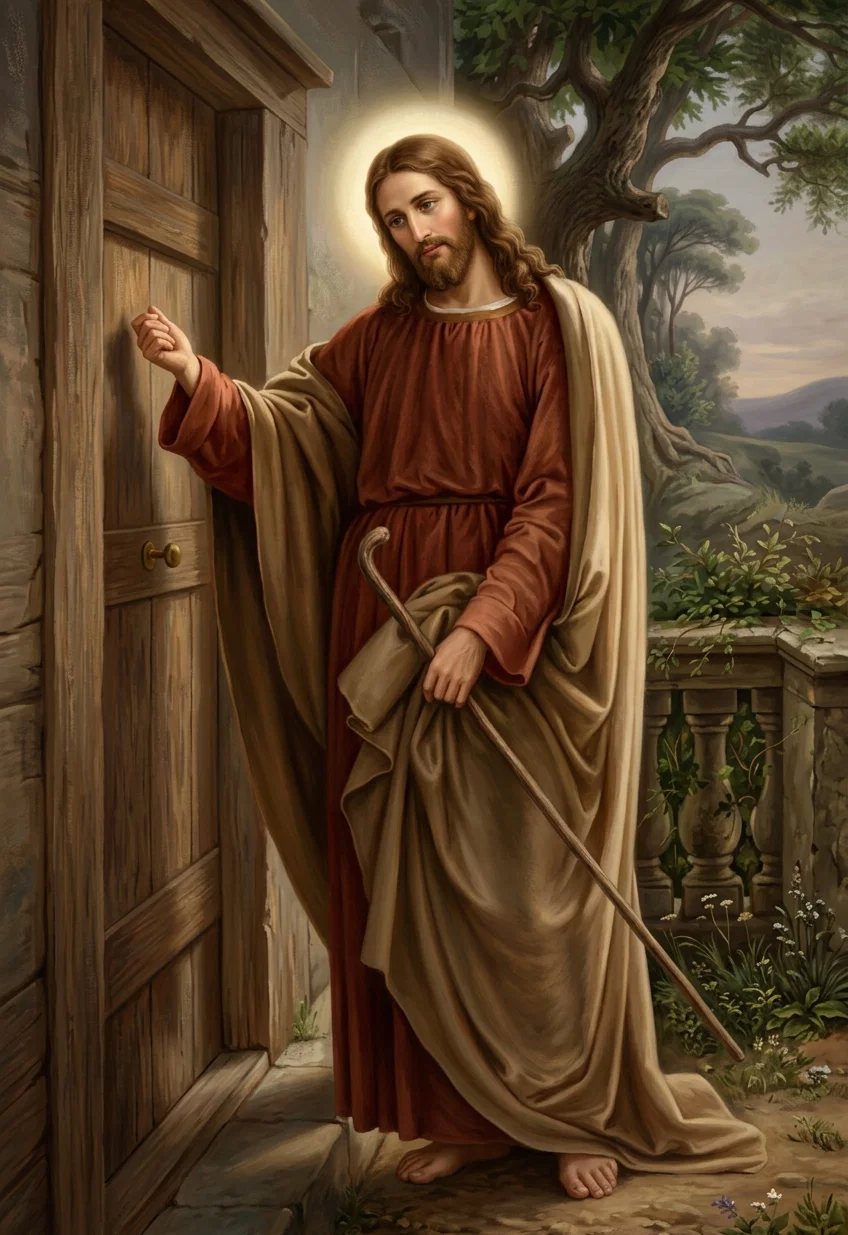
THERE are no more precious words in the Book of God than those found in Rev. 3:20: “Behold, I stand at the door and knock; if any man hear My voice, and open the door, I will come in to him, and will sup with him, and he with Me.”
Behold, I stand at the door, and knock; if any man hear My voice, and open the door, I will come in to him, and will sup with him, and he with Me.

Whose Door?

It is the door of every soul in Laodicea. It is not a general knocking to get into a church; it comes home to the individual heart—to “any man” in Laodicea. It matters not who he is. He may be “wretched, and miserable, and poor, and blind, and naked” (Rev. 3:17), so that all earthly friends will pass him by. His house may be a hovel; his bed, the cold earth floor; his clothing, rags and tatters; he may be diseased and blind. Yet notwithstanding all this there is One who does not pass him by.

Who Is He?

He is one with the everlasting God, the Creator of the heavens and the earth; “for by Him were all things created, that are in heaven, and that are in earth, visible and invisible, whether they be thrones, or dominions, or principalities, or powers; all things were created by Him and for Him; and He is before all things, and by [in] Him all things consist.” Col. 1:17. He is “the high and lofty One that inhabiteth eternity, whose name is Holy.” Isa. 57: 15. He is the King of kings and Lord of lords, and He comes to the doors of the hearts of Laodicea. Nay, more, He does not come in judgment, altho it is a time of judgment. He comes as a brother, an elder brother; for while He is one with God, He is one with humanity. His name is Immanuel—(God with us.)

What a Guest!

Who would or could desire a greater honor than to open the door to receive Him? than to welcome Him? than to entertain Him?

What He Will Do.

“I will come in to him.” He will enter our home and be with us. More, He will “sup” with us. But what have we, the wretched ones, the “miserable, and poor, and blind, and naked,” to set before the Royal Guest? Surely it is a poor bill of fare at the best. Upon it we have reached the condition in which we are. Upon it we have starved, and have become miserable, and poor, and blind. But He will sup with us. “Himself took our infirmities, and bare our sicknesses.” Matt. 8:17. He was “in all things” “made like unto His brethren, that He might be a merciful and faithful high priest.” He is “touched with the feeling of our infirmities.” Heb. 2:17; 4:15. He “became sin for us.” “The chastisement of our peace was upon Him.” “With His stripes we are healed.” O, He is a partaker with us! We may bring all the miserable fare before Him, we may spread our bare-board table, but it will not turn Him away. He will partake with us, and His blessed presence will transmute the bread of sorrow into a feast of gladness.

What More?

O, He will spread His table! He wishes us to sup with Him. When He sups with us, we spread the board and furnish the fare; but when we sup with Him, He will place before us all the delectable bounties of heaven. His goodness fills our whole lives. He takes our rags, and clothes us with His glorious robe of righteousness, woven in the loom of heaven. He takes away our blindness and anoints our eyes with the eye-salve of the Holy Spirit, and we see. He takes from us our poverty, and bestows upon us the riches of His grace and access to the great infinite storehouse. He takes away our wretchedness and despair, and gives us hopefulness. He takes away the misery, and gives us happiness. O, let Him in! Why should He knock longer? You lose all without Him; you obtain all with Him. Let Him in; open the door, and let Jesus in. X.

“THE MORNING COMETH.”

Night has its stars and its moon, but its brightness is not like that of the day. All that is beautiful in earth wakens with the morning. The singing birds break into grand choruses of melody. The whispering leaves stir anew in shimmering gladness. Each opening flower, baptized with dew, exhales fresh fragrance, and man opens his eyes from his long night of slumber to a world of sunlight and of beauty. The very stars are hidden by the light, and the far-off circling worlds wheelon their courses, unmarked by us, unseen by human eyes in the effulgence of the day.
This earth-life is to man the night-time of his being. The shadows are about him—the mystery of the future; and like far-off stars are the hopes which shine to light the horizon of his soul. He sees now “as through a glass darkly.” The sun of God’s visible presence does not yet shine on him, for here he may not see the Father “face to face,” for the mists of sin envelop him so that his vision is not clear. Sin has dominion here, and Christ has not come into the full glory of His earthly kingdom. “My kingdom is not of this world,” He declares. The pomp and vanities of earth form no part of it, and He has commanded us to pray, “Thy kingdom come, Thy will be done on earth as it is in heaven.”
Think of the glory and the joy of this life when God’s will is “done on earth as it is in heaven.” The earth will lack nothing then of heavenly bliss, and then God will dwell among men.
O, this glorious coming of the kingdom of Christ, when the wicked shall no longer hold the rulership of the earth! Then the long night of sin will be ended, and the promise of God will be fulfilled, that “the upright shall have dominion over them in the morning.”
This verse of the psalmist gives us the full assurance that the morning is coming—the morning of the resurrection, when God’s children shall wake from the tomb triumphant over evil and rejoicing forevermore in the power of redeeming love. Then will His kingdom come and His will be done on earth as it is in heaven.
“In the morning.” That means the dawn of a new day for this unhappy earth, one without a night, when the Sun of Righteousness shall shine forth with healing in His beams. It means a dawn bright with the love of our Father and the joy of His presence. The halo of immortal life will be about us, and sinless man will walk with God as he did in Eden.
That “morning” will come to every Christian who makes ready for it. And how is he to make ready for it?—By keeping God’s commandments and hasting for His coming. Supposing that a dear friend from afar whom we had never seen were coming to visit us, one to whose gifts we owed the best that we had in life. He sends us word that he is coming, and that he will be with us soon. Should we not set about with eagerness to make ready for his coming? How speedily we should put our house in order, and prepare for him the best that we could give. We should not count the cost nor spare our efforts to give him fitting welcome. But here is our best Friend, who has said, “Behold, I come quickly,” and shall we fail to prepare our hearts for His coming? And the world also is to be made ready for the Lord’s appearance. Our duty is not done if we simply take thought of our own safety. We must have a care for others and awaken them to their need of preparation. Let us cry aloud, “Watchman, watchman, what of the night?” and the response will ring out through all the arches of time, “The morning cometh.”
And that will be a glorious morning, when all the purposes of God toward this earth shall be fulfilled, and His grand plan of redemption perfected. There is much in the providences of God that is mystery to us now, but then it will all be made plain. God’s children will discover that many things which they deemed evils were but Jacob’s ladder by which they might climb upward. “In the morning” God’s plans concerning the human race will be revealed, and will be no longer a mystery.—Eliza A. Otis, in Los Angeles Sunday Times.

KNOWING CHRIST.

As Christ was speaking His last words of instruction to His disciples, before His crucifixion, Philip said to Him, “Lord, show us the Father, and it sufficeth us.” Amazed at his dulness of comprehension, Christ asked with pained surprise, “Have I been so long time with you, and yet hast thou not known me, Philip?” The disciples had been Christ’s companions for nearly three years; they had listened to His words, witnessed His mighty works, and heard Him say to the Pharisees as He read their thoughts, “I and My Father are one,” and He was astonished that they did not yet know Him. If they had not been so slow of comprehension, if they had been more devoted hearers and doers of the Saviour’s words, they would not thus have grieved His heart of love by their unbelief.
Philip’s doubt called for the utterance of golden truth, which it was essential for the disciples to hear. “Believest thou not that I am in the Father, and the Father in Me?” Christ asked. “The words that I speak unto you I speak not of Myself; but the Father that dwelleth in Me, He doeth the works. Believe Me that I am in the Father, and the Father in Me; or else believe Me for the very works’ sake.” Not long before this, Christ had declared solemnly and decidedly: “He that believeth on Me, believeth not on Me, but on Him that sent Me. And he that seeth Me, seeth Him that sent Me. I am come a light into the world, that whosoever believeth on Me should not abide in darkness.”
Christ showed that the treasures of eternity were at His command. He was under no control in the disposal of them. He who thought it not robbery to be equal with God brought into the world the accumulated treasures of eternity. With authority and decision He said that those who suffered here for His name’s sake should receive their reward in heaven, thus showing His oneness with God.
Speaking by the inspiration of the Holy Spirit, the apostle Paul says of Christ: “God who at sundry times and in divers manners spake in times past unto the fathers by the prophets, hath in these last days spoken unto us by His Son, whom He hath appointed heir of all things, by whom also He made the worlds; who being the brightness of His glory, and the express image of His person, and upholding all things by the word of His power, when He had by Himself purged our sins, sat down on the right hand of the Majesty on high.”
In His teaching Christ referred to Jonah. The prophet went to Nineveh to deliver God’s message, and the warning rang through the streets of the godless city. His message humbled the nation at that time the mightiest in the earth. The proclamation of their destruction caused them to repent in great humiliation, and their doom was averted. The law of God was revered and the God of Israel honored and exalted throughout the heathen world. This experience the Jews kept ever in remembrance. But said Christ, “A greater than Jonas is here.”
Solomon was one of the greatest kings that ever wielded a scepter. He built the magnificent temple at Jerusalem, giving character and greatness to the Jewish nation. The Jews extolled and honored him, yet standing before them, Christ declared, “A greater than Solomon is here.” He spoke of patriarchs and prophets who longed to sit at His feet and learn of Him, who would have thought themselves highly honored could they have ministered to Him. Turning to His disciples, He said: “Blessed are your eyes; for they see; and your ears, for they hear. For verily I say unto you, That many prophets and righteous men have desired to see those things which ye see, and have not seen them; and to hear those things which ye hear, and have not heard them.”
Christ appropriated to Himself the title of authority, and affirmed His claim to our entire service and allegiance. “Ye call Me Master and Lord,” He said; “and ye say well; for so I am.” Had any one but God manifest in the flesh made such a claim, it would have been pronounced blasphemy in the heavenly courts. But Christ made no false claim. He was indeed one with God. How slow of comprehension the disciples must have been to ask, “Show us the Father, and it sufficeth us.”
“This is life eternal,” Christ declared, “that they might know Thee the only true God, and Jesus Christ, whom Thou hast sent.” These words mean much. It is only by knowing Christ that we can know God. The Sent of God calls upon all to listen to these words. They are the words of God, and all should give heed to them; for by them they will be judged. To know Christ savingly is to be vitalized by spiritual knowledge, to practise His words. Without this, all else is valueless.
Christ came to this world to reveal the Father. What patience, what pitying tenderness, what divine compassion, what strength of purpose, he manifested! He did not fail nor become discouraged. He was the embodiment of purity, and His love was without a parallel. At every step He practised self-denial and self-sacrifice. In His death He was the revelation of the reconciliation between God and man. By taking our nature, He bound Himself to us through eternal ages. He is our representative and head. He represents our race before God, still and forever bearing the humanity of the race. He pleads before the Father the perfect righteousness of all who accept Him.
Christ calls upon us to hear His words, that we may know Him. “He that hath ears to hear, let him hear.” We are not to hear as did those of whom the apostles said, “The Word preached did not profit them, not being mixed with faith in them that heard it.” Those who hear savingly are those who hear in faith, and who give earnest heed to the things which they have heard, lest at any time they should let them slip.
“Not every one that saith unto Me, Lord, Lord, shall enter into the kingdom of heaven,” Christ says; “but he that doeth the will of My Father which is in heaven. Many will say unto Me in that day, Lord, Lord, have we not prophesied in Thy name? and in Thy name have cast out devils? and in Thy name done many wonderful works? And then will I profess unto them, I never knew you; depart from Me, ye that work iniquity.”
“Therefore whosoever heareth these sayings of mine, and doeth them, I will liken him unto a wise man, which built his house upon a rock; and the rain descended, and the floods came, and the winds blew, and beat upon that house; and it fell not; for it was founded upon a rock. And every one that heareth these sayings of mine, and doeth them not, shall be likened unto a foolish man, which built his house upon the sand; and the rain descended, and the floods came, and the winds blew, and beat upon that house; and it fell, and great was the fall of it.”
God has measured how much it cost to save man. This salvation was accomplished only by the sacrifice of Himself in His Son. “God so loved the world, that He gave His only-begotten Son, that whosoever believeth in Him should not perish, but have everlasting life.” Earthly parents love their children. How then did God feel when the Son of His love was despised by those whom He came to elevate and ennoble and save? He saw Him dying on the cross,mocked at and jeered at by the passers-by, and He hid as it were His face from Him. Christ was bearing the sin of the whole world, and dying in the sinner’s stead. Exalt the God of heaven, you who can realize the depth of His self-sacrifice; for He suffered with His Son.
The sinner must see Jesus as He is, full of grace and truth. Heavenly peace will be felt by those who know Him who first loved us, who is the chiefest among ten thousand, and altogether lovely. Every lingering doubt will be swept away. Their hearts will burn with the fire of divine love, and their characters will be transformed. MRS. E. G. WHITE.

THE SIMPLICITY OF FAITH.

LIKE every other word in common use, “faith” has a wealth of meaning that is not always appreciated by the mere utterance of the word. Its hidden treasure has been sought for many times through the analysis of human wisdom, but without great success. The best because the most comprehensive definition of the thing called faith, is the following inspired one: “Faith is the substance of things hoped for, the evidence of things not seen.” Heb. 11:1. Faith is not, therefore, a theory, woven in the looms of one’s imagination; it is not logic, drawn from the syllogisms of nature, but a simple giving up of the mind to rest content, without reasoning, upon the word of another. In this way alone does the Word of God become to the Christian the expectation of all that his soul longs for amid the trials of life, and makes real in the present, things of the distant future, which otherwise would appear misty and uncertain. This makes it the substance, or ground, of the things hoped for.
“As a Little Child.”
Faith is evidence of things outside of reason,—things not open to physical eyesight, and, therefore, not demonstrable by comparison with tangible objects. We believe in future existence as taught in the Bible because God said it. Our only evidence of its truthfulness is our faith. There can be no other evidence, because we have never been there, nor have we ever seen those who have, and so we have no basis of proof but simple faith. But there is nothing strange in this method of procedure; we act the same with reference to many things.
For instance: We believe that the first letter of the alphabet is “A,” but we can not prove it. We fully believe it, notwithstanding, and that simply because we were taught it. Faith is the only evidence we have of its correctness. So with the promises of God; we just believe them to be so, and our faith is the evidence that they are so, and we cling tenaciously to this evidence amid the storms and strife of the world, assured that over yonder we shall be forever free from every annoying thing. Say what we may, there is comfort in this evidence, too.
Faith, too, is as natural and simple as it is great in consequences. Indeed, its simplicity is the key to its power. Watch the little child; that confiding smile it carries resting in its mother’s arms is begotten of faith. How quietly it sleeps in its chosen refuge! When old enough to understand what is said, its simple, trusting nature believes every word mother utters, and that without the shadow of a doubt. It has no anxiety about its food or clothing, but when hungry, expects a satisfying portion upon asking for it. Where the necessities of life come from is a question that never occurs to its mind. It simply trusts loving parents for everything.
In the exercise of its natural trusting heart, the little child is a living example of what God would have all become. In its simplicity, it represents the faith of those who dwell in heaven. Being a representative of God’s handiwork at the beginning, it was born with a God-given faith. So in pointing out the nature of conversion to God, the Saviour said: “Except ye be converted, and become as little children, ye shall not enter into the kingdom of heaven.” Matt. 18:3. Again He said: “Suffer little children to come unto Me, and forbid them not: for of such is the kingdom of God.” Mark 10:14.
From these scriptures we may understand that the little child is an example of what men in Christ should be. But the faith of the little child is not acquired through education; for it has had none. It is a direct endowment from God, as an evidence of His care for the human race, even tho fallen under sin. It is the means of salvation which God has so kindly placed within reach of every one born into the world. Every one, therefore, has been given, not simply a measure of faith, according to his power of mind, but the measure of faith, a definite quantity to every one, and that, just what God would have all cultivate into permanent trustfulness. Rom. 12:3. Like the grain of mustard seed, which is also a symbol of the kingdom of heaven, the faith thus bestowed of God should be permitted to find genial soil in every heart, that in its growth, the rule of God may fill every part of the individual. The mustard seed of faith possessed by the little child, should be vigorously cultivated by parents into rapid growth, before the soil of the heart becomes cold and hardened by contact with opposing influences. Unless this is done, association with the world will lead him to lose confidence in human veracity. This in turn is extended, by natural process, to include the Word of God, and so in time he becomes a confirmed doubter.
Faith being the natural gift of God, that is the only thing which pleases Him. Heb. 11:6. Doubt is as unnatural as it is ungodly. It is the cultivation of an evil seed in a fleshly mind. To be able to please God, the sinner must therefore have undone in his mind all that the world has done for him, and return to the natural state of mind which he possessed when a little child. To refuse this is evidence that one is not in harmony with God, but is carnal, and so not in subjection to God’s law, which is spiritual. Rom. 7:14; 8:7.
Again the apostle says that “whatsoever is not of faith is sin.” Rom. 14:23. But sin is the transgression of the law, the very action of the carnal mind. 1 John 3:4. To doubt God’s Word and goodness is, therefore, to transgress His law, because doubt is the manifestation of supposed superior knowledge on the part of the doubter. To call God’s Word in question is to lower His character, and to elevate one’s self above Him as judge. But in doing this, human judgment is arrayed against the mind and will of God, which is revolt against His government; another is put in the place of God, and so His law forbidding such a course is violated. It is therefore plain that the amount of faith possessed by any one is measured by the simplicity with which he submits his judgment to the expressed mind or will of Him who is over all.
“If our faith were but more simple, We should take Him at His word; And our lives would be all sunshine In the sweetness of our Lord.”
JOHN ORR.

ELIJAH THE TISHBITE.

As GOD counts greatness, history, sacred or profane, does not furnish a greater than Elijah the Tishbite. He was great in his life; he was greater in his translation, for, like Enoch, “He was not, for God took him.” He was great in his life, whether we see him obeying the command of the angel of the Lord to meet the messengers of the king of Samaria, and twice calling down fire from heaven, consuming the captains and their fifty followers, or whether we see him taking his mantle and wrapping it together and smiting the river Jordan until the waters were divided and he and Elisha went over on dry ground.
But he was greater in his translation, for it has only been given to two men, Enoch and Elijah, to possess in a peculiar sense everlasting life, for all the sons of Adam have passed or shall pass through the portals of the tomb to the world beyond. Even Christ Himself, who is the resurrection and the life, went down into the silent grave, and tasted the power of the “king of terrors.” But Elijah, seated upon a chariot of fire, grander than the imagination can conceive, was transported even up to the great white throne itself; and the sound of no last trump will be required to summon him from the dreary prison-house of the dead.
But this glory does not end here, nor is his chariot forever lost to sight as it disappears in the blue ether. Summoned with Moses, Elijah is permitted to see the glory of the Son of God upon the Mount of Transfiguration, and to talk with Him of the wonderful death which He should accomplish at Jerusalem.
O wonderfully gifted man! To be wafted to heaven in a chariot of fire was grand! To spend long years in the society of God andhigh archangels was grander! But if possible it was grander still to stand in that glittering company, in the midst of which was the great Redeemer Himself, discoursing of the great sacrifice He was about to make! O, how human greatness pales its ineffectual fires before such a scene as this! How the possibilities of the soul expand and glow as we “behold the Lamb of God, which taketh away the sin of the world”!—Henry A. Lavely, in Christian Work.

A SATISFACTORY SETTLEMENT.

MR. GLADSTONE sums up his opinion of the condition of affairs in the east, especially in reference to the Turkish Empire, in the following terse sentences:—
The pain, shame, and mischief of the last two years in the eastern policy transcend entirely the powers of any language I could use concerning them. The sum is this:—
Firstly, a hundred thousand Armenians have been slaughtered, with no security against a repetition, and with greater profit to the assassins.
Secondly, Turkey is stronger than at any time since the Crimean war.
Thirdly, Greece is weaker than at any time since she became a kingdom.
Fourthly, all this is due to the European concert—that is, the mutual hatred and distrust of the powers.
The last sentence contains Mr. Gladstone’s idea of what the “European concert,” so much talked of, is. It is nothing but the mutual distrust and hatred of the great powers for each other. The Christian Advocate defines the “concert” in the following words:—
The only real concert of Europe at present appears to be on the basis of “hands off.” A union of “hands on” would be like that of ravenous beasts in the presence of a carcass. It would scarcely be made before in the partition the beasts would be tearing each other.
No doubt this is a true statement. From dividing the prey, the powers would soon be engaged in tearing one another, and the fear of this acts as a check upon them, preventing them from doing the very thing they want to do. If each one of the powers were not filled with a burning jealousy and fear that another would get more of the sultan’s estate than it would get, the united powers would soon put an end to his government.
That the “Christian” powers should do this, is what a great part of the religious press of Great Britain and the United States are constantly clamoring for. Mr. Gladstone thinks it should be done. But as these powers are so full of jealousy themselves, how can they be spoken of as “Christian” powers? and how can they be expected to make a just settlement of the sultan’s estate, or of anything else? Can justice be expected where jealousy and cupidity hold full sway? These powers can not treat each other in a Christian manner; much less can they treat Turkey so. Jealousy is the very opposite of Christianity, and as the powers are full of it, they can not be Christian only in name; and such Christianity amounts to nothing. It does not insure just actions.
Furthermore, as they can not settle the affairs of the Turkish Empire in a Christian way, they can only settle them by force, and that is precisely the way that Turkey would do. So it would not be a Christian settlement after all.
But one thing is needed in Europe and everywhere to secure a perfect settlement of all disturbances, and that is the Gospel of Christ. The most seditious Armenian, as well as the most cruel Kurd, becomes a gentle, affectionate, and loving brother when once his heart has been touched by the divine power of the Gospel. The Lord has put every believer in trust with the Gospel to make it known to others. Thus every Christian, however humble and unknown, knows of a power more potent for good, better able to promote peace and harmony among men and among nations, than is possessed by all the kings of the world, with all their armies at their backs. Christ’s ministers are ambassadors of peace for God to men.
And when a man is really and truly at peace with God, he will be at peace with his fellow-men. God would heal the nations with the Gospel, but they will not be healed.
When the last message of mercy, offered to the world in the “everlasting Gospel,” in its great threefold aspect (Rev. 14:6-12), shall be finished, who can accuse God of injustice should He withdraw mercy, close the drama of this world, and bring all things to an end? As the Creator He has a right to do so. And, in view of the obdurate hearts of men, which refuse the Gospel, there is no other way for a final and satisfactory ending of the affairs of this world. Infinite mercy has long been offered, but has been rejected. Infinite justice must at last interfere. Then a perfect—a satisfactory settlement of all the affairs of the world will be made. M. E. K.

THE COVENANT DISANNULED.

“I WON’T wait a minute. When I die I am going to be right in heaven.”
The above are the words of an earnest, active member of one of the self-styled orthodox churches in the town of P. The doctrine of the natural immortality of the soul, as preached and sung in the churches, has so moulded the belief of the laity, and the masses outside the churches, that the idea of waiting until the resurrection, at the last day, for their reward seems to them an unbearable delay, and they recoil from the thought. And yet in unconscious sleep there is no conscious delay.
When the Son of God came to our world “to seek and to save that which was lost,” He said of Himself, “I am the resurrection, and the life; he that believeth in Me, tho he were dead, yet shall he live.” John 11:25. Again, “I will raise him up at the last day.” John 6:40, 44.
In Isa. 28:15, 16 the Lord says, “Because ye have said, We have made a covenant with death: . . . Therefore thus saith the Lord God, Behold, I lay in Zion for a foundation a stone, a tried stone, a precious corner-stone, a sure foundation; he that believeth shall not make haste.” In Isa. 25:9 we read what they who have not made haste will say when their Redeemer raises them up at the last day: “It shall be said in that day, Lo, this is our God; we have waited for Him, and He will save us; this is the Lord; we have waited for Him, we will be glad and rejoice in His salvation.” Is it not better to trust in God’s covenant in Christ, the covenant of life, the covenant with the Life-giver?
From the above scriptures we learn that those who expect to go to heaven at death are making haste, and are represented in the Word of God as having made a covenant with death, which covenant, they are assured in Isa. 28:18, shall be disannulled; while those who put their trust in the sure foundation, Jesus Christ, will not be disappointed, tho they sleep in Him until the resurrection.
J. S. MAXSON.
Erie, Kansas.

Contentment and Happiness

He who enjoys what he has, without regretting the want of what he has not, is a happy man.—Democritus.

Virtue Against Your Enemy

Would you be avenged of your enemy? Be virtuous, that he may have nothing to say against you.—Diogenes.

MY CHOSEN FRIENDS.

I have heard one speak of the wish to greet On that glorious, golden strand, The loving friends, the “chosen friends,” He had found in this pilgrim land; And there with these through the glorious days In the city of God above He would wend his way by the River of Life, And live in their smiles of love.
But a pitiful face is turned to me As I read that wish again, And the thought comes to me o’er and o’er, “Christ died for sinful men;” And now I wonder who’ll look for them When the gates are opened wide, And some we’ve shunned, who’ve fallen low, Are found on the inner side.
I see the Saviour reach far down From His glorious throne above, And lift the fallen tenderly In His gracious arms of love. It mattered not to the Shepherd kind What bramble tore the feet; How low soe’er the fallen were, His pardon was complete.
And that’s the face I long to see, The face of the lost redeemed; For I’ll see it again as I saw it when That mortal learned of God’s love to men, And that wondrous love through His face outstreamed And told me that he was free.
Come view with me that mighty throng That sweeps the eternal shores along, And learn the joy they only know Whom Christ has raised from the depths of wo. In that vast throng my place must be Should the gates of God swing wide for me.
My “chosen friends” I’ll gladly greet, But the face I’ll choose to see Is the face that bled from the thorny crown When Christ was slain for me. And, O, the hand I shall choose to clasp When the gates are opened wide, Is the hand that hung from the cruel nail When man’s Redeemer died!
Then seek who will for your “chosen friends,” And find them ye who may: I’ll seek for Him who purchased me, In that glorious, gladsome day; And methinks I’ll frequent find Him there, As I’ve found Him here below, In those bereft of “chosen friends” While sinking in their wo. These, these are they whom I’ll choose to see When the gates of God swing wide for me.
C. M. Snow.
Oakland, Cal.

THE THIRD COMMANDMENT.

The famous congressman, Thaddeus Stevens, had a colored servant in Washington named Matilda, who one morning smashed a large dish.
“What have you broken now, you — black idiot?” exclaimed Thad.
“’Tain’t de third commandment, bress de Lawd,” replied Matilda.
In regard to the above, if any of our readers do not remember what the third commandment is, they had better look it up, and while they are about it, they may as well read the whole ten and try to remember them.
We are reminded by the above of what was once related to us about a Republican governor of Ohio. He put in his Thanksgiving proclamation a beautiful quotation from the Bible. A Democratic editor declared that the governor had stolen it from some book, for he distinctly remembered seeing it somewhere before. To which a Republican editor replied that the statement was a Democratic lie, for the quotation referred to was purely original with the governor.—Our Dumb Animals.
Continue reading: THE PROPHETIC SYMBOLS OF DANIEL 7