“He calleth to me out of Seir, Watchman, what of the night? Watchman, what of the night! The watchman said, The morning cometh, and also the night; if ye will inquire, inquire ye; return, come.” Isa. 21:11, 12. Having reached the time when every prophecy points with clearness to the great fact that the coming of the Lord is right at hand, it is nothing more than should be expected to find the world full of phenomenal occurrences that force the question from every mind, “Watchman, what of the night? Watchman, what of the night?” Unheard-of storms and most unusual freaks in the weather and climate, present themselves. It is much more difficult to produce a crop than it used to be, for the blight, and the frost, and the insects, seem to have conspired to defeat the work of the husbandman. Then there is the appalling increase of crime on every hand, so that both life and property are very unsafe because of it. And in the face of this terrorizing and all-pervading plague of criminality, the church, with only here and there an isolated, tho noble, individual excepted, stands cowering before it, if, indeed, many of its members are not themselves engulfed in the crimes. The great army of the destitute on the one hand, and the amassing of colossal fortunes by a few on the other, is causing apprehensive disturbances all around the world. And the unprecedented and horrifying preparations for war among all the nations seems to lend a darker coloring to the whole. “What do all these things portend?” is asked with eagerness and bated breath.
To this all-important and all-absorbing question, some answer one thing, and some another. But, rising above every voice, and piercing the inmost chambers of every heart, is the unavoidable conviction that all these things, like so many trumpets with thunder tones, are proclaiming the solemn truth that the end of all things earthly is at hand. The watchman is heard to shout with ringing clearness, “The morning cometh, and also the night.” That night of awful gloom is settling fast around every unyielding sinner; but, O, the joy of that brighter thought, The gleamings of that glorious and eternal day are now distinctly seen! The skies are bursting to reveal the surpassing splendor of our returning Lord. Soon, yes, very soon, our adored Redeemer will appear in the clouds of heaven to call us home.
Herald the tidings, watchman. Let all the world know the glorious news. Bid every one hasten to get ready for the marriage feast of the Lamb of God.
MODERN SCIENCE AND THE WORD OF GOD.
By W. N. G.
THE progress of invention and the instability of “science” are both well illustrated in the following item from the Baptist Argus:—
“Recently the manager of a large electric plant said to us: ‘Five years ago we had a model up-to-date plant, but already it has depreciated seventy-five per cent. In five more years it will not be worth anything. By this you may judge how rapidly progress is being made in our field.’ This striking information reminds us of the professor of science of Glasgow University, of whom Professor Drummond tells us, who instructed the librarian of the university to box up all books in his department over ten years old and put them into the cellar.”
Thus much time and labor and means is spent in acquiring scientific knowledge in the world’s schools, which in the next decade will have to be stowed away as demonstrated error. Not so the true wisdom which is found in the Word of God, which “endureth forever.” The apostle James tells us that “the wisdom which is from above is first pure, then peaceable, gentle, and easy to be entreated, full of mercy and good fruits, without partiality, and without hypocrisy.” When God rehearsed His law to Israel He said, “This is your wisdom and your understanding in the sight of the nations.” See Deut. 4:4-13. “The fear of the Lord is the beginning of wisdom; a good understanding have all they that do His commandments; His praise endureth forever.” Ps. 111:10. W. N. G.
CARNAL AND SPIRITUAL WEAPONS.
At a meeting of scientists and inventors Hiram S. Maxim, in the course of an off hand speech, remarked that the best machine for introducing commerce in the odd corners of the universe was the Maxim gun. He said that a missionary had once told him that he had had great trouble in introducing religion into savage races, and suggested that perhaps a Maxim gun would be a good thing to spread religion as well as commerce. Mr. Maxim replied, “My friend, you are quite right; get a Maxim gun, and the savages will never find any fault with your religion; they will take it ‘holus bolus.’” That was a witty turn, but nothing more. Force that bends the will without changing the hearts will never make any people truly religious. Christianity tried it, and did the world more harm than good. It was an evil day when Constantine began his conquest for Christ. The world groans until this time under the results. Christian methods were well expressed by St. Paul: “The weapons of our warfare are not carnal, but mighty through God to the pulling down of strongholds.” The Maxim gun may subjugate a people, but the less missionaries have to do with Maxim guns or the things that they stand for, the better.—N. Y. Christian Advocate.
Princeton University
Princeton University has closed the saloon against which the Voice has waged such destructive warfare. It is a shame that it should have ever existed in connection with a religious institution. At the annual election of the senior class, December 14, it is said that the affair was an occasion of a scandalous drunken debauch. It is reported that the students went into the spree deliberately, and previously raised $250 among themselves to pay for the property they proposed to destroy while drunk. This is adding heaven-daring presumption to bestial folly.
FATHER AND SON.
“I must look to the sheep of the field,
See that the cattle are fed and warm,
So, Jack, tell your mother to wrap you well,
You may go with me over the farm.
Tho the snow is deep and the weather cold,
You are not a baby—six years old!”
Two feet of snow on the hillside lay,
But the sky was as blue as June,
And father and son came laughing home
When dinner was ready at noon,
Knocking the snow from their weary feet,
Rosy and hungry, and ready to eat.
“The snow was so deep,” the farmer said,
“That I feared I could scarcely get through.”
The mother turned with a pleasant smile—
“Then what could a little boy do?”
“I trod in my father’s steps,” said Jack;
“Wherever he went I kept his track.”
The mother looked in the father’s face,
And a solemn thought was there;
The words had gone like a lightning flash,
To the seat of a noble care;
“If he treads in my steps, then day by day
How carefully I must choose my way!”
“For the child will do as the father does,
And the track that I leave behind,
It will be firm, and clear, and straight,
The feet of my son will find;
He will tread in his father’s steps, and say,
‘I’m right, for this is my father’s way.’”
O fathers, treading life’s hard road,
Be sure of the steps you take;
Then the sons you love, when gray-haired men,
Will tread in them still for your sake;
When gray-haired men, their sons will say,
“We tread in our father’s steps today”! —Anon.
DISCOURAGEMENTS IN GIVING.
A WOMAN, says the New York Times, whose right hand does a large amount of good in the course of every twelve-month, and whose left hand seldom hears of it, on the last holiday had a friend, a widow whose slender income barely kept the wolf from the door of her numerous family, whose needs stirred her generous impulses. In a note to her of Christmas greeting she inclosed a gold coin of considerable value, and as she did so, visions of several winter comforts for her friend or her children gave her a glow of satisfaction. This glow was not increased when she shortly received a note of cordial thanks and the information that the money had filled a long-felt want in the purchase of lace curtains for the parlor windows. “I rushed right off the day after Christmas,” wrote the friend, “to get the curtains, lest, among so many pressing needs of more practical nature, I might be tempted to forego them,” which the sender of the money thought was the most delicious bit of irony she had ever met.
The climax of the situation was reached, however, when a fortnight later the friend wrote asking for the loan of about the amount of the Christmas gift “to meet an urgent obligation which has existed for some time, and which can no longer be deferred.”
A second experience she had in the course of Patti’s last visit to New York. She had never heard the celebrated diva, and much wanted to, but the price of the seats seemed to her a selfish outlay for one evening’s entertainment, when she knew of many to whom the sum would mean some permanent and needed good. So, after some deliberation, she took the amount which the purchase of two of the best single seats would require, and sent it to another whose home necessities were largely in excess of the home income. “Only a day or two ago,” she said, “I had met her in a storm quite insufficiently clad. She is a charming woman, of whom I am very fond, and every time I thought of the Patti seats, a picture of Mrs.— in thin boots, a worn coat of little warmth, and an umbrella whose best days were not, came before me. The price of the tickets, I thought, will remedy all this, and it was sent. In due time came a most felicitous reply; Mrs.— writes delightful notes. The money was very opportune, and was as gratefully accepted as it had been, etc. ‘With it,’ she went on, ‘Tom and I have had the treat of our lives. We have heard Patti.’”
The secret of such people’s poverty is not very difficult to divine. Our old friend, E. A. Egleston, who kept a meat-market, was once importuned to go to see the circus. He declined the invitation, as he was not interested in such performances. Being urged to go, and asked what his objection was, he said, “If I should go, I should see so many people there who are owing me for meat that I should not take any comfort seeing the performance.”
Waste and want are not far apart, and those who squander money for luxuries may need to borrow it for necessaries.
WHERE THE SHINE CAME FROM.
“WELL, grandma,” said a little boy, resting his elbows on the old lady’s stuffed armchair, “what have you been doing here at the window all day by yourself?”
“All I could,” answered dear grandma cheerily; “I have read a little, and prayed a good deal, and then looked out at the people. There’s one little girl, Arthur, that I have learned to watch for. She has sunny brown hair, her brown eyes have the same sunny look in them, and I wonder every day what makes her look so bright. Ah, here she comes now!”
Arthur took his elbows off the stuffed armchair and planted them on the window-sill.
“That girl, with the brown apron on?” he cried. “Why, I know that girl. That’s Susie Moore, and she has a dreadful hard time, grandma.
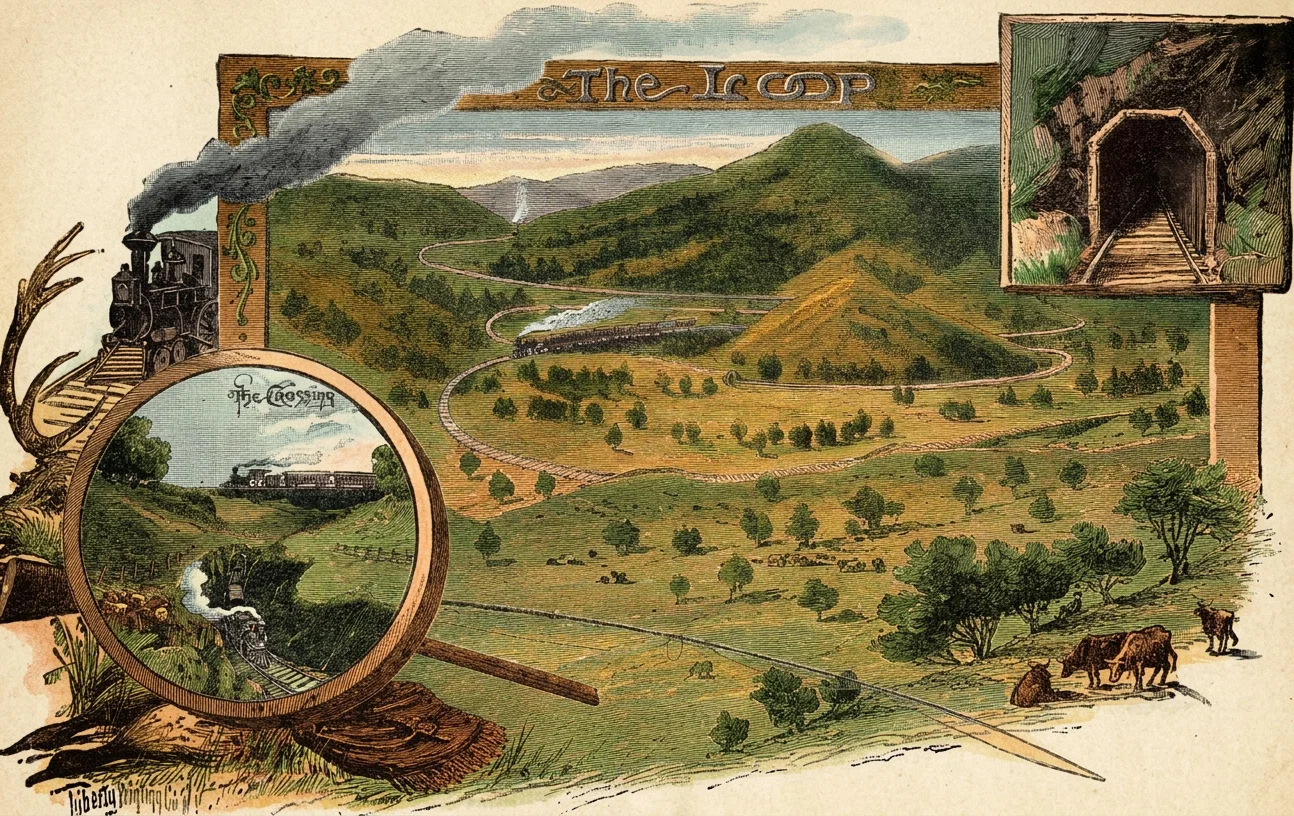
CALIFORNIA SCENERY. NO. 4.—The Loop presents a picturesque combination picture of natural wildness and triumphs of civil engineering. On the north side of the Tehachapi range, in Southern California, where the Southern Pacific Railway descends the mountain, is a series of nineteen tunnels between the summit and Bakersfield. Among the nineteen is one through which the north-bound train passes under the road it traveled a few moments before. The entire ride either down or up the mountain is wild, picturesque, and charming.
“I’ll ask her,” said Arthur promptly, and to grandma’s surprise he raised the window and called:— “Susie, O Susie, come up here a minute; grandma wants to see you!”
The brown eyes opened wide in surprise, but the little maid turned at once and came in.
“Grandma wants to know, Susie Moore,” exclaimed the boy, “what makes you look so bright all the time.”
“Why, I have to,” said Susie; “you see papa’s been sick a long while, and mama is tired out with nursing, and baby’s cross with her teeth, and if I didn’t be bright, who would be?”
“Yes, yes, I see,” said dear old grandma, putting her arm around this little streak of sunshine. “That’s God’s reason for things; they are, because somebody needs them. Shine on, little sun; there couldn’t be a better reason for shining than because it is dark at home.” —Selected.
SOME FACTS ABOUT SIBERIA.
Siberia is the northern division of Asia, and forms the eastern part of the great Russian Empire. From east to west it is not less than 4,142 miles in extent, and at its widest part 2,170 miles from north to south. Its area is greater than that of the United States, but its population is but from ten to fifteen millions. Its extreme cold and lack of traveling facilities has prevented a rapid settlement of a section of the earth extremely rich in mineral resources, and capable of supporting a large population.
As the railways are few, the traveler is dependent upon horse-power; in the summer he uses a boat-like carriage, drawn by three horses abreast, called a “tarantass;” in the winter, a sledge with skates and outriggers. Pursuit by packs of half-starved wolves, or attacks by robbers, who are often escaped convicts, are incidents of travel. The stopping places are post-houses, fifteen to twenty miles apart, under government control. If one is warmly clad, traveling in the cold, clear air is delightful and healthful.
All Siberian travelers, at least those who view the situation from the human standpoint that this world has yet a long life before it, agree that the possibilities and prospects are for a great nation. Aside from untold natural resources, the people are robust and vigorous; and with a greater measure of freedom and a higher state of civilization in methods of material progress, there would be a great influx of energetic immigrants. The extension of the great Trans-Siberian Railroad will add very materially to the increase of population and the development of the country.
The gold mines on the Lena are reputed to be the most extensive in the world, and the government buys all the gold and platinum that is found. Most of the trade of the country is in the hands of a few merchant princes, whose wealth is fabulous.
The animal life of the country is varied. In the north are reindeer, polar bears, and white11foxes; in the central forests, packs of fierce wolves, brown bears, elks, and deer abound. Of the fur-bearing animals the rarest is the silver fox; the best of these are reserved for the czar. Sables, ermine, and lynx abound. Great flocks of geese and swans come south in winter, and in summer the steppes abound with game. The mammoth, now supposed to be extinct, once existed in such quantities that mines of their ivory tusks are exhumed. This ivory is a very valuable article of commerce. The rivers are full of fish, and from the roe of the sturgeon the great national dainty of caviare is made. The cities are supplied by markets, and in winter, fish and meats are frozen as hard as stones, while milk is solid and has to be broken up with an ax.
The cold of winter in the northern parts is terrible. Your ink freezes into a little black bullet as you write. A teamster has frequently to break away the icicles from the noses of his horses to keep them from stifling. When awakening from a doze, one may expect to find his eyelids frozen together, or the beard glued to the fur of his great coat by his frozen breath.
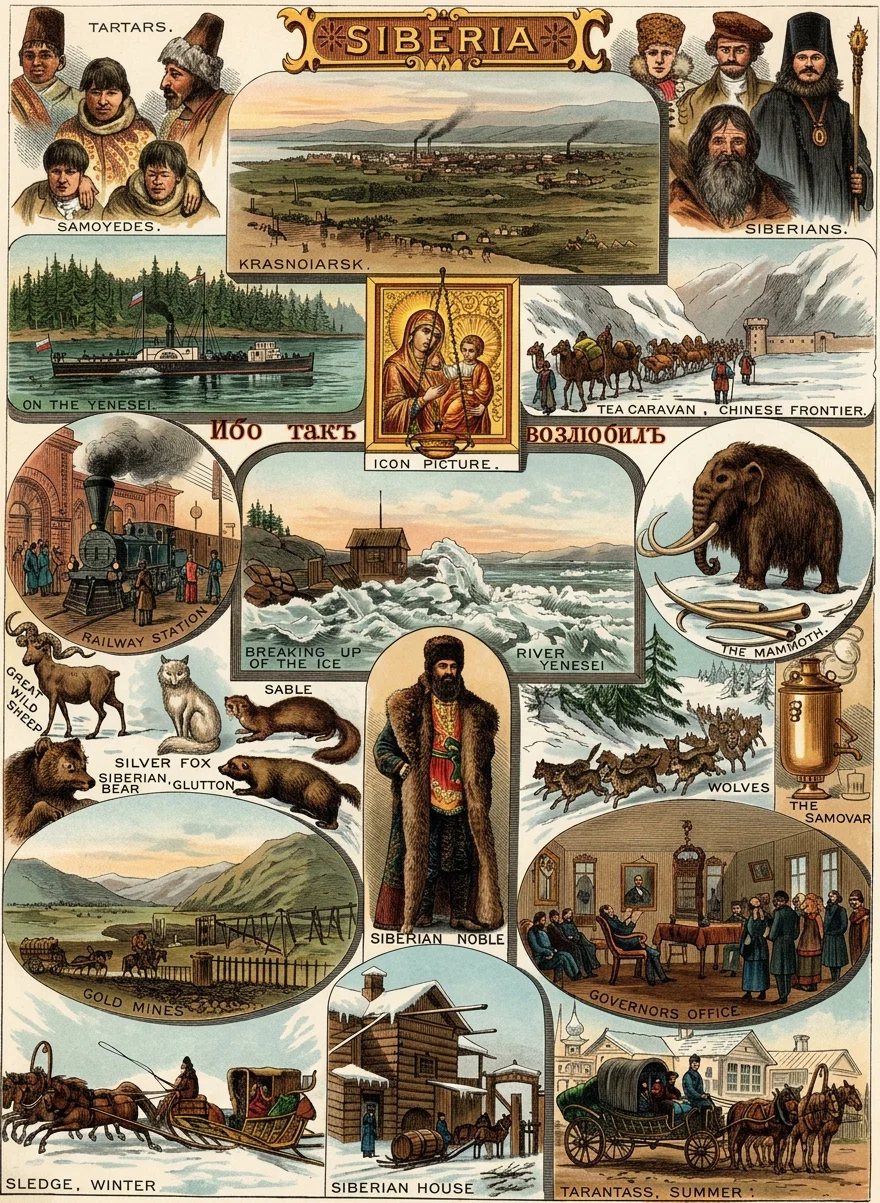
Siberians are very hospitable. They give frequent feasts. In summer, midnight picnics are common, and in the winter, these give place to dances and surprise parties. Every house has its icon, or holy picture (see illustration). On entering, each visitor salutes it before he wishes his host good-day. He will then be offered either vodka or tea. Vodka is a fiery, spirituous liquor, the curse of all Russia and Siberia. The samovar, or tea urn, is always ready. The tea is brought from China on camel back, and is very costly. The poorer classes use brick tea, a preparation made first into small bricks and used as money until it begins to crumble; then they are cut into small pieces and made into tea broth.
In our picture on the right is a Siberian pope, an old wandering pilgrim, and a moojik and wife. At the left are Tartars of the steppes, and Samoyedes from the Arctic region. In the center at the top is one of the great cities of Siberia on the mighty Yenesei, a river 2,500 miles in length, and ten miles wide at the mouth. Most of the other pictures are self-explanatory. At the governor’s office is transacted all public business. The large frame in the center of the table represents the czar, and when that is uncovered, the emperor is supposed to be present.
The religion of the country is that of the Eastern, or Orthodox Church; that is, the State religion of Russia. The clergy are called popes, or papas. Drink is a great failing of these papas. The service is largely musical, is very long, and the people stand through the whole of it. The Siberian chants, which are in a sweet, sad minor key, seem to last for hours. The convict sings in his chains, the post-driver sings to his horses, and the timber-cutter sings while working in the forest.
The Christian religion as held and practised by those who “keep the commandments of God and the faith of Jesus,” has been carried to some parts of the country by Seventh-day Adventists, who were banished from Russia on account of their faith. And these have found other souls waiting for the freedom which Jesus Christ alone can give.
WHO REALLY DISCOVERED STEAM-POWER?
Various countries claim the credit of having made the earliest practical application of steam-power, but, judging by facts gathered from the most authentic sources, it was in Spain that the movement of machinery by steam was first brought under public notice. At Barcelona, in the year 1543, a mechanic named Blasco de Garay, after many persistent efforts, succeeded in impressing the Emperor Charles V. of Austria and I. of Spain with the value of his new invention of driving ships by steam. The trial which took place was considered a success by the public, but the chief of the Royal Commission—Ravago, the treasure-keeper of the kingdom—for certain sinister reasons persuaded the emperor that the discovery was of no practical value, and so ruined the hopes of Blasco de Garay.
Later on, about the beginning of the seventeenth century, Giovanna Branca, an Italian, invented a steam-engine, and his machine is the first of which we have any descriptive or pictorial record. About this same period, too, France produced a claimant for the glory of having invented the steam-engine, and Marion DeLorme, in a letter to M. de Cinq Mars, dated Paris, 1641, gives an account of him in a visit to the Bicetre with the Marquis of Worcester: “We were crossing the court of the madhouse, and I, more dead than alive with fright, kept close to my companion’s side, when a frightful face appeared behind some immense bars, and a hoarse voice exclaimed, ‘I am not mad! I am not mad! I have made a discovery which would enrich the country that adopted it.’ ‘What has he discovered?’ I asked of our guide. ‘O,’ he answered, shrugging his shoulders, ‘something trifling enough; you would never guess it; it is the use of the steam of boiling water!’ I began to laugh. ‘This man,’ continued the keeper, ‘is Salomon de Caus; he came from Normandy four years ago to present to the king a statement of the wonderful effects that might be produced from his invention. The cardinal sent the madman away without listening to him. Salomon de Caus, far from being discouraged, followed the cardinal wherever he went, with the most determined perseverance, who, tired to death with his folly, ordered him to be shut up in the Bicetre, where he has now been for three years and a half.’”
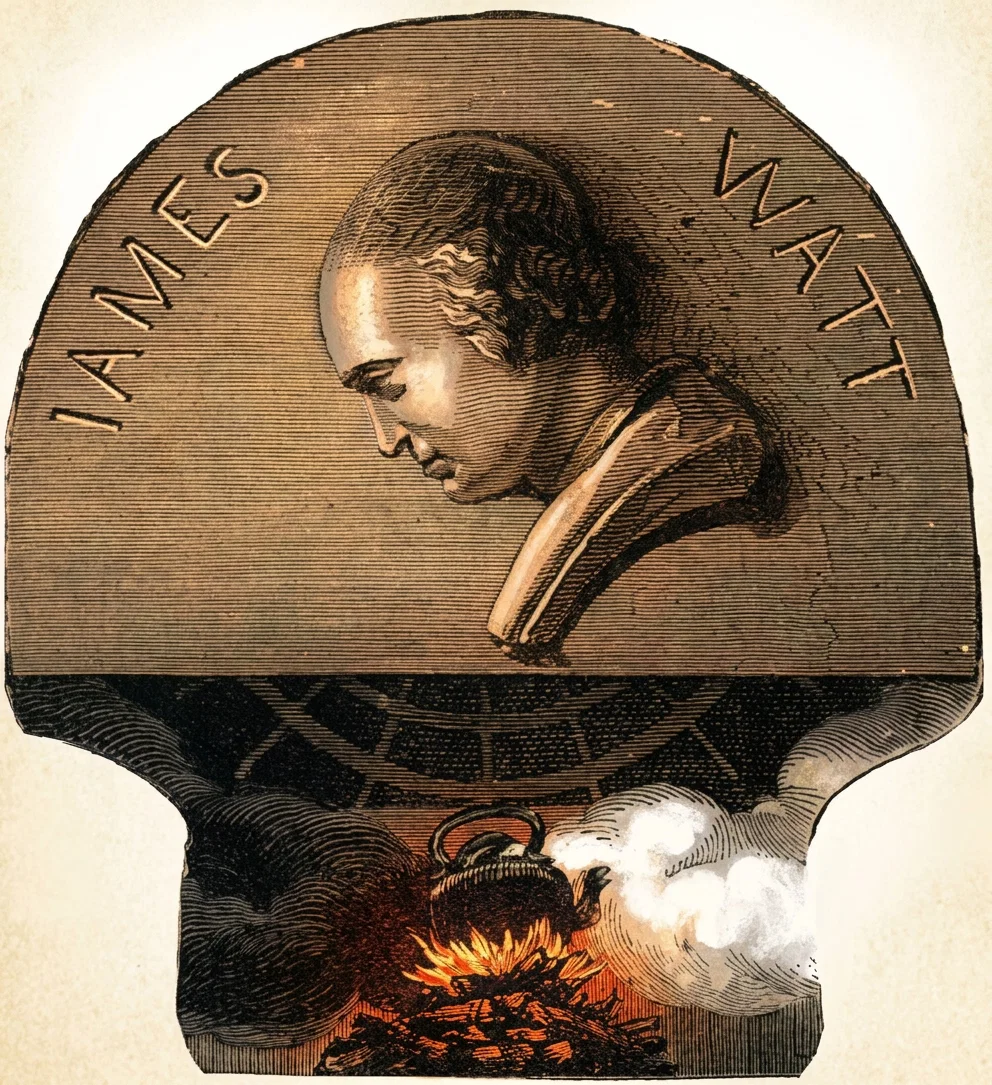
James Watt, the Supposed Discoverer of Steam Power.
Lord Worcester was conducted to his (De Caus’) cell, and came back sad and thoughtful. “He is indeed mad now,” said he. “Misfortune and captivity have alienated his reason, but it is you who have to answer for his madness. When you cast him into the cell, you confined the greatest genius of the age.” Twenty-two years after the above incident, in 1663, in a work of his called “Century of Inventions,” the Marquis of Worcester described a steam apparatus of his own. Papin followed with his invention in 1681. Captain Savery’s engine for water-raising was made in 1698, and in 1712 Thomas Newcomen constructed the first self-acting steam-engine (which worked successfully for over a century), and with it the age of steam may be said to have been inaugurated.—Lloyd’s Weekly.
A “THANKSGIVING” SCENE.
By J. W. B.
Thanksgiving day, 1897, dawned bleak and cold, with a fierce wind blowing the snow in the face of all exposed to its force. After a ride of fifteen miles, a halt is made at a sod house to warm our bodies, and the hearts of the inmates. And while we talk with the old folks, and draw from them their story, our eyes are making an inventory of the house and its contents, and this is what we see: A room 11x15 feet in size, no floor but the earth, the roof in a leaking condition with the ridge-pole cracked and ready to fall, a stove with a little fuel, bed with scant bedding, a few chairs, a table, and a trunk completed the furniture. The inmates were an old man of 62 years, an ex-soldier, crippled for life and quite feeble, his wife in poor health, and neither one with sufficient clothing, a little granddaughter of seven years, father a drunkard and worse, and the mother, with three small children, yet to come to the home of the aged parents. This was the situation at the time of our visit.
Their Thanksgiving dinner consisted of cold biscuit (with no flour to make more), boiled potatoes, with a little milk and butter. How does this picture correspond to the Thanksgiving scenes in some homes of those who call themselves Christians, with fine houses, fine clothes, rich food, and all the luxuries of the season? How shall we answer when the Master says, “Inasmuch as ye did it not to one of the least of these, My brethren, ye did it not to Me”?
In this case we were permitted, by the help of kind friends, to relieve their present needs, and left them with the tears flowing, but with hearts singing for joy. O, that all could realize that it is more “blessed to give than to receive”!—J. W. B., in Nebraska Reporter.
Authenticated News
“AUTHENTICATED” NEWS.—The unreliable character of much that passes for knowledge in this world is aptly illustrated in the following statement, which is said to be taken from an American almanac printed in 1812: “California is a wild and almost unknown land covered throughout the year by dense fogs, as damp as they are unhealthful. On the northern shores live anthropophagi, and in the interior are active volcanoes and vast plains of shifting snow, which sometimes shoot up columns to inconceivable heights.” The book adds that some of these statements would seem incredible were they not so well authenticated by trustworthy travelers.
The Oldest City
The Rome is called the “Eternal City,” the name more properly belongs to the city of Damascus, in Syria, which is the oldest city in the world. As long as men have written records, the city of Damascus has been known.
ASK AND RECEIVE.
When the Christ, my Lord, hung dying, Dying on the shameful tree, Men in all their madness mocked Him; Yet no word at all said He. But when at His side a sinner, Hanging there in shame to die, Pleading, sought His loving favor, Swiftly came love’s glad reply.
“When Thou comest to Thy kingdom, Lord,” he cried, “remember me.” “Yea, most truly,” Jesus answered, “In My kingdom thou shalt be.”
Was not this most wondrous pity, So to bless a dying thief; E’en amid His own deep anguish, Thus to give a soul relief?
Tell it in the highest heaven, Tell it in the depths below, Tell it to the lost and outcast, Tell it in the haunts of wo, To the very chief of sinners Let the blessed tidings go: He who asks a Saviour’s mercy Shall the Saviour’s mercy know.
—British Weekly.
OUR WORK AND WORKERS.
AT Longmont, Colo., Brother J. F. Jensen notes the baptism of three persons.
BROTHER J. W. DORCAS reports two more who are rejoicing in the truth at Manchester, Iowa.
BROTHER H. M. J. RICHARDS mentions the addition of two at Winterset and one at Brittain, Iowa.
AT the last quarterly meeting session of the church at Pueblo, Colo., two persons were baptized and united to the church.
DECEMBER 15 Brother E. J. Van Horn baptized four persons at Castalia, Ohio, and organized a Sabbath-school of thirty members.
THE new house of worship at Shelby, Iowa, was dedicated on the 9th inst., Brother C. Santee, president of the conference, officiating.
A CHURCH of eighteen members was organized at North Fairfield, Ohio, November 28, by Brother H. H. Burkholder. The same brother reports an accession of eight at Lockbourne.
A LOCATION for the Helping Hand Mission in San Francisco, inaugurated by the publishers of the SIGNS OF THE TIMES, has been secured at 641 Commercial Street, between Kearny and Montgomery, and the work of fitting up has been begun. Mission work always means liberality on the part of those interested. Just now the call is for cash (always in order), sheets, pillows, blankets, quilts, mattresses, dishes, and staple provisions. The latter will be always in order also. The location, which has been secured for three years, is in the central portion of the older section of the city.60
BROTHER JAMES A. LELAND has been selected by the Foreign Mission Board as a missionary to South America. His recent field of labor has been Colorado, but he is now on his way south with his family.
BROTHER W. ZEIGLER, who has been laboring at Golden, Colo., reports an addition of eight adults to the number who “keep the commandments of God and the faith of Jesus,” in addition to several children who have given themselves to the Lord.
L. R. WILLIAMS, of Pritchard, Ala., writes concerning the SIGNS: “I received a copy of your paper from a friend, and it is my delight, my joy. It is the best paper of the age, and I think when it gets into Alabama that it will cause souls to be converted. May the time come when Alabama will be blooming with the SIGNS OF THE TIMES.”
BROTHER E. H. GATES, who has been sojourning for a time in Tennessee, reports as part of his work, personal labor with the SIGNS taking short-term subscriptions and delivering them himself, thus coming in contact with the people. He says: “We are satisfied that this is the work for the times. There are vast possibilities before us if the SIGNS is used as it should be.”
A LETTER from Sister Fannie Emmel, of Alliance, Ohio, to the Welcome Visitor, says: “On Saturday night, as one of the sisters and myself went out to sell the SIGNS OF THE TIMES in the saloons, we realized in part the truth of the Saviour’s words, ‘But the Comforter, which is the Holy Ghost, whom the Father will send in My name, He will teach you all things.’ We started out with sixty numbers and came back with seven.”
THE Cleveland, Ohio, Visitor says: “Brother J. W. Collie spoke upon invitation, before the National Association of Spiritualists last week, upon ‘Religious Liberty.’ Before introducing Brother Collie, Mr. Woodbury, the general secretary, paid a most glowing tribute to that body of Christians, Seventh-day Adventists, who stand firm, shoulder to shoulder, for the principles of religious liberty. The address was received with round after round of applause, and seemed to be appreciated very much by the large audience. We felt to thank God for this, an opportunity of giving this Gospel of the kingdom to these people.”
THE Wisconsin Reporter says: “A private letter from a friend in New York reveals the fact that the Lord is working in more ways than one, and people are receiving the light of truth through reading the Bible alone. An extract is as follows: ‘A family away up in the upper part of the city has been found who, without knowing anything about the existence of Seventh-day Adventists, simply from reading the Bible began the observance of the Sabbath, and by the merest accident were found by one of our dear old sisters. There are four young people, all grown, however, and their mother. The boys have a store, which they promptly close on the Sabbath, and put out the customary sign, and you can imagine how happy they are to find such a company as we have here of like faith.’”
THE Chicago Medical Mission is employing about one hundred persons in various lines of relief work in Chicago. It maintains a Working Men’s Home, with beds for about three hundred, a Rescue Home for fallen women, an industrial and home-finding agency for homeless men, several missions and dispensaries, a nursery, a kindergarten, a hospital ward, and several other lines of relief and rescue work. This work is made in part self-supporting, but at the present time the management is overwhelmed with the appalling spectacle of thousands of homeless men, women, and children wandering about the street, without home, without friends, without money, without food. Fifteen hundred men sleep each night on the cold stone floor of the police station, while many more crouch, shivering and frost-bitten, in doorways, empty box-cars, market wagons, wherever they can hide away. Scores of half-clad, hungry men, women, and children call at the mission daily for relief, and hundreds of penniless men apply for shelter at the Working Men’s Home, while a thousand or more gladly avail themselves of the opportunity to get a bowl of hot soup for one cent at the lunch counter. There is much ado about nineteenth-century civilization and material progress, but such reports as are here cited, from only one city in the most favored nation of the world, is a sad commentary on our boasted advancement. The more the material wealth increases, the more widespread is the destitution and the suffering; consequently, the greater the call for the exercise of Christian benevolence. This sad condition, in the face of our boasted national prosperity, is evidence of an ever-increasing selfishness and departure from the commandment of God, “Thou shalt love thy neighbor as thyself.” This very matter is a prominent feature in the final judgment. Against many in that day this charge will be laid: “I was an hungered, and ye gave Me no meat; I was thirsty, and ye gave Me no drink; I was a stranger, and ye took Me not in; naked, and ye clothed Me not; sick and in prison, and ye visited Me not.”
PROCESSION OF THE GODDESS NAI NAI.
Dr. Wagner, of Lin Ching, China, reports the following incident to the Missionary Herald:—
“This year we witnessed for the first time a custom connected with the great fair, which is seen only at intervals of several years, namely, taking the Nai Nai (or goddess of the fair) out to walk. Wherever the devout spread tables on the street outside of their gates, on which are placed food, flowers, and paper money, there the procession must go, even if it takes all night, as it often does. The procession is composed of several bands of music, artillery corps (one or two dozen men carrying small triple-barreled cannon attached to poles borne on their shoulders, which have a fuse attached ready to fire off at different stages of their route), masqueraders, stilt-walkers, banner corps, wrestlers, and other performers, etc. Last comes the chief feature of the procession, namely, two large wooden images of the goddess dressed in gorgeous attire, and borne in two red, highly bedecked chairs, which are preceded by an honorable body-guard of a number of literati with degrees, dressed in flowing robes and wearing hats with buttons on top indicating their rank. No one is able to give any intelligent account of how it originated, or for what purpose all this display is made.”
Affairs in the Kongo Basin.
King Leopold of Belgium, who is the sovereign of the Kongo Free State, has published the reports of his officers who have direct supervision of affairs in the Kongo basin, in which it is declared that while slavery could not be the object of direct attack, yet all practical means have been employed for the suppression of the trade. Efforts have been made to diminish terrible wars and to put an end to cannibalism and human sacrifices. The Free State has to-day 115 stations and 684 agents, the greater portion of these being on the Upper Kongo. The public force numbers 12,000 men. Work upon the railway and in the introduction of the telegraph is progressing. The number of Belgian, British, and American missionaries in the Kongo basin is 223.—Missionary Herald.